How to Use This Presentation To View the presentation as a slideshow with effects  select  “View”  on the menu bar and click on  “Slide Show.” To advance through the presentation, click the right-arrow key or the space bar. From the resources slide, click on any resource to see a presentation for that resource. From the Chapter menu screen click on any lesson to go directly to that lesson’s presentation. You may exit the slide show at any time by pressing  the  Esc  key.
Chapter Presentation Transparencies Sample Problems Visual Concepts Standardized Test Prep Resources
Table of Contents Section 1  Introduction to Vectors Section 2  Vector Operations Section 3  Projectile Motion Section 4  Relative Motion Two-Dimensional Motion and Vectors Chapter  3
Objectives Distinguish  between a scalar and a vector.  Add  and   subtract  vectors by using the graphical method.  Multiply  and   divide   vectors by scalars. Section 1  Introduction to Vectors Chapter  3
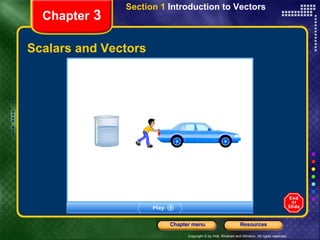
Scalars and Vectors A  scalar   is a physical quantity that has magnitude but no direction. Examples:  speed, volume, the number of pages in your textbook A   vector   is a physical quantity that has both magnitude and direction. Examples:  displacement, velocity, acceleration In this book, scalar quantities are in   italics .  Vectors are represented by   boldface   symbols. Chapter  3 Section 1  Introduction to Vectors
Scalars and Vectors Chapter  3 Section 1  Introduction to Vectors
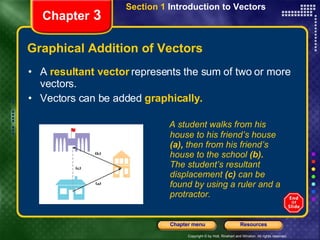
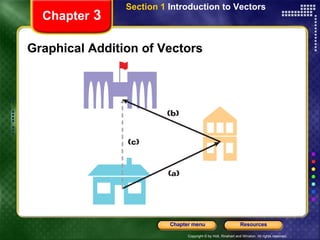
Graphical Addition of Vectors A  resultant vector  represents the sum of two or more vectors. Vectors can be added  graphically. Chapter  3 Section 1  Introduction to Vectors A student walks from his house to his friend’s house  (a),  then from his friend’s house to the school  (b).  The student’s resultant displacement  (c)  can be found by using a ruler and a protractor.
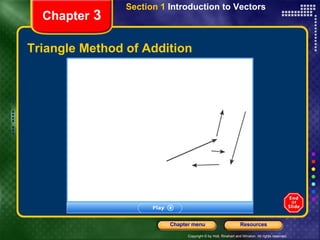
Triangle Method of Addition Vectors can be moved   parallel   to themselves in a diagram.  Thus, you can draw one vector with its  tail  starting at the  tip  of the other as long as the size and direction of each vector do not change.  The   resultant vector   can then be drawn from the tail of the first vector to the tip of the last vector.  Chapter  3 Section 1  Introduction to Vectors
Triangle Method of Addition Chapter  3 Section 1  Introduction to Vectors
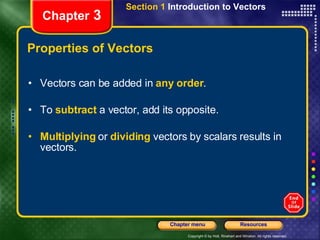
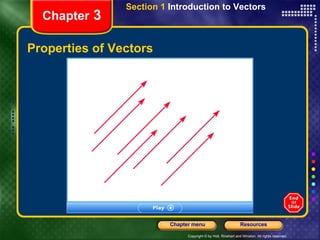
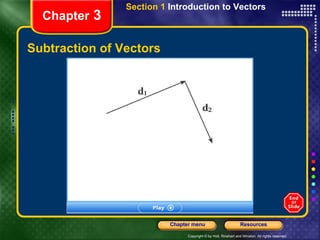
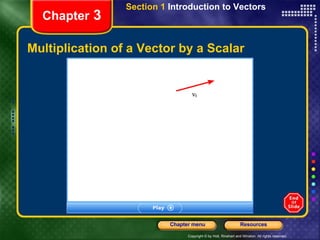
Properties of Vectors Vectors can be added in  any order . To  subtract  a vector, add its opposite. Multiplying  or  dividing   vectors by scalars results in vectors. Chapter  3 Section 1  Introduction to Vectors
Properties of Vectors Chapter  3 Section 1  Introduction to Vectors
Subtraction of Vectors Chapter  3 Section 1  Introduction to Vectors
Multiplication of a Vector by a Scalar Chapter  3 Section 1  Introduction to Vectors
Objectives Identify   appropriate coordinate systems for solving problems with vectors. Apply   the Pythagorean theorem and tangent function to calculate the magnitude and direction of a resultant vector. Resolve   vectors into components using the sine and cosine functions. Add   vectors that are not perpendicular. Section 2  Vector Operations Chapter  3
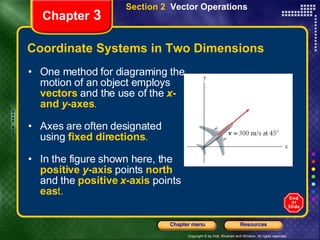
Coordinate Systems in Two Dimensions One method for diagraming the motion of an object employs   vectors   and the use of the   x - and  y -axes . Axes are often designated using   fixed directions .  In the figure shown here, the   positive  y -axis   points  north   and the   positive  x -axis   points   eas t. Chapter  3 Section 2  Vector Operations
Determining Resultant Magnitude and Direction In Section 1, the magnitude and direction of a resultant were found  graphically. With this approach, the accuracy of the answer depends on how carefully the diagram is drawn and measured.  A simpler method uses the   Pythagorean theorem   and the   tangent function. Chapter  3 Section 2  Vector Operations
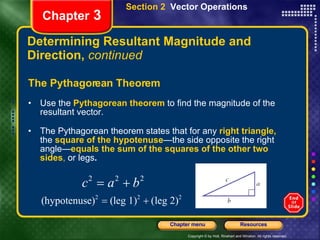
Determining Resultant Magnitude and Direction,  continued The Pythagorean Theorem Use the   Pythagorean theorem   to find the magnitude of the resultant vector. The Pythagorean theorem states that for any   right triangle,   the   square of the hypotenuse —the side opposite the right angle— equals the sum of the squares of the other two sides ,  or legs . Chapter  3 Section 2  Vector Operations
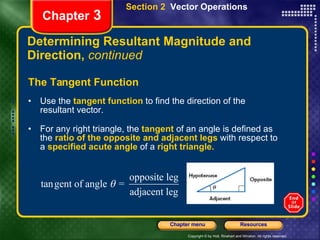
Determining Resultant Magnitude and Direction,  continued The Tangent Function Use the   tangent function   to find the direction of the resultant vector. For any right triangle, the   tangent   of an angle is defined as the   ratio of the opposite and adjacent legs   with respect to a   specified acute angle   of a   right triangle. Chapter  3 Section 2  Vector Operations
Sample Problem Finding Resultant Magnitude and Direction An archaeologist climbs the Great Pyramid in Giza, Egypt. The pyramid’s height is 136 m and its width is 2.30    10 2  m. What is the magnitude and the direction of the displacement of the archaeologist after she has climbed from the bottom of the pyramid to the top? Chapter  3 Section 2  Vector Operations
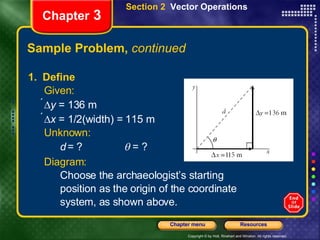
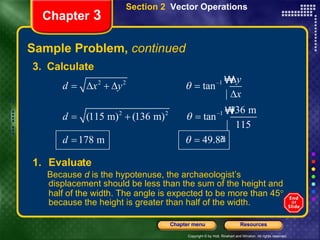
Sample Problem,  continued 1.  Define Given:    y  = 136 m  x  = 1/2(width) = 115 m Unknown:   d   = ?   = ? Diagram:   Choose the archaeologist’s starting position as the origin of the coordinate  system, as shown above. Chapter  3 Section 2  Vector Operations
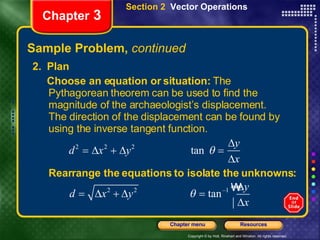
Sample Problem,  continued Rearrange the equations to isolate the unknowns: Chapter  3 Section 2  Vector Operations 2.  Plan Choose an equation or situation:  The Pythagorean theorem can be used to find the magnitude of the archaeologist’s displacement. The direction of the displacement can be found by using the inverse tangent function.
Sample Problem,  continued Chapter  3 Section 2  Vector Operations 3.  Calculate Evaluate  Because  d  is the hypotenuse, the archaeologist’s displacement should be less than the sum of the height and half of the width. The angle is expected to be more than 45   because the height is greater than half of the width.
Resolving Vectors into Components You can often describe an object’s motion more conveniently by breaking a single vector into two   components,   or   resolving   the vector.   The  components of a vector   are the projections of the vector along the axes of a coordinate system. Resolving a vector allows you to   analyze the motion in each direction. Chapter  3 Section 2  Vector Operations
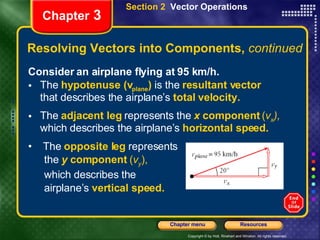
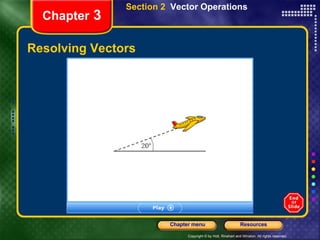
Resolving Vectors into Components,  continued Consider an airplane flying at 95 km/h. The   hypotenuse (v plane )   is the   resultant vector   that describes the airplane’s   total velocity. The  adjacent leg   represents the   x  component  ( v x ),   which describes the airplane’s   horizontal speed. The   opposite leg   represents  the   y  component  ( v y ),   which describes the airplane’s   vertical speed. Chapter  3 Section 2  Vector Operations
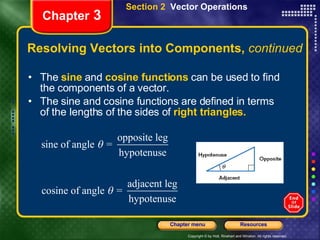
Resolving Vectors into Components,  continued The   sine  and  cosine functions  can be used to find the components of a vector.  The sine and cosine functions are defined in terms of the lengths of the sides of   right triangles. Chapter  3 Section 2  Vector Operations
Resolving Vectors Chapter  3 Section 2  Vector Operations
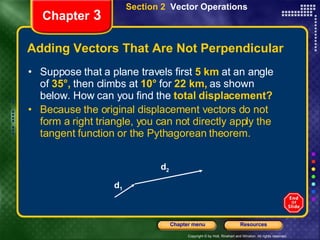
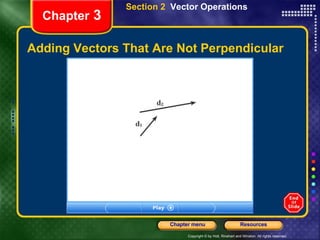
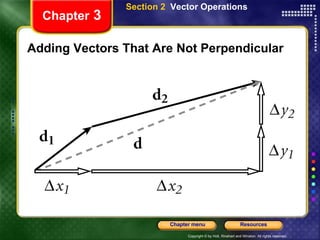
Adding Vectors That Are Not Perpendicular Chapter  3 Section 2  Vector Operations Suppose that a plane travels first   5 km   at an angle of   35°,   then climbs at   10°   for   22 km,   as shown below. How can you find the   total displacement? Because the original displacement vectors do not form a right triangle, you can not directly apply the tangent function or the Pythagorean theorem.   d 2 d 1
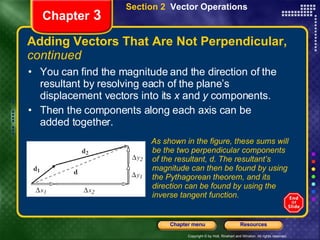
Adding Vectors That Are Not Perpendicular,  continued Chapter  3 Section 2  Vector Operations You can find the magnitude and the direction of the resultant by resolving each of the plane’s displacement vectors into its  x  and  y  components.  Then the components along each axis can be added together.  As shown in the figure, these sums will be the two perpendicular components of the resultant, d. The resultant’s magnitude can then be found by using the Pythagorean theorem, and its direction can be found by using the inverse tangent function.
Adding Vectors That Are Not Perpendicular Chapter  3 Section 2  Vector Operations
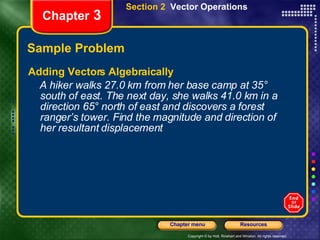
Sample Problem Adding Vectors Algebraically A hiker walks 27.0 km from her base camp at 35° south of east. The next day, she walks 41.0 km in a direction 65° north of east and discovers a forest ranger’s tower. Find the magnitude and direction of her resultant displacement Chapter  3 Section 2  Vector Operations
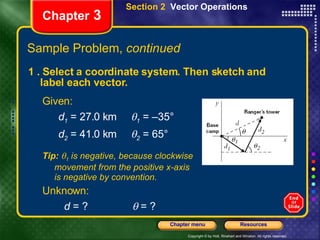
1 . Select a coordinate system. Then sketch and  label each vector. Chapter  3 Section 2  Vector Operations Given:  d 1  = 27.0 km   1  = –35°  d 2  = 41.0 km   2  = 65°   Tip:    1  is negative, because clockwise movement from the positive x-axis is negative by convention. Unknown:  d  = ?      = ? Sample Problem,  continued
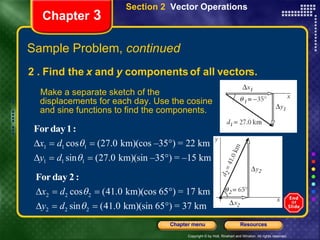
2 . Find the  x  and  y  components of all vectors. Chapter  3 Section 2  Vector Operations Make a separate sketch of the displacements for each day. Use the cosine and sine functions to find the components. Sample Problem,  continued
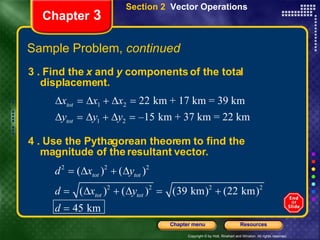
3 . Find the  x  and  y  components of the total displacement. Chapter  3 Section 2  Vector Operations 4 . Use the Pythagorean theorem to find the magnitude of the resultant vector. Sample Problem,  continued
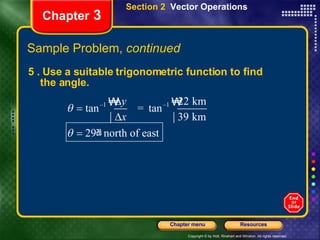
5 . Use a suitable trigonometric function to find the angle. Chapter  3 Section 2  Vector Operations Sample Problem,  continued
Objectives Recognize   examples of projectile motion. Describe   the path of a projectile as a parabola. Resolve   vectors into their components and   apply   the kinematic equations to  solve  problems involving projectile motion. Section 3  Projectile Motion Chapter  3
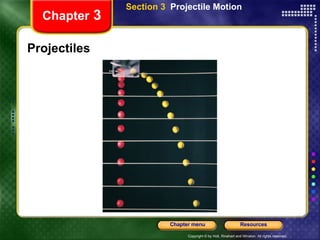
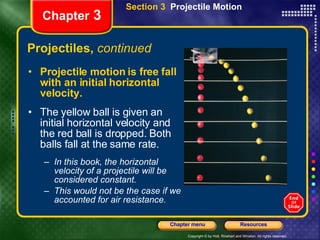
Projectiles Objects that are thrown or launched into the air and are subject to gravity are called   projectiles.   Projectile motion   is the curved path that an object follows when thrown, launched,or otherwise projected near the surface of Earth. If air resistance is disregarded, projectiles follow   parabolic trajectories. Chapter  3 Section 3  Projectile Motion
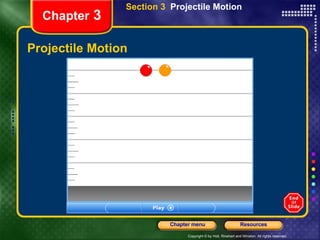
Projectiles,  continued Projectile motion is free fall with an initial horizontal velocity. The yellow ball is given an initial horizontal velocity and the red ball is dropped. Both balls fall at the same rate. In this book, the horizontal velocity of a projectile will be considered constant.  This would not be the case if we accounted for air resistance. Chapter  3 Section 3  Projectile Motion
Projectile Motion Chapter  3 Section 3  Projectile Motion
Kinematic Equations for Projectiles How can you know the displacement, velocity, and acceleration of a projectile at any point in time during its flight? One method is to resolve vectors into components, then apply the simpler one-dimensional forms of the equations for each component.  Finally, you can recombine the components to determine the resultant. Chapter  3 Section 3  Projectile Motion
Kinematic Equations for Projectiles,  continued To solve projectile problems, apply the  kinematic equations  in the  horizontal   and vertical directions. In the   vertical   direction, the acceleration   a y  will equal – g   (–9.81 m/s 2 ) because   the only vertical component of acceleration is free-fall acceleration. In the   horizontal   direction, the acceleration is zero, so the   velocity is constant.   Chapter  3 Section 3  Projectile Motion
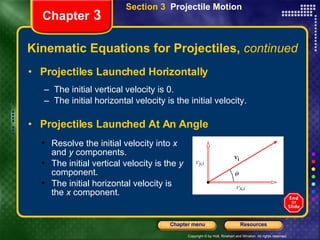
Kinematic Equations for Projectiles,  continued Projectiles Launched Horizontally The initial vertical velocity is 0. The initial horizontal velocity is the initial velocity. Projectiles Launched At An Angle Chapter  3 Section 3  Projectile Motion Resolve the initial velocity into  x  and  y  components. The initial vertical velocity is the  y  component. The initial horizontal velocity is the  x  component.
Sample Problem Projectiles Launched At An Angle A zookeeper finds an escaped monkey hanging from a light pole. Aiming her tranquilizer gun at the monkey, she kneels 10.0 m from the light pole,which is 5.00 m high. The tip of her gun is 1.00 m above the ground. At the same moment that the monkey drops a banana, the zookeeper shoots. If the dart travels at 50.0 m/s,will the dart hit the monkey, the banana, or neither one? Chapter  3 Section 3  Projectile Motion
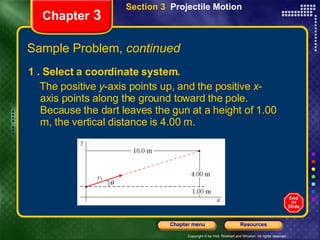
1 . Select a coordinate system.  The positive  y -axis points up, and the positive  x -axis points along the ground toward the pole. Because the dart leaves the gun at a height of 1.00 m, the vertical distance is 4.00 m. Chapter  3 Section 3  Projectile Motion Sample Problem,  continued
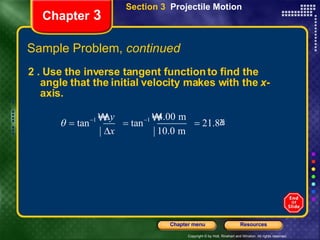
2 . Use the inverse tangent function to find the angle that the initial velocity makes with the  x -axis.  Chapter  3 Section 3  Projectile Motion Sample Problem,  continued
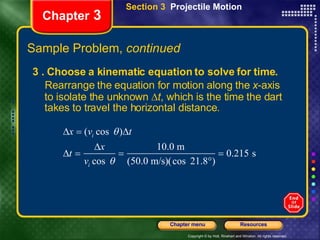
Chapter  3 3 . Choose a kinematic equation to solve for time. Rearrange the equation for motion along the  x -axis to isolate the unknown   t , which is the time the dart takes to travel the horizontal distance. Section 3  Projectile Motion Sample Problem,  continued
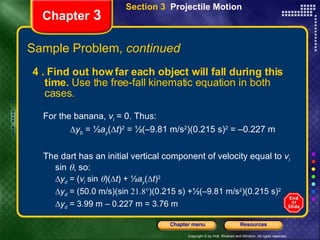
Chapter  3 4 . Find out how far each object will fall during this time.  Use the free-fall kinematic equation in both cases.  For the banana,  v i  = 0. Thus:  y b  =  ½ a y (  t ) 2  =  ½ (–9.81 m/s 2 )(0.215 s) 2  = –0.227 m The dart has an initial vertical component of velocity equal to  v i  sin   , so:  y d  = ( v i  sin   )(  t ) +  ½ a y (  t ) 2    y d  = (50.0 m/s)(sin   )(0.215 s) + ½ (–9.81 m/s 2 )(0.215 s) 2  y d  = 3.99 m – 0.227 m = 3.76 m Section 3  Projectile Motion Sample Problem,  continued
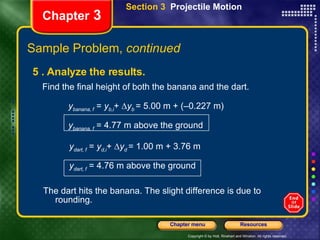
Chapter  3 5 . Analyze the results.  Find the final height of both the banana and the dart. y banana, f  =  y b,i +   y b  = 5.00 m + (–0.227 m)  y banana, f  = 4.77 m above the ground The dart hits the banana. The slight difference is due to rounding. Section 3  Projectile Motion y dart, f  =  y d,i +   y d  = 1.00 m + 3.76 m  y dart, f  = 4.76 m above the ground Sample Problem,  continued
Objectives Describe   situations in terms of frame of reference. Solve   problems involving relative velocity. Section 4  Relative Motion Chapter  3
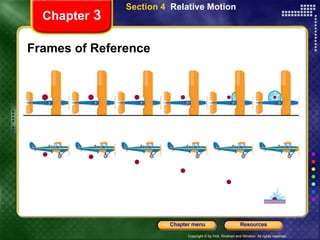
Frames of Reference If you are moving at   80 km/h   north and a car passes you going   90 km/h ,  to you the faster car seems to be moving north at   10 km/h . Someone standing on the side of the road would measure the velocity of the faster car as   90 km/h   toward the north.  This simple example demonstrates that velocity measurements depend on the   frame of reference   of the observer. Chapter  3 Section 4  Relative Motion
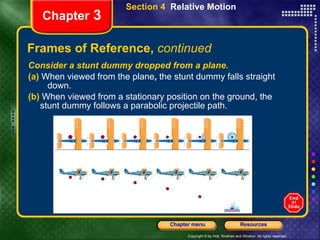
Frames of Reference,  continued Consider a stunt dummy dropped from a plane. (a)   When viewed from the plane ,  the stunt dummy falls straight  down.  (b)   When viewed from a stationary position on the ground, the  stunt dummy follows a parabolic projectile path. Chapter  3 Section 4  Relative Motion
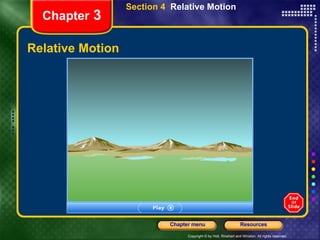
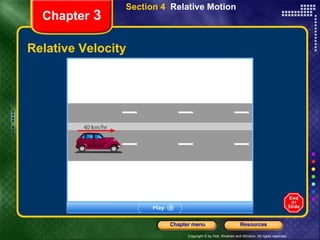
Relative Motion Chapter  3 Section 4  Relative Motion
Relative Velocity When solving relative velocity problems, write down the information in the form of velocities with subscripts.  Using our earlier example, we have: v se  = +80 km/h north  (se = slower car with respect to Earth ) v fe  = +90 km/h north  (fe = fast car with respect to Earth) unknown =  v f s   (fs =  fast car with respect to slower car) Write an equation for   v fs   in terms of the other velocities. The subscripts start with   f   and end with   s .   The other subscripts start with the letter that ended the preceding velocity:  v fs  =  v fe  +  v es Chapter  3 Section 4  Relative Motion
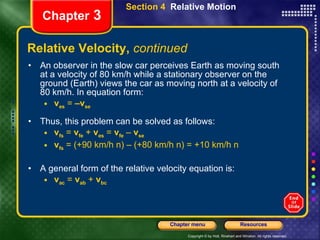
Relative Velocity,  continued An observer in the slow car perceives Earth as moving south at a velocity of 80 km/h while a stationary observer on the ground (Earth) views the car as moving north at a velocity of 80 km/h. In equation form: v es   =  –v se   Thus, this problem can be solved as follows: v fs   =  v fe   +  v es   =  v fe   –  v se v fs   = (+90 km/h n) – (+80 km/h n) = +10 km/h n A general form of the relative velocity equation is: v ac   =  v ab   +  v bc Chapter  3 Section 4  Relative Motion
Relative Velocity Chapter  3 Section 4  Relative Motion
Multiple Choice 1.  Vector  A  has a magnitude of 30 units. Vector  B  is perpendicular to vector  A  and has a magnitude of 40 units. What would the magnitude of the resultant vector  A  +  B  be? A.  10 units B.  50 units C.  70 units D.  zero Standardized Test Prep Chapter  3
Multiple Choice,  continued 2.  What term represents the magnitude of a velocity vector? F.  acceleration G.  momentum H.  speed J.  velocity Standardized Test Prep Chapter  3
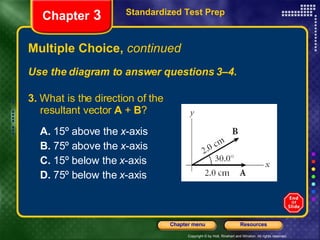
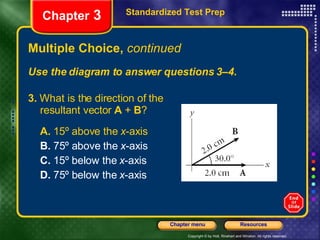
Multiple Choice,  continued Use the diagram to answer questions 3–4. 3.  What is the direction of the  resultant vector  A  +  B ? A.  15º above the  x -axis B.  75º above the  x -axis C.  15º below the  x -axis D.  75º below the  x -axis Standardized Test Prep Chapter  3
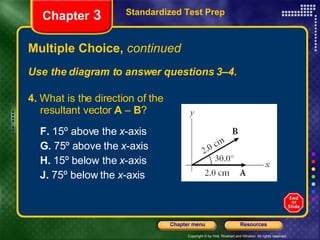
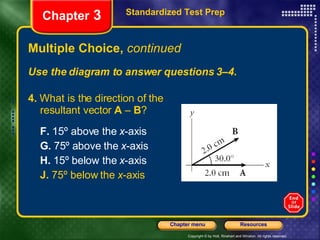
Multiple Choice,  continued Use the diagram to answer questions 3–4. 4.  What is the direction of the  resultant vector  A  –  B ? F.  15º above the  x -axis G.  75º above the  x -axis H.  15º below the  x -axis J.  75º below the  x -axis Standardized Test Prep Chapter  3
Multiple Choice,  continued Use the passage below to answer questions 5–6. A motorboat heads due east at 5.0 m/s across a river that flows toward the south at a speed of 5.0 m/s. 5.  What is the resultant velocity relative to an observer on the shore ? A.  3.2 m/s to the southeast B.  5.0 m/s to the southeast C.  7.1 m/s to the southeast D.  10.0 m/s to the southeast Standardized Test Prep Chapter  3
Multiple Choice,  continued Use the passage below to answer questions 5–6. A motorboat heads due east at 5.0 m/s across a river that flows toward the south at a speed of 5.0 m/s. 6.  If the river is 125 m wide, how long does the boat take to cross the river? F.  39 s G.  25 s H.  17 s J.  12 s Standardized Test Prep Chapter  3
Multiple Choice,  continued 7.  The pilot of a plane measures an air velocity of 165 km/h south relative to the plane. An observer on the ground sees the plane pass overhead at a velocity of 145 km/h toward the north.What is the velocity of the wind that is affecting the plane relative to the observer? A.  20 km/h to the north B.  20 km/h to the south C.  165 km/h to the north D.  310 km/h to the south Standardized Test Prep Chapter  3
Multiple Choice,  continued 8.  A golfer takes two putts to sink his ball in the hole once he is on the green. The first putt displaces the ball 6.00 m east, and the second putt displaces the ball 5.40 m south. What displacement would put the ball in the hole in one putt? F.  11.40 m southeast G.  8.07 m at 48.0Âş south of east H.  3.32 m at 42.0Âş south of east J.  8.07 m at 42.0Âş south of east Standardized Test Prep Chapter  3
Multiple Choice,  continued Use the passage to answer questions 9–12. A girl riding a bicycle at 2.0 m/s throws a tennis ball horizontally forward at a speed of 1.0 m/s from a height of 1.5 m. At the same moment, a boy standing on the sidewalk drops a tennis ball straight down from a height of 1.5 m. 9.  What is the initial speed of the girl’s ball relative to the boy? A.  1.0 m/s   C.  2.0 m/s B.  1.5 m/s  D.  3.0 m/s Standardized Test Prep Chapter  3
Multiple Choice,  continued Use the passage to answer questions 9–12. A girl riding a bicycle at 2.0 m/s throws a tennis ball horizontally forward at a speed of 1.0 m/s from a height of 1.5 m. At the same moment, a boy standing on the sidewalk drops a tennis ball straight down from a height of 1.5 m. 10.  If air resistance is disregarded, which ball will hit the  ground first? F.  the boy’s ball   H.  neither G.  the girl’s ball  J.  cannot be determined Standardized Test Prep Chapter  3
Multiple Choice,  continued Use the passage to answer questions 9–12. A girl riding a bicycle at 2.0 m/s throws a tennis ball horizontally forward at a speed of 1.0 m/s from a height of 1.5 m. At the same moment, a boy standing on the sidewalk drops a tennis ball straight down from a height of 1.5 m. 11.  If air resistance is disregarded, which ball will have  a greater speed (relative to the ground) when it hits  the ground? A.  the boy’s ball   C.  neither B.  the girl’s ball  D.  cannot be determined Standardized Test Prep Chapter  3
Multiple Choice,  continued Use the passage to answer questions 9–12. A girl riding a bicycle at 2.0 m/s throws a tennis ball horizontally forward at a speed of 1.0 m/s from a height of 1.5 m. At the same moment, a boy standing on the sidewalk drops a tennis ball straight down from a height of 1.5 m. 11.  If air resistance is disregarded, which ball will have  a greater speed (relative to the ground) when it hits  the ground? A.  the boy’s ball   C.  neither B.  the girl’s ball   D.  cannot be determined Standardized Test Prep Chapter  3
Multiple Choice,  continued Use the passage to answer questions 9–12. A girl riding a bicycle at 2.0 m/s throws a tennis ball horizontally forward at a speed of 1.0 m/s from a height of 1.5 m. At the same moment, a boy standing on the sidewalk drops a tennis ball straight down from a height of 1.5 m. 12.  What is the speed of the girl’s ball when it hits the  ground? F.  1.0 m/s   H.  6.2 m/s   G.  3.0 m/s J.  8.4 m/s Standardized Test Prep Chapter  3
Short Response 13.  If one of the components of one vector along the  direction of another vector is zero, what can you  conclude about these two vectors? Standardized Test Prep Chapter  3
Short Response 13.  If one of the components of one vector along the  direction of another vector is zero, what can you  conclude about these two vectors? Answer:  They are perpendicular. Standardized Test Prep Chapter  3
Short Response,  continued 14.  A roller coaster travels 41.1 m at an angle of 40.0°  above the horizontal. How far does it move  horizontally and vertically? Standardized Test Prep Chapter  3
Short Response,  continued 14.  A roller coaster travels 41.1 m at an angle of 40.0°  above the horizontal. How far does it move  horizontally and vertically? Answer:  31.5 m horizontally, 26.4 m vertically Standardized Test Prep Chapter  3
Short Response,  continued 15.  A ball is thrown straight upward and returns to the  thrower’s hand after 3.00 s in the air. A second ball  is thrown at an angle of 30.0° with the horizontal. At  what speed must the second ball be thrown to reach  the same height as the one thrown vertically? Standardized Test Prep Chapter  3
Short Response,  continued 15.  A ball is thrown straight upward and returns to the  thrower’s hand after 3.00 s in the air. A second ball  is thrown at an angle of 30.0° with the horizontal. At  what speed must the second ball be thrown to reach  the same height as the one thrown vertically? Standardized Test Prep Chapter  3 Answer:  29.4 m/s
Extended Response 16.  A human cannonball is shot out of a cannon at 45.0°  to the horizontal with an initial speed of 25.0 m/s. A  net is positioned at a horizontal distance of 50.0 m  from the cannon. At what height above the cannon  should the net be placed in order to catch the  human cannonball? Show your work. Standardized Test Prep Chapter  3
Extended Response 16.  A human cannonball is shot out of a cannon at 45.0°  to the horizontal with an initial speed of 25.0 m/s. A  net is positioned at a horizontal distance of 50.0 m  from the cannon. At what height above the cannon  should the net be placed in order to catch the  human cannonball? Show your work. Standardized Test Prep Chapter  3 Answer:  10.8 m
Extended Response,  continued Read the following passage to answer question 17. Three airline executives are discussing ideas for developing flights that are more energy efficient. Executive A:   Because the Earth rotates from west to east, we could operate “static flights”—a helicopter or airship could begin by rising straight up from New York City and then descend straight down four hours later when San Francisco arrives below. Executive B:   This approach could work for one-way flights, but the return trip would take 20 hours.  continued on the next slide Standardized Test Prep Chapter  3
Extended Response,  continued Executive C:   That approach will never work. Think about it.When you throw a ball straight up in the air, it comes straight back down to the same point. Executive A:   The ball returns to the same point because Earth’s motion is not significant during such a short time. 17.  State which of the executives is correct, and explain  why. Standardized Test Prep Chapter  3
Extended Response,  continued 17.  State which of the executives is correct, and explain  why.  Answer:  Executive C is correct. Explanations should include the concept of relative velocity—when a helicopter lifts off straight up from the ground, it is already moving horizontally with Earth’s horizontal velocity. (We assume that Earth’s motion is constant for the purposes of this scenario and does not depend on time.) Standardized Test Prep Chapter  3
Graphical Addition of Vectors Chapter  3 Section 1  Introduction to Vectors
Adding Vectors That Are Not Perpendicular Chapter  3 Section 2  Vector Operations
Projectiles Chapter  3 Section 3  Projectile Motion
Frames of Reference Chapter  3 Section 4  Relative Motion

Chapter 3 Powerpoint

  • 1.
    How to UseThis Presentation To View the presentation as a slideshow with effects select “View” on the menu bar and click on “Slide Show.” To advance through the presentation, click the right-arrow key or the space bar. From the resources slide, click on any resource to see a presentation for that resource. From the Chapter menu screen click on any lesson to go directly to that lesson’s presentation. You may exit the slide show at any time by pressing the Esc key.
  • 2.
    Chapter Presentation TransparenciesSample Problems Visual Concepts Standardized Test Prep Resources
  • 3.
    Table of ContentsSection 1 Introduction to Vectors Section 2 Vector Operations Section 3 Projectile Motion Section 4 Relative Motion Two-Dimensional Motion and Vectors Chapter 3
  • 4.
    Objectives Distinguish between a scalar and a vector. Add and subtract vectors by using the graphical method. Multiply and divide vectors by scalars. Section 1 Introduction to Vectors Chapter 3
  • 5.
    Scalars and VectorsA scalar is a physical quantity that has magnitude but no direction. Examples: speed, volume, the number of pages in your textbook A vector is a physical quantity that has both magnitude and direction. Examples: displacement, velocity, acceleration In this book, scalar quantities are in italics . Vectors are represented by boldface symbols. Chapter 3 Section 1 Introduction to Vectors
  • 6.
    Scalars and VectorsChapter 3 Section 1 Introduction to Vectors
  • 7.
    Graphical Addition ofVectors A resultant vector represents the sum of two or more vectors. Vectors can be added graphically. Chapter 3 Section 1 Introduction to Vectors A student walks from his house to his friend’s house (a), then from his friend’s house to the school (b). The student’s resultant displacement (c) can be found by using a ruler and a protractor.
  • 8.
    Triangle Method ofAddition Vectors can be moved parallel to themselves in a diagram. Thus, you can draw one vector with its tail starting at the tip of the other as long as the size and direction of each vector do not change. The resultant vector can then be drawn from the tail of the first vector to the tip of the last vector. Chapter 3 Section 1 Introduction to Vectors
  • 9.
    Triangle Method ofAddition Chapter 3 Section 1 Introduction to Vectors
  • 10.
    Properties of VectorsVectors can be added in any order . To subtract a vector, add its opposite. Multiplying or dividing vectors by scalars results in vectors. Chapter 3 Section 1 Introduction to Vectors
  • 11.
    Properties of VectorsChapter 3 Section 1 Introduction to Vectors
  • 12.
    Subtraction of VectorsChapter 3 Section 1 Introduction to Vectors
  • 13.
    Multiplication of aVector by a Scalar Chapter 3 Section 1 Introduction to Vectors
  • 14.
    Objectives Identify appropriate coordinate systems for solving problems with vectors. Apply the Pythagorean theorem and tangent function to calculate the magnitude and direction of a resultant vector. Resolve vectors into components using the sine and cosine functions. Add vectors that are not perpendicular. Section 2 Vector Operations Chapter 3
  • 15.
    Coordinate Systems inTwo Dimensions One method for diagraming the motion of an object employs vectors and the use of the x - and y -axes . Axes are often designated using fixed directions . In the figure shown here, the positive y -axis points north and the positive x -axis points eas t. Chapter 3 Section 2 Vector Operations
  • 16.
    Determining Resultant Magnitudeand Direction In Section 1, the magnitude and direction of a resultant were found graphically. With this approach, the accuracy of the answer depends on how carefully the diagram is drawn and measured. A simpler method uses the Pythagorean theorem and the tangent function. Chapter 3 Section 2 Vector Operations
  • 17.
    Determining Resultant Magnitudeand Direction, continued The Pythagorean Theorem Use the Pythagorean theorem to find the magnitude of the resultant vector. The Pythagorean theorem states that for any right triangle, the square of the hypotenuse —the side opposite the right angle— equals the sum of the squares of the other two sides , or legs . Chapter 3 Section 2 Vector Operations
  • 18.
    Determining Resultant Magnitudeand Direction, continued The Tangent Function Use the tangent function to find the direction of the resultant vector. For any right triangle, the tangent of an angle is defined as the ratio of the opposite and adjacent legs with respect to a specified acute angle of a right triangle. Chapter 3 Section 2 Vector Operations
  • 19.
    Sample Problem FindingResultant Magnitude and Direction An archaeologist climbs the Great Pyramid in Giza, Egypt. The pyramid’s height is 136 m and its width is 2.30  10 2 m. What is the magnitude and the direction of the displacement of the archaeologist after she has climbed from the bottom of the pyramid to the top? Chapter 3 Section 2 Vector Operations
  • 20.
    Sample Problem, continued 1. Define Given:  y = 136 m  x = 1/2(width) = 115 m Unknown: d = ?  = ? Diagram: Choose the archaeologist’s starting position as the origin of the coordinate system, as shown above. Chapter 3 Section 2 Vector Operations
  • 21.
    Sample Problem, continued Rearrange the equations to isolate the unknowns: Chapter 3 Section 2 Vector Operations 2. Plan Choose an equation or situation: The Pythagorean theorem can be used to find the magnitude of the archaeologist’s displacement. The direction of the displacement can be found by using the inverse tangent function.
  • 22.
    Sample Problem, continued Chapter 3 Section 2 Vector Operations 3. Calculate Evaluate Because d is the hypotenuse, the archaeologist’s displacement should be less than the sum of the height and half of the width. The angle is expected to be more than 45  because the height is greater than half of the width.
  • 23.
    Resolving Vectors intoComponents You can often describe an object’s motion more conveniently by breaking a single vector into two components, or resolving the vector. The components of a vector are the projections of the vector along the axes of a coordinate system. Resolving a vector allows you to analyze the motion in each direction. Chapter 3 Section 2 Vector Operations
  • 24.
    Resolving Vectors intoComponents, continued Consider an airplane flying at 95 km/h. The hypotenuse (v plane ) is the resultant vector that describes the airplane’s total velocity. The adjacent leg represents the x component ( v x ), which describes the airplane’s horizontal speed. The opposite leg represents the y component ( v y ), which describes the airplane’s vertical speed. Chapter 3 Section 2 Vector Operations
  • 25.
    Resolving Vectors intoComponents, continued The sine and cosine functions can be used to find the components of a vector. The sine and cosine functions are defined in terms of the lengths of the sides of right triangles. Chapter 3 Section 2 Vector Operations
  • 26.
    Resolving Vectors Chapter 3 Section 2 Vector Operations
  • 27.
    Adding Vectors ThatAre Not Perpendicular Chapter 3 Section 2 Vector Operations Suppose that a plane travels first 5 km at an angle of 35°, then climbs at 10° for 22 km, as shown below. How can you find the total displacement? Because the original displacement vectors do not form a right triangle, you can not directly apply the tangent function or the Pythagorean theorem. d 2 d 1
  • 28.
    Adding Vectors ThatAre Not Perpendicular, continued Chapter 3 Section 2 Vector Operations You can find the magnitude and the direction of the resultant by resolving each of the plane’s displacement vectors into its x and y components. Then the components along each axis can be added together. As shown in the figure, these sums will be the two perpendicular components of the resultant, d. The resultant’s magnitude can then be found by using the Pythagorean theorem, and its direction can be found by using the inverse tangent function.
  • 29.
    Adding Vectors ThatAre Not Perpendicular Chapter 3 Section 2 Vector Operations
  • 30.
    Sample Problem AddingVectors Algebraically A hiker walks 27.0 km from her base camp at 35° south of east. The next day, she walks 41.0 km in a direction 65° north of east and discovers a forest ranger’s tower. Find the magnitude and direction of her resultant displacement Chapter 3 Section 2 Vector Operations
  • 31.
    1 . Selecta coordinate system. Then sketch and label each vector. Chapter 3 Section 2 Vector Operations Given: d 1 = 27.0 km  1 = –35° d 2 = 41.0 km  2 = 65° Tip:  1 is negative, because clockwise movement from the positive x-axis is negative by convention. Unknown: d = ?  = ? Sample Problem, continued
  • 32.
    2 . Findthe x and y components of all vectors. Chapter 3 Section 2 Vector Operations Make a separate sketch of the displacements for each day. Use the cosine and sine functions to find the components. Sample Problem, continued
  • 33.
    3 . Findthe x and y components of the total displacement. Chapter 3 Section 2 Vector Operations 4 . Use the Pythagorean theorem to find the magnitude of the resultant vector. Sample Problem, continued
  • 34.
    5 . Usea suitable trigonometric function to find the angle. Chapter 3 Section 2 Vector Operations Sample Problem, continued
  • 35.
    Objectives Recognize examples of projectile motion. Describe the path of a projectile as a parabola. Resolve vectors into their components and apply the kinematic equations to solve problems involving projectile motion. Section 3 Projectile Motion Chapter 3
  • 36.
    Projectiles Objects thatare thrown or launched into the air and are subject to gravity are called projectiles. Projectile motion is the curved path that an object follows when thrown, launched,or otherwise projected near the surface of Earth. If air resistance is disregarded, projectiles follow parabolic trajectories. Chapter 3 Section 3 Projectile Motion
  • 37.
    Projectiles, continuedProjectile motion is free fall with an initial horizontal velocity. The yellow ball is given an initial horizontal velocity and the red ball is dropped. Both balls fall at the same rate. In this book, the horizontal velocity of a projectile will be considered constant. This would not be the case if we accounted for air resistance. Chapter 3 Section 3 Projectile Motion
  • 38.
    Projectile Motion Chapter 3 Section 3 Projectile Motion
  • 39.
    Kinematic Equations forProjectiles How can you know the displacement, velocity, and acceleration of a projectile at any point in time during its flight? One method is to resolve vectors into components, then apply the simpler one-dimensional forms of the equations for each component. Finally, you can recombine the components to determine the resultant. Chapter 3 Section 3 Projectile Motion
  • 40.
    Kinematic Equations forProjectiles, continued To solve projectile problems, apply the kinematic equations in the horizontal and vertical directions. In the vertical direction, the acceleration a y will equal – g (–9.81 m/s 2 ) because the only vertical component of acceleration is free-fall acceleration. In the horizontal direction, the acceleration is zero, so the velocity is constant. Chapter 3 Section 3 Projectile Motion
  • 41.
    Kinematic Equations forProjectiles, continued Projectiles Launched Horizontally The initial vertical velocity is 0. The initial horizontal velocity is the initial velocity. Projectiles Launched At An Angle Chapter 3 Section 3 Projectile Motion Resolve the initial velocity into x and y components. The initial vertical velocity is the y component. The initial horizontal velocity is the x component.
  • 42.
    Sample Problem ProjectilesLaunched At An Angle A zookeeper finds an escaped monkey hanging from a light pole. Aiming her tranquilizer gun at the monkey, she kneels 10.0 m from the light pole,which is 5.00 m high. The tip of her gun is 1.00 m above the ground. At the same moment that the monkey drops a banana, the zookeeper shoots. If the dart travels at 50.0 m/s,will the dart hit the monkey, the banana, or neither one? Chapter 3 Section 3 Projectile Motion
  • 43.
    1 . Selecta coordinate system. The positive y -axis points up, and the positive x -axis points along the ground toward the pole. Because the dart leaves the gun at a height of 1.00 m, the vertical distance is 4.00 m. Chapter 3 Section 3 Projectile Motion Sample Problem, continued
  • 44.
    2 . Usethe inverse tangent function to find the angle that the initial velocity makes with the x -axis. Chapter 3 Section 3 Projectile Motion Sample Problem, continued
  • 45.
    Chapter 33 . Choose a kinematic equation to solve for time. Rearrange the equation for motion along the x -axis to isolate the unknown  t , which is the time the dart takes to travel the horizontal distance. Section 3 Projectile Motion Sample Problem, continued
  • 46.
    Chapter 34 . Find out how far each object will fall during this time. Use the free-fall kinematic equation in both cases. For the banana, v i = 0. Thus:  y b = ½ a y (  t ) 2 = ½ (–9.81 m/s 2 )(0.215 s) 2 = –0.227 m The dart has an initial vertical component of velocity equal to v i sin  , so:  y d = ( v i sin  )(  t ) + ½ a y (  t ) 2  y d = (50.0 m/s)(sin  )(0.215 s) + ½ (–9.81 m/s 2 )(0.215 s) 2  y d = 3.99 m – 0.227 m = 3.76 m Section 3 Projectile Motion Sample Problem, continued
  • 47.
    Chapter 35 . Analyze the results. Find the final height of both the banana and the dart. y banana, f = y b,i +  y b = 5.00 m + (–0.227 m) y banana, f = 4.77 m above the ground The dart hits the banana. The slight difference is due to rounding. Section 3 Projectile Motion y dart, f = y d,i +  y d = 1.00 m + 3.76 m y dart, f = 4.76 m above the ground Sample Problem, continued
  • 48.
    Objectives Describe situations in terms of frame of reference. Solve problems involving relative velocity. Section 4 Relative Motion Chapter 3
  • 49.
    Frames of ReferenceIf you are moving at 80 km/h north and a car passes you going 90 km/h , to you the faster car seems to be moving north at 10 km/h . Someone standing on the side of the road would measure the velocity of the faster car as 90 km/h toward the north. This simple example demonstrates that velocity measurements depend on the frame of reference of the observer. Chapter 3 Section 4 Relative Motion
  • 50.
    Frames of Reference, continued Consider a stunt dummy dropped from a plane. (a) When viewed from the plane , the stunt dummy falls straight down. (b) When viewed from a stationary position on the ground, the stunt dummy follows a parabolic projectile path. Chapter 3 Section 4 Relative Motion
  • 51.
    Relative Motion Chapter 3 Section 4 Relative Motion
  • 52.
    Relative Velocity Whensolving relative velocity problems, write down the information in the form of velocities with subscripts. Using our earlier example, we have: v se = +80 km/h north (se = slower car with respect to Earth ) v fe = +90 km/h north (fe = fast car with respect to Earth) unknown = v f s (fs = fast car with respect to slower car) Write an equation for v fs in terms of the other velocities. The subscripts start with f and end with s . The other subscripts start with the letter that ended the preceding velocity: v fs = v fe + v es Chapter 3 Section 4 Relative Motion
  • 53.
    Relative Velocity, continued An observer in the slow car perceives Earth as moving south at a velocity of 80 km/h while a stationary observer on the ground (Earth) views the car as moving north at a velocity of 80 km/h. In equation form: v es = –v se Thus, this problem can be solved as follows: v fs = v fe + v es = v fe – v se v fs = (+90 km/h n) – (+80 km/h n) = +10 km/h n A general form of the relative velocity equation is: v ac = v ab + v bc Chapter 3 Section 4 Relative Motion
  • 54.
    Relative Velocity Chapter 3 Section 4 Relative Motion
  • 55.
    Multiple Choice 1. Vector A has a magnitude of 30 units. Vector B is perpendicular to vector A and has a magnitude of 40 units. What would the magnitude of the resultant vector A + B be? A. 10 units B. 50 units C. 70 units D. zero Standardized Test Prep Chapter 3
  • 56.
    Multiple Choice 1. Vector A has a magnitude of 30 units. Vector B is perpendicular to vector A and has a magnitude of 40 units. What would the magnitude of the resultant vector A + B be? A. 10 units B. 50 units C. 70 units D. zero Standardized Test Prep Chapter 3
  • 57.
    Multiple Choice, continued 2. What term represents the magnitude of a velocity vector? F. acceleration G. momentum H. speed J. velocity Standardized Test Prep Chapter 3
  • 58.
    Multiple Choice, continued 2. What term represents the magnitude of a velocity vector? F. acceleration G. momentum H. speed J. velocity Standardized Test Prep Chapter 3
  • 59.
    Multiple Choice, continued Use the diagram to answer questions 3–4. 3. What is the direction of the resultant vector A + B ? A. 15º above the x -axis B. 75º above the x -axis C. 15º below the x -axis D. 75º below the x -axis Standardized Test Prep Chapter 3
  • 60.
    Multiple Choice, continued Use the diagram to answer questions 3–4. 3. What is the direction of the resultant vector A + B ? A. 15º above the x -axis B. 75º above the x -axis C. 15º below the x -axis D. 75º below the x -axis Standardized Test Prep Chapter 3
  • 61.
    Multiple Choice, continued Use the diagram to answer questions 3–4. 4. What is the direction of the resultant vector A – B ? F. 15º above the x -axis G. 75º above the x -axis H. 15º below the x -axis J. 75º below the x -axis Standardized Test Prep Chapter 3
  • 62.
    Multiple Choice, continued Use the diagram to answer questions 3–4. 4. What is the direction of the resultant vector A – B ? F. 15º above the x -axis G. 75º above the x -axis H. 15º below the x -axis J. 75º below the x -axis Standardized Test Prep Chapter 3
  • 63.
    Multiple Choice, continued Use the passage below to answer questions 5–6. A motorboat heads due east at 5.0 m/s across a river that flows toward the south at a speed of 5.0 m/s. 5. What is the resultant velocity relative to an observer on the shore ? A. 3.2 m/s to the southeast B. 5.0 m/s to the southeast C. 7.1 m/s to the southeast D. 10.0 m/s to the southeast Standardized Test Prep Chapter 3
  • 64.
    Multiple Choice, continued Use the passage below to answer questions 5–6. A motorboat heads due east at 5.0 m/s across a river that flows toward the south at a speed of 5.0 m/s. 5. What is the resultant velocity relative to an observer on the shore ? A. 3.2 m/s to the southeast B. 5.0 m/s to the southeast C. 7.1 m/s to the southeast D. 10.0 m/s to the southeast Standardized Test Prep Chapter 3
  • 65.
    Multiple Choice, continued Use the passage below to answer questions 5–6. A motorboat heads due east at 5.0 m/s across a river that flows toward the south at a speed of 5.0 m/s. 6. If the river is 125 m wide, how long does the boat take to cross the river? F. 39 s G. 25 s H. 17 s J. 12 s Standardized Test Prep Chapter 3
  • 66.
    Multiple Choice, continued Use the passage below to answer questions 5–6. A motorboat heads due east at 5.0 m/s across a river that flows toward the south at a speed of 5.0 m/s. 6. If the river is 125 m wide, how long does the boat take to cross the river? F. 39 s G. 25 s H. 17 s J. 12 s Standardized Test Prep Chapter 3
  • 67.
    Multiple Choice, continued 7. The pilot of a plane measures an air velocity of 165 km/h south relative to the plane. An observer on the ground sees the plane pass overhead at a velocity of 145 km/h toward the north.What is the velocity of the wind that is affecting the plane relative to the observer? A. 20 km/h to the north B. 20 km/h to the south C. 165 km/h to the north D. 310 km/h to the south Standardized Test Prep Chapter 3
  • 68.
    Multiple Choice, continued 7. The pilot of a plane measures an air velocity of 165 km/h south relative to the plane. An observer on the ground sees the plane pass overhead at a velocity of 145 km/h toward the north.What is the velocity of the wind that is affecting the plane relative to the observer? A. 20 km/h to the north B. 20 km/h to the south C. 165 km/h to the north D. 310 km/h to the south Standardized Test Prep Chapter 3
  • 69.
    Multiple Choice, continued 8. A golfer takes two putts to sink his ball in the hole once he is on the green. The first putt displaces the ball 6.00 m east, and the second putt displaces the ball 5.40 m south. What displacement would put the ball in the hole in one putt? F. 11.40 m southeast G. 8.07 m at 48.0Âş south of east H. 3.32 m at 42.0Âş south of east J. 8.07 m at 42.0Âş south of east Standardized Test Prep Chapter 3
  • 70.
    Multiple Choice, continued 8. A golfer takes two putts to sink his ball in the hole once he is on the green. The first putt displaces the ball 6.00 m east, and the second putt displaces the ball 5.40 m south. What displacement would put the ball in the hole in one putt? F. 11.40 m southeast G. 8.07 m at 48.0Âş south of east H. 3.32 m at 42.0Âş south of east J. 8.07 m at 42.0Âş south of east Standardized Test Prep Chapter 3
  • 71.
    Multiple Choice, continued Use the passage to answer questions 9–12. A girl riding a bicycle at 2.0 m/s throws a tennis ball horizontally forward at a speed of 1.0 m/s from a height of 1.5 m. At the same moment, a boy standing on the sidewalk drops a tennis ball straight down from a height of 1.5 m. 9. What is the initial speed of the girl’s ball relative to the boy? A. 1.0 m/s C. 2.0 m/s B. 1.5 m/s D. 3.0 m/s Standardized Test Prep Chapter 3
  • 72.
    Multiple Choice, continued Use the passage to answer questions 9–12. A girl riding a bicycle at 2.0 m/s throws a tennis ball horizontally forward at a speed of 1.0 m/s from a height of 1.5 m. At the same moment, a boy standing on the sidewalk drops a tennis ball straight down from a height of 1.5 m. 9. What is the initial speed of the girl’s ball relative to the boy? A. 1.0 m/s C. 2.0 m/s B. 1.5 m/s D. 3.0 m/s Standardized Test Prep Chapter 3
  • 73.
    Multiple Choice, continued Use the passage to answer questions 9–12. A girl riding a bicycle at 2.0 m/s throws a tennis ball horizontally forward at a speed of 1.0 m/s from a height of 1.5 m. At the same moment, a boy standing on the sidewalk drops a tennis ball straight down from a height of 1.5 m. 10. If air resistance is disregarded, which ball will hit the ground first? F. the boy’s ball H. neither G. the girl’s ball J. cannot be determined Standardized Test Prep Chapter 3
  • 74.
    Multiple Choice, continued Use the passage to answer questions 9–12. A girl riding a bicycle at 2.0 m/s throws a tennis ball horizontally forward at a speed of 1.0 m/s from a height of 1.5 m. At the same moment, a boy standing on the sidewalk drops a tennis ball straight down from a height of 1.5 m. 10. If air resistance is disregarded, which ball will hit the ground first? F. the boy’s ball H. neither G. the girl’s ball J. cannot be determined Standardized Test Prep Chapter 3
  • 75.
    Multiple Choice, continued Use the passage to answer questions 9–12. A girl riding a bicycle at 2.0 m/s throws a tennis ball horizontally forward at a speed of 1.0 m/s from a height of 1.5 m. At the same moment, a boy standing on the sidewalk drops a tennis ball straight down from a height of 1.5 m. 11. If air resistance is disregarded, which ball will have a greater speed (relative to the ground) when it hits the ground? A. the boy’s ball C. neither B. the girl’s ball D. cannot be determined Standardized Test Prep Chapter 3
  • 76.
    Multiple Choice, continued Use the passage to answer questions 9–12. A girl riding a bicycle at 2.0 m/s throws a tennis ball horizontally forward at a speed of 1.0 m/s from a height of 1.5 m. At the same moment, a boy standing on the sidewalk drops a tennis ball straight down from a height of 1.5 m. 11. If air resistance is disregarded, which ball will have a greater speed (relative to the ground) when it hits the ground? A. the boy’s ball C. neither B. the girl’s ball D. cannot be determined Standardized Test Prep Chapter 3
  • 77.
    Multiple Choice, continued Use the passage to answer questions 9–12. A girl riding a bicycle at 2.0 m/s throws a tennis ball horizontally forward at a speed of 1.0 m/s from a height of 1.5 m. At the same moment, a boy standing on the sidewalk drops a tennis ball straight down from a height of 1.5 m. 12. What is the speed of the girl’s ball when it hits the ground? F. 1.0 m/s H. 6.2 m/s G. 3.0 m/s J. 8.4 m/s Standardized Test Prep Chapter 3
  • 78.
    Multiple Choice, continued Use the passage to answer questions 9–12. A girl riding a bicycle at 2.0 m/s throws a tennis ball horizontally forward at a speed of 1.0 m/s from a height of 1.5 m. At the same moment, a boy standing on the sidewalk drops a tennis ball straight down from a height of 1.5 m. 12. What is the speed of the girl’s ball when it hits the ground? F. 1.0 m/s H. 6.2 m/s G. 3.0 m/s J. 8.4 m/s Standardized Test Prep Chapter 3
  • 79.
    Short Response 13. If one of the components of one vector along the direction of another vector is zero, what can you conclude about these two vectors? Standardized Test Prep Chapter 3
  • 80.
    Short Response 13. If one of the components of one vector along the direction of another vector is zero, what can you conclude about these two vectors? Answer: They are perpendicular. Standardized Test Prep Chapter 3
  • 81.
    Short Response, continued 14. A roller coaster travels 41.1 m at an angle of 40.0° above the horizontal. How far does it move horizontally and vertically? Standardized Test Prep Chapter 3
  • 82.
    Short Response, continued 14. A roller coaster travels 41.1 m at an angle of 40.0° above the horizontal. How far does it move horizontally and vertically? Answer: 31.5 m horizontally, 26.4 m vertically Standardized Test Prep Chapter 3
  • 83.
    Short Response, continued 15. A ball is thrown straight upward and returns to the thrower’s hand after 3.00 s in the air. A second ball is thrown at an angle of 30.0° with the horizontal. At what speed must the second ball be thrown to reach the same height as the one thrown vertically? Standardized Test Prep Chapter 3
  • 84.
    Short Response, continued 15. A ball is thrown straight upward and returns to the thrower’s hand after 3.00 s in the air. A second ball is thrown at an angle of 30.0° with the horizontal. At what speed must the second ball be thrown to reach the same height as the one thrown vertically? Standardized Test Prep Chapter 3 Answer: 29.4 m/s
  • 85.
    Extended Response 16. A human cannonball is shot out of a cannon at 45.0° to the horizontal with an initial speed of 25.0 m/s. A net is positioned at a horizontal distance of 50.0 m from the cannon. At what height above the cannon should the net be placed in order to catch the human cannonball? Show your work. Standardized Test Prep Chapter 3
  • 86.
    Extended Response 16. A human cannonball is shot out of a cannon at 45.0° to the horizontal with an initial speed of 25.0 m/s. A net is positioned at a horizontal distance of 50.0 m from the cannon. At what height above the cannon should the net be placed in order to catch the human cannonball? Show your work. Standardized Test Prep Chapter 3 Answer: 10.8 m
  • 87.
    Extended Response, continued Read the following passage to answer question 17. Three airline executives are discussing ideas for developing flights that are more energy efficient. Executive A: Because the Earth rotates from west to east, we could operate “static flights”—a helicopter or airship could begin by rising straight up from New York City and then descend straight down four hours later when San Francisco arrives below. Executive B: This approach could work for one-way flights, but the return trip would take 20 hours. continued on the next slide Standardized Test Prep Chapter 3
  • 88.
    Extended Response, continued Executive C: That approach will never work. Think about it.When you throw a ball straight up in the air, it comes straight back down to the same point. Executive A: The ball returns to the same point because Earth’s motion is not significant during such a short time. 17. State which of the executives is correct, and explain why. Standardized Test Prep Chapter 3
  • 89.
    Extended Response, continued 17. State which of the executives is correct, and explain why. Answer: Executive C is correct. Explanations should include the concept of relative velocity—when a helicopter lifts off straight up from the ground, it is already moving horizontally with Earth’s horizontal velocity. (We assume that Earth’s motion is constant for the purposes of this scenario and does not depend on time.) Standardized Test Prep Chapter 3
  • 90.
    Graphical Addition ofVectors Chapter 3 Section 1 Introduction to Vectors
  • 91.
    Adding Vectors ThatAre Not Perpendicular Chapter 3 Section 2 Vector Operations
  • 92.
    Projectiles Chapter 3 Section 3 Projectile Motion
  • 93.
    Frames of ReferenceChapter 3 Section 4 Relative Motion