Physics IGCSE Revision
        (Part 3)


        By: Momina
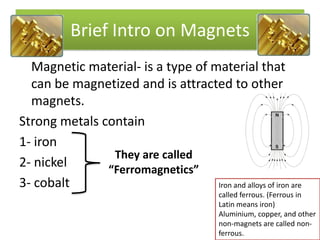
Brief Intro on Magnets
  Magnetic material- is a type of material that
  can be magnetized and is attracted to other
  magnets.
Strong metals contain
1- iron
                They are called
2- nickel      “Ferromagnetics”
3- cobalt                          Iron and alloys of iron are
                                           called ferrous. (Ferrous in
                                           Latin means iron)
                                           Aluminium, copper, and other
                                           non-magnets are called non-
                                           ferrous.
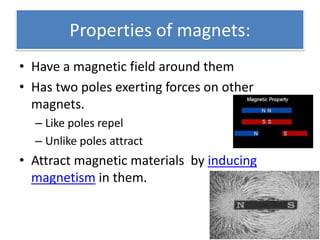
Properties of magnets:
• Have a magnetic field around them
• Has two poles exerting forces on other
  magnets.
  – Like poles repel
  – Unlike poles attract
• Attract magnetic materials by inducing
  magnetism in them.
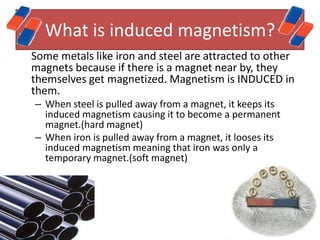
What is induced magnetism?
Some metals like iron and steel are attracted to other
magnets because if there is a magnet near by, they
themselves get magnetized. Magnetism is INDUCED in
them.
– When steel is pulled away from a magnet, it keeps its
  induced magnetism causing it to become a permanent
  magnet.(hard magnet)
– When iron is pulled away from a magnet, it looses its
  induced magnetism meaning that iron was only a
  temporary magnet.(soft magnet)
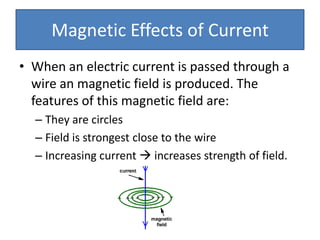
Magnetic Effects of Current
• When an electric current is passed through a
  wire an magnetic field is produced. The
  features of this magnetic field are:
  – They are circles
  – Field is strongest close to the wire
  – Increasing current  increases strength of field.
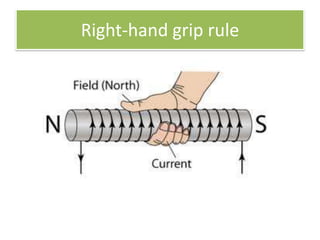
Right-hand grip rule
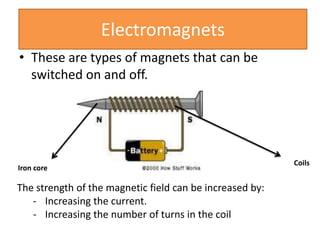
Electromagnets
• These are types of magnets that can be
  switched on and off.


                                                          Coils
Iron core

The strength of the magnetic field can be increased by:
   - Increasing the current.
   - Increasing the number of turns in the coil
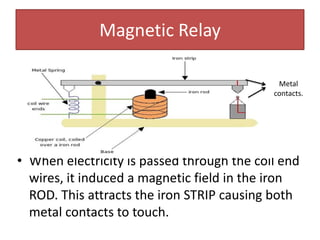
Magnetic Relay

                                             Metal
                                            contacts.


• When electricity is passed through the coil end
  wires, it induced a magnetic field in the iron
  ROD. This attracts the iron STRIP causing both
  metal contacts to touch.
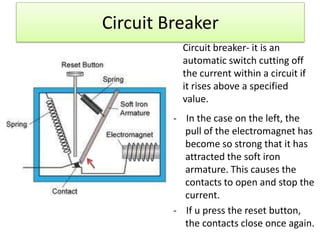
Circuit Breaker
           Circuit breaker- it is an
           automatic switch cutting off
           the current within a circuit if
           it rises above a specified
           value.
         - In the case on the left, the
           pull of the electromagnet has
           become so strong that it has
           attracted the soft iron
           armature. This causes the
           contacts to open and stop the
           current.
         - If u press the reset button,
           the contacts close once again.
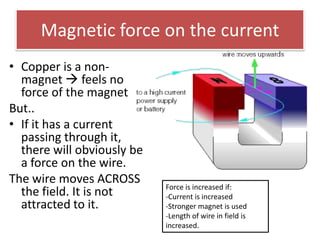
Magnetic force on the current
• Copper is a non-
  magnet  feels no
  force of the magnet
But..
• If it has a current
  passing through it,
  there will obviously be
  a force on the wire.
The wire moves ACROSS
                            Force is increased if:
  the field. It is not      -Current is increased
  attracted to it.          -Stronger magnet is used
                            -Length of wire in field is
                            increased.
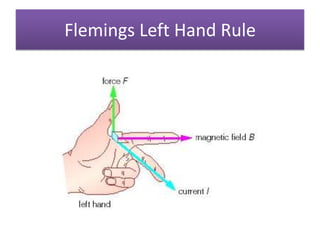
Flemings Left Hand Rule
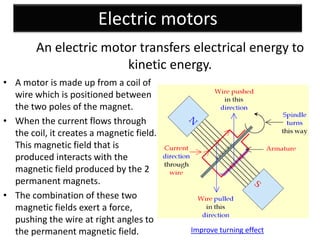
Electric motors
        An electric motor transfers electrical energy to
                        kinetic energy.
• A motor is made up from a coil of
  wire which is positioned between
  the two poles of the magnet.
• When the current flows through
  the coil, it creates a magnetic field.
  This magnetic field that is
  produced interacts with the
  magnetic field produced by the 2
  permanent magnets.
• The combination of these two
  magnetic fields exert a force,
  pushing the wire at right angles to
  the permanent magnetic field.            Improve turning effect
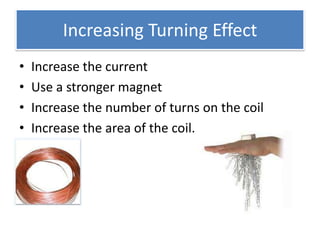
Increasing Turning Effect
•   Increase the current
•   Use a stronger magnet
•   Increase the number of turns on the coil
•   Increase the area of the coil.
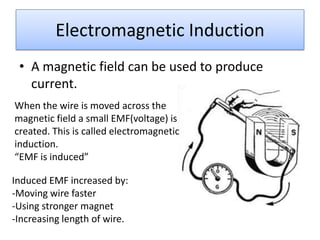
Electromagnetic Induction
 • A magnetic field can be used to produce
   current.
When the wire is moved across the
magnetic field a small EMF(voltage) is
created. This is called electromagnetic
induction.
“EMF is induced”

Induced EMF increased by:
-Moving wire faster
-Using stronger magnet
-Increasing length of wire.
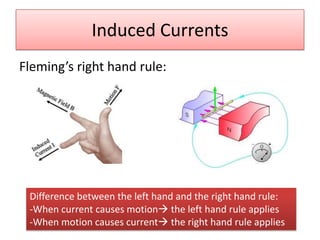
Induced Currents
Fleming’s right hand rule:


 Difference between the left hand and the right hand rule:
 -When current causes motion the left hand rule applies
 -When motion causes current the right hand rule applies
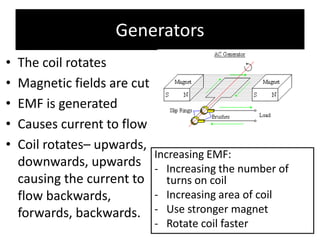
Generators
•   The coil rotates
•   Magnetic fields are cut
•   EMF is generated
•   Causes current to flow
•   Coil rotates– upwards,
                              Increasing EMF:
    downwards, upwards        - Increasing the number of
    causing the current to       turns on coil
    flow backwards,           - Increasing area of coil
    forwards, backwards.      - Use stronger magnet
                              - Rotate coil faster
Coils and Transformers
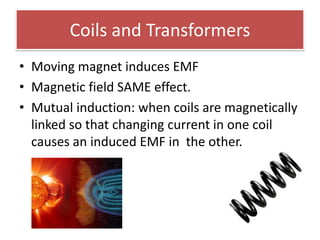
• Moving magnet induces EMF
• Magnetic field SAME effect.
• Mutual induction: when coils are magnetically
  linked so that changing current in one coil
  causes an induced EMF in the other.
Simple Transformer

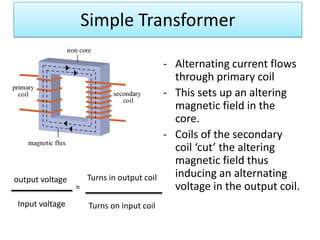
                                            - Alternating current flows
                                              through primary coil
                                            - This sets up an altering
                                              magnetic field in the
                                              core.
                                            - Coils of the secondary
                                              coil ‘cut’ the altering
                                              magnetic field thus
output voltage       Turns in output coil     inducing an alternating
                 =                            voltage in the output coil.
 Input voltage       Turns on input coil
Step-up and Step-down transformers
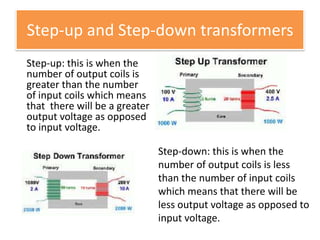
Step-up: this is when the
number of output coils is
greater than the number
of input coils which means
that there will be a greater
output voltage as opposed
to input voltage.

                               Step-down: this is when the
                               number of output coils is less
                               than the number of input coils
                               which means that there will be
                               less output voltage as opposed to
                               input voltage.
Power Through a Transformer


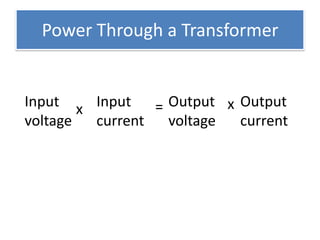
Input x Input   = Output x Output
voltage current   voltage  current
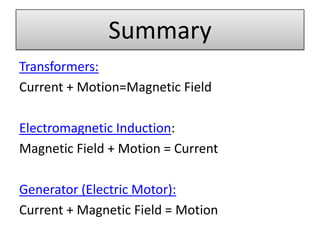
Summary
Transformers:
Current + Motion=Magnetic Field

Electromagnetic Induction:
Magnetic Field + Motion = Current

Generator (Electric Motor):
Current + Magnetic Field = Motion
Important electronic components
1. Resistors – keep currents + voltages at levels
    desired by the electronic component
2. Capacitor – store small amounts of electric
    charge
3. Diodes – allow the current to flow in only one
    direction
4. Light-emittingg diodes (LED) – glow when a
    small current is passed through them.
Continued…
5. Transistors – used to amplify signals
6. Integrated circuits(micro-chips)– contain complete circuits with :
         a) Resistors
         b) Transistors
         c) Other components

7. Relays– electromagnetic switches.
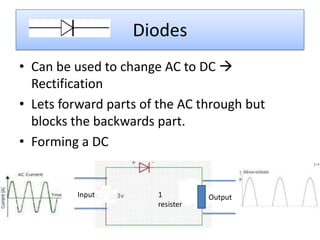
Diodes
• Can be used to change AC to DC 
  Rectification
• Lets forward parts of the AC through but
  blocks the backwards part.
• Forming a DC


         Input         1          Output
                       resister
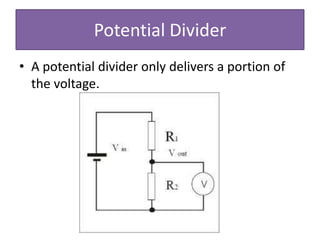
Potential Divider
• A potential divider only delivers a portion of
  the voltage.
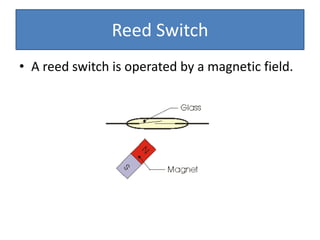
Reed Switch
• A reed switch is operated by a magnetic field.
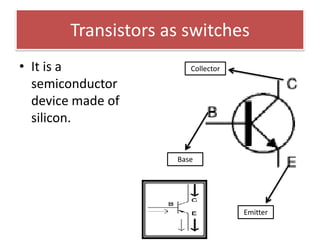
Transistors as switches
• It is a               Collector

  semiconductor
  device made of
  silicon.

                     Base


                                    Emitter
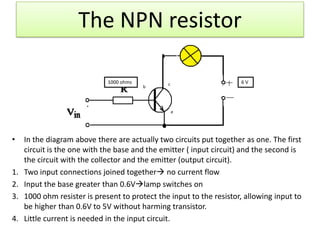
The NPN resistor

                              1000 ohms         c                     6V
                                          b


                                                    e


•    In the diagram above there are actually two circuits put together as one. The first
     circuit is the one with the base and the emitter ( input circuit) and the second is
     the circuit with the collector and the emitter (output circuit).
1.   Two input connections joined together no current flow
2.   Input the base greater than 0.6Vlamp switches on
3.   1000 ohm resister is present to protect the input to the resistor, allowing input to
     be higher than 0.6V to 5V without harming transistor.
4.   Little current is needed in the input circuit.
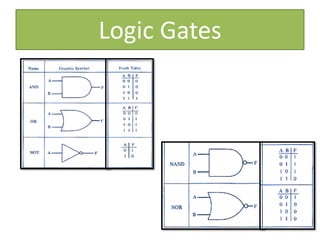
Logic Gates
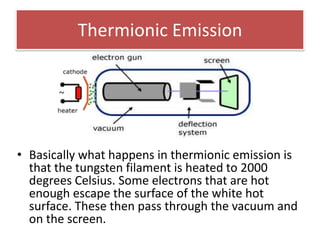
Thermionic Emission


• Basically what happens in thermionic emission is
  that the tungsten filament is heated to 2000
  degrees Celsius. Some electrons that are hot
  enough escape the surface of the white hot
  surface. These then pass through the vacuum and
  on the screen.
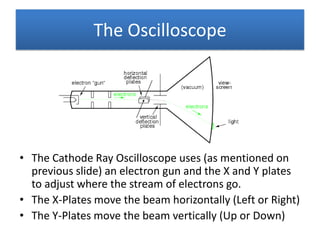
The Oscilloscope


• The Cathode Ray Oscilloscope uses (as mentioned on
  previous slide) an electron gun and the X and Y plates
  to adjust where the stream of electrons go.
• The X-Plates move the beam horizontally (Left or Right)
• The Y-Plates move the beam vertically (Up or Down)
• The Y-plates are connected to a Y input
  terminal. These are connected to an AC
  supply.
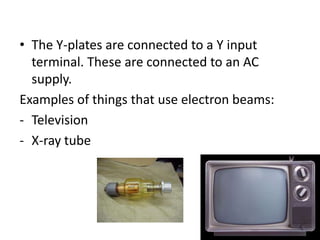
Examples of things that use electron beams:
- Television
- X-ray tube
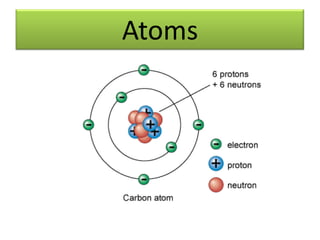
Atoms
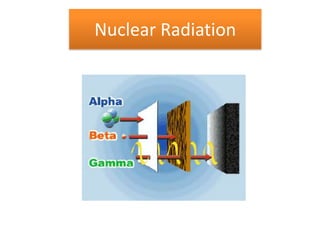
Nuclear Radiation
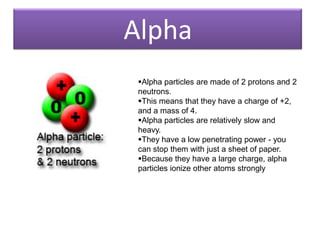
Alpha
 Alpha particles are made of 2 protons and 2
 neutrons.
 This means that they have a charge of +2,
 and a mass of 4.
 Alpha particles are relatively slow and
 heavy.
 They have a low penetrating power - you
 can stop them with just a sheet of paper.
 Because they have a large charge, alpha
 particles ionize other atoms strongly
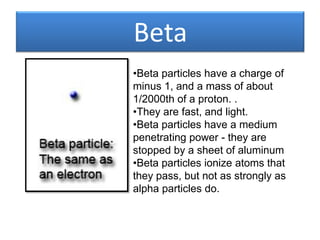
Beta
•Beta particles have a charge of
minus 1, and a mass of about
1/2000th of a proton. .
•They are fast, and light.
•Beta particles have a medium
penetrating power - they are
stopped by a sheet of aluminum
•Beta particles ionize atoms that
they pass, but not as strongly as
alpha particles do.
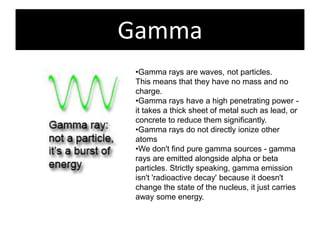
Gamma
 •Gamma rays are waves, not particles.
 This means that they have no mass and no
 charge.
 •Gamma rays have a high penetrating power -
 it takes a thick sheet of metal such as lead, or
 concrete to reduce them significantly.
 •Gamma rays do not directly ionize other
 atoms
 •We don't find pure gamma sources - gamma
 rays are emitted alongside alpha or beta
 particles. Strictly speaking, gamma emission
 isn't 'radioactive decay' because it doesn't
 change the state of the nucleus, it just carries
 away some energy.
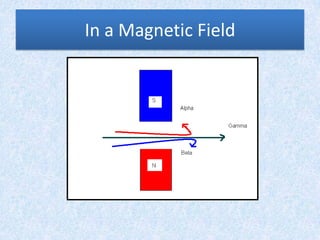
In a Magnetic Field
What is Background Radiation?
• Background radiation comes from naturally
  decaying substances such as soil, rocks, air,
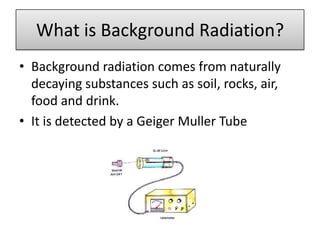
  food and drink.
• It is detected by a Geiger Muller Tube
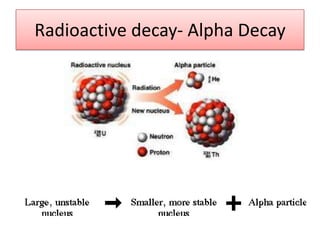
Radioactive decay- Alpha Decay
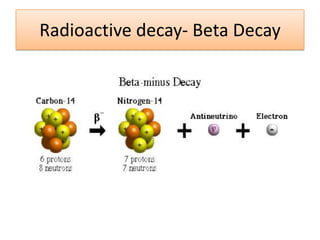
Radioactive decay- Beta Decay
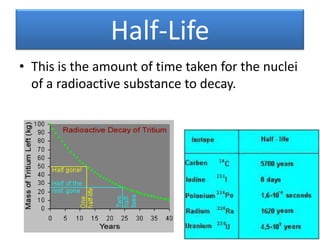
Half-Life
• This is the amount of time taken for the nuclei
  of a radioactive substance to decay.
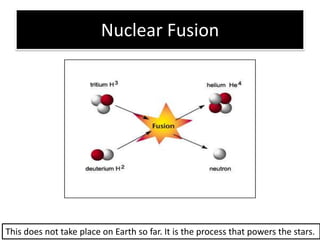
Nuclear Fusion


This does not take place on Earth so far. It is the process that powers the stars.
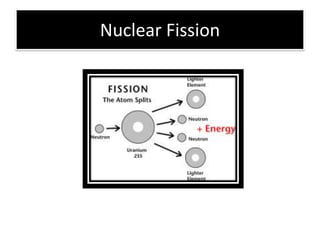
Nuclear Fission
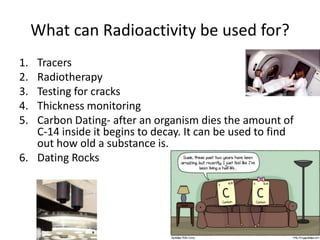
What can Radioactivity be used for?
1. Tracers
2. Radiotherapy
3. Testing for cracks
4. Thickness monitoring
5. Carbon Dating- after an organism dies the amount of
   C-14 inside it begins to decay. It can be used to find
   out how old a substance is.
6. Dating Rocks
This is the physics syllabus Complete


        Best of luck for
       your IGCSE exams


  Especially my fellow candidates of May/June 2011!!!

Igcse physics part 3

  • 1.
    Physics IGCSE Revision (Part 3) By: Momina
  • 2.
    Brief Intro onMagnets Magnetic material- is a type of material that can be magnetized and is attracted to other magnets. Strong metals contain 1- iron They are called 2- nickel “Ferromagnetics” 3- cobalt Iron and alloys of iron are called ferrous. (Ferrous in Latin means iron) Aluminium, copper, and other non-magnets are called non- ferrous.
  • 3.
    Properties of magnets: •Have a magnetic field around them • Has two poles exerting forces on other magnets. – Like poles repel – Unlike poles attract • Attract magnetic materials by inducing magnetism in them.
  • 4.
    What is inducedmagnetism? Some metals like iron and steel are attracted to other magnets because if there is a magnet near by, they themselves get magnetized. Magnetism is INDUCED in them. – When steel is pulled away from a magnet, it keeps its induced magnetism causing it to become a permanent magnet.(hard magnet) – When iron is pulled away from a magnet, it looses its induced magnetism meaning that iron was only a temporary magnet.(soft magnet)
  • 5.
    Magnetic Effects ofCurrent • When an electric current is passed through a wire an magnetic field is produced. The features of this magnetic field are: – They are circles – Field is strongest close to the wire – Increasing current  increases strength of field.
  • 6.
  • 7.
    Electromagnets • These aretypes of magnets that can be switched on and off. Coils Iron core The strength of the magnetic field can be increased by: - Increasing the current. - Increasing the number of turns in the coil
  • 8.
    Magnetic Relay Metal contacts. • When electricity is passed through the coil end wires, it induced a magnetic field in the iron ROD. This attracts the iron STRIP causing both metal contacts to touch.
  • 9.
    Circuit Breaker Circuit breaker- it is an automatic switch cutting off the current within a circuit if it rises above a specified value. - In the case on the left, the pull of the electromagnet has become so strong that it has attracted the soft iron armature. This causes the contacts to open and stop the current. - If u press the reset button, the contacts close once again.
  • 10.
    Magnetic force onthe current • Copper is a non- magnet  feels no force of the magnet But.. • If it has a current passing through it, there will obviously be a force on the wire. The wire moves ACROSS Force is increased if: the field. It is not -Current is increased attracted to it. -Stronger magnet is used -Length of wire in field is increased.
  • 11.
  • 12.
    Electric motors An electric motor transfers electrical energy to kinetic energy. • A motor is made up from a coil of wire which is positioned between the two poles of the magnet. • When the current flows through the coil, it creates a magnetic field. This magnetic field that is produced interacts with the magnetic field produced by the 2 permanent magnets. • The combination of these two magnetic fields exert a force, pushing the wire at right angles to the permanent magnetic field. Improve turning effect
  • 13.
    Increasing Turning Effect • Increase the current • Use a stronger magnet • Increase the number of turns on the coil • Increase the area of the coil.
  • 14.
    Electromagnetic Induction •A magnetic field can be used to produce current. When the wire is moved across the magnetic field a small EMF(voltage) is created. This is called electromagnetic induction. “EMF is induced” Induced EMF increased by: -Moving wire faster -Using stronger magnet -Increasing length of wire.
  • 15.
    Induced Currents Fleming’s righthand rule: Difference between the left hand and the right hand rule: -When current causes motion the left hand rule applies -When motion causes current the right hand rule applies
  • 16.
    Generators • The coil rotates • Magnetic fields are cut • EMF is generated • Causes current to flow • Coil rotates– upwards, Increasing EMF: downwards, upwards - Increasing the number of causing the current to turns on coil flow backwards, - Increasing area of coil forwards, backwards. - Use stronger magnet - Rotate coil faster
  • 17.
    Coils and Transformers •Moving magnet induces EMF • Magnetic field SAME effect. • Mutual induction: when coils are magnetically linked so that changing current in one coil causes an induced EMF in the other.
  • 18.
    Simple Transformer - Alternating current flows through primary coil - This sets up an altering magnetic field in the core. - Coils of the secondary coil ‘cut’ the altering magnetic field thus output voltage Turns in output coil inducing an alternating = voltage in the output coil. Input voltage Turns on input coil
  • 19.
    Step-up and Step-downtransformers Step-up: this is when the number of output coils is greater than the number of input coils which means that there will be a greater output voltage as opposed to input voltage. Step-down: this is when the number of output coils is less than the number of input coils which means that there will be less output voltage as opposed to input voltage.
  • 20.
    Power Through aTransformer Input x Input = Output x Output voltage current voltage current
  • 21.
    Summary Transformers: Current + Motion=MagneticField Electromagnetic Induction: Magnetic Field + Motion = Current Generator (Electric Motor): Current + Magnetic Field = Motion
  • 22.
    Important electronic components 1.Resistors – keep currents + voltages at levels desired by the electronic component 2. Capacitor – store small amounts of electric charge 3. Diodes – allow the current to flow in only one direction 4. Light-emittingg diodes (LED) – glow when a small current is passed through them.
  • 23.
    Continued… 5. Transistors –used to amplify signals 6. Integrated circuits(micro-chips)– contain complete circuits with : a) Resistors b) Transistors c) Other components 7. Relays– electromagnetic switches.
  • 24.
    Diodes • Can beused to change AC to DC  Rectification • Lets forward parts of the AC through but blocks the backwards part. • Forming a DC Input 1 Output resister
  • 25.
    Potential Divider • Apotential divider only delivers a portion of the voltage.
  • 26.
    Reed Switch • Areed switch is operated by a magnetic field.
  • 27.
    Transistors as switches •It is a Collector semiconductor device made of silicon. Base Emitter
  • 28.
    The NPN resistor 1000 ohms c 6V b e • In the diagram above there are actually two circuits put together as one. The first circuit is the one with the base and the emitter ( input circuit) and the second is the circuit with the collector and the emitter (output circuit). 1. Two input connections joined together no current flow 2. Input the base greater than 0.6Vlamp switches on 3. 1000 ohm resister is present to protect the input to the resistor, allowing input to be higher than 0.6V to 5V without harming transistor. 4. Little current is needed in the input circuit.
  • 29.
  • 30.
    Thermionic Emission • Basicallywhat happens in thermionic emission is that the tungsten filament is heated to 2000 degrees Celsius. Some electrons that are hot enough escape the surface of the white hot surface. These then pass through the vacuum and on the screen.
  • 31.
    The Oscilloscope • TheCathode Ray Oscilloscope uses (as mentioned on previous slide) an electron gun and the X and Y plates to adjust where the stream of electrons go. • The X-Plates move the beam horizontally (Left or Right) • The Y-Plates move the beam vertically (Up or Down)
  • 32.
    • The Y-platesare connected to a Y input terminal. These are connected to an AC supply. Examples of things that use electron beams: - Television - X-ray tube
  • 33.
  • 34.
  • 35.
    Alpha Alpha particlesare made of 2 protons and 2 neutrons. This means that they have a charge of +2, and a mass of 4. Alpha particles are relatively slow and heavy. They have a low penetrating power - you can stop them with just a sheet of paper. Because they have a large charge, alpha particles ionize other atoms strongly
  • 36.
    Beta •Beta particles havea charge of minus 1, and a mass of about 1/2000th of a proton. . •They are fast, and light. •Beta particles have a medium penetrating power - they are stopped by a sheet of aluminum •Beta particles ionize atoms that they pass, but not as strongly as alpha particles do.
  • 37.
    Gamma •Gamma raysare waves, not particles. This means that they have no mass and no charge. •Gamma rays have a high penetrating power - it takes a thick sheet of metal such as lead, or concrete to reduce them significantly. •Gamma rays do not directly ionize other atoms •We don't find pure gamma sources - gamma rays are emitted alongside alpha or beta particles. Strictly speaking, gamma emission isn't 'radioactive decay' because it doesn't change the state of the nucleus, it just carries away some energy.
  • 38.
  • 39.
    What is BackgroundRadiation? • Background radiation comes from naturally decaying substances such as soil, rocks, air, food and drink. • It is detected by a Geiger Muller Tube
  • 40.
  • 41.
  • 42.
    Half-Life • This isthe amount of time taken for the nuclei of a radioactive substance to decay.
  • 43.
    Nuclear Fusion This doesnot take place on Earth so far. It is the process that powers the stars.
  • 44.
  • 45.
    What can Radioactivitybe used for? 1. Tracers 2. Radiotherapy 3. Testing for cracks 4. Thickness monitoring 5. Carbon Dating- after an organism dies the amount of C-14 inside it begins to decay. It can be used to find out how old a substance is. 6. Dating Rocks
  • 46.
    This is thephysics syllabus Complete Best of luck for your IGCSE exams Especially my fellow candidates of May/June 2011!!!