General Physics 1/2
Science, Technology, Engineering, and Mathematics
General Physics 1
Science, Technology, Engineering, and Mathematics
Lesson 2.2
Vector Addition
Through Analytic
Method
2
Have you ever played a treasure hunting game?
Most of the time, people looking for these
supposedly “treasures” use a map.
3
In literature and film,
a common treasure
map is tattered and
has a signature “x” in
the middle to identify
the location of the
treasure.
4
Each individual path
can be combined and
added to specifically
identify how far and in
what direction you
should go to reach it.
5
How are two or more vectors
added?
Learning Competency
At the end of the lesson, you should be able to do the
following:
6
Perform addition of vectors
(STEM_GP12V-Ia-9).
Learning Objectives
At the end of the lesson, you should be able to do the
following:
7
● Explain the rules of vector addition and
subtraction.
● Use the graphical method to add vectors.
8
Can you help
the monkey
get its
banana?
Recall of Vectors
9
In what directions
did you go into?
Recall of Vectors
10
What is the total
distance you have
travelled in
bringing the
banana to the
monkey?
Recall of Vectors
11
What is the total
displacement you
have travelled in
bringing the
banana to the
monkey?
Recall of Vectors
12
Two vectors are considered
equal if their magnitudes and
direction are the same.
If two or more vectors are
pointing in the same
direction, it means that they
are parallel to each other.
Vectors in One Dimension
13
When two vectors have
opposite directions but have
the same magnitude, they
are called antiparallel.
Vectors in One Dimension
14
What is the difference between
parallel and antiparallel
vectors?
15
What are the rules in adding
and subtracting vectors?
16
Suppose a person has a displacement of A eastward.
Addition of Vectors
17
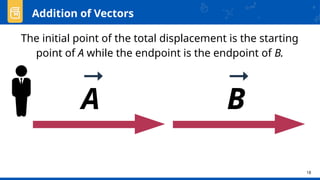
Suppose he covered an additional displacement B eastward.
Addition of Vectors
18
The initial point of the total displacement is the starting
point of A while the endpoint is the endpoint of B.
Addition of Vectors
19
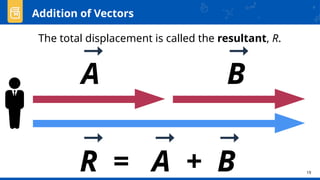
The total displacement is called the resultant, R.
Addition of Vectors
20
The addition (and subtraction) of vectors can be done using
the head to tail method.
Addition of Vectors
tail head head
tail
21
Suppose a person has a displacement of A eastward.
Subtraction of Vectors
22
Suppose he covers another displacement of B westward.
Subtraction of Vectors
23
The resultant R can be measured using head to tail method.
Subtraction of Vectors
24
The resultant R can be measured using head to tail method.
Subtraction of Vectors
25
● Most of the vectors that you will encounter are not
always parallel or antiparallel.
● However, the same rules for the addition of vectors
apply even if there are specific angles given.
● Head to tail method can still be used in adding vectors
while considering their angles.
Graphical Method of Adding Vectors
26
We can add vectors by placing them head to tail.
Graphical Method of Adding Vectors
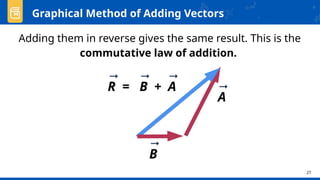
27
Adding them in reverse gives the same result. This is the
commutative law of addition.
Graphical Method of Adding Vectors
Remember
28
When you add two or more vectors,
they should contain similar units and
should describe the same physical
quantity. For example, a displacement
vector can only be added to another
displacement vector. It does not make
sense to add it to a velocity vector, for
example.
29
How are vectors added
graphically?
30
● Vectors can be added graphically (geometrically) or
algebraically.
● A graphing paper or a bond paper, a ruler, and a
protractor are needed in adding vectors graphically.
Graphical Method of Adding Vectors
Let’s Practice!
31
A car initially traveled 35 km due south and then
traveled 65 km to the west. What is the car’s
resultant displacement?
Let’s Practice!
32
A car initially traveled 35 km due south and then
traveled 65 km to the west. What is the car’s
resultant displacement?
The resultant displacement is 74 km, 28°.
Try It!
33
33
What is the resultant displacement if a
man jogs 120 m, east and then walks 50
m due south?
Try It!
34
34
Philip jogged along the street and
covered 110 m north. He stopped for
a while and jogged for another 20 m
north. What is his total
displacement?
Try It!
35
35
A student walks 10 m east and 6 m
north. What is her resultant
displacement?
Remember
36
The vector sum or resultant may vary
from one individual to another due to
the limitations of our measuring
devices such as the ruler and the
protractor. However, this deviation
should only be by a few millimeters and
a few degrees.
Let’s Sum It Up!
37
● The sum of the vectors is called the resultant, R.
● Vectors are considered equal only if they have the
same magnitude and direction.
● Parallel vectors are those that are pointing in
the same direction. On the other hand,
antiparallel vectors are those that are in
Let’s Sum It Up!
38
● Vector addition follows the commutative and
associative laws of addition.
● Vectors can be added graphically using the head
to tail method.
Bibliography
39
Bauer, W., and Gary D. Westfall. University Physics with Modern Physics. New York: McGraw-Hill,
2013.
Faughn, Jerry S. and Raymond A. Serway. Serway’s College Physics (7th ed). Singapore: Brooks/Cole,
2006.
Knight, Randall Dewey. Physics for Scientists and Engineers: a Strategic Approach with Modern
Physics. Pearson, 2017.
Serway, Raymond A. and John W. Jewett, Jr. Physics for Scientists and Engineers with Modern Physics (9th
ed). USA: Brooks/Cole, 2014.
Young, Hugh D., Roger A. Freedman, and A. Lewis Ford. Sears and Zemansky’s University Physics with
Modern Physics (13th ed). USA: Pearson Education, 2012.
Vector Addition Through Analytic Method.

  • 1.
    General Physics 1/2 Science,Technology, Engineering, and Mathematics General Physics 1 Science, Technology, Engineering, and Mathematics Lesson 2.2 Vector Addition Through Analytic Method
  • 2.
    2 Have you everplayed a treasure hunting game? Most of the time, people looking for these supposedly “treasures” use a map.
  • 3.
    3 In literature andfilm, a common treasure map is tattered and has a signature “x” in the middle to identify the location of the treasure.
  • 4.
    4 Each individual path canbe combined and added to specifically identify how far and in what direction you should go to reach it.
  • 5.
    5 How are twoor more vectors added?
  • 6.
    Learning Competency At theend of the lesson, you should be able to do the following: 6 Perform addition of vectors (STEM_GP12V-Ia-9).
  • 7.
    Learning Objectives At theend of the lesson, you should be able to do the following: 7 ● Explain the rules of vector addition and subtraction. ● Use the graphical method to add vectors.
  • 8.
    8 Can you help themonkey get its banana? Recall of Vectors
  • 9.
    9 In what directions didyou go into? Recall of Vectors
  • 10.
    10 What is thetotal distance you have travelled in bringing the banana to the monkey? Recall of Vectors
  • 11.
    11 What is thetotal displacement you have travelled in bringing the banana to the monkey? Recall of Vectors
  • 12.
    12 Two vectors areconsidered equal if their magnitudes and direction are the same. If two or more vectors are pointing in the same direction, it means that they are parallel to each other. Vectors in One Dimension
  • 13.
    13 When two vectorshave opposite directions but have the same magnitude, they are called antiparallel. Vectors in One Dimension
  • 14.
    14 What is thedifference between parallel and antiparallel vectors?
  • 15.
    15 What are therules in adding and subtracting vectors?
  • 16.
    16 Suppose a personhas a displacement of A eastward. Addition of Vectors
  • 17.
    17 Suppose he coveredan additional displacement B eastward. Addition of Vectors
  • 18.
    18 The initial pointof the total displacement is the starting point of A while the endpoint is the endpoint of B. Addition of Vectors
  • 19.
    19 The total displacementis called the resultant, R. Addition of Vectors
  • 20.
    20 The addition (andsubtraction) of vectors can be done using the head to tail method. Addition of Vectors tail head head tail
  • 21.
    21 Suppose a personhas a displacement of A eastward. Subtraction of Vectors
  • 22.
    22 Suppose he coversanother displacement of B westward. Subtraction of Vectors
  • 23.
    23 The resultant Rcan be measured using head to tail method. Subtraction of Vectors
  • 24.
    24 The resultant Rcan be measured using head to tail method. Subtraction of Vectors
  • 25.
    25 ● Most ofthe vectors that you will encounter are not always parallel or antiparallel. ● However, the same rules for the addition of vectors apply even if there are specific angles given. ● Head to tail method can still be used in adding vectors while considering their angles. Graphical Method of Adding Vectors
  • 26.
    26 We can addvectors by placing them head to tail. Graphical Method of Adding Vectors
  • 27.
    27 Adding them inreverse gives the same result. This is the commutative law of addition. Graphical Method of Adding Vectors
  • 28.
    Remember 28 When you addtwo or more vectors, they should contain similar units and should describe the same physical quantity. For example, a displacement vector can only be added to another displacement vector. It does not make sense to add it to a velocity vector, for example.
  • 29.
    29 How are vectorsadded graphically?
  • 30.
    30 ● Vectors canbe added graphically (geometrically) or algebraically. ● A graphing paper or a bond paper, a ruler, and a protractor are needed in adding vectors graphically. Graphical Method of Adding Vectors
  • 31.
    Let’s Practice! 31 A carinitially traveled 35 km due south and then traveled 65 km to the west. What is the car’s resultant displacement?
  • 32.
    Let’s Practice! 32 A carinitially traveled 35 km due south and then traveled 65 km to the west. What is the car’s resultant displacement? The resultant displacement is 74 km, 28°.
  • 33.
    Try It! 33 33 What isthe resultant displacement if a man jogs 120 m, east and then walks 50 m due south?
  • 34.
    Try It! 34 34 Philip joggedalong the street and covered 110 m north. He stopped for a while and jogged for another 20 m north. What is his total displacement?
  • 35.
    Try It! 35 35 A studentwalks 10 m east and 6 m north. What is her resultant displacement?
  • 36.
    Remember 36 The vector sumor resultant may vary from one individual to another due to the limitations of our measuring devices such as the ruler and the protractor. However, this deviation should only be by a few millimeters and a few degrees.
  • 37.
    Let’s Sum ItUp! 37 ● The sum of the vectors is called the resultant, R. ● Vectors are considered equal only if they have the same magnitude and direction. ● Parallel vectors are those that are pointing in the same direction. On the other hand, antiparallel vectors are those that are in
  • 38.
    Let’s Sum ItUp! 38 ● Vector addition follows the commutative and associative laws of addition. ● Vectors can be added graphically using the head to tail method.
  • 39.
    Bibliography 39 Bauer, W., andGary D. Westfall. University Physics with Modern Physics. New York: McGraw-Hill, 2013. Faughn, Jerry S. and Raymond A. Serway. Serway’s College Physics (7th ed). Singapore: Brooks/Cole, 2006. Knight, Randall Dewey. Physics for Scientists and Engineers: a Strategic Approach with Modern Physics. Pearson, 2017. Serway, Raymond A. and John W. Jewett, Jr. Physics for Scientists and Engineers with Modern Physics (9th ed). USA: Brooks/Cole, 2014. Young, Hugh D., Roger A. Freedman, and A. Lewis Ford. Sears and Zemansky’s University Physics with Modern Physics (13th ed). USA: Pearson Education, 2012.