Vectors and Scalars
Lecture 1
In this lecture, you will learn
● Physical interpretations and examples of
scalars and vectors
● Basic operations on scalars and vectors
● Properties of vector algebra
● How to represent vectors in abstract space
● How to carry out the basic operations
mathematically
What are vectors?
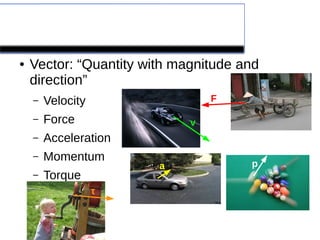
● Vector: “Quantity with magnitude and
direction”
– Velocity
– Force
– Acceleration
– Momentum
– Torque
v
F
a p
τ
What are scalars?
● Scalar: “Quantity with magnitude, but no
direction”
– Temperature
– Pressure
– Time
– Energy
– Mass
T
P
t
m
E
A joke
● What do you get when you cross a
disease-carrying mosquito with a mountain
climber?
?
A joke
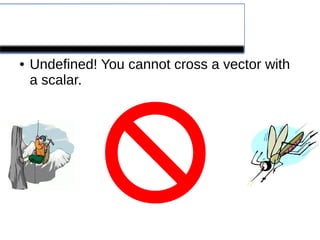
● Undefined! You cannot cross a vector with
a scalar.
What was that for?
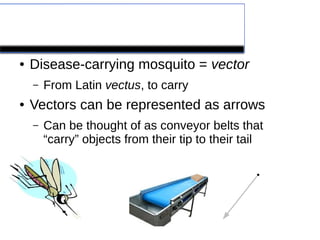
● Disease-carrying mosquito = vector
– From Latin vectus, to carry
● Vectors can be represented as arrows
– Can be thought of as conveyor belts that
“carry” objects from their tip to their tail
What was that for?
● Mountain climber = scaler
– Pronounced the same way as scalar
● Scalars are just real numbers (in physics,
usually with units)
– Their purpose is to scale vectors
⃗v
2⃗v
3⃗v
Vectors
● The precise definition of a vector is more
than just a quantity with magnitude and
direction...
...but you can think of vectors that way for
now.
Geometric Representation
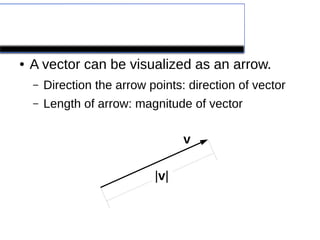
● A vector can be visualized as an arrow.
– Direction the arrow points: direction of vector
– Length of arrow: magnitude of vector
v
|v|
Vector Addition
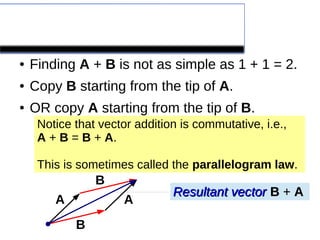
● Finding A + B is not as simple as 1 + 1 = 2.
● Copy B starting from the tip of A.
● OR copy A starting from the tip of B.
A
B
A
B
Resultant vectorResultant vector AA ++ BBResultant vectorResultant vector BB ++ AA
Notice that vector addition is commutative, i.e.,
A + B = B + A.
This is sometimes called the parallelogram law.
Scalar Multiplication
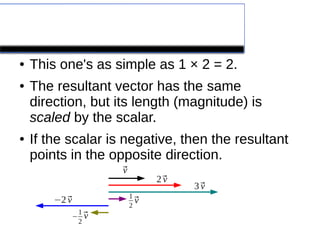
● This one's as simple as 1 × 2 = 2.
● The resultant vector has the same
direction, but its length (magnitude) is
scaled by the scalar.
● If the scalar is negative, then the resultant
points in the opposite direction.
⃗v
2⃗v
3⃗v
1
2
⃗v
−
1
2
⃗v
−2⃗v
The Zero Vector
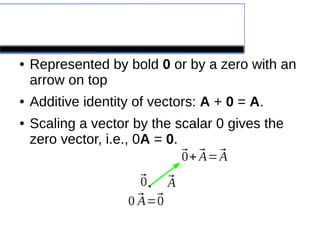
● Represented by bold 0 or by a zero with an
arrow on top
● Additive identity of vectors: A + 0 = A.
● Scaling a vector by the scalar 0 gives the
zero vector, i.e., 0A = 0.
⃗0 ⃗A
⃗0+ ⃗A=⃗A
0 ⃗A=⃗0
The Negative of a Vector
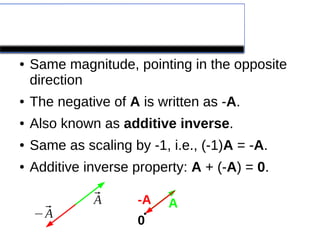
● Same magnitude, pointing in the opposite
direction
● The negative of A is written as -A.
● Also known as additive inverse.
● Same as scaling by -1, i.e., (-1)A = -A.
● Additive inverse property: A + (-A) = 0.
⃗A
−⃗A
A-A
0
Vector Subtraction
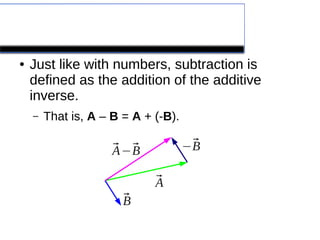
● Just like with numbers, subtraction is
defined as the addition of the additive
inverse.
– That is, A – B = A + (-B).
⃗A
⃗B
−⃗B⃗A−⃗B
More Properties of Vector
Algebra
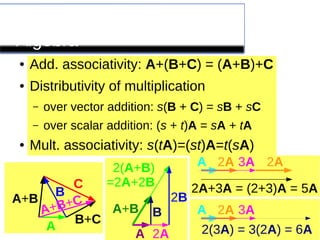
● Add. associativity: A+(B+C) = (A+B)+C
● Distributivity of multiplication
– over vector addition: s(B + C) = sB + sC
– over scalar addition: (s + t)A = sA + tA
● Mult. associativity: s(tA)=(st)A=t(sA)
A
B
C
A+B+CA+B
B+C
A 2A
B
2B
A+B
2(A+B)
=2A+2B
A 2A 3A 2A
2A+3A = (2+3)A = 5A
A 2A 3A
2(3A) = 3(2A) = 6A
Magnitude of a Vector
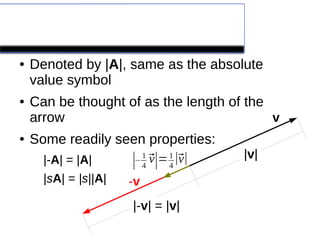
● Denoted by |A|, same as the absolute
value symbol
● Can be thought of as the length of the
arrow
● Some readily seen properties:
|-A| = |A|
|sA| = |s||A|
v
|v|
|-v| = |v|
-v
∣−
1
4
⃗v∣=1
4
∣⃗v∣
Vectors in a Coordinate
System
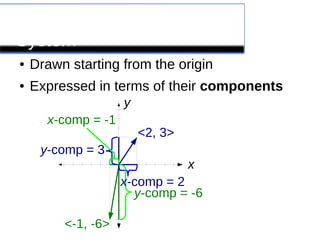
● Drawn starting from the origin
● Expressed in terms of their components
<2, 3>
<-1, -6>
x-comp = 2
y-comp = 3
x-comp = -1
y-comp = -6
x
y
Unit Vectors
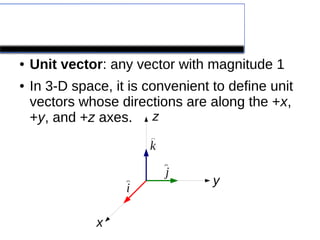
● Unit vector: any vector with magnitude 1
● In 3-D space, it is convenient to define unit
vectors whose directions are along the +x,
+y, and +z axes.
x
y
z
̂i
̂j
̂k
Algebraic Representation of
Vectors
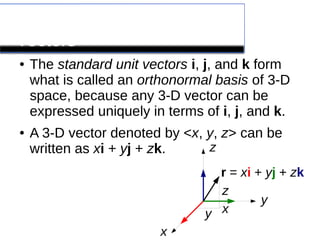
● The standard unit vectors i, j, and k form
what is called an orthonormal basis of 3-D
space, because any 3-D vector can be
expressed uniquely in terms of i, j, and k.
● A 3-D vector denoted by <x, y, z> can be
written as xi + yj + zk.
x
y
z
r = xi + yj + zk
xy
z
Algebraic Addition of
Vectors
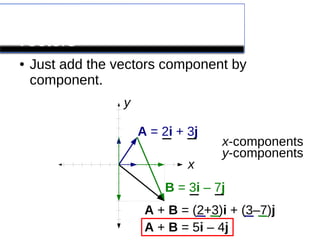
● Just add the vectors component by
component.
A = 2i + 3j
x
y
B = 3i – 7j
A + B = (2+3)i + (3–7)j
A + B = 5i – 4j
x-components
y-components
Algebraic Multiplication of a
Vector by a Scalar
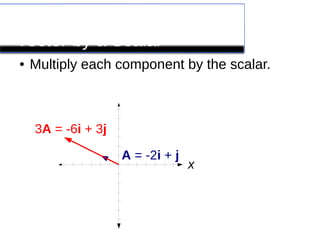
● Multiply each component by the scalar.
x
A = -2i + j
3A = -6i + 3j
Example 1
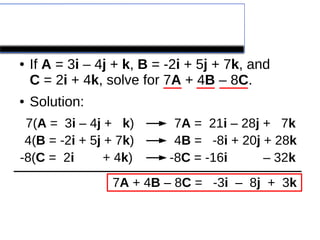
● If A = 3i – 4j + k, B = -2i + 5j + 7k, and
C = 2i + 4k, solve for 7A + 4B – 8C.
● Solution:
7(A = 3i – 4j + k)
4(B = -2i + 5j + 7k)
-8(C = 2i + 4k)
7A = 21i – 28j + 7k
4B = -8i + 20j + 28k
-8C = -16i – 32k
7A + 4B – 8C = -3i – 8j + 3k
Example 2
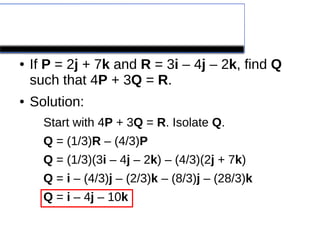
● If P = 2j + 7k and R = 3i – 4j – 2k, find Q
such that 4P + 3Q = R.
● Solution:
Start with 4P + 3Q = R. Isolate Q.
Q = (1/3)R – (4/3)P
Q = (1/3)(3i – 4j – 2k) – (4/3)(2j + 7k)
Q = i – (4/3)j – (2/3)k – (8/3)j – (28/3)k
Q = i – 4j – 10k
A few words of caution
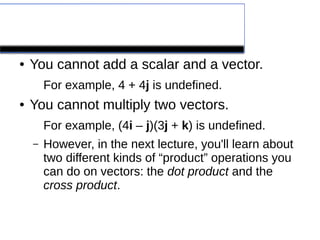
● You cannot add a scalar and a vector.
For example, 4 + 4j is undefined.
● You cannot multiply two vectors.
For example, (4i – j)(3j + k) is undefined.
– However, in the next lecture, you'll learn about
two different kinds of “product” operations you
can do on vectors: the dot product and the
cross product.
Problems
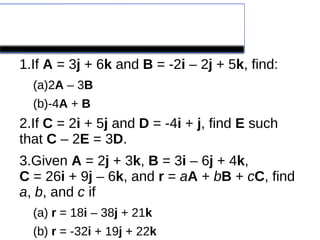
1.If A = 3j + 6k and B = -2i – 2j + 5k, find:
(a)2A – 3B
(b)-4A + B
2.If C = 2i + 5j and D = -4i + j, find E such
that C – 2E = 3D.
3.Given A = 2j + 3k, B = 3i – 6j + 4k,
C = 26i + 9j – 6k, and r = aA + bB + cC, find
a, b, and c if
(a) r = 18i – 38j + 21k
(b) r = -32i + 19j + 22k

Lesson 1: Vectors and Scalars

  • 1.
  • 2.
    In this lecture,you will learn ● Physical interpretations and examples of scalars and vectors ● Basic operations on scalars and vectors ● Properties of vector algebra ● How to represent vectors in abstract space ● How to carry out the basic operations mathematically
  • 3.
    What are vectors? ●Vector: “Quantity with magnitude and direction” – Velocity – Force – Acceleration – Momentum – Torque v F a p τ
  • 4.
    What are scalars? ●Scalar: “Quantity with magnitude, but no direction” – Temperature – Pressure – Time – Energy – Mass T P t m E
  • 5.
    A joke ● Whatdo you get when you cross a disease-carrying mosquito with a mountain climber? ?
  • 6.
    A joke ● Undefined!You cannot cross a vector with a scalar.
  • 7.
    What was thatfor? ● Disease-carrying mosquito = vector – From Latin vectus, to carry ● Vectors can be represented as arrows – Can be thought of as conveyor belts that “carry” objects from their tip to their tail
  • 8.
    What was thatfor? ● Mountain climber = scaler – Pronounced the same way as scalar ● Scalars are just real numbers (in physics, usually with units) – Their purpose is to scale vectors ⃗v 2⃗v 3⃗v
  • 9.
    Vectors ● The precisedefinition of a vector is more than just a quantity with magnitude and direction... ...but you can think of vectors that way for now.
  • 10.
    Geometric Representation ● Avector can be visualized as an arrow. – Direction the arrow points: direction of vector – Length of arrow: magnitude of vector v |v|
  • 11.
    Vector Addition ● FindingA + B is not as simple as 1 + 1 = 2. ● Copy B starting from the tip of A. ● OR copy A starting from the tip of B. A B A B Resultant vectorResultant vector AA ++ BBResultant vectorResultant vector BB ++ AA Notice that vector addition is commutative, i.e., A + B = B + A. This is sometimes called the parallelogram law.
  • 12.
    Scalar Multiplication ● Thisone's as simple as 1 × 2 = 2. ● The resultant vector has the same direction, but its length (magnitude) is scaled by the scalar. ● If the scalar is negative, then the resultant points in the opposite direction. ⃗v 2⃗v 3⃗v 1 2 ⃗v − 1 2 ⃗v −2⃗v
  • 13.
    The Zero Vector ●Represented by bold 0 or by a zero with an arrow on top ● Additive identity of vectors: A + 0 = A. ● Scaling a vector by the scalar 0 gives the zero vector, i.e., 0A = 0. ⃗0 ⃗A ⃗0+ ⃗A=⃗A 0 ⃗A=⃗0
  • 14.
    The Negative ofa Vector ● Same magnitude, pointing in the opposite direction ● The negative of A is written as -A. ● Also known as additive inverse. ● Same as scaling by -1, i.e., (-1)A = -A. ● Additive inverse property: A + (-A) = 0. ⃗A −⃗A A-A 0
  • 15.
    Vector Subtraction ● Justlike with numbers, subtraction is defined as the addition of the additive inverse. – That is, A – B = A + (-B). ⃗A ⃗B −⃗B⃗A−⃗B
  • 16.
    More Properties ofVector Algebra ● Add. associativity: A+(B+C) = (A+B)+C ● Distributivity of multiplication – over vector addition: s(B + C) = sB + sC – over scalar addition: (s + t)A = sA + tA ● Mult. associativity: s(tA)=(st)A=t(sA) A B C A+B+CA+B B+C A 2A B 2B A+B 2(A+B) =2A+2B A 2A 3A 2A 2A+3A = (2+3)A = 5A A 2A 3A 2(3A) = 3(2A) = 6A
  • 17.
    Magnitude of aVector ● Denoted by |A|, same as the absolute value symbol ● Can be thought of as the length of the arrow ● Some readily seen properties: |-A| = |A| |sA| = |s||A| v |v| |-v| = |v| -v ∣− 1 4 ⃗v∣=1 4 ∣⃗v∣
  • 18.
    Vectors in aCoordinate System ● Drawn starting from the origin ● Expressed in terms of their components <2, 3> <-1, -6> x-comp = 2 y-comp = 3 x-comp = -1 y-comp = -6 x y
  • 19.
    Unit Vectors ● Unitvector: any vector with magnitude 1 ● In 3-D space, it is convenient to define unit vectors whose directions are along the +x, +y, and +z axes. x y z ̂i ̂j ̂k
  • 20.
    Algebraic Representation of Vectors ●The standard unit vectors i, j, and k form what is called an orthonormal basis of 3-D space, because any 3-D vector can be expressed uniquely in terms of i, j, and k. ● A 3-D vector denoted by <x, y, z> can be written as xi + yj + zk. x y z r = xi + yj + zk xy z
  • 21.
    Algebraic Addition of Vectors ●Just add the vectors component by component. A = 2i + 3j x y B = 3i – 7j A + B = (2+3)i + (3–7)j A + B = 5i – 4j x-components y-components
  • 22.
    Algebraic Multiplication ofa Vector by a Scalar ● Multiply each component by the scalar. x A = -2i + j 3A = -6i + 3j
  • 23.
    Example 1 ● IfA = 3i – 4j + k, B = -2i + 5j + 7k, and C = 2i + 4k, solve for 7A + 4B – 8C. ● Solution: 7(A = 3i – 4j + k) 4(B = -2i + 5j + 7k) -8(C = 2i + 4k) 7A = 21i – 28j + 7k 4B = -8i + 20j + 28k -8C = -16i – 32k 7A + 4B – 8C = -3i – 8j + 3k
  • 24.
    Example 2 ● IfP = 2j + 7k and R = 3i – 4j – 2k, find Q such that 4P + 3Q = R. ● Solution: Start with 4P + 3Q = R. Isolate Q. Q = (1/3)R – (4/3)P Q = (1/3)(3i – 4j – 2k) – (4/3)(2j + 7k) Q = i – (4/3)j – (2/3)k – (8/3)j – (28/3)k Q = i – 4j – 10k
  • 25.
    A few wordsof caution ● You cannot add a scalar and a vector. For example, 4 + 4j is undefined. ● You cannot multiply two vectors. For example, (4i – j)(3j + k) is undefined. – However, in the next lecture, you'll learn about two different kinds of “product” operations you can do on vectors: the dot product and the cross product.
  • 26.
    Problems 1.If A =3j + 6k and B = -2i – 2j + 5k, find: (a)2A – 3B (b)-4A + B 2.If C = 2i + 5j and D = -4i + j, find E such that C – 2E = 3D. 3.Given A = 2j + 3k, B = 3i – 6j + 4k, C = 26i + 9j – 6k, and r = aA + bB + cC, find a, b, and c if (a) r = 18i – 38j + 21k (b) r = -32i + 19j + 22k

Editor's Notes

  • #4 Insert pictures
  • #5 Insert pictures
  • #6 Insert pictures
  • #7 Insert pictures The mountain climber is a scaler (“scalar”). The cross product of two vectors is defined, but not between a vector and a scalar. Credits to Lean Palma for the joke.
  • #8 Insert pictures
  • #9 Insert pictures
  • #10 Not all quantities with magnitude and direction are vectors. More formally, a vector is a quantity that transforms in a certain way when the coordinate system is rotated, flipped, or translated, but we&amp;apos;ll get there in a later lecture.
  • #12 In typewritten manuscripts, vectors are usually written as bold letters, such as A, B, u, or v, in contrast to scalars a, b, u, and v. Since it&amp;apos;s difficult to write bold letters in handwritten tests, simply put an arrow (or upper half of an arrow) above vector quantities. Occasionally, vectors with arrows above them also appear in typewritten manuscripts.
  • #18 A more general term for magnitude that applies not only to vectors is the norm, denoted by two sets of absolute value bars, ||A||.
  • #21 Techincally, it is the set of vectors {i, j, and k}, also denoted as {(1, 0, 0), (0, 1, 0), and (0, 0, 1)}, is the orthonormal basis. Ortho, from orthogonal, means perpendicular. Normal, from normalized, means having magnitude 1. A basis is a set of vectors that can be used to uniquely represent any other vector in the space.