© Boardworks Ltd 20131 of 38
This icon indicates the slide contains activities created in Flash. These activities are not editable.
For more detailed instructions, see the Getting Started presentation.
This icon indicates an accompanying worksheet.
This icon indicates teacher’s notes in the
Notes field.
© Boardworks Ltd 20132 of 38
© Boardworks Ltd 20133 of 38
Vectors
It doesn’t tell
you where to start.
E.g. you are told to
move five seats to
the left.
A vector is an instruction that tells you how far to go
and which direction to go in.
© Boardworks Ltd 20134 of 38
Vectors and scalars
Examples of vector quantities are:
Examples of scalar quantities are:
velocity
displacement
force
speed
length
mass
A scalar is a quantity that has size (or magnitude) only.
A vector is a quantity that has both size (or magnitude)
and direction.
© Boardworks Ltd 20135 of 38
Representing vectors
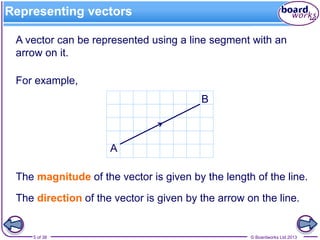
A vector can be represented using a line segment with an
arrow on it.
For example,
A
B
The magnitude of the vector is given by the length of the line.
The direction of the vector is given by the arrow on the line.
© Boardworks Ltd 20136 of 38
Representing vectors
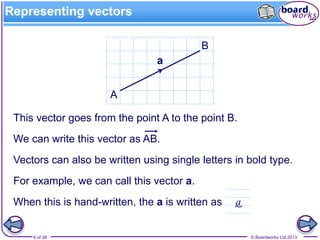
A
B
This vector goes from the point A to the point B.
We can write this vector as AB.
Vectors can also be written using single letters in bold type.
For example, we can call this vector a.
a
When this is hand-written, the a is written as a
© Boardworks Ltd 20137 of 38
Representing vectors
A
B
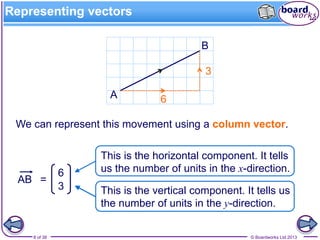
This vector tells you to go six chairs to the right,
and three chairs up.
It doesn’t matter which seat you are sat in to start with.
© Boardworks Ltd 20138 of 38
Representing vectors
A
B
We can represent this movement using a column vector.
AB =
6
3
This is the horizontal component. It tells
us the number of units in the x-direction.
This is the vertical component. It tells us
the number of units in the y-direction.
6
3
© Boardworks Ltd 20139 of 38
Representing vectors
© Boardworks Ltd 201310 of 38
© Boardworks Ltd 201311 of 38
Equal vectors
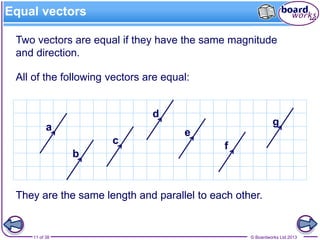
Two vectors are equal if they have the same magnitude
and direction.
All of the following vectors are equal:
They are the same length and parallel to each other.
a
b
c
d
e
f
g
They are the same length and parallel to each other.
© Boardworks Ltd 201312 of 38
The negative of a vector
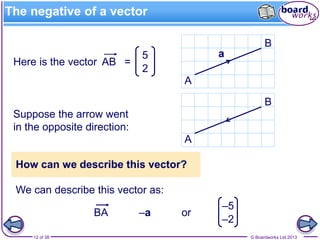
Here is the vector AB =
5
2
a
A
B
Suppose the arrow went
in the opposite direction:
A
B
We can describe this vector as:
BA –a
–5
–2
or
How can we describe this vector?
© Boardworks Ltd 201313 of 38
The negative of a vector
a
A
B
–a
A
B
If this is the vector a, this is the vector –a.
The negative of a vector is the same length and has the
same slope, but goes in the opposite direction.
In general,
if a =
x
y
then –a =
–x
–y
© Boardworks Ltd 201314 of 38
The negative of a vector
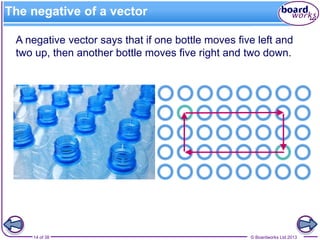
A negative vector says that if one bottle moves five left and
two up, then another bottle moves five right and two down.
© Boardworks Ltd 201315 of 38
The negative of a vector
© Boardworks Ltd 201316 of 38
© Boardworks Ltd 201317 of 38
The zero and unit vector
A vector with a magnitude of 0 is called the zero vector.
The zero vector is written as 0 or hand-written as 0
A vector with a magnitude of 1 is called a unit vector.
The most important unit vectors are those that are horizontal
and vertical. These are called unit base vectors.
The horizontal unit base vector, , is called i.
1
0
The vertical unit base vector, , is called j.
0
1
© Boardworks Ltd 201318 of 38
The unit base vectors
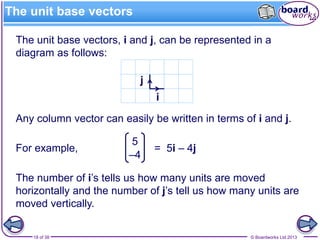
The unit base vectors, i and j, can be represented in a
diagram as follows:
j
i
Any column vector can easily be written in terms of i and j.
For example,
5
–4
= 5i – 4j
The number of i’s tells us how many units are moved
horizontally and the number of j’s tell us how many units are
moved vertically.
© Boardworks Ltd 201319 of 38
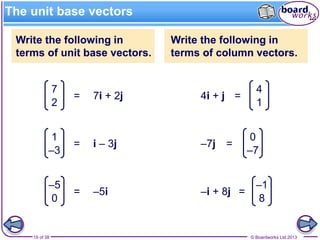
The unit base vectors
7i + 2j
7
2
=
i – 3j
1
–3
=
–5i
–5
0
=
Write the following in
terms of unit base vectors.
Write the following in
terms of column vectors.
4
1
4i + j =
0
–7
–7j =
–1
8
–i + 8j =
© Boardworks Ltd 201320 of 38
© Boardworks Ltd 201321 of 38
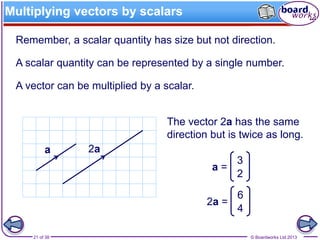
Multiplying vectors by scalars
Remember, a scalar quantity has size but not direction.
A scalar quantity can be represented by a single number.
A vector can be multiplied by a scalar.
The vector 2a has the same
direction but is twice as long.
a =
3
2
2a =
6
4
a 2a
© Boardworks Ltd 201322 of 38
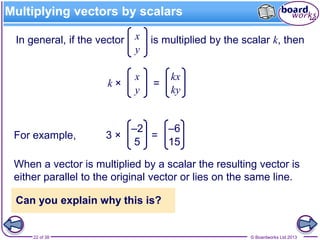
Multiplying vectors by scalars
In general, if the vector is multiplied by the scalar k, thenx
y
x
y
k × =
kx
ky
When a vector is multiplied by a scalar the resulting vector is
either parallel to the original vector or lies on the same line.
For example,
–2
5
3 × =
–6
15
Can you explain why this is?
© Boardworks Ltd 201323 of 38
Multiplying vectors by scalars
© Boardworks Ltd 201324 of 38
Pairs – parallel vectors
© Boardworks Ltd 201325 of 38
© Boardworks Ltd 201326 of 38
Adding vectors
Adding vectors is like
saying move 2 left
and 6 up then move
5 right and 1 down.
From your starting position you
have moved 3 right and 5 up.
3
5
How would you
describe this
more simply?
© Boardworks Ltd 201327 of 38
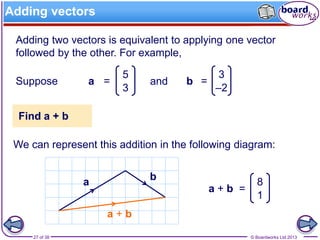
Adding vectors
Adding two vectors is equivalent to applying one vector
followed by the other. For example,
Suppose a =
5
3
and b =
3
–2
Find a + b
We can represent this addition in the following diagram:
a b
a + b
a + b =
8
1
© Boardworks Ltd 201328 of 38
Adding vectors
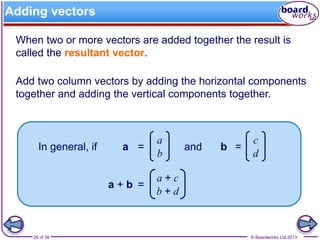
When two or more vectors are added together the result is
called the resultant vector.
In general, if a =
a
b
and b =
c
d
Add two column vectors by adding the horizontal components
together and adding the vertical components together.
a + b =
a + c
b + d
© Boardworks Ltd 201329 of 38
Adding vectors
© Boardworks Ltd 201330 of 38
Adding vectors
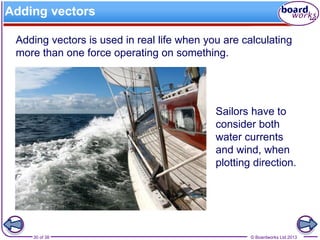
Adding vectors is used in real life when you are calculating
more than one force operating on something.
Sailors have to
consider both
water currents
and wind, when
plotting direction.
© Boardworks Ltd 201331 of 38
Adding vectors
Meteorologists use vectors to map out weather patterns.
Wind speed can be mapped by vectors indicating direction
of the wind with their length indicating intensity.
© Boardworks Ltd 201332 of 38
© Boardworks Ltd 201333 of 38
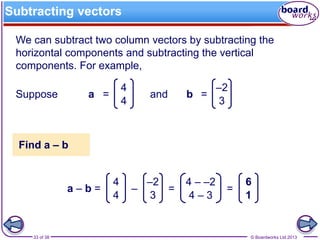
Subtracting vectors
We can subtract two column vectors by subtracting the
horizontal components and subtracting the vertical
components. For example,
Find a – b
Suppose and b =
–2
3
a =
4
4
a – b =
4
4
–
–2
3
=
4 – –2
4 – 3
=
6
1
© Boardworks Ltd 201334 of 38
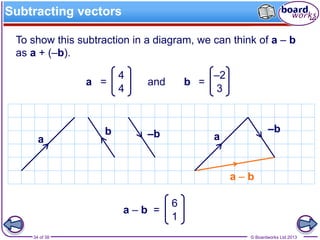
Subtracting vectors
To show this subtraction in a diagram, we can think of a – b
as a + (–b).
and b =
–2
3
a =
4
4
a
b
a – b
a – b =
6
1
–b a
–b
© Boardworks Ltd 201335 of 38
© Boardworks Ltd 201336 of 38
Adding and subtracting vectors
© Boardworks Ltd 201337 of 38
The resultant vector
© Boardworks Ltd 201338 of 38
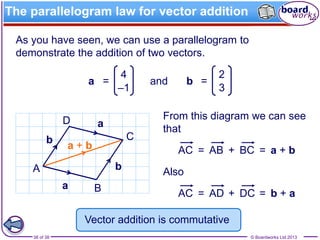
The parallelogram law for vector addition
As you have seen, we can use a parallelogram to
demonstrate the addition of two vectors.
and b =
2
3
a =
4
–1
a
a + b
b
B
C
From this diagram we can see
that
a + bAC = AB + BC =
a
b
Also
b + aAC = AD + DC =
a
Vector addition is commutative
A
D

Vectors

  • 1.
    © Boardworks Ltd20131 of 38 This icon indicates the slide contains activities created in Flash. These activities are not editable. For more detailed instructions, see the Getting Started presentation. This icon indicates an accompanying worksheet. This icon indicates teacher’s notes in the Notes field.
  • 2.
    © Boardworks Ltd20132 of 38
  • 3.
    © Boardworks Ltd20133 of 38 Vectors It doesn’t tell you where to start. E.g. you are told to move five seats to the left. A vector is an instruction that tells you how far to go and which direction to go in.
  • 4.
    © Boardworks Ltd20134 of 38 Vectors and scalars Examples of vector quantities are: Examples of scalar quantities are: velocity displacement force speed length mass A scalar is a quantity that has size (or magnitude) only. A vector is a quantity that has both size (or magnitude) and direction.
  • 5.
    © Boardworks Ltd20135 of 38 Representing vectors A vector can be represented using a line segment with an arrow on it. For example, A B The magnitude of the vector is given by the length of the line. The direction of the vector is given by the arrow on the line.
  • 6.
    © Boardworks Ltd20136 of 38 Representing vectors A B This vector goes from the point A to the point B. We can write this vector as AB. Vectors can also be written using single letters in bold type. For example, we can call this vector a. a When this is hand-written, the a is written as a
  • 7.
    © Boardworks Ltd20137 of 38 Representing vectors A B This vector tells you to go six chairs to the right, and three chairs up. It doesn’t matter which seat you are sat in to start with.
  • 8.
    © Boardworks Ltd20138 of 38 Representing vectors A B We can represent this movement using a column vector. AB = 6 3 This is the horizontal component. It tells us the number of units in the x-direction. This is the vertical component. It tells us the number of units in the y-direction. 6 3
  • 9.
    © Boardworks Ltd20139 of 38 Representing vectors
  • 10.
    © Boardworks Ltd201310 of 38
  • 11.
    © Boardworks Ltd201311 of 38 Equal vectors Two vectors are equal if they have the same magnitude and direction. All of the following vectors are equal: They are the same length and parallel to each other. a b c d e f g They are the same length and parallel to each other.
  • 12.
    © Boardworks Ltd201312 of 38 The negative of a vector Here is the vector AB = 5 2 a A B Suppose the arrow went in the opposite direction: A B We can describe this vector as: BA –a –5 –2 or How can we describe this vector?
  • 13.
    © Boardworks Ltd201313 of 38 The negative of a vector a A B –a A B If this is the vector a, this is the vector –a. The negative of a vector is the same length and has the same slope, but goes in the opposite direction. In general, if a = x y then –a = –x –y
  • 14.
    © Boardworks Ltd201314 of 38 The negative of a vector A negative vector says that if one bottle moves five left and two up, then another bottle moves five right and two down.
  • 15.
    © Boardworks Ltd201315 of 38 The negative of a vector
  • 16.
    © Boardworks Ltd201316 of 38
  • 17.
    © Boardworks Ltd201317 of 38 The zero and unit vector A vector with a magnitude of 0 is called the zero vector. The zero vector is written as 0 or hand-written as 0 A vector with a magnitude of 1 is called a unit vector. The most important unit vectors are those that are horizontal and vertical. These are called unit base vectors. The horizontal unit base vector, , is called i. 1 0 The vertical unit base vector, , is called j. 0 1
  • 18.
    © Boardworks Ltd201318 of 38 The unit base vectors The unit base vectors, i and j, can be represented in a diagram as follows: j i Any column vector can easily be written in terms of i and j. For example, 5 –4 = 5i – 4j The number of i’s tells us how many units are moved horizontally and the number of j’s tell us how many units are moved vertically.
  • 19.
    © Boardworks Ltd201319 of 38 The unit base vectors 7i + 2j 7 2 = i – 3j 1 –3 = –5i –5 0 = Write the following in terms of unit base vectors. Write the following in terms of column vectors. 4 1 4i + j = 0 –7 –7j = –1 8 –i + 8j =
  • 20.
    © Boardworks Ltd201320 of 38
  • 21.
    © Boardworks Ltd201321 of 38 Multiplying vectors by scalars Remember, a scalar quantity has size but not direction. A scalar quantity can be represented by a single number. A vector can be multiplied by a scalar. The vector 2a has the same direction but is twice as long. a = 3 2 2a = 6 4 a 2a
  • 22.
    © Boardworks Ltd201322 of 38 Multiplying vectors by scalars In general, if the vector is multiplied by the scalar k, thenx y x y k × = kx ky When a vector is multiplied by a scalar the resulting vector is either parallel to the original vector or lies on the same line. For example, –2 5 3 × = –6 15 Can you explain why this is?
  • 23.
    © Boardworks Ltd201323 of 38 Multiplying vectors by scalars
  • 24.
    © Boardworks Ltd201324 of 38 Pairs – parallel vectors
  • 25.
    © Boardworks Ltd201325 of 38
  • 26.
    © Boardworks Ltd201326 of 38 Adding vectors Adding vectors is like saying move 2 left and 6 up then move 5 right and 1 down. From your starting position you have moved 3 right and 5 up. 3 5 How would you describe this more simply?
  • 27.
    © Boardworks Ltd201327 of 38 Adding vectors Adding two vectors is equivalent to applying one vector followed by the other. For example, Suppose a = 5 3 and b = 3 –2 Find a + b We can represent this addition in the following diagram: a b a + b a + b = 8 1
  • 28.
    © Boardworks Ltd201328 of 38 Adding vectors When two or more vectors are added together the result is called the resultant vector. In general, if a = a b and b = c d Add two column vectors by adding the horizontal components together and adding the vertical components together. a + b = a + c b + d
  • 29.
    © Boardworks Ltd201329 of 38 Adding vectors
  • 30.
    © Boardworks Ltd201330 of 38 Adding vectors Adding vectors is used in real life when you are calculating more than one force operating on something. Sailors have to consider both water currents and wind, when plotting direction.
  • 31.
    © Boardworks Ltd201331 of 38 Adding vectors Meteorologists use vectors to map out weather patterns. Wind speed can be mapped by vectors indicating direction of the wind with their length indicating intensity.
  • 32.
    © Boardworks Ltd201332 of 38
  • 33.
    © Boardworks Ltd201333 of 38 Subtracting vectors We can subtract two column vectors by subtracting the horizontal components and subtracting the vertical components. For example, Find a – b Suppose and b = –2 3 a = 4 4 a – b = 4 4 – –2 3 = 4 – –2 4 – 3 = 6 1
  • 34.
    © Boardworks Ltd201334 of 38 Subtracting vectors To show this subtraction in a diagram, we can think of a – b as a + (–b). and b = –2 3 a = 4 4 a b a – b a – b = 6 1 –b a –b
  • 35.
    © Boardworks Ltd201335 of 38
  • 36.
    © Boardworks Ltd201336 of 38 Adding and subtracting vectors
  • 37.
    © Boardworks Ltd201337 of 38 The resultant vector
  • 38.
    © Boardworks Ltd201338 of 38 The parallelogram law for vector addition As you have seen, we can use a parallelogram to demonstrate the addition of two vectors. and b = 2 3 a = 4 –1 a a + b b B C From this diagram we can see that a + bAC = AB + BC = a b Also b + aAC = AD + DC = a Vector addition is commutative A D