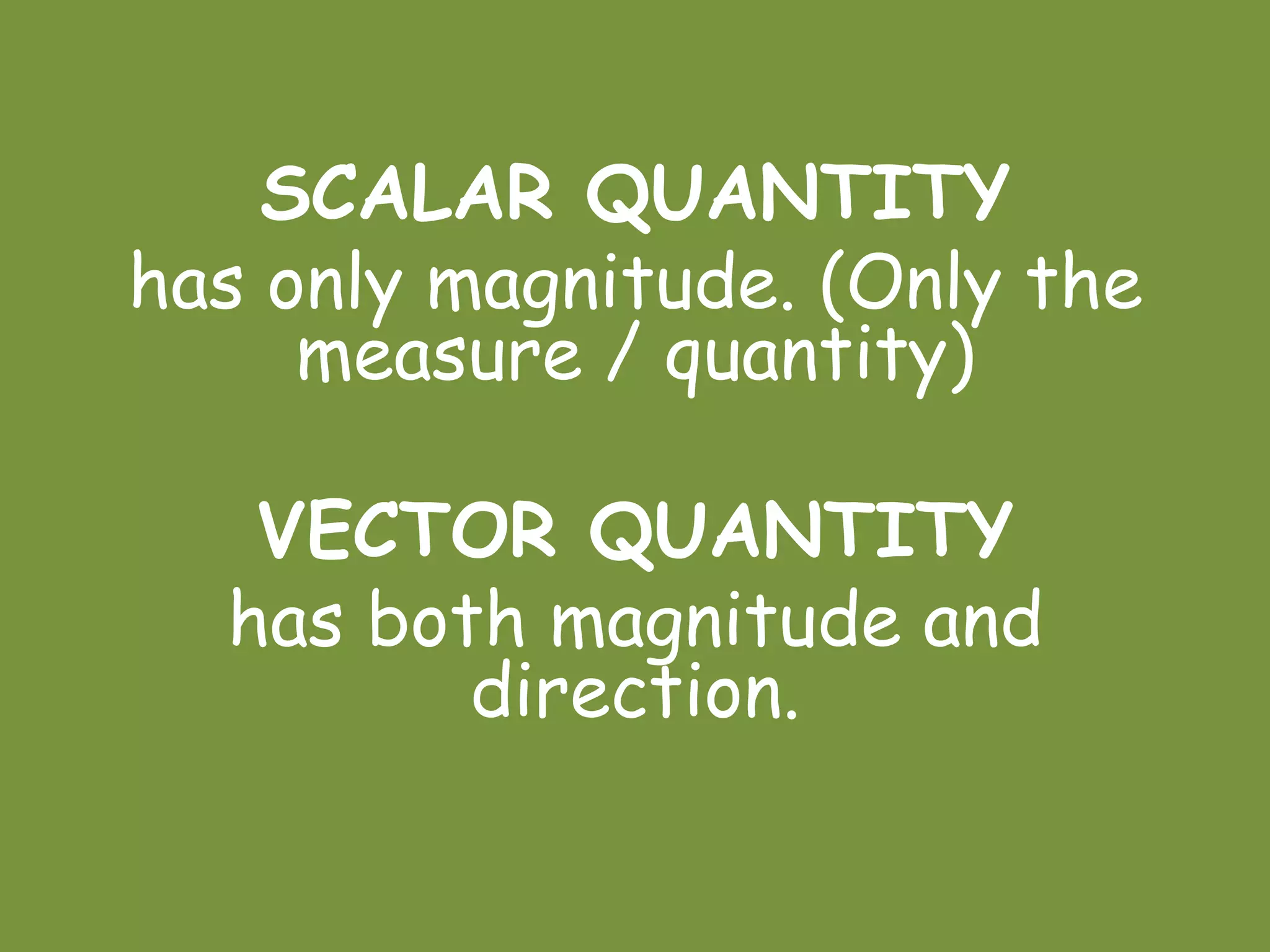
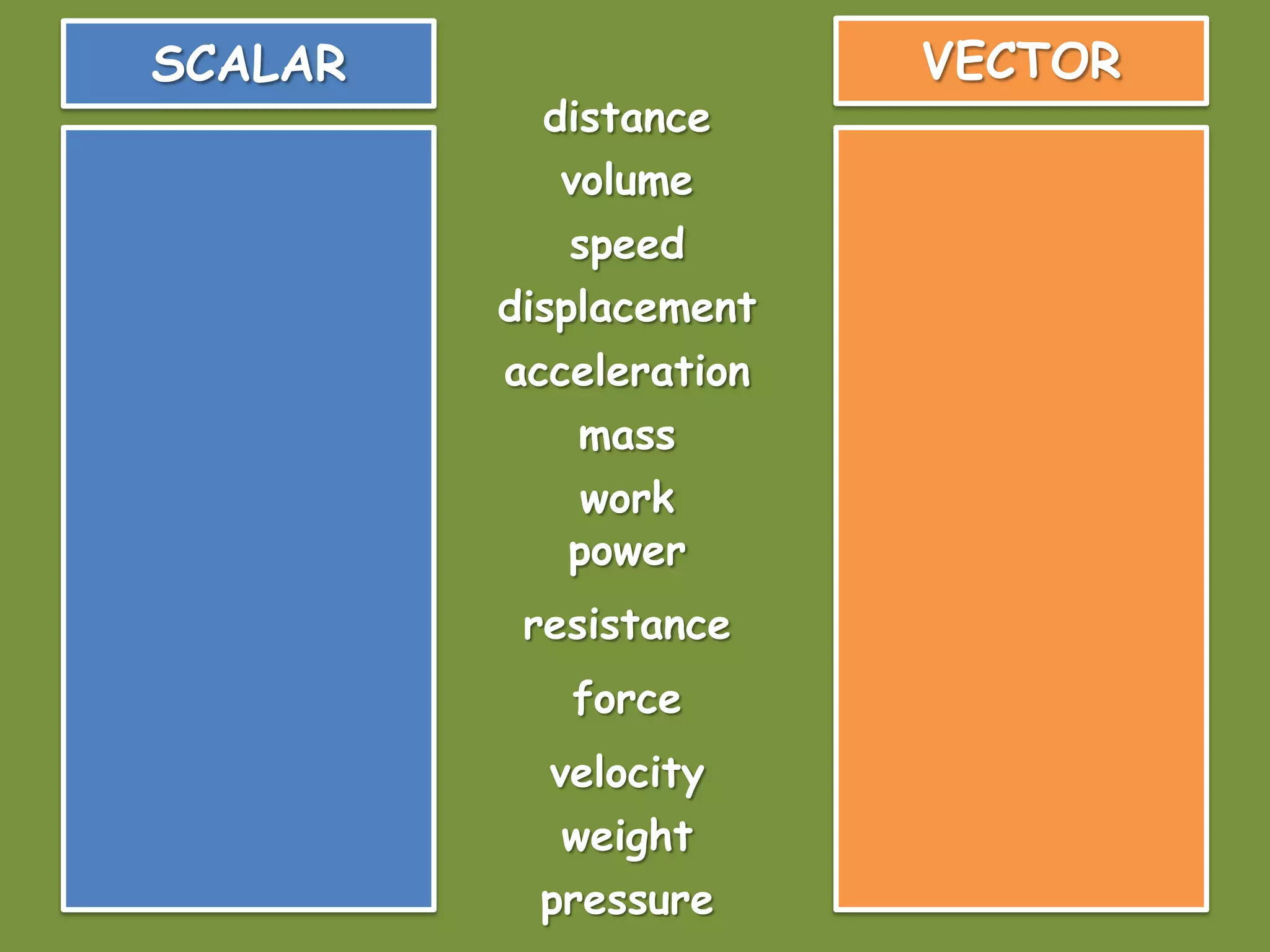
This document discusses scalar and vector quantities. It defines a scalar quantity as having only magnitude, while a vector quantity has both magnitude and direction. Examples are given of quantities that are scalar like distance and those that are vector like force. The document also discusses the concept of a resultant vector, which results from adding two or more vectors together. Three techniques for finding the magnitude and angle of the resultant vector are described: the graphical method, Pythagorean theorem, and analytical/component method. The component method involves breaking vectors into their x and y components and then adding the components.
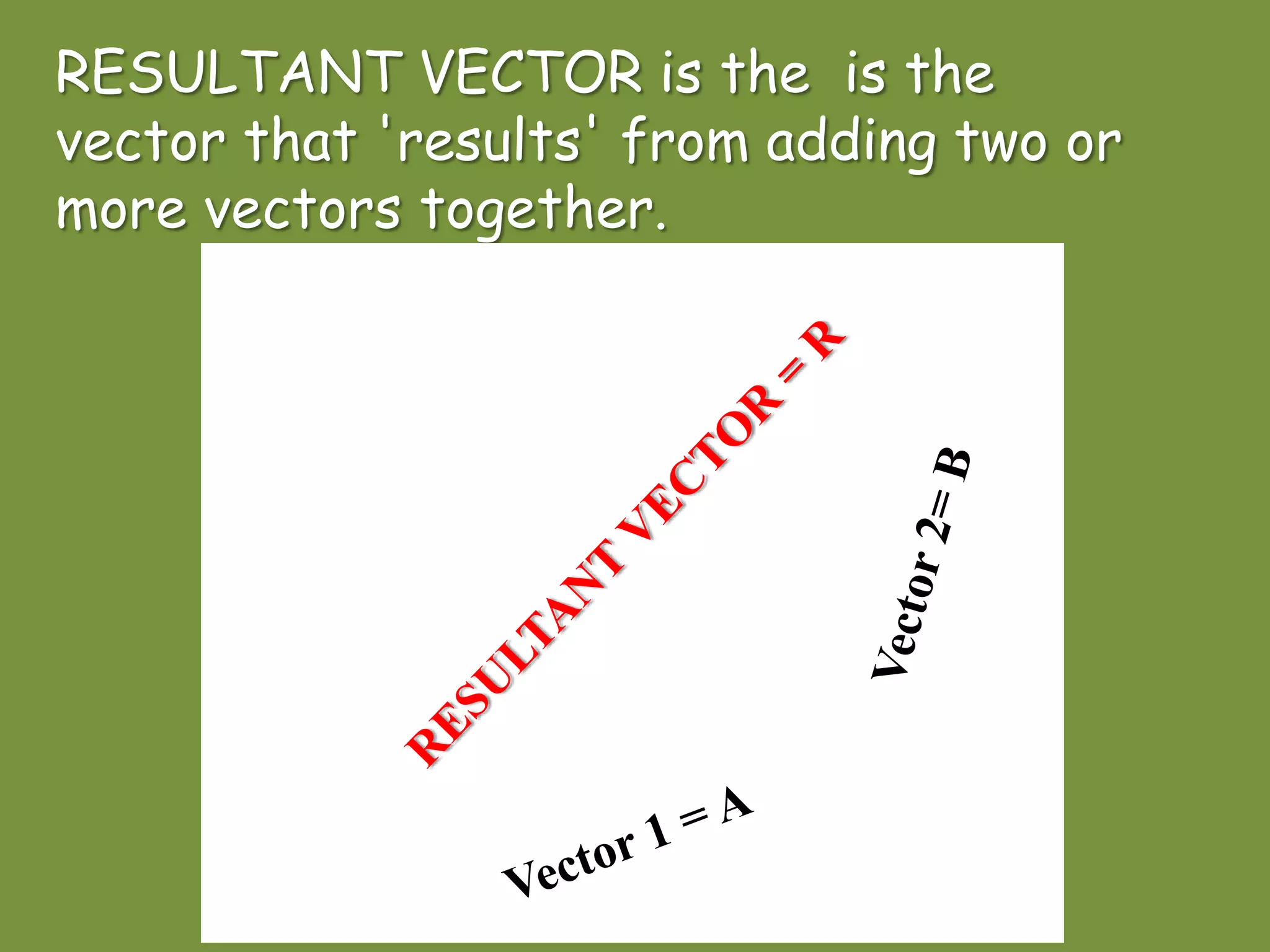
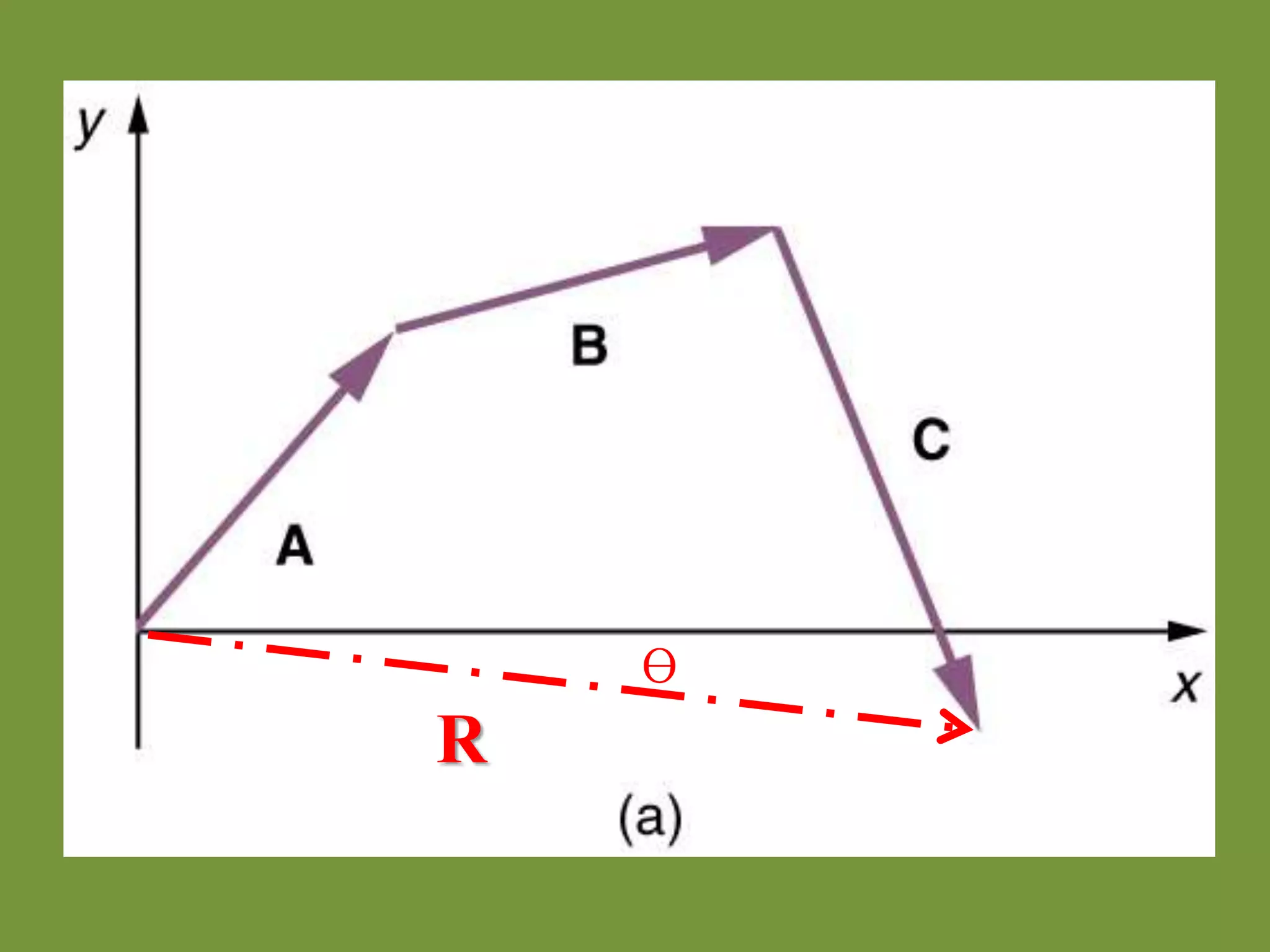
RESULTANT VECTOR isthe is the
vector that 'results' from adding two or
more vectors together.
-1 -0.5 0.5 1 1.5 2 2.5 3 3.5 4 4.5 5 5.5 6 6.5
0.5
1
1.5
2
2.5
3
3.5
4
y
7.
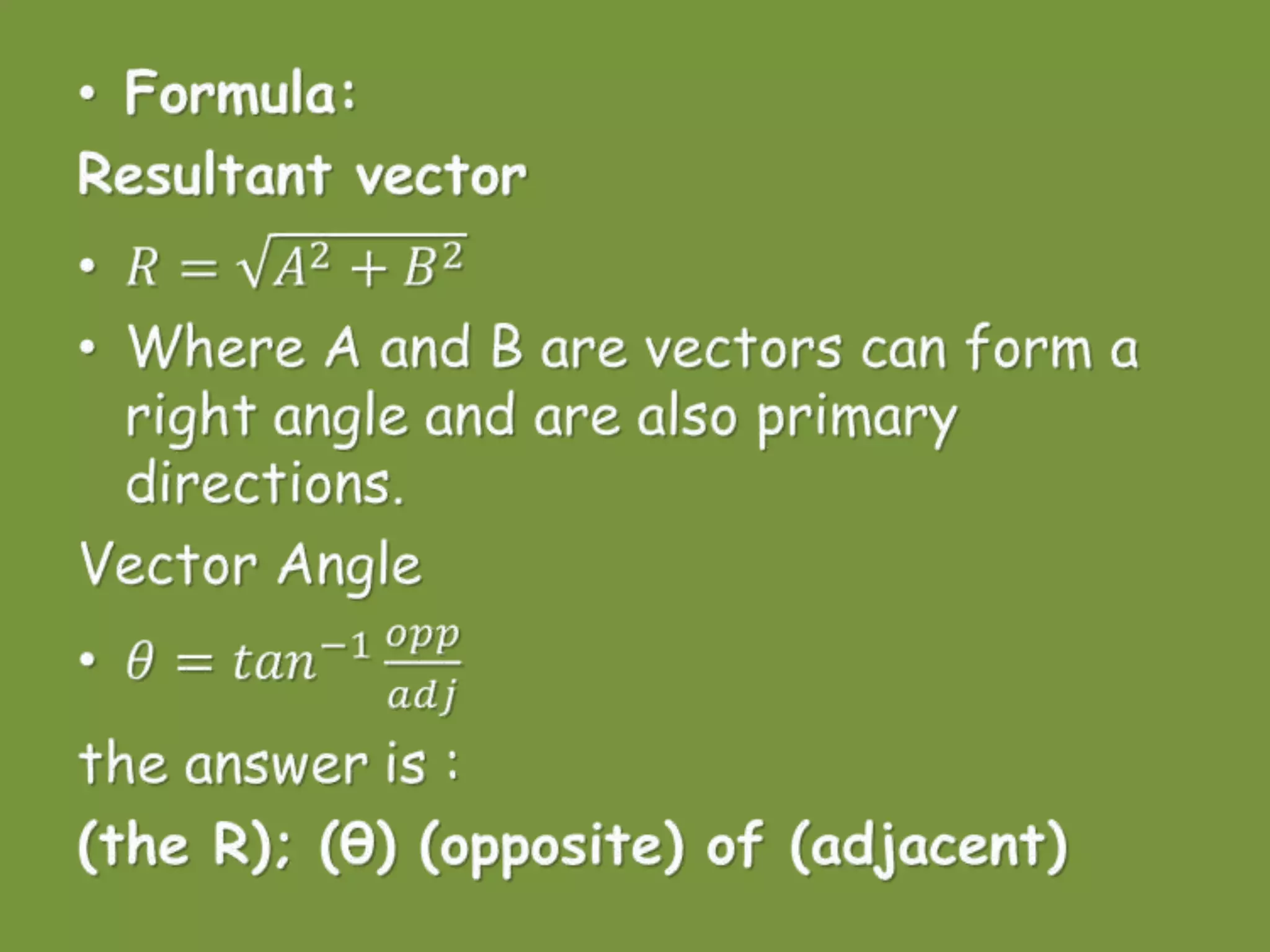
The goal ofthis topic is to
find the MAGNITUDE OF
THE RESULTANT VECTOR
(R), and the VECTOR
ANGLE (θ)
8.
THERE ARE THREETECHNIQUES TO
FIND THE RESULTANT VECTOR AND
THE VECTOR ANGLE:
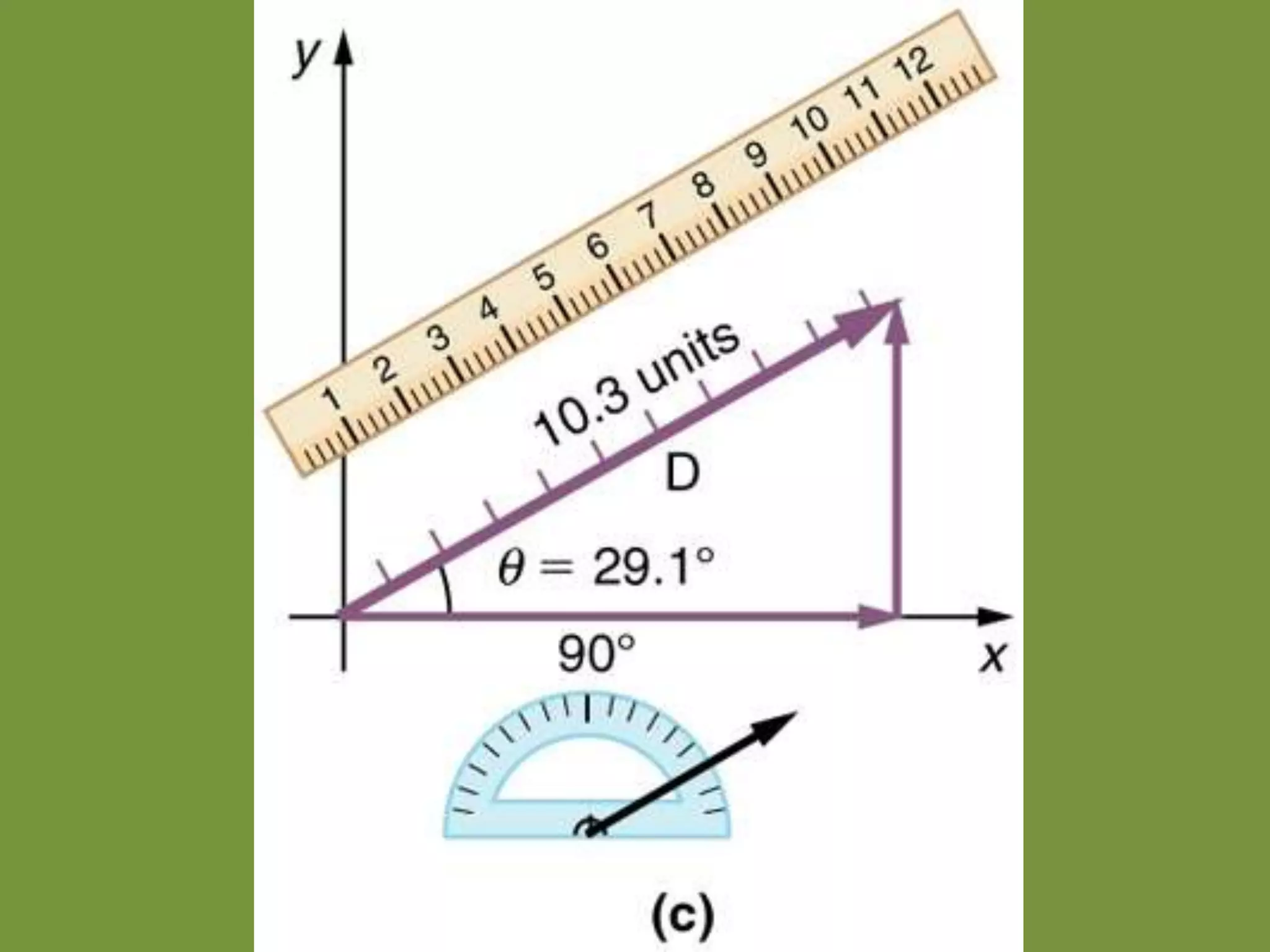
1. GRAPHICAL METHOD – you need the
technical tools like sharp pencil, ruler,
protractor and the paper (graphing or
bond) to show the vectors graphically.
The output is the connection of
vectors is like a polygon.
SAMPLE PROBLEM
1. Aman walks at40 meters East
and 30 meters North. Find the
magnitude of resultant
displacement and its vector
angle. Use Graphical Method.
12.
Solution: Write thegiven
facts
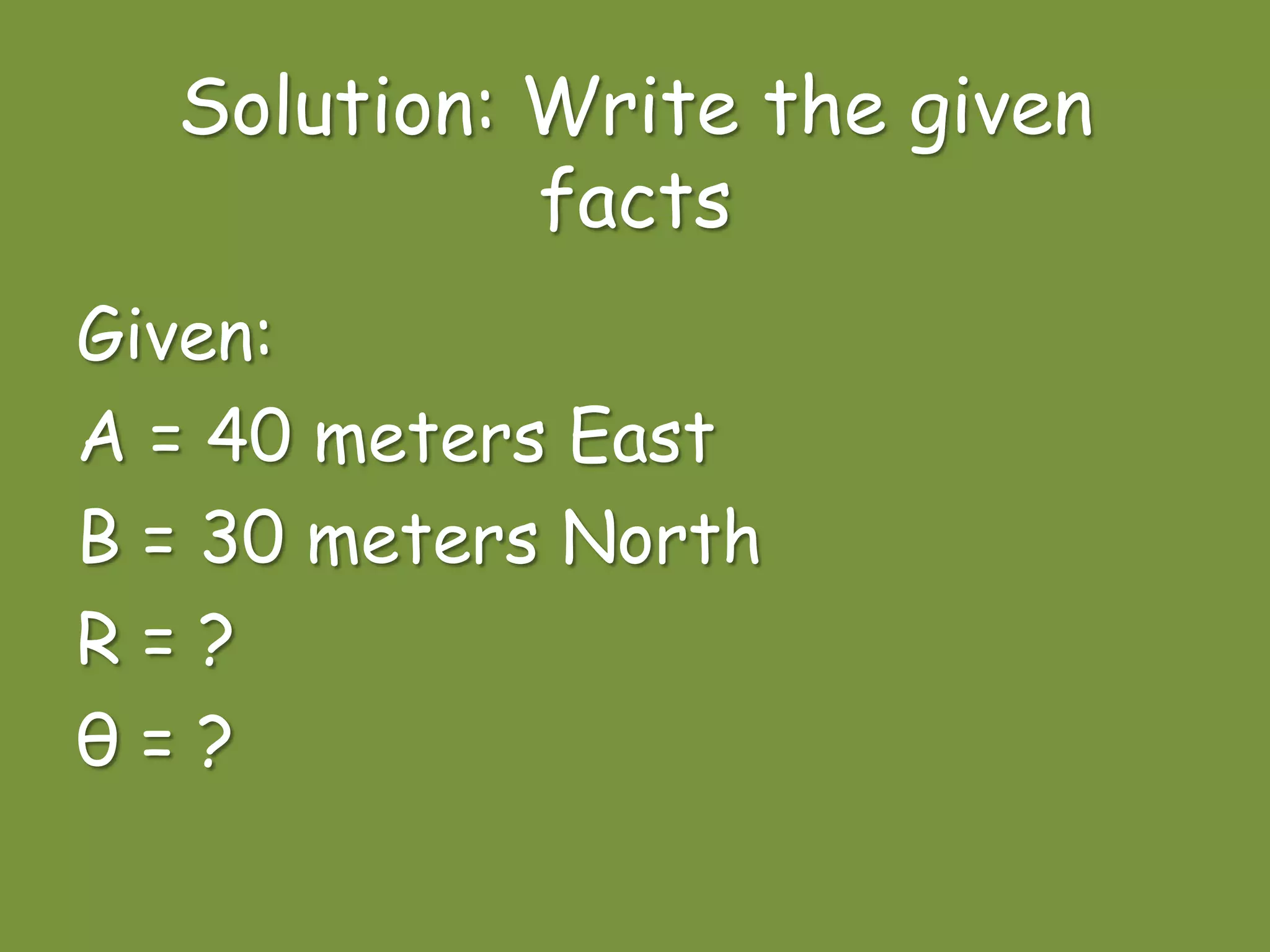
Given:
A = 40 meters East
B = 30 meters North
R = ?
θ = ?
13.
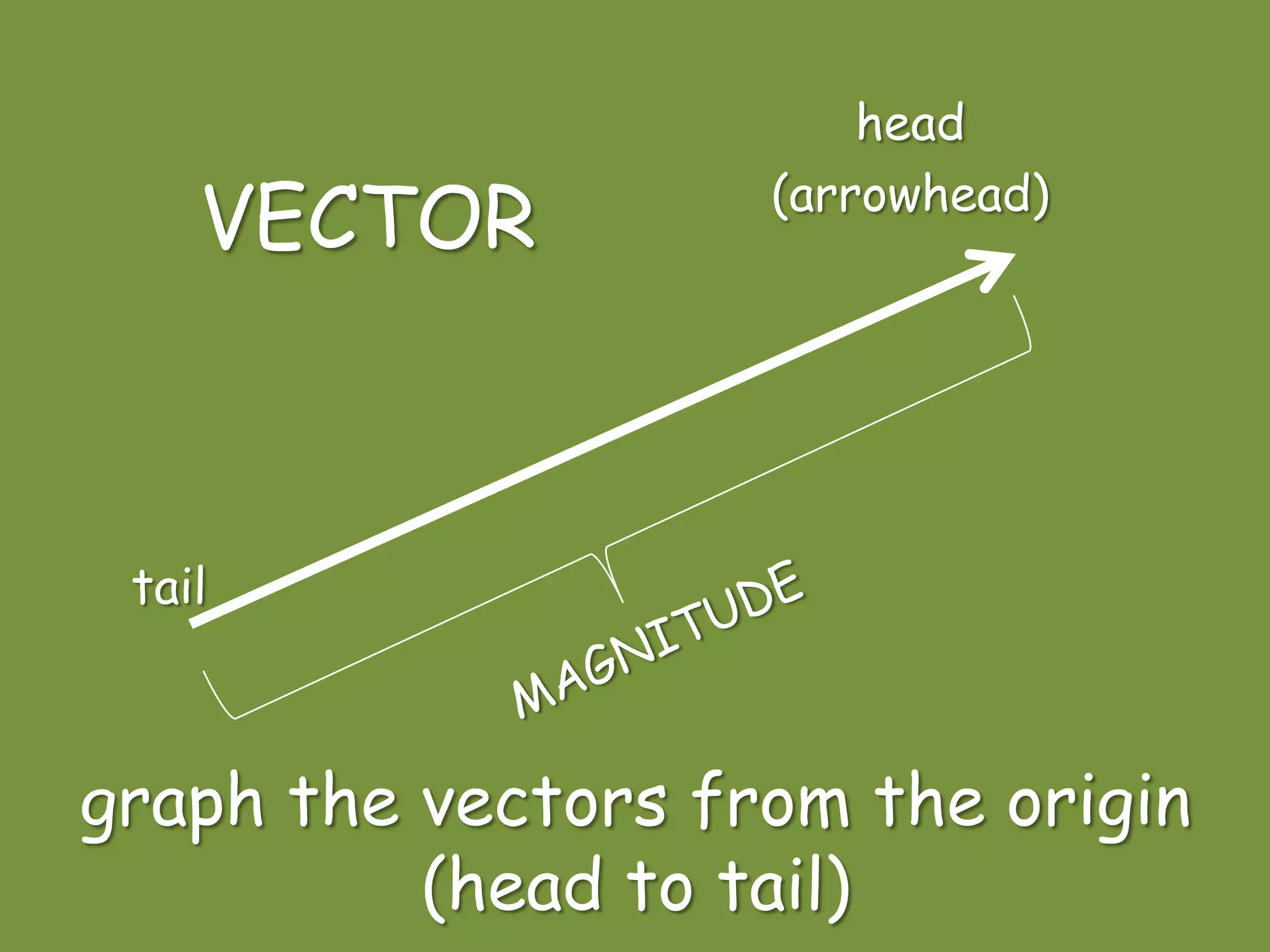
graph the vectorsfrom the origin
(head to tail)
head
(arrowhead)
VECTOR
tail
14.
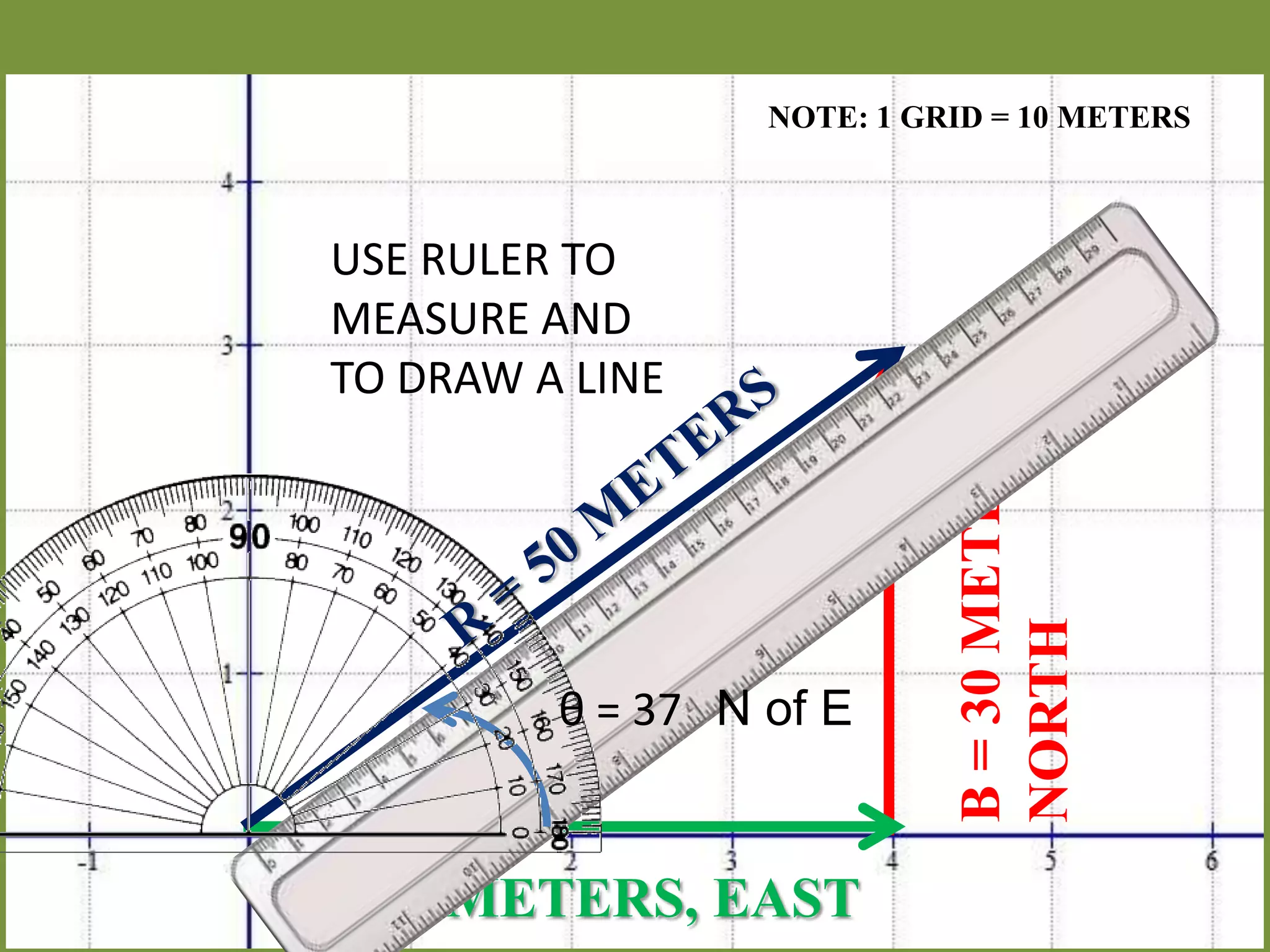
graph the vectorsfrom the origin
(head to tail)
NOTE: 1 GRID = 10 METERS
B=30METERS,
NORTH
A = 40 METERS, EAST
USE RULER TO
MEASURE AND
TO DRAW A LINE
θ = 37 N of E
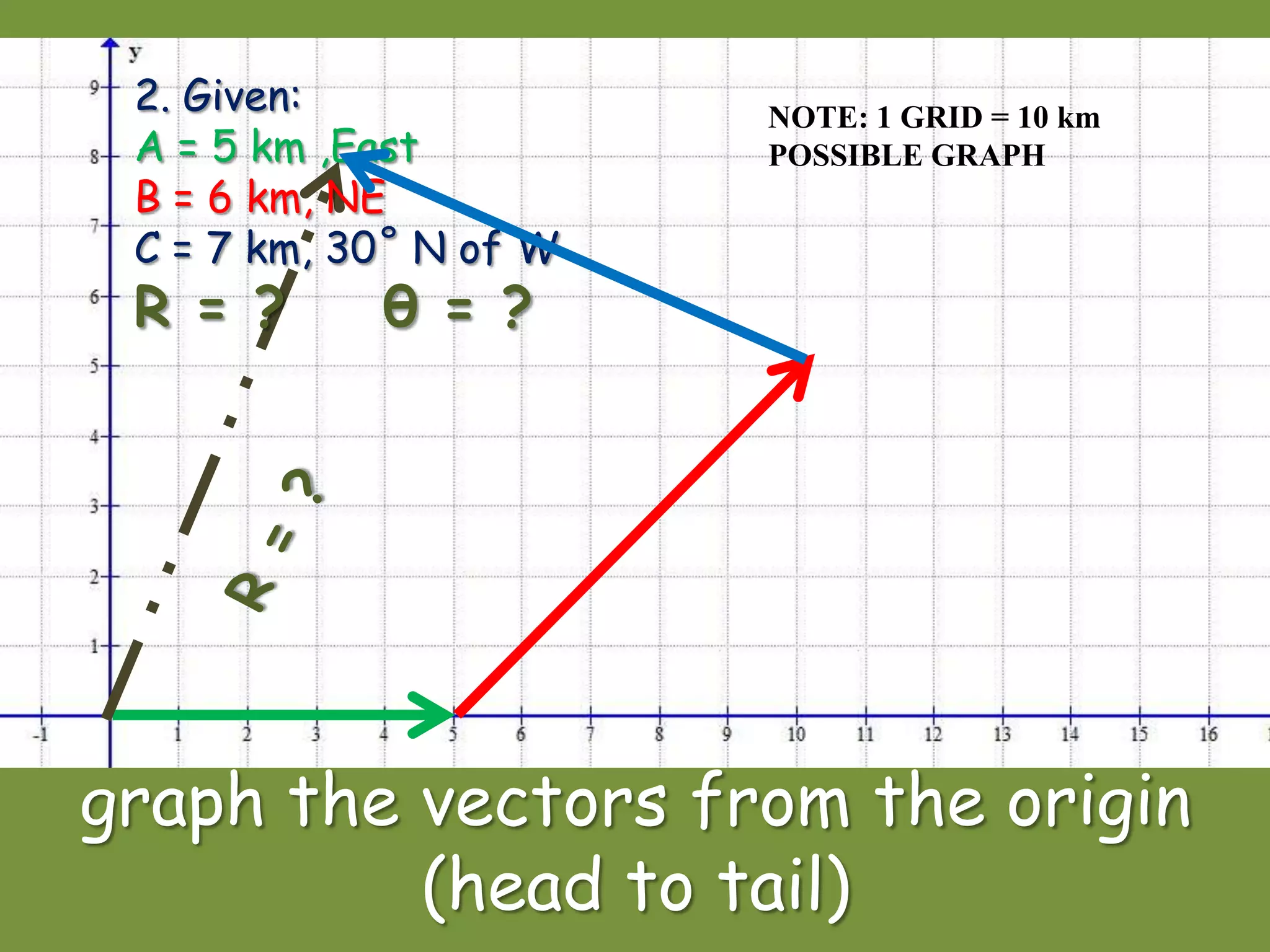
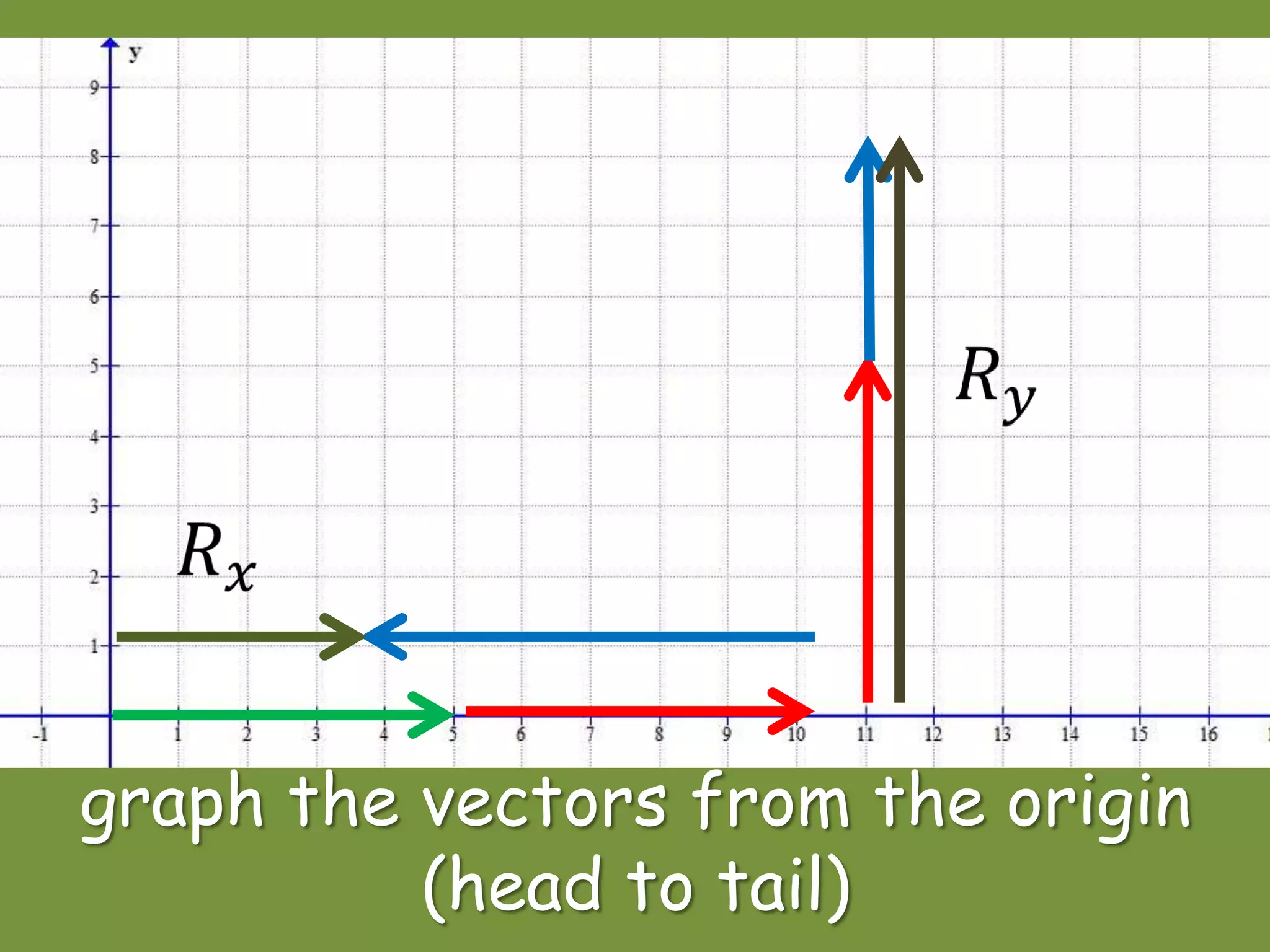
graph the vectorsfrom the origin
(head to tail)
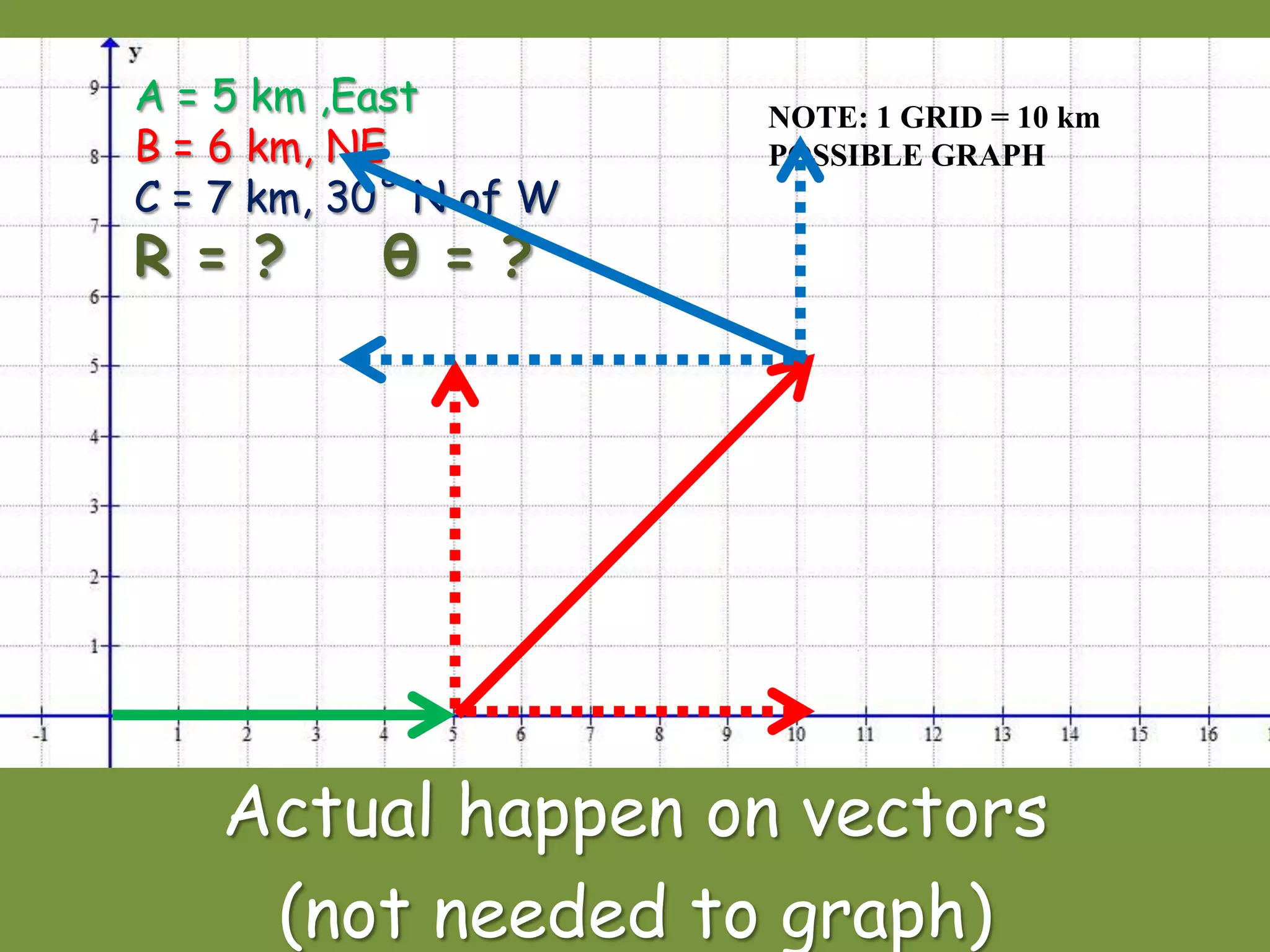
NOTE: 1 GRID = 10 km
POSSIBLE GRAPH
2. Given:
A = 5 km ,East
B = 6 km, NE
C = 7 km, 30˚ N of W
R = ? θ = ?
17.
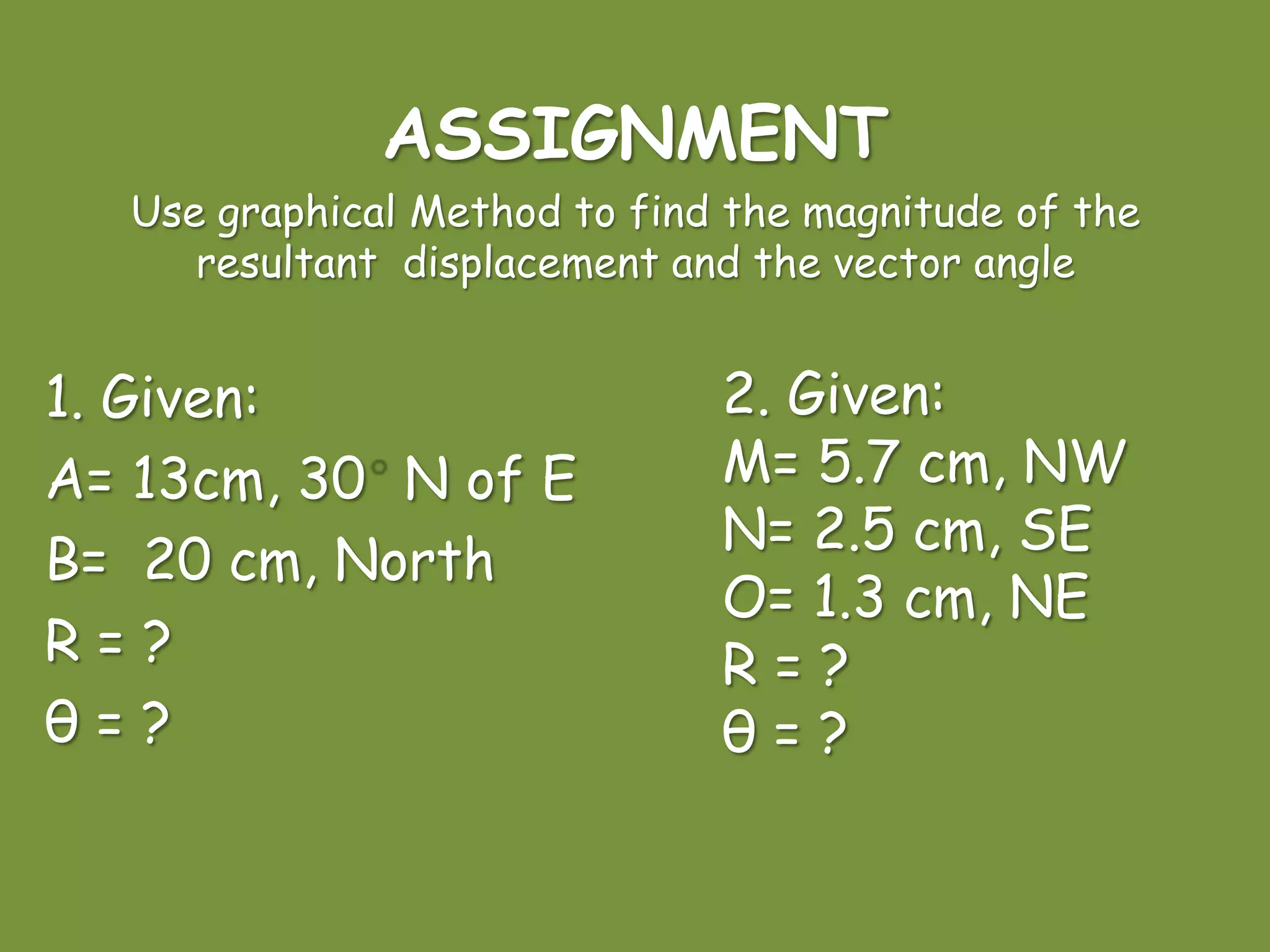
ASSIGNMENT
Use graphical Methodto find the magnitude of the
resultant displacement and the vector angle
1. Given:
A= 13cm, 30 N of E
B= 20 cm, North
R = ?
θ = ?
2. Given:
M= 5.7 cm, NW
N= 2.5 cm, SE
O= 1.3 cm, NE
R = ?
θ = ?
18.
2. The PythagoreanTheorem
The Pythagorean theorem is a useful method
for determining the result of adding two
(and only two) vectors that make a right
angle to each other. The method is not
applicable for adding more than two vectors
or for adding vectors that are not at 90-
degrees to each other. The Pythagorean
theorem is a mathematical equation that
relates the length of the sides of a right
triangle to the length of the hypotenuse of a
right triangle.
20.
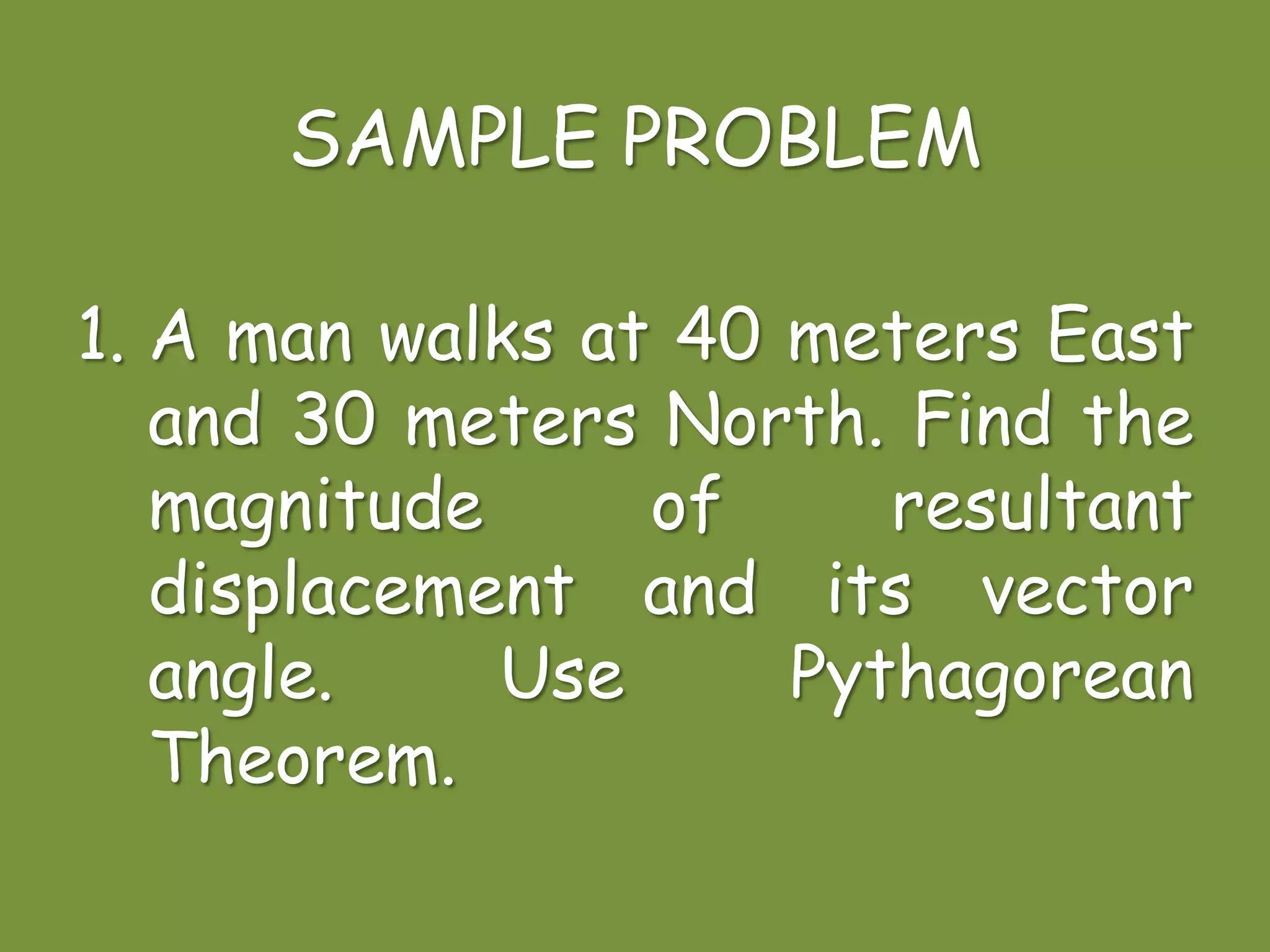
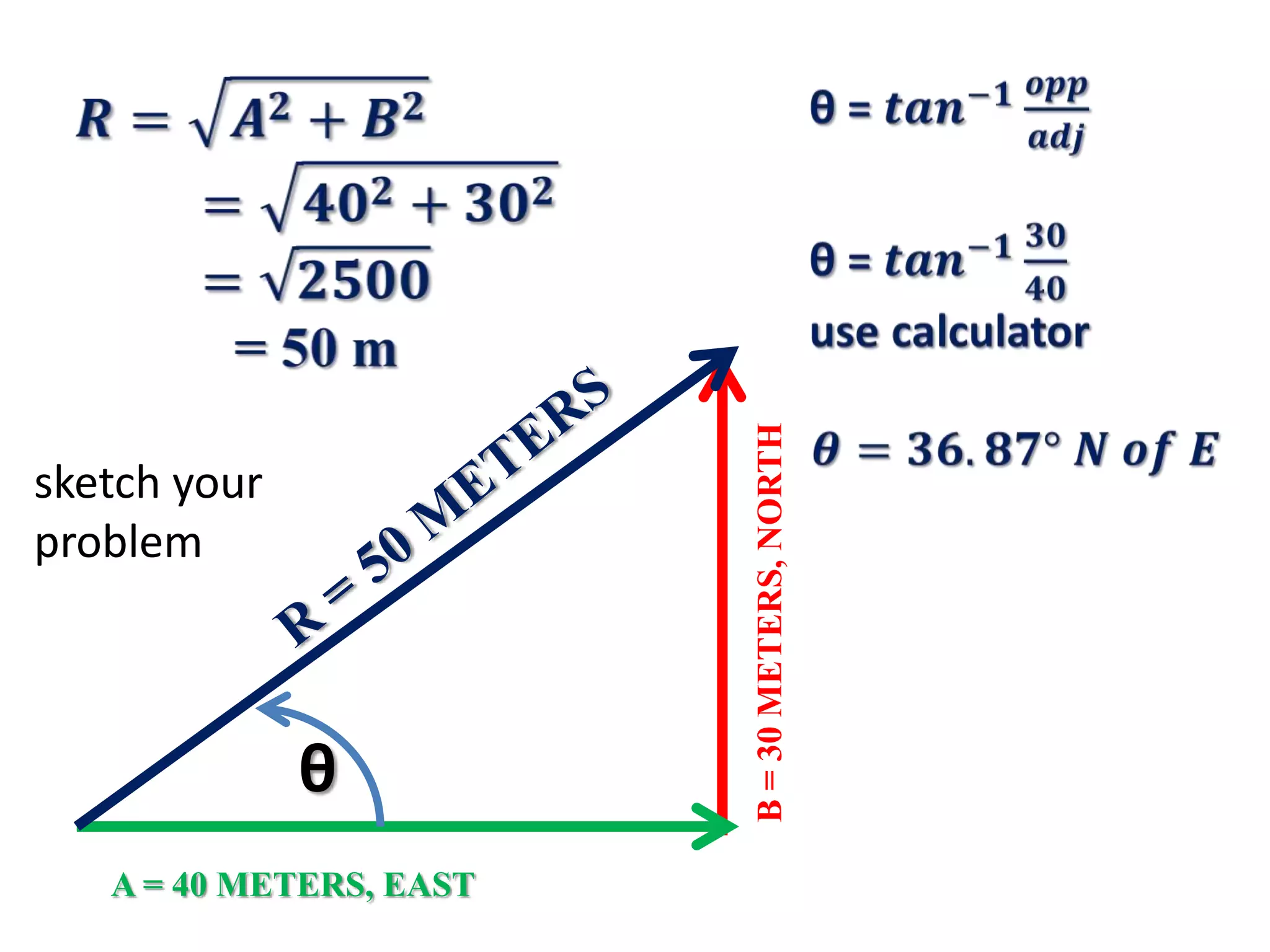
SAMPLE PROBLEM
1. Aman walks at 40 meters East
and 30 meters North. Find the
magnitude of resultant
displacement and its vector
angle. Use Pythagorean
Theorem.
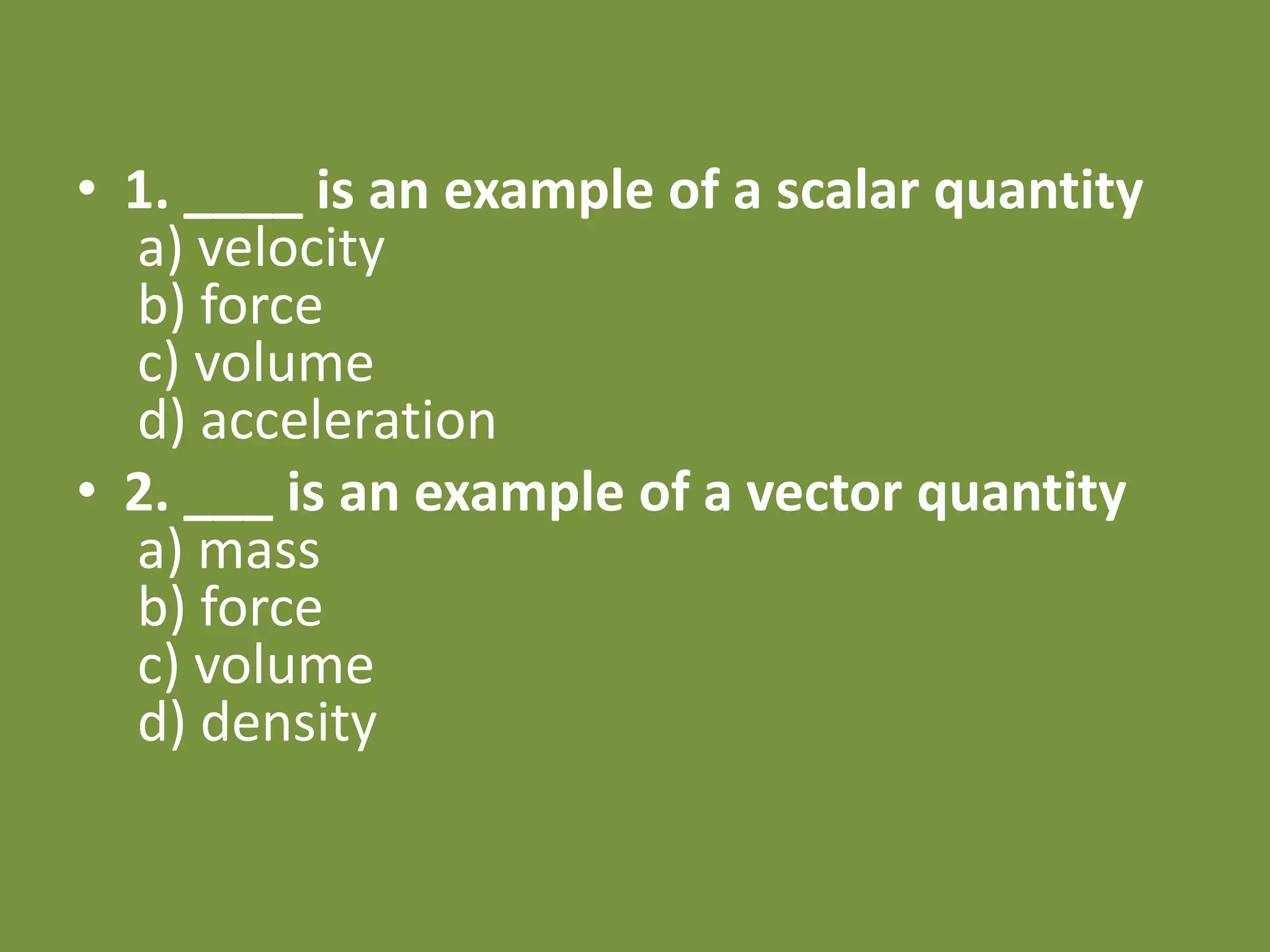
• 1. ____is an example of a scalar quantity
a) velocity
b) force
c) volume
d) acceleration
• 2. ___ is an example of a vector quantity
a) mass
b) force
c) volume
d) density
27.
• 3. Ascalar quantity:
a) always has mass
b) is a quantity that is completely specified by its
magnitude
c) shows direction
d) does not have units
• 4. A vector quantity
a) can be a dimensionless quantity
b) specifies only magnitude
c) specifies only direction
d) specifies both a magnitude and a direction
28.
• 5. Aboy pushes against the wall with 50 pounds of
force. The wall does not move. The resultant force is:
a) -50 pounds
b) 100 pounds
c) 0 pounds
d) -75 pounds
• 6. A man walks 3 miles north then turns right and walks
4 miles east. The resultant displacement is:
a) 1 mile SW
b) 7 miles NE
c) 5 miles NE
d) 5 miles E
29.
• 7. Aman walks at 10 m East, but he returns back at 10
m at west. The resultant displacement is:
a) 0 km
b) 20 km
c) 10 km
d) -10 km
• 8. The difference between speed and velocity is:
a) speed has no units
b) speed shows only magnitude, while velocity
represents both magnitude (strength) and direction
c) they use different units to represent their magnitude
d) velocity has a higher magnitude
30.
• 7. Aplane flying 500 MI/hr due north has a tail wind of
45 MI/hr the resultant velocity is:
a) 545 miles/hour due south.
b) 455 miles/hour north.
c) 545 miles/hr due north.
d) 455 MI/hr due south
• 8. The difference between speed and velocity is:
a) speed has no units
b) speed shows only magnitude, while velocity
represents both magnitude (strength) and direction
c) they use different units to represent their magnitude
d) velocity has a higher magnitude
31.
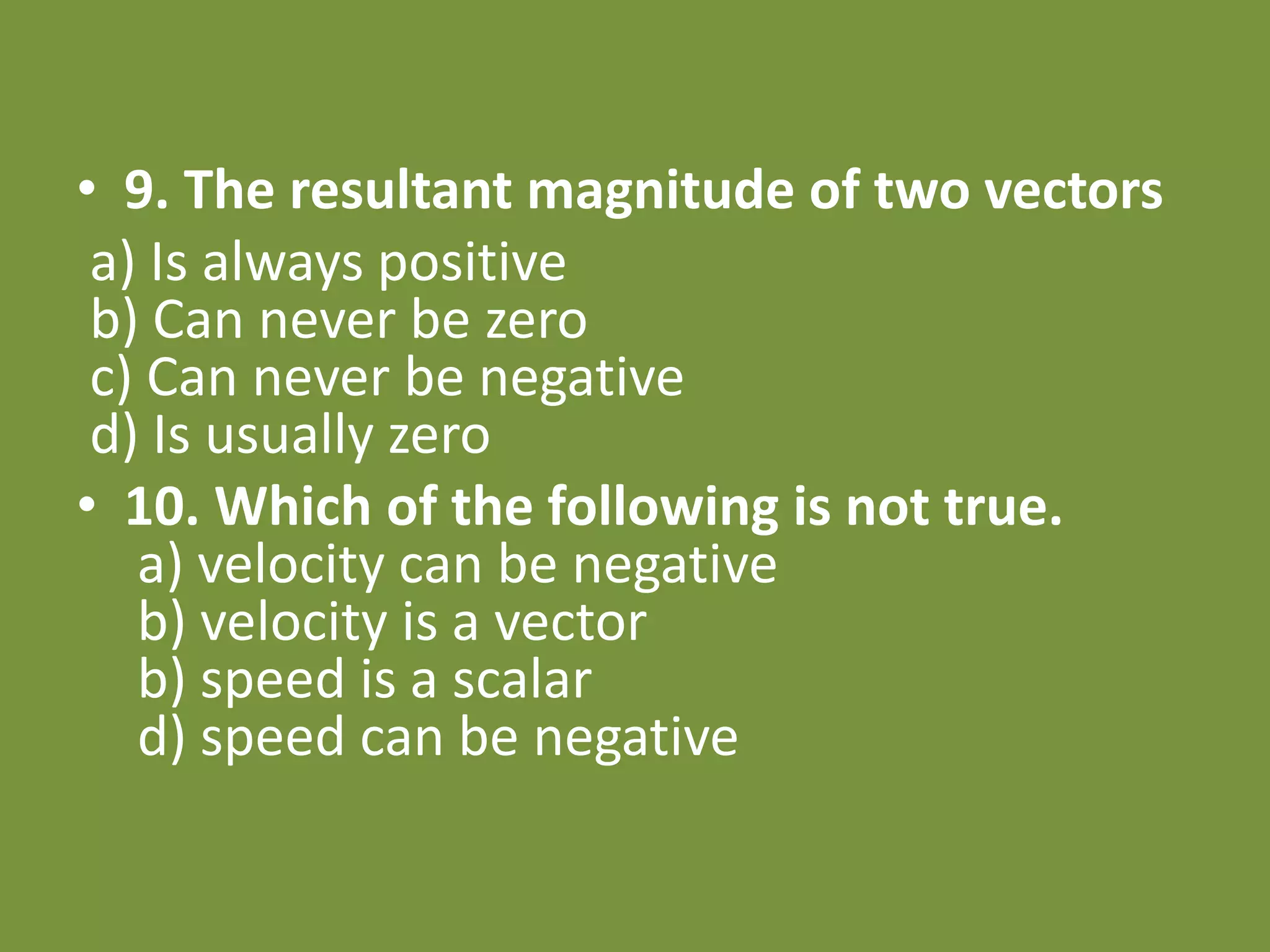
• 9. Theresultant magnitude of two vectors
a) Is always positive
b) Can never be zero
c) Can never be negative
d) Is usually zero
• 10. Which of the following is not true.
a) velocity can be negative
b) velocity is a vector
b) speed is a scalar
d) speed can be negative
32.
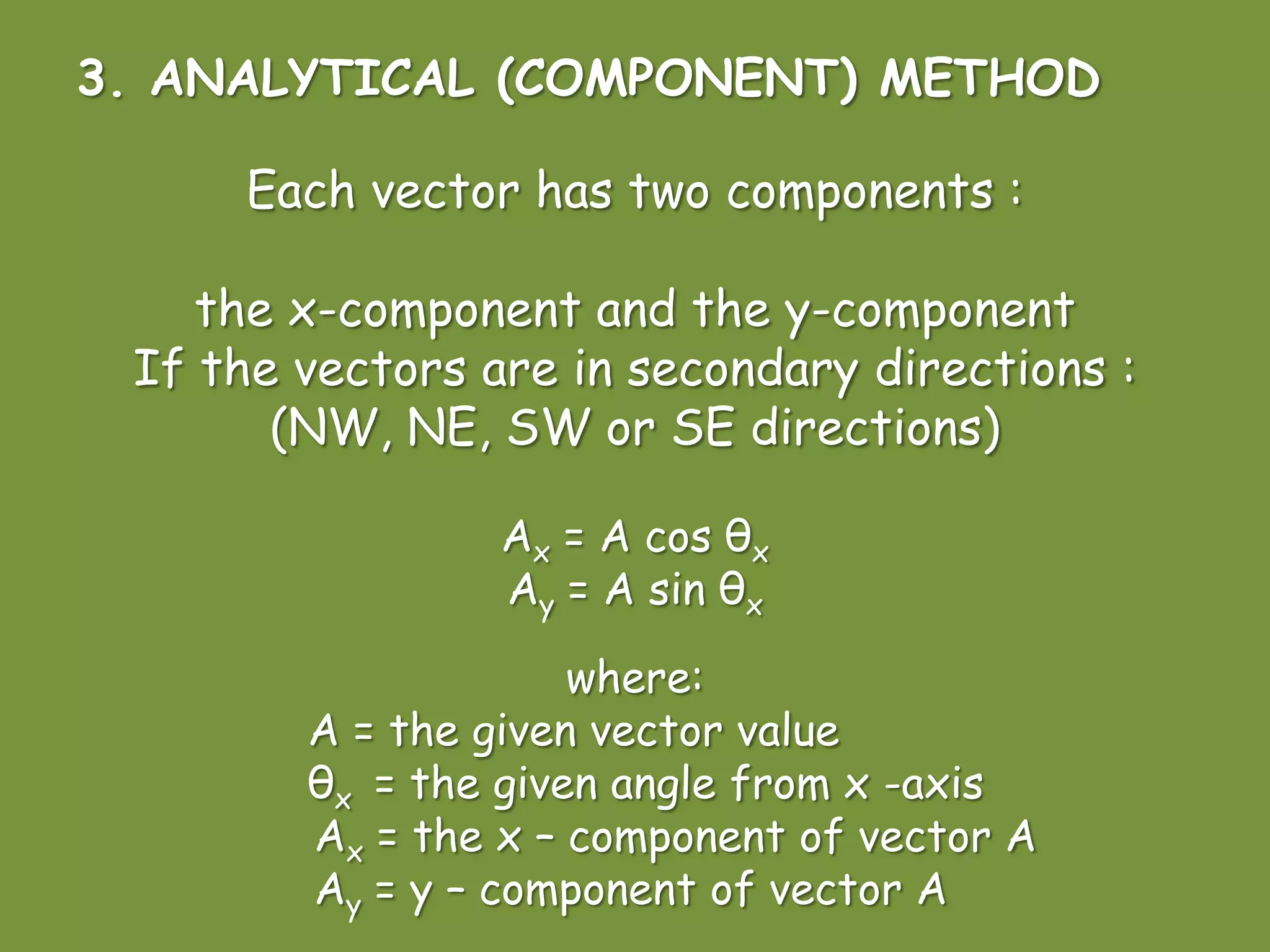
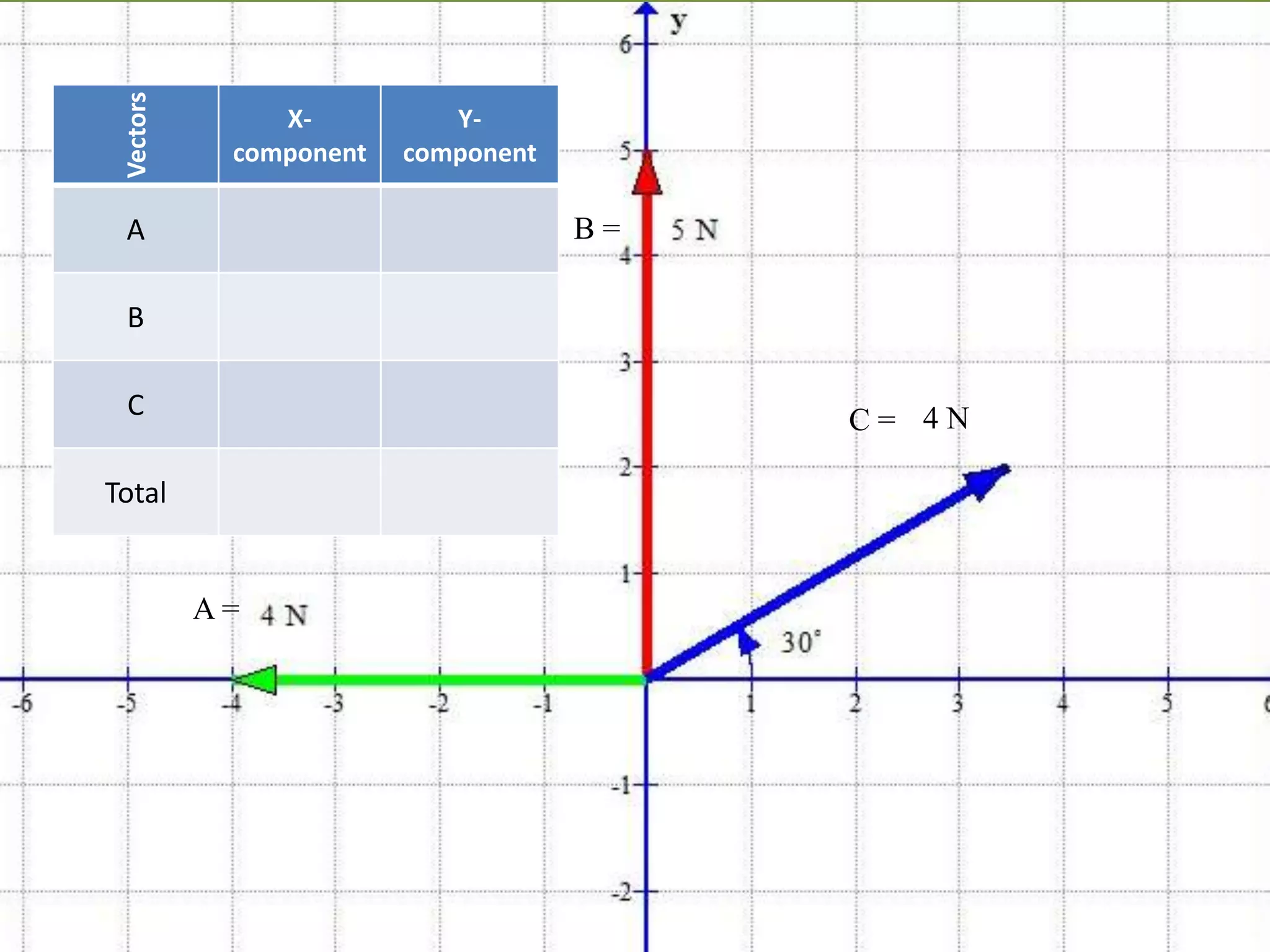
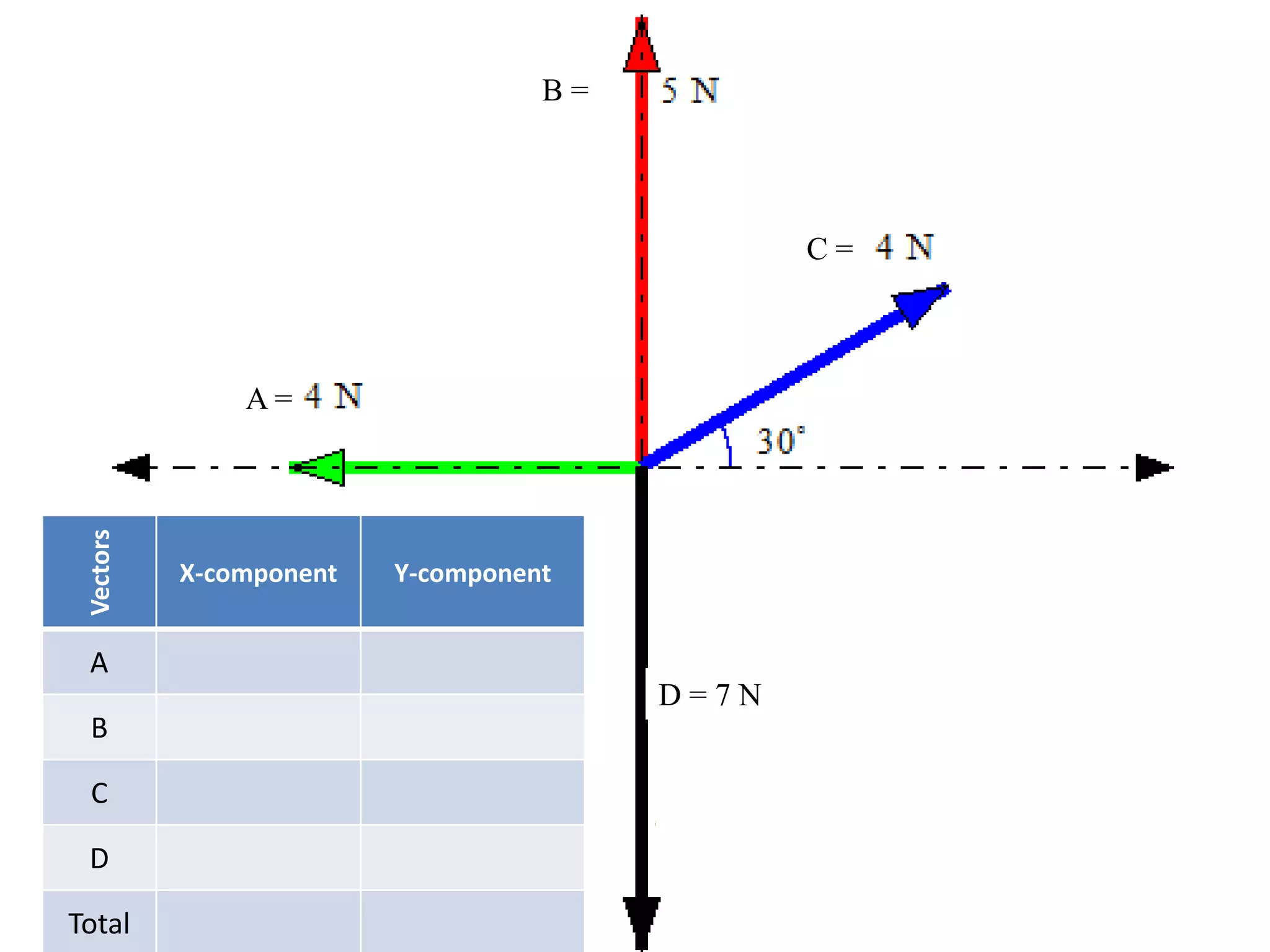
3. ANALYTICAL (COMPONENT)METHOD
Each vector has two components :
the x-component and the y-component
If the vectors are in secondary directions :
(NW, NE, SW or SE directions)
Ax = A cos θx
Ay = A sin θx
where:
A = the given vector value
θx = the given angle from x -axis
Ax = the x – component of vector A
Ay = y – component of vector A
33.
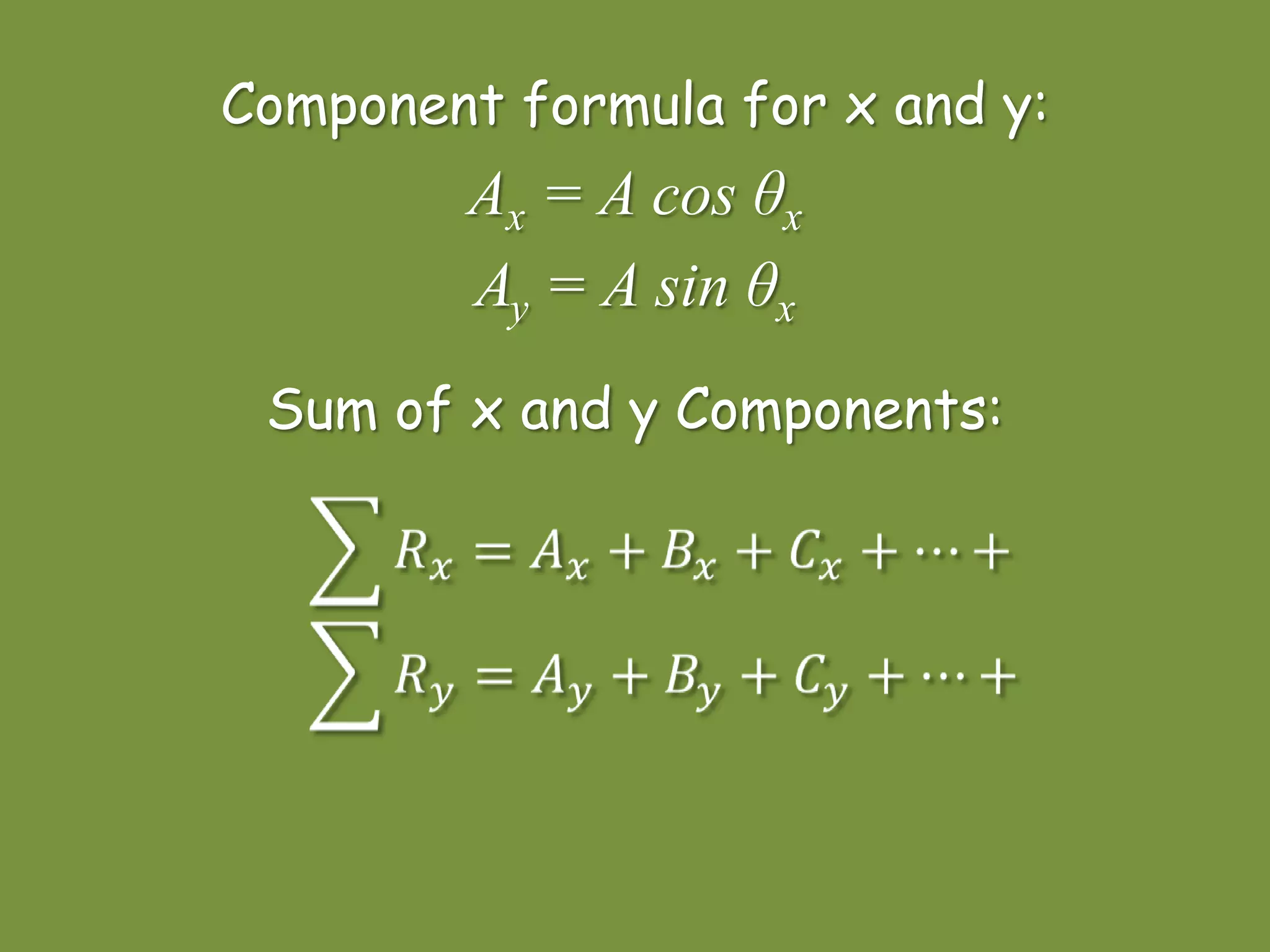
Component formula forx and y:
Ax = A cos θx
Ay = A sin θx
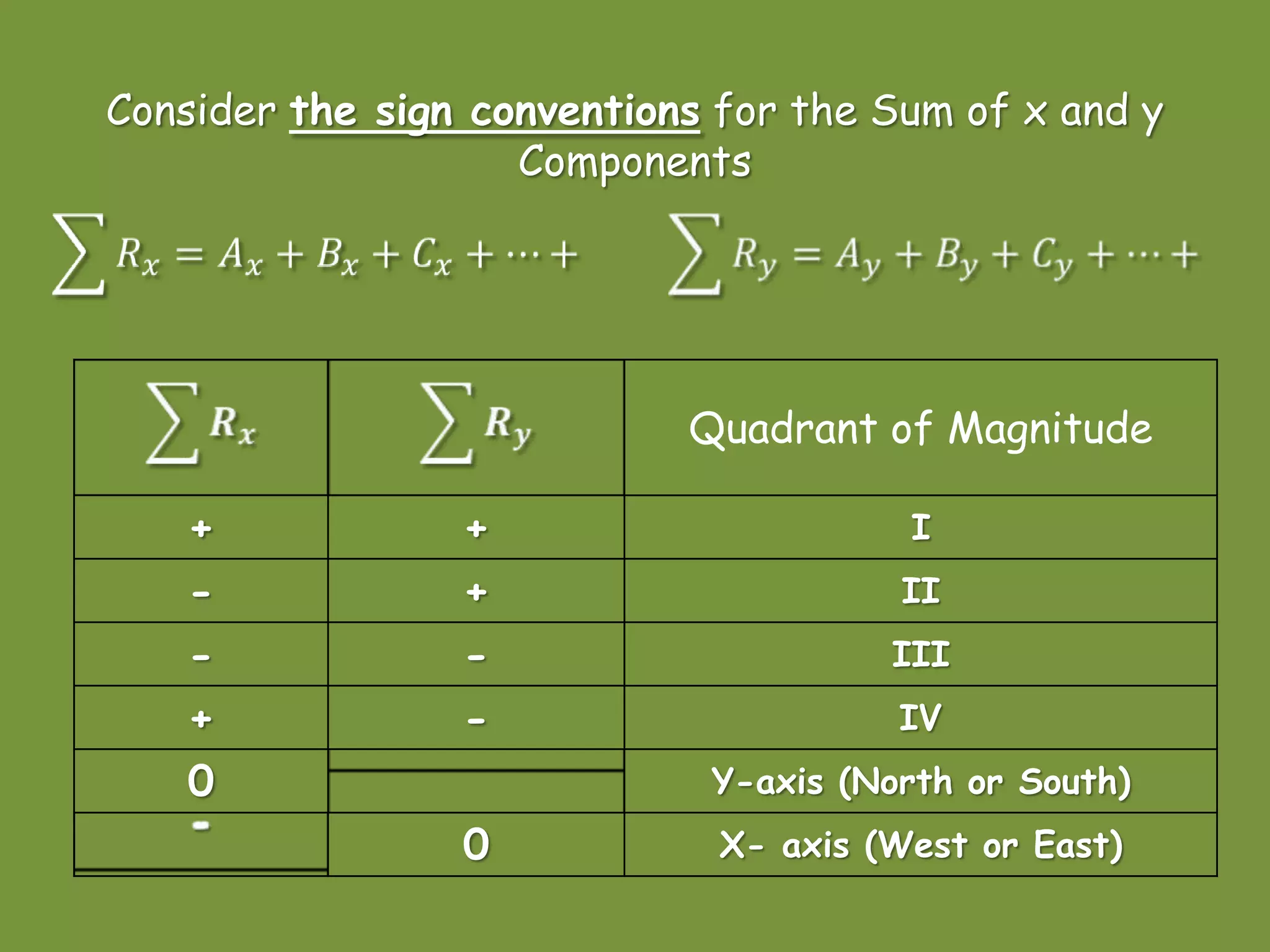
Sum of x and y Components:
35.
Consider the signconventions for the Sum of x and y
Components
Quadrant of Magnitude
+ + I
- + II
- - III
+ - IV
0 Y-axis (North or South)
0 X- axis (West or East)
36.
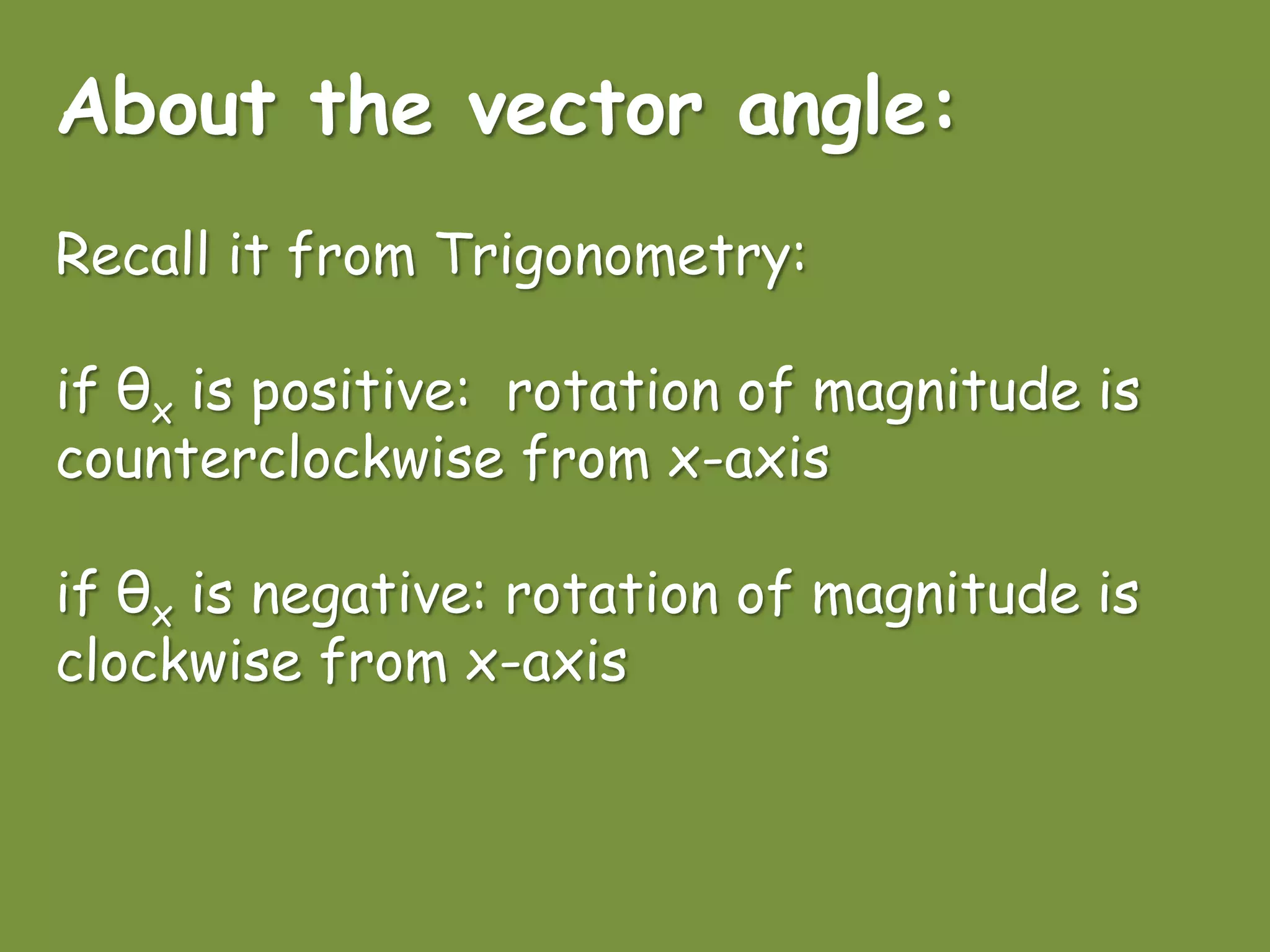
About the vectorangle:
Recall it from Trigonometry:
if θx is positive: rotation of magnitude is
counterclockwise from x-axis
if θx is negative: rotation of magnitude is
clockwise from x-axis
37.
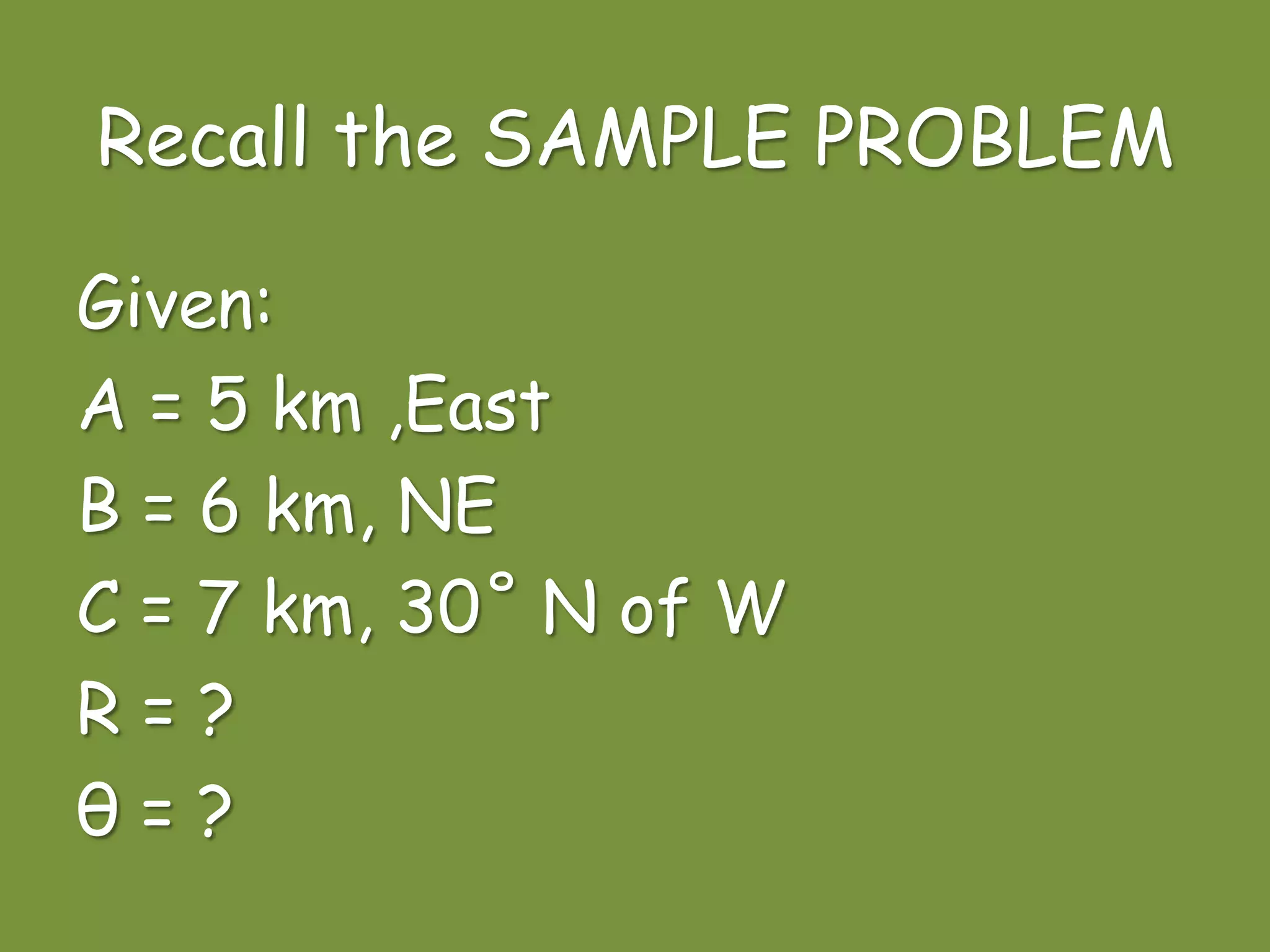
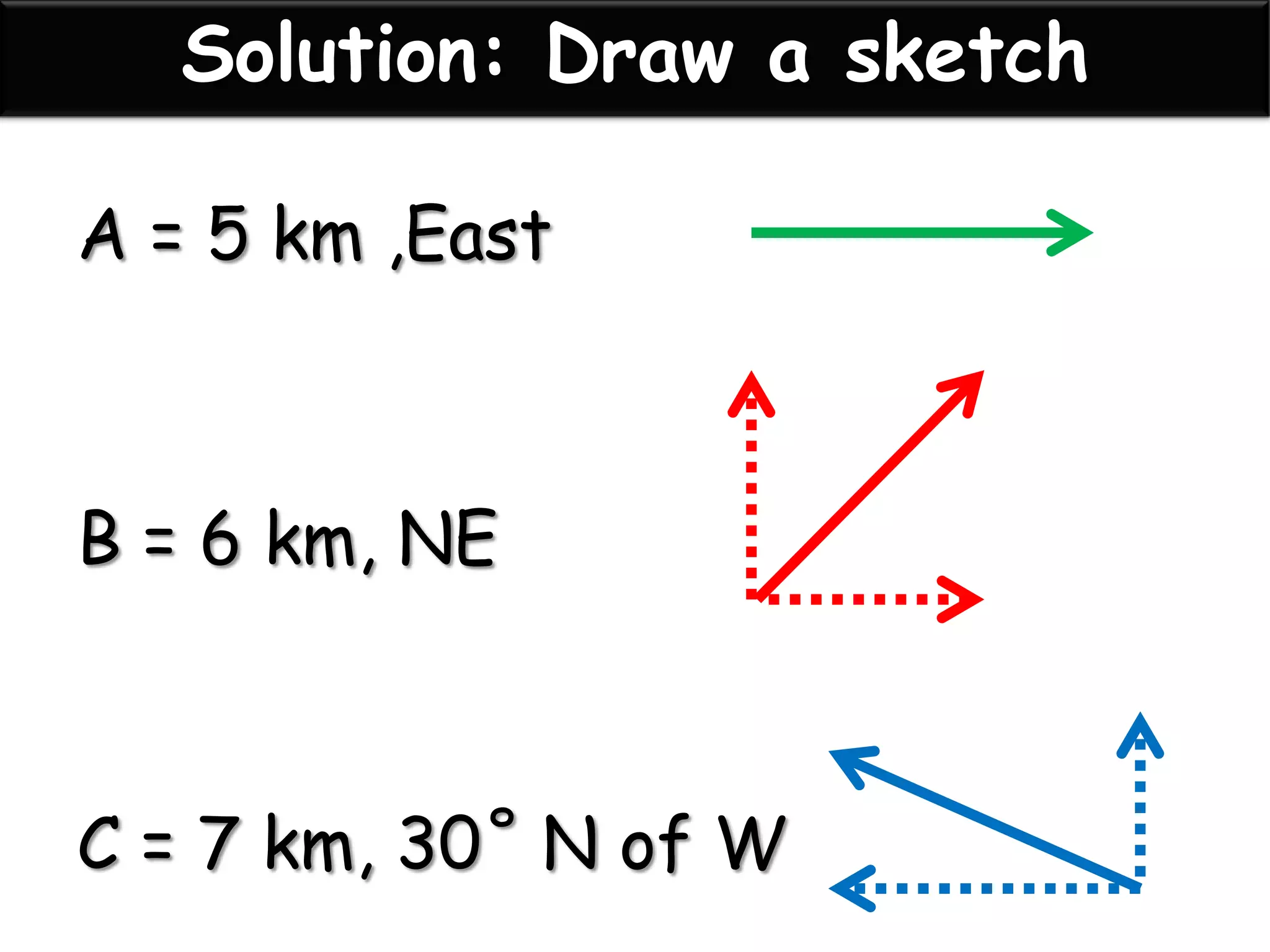
Recall the SAMPLEPROBLEM
Given:
A = 5 km ,East
B = 6 km, NE
C = 7 km, 30˚ N of W
R = ?
θ = ?
38.
Solution: Draw asketch
A = 5 km ,East
B = 6 km, NE
C = 7 km, 30˚ N of W
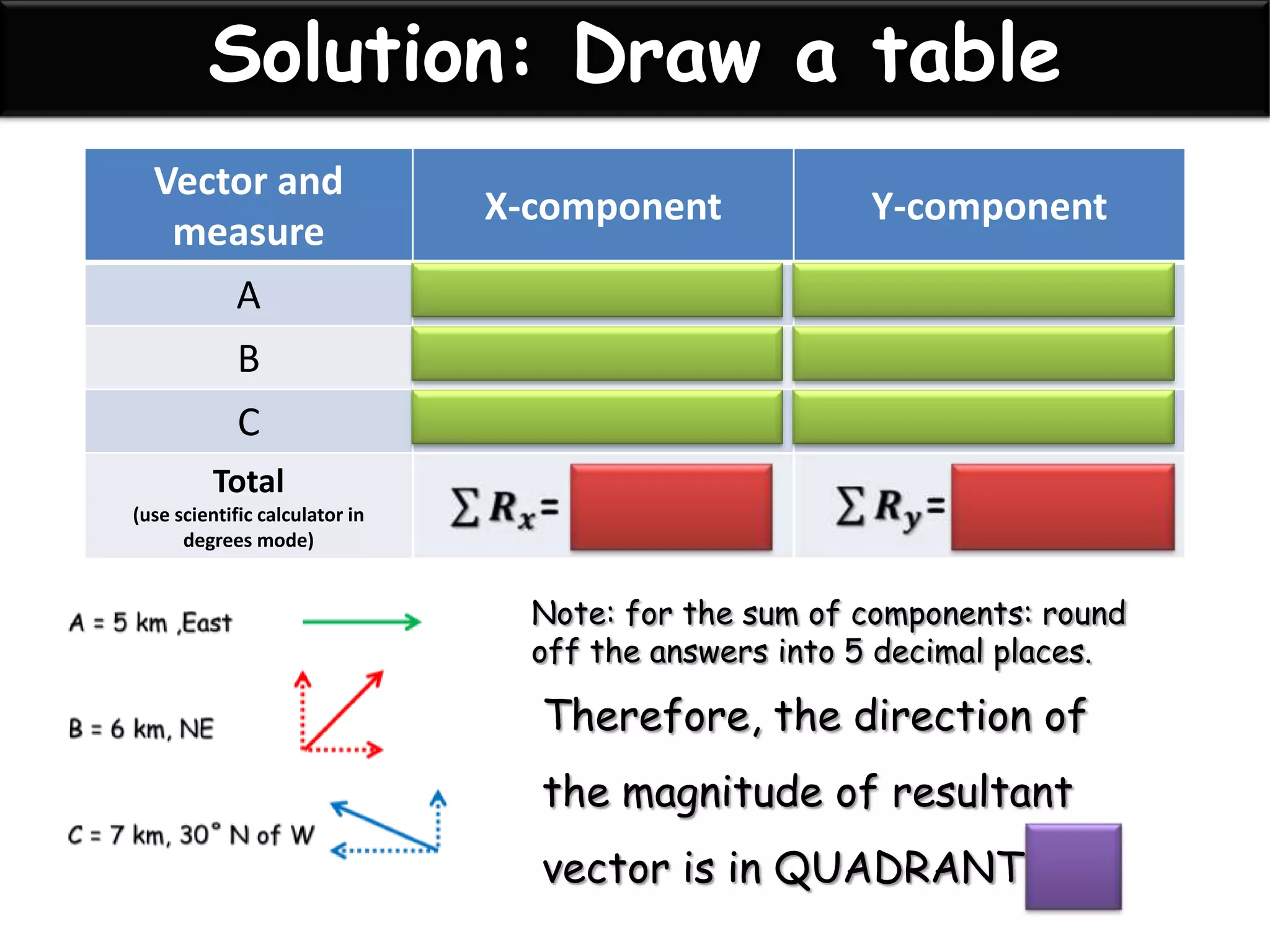
39.
Solution: Draw atable
Vector and
measure
X-component Y-component
A +5 0
B +6 cos 45 +6 sin 45
C -7 cos30 +7 sin 30
Total
(use scientific calculator in
degrees mode)
Note: for the sum of components: round
off the answers into 5 decimal places.
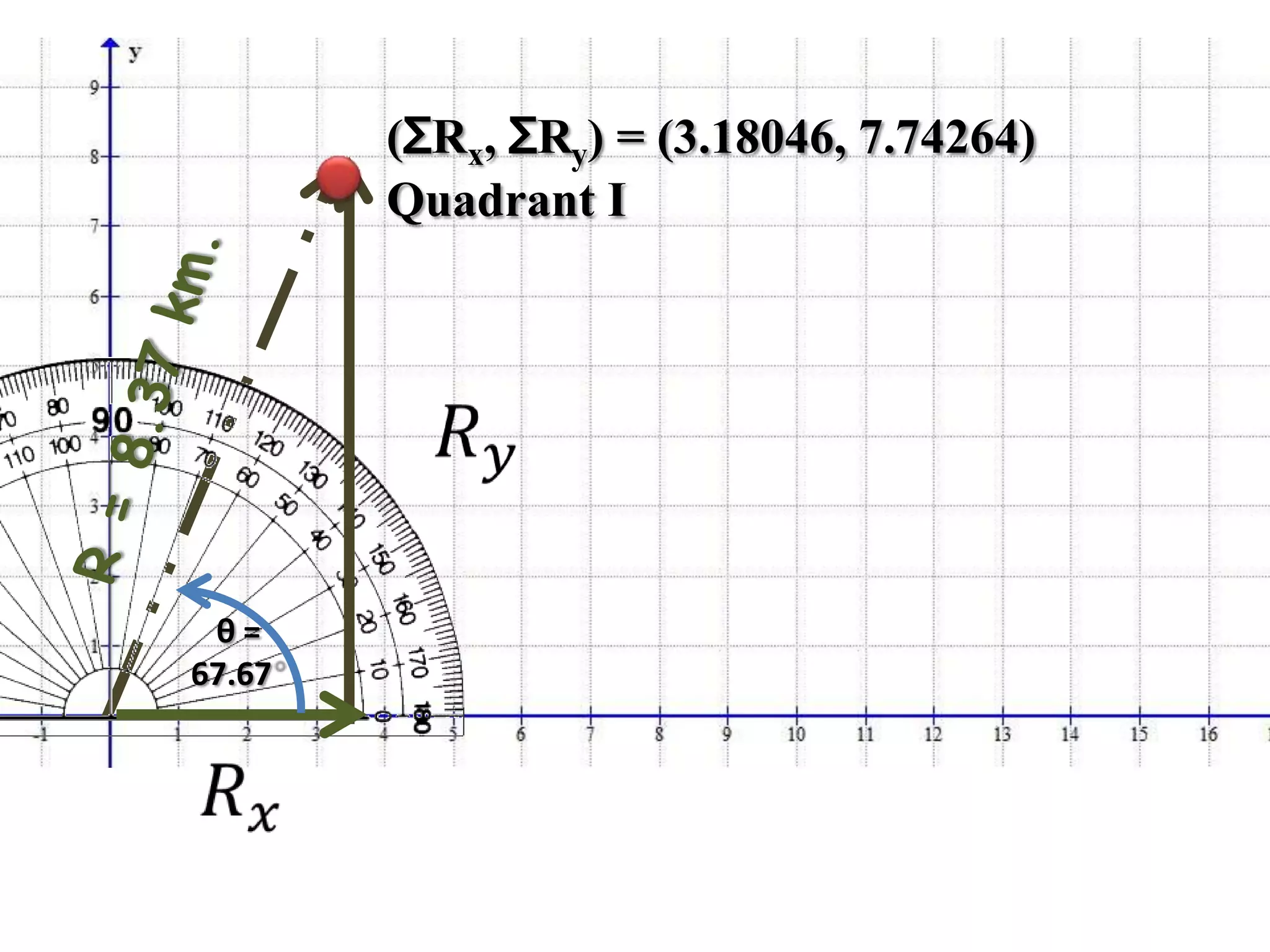
Therefore, the direction of
the magnitude of resultant
vector is in QUADRANT I
40.
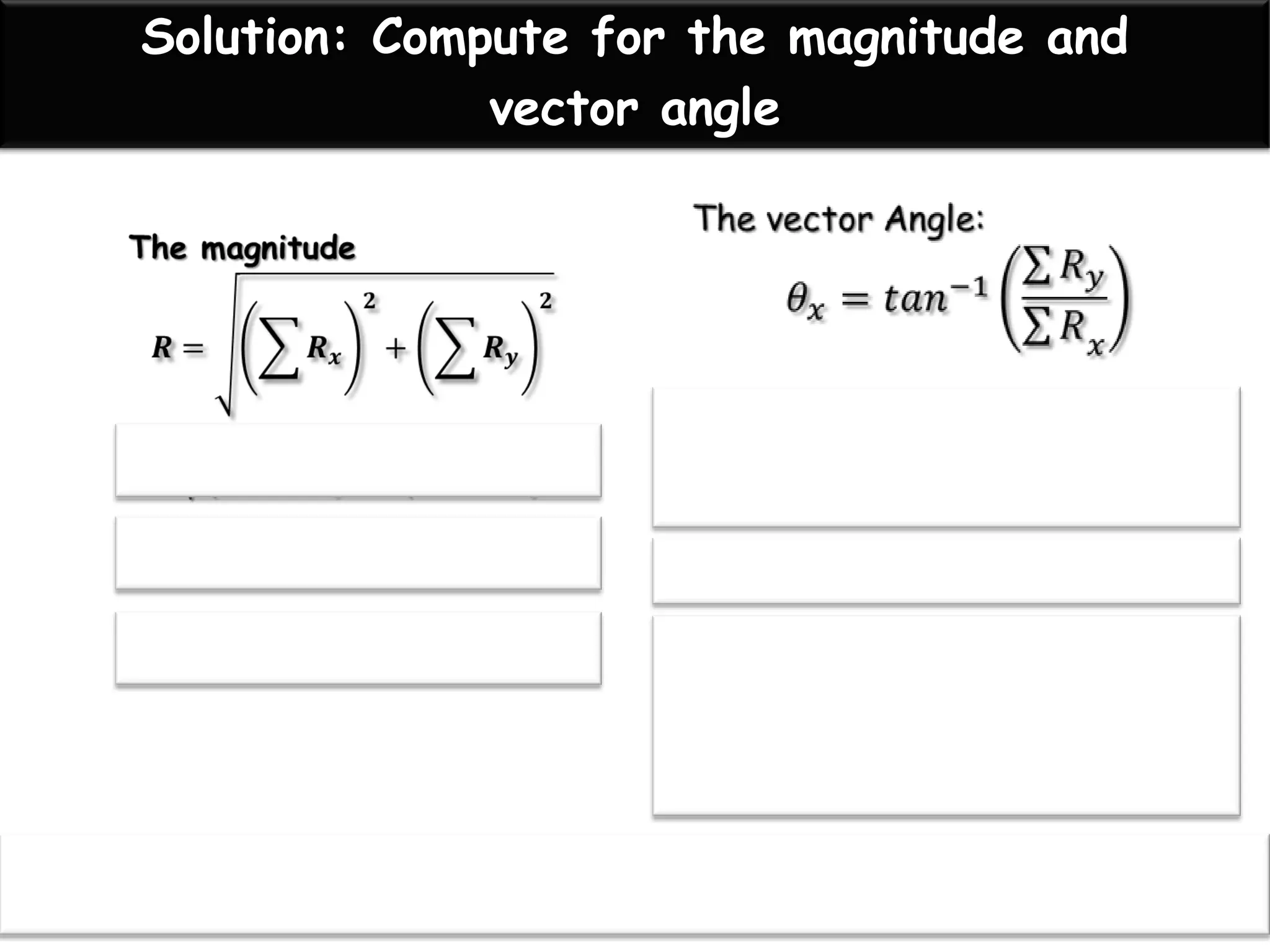
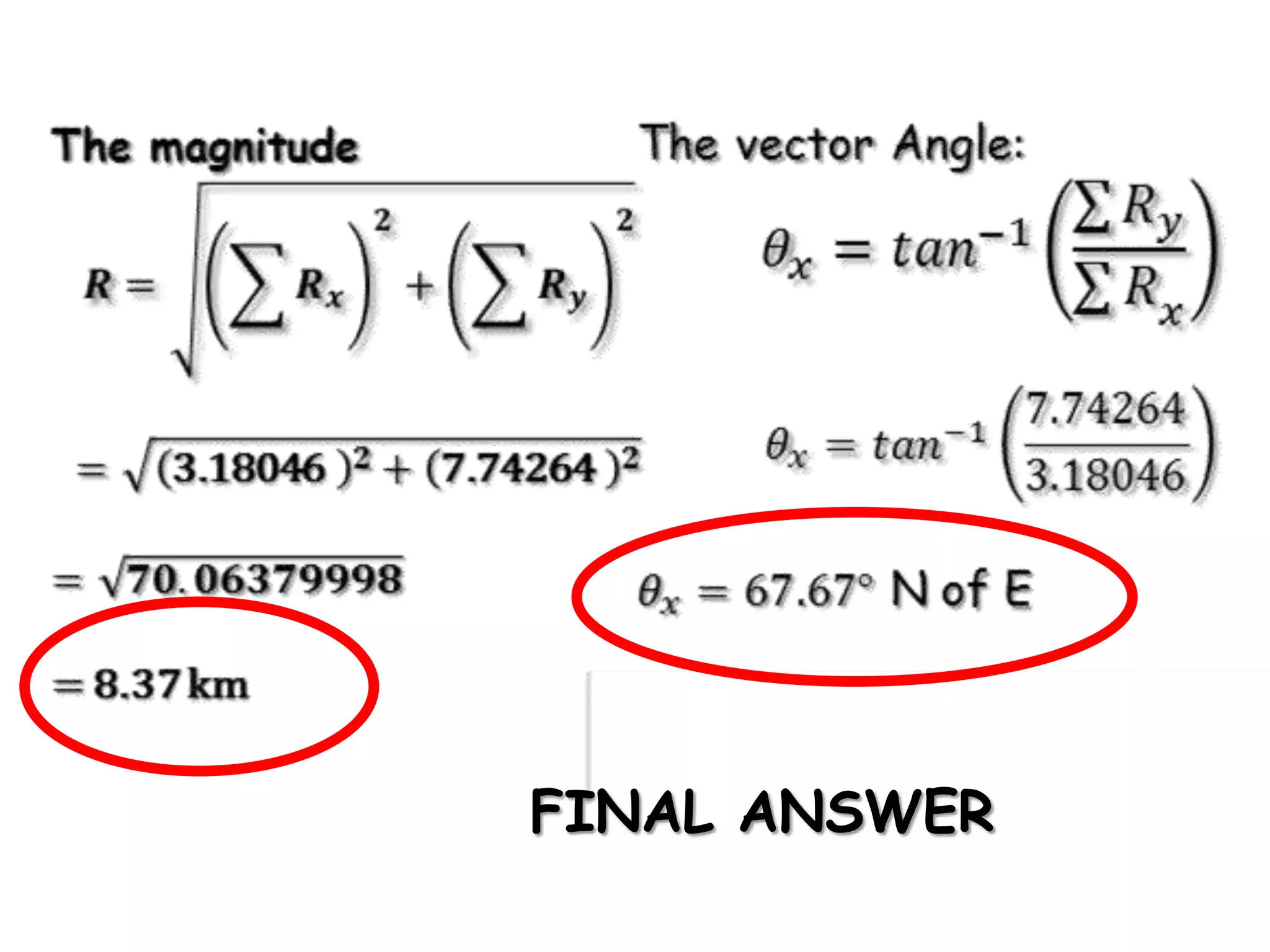
Solution: Compute forthe magnitude and
vector angle
WHICH IS NEAR IN OUR PREVIOUS DRAWING IN GRAPHICAL METHOD
41.
Actual happen onvectors
(not needed to graph)
NOTE: 1 GRID = 10 km
POSSIBLE GRAPH
A = 5 km ,East
B = 6 km, NE
C = 7 km, 30˚ N of W
R = ? θ = ?