Scalar
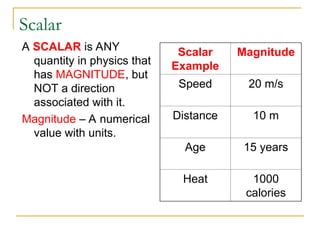
A SCALAR isANY
quantity in physics that
has MAGNITUDE, but
NOT a direction
associated with it.
Magnitude – A numerical
value with units.
Scalar
Example
Magnitude
Speed 20 m/s
Distance 10 m
Age 15 years
Heat 1000
calories
3.
Vector
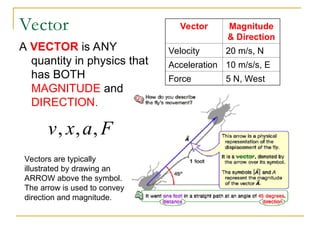
A VECTOR isANY
quantity in physics that
has BOTH
MAGNITUDE and
DIRECTION.
Vector Magnitude
& Direction
Velocity 20 m/s, N
Acceleration 10 m/s/s, E
Force 5 N, West
F
a
x
v
,
,
,
Vectors are typically
illustrated by drawing an
ARROW above the symbol.
The arrow is used to convey
direction and magnitude.
4.
Polar Notation
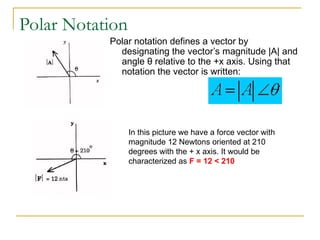
Polar notationdefines a vector by
designating the vector’s magnitude |A| and
angle θ relative to the +x axis. Using that
notation the vector is written:
In this picture we have a force vector with
magnitude 12 Newtons oriented at 210
degrees with the + x axis. It would be
characterized as F = 12 < 210
5.
Polar Notation
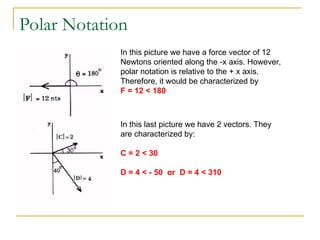
In thispicture we have a force vector of 12
Newtons oriented along the -x axis. However,
polar notation is relative to the + x axis.
Therefore, it would be characterized by
F = 12 < 180
In this last picture we have 2 vectors. They
are characterized by:
C = 2 < 30
D = 4 < - 50 or D = 4 < 310
6.
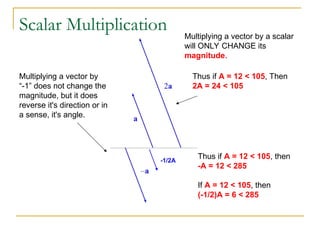
Scalar Multiplication Multiplyinga vector by a scalar
will ONLY CHANGE its
magnitude.
Thus if A = 12 < 105, Then
2A = 24 < 105
Multiplying a vector by
“-1” does not change the
magnitude, but it does
reverse it's direction or in
a sense, it's angle.
Thus if A = 12 < 105, then
-A = 12 < 285
If A = 12 < 105, then
(-1/2)A = 6 < 285
-1/2A
7.
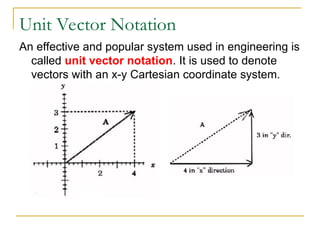
Unit Vector Notation
Aneffective and popular system used in engineering is
called unit vector notation. It is used to denote
vectors with an x-y Cartesian coordinate system.
8.
Unit Vector Notation
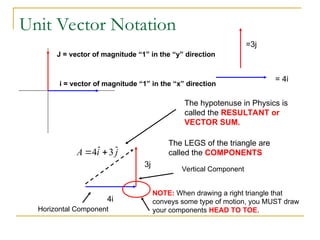
J= vector of magnitude “1” in the “y” direction
i = vector of magnitude “1” in the “x” direction
= 4i
=3j
4i
3j
j
i
A ˆ
3
ˆ
4
The hypotenuse in Physics is
called the RESULTANT or
VECTOR SUM.
The LEGS of the triangle are
called the COMPONENTS
Horizontal Component
Vertical Component
NOTE: When drawing a right triangle that
conveys some type of motion, you MUST draw
your components HEAD TO TOE.
9.
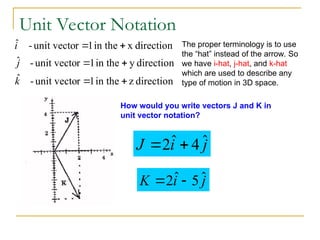
Unit Vector Notation
direction
z
inthe
1
r
unit vecto
-
ˆ
direction
y
in the
1
r
unit vecto
-
ˆ
direction
x
in the
1
r
unit vecto
-
ˆ
k
j
i
j
i
J ˆ
4
ˆ
2
The proper terminology is to use
the “hat” instead of the arrow. So
we have i-hat, j-hat, and k-hat
which are used to describe any
type of motion in 3D space.
How would you write vectors J and K in
unit vector notation?
j
i
K ˆ
5
ˆ
2
10.
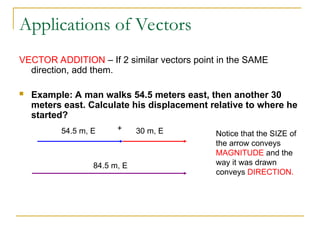
Applications of Vectors
VECTORADDITION – If 2 similar vectors point in the SAME
direction, add them.
Example: A man walks 54.5 meters east, then another 30
meters east. Calculate his displacement relative to where he
started?
54.5 m, E 30 m, E
+
84.5 m, E
Notice that the SIZE of
the arrow conveys
MAGNITUDE and the
way it was drawn
conveys DIRECTION.
11.
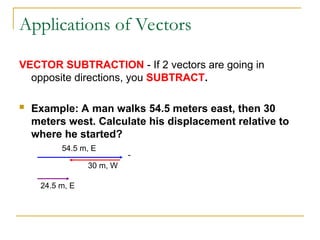
Applications of Vectors
VECTORSUBTRACTION - If 2 vectors are going in
opposite directions, you SUBTRACT.
Example: A man walks 54.5 meters east, then 30
meters west. Calculate his displacement relative to
where he started?
54.5 m, E
30 m, W
-
24.5 m, E
12.
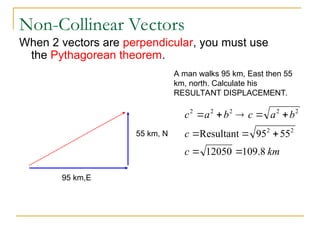
Non-Collinear Vectors
When 2vectors are perpendicular, you must use
the Pythagorean theorem.
95 km,E
55 km, N
A man walks 95 km, East then 55
km, north. Calculate his
RESULTANT DISPLACEMENT.
km
c
c
b
a
c
b
a
c
8
.
109
12050
55
95
Resultant 2
2
2
2
2
2
2
13.
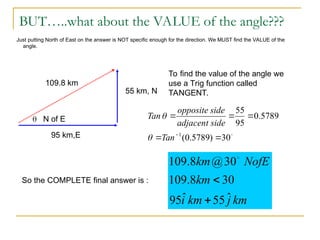
BUT…..what about theVALUE of the angle???
Just putting North of East on the answer is NOT specific enough for the direction. We MUST find the VALUE of the
angle.
30
)
5789
.
0
(
5789
.
0
95
55
1
Tan
side
adjacent
side
opposite
Tan
N of E
55 km, N
95 km,E
To find the value of the angle we
use a Trig function called
TANGENT.
109.8 km
So the COMPLETE final answer is :
km
j
km
i
km
NofE
km
ˆ
55
ˆ
95
30
8
.
109
30
@
8
.
109
14.
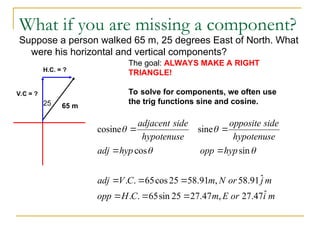
What if youare missing a component?
Suppose a person walked 65 m, 25 degrees East of North. What
were his horizontal and vertical components?
65 m
25
H.C. = ?
V.C = ?
The goal: ALWAYS MAKE A RIGHT
TRIANGLE!
To solve for components, we often use
the trig functions sine and cosine.
m
i
or
E
m
C
H
opp
m
j
or
N
m
C
V
adj
hyp
opp
hyp
adj
hypotenuse
side
opposite
hypotenuse
side
adjacent
ˆ
47
.
27
,
47
.
27
25
sin
65
.
.
ˆ
91
.
58
,
91
.
58
25
cos
65
.
.
sin
cos
sine
cosine
15.
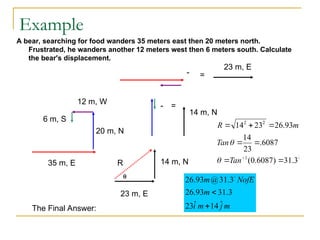
Example
A bear, searchingfor food wanders 35 meters east then 20 meters north.
Frustrated, he wanders another 12 meters west then 6 meters south. Calculate
the bear's displacement.
3
.
31
)
6087
.
0
(
6087
.
23
14
93
.
26
23
14
1
2
2
Tan
Tan
m
R
35 m, E
20 m, N
12 m, W
6 m, S
- =
23 m, E
- =
14 m, N
23 m, E
14 m, N
The Final Answer:
R
m
j
m
i
m
NofE
m
ˆ
14
ˆ
23
3
.
31
93
.
26
3
.
31
@
93
.
26
16.
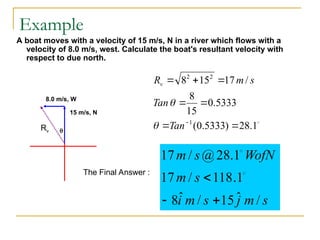
Example
A boat moveswith a velocity of 15 m/s, N in a river which flows with a
velocity of 8.0 m/s, west. Calculate the boat's resultant velocity with
respect to due north.
1
.
28
)
5333
.
0
(
5333
.
0
15
8
/
17
15
8
1
2
2
Tan
Tan
s
m
Rv
15 m/s, N
8.0 m/s, W
Rv
The Final Answer :
s
m
j
s
m
i
s
m
WofN
s
m
/
ˆ
15
/
ˆ
8
1
.
118
/
17
1
.
28
@
/
17
17.
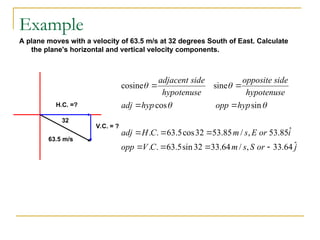
Example
A plane moveswith a velocity of 63.5 m/s at 32 degrees South of East. Calculate
the plane's horizontal and vertical velocity components.
63.5 m/s
32
H.C. =?
V.C. = ?
j
or
S
s
m
C
V
opp
i
or
E
s
m
C
H
adj
hyp
opp
hyp
adj
hypotenuse
side
opposite
hypotenuse
side
adjacent
ˆ
64
.
33
,
/
64
.
33
32
sin
5
.
63
.
.
ˆ
85
.
53
,
/
85
.
53
32
cos
5
.
63
.
.
sin
cos
sine
cosine
18.
The “Dot” Product(Vector Multiplication)
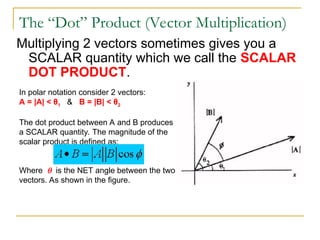
Multiplying 2 vectors sometimes gives you a
SCALAR quantity which we call the SCALAR
DOT PRODUCT.
In polar notation consider 2 vectors:
A = |A| < θ1 & B = |B| < θ2
The dot product between A and B produces
a SCALAR quantity. The magnitude of the
scalar product is defined as:
Where is the NET angle between the two
vectors. As shown in the figure.
19.
The Scalar DotProduct
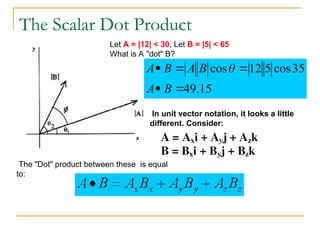
Let A = |12| < 30, Let B = |5| < 65
What is A "dot" B?
15
.
49
35
cos
5
12
cos
B
A
B
A
B
A
In unit vector notation, it looks a little
different. Consider:
The "Dot" product between these is equal
to:
20.
The Scalar DotProduct
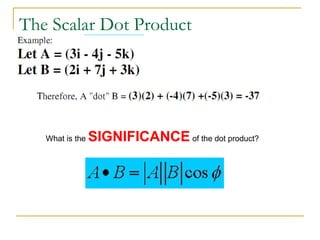
What is the SIGNIFICANCE of the dot product?
21.
The significance ofthe dot product
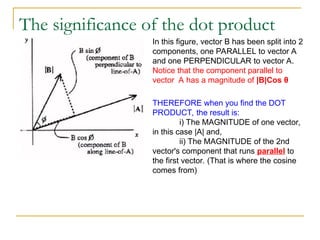
In this figure, vector B has been split into 2
components, one PARALLEL to vector A
and one PERPENDICULAR to vector A.
Notice that the component parallel to
vector A has a magnitude of |B|Cos θ
THEREFORE when you find the DOT
PRODUCT, the result is:
i) The MAGNITUDE of one vector,
in this case |A| and,
ii) The MAGNITUDE of the 2nd
vector's component that runs parallel to
the first vector. (That is where the cosine
comes from)
22.
Dot Products inPhysics
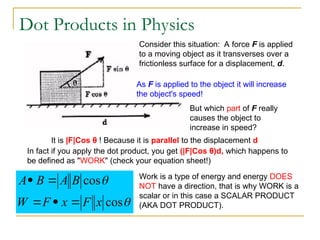
Consider this situation: A force F is applied
to a moving object as it transverses over a
frictionless surface for a displacement, d.
As F is applied to the object it will increase
the object's speed!
But which part of F really
causes the object to
increase in speed?
It is |F|Cos θ ! Because it is parallel to the displacement d
In fact if you apply the dot product, you get (|F|Cos θ)d, which happens to
be defined as "WORK" (check your equation sheet!)
cos
cos
x
F
x
F
W
B
A
B
A
Work is a type of energy and energy DOES
NOT have a direction, that is why WORK is a
scalar or in this case a SCALAR PRODUCT
(AKA DOT PRODUCT).
23.
Dot products usingthe TI-89
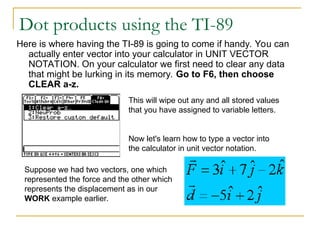
Here is where having the TI-89 is going to come if handy. You can
actually enter vector into your calculator in UNIT VECTOR
NOTATION. On your calculator we first need to clear any data
that might be lurking in its memory. Go to F6, then choose
CLEAR a-z.
This will wipe out any and all stored values
that you have assigned to variable letters.
Now let's learn how to type a vector into
the calculator in unit vector notation.
Suppose we had two vectors, one which
represented the force and the other which
represents the displacement as in our
WORK example earlier.
24.
Dot products usingthe TI-89
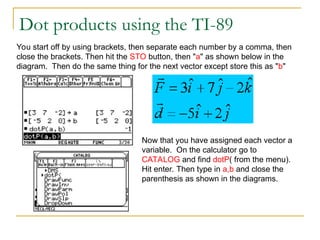
You start off by using brackets, then separate each number by a comma, then
close the brackets. Then hit the STO button, then "a" as shown below in the
diagram. Then do the same thing for the next vector except store this as "b"
Now that you have assigned each vector a
variable. On the calculator go to
CATALOG and find dotP( from the menu).
Hit enter. Then type in a,b and close the
parenthesis as shown in the diagrams.
25.
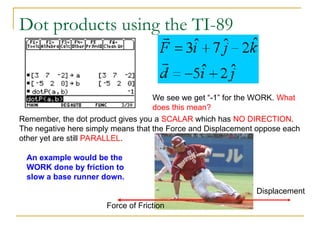
Dot products usingthe TI-89
We see we get “-1” for the WORK. What
does this mean?
Remember, the dot product gives you a SCALAR which has NO DIRECTION.
The negative here simply means that the Force and Displacement oppose each
other yet are still PARALLEL.
Displacement
Force of Friction
An example would be the
WORK done by friction to
slow a base runner down.
26.
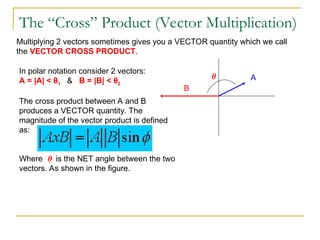
The “Cross” Product(Vector Multiplication)
Multiplying 2 vectors sometimes gives you a VECTOR quantity which we call
the VECTOR CROSS PRODUCT.
In polar notation consider 2 vectors:
A = |A| < θ1 & B = |B| < θ2
The cross product between A and B
produces a VECTOR quantity. The
magnitude of the vector product is defined
as:
Where is the NET angle between the two
vectors. As shown in the figure.
A
B
27.
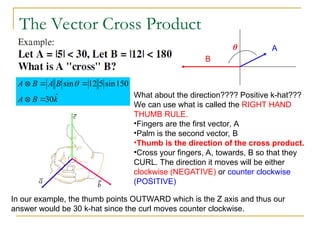
The Vector CrossProduct
k
B
A
B
A
B
A
ˆ
30
150
sin
5
12
sin
A
B
What about the direction???? Positive k-hat???
We can use what is called the RIGHT HAND
THUMB RULE.
•Fingers are the first vector, A
•Palm is the second vector, B
•Thumb is the direction of the cross product.
•Cross your fingers, A, towards, B so that they
CURL. The direction it moves will be either
clockwise (NEGATIVE) or counter clockwise
(POSITIVE)
In our example, the thumb points OUTWARD which is the Z axis and thus our
answer would be 30 k-hat since the curl moves counter clockwise.
28.
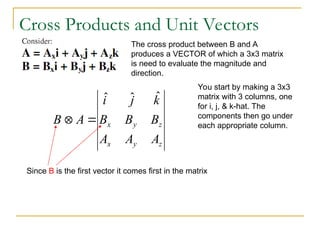
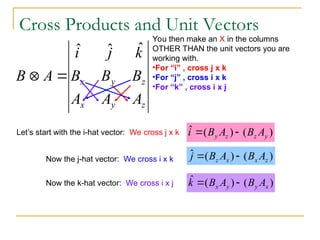
Cross Products andUnit Vectors
The cross product between B and A
produces a VECTOR of which a 3x3 matrix
is need to evaluate the magnitude and
direction.
z
y
x
z
y
x
A
A
A
B
B
B
k
j
i
A
B
ˆ
ˆ
ˆ
You start by making a 3x3
matrix with 3 columns, one
for i, j, & k-hat. The
components then go under
each appropriate column.
Since B is the first vector it comes first in the matrix
29.
Cross Products andUnit Vectors
z
y
x
z
y
x
A
A
A
B
B
B
k
j
i
A
B
ˆ
ˆ
ˆ
)
(
)
(
ˆ y
z
z
y A
B
A
B
i
)
(
)
(
ˆ z
x
x
z A
B
A
B
j
You then make an X in the columns
OTHER THAN the unit vectors you are
working with.
•For “i” , cross j x k
•For “j” , cross i x k
•For “k” , cross i x j
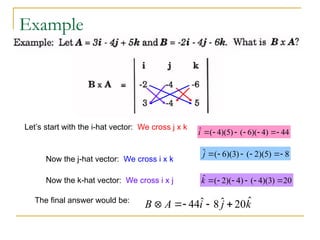
Let’s start with the i-hat vector: We cross j x k
)
(
)
(
ˆ
x
y
y
x A
B
A
B
k
Now the j-hat vector: We cross i x k
Now the k-hat vector: We cross i x j
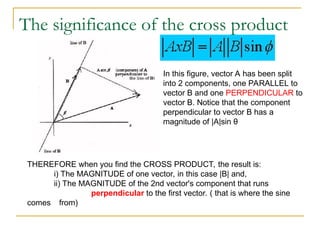
The significance ofthe cross product
In this figure, vector A has been split
into 2 components, one PARALLEL to
vector B and one PERPENDICULAR to
vector B. Notice that the component
perpendicular to vector B has a
magnitude of |A|sin θ
THEREFORE when you find the CROSS PRODUCT, the result is:
i) The MAGNITUDE of one vector, in this case |B| and,
ii) The MAGNITUDE of the 2nd vector's component that runs
perpendicular to the first vector. ( that is where the sine
comes from)
32.
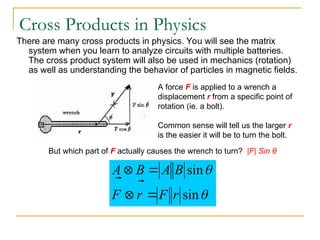
Cross Products inPhysics
There are many cross products in physics. You will see the matrix
system when you learn to analyze circuits with multiple batteries.
The cross product system will also be used in mechanics (rotation)
as well as understanding the behavior of particles in magnetic fields.
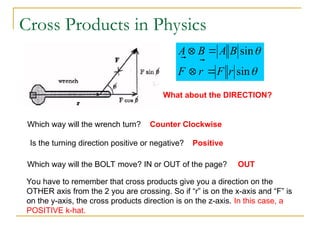
A force F is applied to a wrench a
displacement r from a specific point of
rotation (ie. a bolt).
Common sense will tell us the larger r
is the easier it will be to turn the bolt.
But which part of F actually causes the wrench to turn? |F| Sin θ
sin
sin
r
F
r
F
B
A
B
A
33.
Cross Products inPhysics
sin
sin
r
F
r
F
B
A
B
A
What about the DIRECTION?
Which way will the wrench turn? Counter Clockwise
Is the turning direction positive or negative? Positive
Which way will the BOLT move? IN or OUT of the page? OUT
You have to remember that cross products give you a direction on the
OTHER axis from the 2 you are crossing. So if “r” is on the x-axis and “F” is
on the y-axis, the cross products direction is on the z-axis. In this case, a
POSITIVE k-hat.
34.
Cross products usingthe TI-89
?
5
30
.
0
A
B
N
F
B
m
r
A
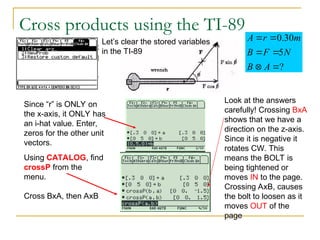
Let’s clear the stored variables
in the TI-89
Since “r” is ONLY on
the x-axis, it ONLY has
an i-hat value. Enter,
zeros for the other unit
vectors.
Using CATALOG, find
crossP from the
menu.
Cross BxA, then AxB
Look at the answers
carefully! Crossing BxA
shows that we have a
direction on the z-axis.
Since it is negative it
rotates CW. This
means the BOLT is
being tightened or
moves IN to the page.
Crossing AxB, causes
the bolt to loosen as it
moves OUT of the
page