TOPIC 2 :
STATISTICS IN DIMENSIONAL
MEASUREMENT- part 3
Topic Contents :
1. Terminology in Engineering Statistic for measurement and
Instrumentation.
1.1 Types of studies
1.2 Types of Data
1.3 Samples study
1.4 Sampling
1.5 Recording
1.6 Mean, Median Mode
1.7 Dispersion
Topic Contents :
2. Control Chart
2.1 X bar R Chart
3. Measurement System Analysis
3.1 Definition And Terminology
3.2 Methodologies for assessing measurement system
Stability
Linearity
3.3 Gage repeatability & reproducibility (GRR)
4. Errors and Uncertainty
4.1 Types od Errors
4.2 Sources of Measurement Errors
4.3 Types of Uncertainty
4.4 Calculating of Uncertainty
Part 3
4. Errors and Uncertainty
• Error in science does not mean the terms
of mistake .
• Error in a scientific measurement means
the different between the individual result
and true value.
• Errors cannot be eliminated although the
measurement is being done very carefully .
• The total value of error is made up of a
number of error source.
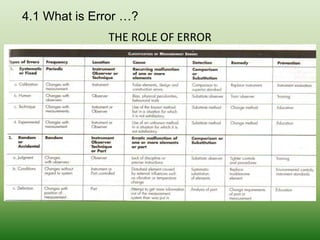
4.1 What is Error …?
• Repeated measurement will contribute the
discrepancy or random errors. The
discrepancy can only be obtained when
there are differences between the
readings and the true value. The smaller
the random errors, the greater the
precision.
• If the individual readings are the same,
there still an error called uniform error or
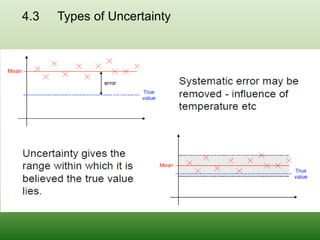
systematic error.
THE ROLE OF ERROR
4.1 What is Error …?
THE ROLE OF ERROR
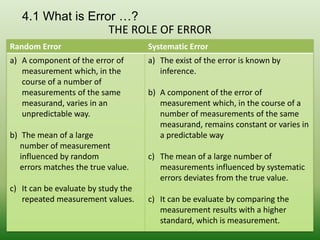
Random Error Systematic Error
a) A component of the error of
measurement which, in the
course of a number of
measurements of the same
measurand, varies in an
unpredictable way.
b) The mean of a large
number of measurement
influenced by random
errors matches the true value.
c) It can be evaluate by study the
repeated measurement values.
a) The exist of the error is known by
inference.
b) A component of the error of
measurement which, in the course of a
number of measurements of the same
measurand, remains constant or varies in
a predictable way
c) The mean of a large number of
measurements influenced by systematic
errors deviates from the true value.
c) It can be evaluate by comparing the
measurement results with a higher
standard, which is measurement.
4.1 What is Error …?
THE ROLE OF ERROR
4.2 Sources of Measurement Errors
Dynamic error
• Characterised by frequency and phase response of the
system for periodic variations in the measured input.
Loading error
• It is the difference between the value measured before
and after the measurement system is measured.
Static error
• It is cause by physical nature of various components of
the measuring system.
4.2 Sources of Measurement Errors
Characteristic error
• It is the deviation of measurement under constant
environmental conditions from the theoretical predicted
performance.
Elastic deformation
• It is divided into two ;
a)Error cause from reflection when end gage is used for
setting or measure.
b)Error cause from deflection due to self weight of the object.
Parallax
• Any instrument that using pointer and scale may have
parallax error because the gap between pointer and scale is
different at any reading angle.
4.2 Sources of Measurement Errors
Contact pressure
• While measuring, the pressure at contact causes some
penetration causing error in measurement.
Backlash
• Due to backlash in gears and screw threads, some
motion is lost to overcome backlash
Hysteretic
• It is a source of errors in electrical instruments.
Ascending values are observed when decrease current
or voltage.
Avoidable error
• The errors occurred due to non-alignment of workpiece
centre, improper of measuring instruments, etc.
4.2 Sources of Measurement Errors
Human Error
• Difficult to detect. It can be include a tendency to read
high or low using a wrong instrument. Human training is
the best way to prevent these error.
Errors in Technique and Experimental Error
• If wrong techniques is used. Example: Calibration
technique for vernier is used for micrometer. Education
helps to prevent these errors.
4.2 Sources of Measurement Errors
Computational Error
• Can be random or continuous, but, once an error has
started, it usually establishes itself in the computation.
This error is affected by environmental, fatigue and
instrumentation.
Chaotic Error
• Extreme disturbances that ruin or hide the measurement
results. This error include vibration, shock, extreme
noise and etc.
4.3 Types of Uncertainty
• No measurement is ever guaranteed to be perfect.
• Uncertainty of measurement is the doubt that exists
about the result of any measurement. By quantifying the
possible spread of measurements, we can say how
confident we are about the result.
• A measurement result is only complete when
accompanied by a statement of its uncertainty. A
statement of uncertainty is required in order to decide if
the result is adequate for its intended purpose and
consistent with other similar results.
4.3 Types of Uncertainty
Many things can undermine a measurement:
• The measuring instrument
Errors due to bias, wear, drift, noise, reliability…
• The measurand
Stability
• The measurement process
Difficulty of measurement …
• Imported uncertainties
Uncertainty associated with your instrument affects
the uncertainty of the measurements you make.
Where do the uncertainty originate?
4.3 Types of Uncertainty
Where do the uncertainty originate?
• Operator skill
Skill and judgment of the operator … how would you
quantify this?
• Sampling issues
When and where you take measurements
• The environment
Temperature, air pressure, humidity etc can affect the
measurement.
4.3 Types of Uncertainty
Calculating and expressing uncertainty is important to
anybody wishing to make good ‘quality’ measurements.
Other cases:
• calibration - the uncertainty of measurement must be
quoted.
• test - uncertainty of measurement is needed to determine
pass or fail.
• tolerance - you need to know the uncertainty before a
decision on whether the tolerance is met can be made.
Why does Uncertainty matter?
4.4 Calculating Uncertainty
To calculate the uncertainty of a measurement,
firstly you must identify the sources of uncertainty
in the measurement, then estimate the size of the
uncertainty from each source.
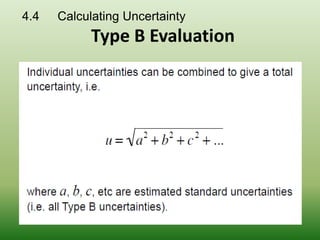
The individual uncertainties are combined to give
an overall figure for the measurement uncertainty.
There are two types of evaluation of measurement
uncertainty:
1) TYPE A
2) TYPE B
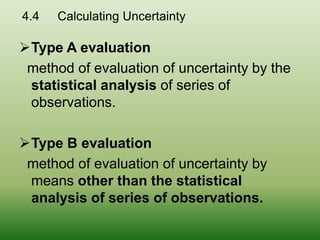
Type A evaluation
method of evaluation of uncertainty by the
statistical analysis of series of
observations.
Type B evaluation
method of evaluation of uncertainty by
means other than the statistical
analysis of series of observations.
4.4 Calculating Uncertainty
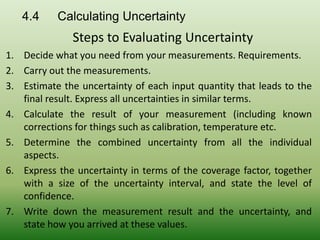
1. Decide what you need from your measurements. Requirements.
2. Carry out the measurements.
3. Estimate the uncertainty of each input quantity that leads to the
final result. Express all uncertainties in similar terms.
4. Calculate the result of your measurement (including known
corrections for things such as calibration, temperature etc.
5. Determine the combined uncertainty from all the individual
aspects.
6. Express the uncertainty in terms of the coverage factor, together
with a size of the uncertainty interval, and state the level of
confidence.
7. Write down the measurement result and the uncertainty, and
state how you arrived at these values.
Steps to Evaluating Uncertainty
4.4 Calculating Uncertainty
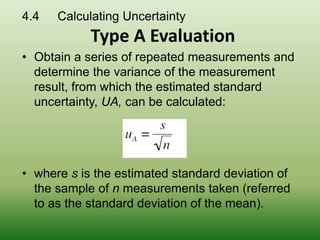
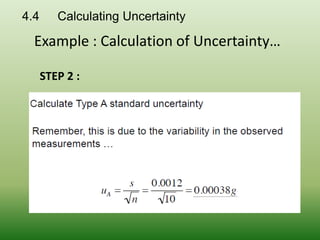
• Obtain a series of repeated measurements and
determine the variance of the measurement
result, from which the estimated standard
uncertainty, UA, can be calculated:
• where s is the estimated standard deviation of
the sample of n measurements taken (referred
to as the standard deviation of the mean).
4.4 Calculating Uncertainty
Type A Evaluation
4.4 Calculating Uncertainty
Type B Evaluation
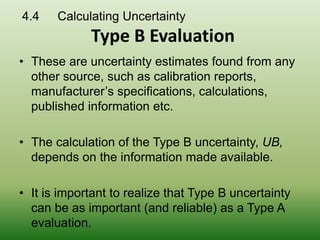
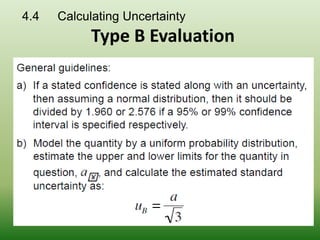
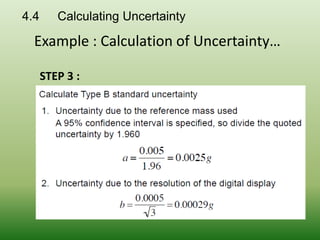
• These are uncertainty estimates found from any
other source, such as calibration reports,
manufacturer’s specifications, calculations,
published information etc.
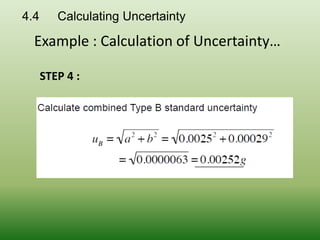
• The calculation of the Type B uncertainty, UB,
depends on the information made available.
• It is important to realize that Type B uncertainty
can be as important (and reliable) as a Type A
evaluation.
4.4 Calculating Uncertainty
Type B Evaluation
4.4 Calculating Uncertainty
Type B Evaluation
4.4 Calculating Uncertainty
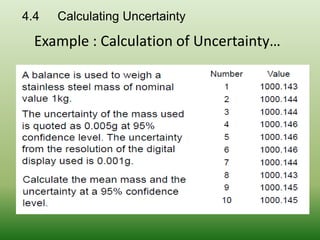
Example : Calculation of Uncertainty…
4.4 Calculating Uncertainty
Example : Calculation of Uncertainty…
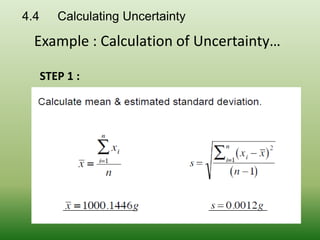
STEP 1 :
4.4 Calculating Uncertainty
Example : Calculation of Uncertainty…
STEP 2 :
4.4 Calculating Uncertainty
Example : Calculation of Uncertainty…
STEP 3 :
4.4 Calculating Uncertainty
Example : Calculation of Uncertainty…
STEP 4 :

Topic 2 error & uncertainty- part 3

  • 1.
    TOPIC 2 : STATISTICSIN DIMENSIONAL MEASUREMENT- part 3
  • 2.
    Topic Contents : 1.Terminology in Engineering Statistic for measurement and Instrumentation. 1.1 Types of studies 1.2 Types of Data 1.3 Samples study 1.4 Sampling 1.5 Recording 1.6 Mean, Median Mode 1.7 Dispersion
  • 3.
    Topic Contents : 2.Control Chart 2.1 X bar R Chart 3. Measurement System Analysis 3.1 Definition And Terminology 3.2 Methodologies for assessing measurement system Stability Linearity 3.3 Gage repeatability & reproducibility (GRR) 4. Errors and Uncertainty 4.1 Types od Errors 4.2 Sources of Measurement Errors 4.3 Types of Uncertainty 4.4 Calculating of Uncertainty Part 3
  • 4.
    4. Errors andUncertainty
  • 5.
    • Error inscience does not mean the terms of mistake . • Error in a scientific measurement means the different between the individual result and true value. • Errors cannot be eliminated although the measurement is being done very carefully . • The total value of error is made up of a number of error source. 4.1 What is Error …?
  • 6.
    4.1 What isError …? • Repeated measurement will contribute the discrepancy or random errors. The discrepancy can only be obtained when there are differences between the readings and the true value. The smaller the random errors, the greater the precision. • If the individual readings are the same, there still an error called uniform error or systematic error. THE ROLE OF ERROR
  • 7.
    4.1 What isError …? THE ROLE OF ERROR Random Error Systematic Error a) A component of the error of measurement which, in the course of a number of measurements of the same measurand, varies in an unpredictable way. b) The mean of a large number of measurement influenced by random errors matches the true value. c) It can be evaluate by study the repeated measurement values. a) The exist of the error is known by inference. b) A component of the error of measurement which, in the course of a number of measurements of the same measurand, remains constant or varies in a predictable way c) The mean of a large number of measurements influenced by systematic errors deviates from the true value. c) It can be evaluate by comparing the measurement results with a higher standard, which is measurement.
  • 8.
    4.1 What isError …? THE ROLE OF ERROR
  • 9.
    4.2 Sources ofMeasurement Errors Dynamic error • Characterised by frequency and phase response of the system for periodic variations in the measured input. Loading error • It is the difference between the value measured before and after the measurement system is measured. Static error • It is cause by physical nature of various components of the measuring system.
  • 10.
    4.2 Sources ofMeasurement Errors Characteristic error • It is the deviation of measurement under constant environmental conditions from the theoretical predicted performance. Elastic deformation • It is divided into two ; a)Error cause from reflection when end gage is used for setting or measure. b)Error cause from deflection due to self weight of the object. Parallax • Any instrument that using pointer and scale may have parallax error because the gap between pointer and scale is different at any reading angle.
  • 11.
    4.2 Sources ofMeasurement Errors Contact pressure • While measuring, the pressure at contact causes some penetration causing error in measurement. Backlash • Due to backlash in gears and screw threads, some motion is lost to overcome backlash Hysteretic • It is a source of errors in electrical instruments. Ascending values are observed when decrease current or voltage. Avoidable error • The errors occurred due to non-alignment of workpiece centre, improper of measuring instruments, etc.
  • 12.
    4.2 Sources ofMeasurement Errors Human Error • Difficult to detect. It can be include a tendency to read high or low using a wrong instrument. Human training is the best way to prevent these error. Errors in Technique and Experimental Error • If wrong techniques is used. Example: Calibration technique for vernier is used for micrometer. Education helps to prevent these errors.
  • 13.
    4.2 Sources ofMeasurement Errors Computational Error • Can be random or continuous, but, once an error has started, it usually establishes itself in the computation. This error is affected by environmental, fatigue and instrumentation. Chaotic Error • Extreme disturbances that ruin or hide the measurement results. This error include vibration, shock, extreme noise and etc.
  • 14.
    4.3 Types ofUncertainty • No measurement is ever guaranteed to be perfect. • Uncertainty of measurement is the doubt that exists about the result of any measurement. By quantifying the possible spread of measurements, we can say how confident we are about the result. • A measurement result is only complete when accompanied by a statement of its uncertainty. A statement of uncertainty is required in order to decide if the result is adequate for its intended purpose and consistent with other similar results.
  • 15.
    4.3 Types ofUncertainty Many things can undermine a measurement: • The measuring instrument Errors due to bias, wear, drift, noise, reliability… • The measurand Stability • The measurement process Difficulty of measurement … • Imported uncertainties Uncertainty associated with your instrument affects the uncertainty of the measurements you make. Where do the uncertainty originate?
  • 16.
    4.3 Types ofUncertainty Where do the uncertainty originate? • Operator skill Skill and judgment of the operator … how would you quantify this? • Sampling issues When and where you take measurements • The environment Temperature, air pressure, humidity etc can affect the measurement.
  • 17.
    4.3 Types ofUncertainty
  • 18.
    4.3 Types ofUncertainty Calculating and expressing uncertainty is important to anybody wishing to make good ‘quality’ measurements. Other cases: • calibration - the uncertainty of measurement must be quoted. • test - uncertainty of measurement is needed to determine pass or fail. • tolerance - you need to know the uncertainty before a decision on whether the tolerance is met can be made. Why does Uncertainty matter?
  • 19.
    4.4 Calculating Uncertainty Tocalculate the uncertainty of a measurement, firstly you must identify the sources of uncertainty in the measurement, then estimate the size of the uncertainty from each source. The individual uncertainties are combined to give an overall figure for the measurement uncertainty. There are two types of evaluation of measurement uncertainty: 1) TYPE A 2) TYPE B
  • 20.
    Type A evaluation methodof evaluation of uncertainty by the statistical analysis of series of observations. Type B evaluation method of evaluation of uncertainty by means other than the statistical analysis of series of observations. 4.4 Calculating Uncertainty
  • 21.
    1. Decide whatyou need from your measurements. Requirements. 2. Carry out the measurements. 3. Estimate the uncertainty of each input quantity that leads to the final result. Express all uncertainties in similar terms. 4. Calculate the result of your measurement (including known corrections for things such as calibration, temperature etc. 5. Determine the combined uncertainty from all the individual aspects. 6. Express the uncertainty in terms of the coverage factor, together with a size of the uncertainty interval, and state the level of confidence. 7. Write down the measurement result and the uncertainty, and state how you arrived at these values. Steps to Evaluating Uncertainty 4.4 Calculating Uncertainty
  • 22.
    • Obtain aseries of repeated measurements and determine the variance of the measurement result, from which the estimated standard uncertainty, UA, can be calculated: • where s is the estimated standard deviation of the sample of n measurements taken (referred to as the standard deviation of the mean). 4.4 Calculating Uncertainty Type A Evaluation
  • 23.
    4.4 Calculating Uncertainty TypeB Evaluation • These are uncertainty estimates found from any other source, such as calibration reports, manufacturer’s specifications, calculations, published information etc. • The calculation of the Type B uncertainty, UB, depends on the information made available. • It is important to realize that Type B uncertainty can be as important (and reliable) as a Type A evaluation.
  • 24.
  • 25.
  • 26.
    4.4 Calculating Uncertainty Example: Calculation of Uncertainty…
  • 27.
    4.4 Calculating Uncertainty Example: Calculation of Uncertainty… STEP 1 :
  • 28.
    4.4 Calculating Uncertainty Example: Calculation of Uncertainty… STEP 2 :
  • 29.
    4.4 Calculating Uncertainty Example: Calculation of Uncertainty… STEP 3 :
  • 30.
    4.4 Calculating Uncertainty Example: Calculation of Uncertainty… STEP 4 :