Kinematics in One Dimension Topic 2
Lecture Outline Distance and Displacement Speed and Velocity Acceleration
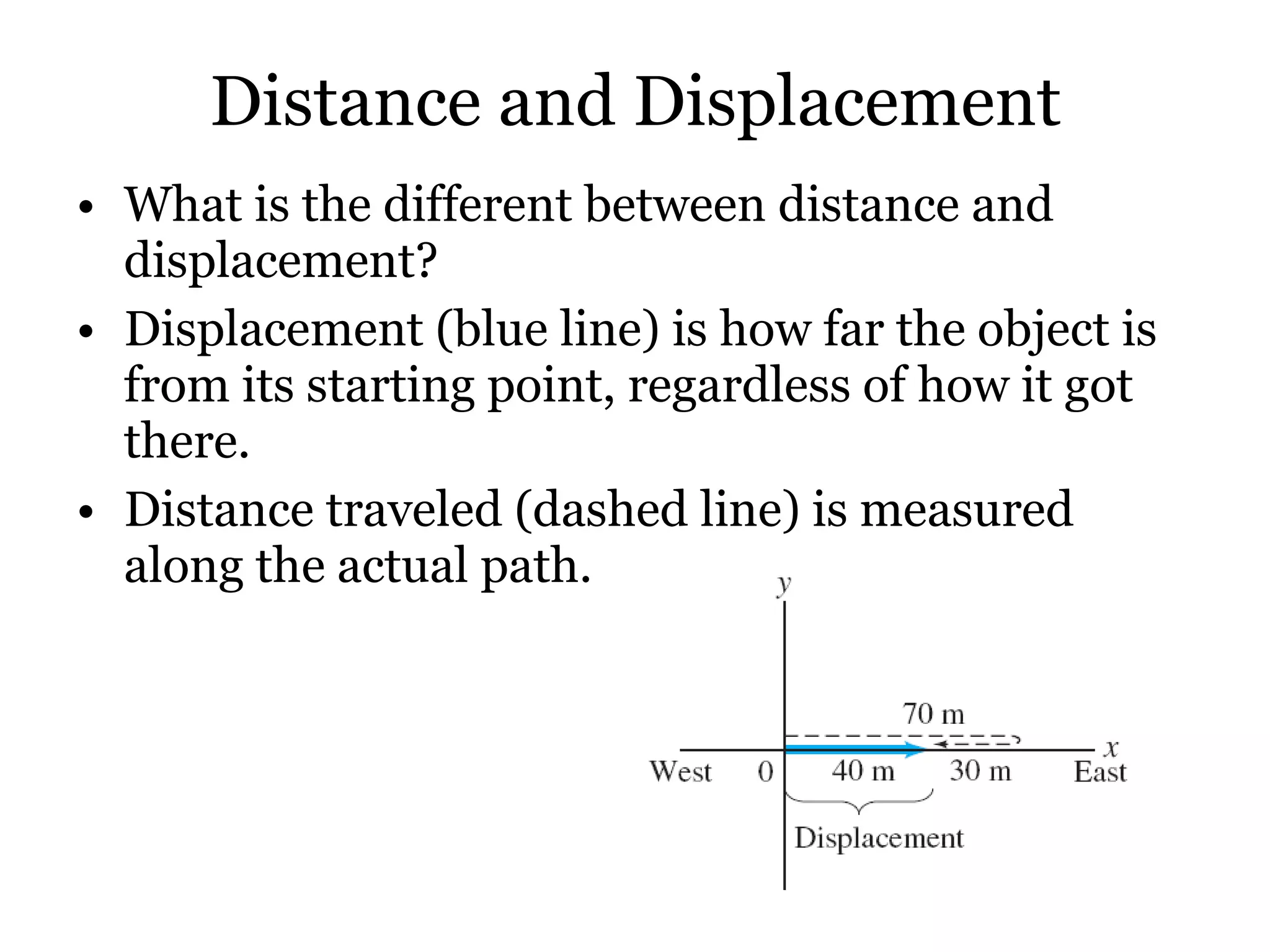
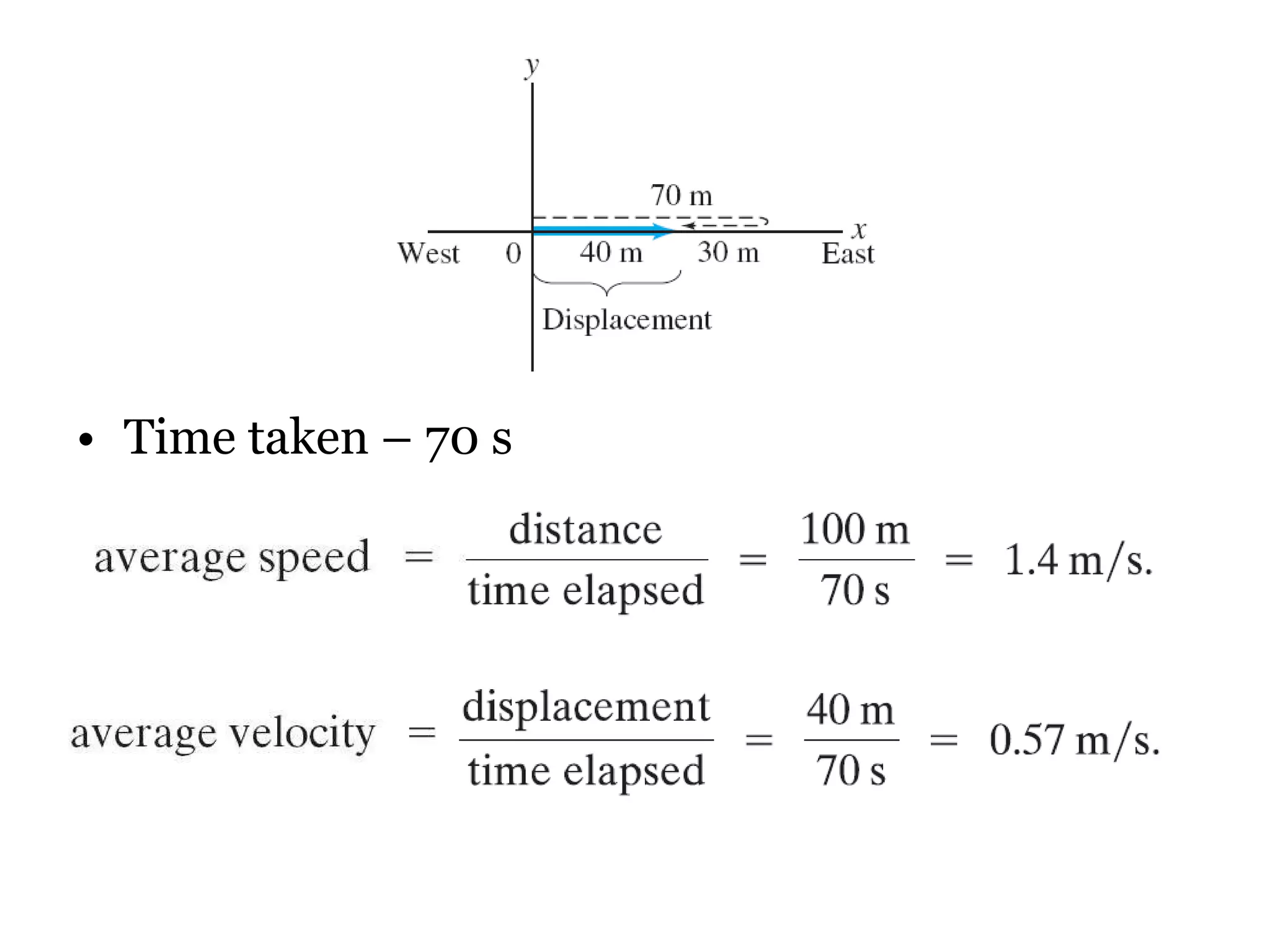
Distance and Displacement What is the different between distance and displacement?  Displacement (blue line) is how far the object is from its starting point, regardless of how it got there. Distance traveled (dashed line) is measured along the actual path.
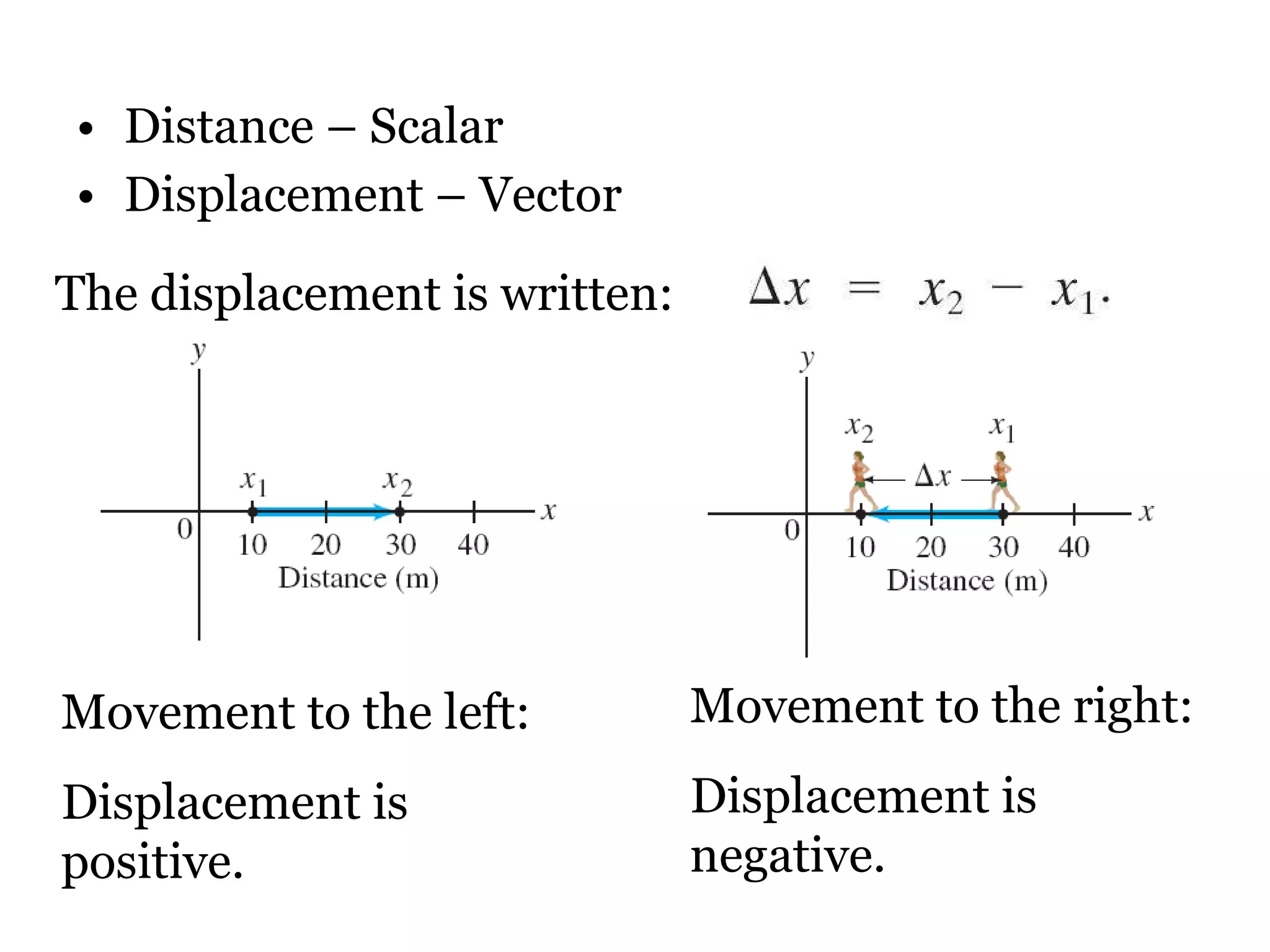
Distance – Scalar Displacement – Vector The displacement is written: Movement to the left:  Displacement is positive.  Movement to the right:  Displacement is negative.
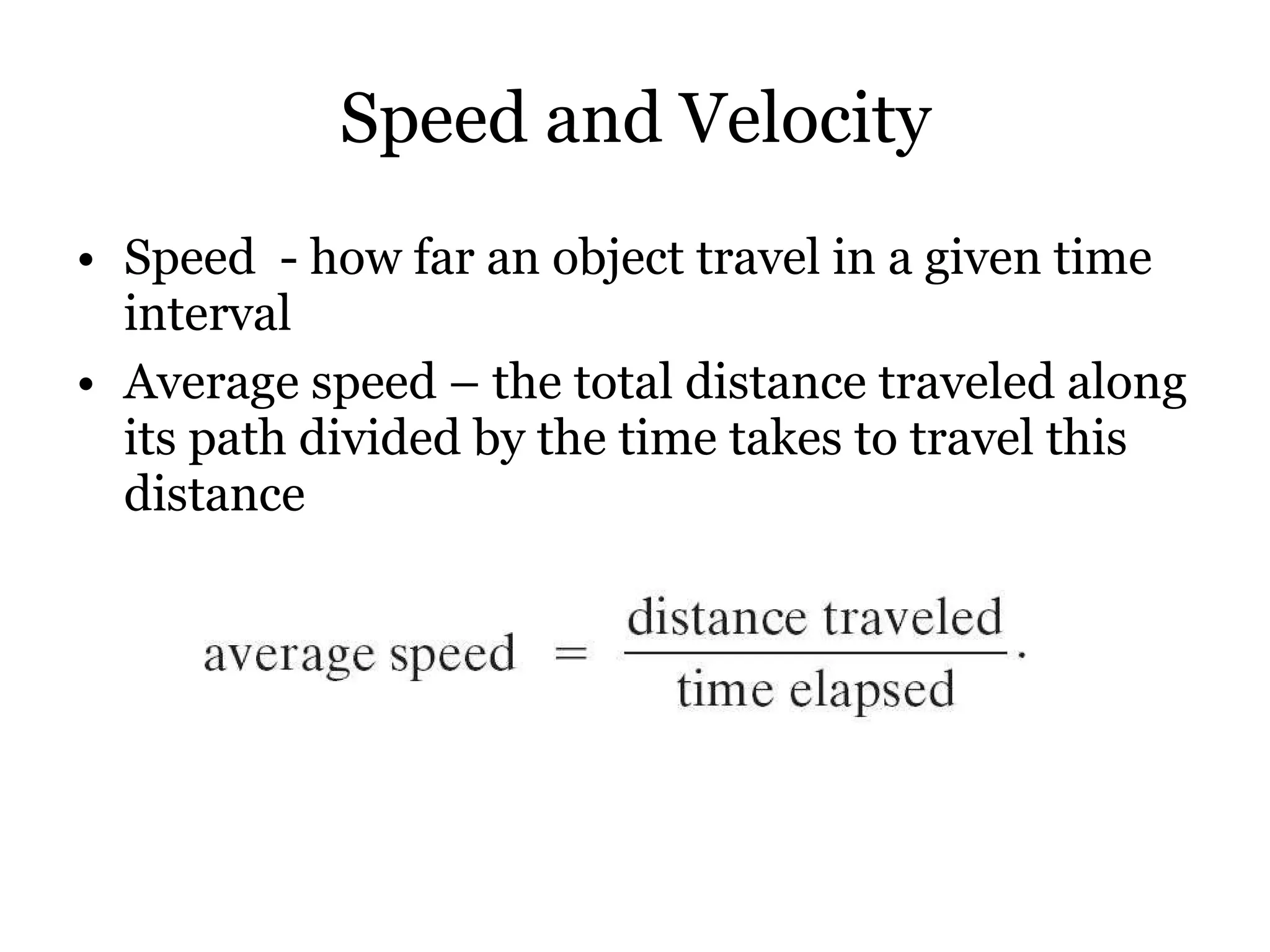
Speed and Velocity Speed  - how far an object travel in a given time interval Average speed – the total distance traveled along its path divided by the time takes to travel this distance
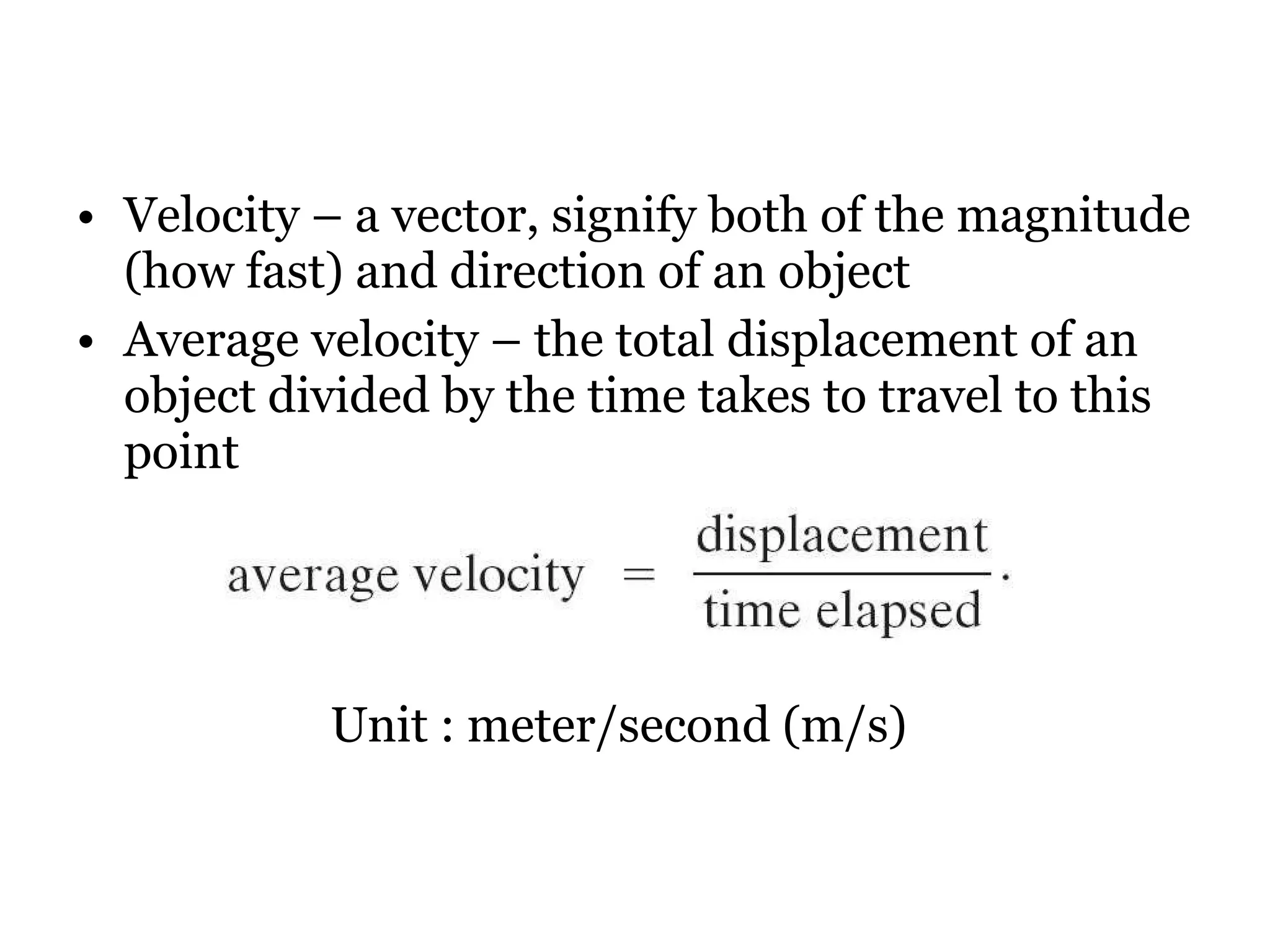
Velocity – a vector, signify both of the magnitude (how fast) and direction of an object Average velocity – the total displacement of an object divided by the time takes to travel to this point Unit : meter/second (m/s)
Time taken – 70 s
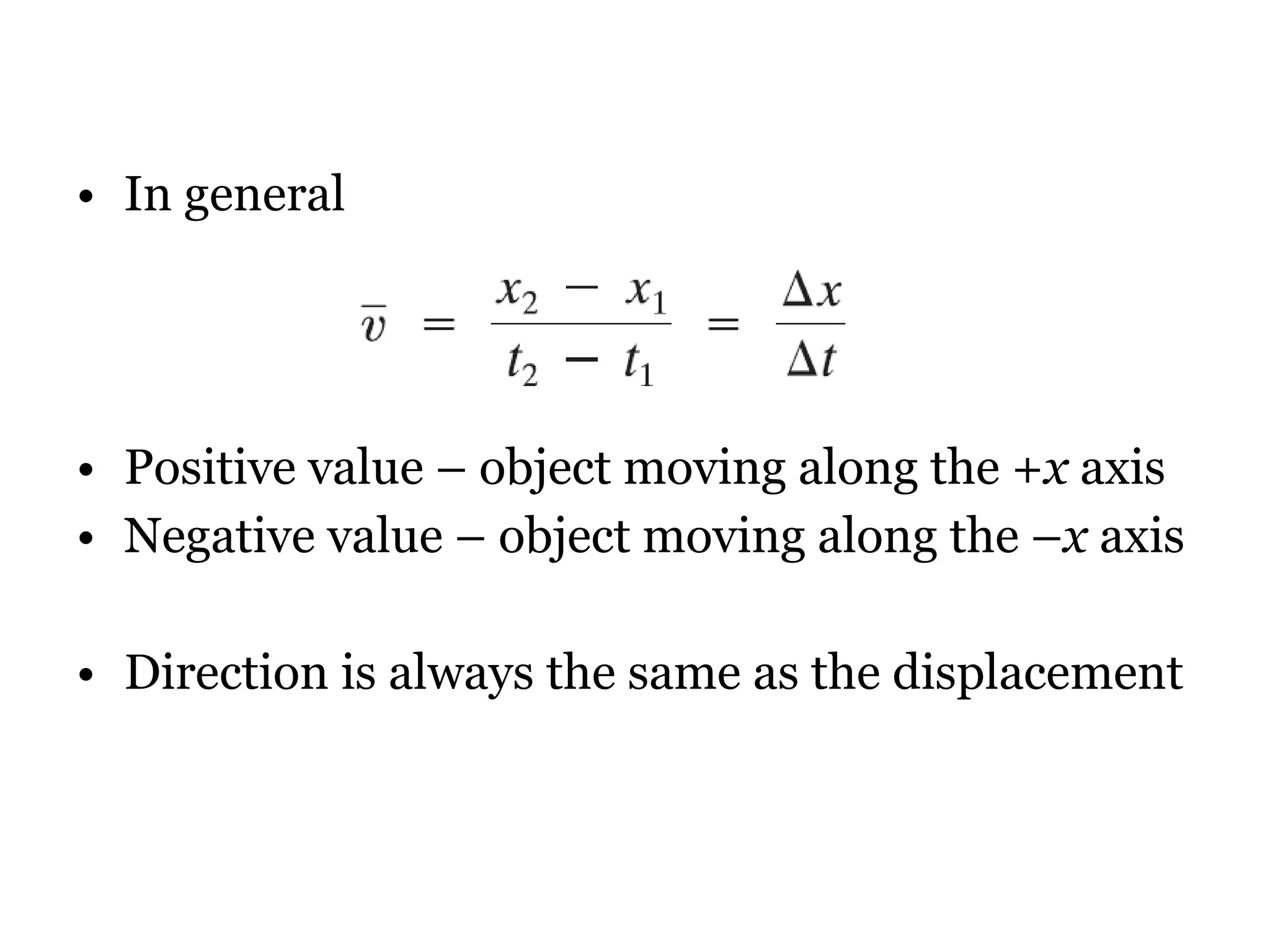
In general Positive value – object moving along the + x  axis Negative value – object moving along the – x  axis Direction is always the same as the displacement
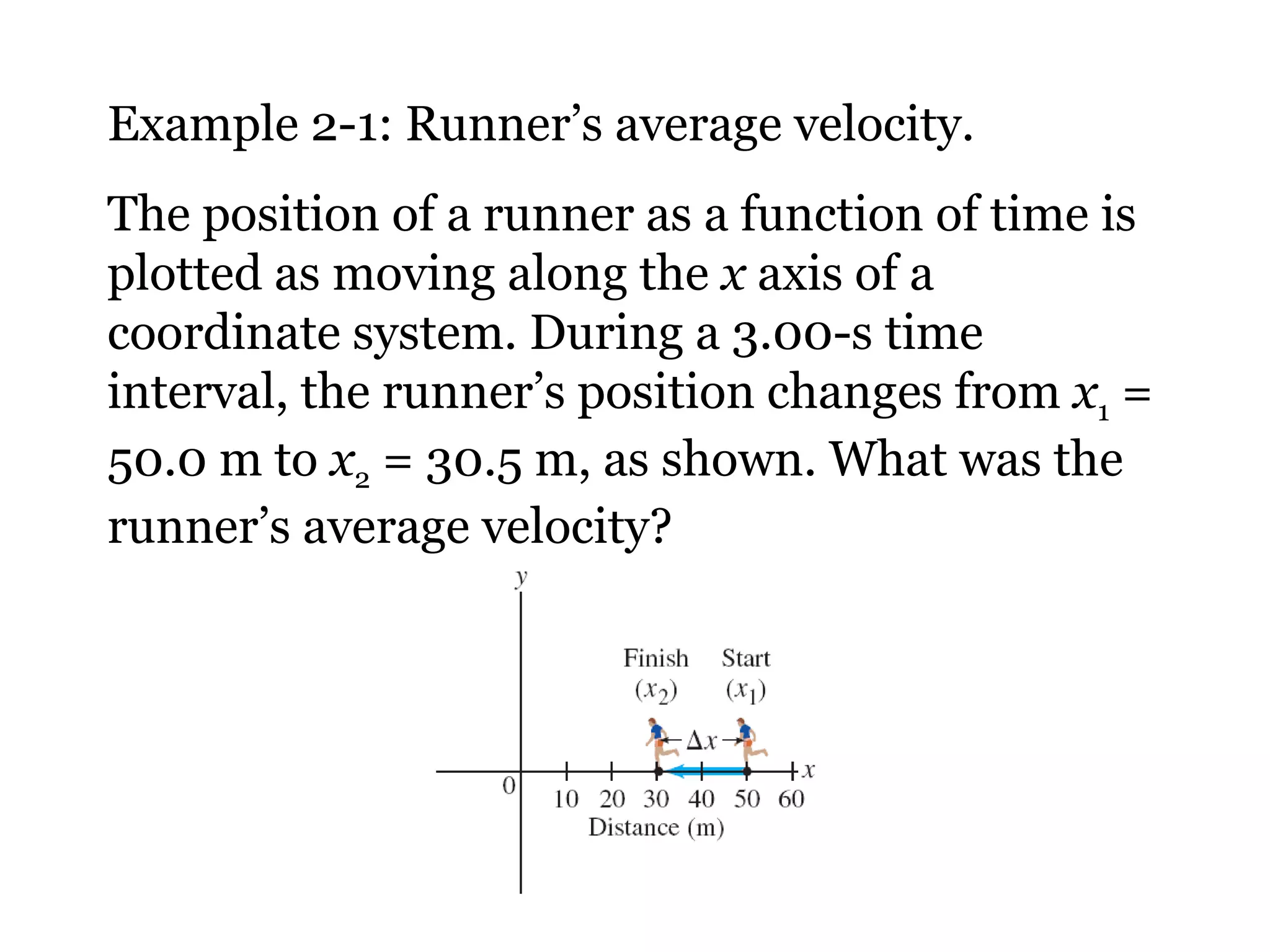
Example 2-1: Runner’s average velocity. The position of a runner as a function of time is plotted as moving along the  x  axis of a coordinate system. During a 3.00-s time interval, the runner’s position changes from  x 1  = 50.0 m to  x 2  = 30.5 m, as shown. What was the runner’s average velocity?
Example 2-2: Distance a cyclist travels. How far can a cyclist travel in 2.5 h along a straight road if her average velocity is 18 km/h?
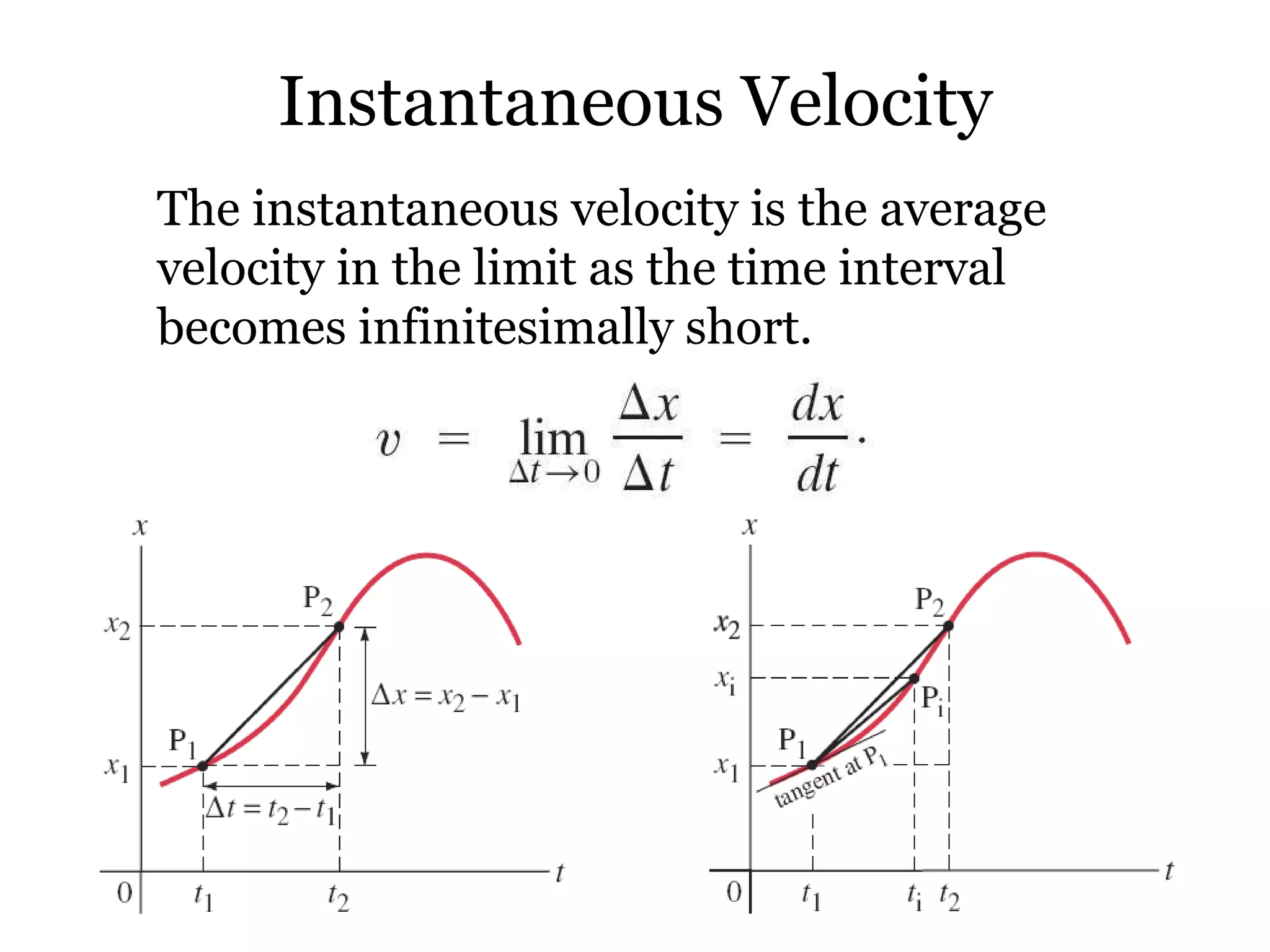
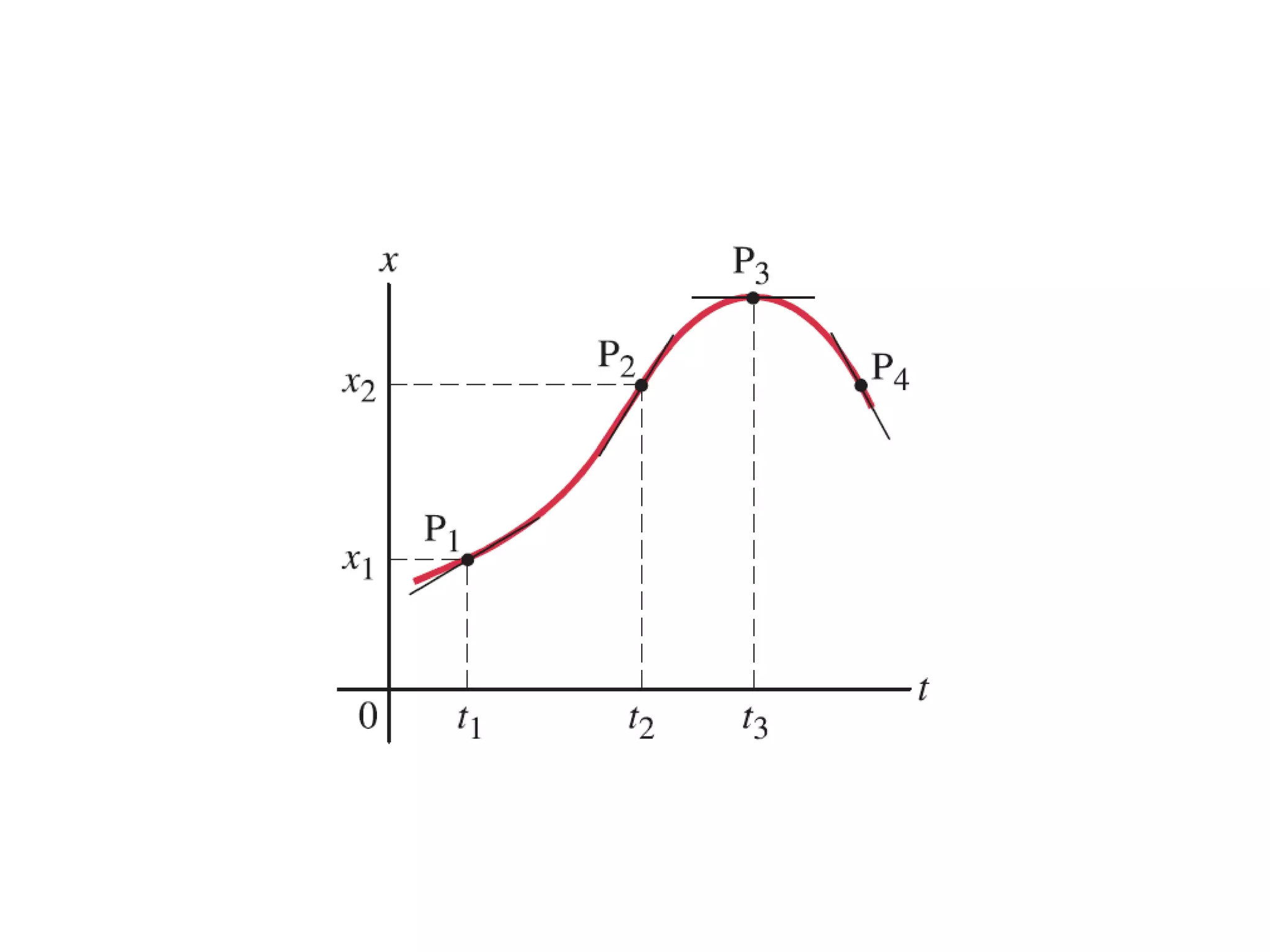
Instantaneous Velocity The instantaneous velocity is the average velocity in the limit as the time interval becomes infinitesimally short.
 
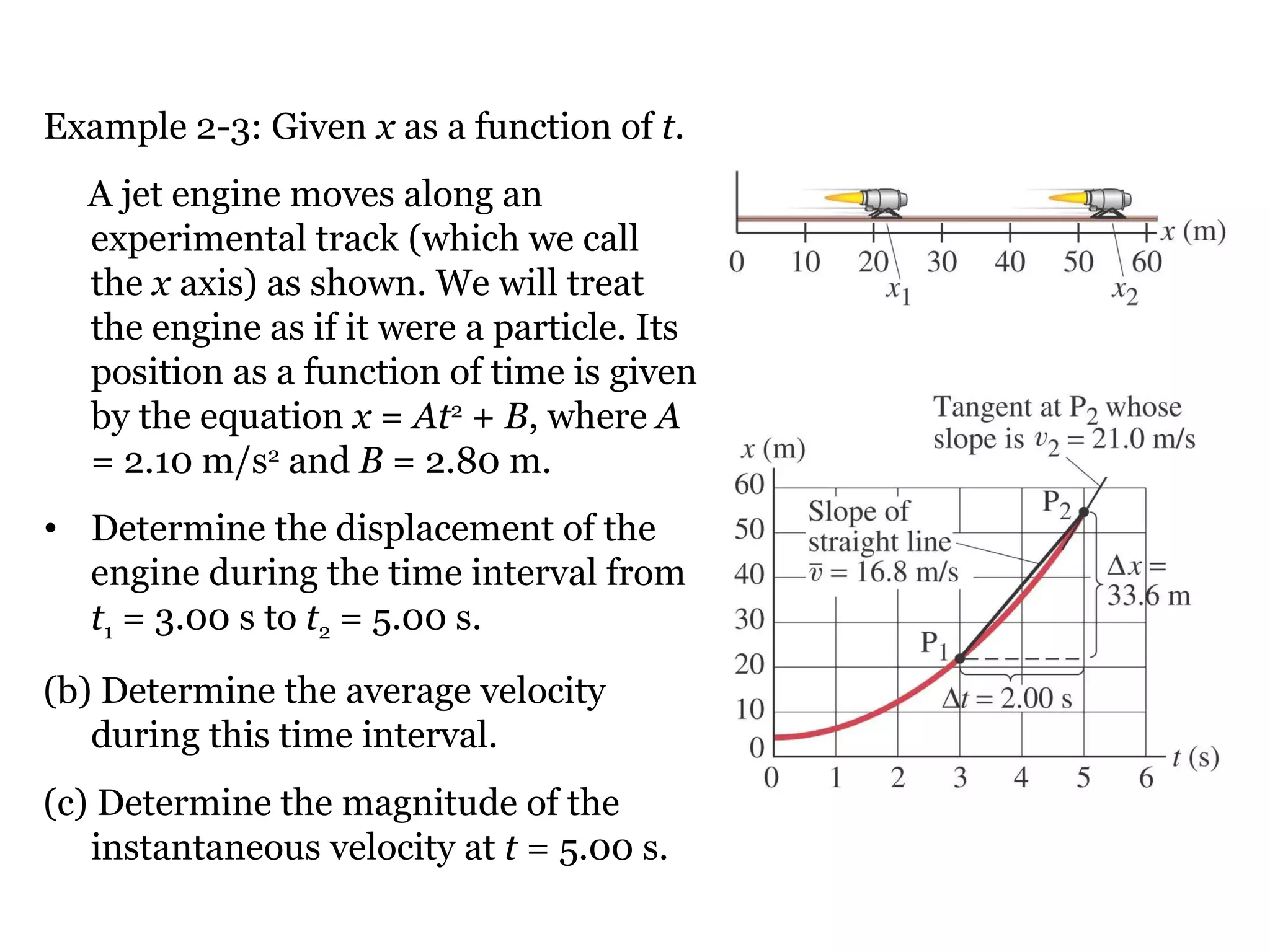
Example 2-3: Given  x  as a function of  t . A jet engine moves along an experimental track (which we call the  x  axis) as shown. We will treat the engine as if it were a particle. Its position as a function of time is given by the equation  x  =  At 2  +  B , where  A  = 2.10 m/s 2  and  B  = 2.80 m.  Determine the displacement of the engine during the time interval from  t 1  = 3.00 s to  t 2  = 5.00 s. (b) Determine the average velocity during this time interval.  (c) Determine the magnitude of the instantaneous velocity at  t  = 5.00 s.
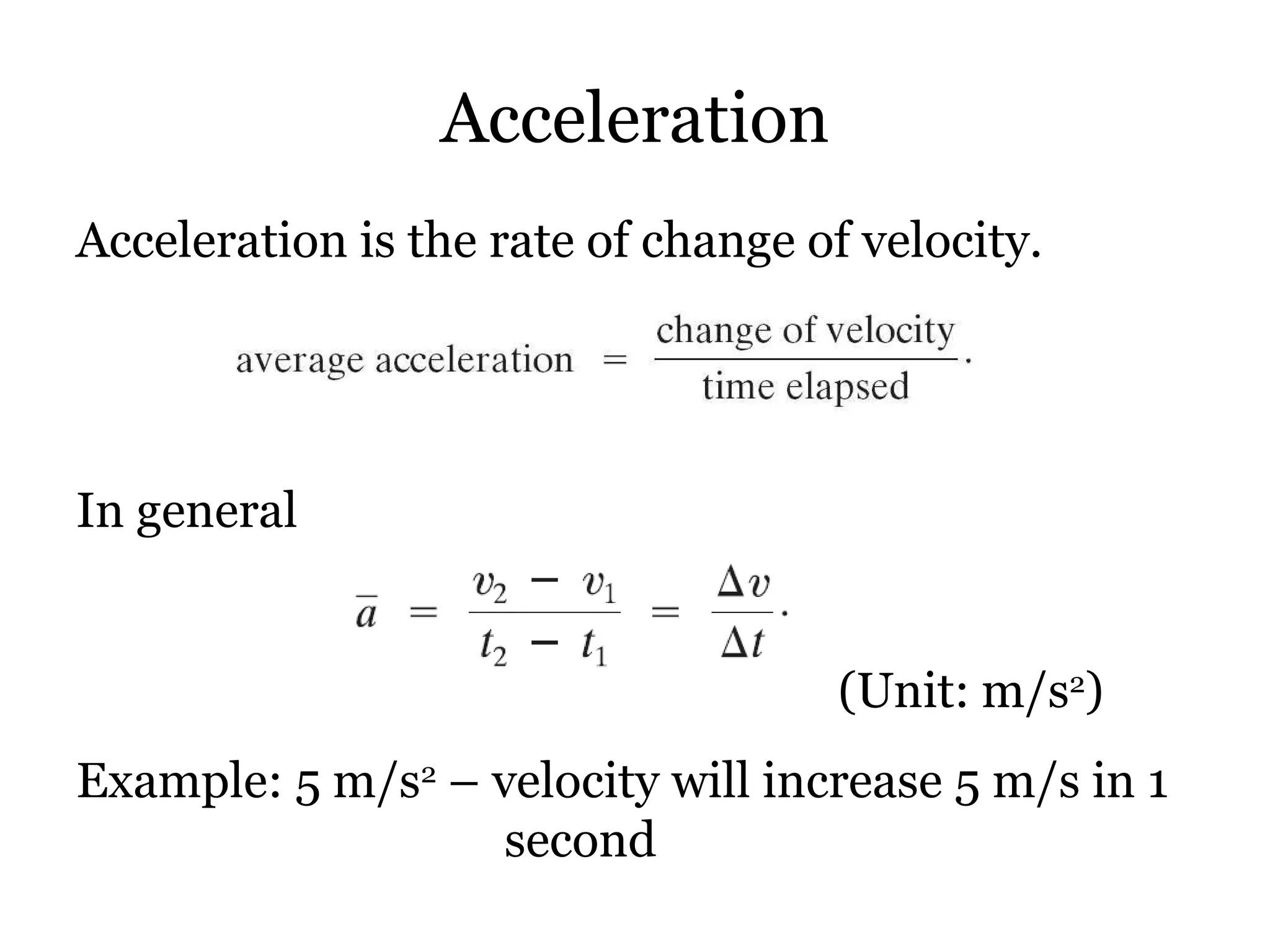
Acceleration Acceleration is the rate of change of velocity. In general (Unit: m/s 2 ) Example: 5 m/s 2  – velocity will increase 5 m/s in 1    second
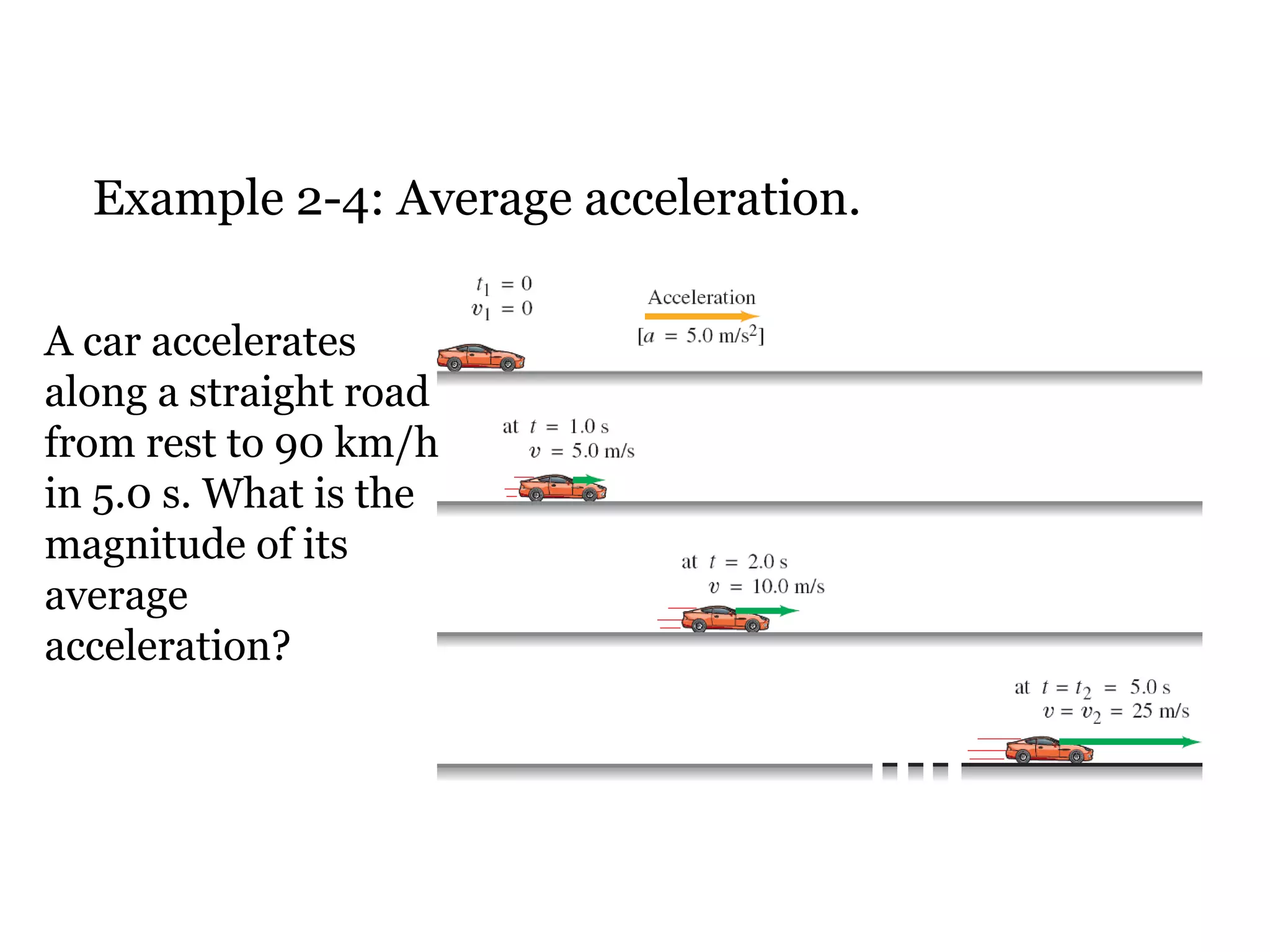
Example 2-4: Average acceleration. A car accelerates along a straight road from rest to 90 km/h in 5.0 s. What is the magnitude of its average acceleration?
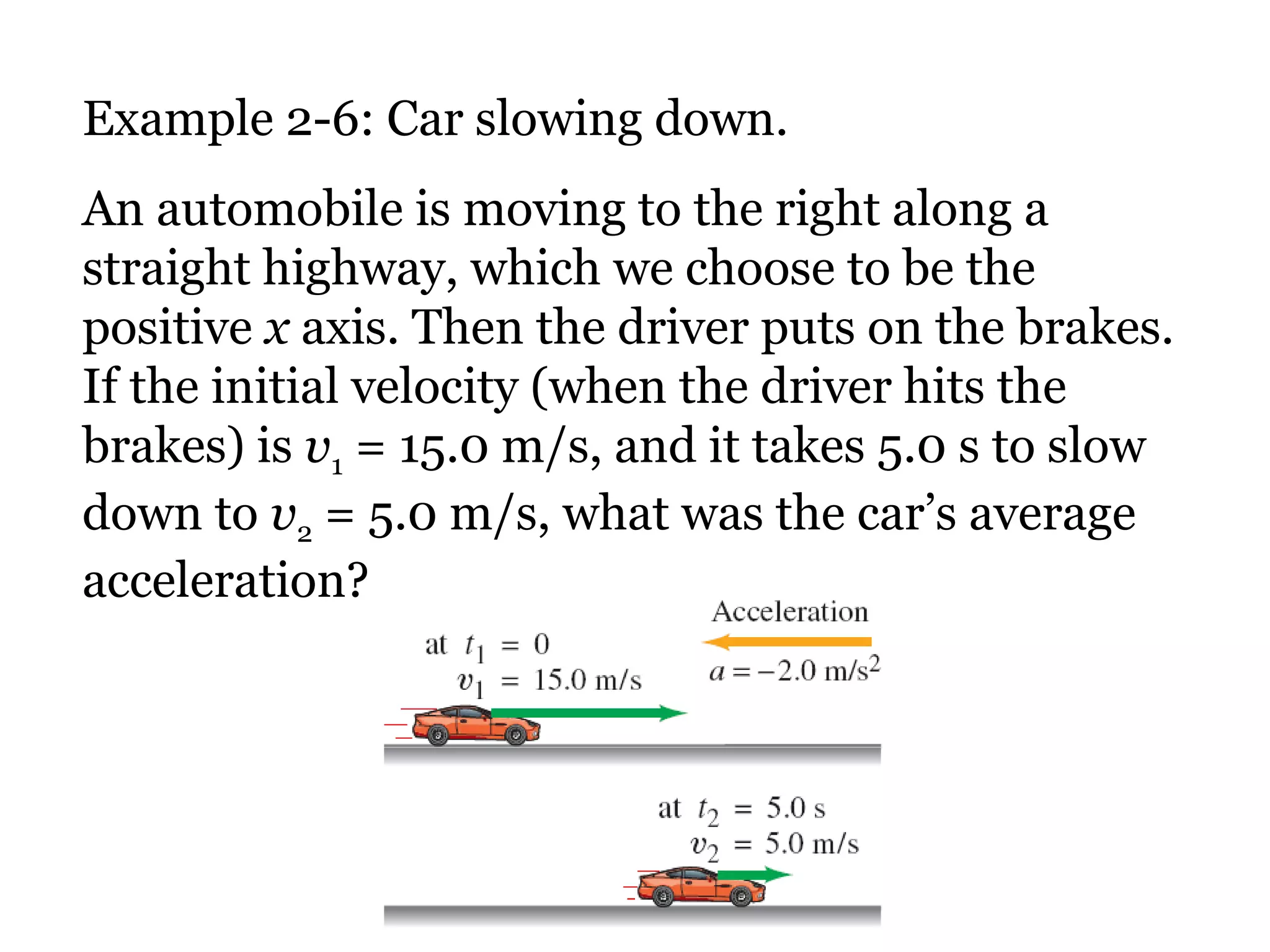
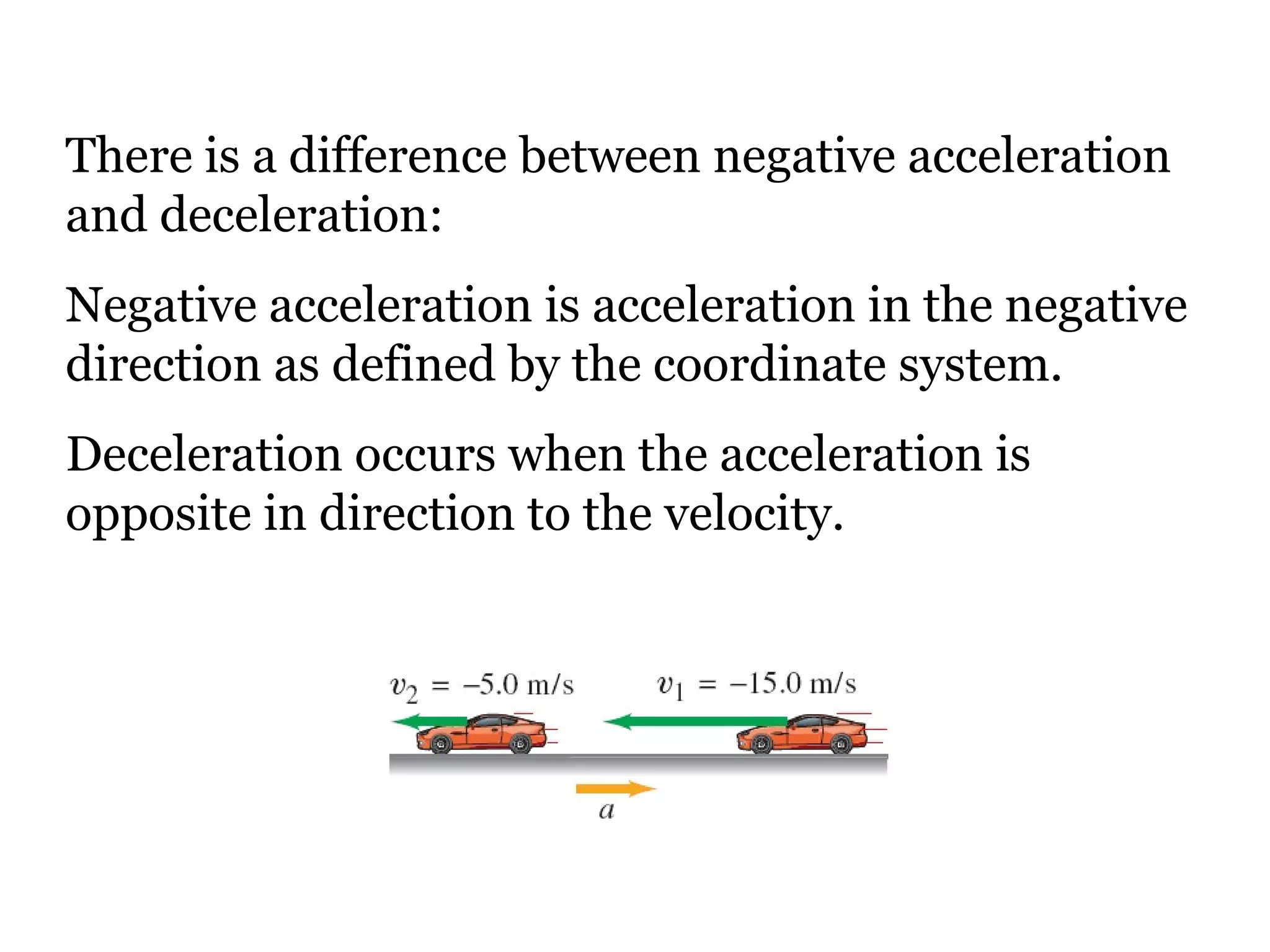
Example 2-6: Car slowing down. An automobile is moving to the right along a straight highway, which we choose to be the positive  x  axis. Then the driver puts on the brakes. If the initial velocity (when the driver hits the brakes) is  v 1  = 15.0 m/s, and it takes 5.0 s to slow down to  v 2  = 5.0 m/s, what was the car’s average acceleration?
There is a difference between negative acceleration and deceleration:  Negative acceleration is acceleration in the negative direction as defined by the coordinate system. Deceleration occurs when the acceleration is opposite in direction to the velocity.
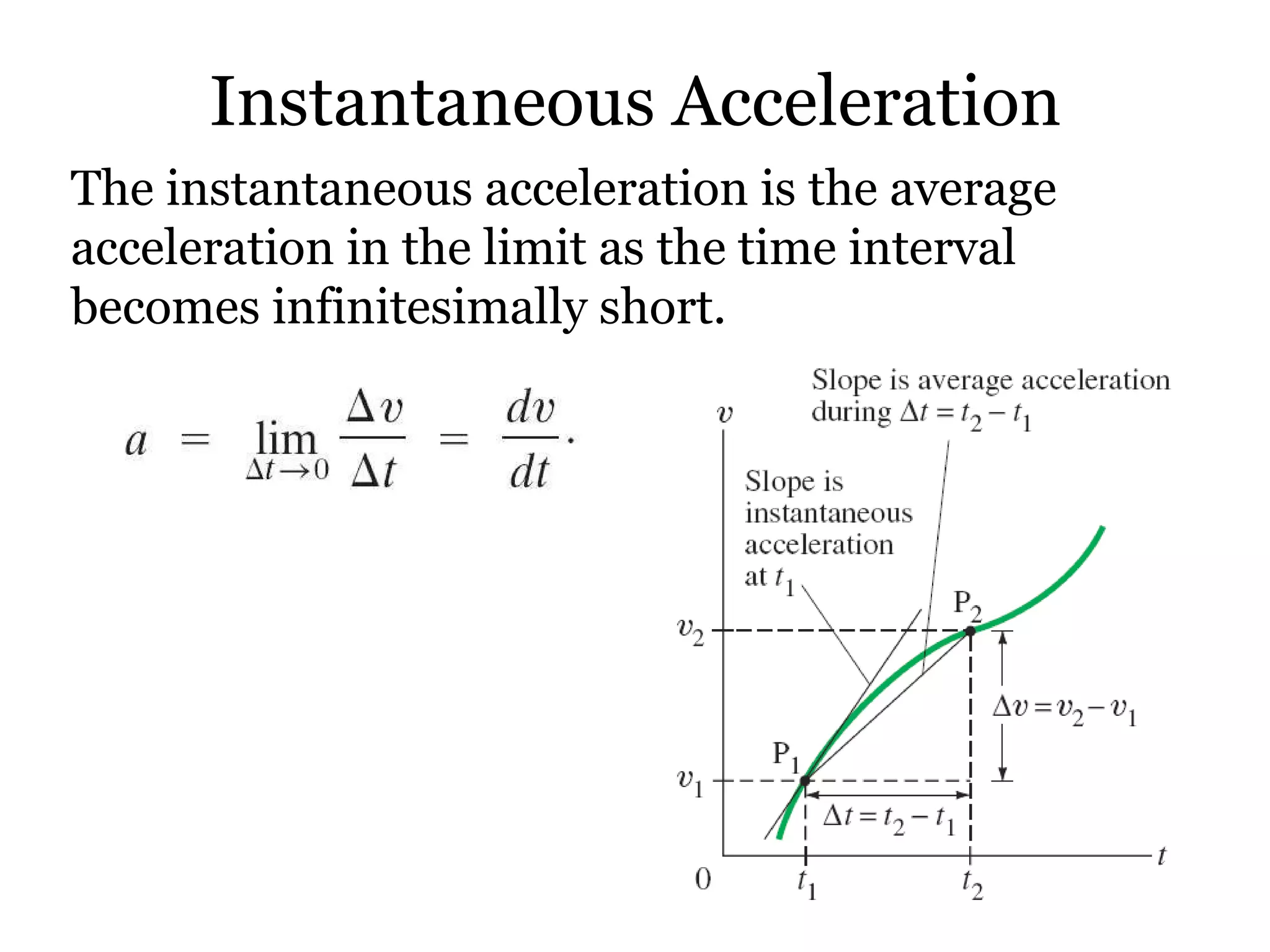
Instantaneous Acceleration The instantaneous acceleration is the average acceleration in the limit as the time interval becomes infinitesimally short.
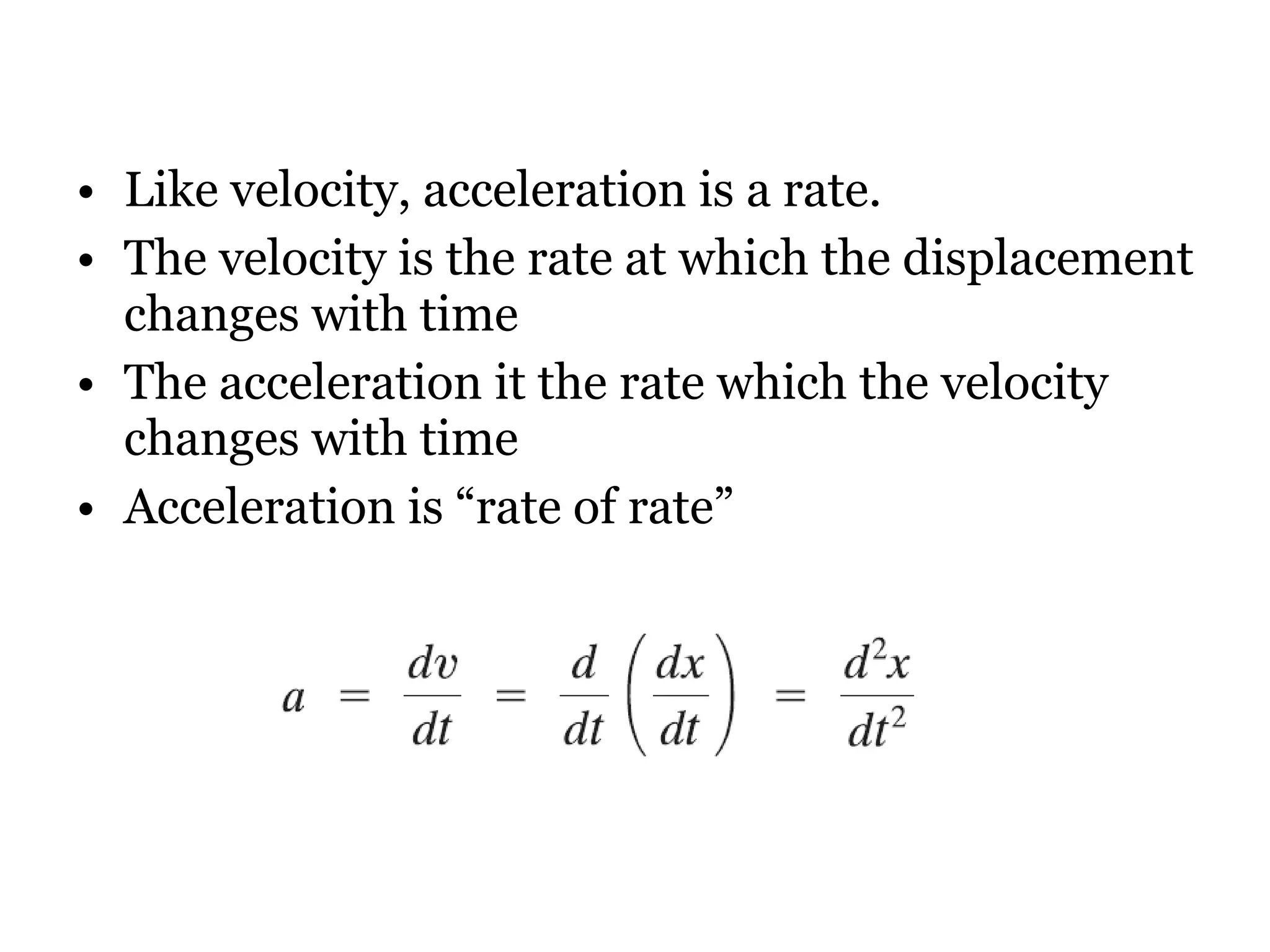
Like velocity, acceleration is a rate.  The velocity is the rate at which the displacement changes with time The acceleration it the rate which the velocity changes with time Acceleration is “rate of rate”
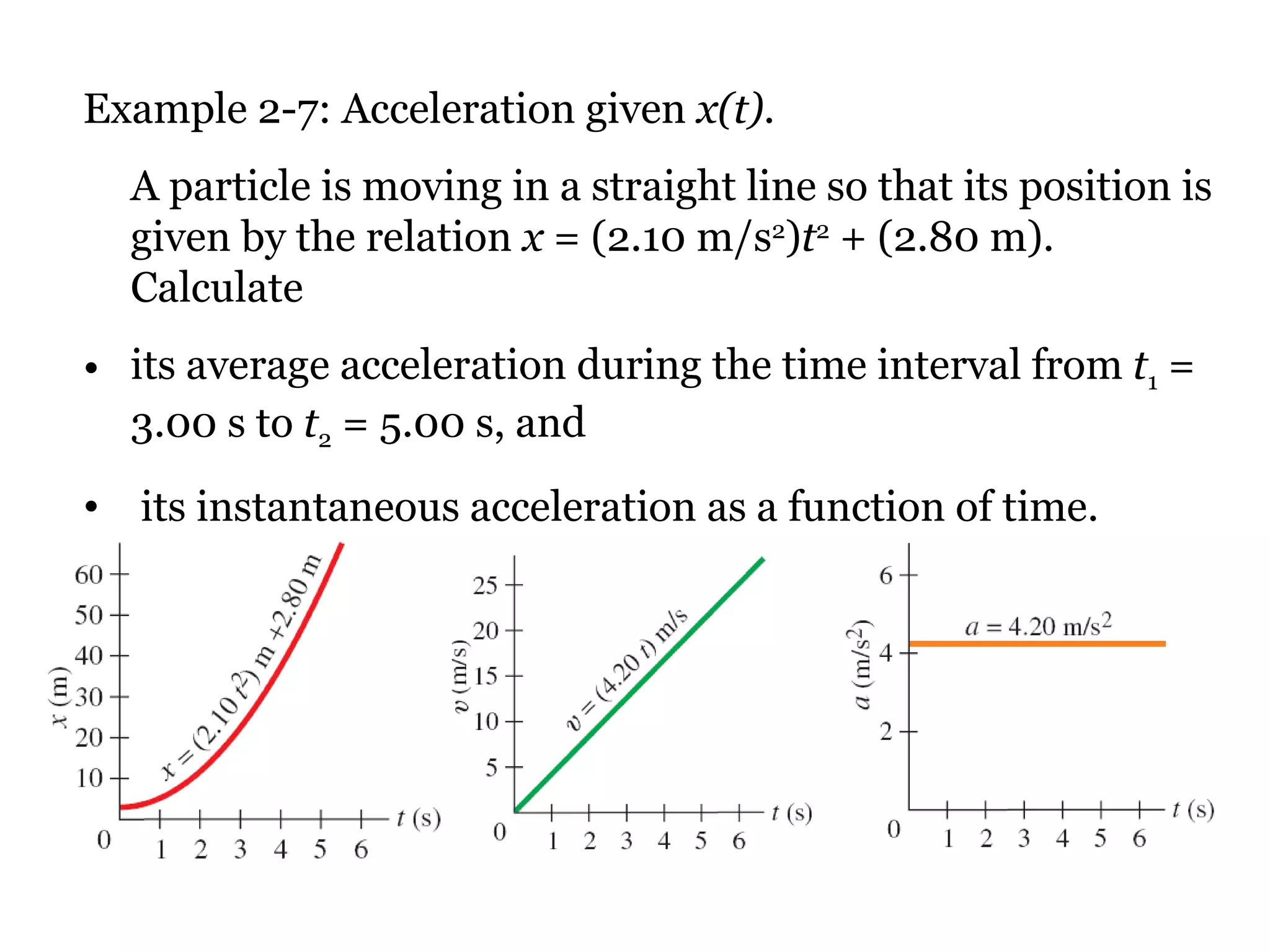
Example 2-7: Acceleration given  x(t). A particle is moving in a straight line so that its position is given by the relation  x  = (2.10 m/s 2 ) t 2  + (2.80 m). Calculate  its average acceleration during the time interval from  t 1  = 3.00 s to  t 2  = 5.00 s, and  its instantaneous acceleration as a function of time.
You and your dog go for a walk to the park.  On the way, your dog takes many side trips to chase squirrels or examine fire hydrants.  When you arrive at the park, do you and your dog have the same displacement? 1)  yes 2)  no ConcepTest 2.1 Walking the Dog
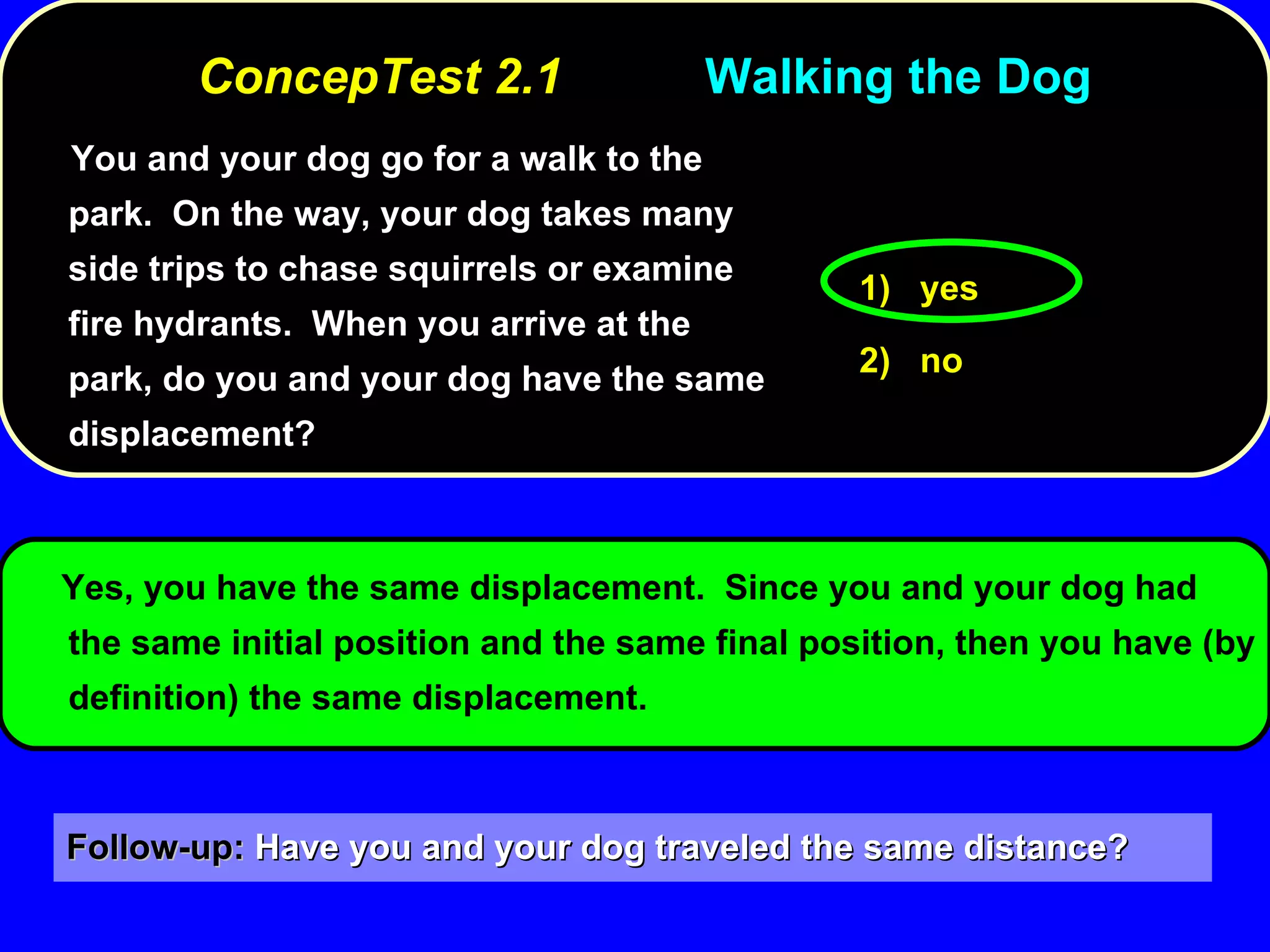
You and your dog go for a walk to the park.  On the way, your dog takes many side trips to chase squirrels or examine fire hydrants.  When you arrive at the park, do you and your dog have the same displacement? 1)  yes 2)  no Yes, you have the same displacement.  Since you and your dog had the same initial position and the same final position, then you have (by definition) the same displacement.   ConcepTest 2.1 Walking the Dog Follow-up:  Have you and your dog traveled the same distance?
ConcepTest 2.2 Displacement Does the displacement of an object depend on the specific location of the origin of the coordinate system? 1)  yes 2)  no 3)  it depends on the coordinate system
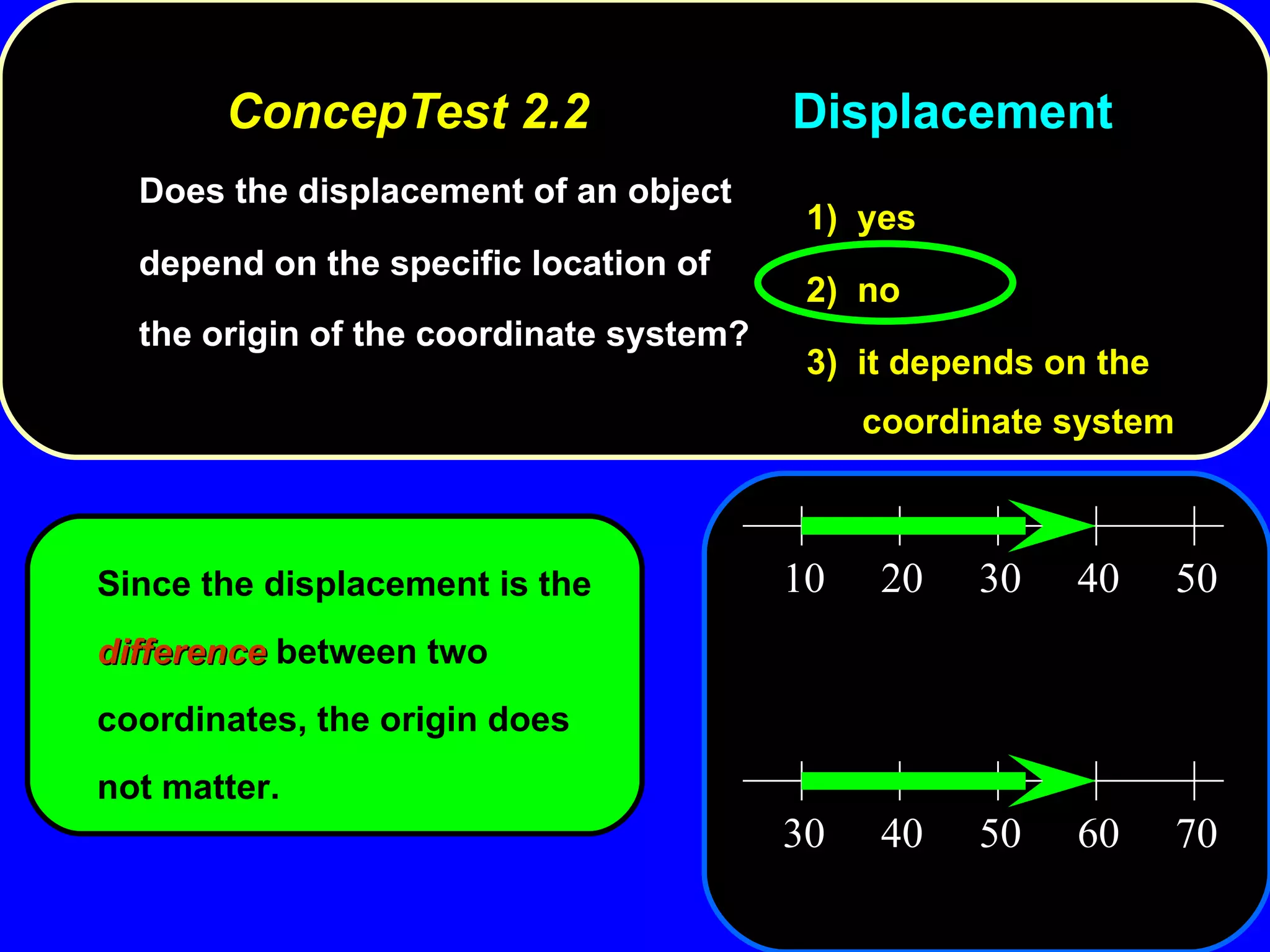
ConcepTest 2.2 Displacement Does the displacement of an object depend on the specific location of the origin of the coordinate system? Since the displacement is the  difference  between two coordinates, the origin does not matter. 1)  yes 2)  no 3)  it depends on the coordinate system 10 20 30 40 50 30 40 50 60 70
If the position of a car is zero, does its speed have to be zero? 1)  yes 2)  no 3) it depends on the position ConcepTest 2.3 Position and Speed
If the position of a car is zero, does its speed have to be zero? 1)  yes 2)  no 3) it depends on the position No, the speed does not depend on position; it depends on the  change  of position.  Since we know that the displacement does not depend on the origin of the coordinate system, an object can easily start at  x  =  – 3 and be moving by the time it gets to  x  = 0.  ConcepTest 2.3 Position and Speed
You drive for 30 minutes at 30 mi/hr and then for another  30 minutes at 50 mi/hr.  What is your average speed for the whole trip? 1)  more than 40 mi/hr 2)  equal to 40 mi/hr 3)  less than 40 mi/hr ConcepTest 2.6a  Cruising Along I
You drive for 30 minutes at 30 mi/hr and then for another  30 minutes at 50 mi/hr.  What is your average speed for the whole trip? 1)  more than 40 mi/hr 2)  equal to 40 mi/hr 3)  less than 40 mi/hr It is 40 mi/hr in this case.  Since the average speed is distance/time and you spend the same amount of time at each speed, then your average speed would indeed be 40 mi/hr. ConcepTest 2.6a  Cruising Along I
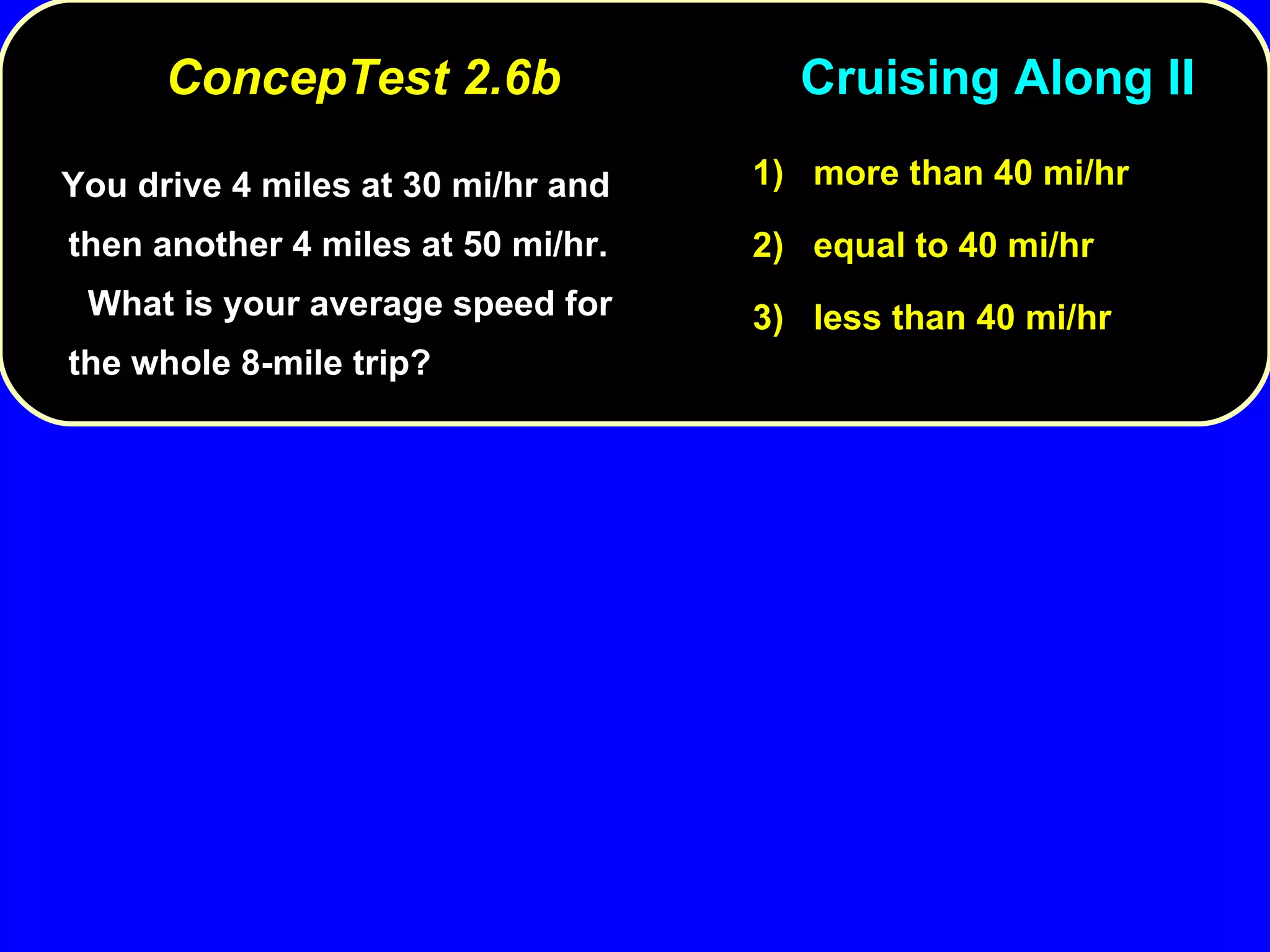
You drive 4 miles at 30 mi/hr and then another 4 miles at 50 mi/hr.  What is your average speed for the whole 8-mile trip? 1)  more than 40 mi/hr 2)  equal to 40 mi/hr 3)  less than 40 mi/hr ConcepTest 2.6b  Cruising Along II
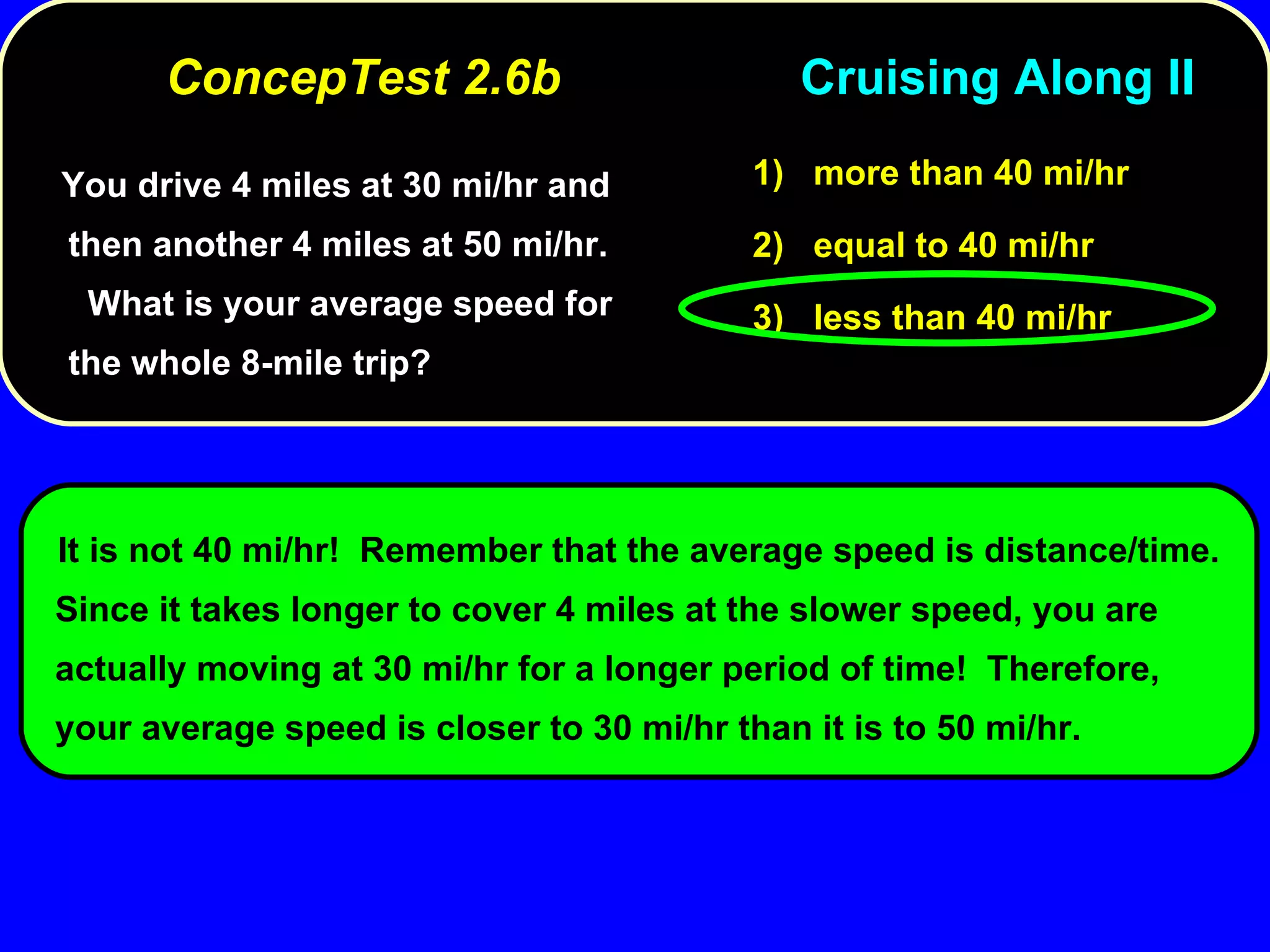
You drive 4 miles at 30 mi/hr and then another 4 miles at 50 mi/hr.  What is your average speed for the whole 8-mile trip? 1)  more than 40 mi/hr 2)  equal to 40 mi/hr 3)  less than 40 mi/hr It is not 40 mi/hr!  Remember that the average speed is distance/time.  Since it takes longer to cover 4 miles at the slower speed, you are actually moving at 30 mi/hr for a longer period of time!  Therefore, your average speed is closer to 30 mi/hr than it is to 50 mi/hr. ConcepTest 2.6b  Cruising Along II
ConcepTest 2.7 Velocity in One Dimension   If the  average  velocity is non-zero over some time interval, does this mean that the  instantaneous  velocity is  never  zero during the same interval? 1)  yes 2)  no 3) it depends
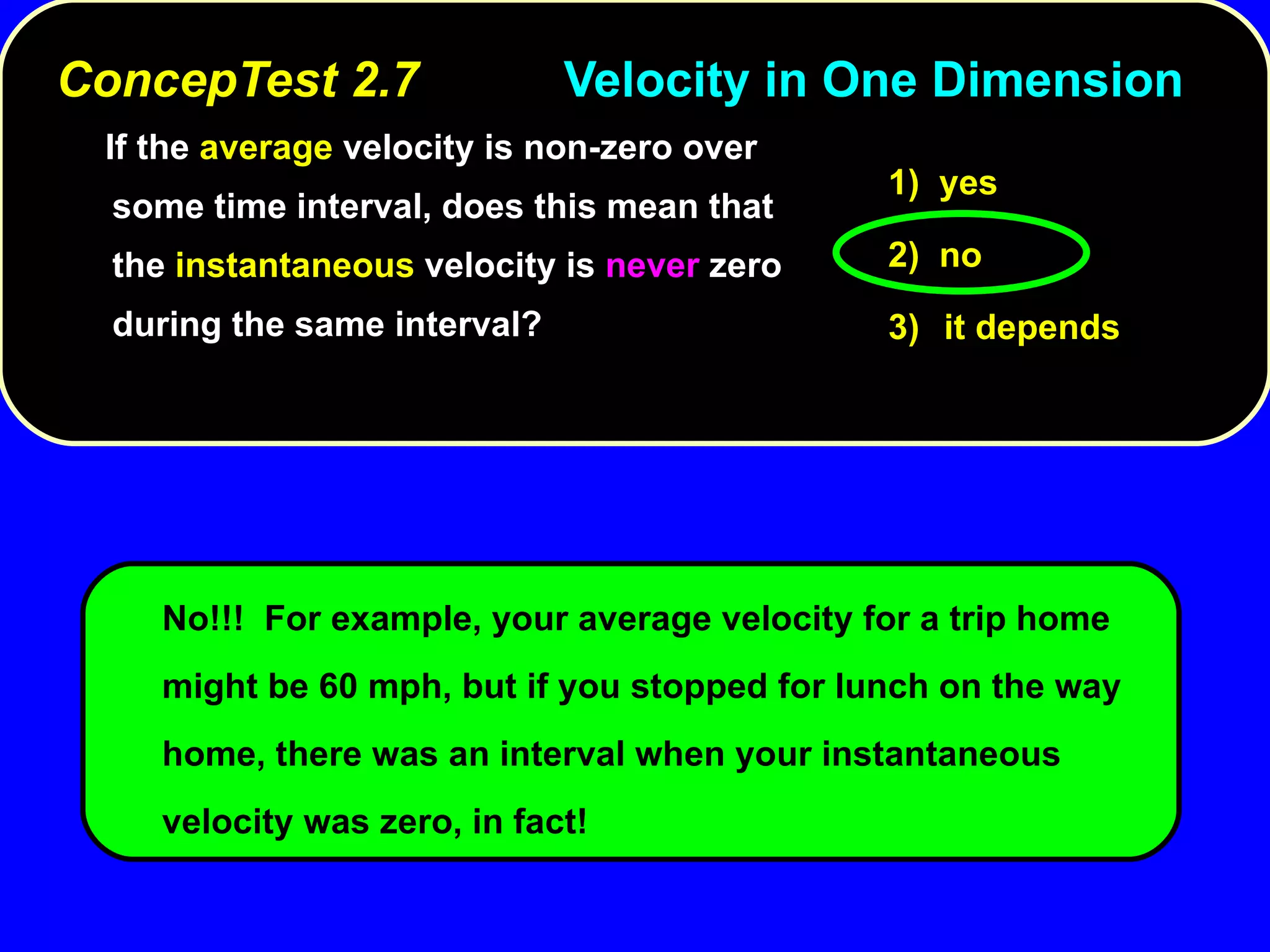
ConcepTest 2.7 Velocity in One Dimension   If the  average  velocity is non-zero over some time interval, does this mean that the  instantaneous  velocity is  never  zero during the same interval? No!!!  For example, your average velocity for a trip home might be 60 mph, but if you stopped for lunch on the way home, there was an interval when your instantaneous velocity was zero, in fact! 1)  yes 2)  no 3) it depends
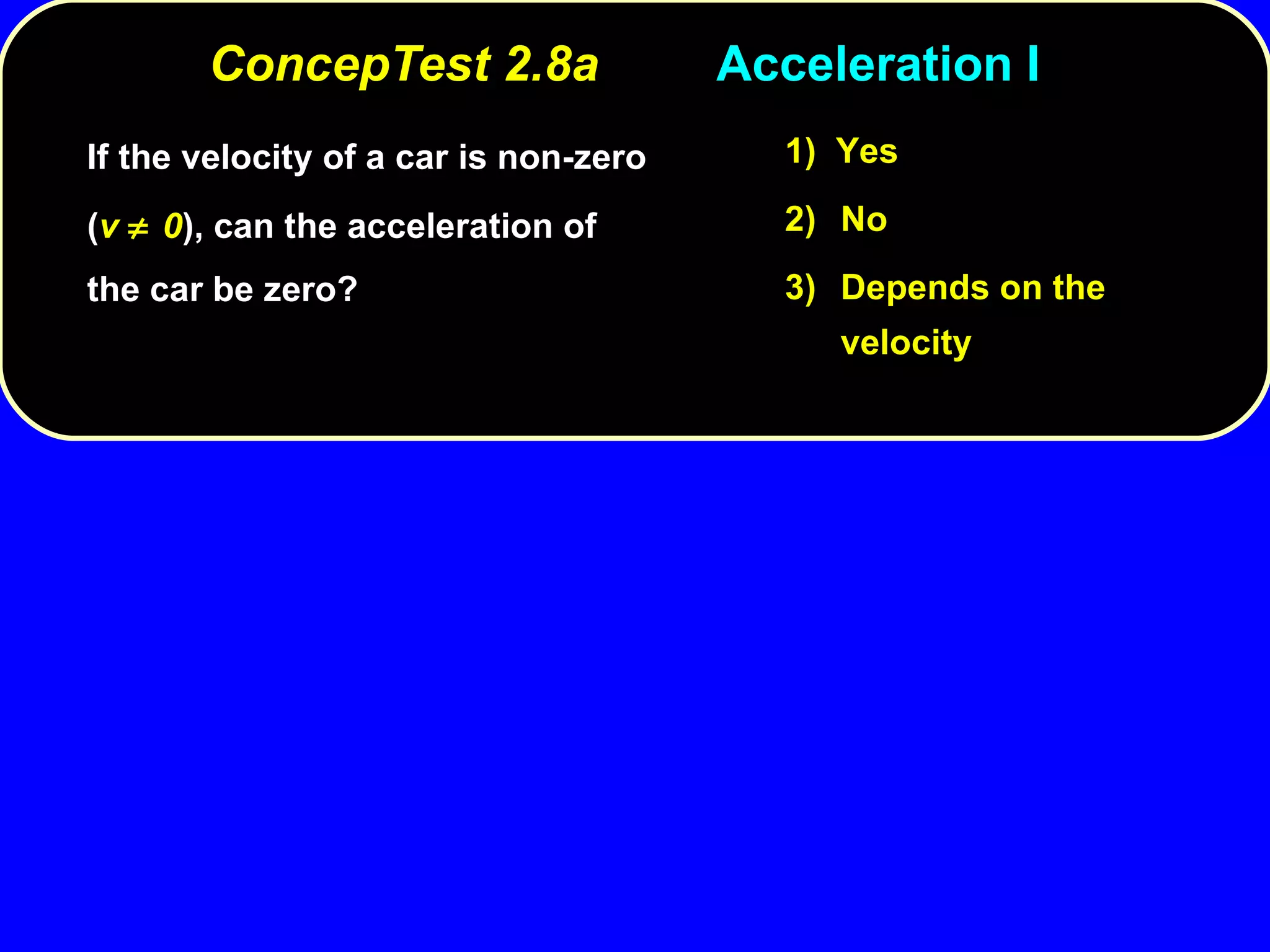
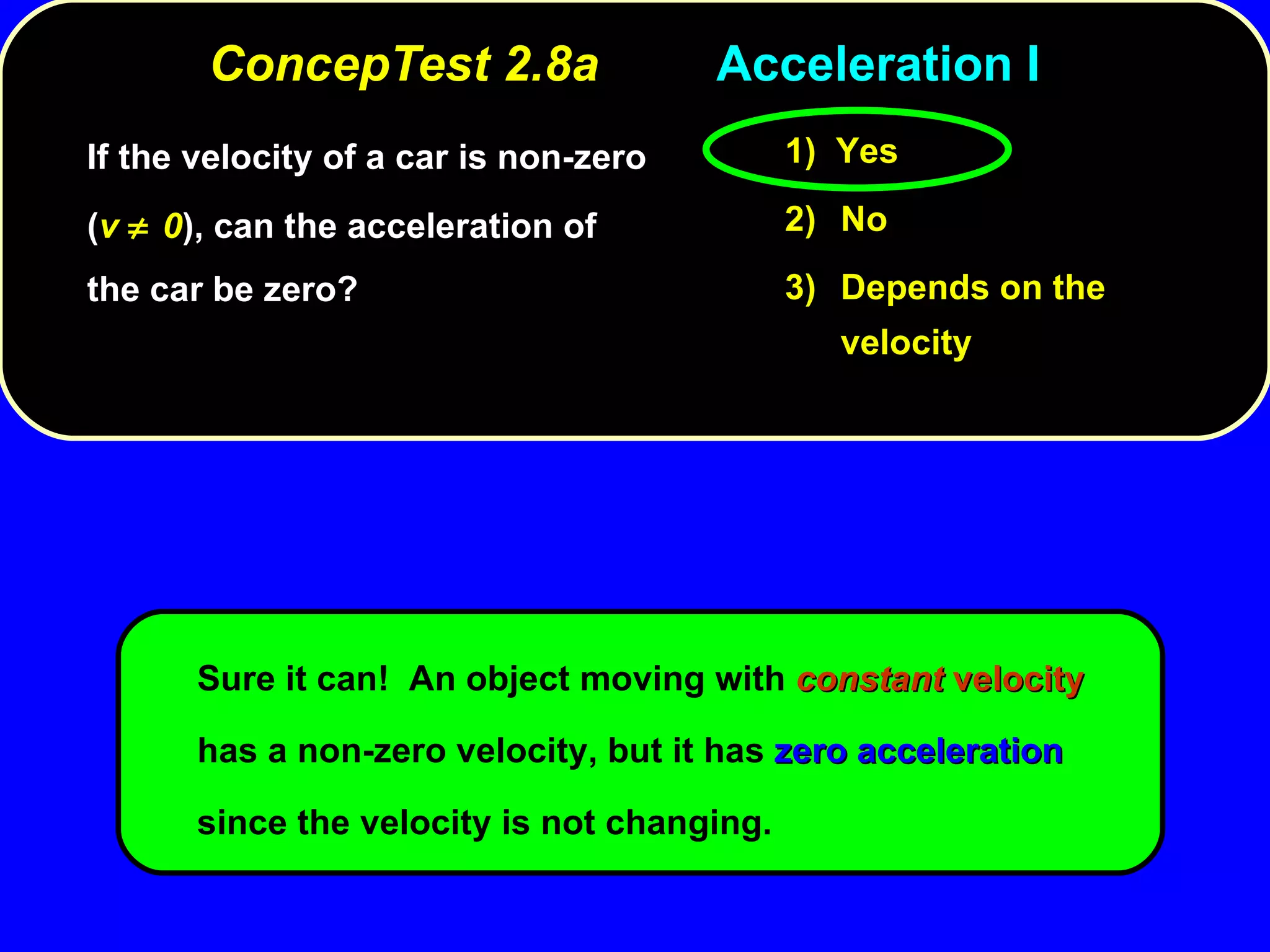
ConcepTest 2.8a Acceleration I If the velocity of a car is non-zero ( v   0 ), can the acceleration of the car be zero? 1)  Yes 2) No 3) Depends on the velocity
ConcepTest 2.8a Acceleration I If the velocity of a car is non-zero ( v   0 ), can the acceleration of the car be zero? Sure it can!  An object moving with  constant   velocity  has a non-zero velocity, but it has  zero   acceleration  since the velocity is not changing. 1)  Yes 2) No 3) Depends on the velocity
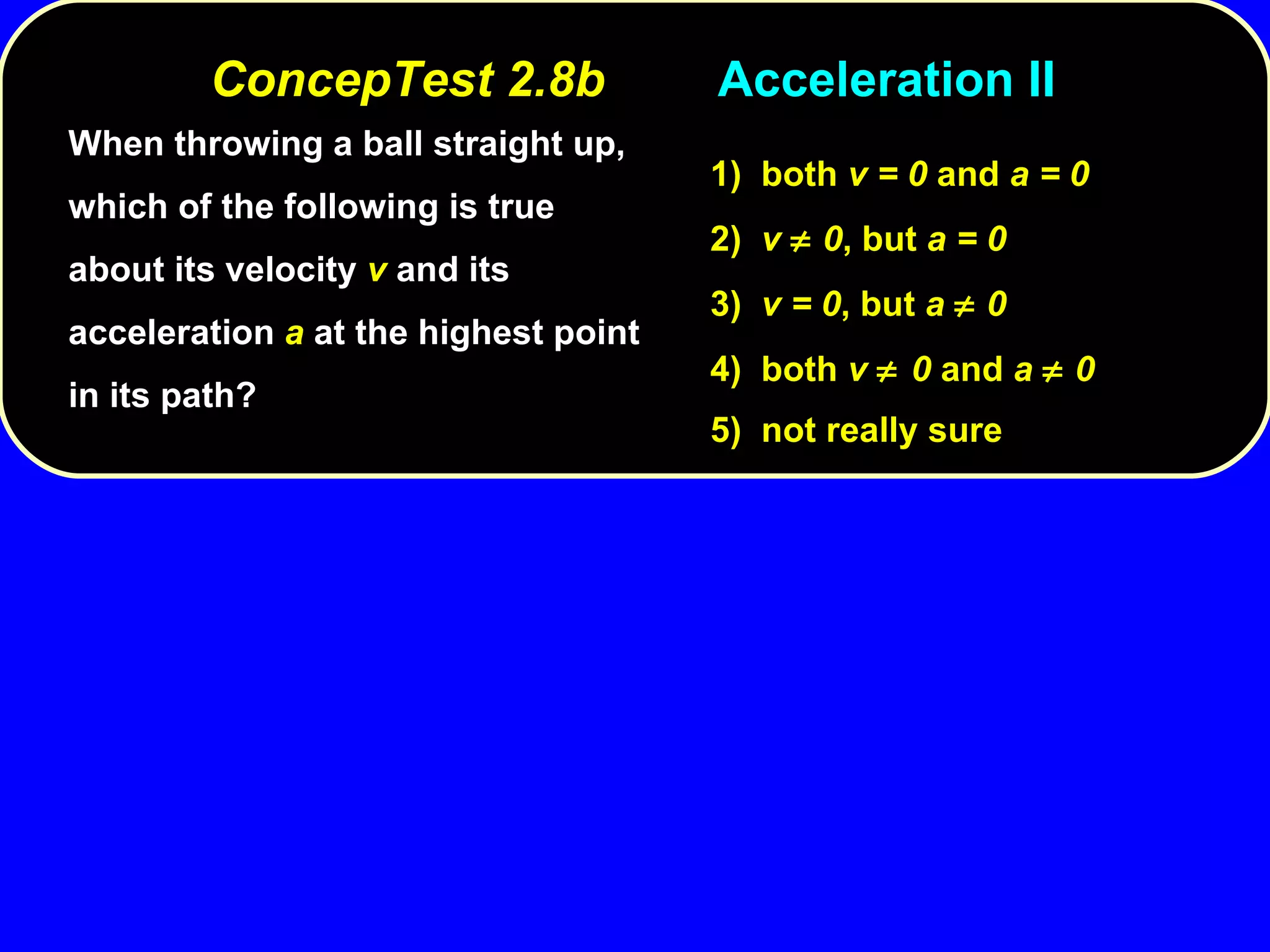
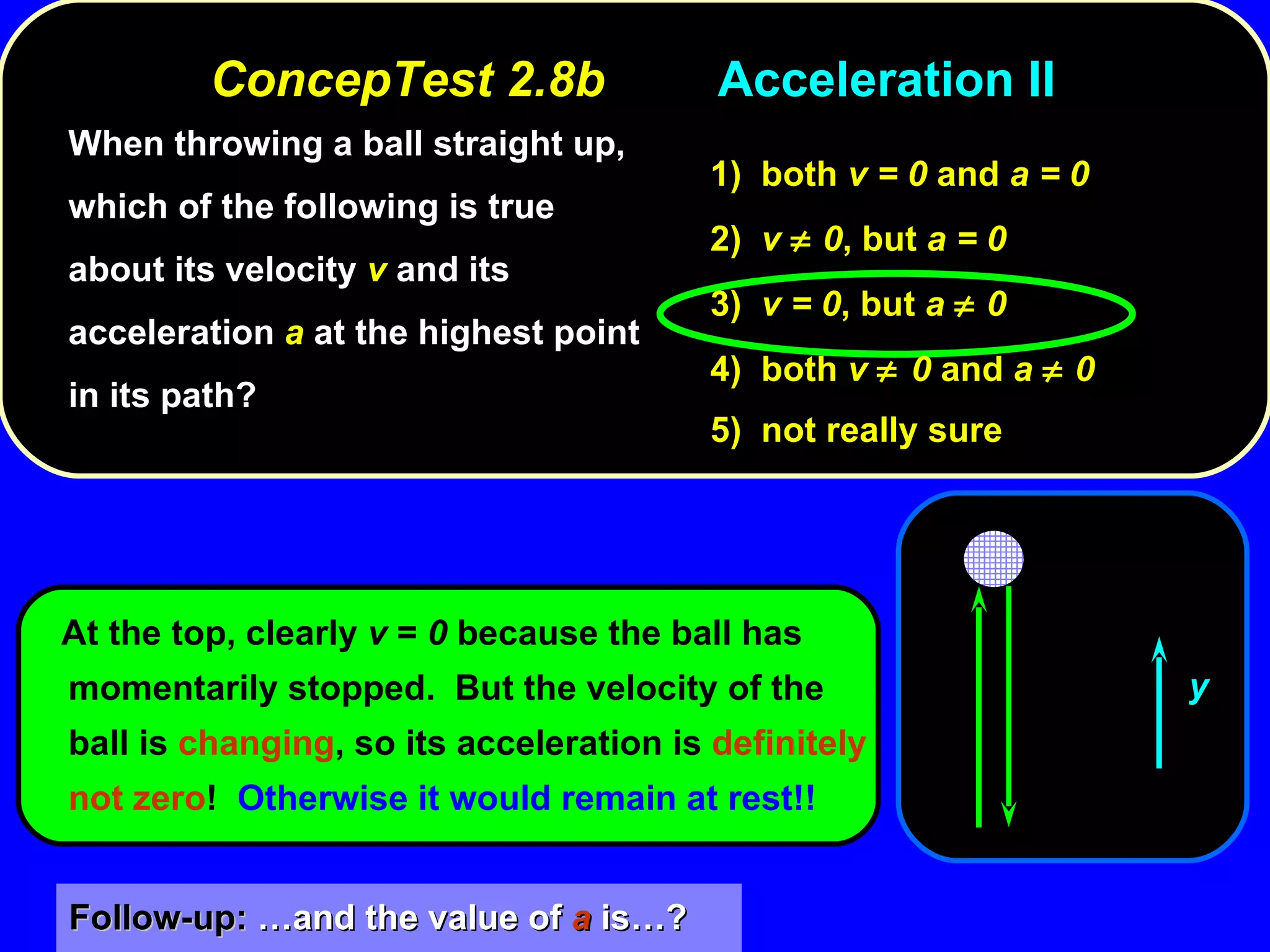
When throwing a ball straight up, which of the following is true about its velocity  v  and its acceleration  a  at the highest point in its path? 1)  both  v = 0  and  a = 0 2)  v    0 , but  a = 0 3)  v = 0 , but  a    0 4)  both  v   0  and  a    0 5)  not really sure ConcepTest 2.8b Acceleration II
When throwing a ball straight up, which of the following is true about its velocity  v  and its acceleration  a  at the highest point in its path? At the top, clearly  v  =  0  because the ball has momentarily stopped.  But the velocity of the ball is  changing , so its acceleration is  definitely not zero !  Otherwise it would remain at rest!! 1)  both  v = 0  and  a = 0 2)  v    0 , but  a = 0 3)  v = 0 , but  a    0 4)  both  v   0  and  a    0 5)  not really sure ConcepTest 2.8b Acceleration II Follow-up:  …and the value of  a  is…? y

03 kinematics in one dimension

  • 1.
    Kinematics in OneDimension Topic 2
  • 2.
    Lecture Outline Distanceand Displacement Speed and Velocity Acceleration
  • 3.
    Distance and DisplacementWhat is the different between distance and displacement? Displacement (blue line) is how far the object is from its starting point, regardless of how it got there. Distance traveled (dashed line) is measured along the actual path.
  • 4.
    Distance – ScalarDisplacement – Vector The displacement is written: Movement to the left: Displacement is positive. Movement to the right: Displacement is negative.
  • 5.
    Speed and VelocitySpeed - how far an object travel in a given time interval Average speed – the total distance traveled along its path divided by the time takes to travel this distance
  • 6.
    Velocity – avector, signify both of the magnitude (how fast) and direction of an object Average velocity – the total displacement of an object divided by the time takes to travel to this point Unit : meter/second (m/s)
  • 7.
  • 8.
    In general Positivevalue – object moving along the + x axis Negative value – object moving along the – x axis Direction is always the same as the displacement
  • 9.
    Example 2-1: Runner’saverage velocity. The position of a runner as a function of time is plotted as moving along the x axis of a coordinate system. During a 3.00-s time interval, the runner’s position changes from x 1 = 50.0 m to x 2 = 30.5 m, as shown. What was the runner’s average velocity?
  • 10.
    Example 2-2: Distancea cyclist travels. How far can a cyclist travel in 2.5 h along a straight road if her average velocity is 18 km/h?
  • 11.
    Instantaneous Velocity Theinstantaneous velocity is the average velocity in the limit as the time interval becomes infinitesimally short.
  • 12.
  • 13.
    Example 2-3: Given x as a function of t . A jet engine moves along an experimental track (which we call the x axis) as shown. We will treat the engine as if it were a particle. Its position as a function of time is given by the equation x = At 2 + B , where A = 2.10 m/s 2 and B = 2.80 m. Determine the displacement of the engine during the time interval from t 1 = 3.00 s to t 2 = 5.00 s. (b) Determine the average velocity during this time interval. (c) Determine the magnitude of the instantaneous velocity at t = 5.00 s.
  • 14.
    Acceleration Acceleration isthe rate of change of velocity. In general (Unit: m/s 2 ) Example: 5 m/s 2 – velocity will increase 5 m/s in 1 second
  • 15.
    Example 2-4: Averageacceleration. A car accelerates along a straight road from rest to 90 km/h in 5.0 s. What is the magnitude of its average acceleration?
  • 16.
    Example 2-6: Carslowing down. An automobile is moving to the right along a straight highway, which we choose to be the positive x axis. Then the driver puts on the brakes. If the initial velocity (when the driver hits the brakes) is v 1 = 15.0 m/s, and it takes 5.0 s to slow down to v 2 = 5.0 m/s, what was the car’s average acceleration?
  • 17.
    There is adifference between negative acceleration and deceleration: Negative acceleration is acceleration in the negative direction as defined by the coordinate system. Deceleration occurs when the acceleration is opposite in direction to the velocity.
  • 18.
    Instantaneous Acceleration Theinstantaneous acceleration is the average acceleration in the limit as the time interval becomes infinitesimally short.
  • 19.
    Like velocity, accelerationis a rate. The velocity is the rate at which the displacement changes with time The acceleration it the rate which the velocity changes with time Acceleration is “rate of rate”
  • 20.
    Example 2-7: Accelerationgiven x(t). A particle is moving in a straight line so that its position is given by the relation x = (2.10 m/s 2 ) t 2 + (2.80 m). Calculate its average acceleration during the time interval from t 1 = 3.00 s to t 2 = 5.00 s, and its instantaneous acceleration as a function of time.
  • 21.
    You and yourdog go for a walk to the park. On the way, your dog takes many side trips to chase squirrels or examine fire hydrants. When you arrive at the park, do you and your dog have the same displacement? 1) yes 2) no ConcepTest 2.1 Walking the Dog
  • 22.
    You and yourdog go for a walk to the park. On the way, your dog takes many side trips to chase squirrels or examine fire hydrants. When you arrive at the park, do you and your dog have the same displacement? 1) yes 2) no Yes, you have the same displacement. Since you and your dog had the same initial position and the same final position, then you have (by definition) the same displacement. ConcepTest 2.1 Walking the Dog Follow-up: Have you and your dog traveled the same distance?
  • 23.
    ConcepTest 2.2 DisplacementDoes the displacement of an object depend on the specific location of the origin of the coordinate system? 1) yes 2) no 3) it depends on the coordinate system
  • 24.
    ConcepTest 2.2 DisplacementDoes the displacement of an object depend on the specific location of the origin of the coordinate system? Since the displacement is the difference between two coordinates, the origin does not matter. 1) yes 2) no 3) it depends on the coordinate system 10 20 30 40 50 30 40 50 60 70
  • 25.
    If the positionof a car is zero, does its speed have to be zero? 1) yes 2) no 3) it depends on the position ConcepTest 2.3 Position and Speed
  • 26.
    If the positionof a car is zero, does its speed have to be zero? 1) yes 2) no 3) it depends on the position No, the speed does not depend on position; it depends on the change of position. Since we know that the displacement does not depend on the origin of the coordinate system, an object can easily start at x = – 3 and be moving by the time it gets to x = 0. ConcepTest 2.3 Position and Speed
  • 27.
    You drive for30 minutes at 30 mi/hr and then for another 30 minutes at 50 mi/hr. What is your average speed for the whole trip? 1) more than 40 mi/hr 2) equal to 40 mi/hr 3) less than 40 mi/hr ConcepTest 2.6a Cruising Along I
  • 28.
    You drive for30 minutes at 30 mi/hr and then for another 30 minutes at 50 mi/hr. What is your average speed for the whole trip? 1) more than 40 mi/hr 2) equal to 40 mi/hr 3) less than 40 mi/hr It is 40 mi/hr in this case. Since the average speed is distance/time and you spend the same amount of time at each speed, then your average speed would indeed be 40 mi/hr. ConcepTest 2.6a Cruising Along I
  • 29.
    You drive 4miles at 30 mi/hr and then another 4 miles at 50 mi/hr. What is your average speed for the whole 8-mile trip? 1) more than 40 mi/hr 2) equal to 40 mi/hr 3) less than 40 mi/hr ConcepTest 2.6b Cruising Along II
  • 30.
    You drive 4miles at 30 mi/hr and then another 4 miles at 50 mi/hr. What is your average speed for the whole 8-mile trip? 1) more than 40 mi/hr 2) equal to 40 mi/hr 3) less than 40 mi/hr It is not 40 mi/hr! Remember that the average speed is distance/time. Since it takes longer to cover 4 miles at the slower speed, you are actually moving at 30 mi/hr for a longer period of time! Therefore, your average speed is closer to 30 mi/hr than it is to 50 mi/hr. ConcepTest 2.6b Cruising Along II
  • 31.
    ConcepTest 2.7 Velocityin One Dimension If the average velocity is non-zero over some time interval, does this mean that the instantaneous velocity is never zero during the same interval? 1) yes 2) no 3) it depends
  • 32.
    ConcepTest 2.7 Velocityin One Dimension If the average velocity is non-zero over some time interval, does this mean that the instantaneous velocity is never zero during the same interval? No!!! For example, your average velocity for a trip home might be 60 mph, but if you stopped for lunch on the way home, there was an interval when your instantaneous velocity was zero, in fact! 1) yes 2) no 3) it depends
  • 33.
    ConcepTest 2.8a AccelerationI If the velocity of a car is non-zero ( v  0 ), can the acceleration of the car be zero? 1) Yes 2) No 3) Depends on the velocity
  • 34.
    ConcepTest 2.8a AccelerationI If the velocity of a car is non-zero ( v  0 ), can the acceleration of the car be zero? Sure it can! An object moving with constant velocity has a non-zero velocity, but it has zero acceleration since the velocity is not changing. 1) Yes 2) No 3) Depends on the velocity
  • 35.
    When throwing aball straight up, which of the following is true about its velocity v and its acceleration a at the highest point in its path? 1) both v = 0 and a = 0 2) v  0 , but a = 0 3) v = 0 , but a  0 4) both v  0 and a  0 5) not really sure ConcepTest 2.8b Acceleration II
  • 36.
    When throwing aball straight up, which of the following is true about its velocity v and its acceleration a at the highest point in its path? At the top, clearly v = 0 because the ball has momentarily stopped. But the velocity of the ball is changing , so its acceleration is definitely not zero ! Otherwise it would remain at rest!! 1) both v = 0 and a = 0 2) v  0 , but a = 0 3) v = 0 , but a  0 4) both v  0 and a  0 5) not really sure ConcepTest 2.8b Acceleration II Follow-up: …and the value of a is…? y