Torque
Chapter 9 – Rotational
Dynamics
What is Torque?
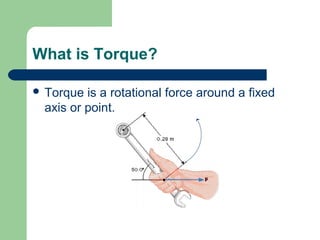
 Torque is a rotational force around a fixed
axis or point.
Torque
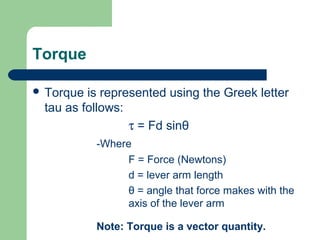
 Torque is represented using the Greek letter
tau as follows:
τ = Fd sinθ
-Where
F = Force (Newtons)
d = lever arm length
θ = angle that force makes with the
axis of the lever arm
Note: Torque is a vector quantity.
Factors that affect Torque
 Distance: The distance from the point of rotation affects
torque in such a manner that the further you are from the
axis of rotation, the easier it is to rotate around that point.
F1
F2
d2
d1
Note: The distance d is also known as the lever arm.
Factors that affect Torque
 Angle: Torque also depends on the angle at which the
force makes with the lever arm. Torque is maximum
when the force makes a 90° angle with the lever arm.
d
F
θ
θ
Factors that affect Torque
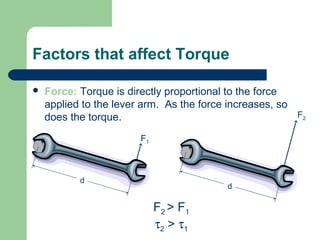
 Force: Torque is directly proportional to the force
applied to the lever arm. As the force increases, so
does the torque.
F1
d
F2
d
F2 > F1
τ2 > τ1
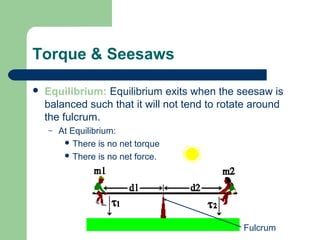
Torque & Seesaws
 Equilibrium: Equilibrium exits when the seesaw is
balanced such that it will not tend to rotate around
the fulcrum.
– At Equilibrium:
 There is no net torque
 There is no net force.
Fulcrum
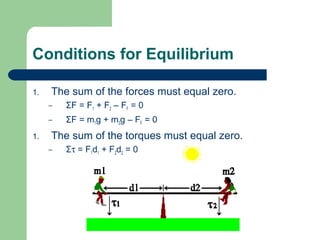
Conditions for Equilibrium
1. The sum of the forces must equal zero.
– ΣF = F1 + F2 – FF = 0
– ΣF = m1g + m2g – FF = 0
1. The sum of the torques must equal zero.
– Στ = F1d1 + F2d2 = 0
Translational Equilibrium
 The sum of the forces must equal zero.
– ΣF = F1 + F2 – FF = 0
– ΣF = m1g + m2g – FF = 0
F1 F2
FF
Rotational Equilibrium
 The sum of the torques must equal zero.
– Στ = F1d1 + F2d2 = 0
– Note that one torque will provide a rotational force in
the counterclockwise direction (F1) while the other
force will provide a rotational force in the clockwise
direction (F2)
F1 F2
d1 d2
Center of Mass
 If the fulcrum (pivot point) does not occur at
the center of the object, then the center of
mass must be factored into the problem.
 For uniform geometric shapes, the center of
mass can be conveniently chosen at the
center of the object.
Center of Mass
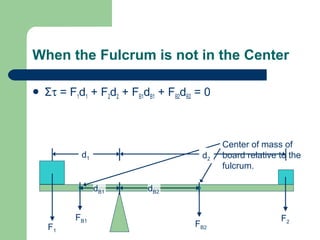
When the Fulcrum is not in the Center
 Στ = F1d1 + F2d2 + FB1dB1 + FB2dB2 = 0
F1
F2
Center of mass of
board relative to the
fulcrum.
FB1
FB2
d1
dB1 dB2
d2
Solving Problems involving Torque
1. Select the object to which the equations for equilibrium are to
be applied.
2. Draw a free-body diagram that shows all of the external
forces acting on the object.
3. Choose a convenient set of x, y axes and resolve all forces
into components that lie along these axes.
4. Apply the equations that specify the balance of forces at
equilibrium. (Set the net force in the x and y directions equal
to zero.)
5. Select a convenient axis of rotation. Set the sum of the
torques about this axis equal to zero.
6. Solve the equations for the desired unknown quantities.
A woman whose weight is 530 N is
poised at the right end of a diving board
with length 3.90 m. The board has
negligible weight and is supported by
a fulcrum 1.40 m away from the left
end.
Find the forces that the bolt and the
fulcrum exert on the board.
Example 1: A Diving
Board
022 =−=∑ WWF τ
( )( ) N1480
m1.40
m90.3N530
2 ==F
2
2

WW
F =
Example 1: A Diving
Board
021 =−+−=∑ WFFFy
0N530N14801 =−+− F
N9501 =F
Example 1: A Diving
Board
Torque Applied to Mobiles
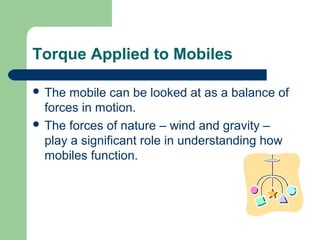
 The mobile can be looked at as a balance of
forces in motion.
 The forces of nature – wind and gravity –
play a significant role in understanding how
mobiles function.
Torque and Mobiles
FM
FE
FS
Στ = 0

Torque

  • 1.
    Torque Chapter 9 –Rotational Dynamics
  • 2.
    What is Torque? Torque is a rotational force around a fixed axis or point.
  • 3.
    Torque  Torque isrepresented using the Greek letter tau as follows: τ = Fd sinθ -Where F = Force (Newtons) d = lever arm length θ = angle that force makes with the axis of the lever arm Note: Torque is a vector quantity.
  • 4.
    Factors that affectTorque  Distance: The distance from the point of rotation affects torque in such a manner that the further you are from the axis of rotation, the easier it is to rotate around that point. F1 F2 d2 d1 Note: The distance d is also known as the lever arm.
  • 5.
    Factors that affectTorque  Angle: Torque also depends on the angle at which the force makes with the lever arm. Torque is maximum when the force makes a 90° angle with the lever arm. d F θ θ
  • 6.
    Factors that affectTorque  Force: Torque is directly proportional to the force applied to the lever arm. As the force increases, so does the torque. F1 d F2 d F2 > F1 τ2 > τ1
  • 7.
    Torque & Seesaws Equilibrium: Equilibrium exits when the seesaw is balanced such that it will not tend to rotate around the fulcrum. – At Equilibrium:  There is no net torque  There is no net force. Fulcrum
  • 8.
    Conditions for Equilibrium 1.The sum of the forces must equal zero. – ΣF = F1 + F2 – FF = 0 – ΣF = m1g + m2g – FF = 0 1. The sum of the torques must equal zero. – Στ = F1d1 + F2d2 = 0
  • 9.
    Translational Equilibrium  Thesum of the forces must equal zero. – ΣF = F1 + F2 – FF = 0 – ΣF = m1g + m2g – FF = 0 F1 F2 FF
  • 10.
    Rotational Equilibrium  Thesum of the torques must equal zero. – Στ = F1d1 + F2d2 = 0 – Note that one torque will provide a rotational force in the counterclockwise direction (F1) while the other force will provide a rotational force in the clockwise direction (F2) F1 F2 d1 d2
  • 11.
    Center of Mass If the fulcrum (pivot point) does not occur at the center of the object, then the center of mass must be factored into the problem.  For uniform geometric shapes, the center of mass can be conveniently chosen at the center of the object. Center of Mass
  • 12.
    When the Fulcrumis not in the Center  Στ = F1d1 + F2d2 + FB1dB1 + FB2dB2 = 0 F1 F2 Center of mass of board relative to the fulcrum. FB1 FB2 d1 dB1 dB2 d2
  • 13.
    Solving Problems involvingTorque 1. Select the object to which the equations for equilibrium are to be applied. 2. Draw a free-body diagram that shows all of the external forces acting on the object. 3. Choose a convenient set of x, y axes and resolve all forces into components that lie along these axes. 4. Apply the equations that specify the balance of forces at equilibrium. (Set the net force in the x and y directions equal to zero.) 5. Select a convenient axis of rotation. Set the sum of the torques about this axis equal to zero. 6. Solve the equations for the desired unknown quantities.
  • 14.
    A woman whoseweight is 530 N is poised at the right end of a diving board with length 3.90 m. The board has negligible weight and is supported by a fulcrum 1.40 m away from the left end. Find the forces that the bolt and the fulcrum exert on the board. Example 1: A Diving Board
  • 15.
    022 =−=∑ WWFτ ( )( ) N1480 m1.40 m90.3N530 2 ==F 2 2  WW F = Example 1: A Diving Board
  • 16.
    021 =−+−=∑ WFFFy 0N530N14801=−+− F N9501 =F Example 1: A Diving Board
  • 17.
    Torque Applied toMobiles  The mobile can be looked at as a balance of forces in motion.  The forces of nature – wind and gravity – play a significant role in understanding how mobiles function.
  • 18.