
PHYSICAL QUANTITIES, UNITS
AND MEASUREMENT
PHYSICAL QUANTITIES, UNITS AND
MEASUREMENT
A physical quantity is a quantity that can be measured and consists
of a numerical magnitude and unit.
PHYSICAL QUANTITIES, UNITS AND
MEASUREMENT
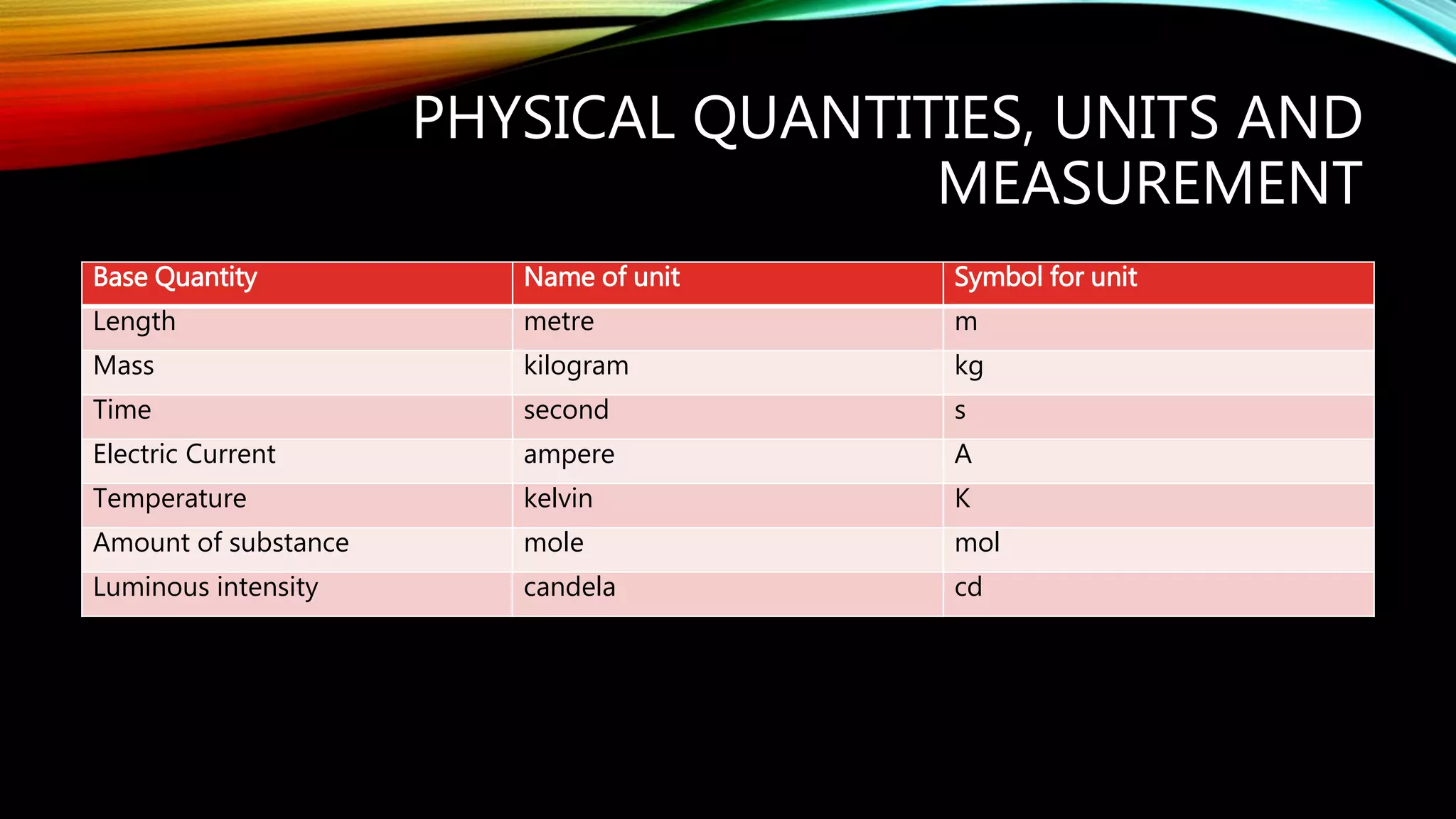
Base Quantity Name of unit Symbol for unit
Length metre m
Mass kilogram kg
Time second s
Electric Current ampere A
Temperature kelvin K
Amount of substance mole mol
Luminous intensity candela cd
PHYSICAL QUANTITIES, UNITS AND
MEASUREMENT
The units of any particular physical quantity can be derived
according to base units involved.
PHYSICAL QUANTITIES, UNITS AND
MEASUREMENT
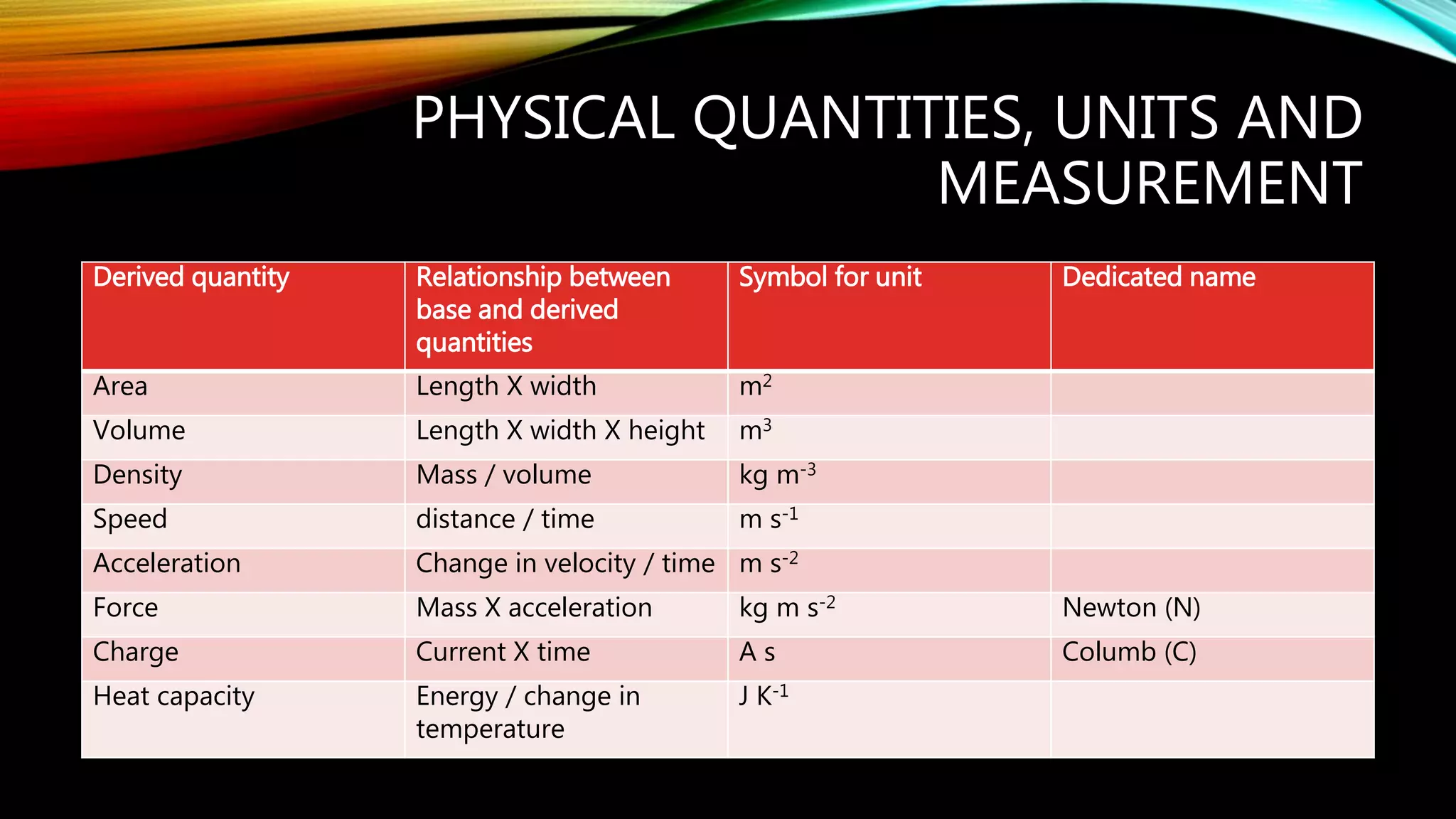
Derived quantity Relationship between
base and derived
quantities
Symbol for unit Dedicated name
Area Length X width m2
Volume Length X width X height m3
Density Mass / volume kg m-3
Speed distance / time m s-1
Acceleration Change in velocity / time m s-2
Force Mass X acceleration kg m s-2 Newton (N)
Charge Current X time A s Columb (C)
Heat capacity Energy / change in
temperature
J K-1
PHYSICAL QUANTITIES, UNITS AND
MEASUREMENT
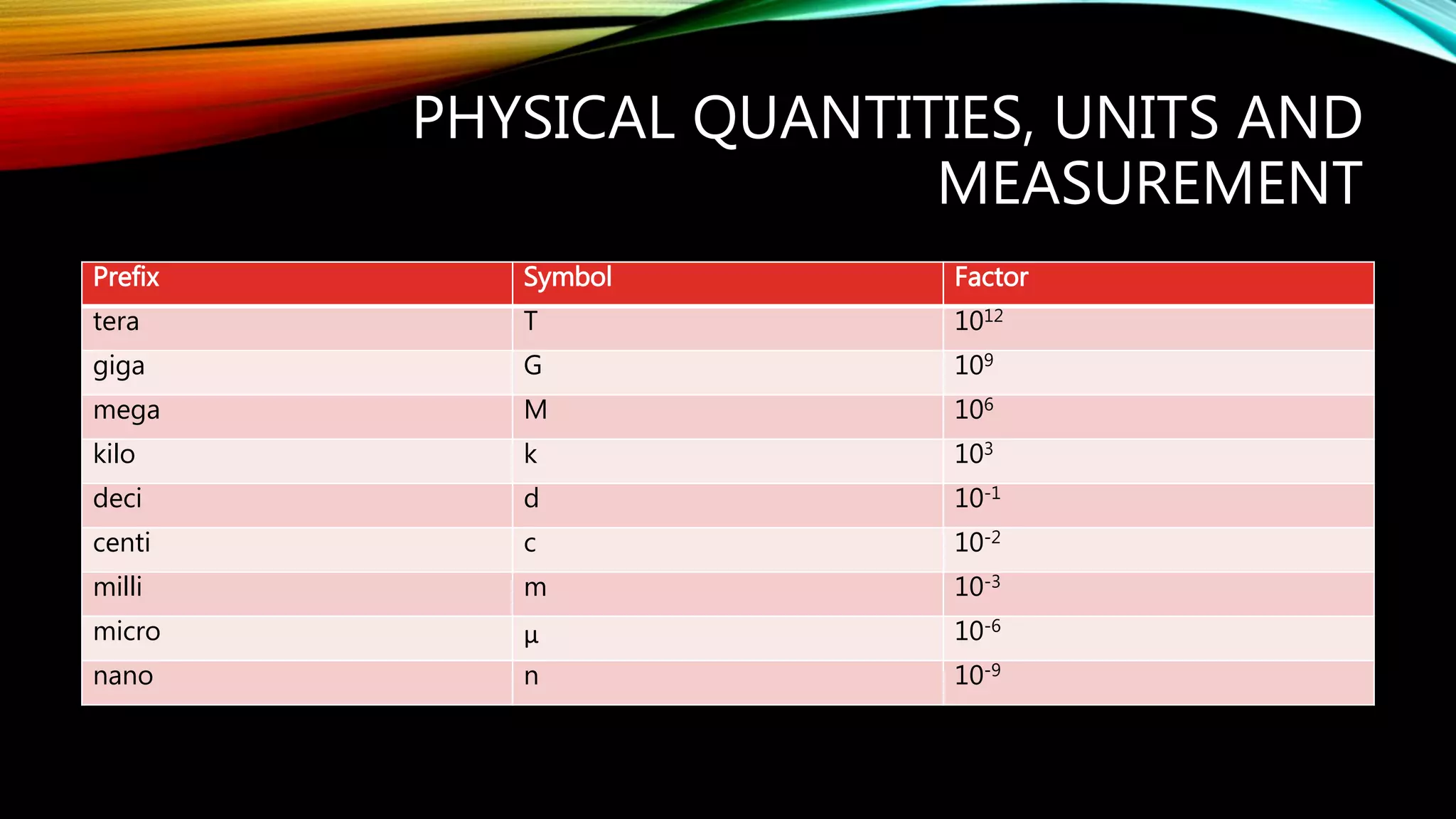
To handle huge numbers easily, we use prefixes to simplify the
writing of such numbers.
PHYSICAL QUANTITIES, UNITS AND
MEASUREMENT
Prefix Symbol Factor
tera T 1012
giga G 109
mega M 106
kilo k 103
deci d 10-1
centi c 10-2
milli m 10-3
micro μ 10-6
nano n 10-9
PHYSICAL QUANTITIES, UNITS AND
MEASUREMENT
When taking measurements using tools and apparatus, it is quite
common to experience errors. There are two kinds of errors:
Random error
Systematic error
PHYSICAL QUANTITIES, UNITS AND
MEASUREMENT
Random errors arises when observers estimate the last figure of a
reading on an instrument. Usually affected due to reaction time,
background noises or vibrations.
To reduce such errors, we usually take a large number of readings
and obtain the average. Any distinct abnormally is usually excluded
in the calculation of the average.
PHYSICAL QUANTITIES, UNITS AND
MEASUREMENT
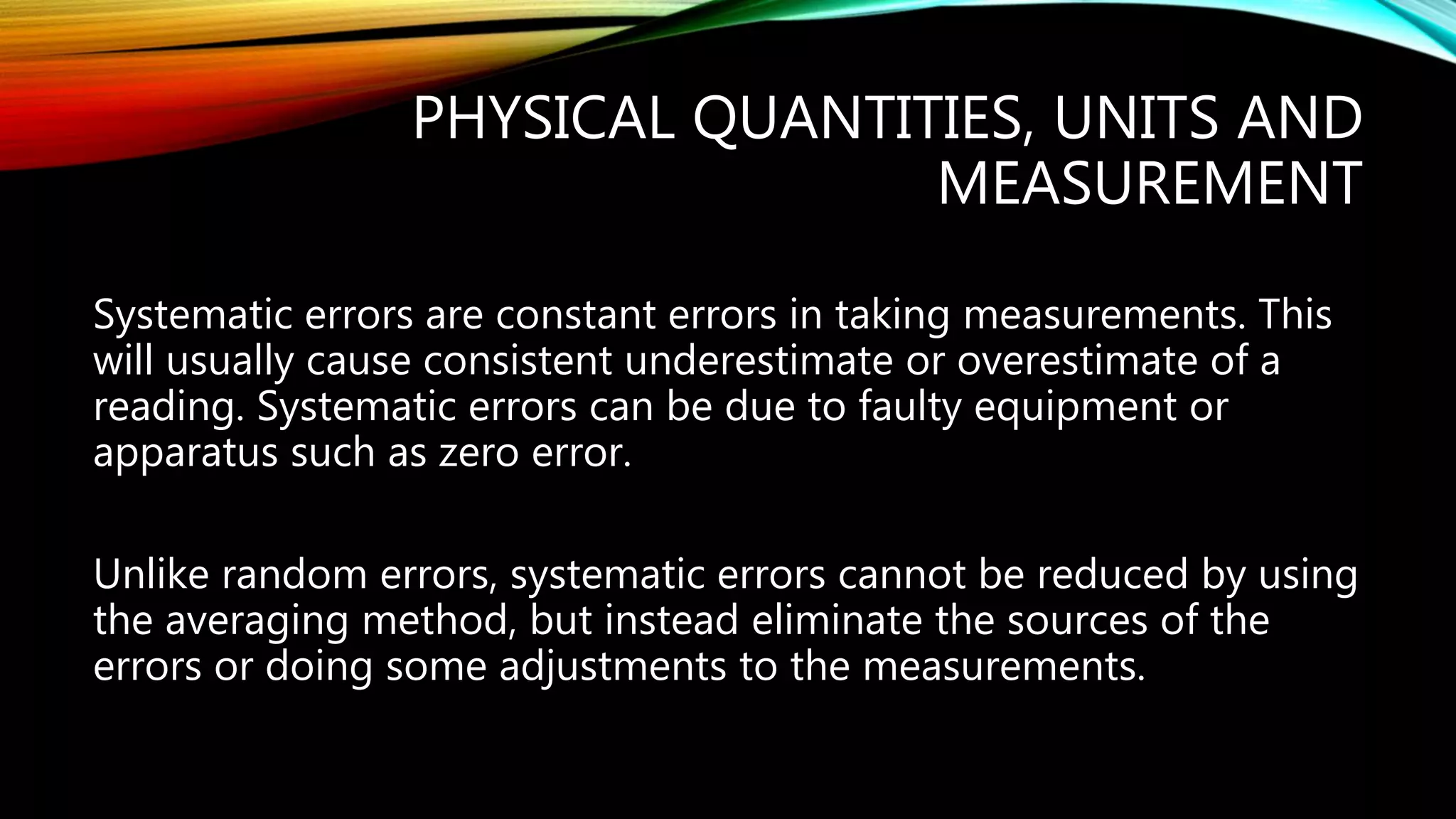
Systematic errors are constant errors in taking measurements. This
will usually cause consistent underestimate or overestimate of a
reading. Systematic errors can be due to faulty equipment or
apparatus such as zero error.
Unlike random errors, systematic errors cannot be reduced by using
the averaging method, but instead eliminate the sources of the
errors or doing some adjustments to the measurements.
PHYSICAL QUANTITIES, UNITS AND
MEASUREMENT
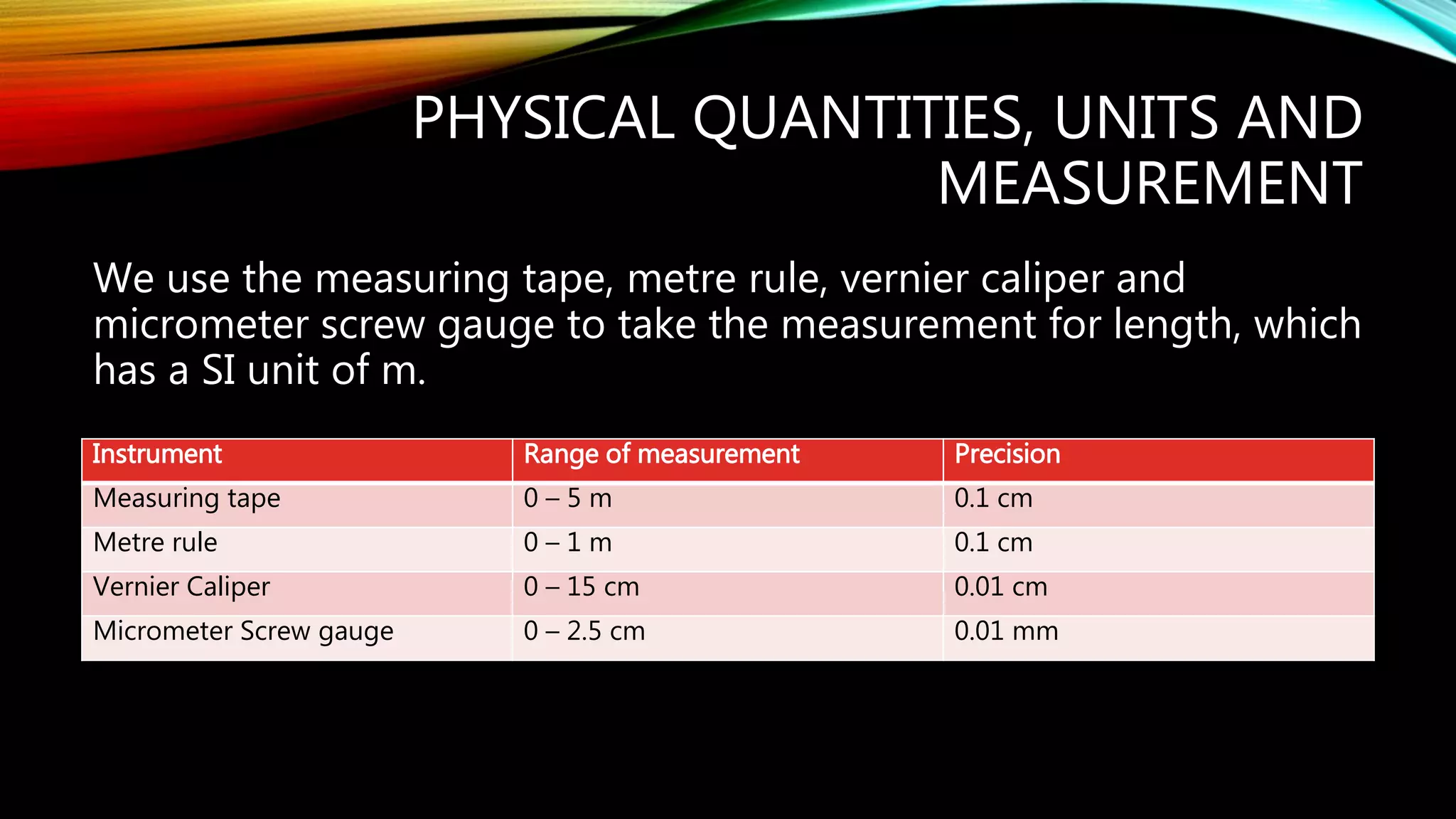
We use the measuring tape, metre rule, vernier caliper and
micrometer screw gauge to take the measurement for length, which
has a SI unit of m.
Instrument Range of measurement Precision
Measuring tape 0 – 5 m 0.1 cm
Metre rule 0 – 1 m 0.1 cm
Vernier Caliper 0 – 15 cm 0.01 cm
Micrometer Screw gauge 0 – 2.5 cm 0.01 mm
PHYSICAL QUANTITIES, UNITS AND
MEASUREMENT
When using the measuring tape and metre rule, we should be
careful to avoid parallax error by positioning our eye so that the
line of sight is at right angle to the scale.
When using the vernier caliper and micrometer screw gauge, we
should be careful to avoid zero error by ensuring the initial
readings starts at zero.
PHYSICAL QUANTITIES, UNITS AND
MEASUREMENT
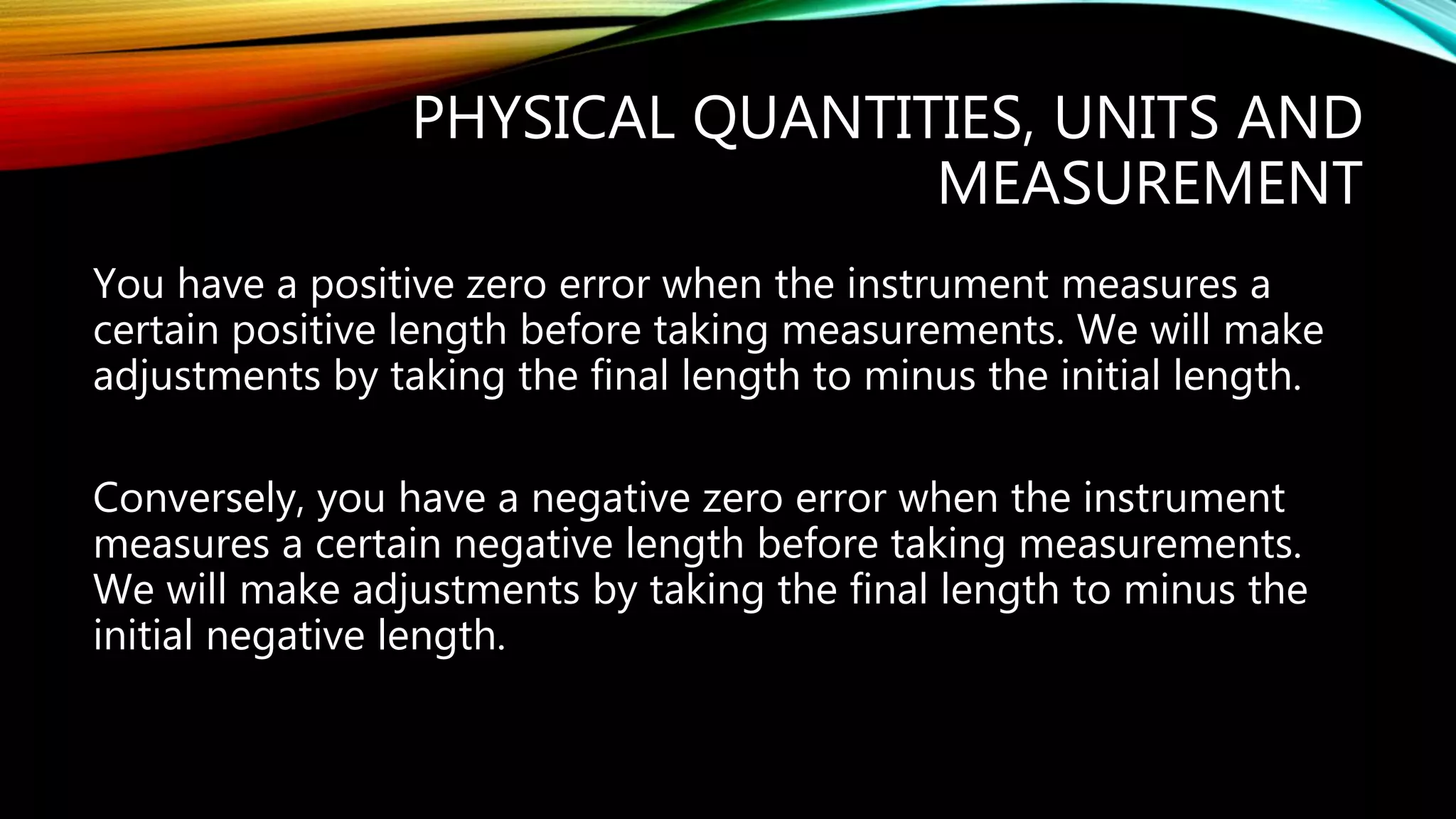
You have a positive zero error when the instrument measures a
certain positive length before taking measurements. We will make
adjustments by taking the final length to minus the initial length.
Conversely, you have a negative zero error when the instrument
measures a certain negative length before taking measurements.
We will make adjustments by taking the final length to minus the
initial negative length.
PHYSICAL QUANTITIES, UNITS AND
MEASUREMENT
Positive error example:
The vernier caliper measures 0.1 cm when closed.
We measure the diameter of a nut and the observed reading is 3.25
cm
Adjustment: 3.25 cm – 0.1 cm = 3.15cm
Diameter of the nut = 3.15 cm
PHYSICAL QUANTITIES, UNITS AND
MEASUREMENT
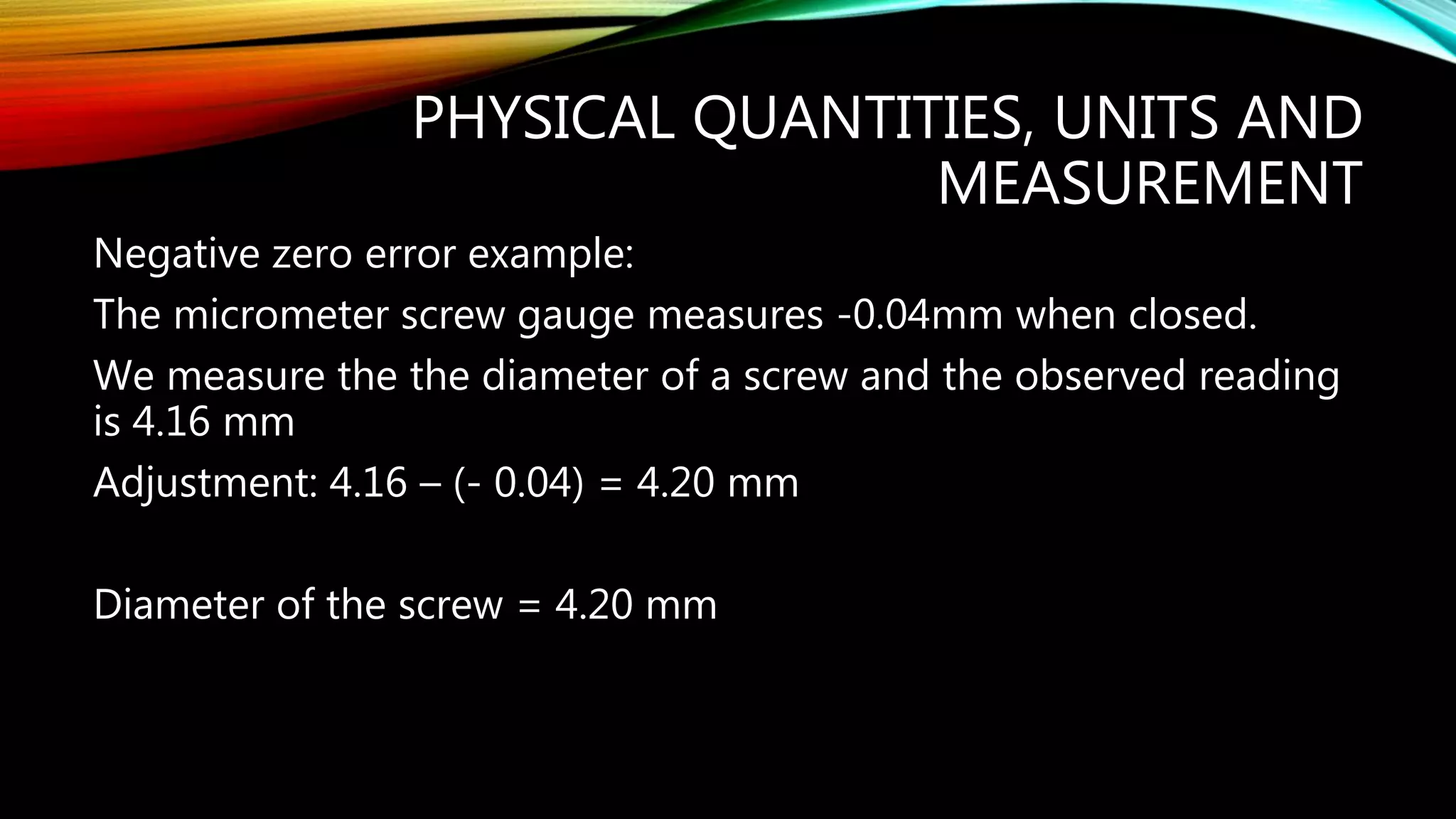
Negative zero error example:
The micrometer screw gauge measures -0.04mm when closed.
We measure the the diameter of a screw and the observed reading
is 4.16 mm
Adjustment: 4.16 – (- 0.04) = 4.20 mm
Diameter of the screw = 4.20 mm
PHYSICAL QUANTITIES, UNITS AND
MEASUREMENT
We use the stopwatch to measure short intervals of time. The
digital stopwatches are more common these days and have a
accuracy to 0.01s.
One possible reason for errors in time taking using the stopwatch is
due to our reaction time.
PHYSICAL QUANTITIES, UNITS AND
MEASUREMENT
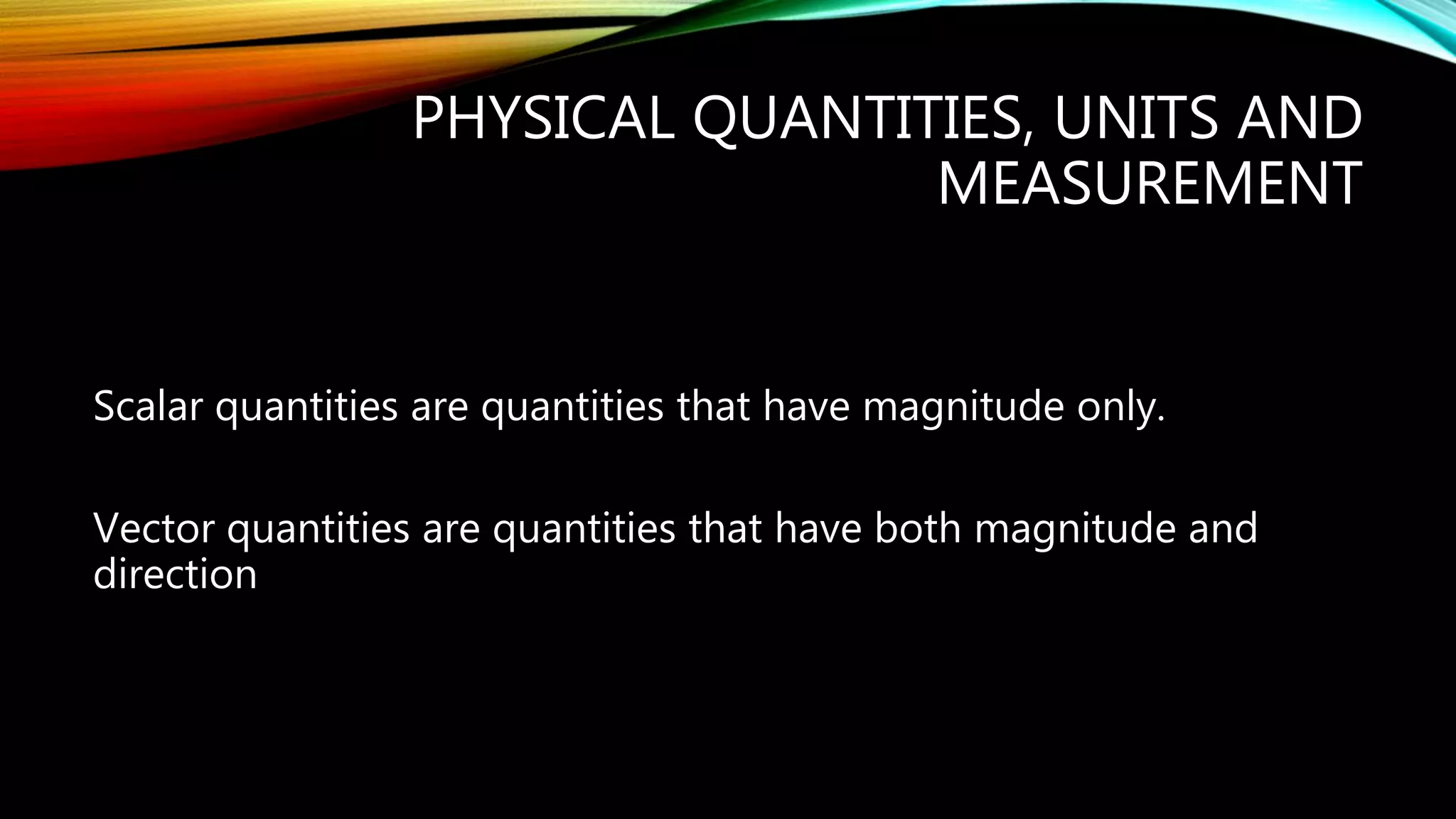
Scalar quantities are quantities that have magnitude only.
Vector quantities are quantities that have both magnitude and
direction
PHYSICAL QUANTITIES, UNITS AND
MEASUREMENT
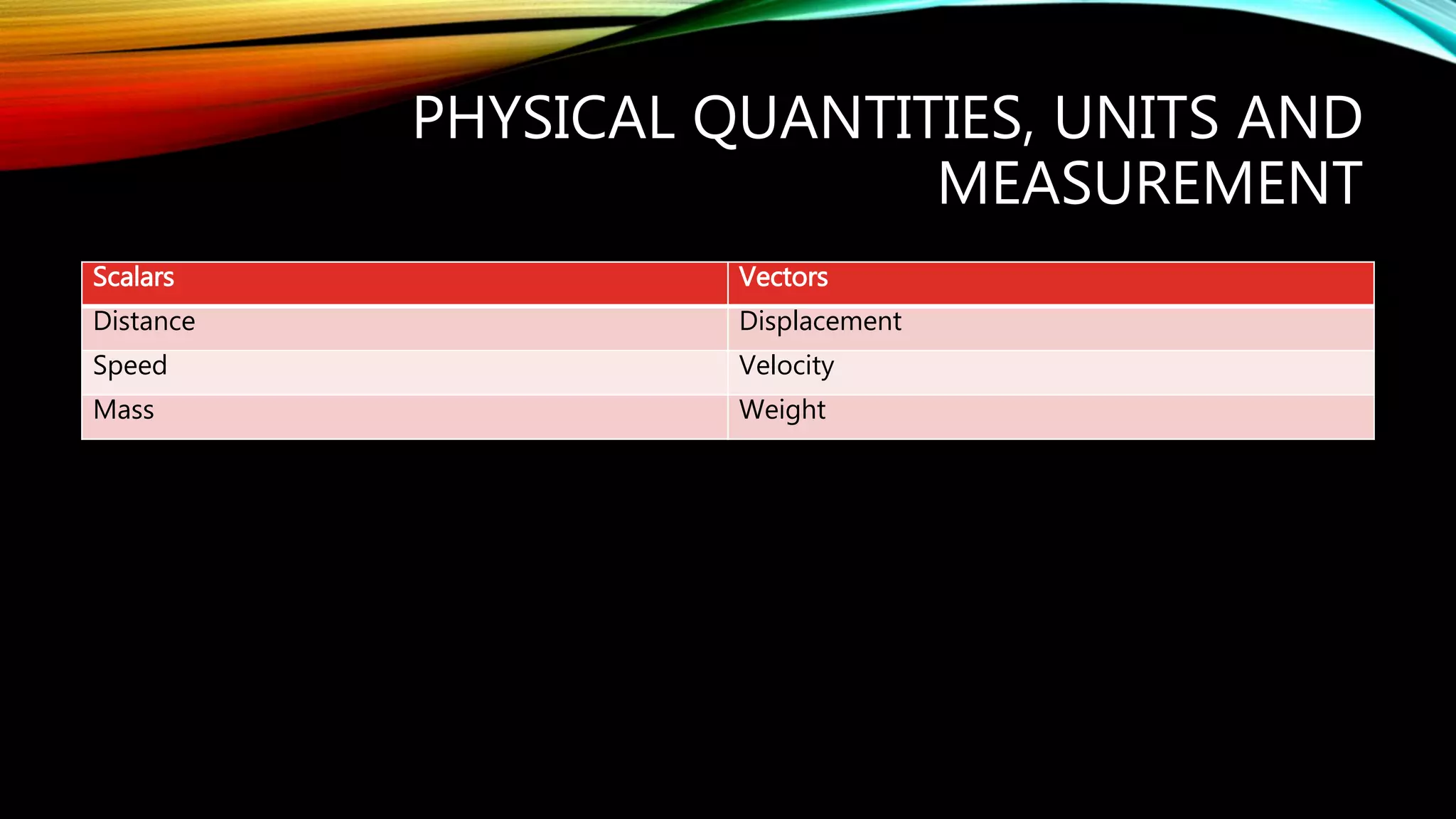
Scalars Vectors
Distance Displacement
Speed Velocity
Mass Weight
PHYSICAL QUANTITIES, UNITS AND
MEASUREMENT
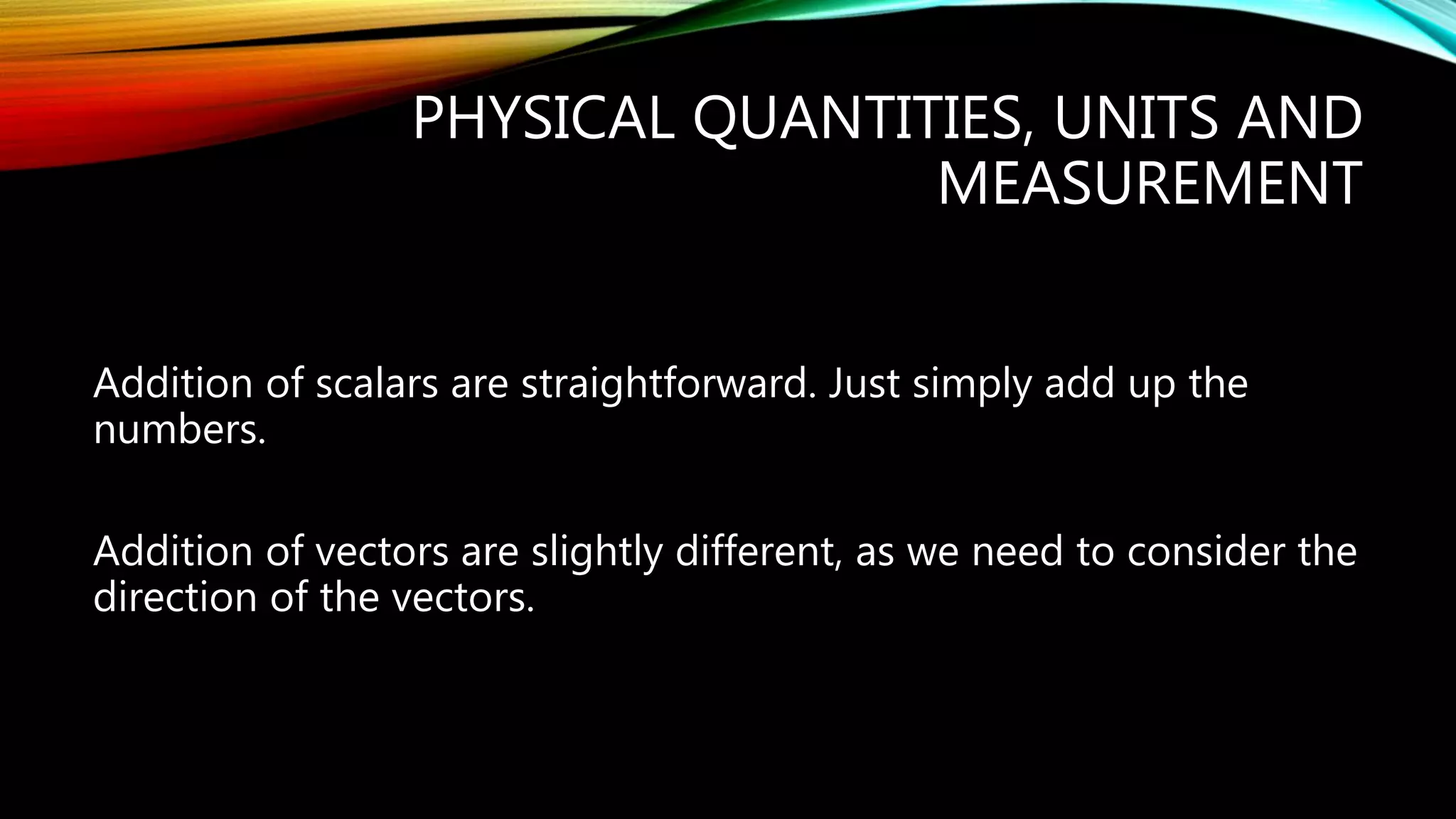
Addition of scalars are straightforward. Just simply add up the
numbers.
Addition of vectors are slightly different, as we need to consider the
direction of the vectors.
PHYSICAL QUANTITIES, UNITS AND
MEASUREMENT
5N
5N
Resultant force = 5N + 5N = 10N to the right
PHYSICAL QUANTITIES, UNITS AND
MEASUREMENT
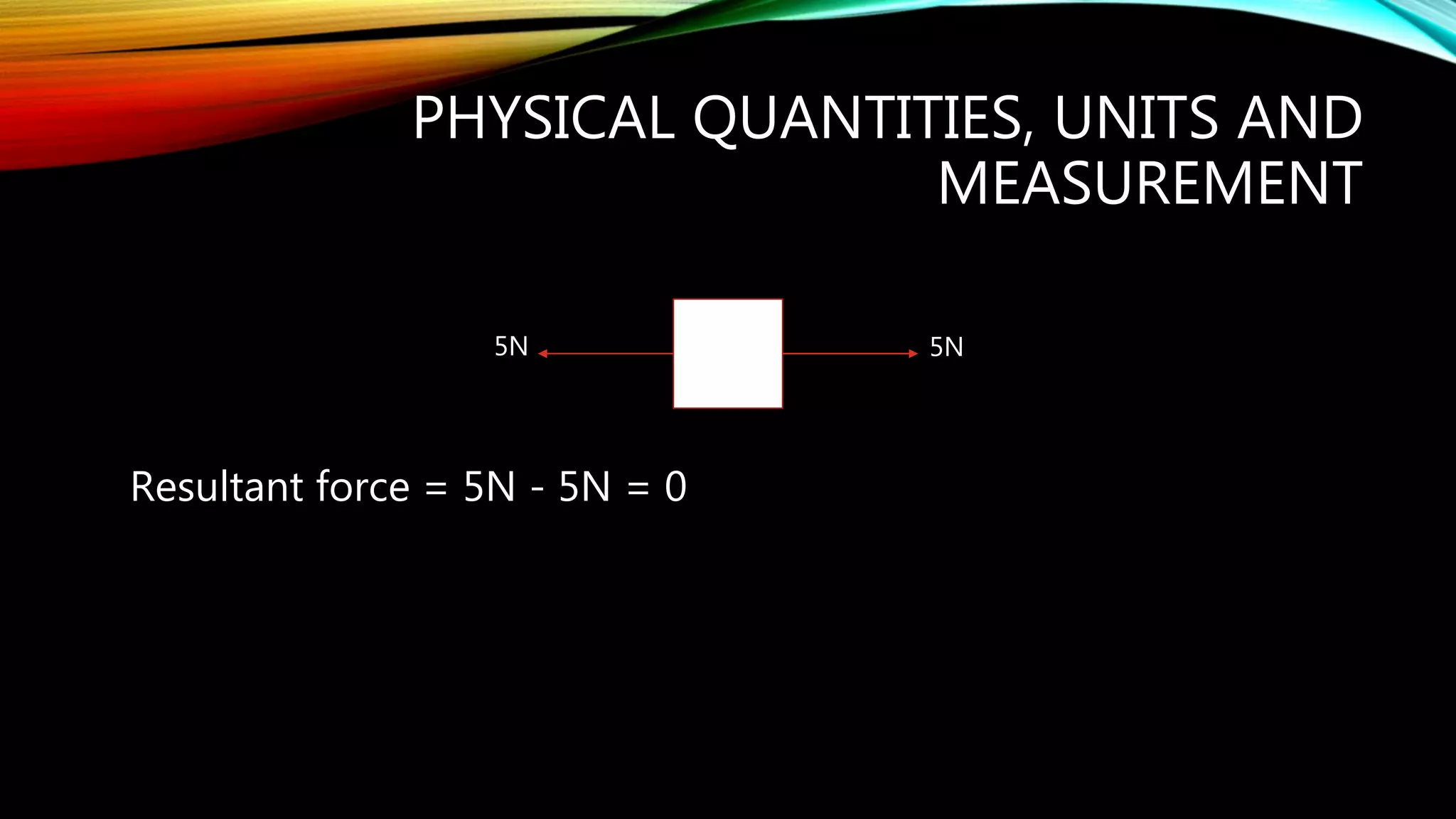
5N 5N
Resultant force = 5N - 5N = 0
PHYSICAL QUANTITIES, UNITS AND
MEASUREMENT
5N
Resultant force = 10N + 5N = 15N to the right
10N
PHYSICAL QUANTITIES, UNITS AND
MEASUREMENT
5N
Resultant force = 10N - 5N = 5N to the left
10N
PHYSICAL QUANTITIES, UNITS AND
MEASUREMENT
We can also solve forces at an angle to each other using the
parallelogram method.
PHYSICAL QUANTITIES, UNITS AND
MEASUREMENT
A
B
Resultant force
PHYSICAL QUANTITIES, UNITS AND
MEASUREMENT
Alternatively, we can use the vector triangle method (tail to head,
head to tail method).
PHYSICAL QUANTITIES, UNITS AND
MEASUREMENT
Resultant force
PHYSICAL QUANTITIES, UNITS AND
MEASUREMENT
The End

Physical quantities, units and measurement

  • 1.
  • 2.
    PHYSICAL QUANTITIES, UNITSAND MEASUREMENT A physical quantity is a quantity that can be measured and consists of a numerical magnitude and unit.
  • 3.
    PHYSICAL QUANTITIES, UNITSAND MEASUREMENT Base Quantity Name of unit Symbol for unit Length metre m Mass kilogram kg Time second s Electric Current ampere A Temperature kelvin K Amount of substance mole mol Luminous intensity candela cd
  • 4.
    PHYSICAL QUANTITIES, UNITSAND MEASUREMENT The units of any particular physical quantity can be derived according to base units involved.
  • 5.
    PHYSICAL QUANTITIES, UNITSAND MEASUREMENT Derived quantity Relationship between base and derived quantities Symbol for unit Dedicated name Area Length X width m2 Volume Length X width X height m3 Density Mass / volume kg m-3 Speed distance / time m s-1 Acceleration Change in velocity / time m s-2 Force Mass X acceleration kg m s-2 Newton (N) Charge Current X time A s Columb (C) Heat capacity Energy / change in temperature J K-1
  • 6.
    PHYSICAL QUANTITIES, UNITSAND MEASUREMENT To handle huge numbers easily, we use prefixes to simplify the writing of such numbers.
  • 7.
    PHYSICAL QUANTITIES, UNITSAND MEASUREMENT Prefix Symbol Factor tera T 1012 giga G 109 mega M 106 kilo k 103 deci d 10-1 centi c 10-2 milli m 10-3 micro μ 10-6 nano n 10-9
  • 8.
    PHYSICAL QUANTITIES, UNITSAND MEASUREMENT When taking measurements using tools and apparatus, it is quite common to experience errors. There are two kinds of errors: Random error Systematic error
  • 9.
    PHYSICAL QUANTITIES, UNITSAND MEASUREMENT Random errors arises when observers estimate the last figure of a reading on an instrument. Usually affected due to reaction time, background noises or vibrations. To reduce such errors, we usually take a large number of readings and obtain the average. Any distinct abnormally is usually excluded in the calculation of the average.
  • 10.
    PHYSICAL QUANTITIES, UNITSAND MEASUREMENT Systematic errors are constant errors in taking measurements. This will usually cause consistent underestimate or overestimate of a reading. Systematic errors can be due to faulty equipment or apparatus such as zero error. Unlike random errors, systematic errors cannot be reduced by using the averaging method, but instead eliminate the sources of the errors or doing some adjustments to the measurements.
  • 11.
    PHYSICAL QUANTITIES, UNITSAND MEASUREMENT We use the measuring tape, metre rule, vernier caliper and micrometer screw gauge to take the measurement for length, which has a SI unit of m. Instrument Range of measurement Precision Measuring tape 0 – 5 m 0.1 cm Metre rule 0 – 1 m 0.1 cm Vernier Caliper 0 – 15 cm 0.01 cm Micrometer Screw gauge 0 – 2.5 cm 0.01 mm
  • 12.
    PHYSICAL QUANTITIES, UNITSAND MEASUREMENT When using the measuring tape and metre rule, we should be careful to avoid parallax error by positioning our eye so that the line of sight is at right angle to the scale. When using the vernier caliper and micrometer screw gauge, we should be careful to avoid zero error by ensuring the initial readings starts at zero.
  • 13.
    PHYSICAL QUANTITIES, UNITSAND MEASUREMENT You have a positive zero error when the instrument measures a certain positive length before taking measurements. We will make adjustments by taking the final length to minus the initial length. Conversely, you have a negative zero error when the instrument measures a certain negative length before taking measurements. We will make adjustments by taking the final length to minus the initial negative length.
  • 14.
    PHYSICAL QUANTITIES, UNITSAND MEASUREMENT Positive error example: The vernier caliper measures 0.1 cm when closed. We measure the diameter of a nut and the observed reading is 3.25 cm Adjustment: 3.25 cm – 0.1 cm = 3.15cm Diameter of the nut = 3.15 cm
  • 15.
    PHYSICAL QUANTITIES, UNITSAND MEASUREMENT Negative zero error example: The micrometer screw gauge measures -0.04mm when closed. We measure the the diameter of a screw and the observed reading is 4.16 mm Adjustment: 4.16 – (- 0.04) = 4.20 mm Diameter of the screw = 4.20 mm
  • 16.
    PHYSICAL QUANTITIES, UNITSAND MEASUREMENT We use the stopwatch to measure short intervals of time. The digital stopwatches are more common these days and have a accuracy to 0.01s. One possible reason for errors in time taking using the stopwatch is due to our reaction time.
  • 17.
    PHYSICAL QUANTITIES, UNITSAND MEASUREMENT Scalar quantities are quantities that have magnitude only. Vector quantities are quantities that have both magnitude and direction
  • 18.
    PHYSICAL QUANTITIES, UNITSAND MEASUREMENT Scalars Vectors Distance Displacement Speed Velocity Mass Weight
  • 19.
    PHYSICAL QUANTITIES, UNITSAND MEASUREMENT Addition of scalars are straightforward. Just simply add up the numbers. Addition of vectors are slightly different, as we need to consider the direction of the vectors.
  • 20.
    PHYSICAL QUANTITIES, UNITSAND MEASUREMENT 5N 5N Resultant force = 5N + 5N = 10N to the right
  • 21.
    PHYSICAL QUANTITIES, UNITSAND MEASUREMENT 5N 5N Resultant force = 5N - 5N = 0
  • 22.
    PHYSICAL QUANTITIES, UNITSAND MEASUREMENT 5N Resultant force = 10N + 5N = 15N to the right 10N
  • 23.
    PHYSICAL QUANTITIES, UNITSAND MEASUREMENT 5N Resultant force = 10N - 5N = 5N to the left 10N
  • 24.
    PHYSICAL QUANTITIES, UNITSAND MEASUREMENT We can also solve forces at an angle to each other using the parallelogram method.
  • 25.
    PHYSICAL QUANTITIES, UNITSAND MEASUREMENT A B Resultant force
  • 26.
    PHYSICAL QUANTITIES, UNITSAND MEASUREMENT Alternatively, we can use the vector triangle method (tail to head, head to tail method).
  • 27.
    PHYSICAL QUANTITIES, UNITSAND MEASUREMENT Resultant force
  • 28.
    PHYSICAL QUANTITIES, UNITSAND MEASUREMENT The End