Chapter 2 ~ Vector
Animesh Samundh
Bangladesh International School & College
Physics Paper 1
Chapter 2 – Vector
At the end of the chapter we will be able to –
• explain vector characteristics
• Explain vector representation of various physical quantities of
Physics
• Define some special vector quantities
• Explain geometrical addition and subtraction
• Divide a vector into two and three dimensional components
• Describe the uses and the importance of calculus in physics
• Describe the concept of vector calculus, divergence, gradient, curl
• Apply vector operator
Scalar quantities
Vector quantities
Law of triangle
Law of parallelogram
Unit vector
Rectangular unit
vector
Scalar or dot product
Vector or cross product
Vector operator
Key words
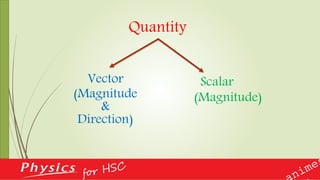
Quantity
Vector Scalar
(Magnitude
&
Direction)
(Magnitude)
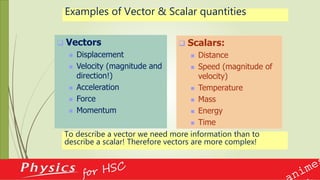
 Vectors
 Displacement
 Velocity (magnitude and
direction!)
 Acceleration
 Force
 Momentum
 Scalars:
 Distance
 Speed (magnitude of
velocity)
 Temperature
 Mass
 Energy
 Time
To describe a vector we need more information than to
describe a scalar! Therefore vectors are more complex!
Examples of Vector & Scalar quantities
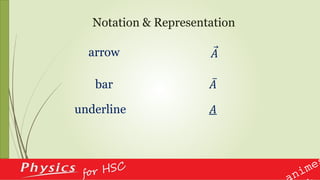
Notation & Representation
arrow 𝐴
bar 𝐴
underline 𝐴
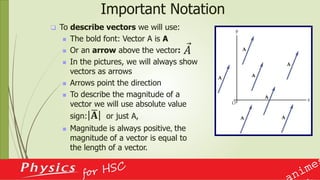
Important Notation
 To describe vectors we will use:
 The bold font: Vector A is A
 Or an arrow above the vector:
 In the pictures, we will always show
vectors as arrows
 Arrows point the direction
 To describe the magnitude of a
vector we will use absolute value
sign: 𝐀 or just A,
 Magnitude is always positive, the
magnitude of a vector is equal to
the length of a vector.
𝐴
Examples of vectors
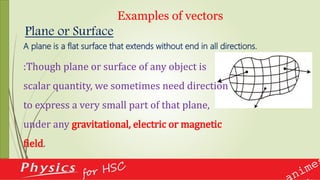
Plane or Surface
:Though plane or surface of any object is
scalar quantity, we sometimes need direction
to express a very small part of that plane,
under any gravitational, electric or magnetic
field.
A plane is a flat surface that extends without end in all directions.
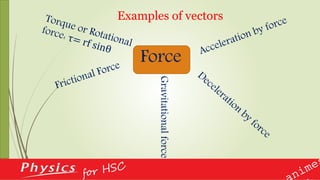
Examples of vectors
Force
Gravitationalforce
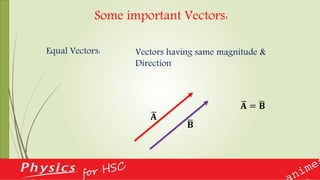
Some important Vectors:
Equal Vectors: Vectors having same magnitude &
Direction
𝐀
𝐀 = 𝐁
𝐁
Some important Vectors:
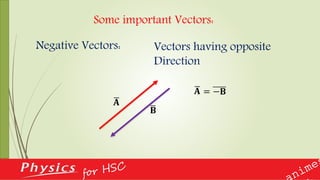
Negative Vectors: Vectors having opposite
Direction
𝐀
= −𝐁𝐀
𝐁
Some important Vectors:
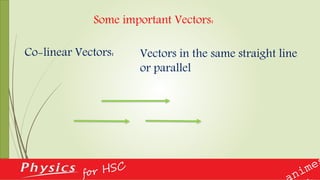
Co-linear Vectors: Vectors in the same straight line
or parallel
Some important Vectors:
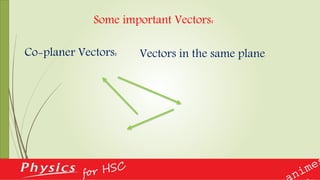
Co-planer Vectors: Vectors in the same plane
Some important Vectors:
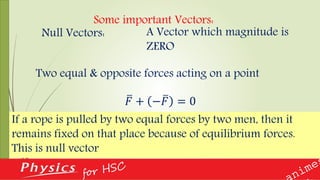
Null Vectors: A Vector which magnitude is
ZERO
Two equal & opposite forces acting on a point
𝐹 + − 𝐹 = 0
If a rope is pulled by two equal forces by two men, then it
remains fixed on that place because of equilibrium forces.
This is null vector
Some important Vectors:
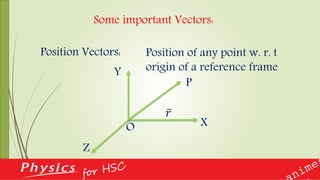
Position Vectors: Position of any point w. r. t
origin of a reference frame
X
Y
Z
P
O
𝑟
Some important Vectors:
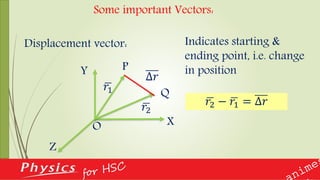
Displacement vector: Indicates starting &
ending point, i.e. change
in position
X
Y
Z
P
O
𝑟1
𝑟2
Q
Δ𝑟
𝑟2 − 𝑟1 = Δ𝑟
Geometric method of Vector Addition
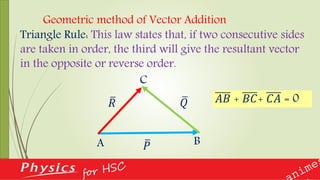
Triangle Rule: This law states that, if two consecutive sides
are taken in order, the third will give the resultant vector
in the opposite or reverse order.
𝐴𝐵 + 𝐵𝐶+ 𝐶𝐴 = 0
A B
C
𝑃
𝑄𝑅
Geometric method of Vector Addition
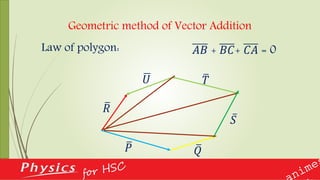
Law of polygon: 𝐴𝐵 + 𝐵𝐶+ 𝐶𝐴 = 0
𝑃 𝑄
𝑅
𝑆
𝑇𝑈
Geometric method of Vector Addition
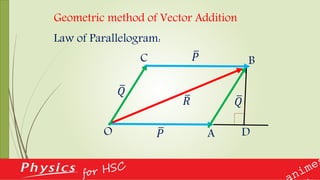
Law of Parallelogram:
𝑃
𝑄
𝑅
𝑃
𝑄
O A
BC
D
Geometric method of Vector Addition
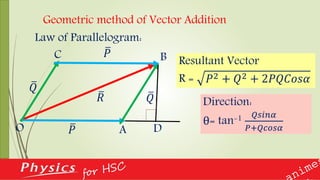
Law of Parallelogram:
𝑃
𝑄
𝑅
𝑃
𝑄
O A
BC
D
Resultant Vector
R = 𝑃2 + 𝑄2 + 2𝑃𝑄𝐶𝑜𝑠𝛼
Direction:
θ= tan-1 𝑄𝑠𝑖𝑛𝛼
𝑃+𝑄𝑐𝑜𝑠𝛼
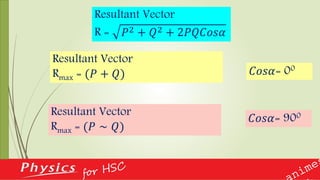
Resultant Vector
R = 𝑃2 + 𝑄2 + 2𝑃𝑄𝐶𝑜𝑠𝛼
Resultant Vector
Rmax = (𝑃 + 𝑄) 𝐶𝑜𝑠𝛼= 00
Resultant Vector
Rmax = (𝑃 ∼ 𝑄)
𝐶𝑜𝑠𝛼= 900
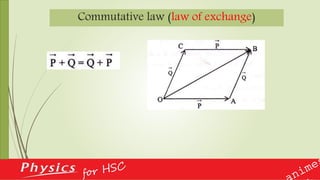
Commutative law (law of exchange)
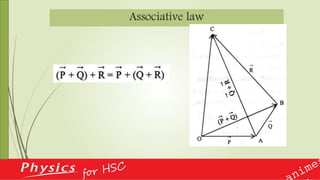
Associative law
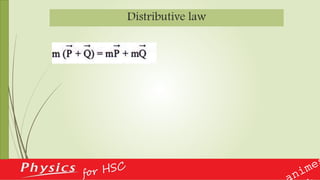
Distributive law
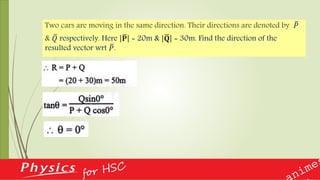
Two cars are moving in the same direction. Their directions are denoted by 𝑃
& 𝑄 respectively. Here 𝐏 = 20m & 𝐐 = 30m. Find the direction of the
resulted vector wrt 𝑃.
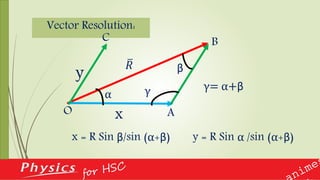
Vector Resolution:
x = R Sin β/sin (α+β)
x
y
𝑅
O A
α
C B
β
γ γ= α+β
y = R Sin α /sin (α+β)
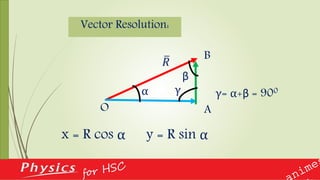
Vector Resolution:
x = R cos α
𝑅
O A
α
B
β
γ γ= α+β = 900
y = R sin α
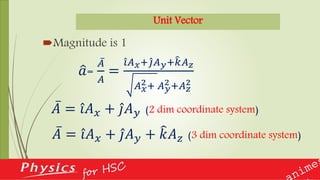
Unit Vector
Magnitude is 1
𝑎=
𝐴
𝐴
=
𝑖𝐴 𝑥+ 𝑗𝐴 𝑦+ 𝑘𝐴 𝑧
𝐴 𝑥
2+ 𝐴 𝑦
2 +𝐴 𝑧
2
𝐴 = 𝑖𝐴 𝑥 + 𝑗𝐴 𝑦 (2 dim coordinate system)
𝐴 = 𝑖𝐴 𝑥 + 𝑗𝐴 𝑦 + 𝑘𝐴 𝑧 (3 dim coordinate system)
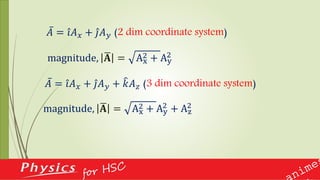
𝐴 = 𝑖𝐴 𝑥 + 𝑗𝐴 𝑦 (2 dim coordinate system)
𝐴 = 𝑖𝐴 𝑥 + 𝑗𝐴 𝑦 + 𝑘𝐴 𝑧 (3 dim coordinate system)
magnitude, 𝐀 = Ax
2 + Ay
2
magnitude, 𝐀 = Ax
2 + Ay
2
+ Az
2
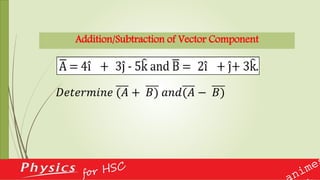
Addition/Subtraction of Vector Component
𝐷𝑒𝑡𝑒𝑟𝑚𝑖𝑛𝑒 (𝐴 + 𝐵) 𝑎𝑛𝑑(𝐴 − 𝐵)
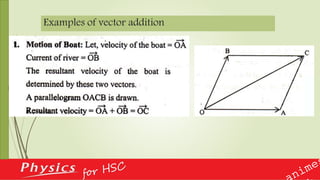
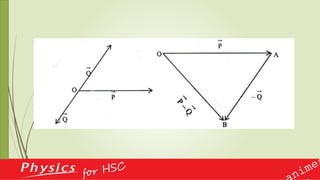
Examples of vector addition
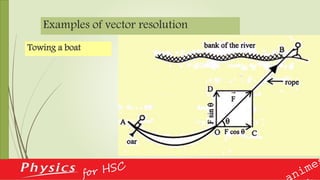
Examples of vector resolution
Towing a boat
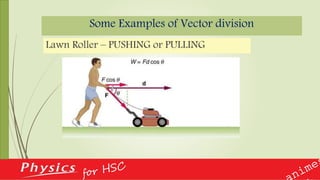
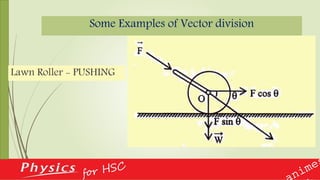
Some Examples of Vector division
Lawn Roller – PUSHING or PULLING
Some Examples of Vector division
Lawn Roller - PUSHING
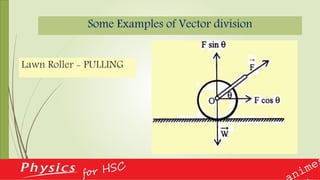
Some Examples of Vector division
Lawn Roller - PULLING
Vector Multiplication
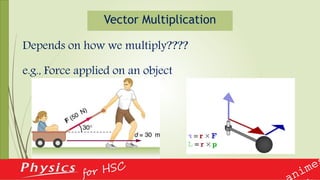
Depends on how we multiply????
e.g., Force applied on an object
Vector Multiplication
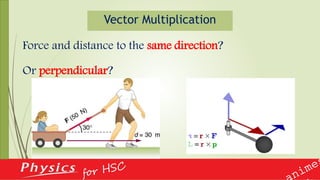
Force and distance to the same direction?
Or perpendicular?
Vector Multiplication
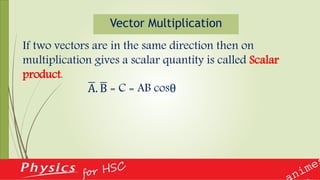
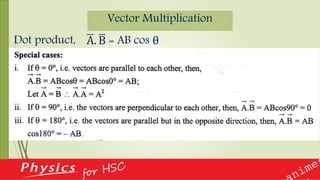
If two vectors are in the same direction then on
multiplication gives a scalar quantity is called Scalar
product.
A. B = C = AB cosθ
DOT PRODUCT or SCALAR PRODUCT
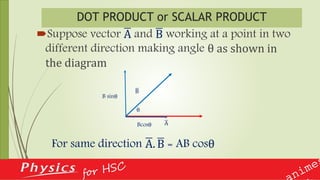
Suppose vector A and B working at a point in two
different direction making angle θ as shown in
the diagram
For same direction A. B = AB cosθ
A
B
θ
Bcosθ
B sinθ
Vector Multiplication
Dot product, A. B = AB cos θ
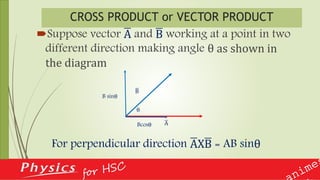
CROSS PRODUCT or VECTOR PRODUCT
Suppose vector A and B working at a point in two
different direction making angle θ as shown in
the diagram
For perpendicular direction AXB = AB sinθ
A
B
θ
Bcosθ
B sinθ
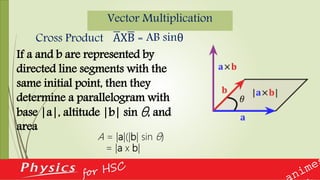
Vector Multiplication
Cross Product AXB = AB sinθ
If a and b are represented by
directed line segments with the
same initial point, then they
determine a parallelogram with
base |a|, altitude |b| sin θ, and
area
A = |a|(|b| sin θ)
= |a x b|
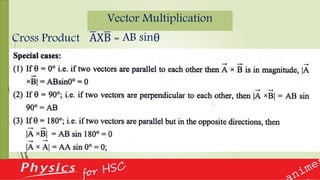
Vector Multiplication
Cross Product AXB = AB sinθ
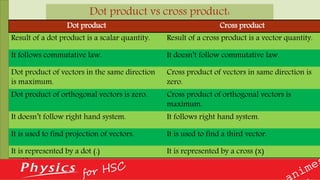
Dot product vs cross product:
Dot product Cross product
Result of a dot product is a scalar quantity. Result of a cross product is a vector quantity.
It follows commutative law. It doesn’t follow commutative law.
Dot product of vectors in the same direction
is maximum.
Cross product of vectors in same direction is
zero.
Dot product of orthogonal vectors is zero. Cross product of orthogonal vectors is
maximum.
It doesn’t follow right hand system. It follows right hand system.
It is used to find projection of vectors. It is used to find a third vector.
It is represented by a dot (.) It is represented by a cross (x)
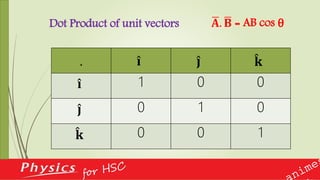
Dot Product of unit vectors 𝐀. 𝐁 = AB cos θ
. 𝐢 𝐣 𝐤
𝐢 1 0 0
𝐣 0 1 0
𝐤 0 0 1
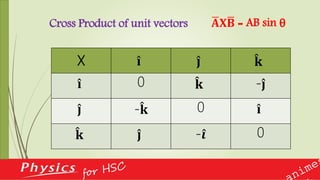
Cross Product of unit vectors 𝐀𝐗 𝐁 = AB sin θ
X 𝐢 𝐣 𝐤
𝐢 0 𝐤 - 𝐣
𝐣 - 𝐤 0 𝐢
𝐤 𝐣 - 𝒊 0
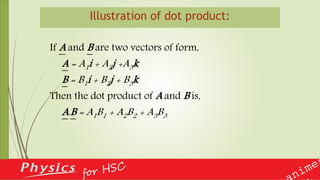
Illustration of dot product:
If A and B are two vectors of form,
A = A1i + A2j +A3k
B = B1i + B2j + B3k
Then the dot product of A and B is,
A.B = A1B1 + A2B2 + A3B3
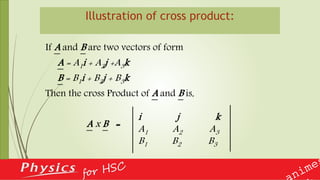
Illustration of cross product:
If A and B are two vectors of form
A = A1i + A2j +A3k
B = B1i + B2j + B3k
Then the cross Product of A and B is,
A x B =
i j k
A1 A2 A3
B1 B2 B3
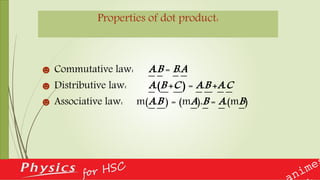
Properties of dot product:
☻ Commutative law: A.B = B.A
☻ Distributive law: A.(B +C ) = A.B +A.C
☻ Associative law: m(A.B ) = (mA).B = A.(mB)
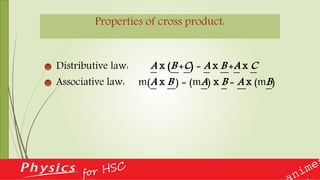
Properties of cross product:
☻ Distributive law: A x (B +C) = A x B +A x C
☻ Associative law: m(A x B ) = (mA) x B = A x (mB)
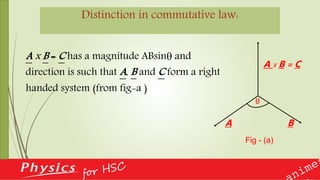
Distinction in commutative law:
A x B = C has a magnitude ABsin and
direction is such that A, B and C form a right
handed system (from fig-a )
θ
A x B = C
A B
Fig - (a)
Distinction in commutative law:
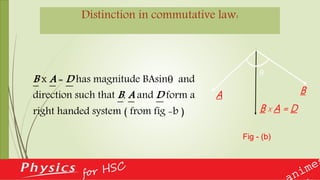
B x A = D has magnitude BAsin and
direction such that B, A and D form a
right handed system ( from fig -b ) B x A = D
Fig - (b)
A B
Distinction in commutative law:
Then D has the same magnitude as C but is opposite
in direction,
that is, C = - D
A x B = - B x A
Therefore the commutative law for cross product is
not valid.
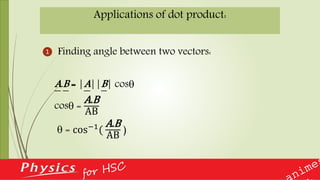
Applications of dot product:
❶ Finding angle between two vectors:
A.B = |A||B| cos
cos =
A.B
AB
 = cos−1
(
A.B
AB
)
Real life applications of dot product:
o Calculating total cost
o Electromagnetism, from which we get light,
electricity, computers etc.
o Gives the combined effect of the coordinates in
different dimensions on each other.
Applications of cross product:
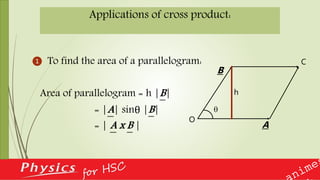
❶ To find the area of a parallelogram:
Area of parallelogram = h |B|
= |A| sinθ |B|
= | A x B |

A
B
h
O
C
Applications of cross product:
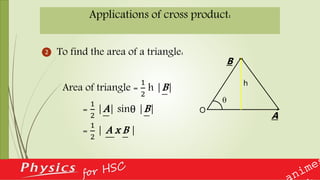
❷ To find the area of a triangle:
Area of triangle =
1
2
h |B|
=
1
2
|A| sinθ |B|
=
1
2
| A x B |

A
B
h
O
Real life applications of cross product:
o Finding moment
o Finding torque
o Rowing a boat
o Finding the most effective path
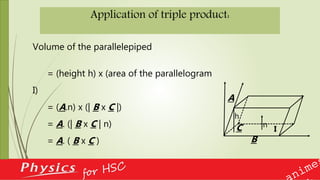
Application of triple product:
h
n
A
B
C
Volume of the parallelepiped
= (height h) x (area of the parallelogram
I)
= (A.n) x (| B x C |)
= A. (| B x C | n)
= A. ( B x C )
I
Vector Multiplication
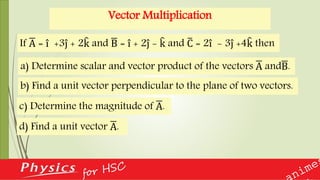
If A = i +3j + 2k and B = i + 2j - k and C = 2i - 3j +4k then
a) Determine scalar and vector product of the vectors A andB.
b) Find a unit vector perpendicular to the plane of two vectors.
c) Determine the magnitude of A.
d) Find a unit vector A.
Vector Multiplication
h) Find the normal projection of A on B. [Hints: A.B = ABcosθ]
If A = i +3j + 2k and B = i + 2j - k and C = 2i - 3j +4k then
e) Find the magnitude of the unit vector A.
f) Prove that (B + C) X A = B X A + CX A
g) Prove that the vectors A and B are coplanar
b) Perpendicular to each other? [Hints: use dot product]
If A = 5i +2j - 3k and B = 15i - mj -9k then for what value
of m the vectors will be
a) parallel to each other? [Hints: use cross product]
Scalar product of two vectors is 18 unit and
magnitude vector product is 6√3. Find the angle
between the vectors. [300]
Calculus in Physics
 Calculus is very important branch of mathematics. Geomrtry studies the shape
of the object, Algebra studies the different operations and calculus studies the
change.
 Two important branches of calculus are,
 i. Differential Calculus ~ discuss increasing and decreasing quantities and their
rate of change and slope of a curve
 ii. Integral Calculus ~ discuss about the accumulation of quantities and internal
area or volume of any closed object
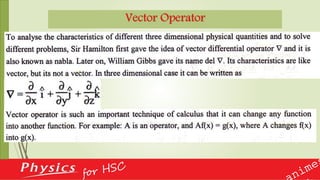
Vector Operator
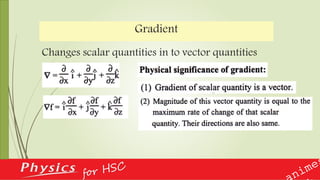
Gradient
Changes scalar quantities in to vector quantities
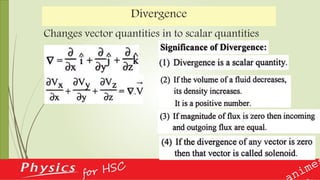
Divergence
Changes vector quantities in to scalar quantities
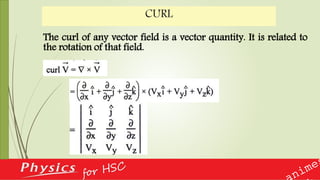
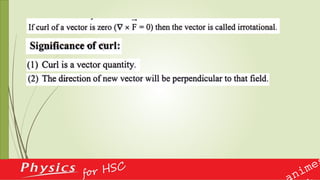
CURL
The curl of any vector field is a vector quantity. It is related to
the rotation of that field.
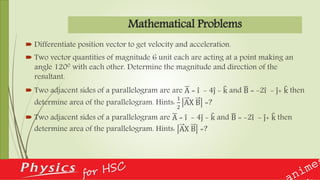
Mathematical Problems
 Differentiate position vector to get velocity and acceleration.
 Two vector quantities of magnitude 6 unit each are acting at a point making an
angle 1200 with each other. Determine the magnitude and direction of the
resultant.
 Two adjacent sides of a parallelogram are are A = i - 4j - k and B = -2i - j+ k then
determine area of the parallelogram. Hints:
1
2
AX B =?
 Two adjacent sides of a parallelogram are A = i - 4j - k and B = -2i - j+ k then
determine area of the parallelogram. Hints: AX B =?
Mathematical Problems
 Determine angle between two vectors of magnitude A = 3i +3j - 3k and B = 2i +j+
k. [Hints:A.B = ABcosθ]
 If two vectors acting simultaneously at a point are equal, show that their resultant
bisects the angle between those vectors.
 A boat starts rowing with velocity 20 ms-1 along the width of a river. The velocity of
the current of the river is 15 ms-1. Determine the resultant velocity of the boat. If
the river is of width 3 km, what will be the time required by the boat to reach the
other side of the river? [Hints: R= P2 + Q2 + 2PQcosα and t=d/v] ans: 25
ms-1 and 150s
Mathematical Problems
 A boat velocity is 18 kmh-1 towards the river current and 6 kmh-1 against the
current. At what direction the boat needs to move so that it will reach to the shore
perpendicularly. What will be the velocity of boat then?
 A man while running at velocity 3 ms-1 comes across rain falling vertically of
velocity 6 ms-1. At what angle he will have to hold an umbrella to protect himself
from rain? [Hints: tanθ] 26034’
Mathematical Problems
 If A = i +3j + 2k and B = i + 2j - k and C = 2i - 3j +4k then
 a) Determine scalar and vector product of the vectors A and B.
 b) Find a unit vector perpendicular to the plane of two vectors A and B.
 c) Determine the magnitude of A.
 d) Find a unit vector A.
 e) Find the magnitude of the unit vector A.
 f) Prove that (B + C) X A = B X A + CX A
 g) Prove that the vectors A and B are coplanar
 h) Find the normal projection of A on B. [Hints: A.B = ABcosθ]
Mathematical Problems
 If A = 5i +2j - 3k and B = 15i - mj -9k then for what value of m the vectors will
be
a) parallel to each other? [Hints: use cross product]
b) Perpendicular to each other? [Hints: use dot product]
 A force F = (6i - 3j +2k)N acts upon a particle and produces a displacement r = (2i
+ 2j - k) m. calculate the work done by the force.
 If A + B = A − B then show that A is perpendicular toB.
 Prove that A. B 2 + AXB 2 = A2B2
 The position vector of a particle is r = 2ti + 2t2j where t is time. determine it’s a)
velocity, b) acceleration
Mathematical Problems
 If A = 5i +2j - 3k and B = 15i - mj -9k then for what value of m the vectors will
be
 A = i 2x + y + j 3y + z2 + k(az + x) will be solenoidal?
[Hints: 𝛻. A = 0]
 A = i 2x + y + j 3y + z2
+ k(az + x) will be rotational or irrotational?
 A = 2i - 2j + k and B = i + j +2k
a) Determine projection of A on B
b) Are θ1 and θ2 equal? Show.
Mathematical Problems
 Two vectors, A = xi +yj + zk and B = pi +qj + rk are parallel to each other then
show that
x
y
=
p
q
,
y
z
=
q
r
and
z
x
=
r
p
 If φ= 2xy4 – x2z then, find 𝛻φ at (2, -1, -2)
 Two vector quantities F1 andF2 are working at the same point whereas F1 = 10 unit
and it acts at 300 with the ground and F2 = 5 unit acts perpendicularly. Determine
horizontal and perpendicular component of the resultant. [8.66 unit and 10 unit]
Hints: horizontal component R cosθ = F1cosα1 + F2 cosα2 And vertical component R
cosθ = F1sinα1 + F2 sinα2
Mathematical Problems
 Determine angular distance between A = i - 2j + 2k and x, y and z axis.
[Hints: Find α, β and γ
A .i = Ai cos α and α = ?
A .j = Aj cos β and β = ?
A . k = Ak cos γ and γ = ?]
Any Question?
Thank you

Ch 2 ~ vector

  • 1.
    Chapter 2 ~Vector Animesh Samundh Bangladesh International School & College
  • 2.
    Physics Paper 1 Chapter2 – Vector At the end of the chapter we will be able to – • explain vector characteristics • Explain vector representation of various physical quantities of Physics • Define some special vector quantities • Explain geometrical addition and subtraction • Divide a vector into two and three dimensional components • Describe the uses and the importance of calculus in physics • Describe the concept of vector calculus, divergence, gradient, curl • Apply vector operator
  • 3.
    Scalar quantities Vector quantities Lawof triangle Law of parallelogram Unit vector Rectangular unit vector Scalar or dot product Vector or cross product Vector operator Key words
  • 4.
  • 5.
     Vectors  Displacement Velocity (magnitude and direction!)  Acceleration  Force  Momentum  Scalars:  Distance  Speed (magnitude of velocity)  Temperature  Mass  Energy  Time To describe a vector we need more information than to describe a scalar! Therefore vectors are more complex! Examples of Vector & Scalar quantities
  • 6.
    Notation & Representation arrow𝐴 bar 𝐴 underline 𝐴
  • 7.
    Important Notation  Todescribe vectors we will use:  The bold font: Vector A is A  Or an arrow above the vector:  In the pictures, we will always show vectors as arrows  Arrows point the direction  To describe the magnitude of a vector we will use absolute value sign: 𝐀 or just A,  Magnitude is always positive, the magnitude of a vector is equal to the length of a vector. 𝐴
  • 8.
    Examples of vectors Planeor Surface :Though plane or surface of any object is scalar quantity, we sometimes need direction to express a very small part of that plane, under any gravitational, electric or magnetic field. A plane is a flat surface that extends without end in all directions.
  • 9.
  • 11.
    Some important Vectors: EqualVectors: Vectors having same magnitude & Direction 𝐀 𝐀 = 𝐁 𝐁
  • 12.
    Some important Vectors: NegativeVectors: Vectors having opposite Direction 𝐀 = −𝐁𝐀 𝐁
  • 13.
    Some important Vectors: Co-linearVectors: Vectors in the same straight line or parallel
  • 14.
    Some important Vectors: Co-planerVectors: Vectors in the same plane
  • 15.
    Some important Vectors: NullVectors: A Vector which magnitude is ZERO Two equal & opposite forces acting on a point 𝐹 + − 𝐹 = 0 If a rope is pulled by two equal forces by two men, then it remains fixed on that place because of equilibrium forces. This is null vector
  • 16.
    Some important Vectors: PositionVectors: Position of any point w. r. t origin of a reference frame X Y Z P O 𝑟
  • 17.
    Some important Vectors: Displacementvector: Indicates starting & ending point, i.e. change in position X Y Z P O 𝑟1 𝑟2 Q Δ𝑟 𝑟2 − 𝑟1 = Δ𝑟
  • 18.
    Geometric method ofVector Addition Triangle Rule: This law states that, if two consecutive sides are taken in order, the third will give the resultant vector in the opposite or reverse order. 𝐴𝐵 + 𝐵𝐶+ 𝐶𝐴 = 0 A B C 𝑃 𝑄𝑅
  • 19.
    Geometric method ofVector Addition Law of polygon: 𝐴𝐵 + 𝐵𝐶+ 𝐶𝐴 = 0 𝑃 𝑄 𝑅 𝑆 𝑇𝑈
  • 20.
    Geometric method ofVector Addition Law of Parallelogram: 𝑃 𝑄 𝑅 𝑃 𝑄 O A BC D
  • 21.
    Geometric method ofVector Addition Law of Parallelogram: 𝑃 𝑄 𝑅 𝑃 𝑄 O A BC D Resultant Vector R = 𝑃2 + 𝑄2 + 2𝑃𝑄𝐶𝑜𝑠𝛼 Direction: θ= tan-1 𝑄𝑠𝑖𝑛𝛼 𝑃+𝑄𝑐𝑜𝑠𝛼
  • 22.
    Resultant Vector R =𝑃2 + 𝑄2 + 2𝑃𝑄𝐶𝑜𝑠𝛼 Resultant Vector Rmax = (𝑃 + 𝑄) 𝐶𝑜𝑠𝛼= 00 Resultant Vector Rmax = (𝑃 ∼ 𝑄) 𝐶𝑜𝑠𝛼= 900
  • 23.
  • 24.
  • 25.
  • 26.
    Two cars aremoving in the same direction. Their directions are denoted by 𝑃 & 𝑄 respectively. Here 𝐏 = 20m & 𝐐 = 30m. Find the direction of the resulted vector wrt 𝑃.
  • 27.
    Vector Resolution: x =R Sin β/sin (α+β) x y 𝑅 O A α C B β γ γ= α+β y = R Sin α /sin (α+β)
  • 28.
    Vector Resolution: x =R cos α 𝑅 O A α B β γ γ= α+β = 900 y = R sin α
  • 29.
    Unit Vector Magnitude is1 𝑎= 𝐴 𝐴 = 𝑖𝐴 𝑥+ 𝑗𝐴 𝑦+ 𝑘𝐴 𝑧 𝐴 𝑥 2+ 𝐴 𝑦 2 +𝐴 𝑧 2 𝐴 = 𝑖𝐴 𝑥 + 𝑗𝐴 𝑦 (2 dim coordinate system) 𝐴 = 𝑖𝐴 𝑥 + 𝑗𝐴 𝑦 + 𝑘𝐴 𝑧 (3 dim coordinate system)
  • 30.
    𝐴 = 𝑖𝐴𝑥 + 𝑗𝐴 𝑦 (2 dim coordinate system) 𝐴 = 𝑖𝐴 𝑥 + 𝑗𝐴 𝑦 + 𝑘𝐴 𝑧 (3 dim coordinate system) magnitude, 𝐀 = Ax 2 + Ay 2 magnitude, 𝐀 = Ax 2 + Ay 2 + Az 2
  • 31.
    Addition/Subtraction of VectorComponent 𝐷𝑒𝑡𝑒𝑟𝑚𝑖𝑛𝑒 (𝐴 + 𝐵) 𝑎𝑛𝑑(𝐴 − 𝐵)
  • 33.
  • 35.
    Examples of vectorresolution Towing a boat
  • 36.
    Some Examples ofVector division Lawn Roller – PUSHING or PULLING
  • 37.
    Some Examples ofVector division Lawn Roller - PUSHING
  • 38.
    Some Examples ofVector division Lawn Roller - PULLING
  • 40.
    Vector Multiplication Depends onhow we multiply???? e.g., Force applied on an object
  • 41.
    Vector Multiplication Force anddistance to the same direction? Or perpendicular?
  • 42.
    Vector Multiplication If twovectors are in the same direction then on multiplication gives a scalar quantity is called Scalar product. A. B = C = AB cosθ
  • 43.
    DOT PRODUCT orSCALAR PRODUCT Suppose vector A and B working at a point in two different direction making angle θ as shown in the diagram For same direction A. B = AB cosθ A B θ Bcosθ B sinθ
  • 44.
  • 45.
    CROSS PRODUCT orVECTOR PRODUCT Suppose vector A and B working at a point in two different direction making angle θ as shown in the diagram For perpendicular direction AXB = AB sinθ A B θ Bcosθ B sinθ
  • 46.
    Vector Multiplication Cross ProductAXB = AB sinθ If a and b are represented by directed line segments with the same initial point, then they determine a parallelogram with base |a|, altitude |b| sin θ, and area A = |a|(|b| sin θ) = |a x b|
  • 47.
  • 48.
    Dot product vscross product: Dot product Cross product Result of a dot product is a scalar quantity. Result of a cross product is a vector quantity. It follows commutative law. It doesn’t follow commutative law. Dot product of vectors in the same direction is maximum. Cross product of vectors in same direction is zero. Dot product of orthogonal vectors is zero. Cross product of orthogonal vectors is maximum. It doesn’t follow right hand system. It follows right hand system. It is used to find projection of vectors. It is used to find a third vector. It is represented by a dot (.) It is represented by a cross (x)
  • 49.
    Dot Product ofunit vectors 𝐀. 𝐁 = AB cos θ . 𝐢 𝐣 𝐤 𝐢 1 0 0 𝐣 0 1 0 𝐤 0 0 1
  • 50.
    Cross Product ofunit vectors 𝐀𝐗 𝐁 = AB sin θ X 𝐢 𝐣 𝐤 𝐢 0 𝐤 - 𝐣 𝐣 - 𝐤 0 𝐢 𝐤 𝐣 - 𝒊 0
  • 51.
    Illustration of dotproduct: If A and B are two vectors of form, A = A1i + A2j +A3k B = B1i + B2j + B3k Then the dot product of A and B is, A.B = A1B1 + A2B2 + A3B3
  • 52.
    Illustration of crossproduct: If A and B are two vectors of form A = A1i + A2j +A3k B = B1i + B2j + B3k Then the cross Product of A and B is, A x B = i j k A1 A2 A3 B1 B2 B3
  • 53.
    Properties of dotproduct: ☻ Commutative law: A.B = B.A ☻ Distributive law: A.(B +C ) = A.B +A.C ☻ Associative law: m(A.B ) = (mA).B = A.(mB)
  • 54.
    Properties of crossproduct: ☻ Distributive law: A x (B +C) = A x B +A x C ☻ Associative law: m(A x B ) = (mA) x B = A x (mB)
  • 55.
    Distinction in commutativelaw: A x B = C has a magnitude ABsin and direction is such that A, B and C form a right handed system (from fig-a ) θ A x B = C A B Fig - (a)
  • 56.
    Distinction in commutativelaw: B x A = D has magnitude BAsin and direction such that B, A and D form a right handed system ( from fig -b ) B x A = D Fig - (b) A B
  • 57.
    Distinction in commutativelaw: Then D has the same magnitude as C but is opposite in direction, that is, C = - D A x B = - B x A Therefore the commutative law for cross product is not valid.
  • 58.
    Applications of dotproduct: ❶ Finding angle between two vectors: A.B = |A||B| cos cos = A.B AB  = cos−1 ( A.B AB )
  • 59.
    Real life applicationsof dot product: o Calculating total cost o Electromagnetism, from which we get light, electricity, computers etc. o Gives the combined effect of the coordinates in different dimensions on each other.
  • 60.
    Applications of crossproduct: ❶ To find the area of a parallelogram: Area of parallelogram = h |B| = |A| sinθ |B| = | A x B |  A B h O C
  • 61.
    Applications of crossproduct: ❷ To find the area of a triangle: Area of triangle = 1 2 h |B| = 1 2 |A| sinθ |B| = 1 2 | A x B |  A B h O
  • 62.
    Real life applicationsof cross product: o Finding moment o Finding torque o Rowing a boat o Finding the most effective path
  • 63.
    Application of tripleproduct: h n A B C Volume of the parallelepiped = (height h) x (area of the parallelogram I) = (A.n) x (| B x C |) = A. (| B x C | n) = A. ( B x C ) I
  • 64.
    Vector Multiplication If A= i +3j + 2k and B = i + 2j - k and C = 2i - 3j +4k then a) Determine scalar and vector product of the vectors A andB. b) Find a unit vector perpendicular to the plane of two vectors. c) Determine the magnitude of A. d) Find a unit vector A.
  • 65.
    Vector Multiplication h) Findthe normal projection of A on B. [Hints: A.B = ABcosθ] If A = i +3j + 2k and B = i + 2j - k and C = 2i - 3j +4k then e) Find the magnitude of the unit vector A. f) Prove that (B + C) X A = B X A + CX A g) Prove that the vectors A and B are coplanar
  • 66.
    b) Perpendicular toeach other? [Hints: use dot product] If A = 5i +2j - 3k and B = 15i - mj -9k then for what value of m the vectors will be a) parallel to each other? [Hints: use cross product]
  • 67.
    Scalar product oftwo vectors is 18 unit and magnitude vector product is 6√3. Find the angle between the vectors. [300]
  • 68.
    Calculus in Physics Calculus is very important branch of mathematics. Geomrtry studies the shape of the object, Algebra studies the different operations and calculus studies the change.  Two important branches of calculus are,  i. Differential Calculus ~ discuss increasing and decreasing quantities and their rate of change and slope of a curve  ii. Integral Calculus ~ discuss about the accumulation of quantities and internal area or volume of any closed object
  • 69.
  • 70.
    Gradient Changes scalar quantitiesin to vector quantities
  • 71.
    Divergence Changes vector quantitiesin to scalar quantities
  • 72.
    CURL The curl ofany vector field is a vector quantity. It is related to the rotation of that field.
  • 74.
    Mathematical Problems  Differentiateposition vector to get velocity and acceleration.  Two vector quantities of magnitude 6 unit each are acting at a point making an angle 1200 with each other. Determine the magnitude and direction of the resultant.  Two adjacent sides of a parallelogram are are A = i - 4j - k and B = -2i - j+ k then determine area of the parallelogram. Hints: 1 2 AX B =?  Two adjacent sides of a parallelogram are A = i - 4j - k and B = -2i - j+ k then determine area of the parallelogram. Hints: AX B =?
  • 75.
    Mathematical Problems  Determineangle between two vectors of magnitude A = 3i +3j - 3k and B = 2i +j+ k. [Hints:A.B = ABcosθ]  If two vectors acting simultaneously at a point are equal, show that their resultant bisects the angle between those vectors.  A boat starts rowing with velocity 20 ms-1 along the width of a river. The velocity of the current of the river is 15 ms-1. Determine the resultant velocity of the boat. If the river is of width 3 km, what will be the time required by the boat to reach the other side of the river? [Hints: R= P2 + Q2 + 2PQcosα and t=d/v] ans: 25 ms-1 and 150s
  • 76.
    Mathematical Problems  Aboat velocity is 18 kmh-1 towards the river current and 6 kmh-1 against the current. At what direction the boat needs to move so that it will reach to the shore perpendicularly. What will be the velocity of boat then?  A man while running at velocity 3 ms-1 comes across rain falling vertically of velocity 6 ms-1. At what angle he will have to hold an umbrella to protect himself from rain? [Hints: tanθ] 26034’
  • 77.
    Mathematical Problems  IfA = i +3j + 2k and B = i + 2j - k and C = 2i - 3j +4k then  a) Determine scalar and vector product of the vectors A and B.  b) Find a unit vector perpendicular to the plane of two vectors A and B.  c) Determine the magnitude of A.  d) Find a unit vector A.  e) Find the magnitude of the unit vector A.  f) Prove that (B + C) X A = B X A + CX A  g) Prove that the vectors A and B are coplanar  h) Find the normal projection of A on B. [Hints: A.B = ABcosθ]
  • 78.
    Mathematical Problems  IfA = 5i +2j - 3k and B = 15i - mj -9k then for what value of m the vectors will be a) parallel to each other? [Hints: use cross product] b) Perpendicular to each other? [Hints: use dot product]  A force F = (6i - 3j +2k)N acts upon a particle and produces a displacement r = (2i + 2j - k) m. calculate the work done by the force.  If A + B = A − B then show that A is perpendicular toB.  Prove that A. B 2 + AXB 2 = A2B2  The position vector of a particle is r = 2ti + 2t2j where t is time. determine it’s a) velocity, b) acceleration
  • 79.
    Mathematical Problems  IfA = 5i +2j - 3k and B = 15i - mj -9k then for what value of m the vectors will be  A = i 2x + y + j 3y + z2 + k(az + x) will be solenoidal? [Hints: 𝛻. A = 0]  A = i 2x + y + j 3y + z2 + k(az + x) will be rotational or irrotational?  A = 2i - 2j + k and B = i + j +2k a) Determine projection of A on B b) Are θ1 and θ2 equal? Show.
  • 80.
    Mathematical Problems  Twovectors, A = xi +yj + zk and B = pi +qj + rk are parallel to each other then show that x y = p q , y z = q r and z x = r p  If φ= 2xy4 – x2z then, find 𝛻φ at (2, -1, -2)  Two vector quantities F1 andF2 are working at the same point whereas F1 = 10 unit and it acts at 300 with the ground and F2 = 5 unit acts perpendicularly. Determine horizontal and perpendicular component of the resultant. [8.66 unit and 10 unit] Hints: horizontal component R cosθ = F1cosα1 + F2 cosα2 And vertical component R cosθ = F1sinα1 + F2 sinα2
  • 81.
    Mathematical Problems  Determineangular distance between A = i - 2j + 2k and x, y and z axis. [Hints: Find α, β and γ A .i = Ai cos α and α = ? A .j = Aj cos β and β = ? A . k = Ak cos γ and γ = ?]
  • 82.

Editor's Notes

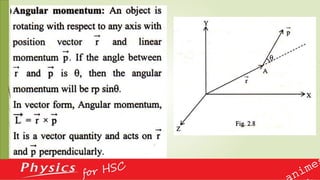
  • #10 Torque is the force which causes rotation, The angular momentum of a rigid object is defined as the product of the moment of inertiaand the angular velocity.