Hooke’s Law
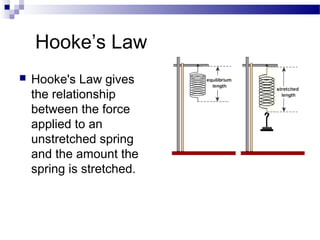
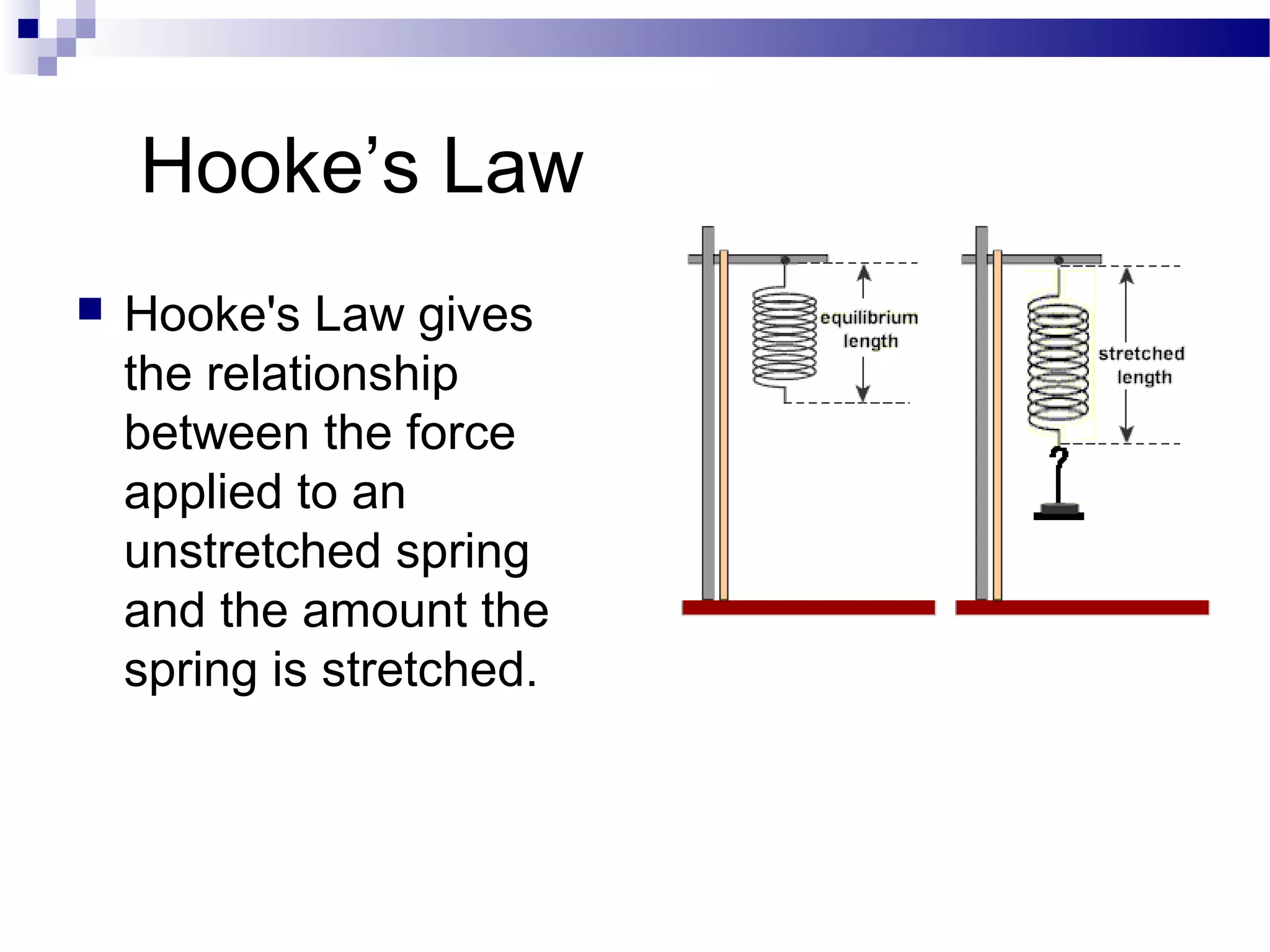
 Hooke's Law gives
the relationship
between the force
applied to an
unstretched spring
and the amount the
spring is stretched.
 Recall: How does a spring
stretch when a force is applied
to it?
 Try stretching a piece of thin
copper wire and an elastic.
 How do they differ from the
springs?
 What does it feel like as you
pull harder and harder?
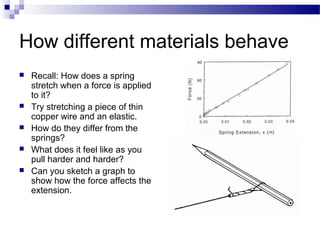
 Can you sketch a graph to
show how the force affects the
extension.
How different materials behave
Elastic and wire
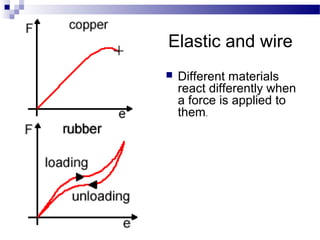
 Different materials
react differently when
a force is applied to
them.
How does a spring behave?
 Aim: We shall conduct an experiment to
determine how the extension of a spring varies
with the stretching force.
 A spring is hung vertically from a fixed point and
a force is applied in stages by hanging weights
from the spring.
Extension = present length – original length
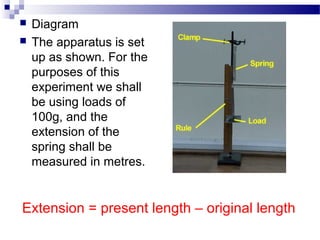
 Diagram
 The apparatus is set 
up as shown. For the 
purposes of this 
experiment we shall 
be using loads of 
100g, and the 
extension of the 
spring shall be 
measured in metres. 
 
Method: 
What is the independent 
variable? (range?)
What is the dependent 
variable? ( How will 
this be measured 
accurately?)
What are the control 
variables? 
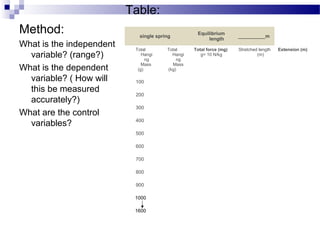
Table:
single spring  
Equilibrium
length
__________m 
Total 
Hangi
ng 
Mass 
(g)
Total 
Hangi
ng 
Mass
(kg)
Total force (mg) 
g= 10 N/kg
Stretched length 
(m)
Extension (m)
100       
200       
300       
400       
500       
600       
700       
800       
900       
1000
1600      
 
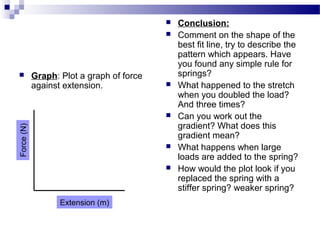
 Graph: Plot a graph of force 
against extension.
 Conclusion: 
 Comment on the shape of the 
best fit line, try to describe the 
pattern which appears. Have 
you found any simple rule for 
springs?
 What happened to the stretch 
when you doubled the load? 
And three times?
 Can you work out the 
gradient? What does this 
gradient mean? 
 What happens when large 
loads are added to the spring?
 How would the plot look if you 
replaced the spring with a 
stiffer spring? weaker spring?
Force (N)
Extension (m)
Hooke’s Law
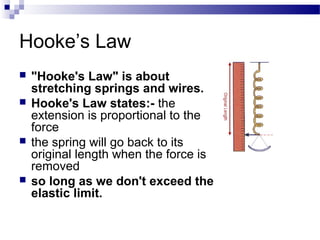
 "Hooke's Law" is about
stretching springs and wires.
 Hooke's Law states:- the 
extension is proportional to the 
force 
 the spring will go back to its 
original length when the force is 
removed 
 so long as we don't exceed the
elastic limit.
Elastic Limit
 Below the elastic limit, we
say that the spring is showing
"elastic behaviour": the
extension is proportional to the
force, and it'll go back to it's
original length when we
remove the force.
 Beyond the elastic limit, we
say that it shows "plastic
behaviour". This means that
when a force is applied to
deform the shape, it stays
deformed when the force is
removed.
Elastic limit
Elasticbehaviour
Plastic
behaviour
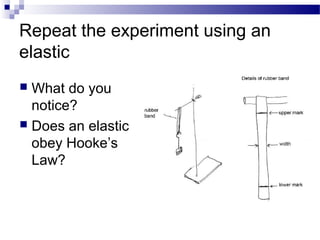
Repeat the experiment using an
elastic
 What do you
notice?
 Does an elastic
obey Hooke’s
Law?
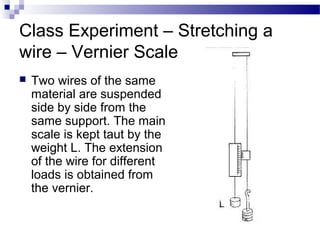
Class Experiment – Stretching a
wire – Vernier Scale
 Two wires of the same
material are suspended
side by side from the
same support. The main
scale is kept taut by the
weight L. The extension
of the wire for different
loads is obtained from
the vernier.
Elastic and wire
 Different materials react
differently when a force is
applied to them.
 If a material obeys Hooke's
Law, its extension is
proportional to the applied
force. If the force is removed,
the material returns to its
original length.
 Springs and metal wire obey
Hooke's law up to the elastic
limit. Beyond this point, they
are permanently deformed.
They will not return to its
original length when the force
is removed.
copper
rubberF
F
e
e
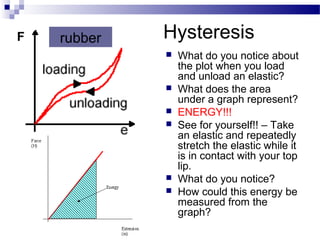
HysteresisrubberF
 What do you notice about
the plot when you load
and unload an elastic?
 What does the area
under a graph represent?
 ENERGY!!!
 See for yourself!! – Take
an elastic and repeatedly
stretch the elastic while it
is in contact with your top
lip.
 What do you notice?
 How could this energy be
measured from the
graph?

Hook law (stem school).