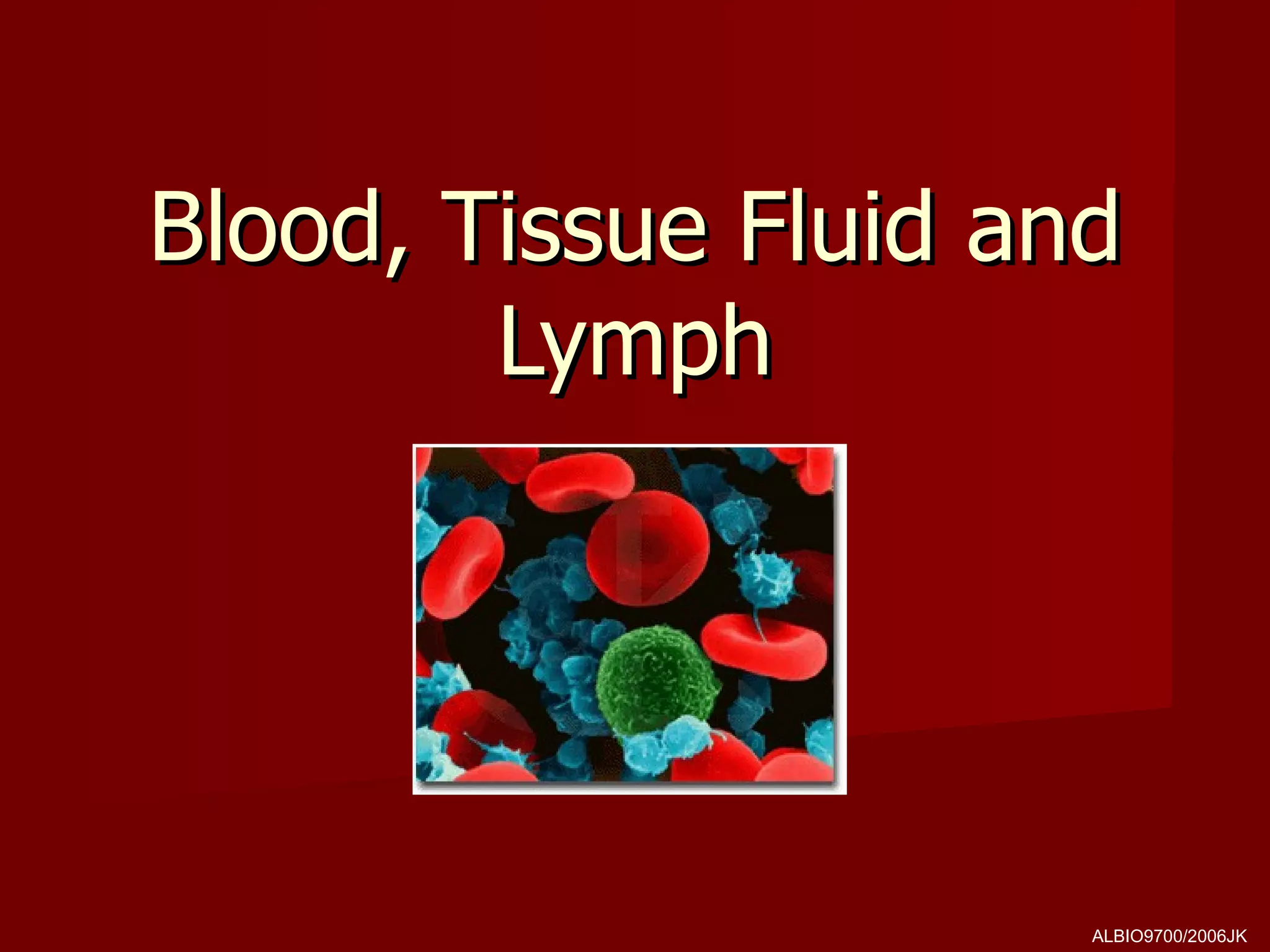
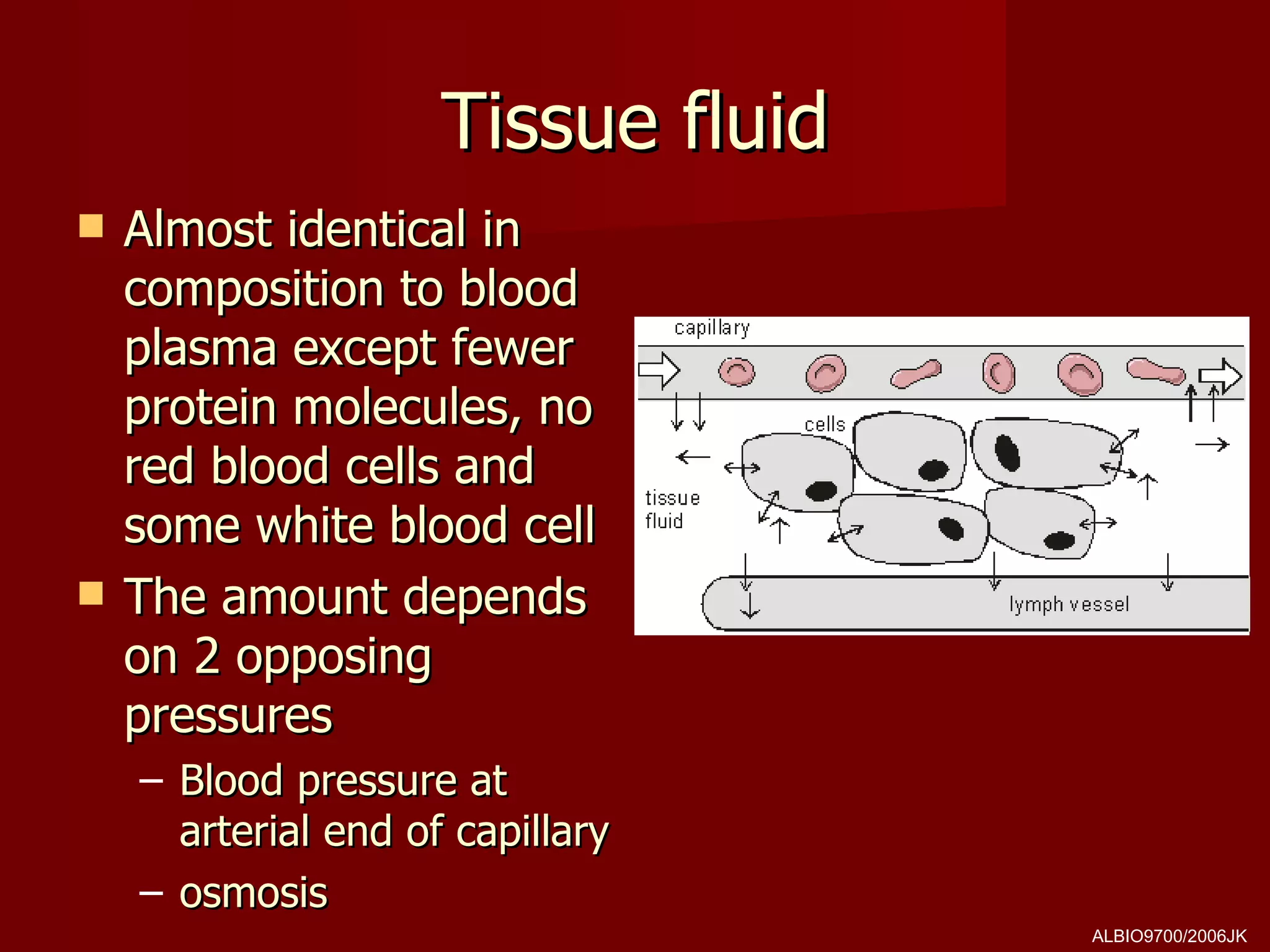
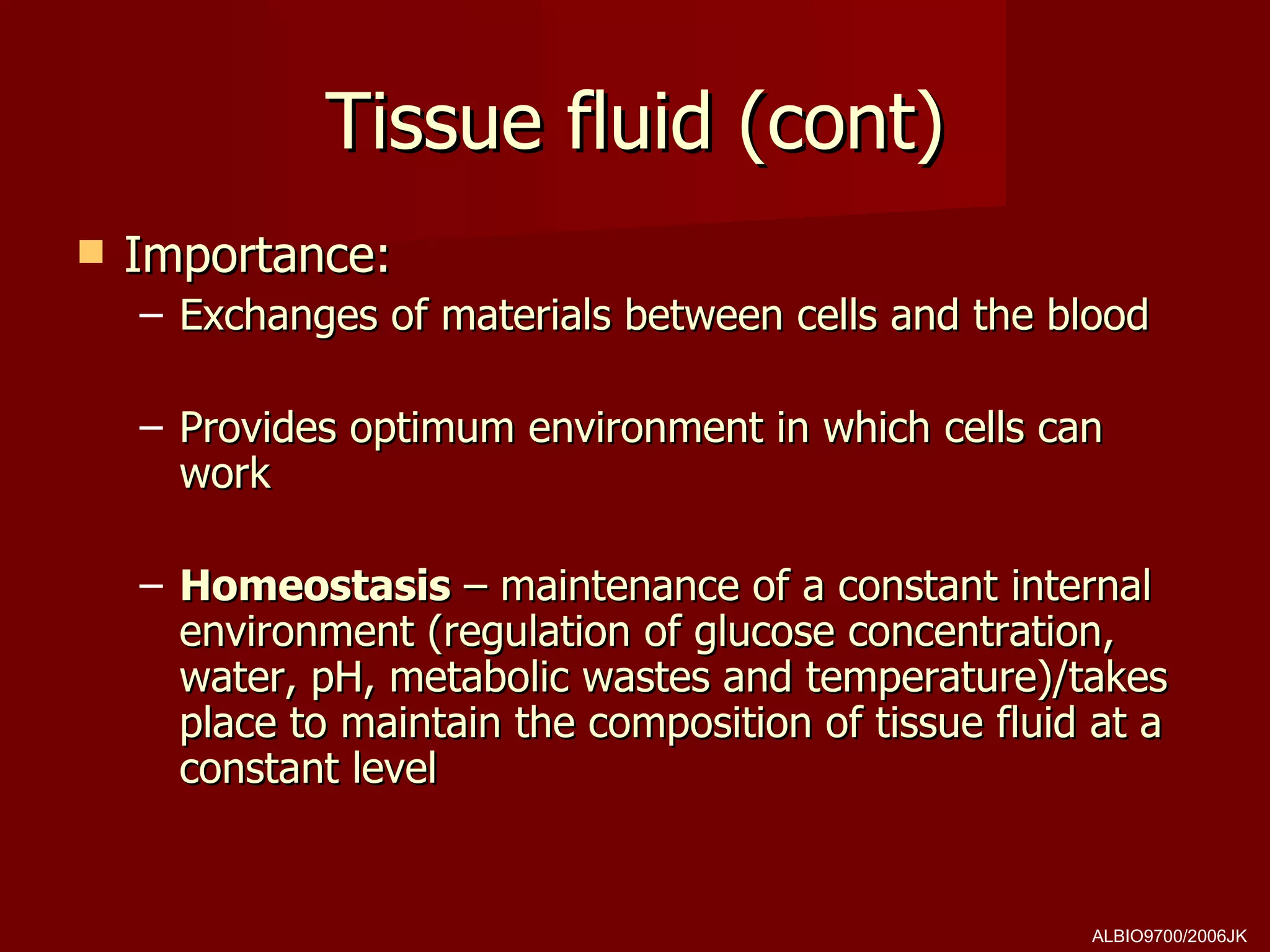
Blood, Tissue Fluid and
        Lymph


                      ALBIO9700/2006JK
Blood plasma
   Pale yellow liquid consisting of a variety of
    substances (10%) dissolved in water (90%)


                                                    ALBIO9700/2006JK
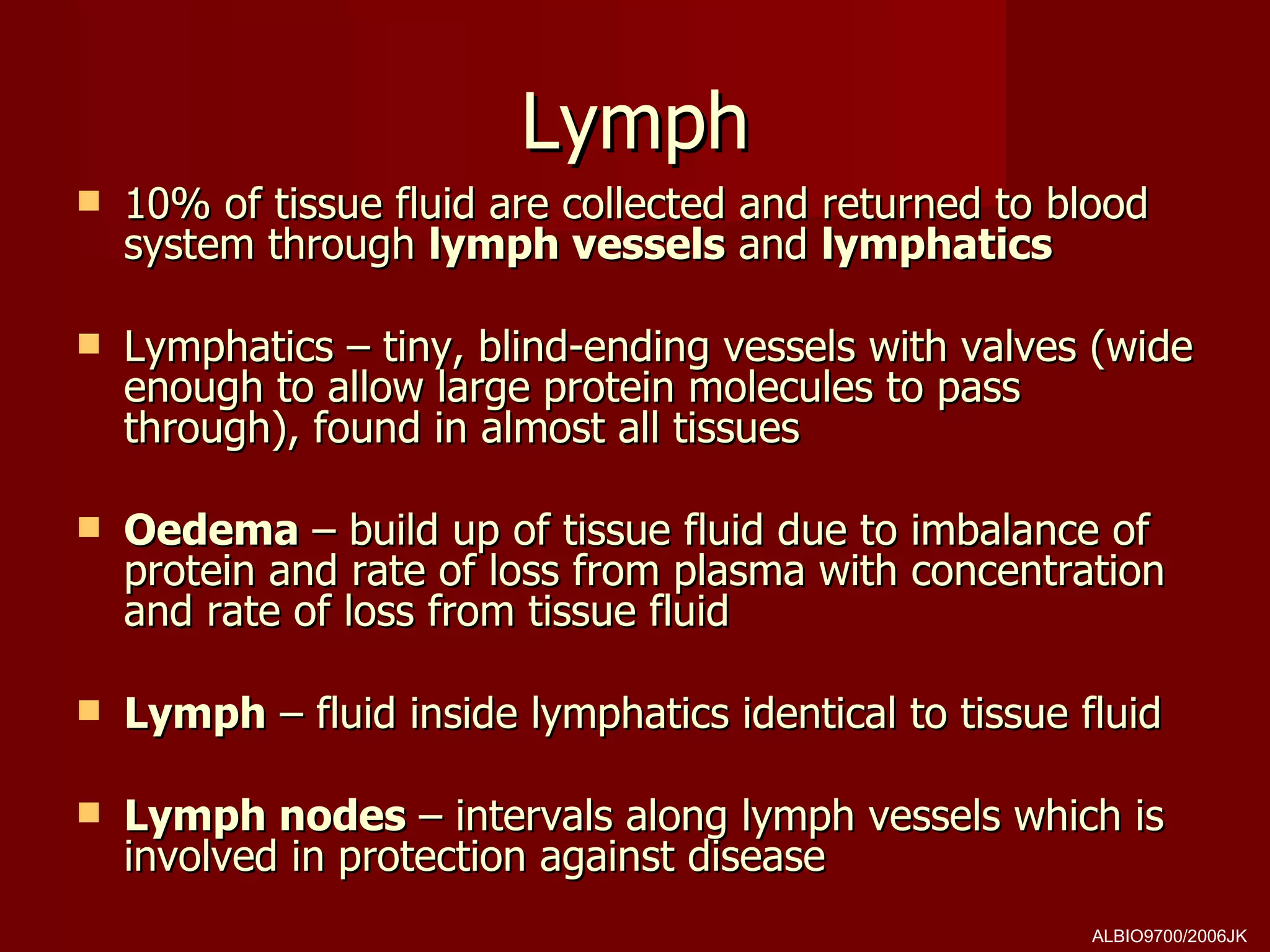
Tissue fluid
   Almost identical in
    composition to blood
    plasma except fewer
    protein molecules, no
    red blood cells and
    some white blood cell
   The amount depends
    on 2 opposing
    pressures
    – Blood pressure at
      arterial end of capillary
    – osmosis
                                    ALBIO9700/2006JK
Tissue fluid (cont)
   Importance:
    – Exchanges of materials between cells and the blood

    – Provides optimum environment in which cells can
      work

    – Homeostasis – maintenance of a constant internal
      environment (regulation of glucose concentration,
      water, pH, metabolic wastes and temperature)/takes
      place to maintain the composition of tissue fluid at a
      constant level


                                                       ALBIO9700/2006JK
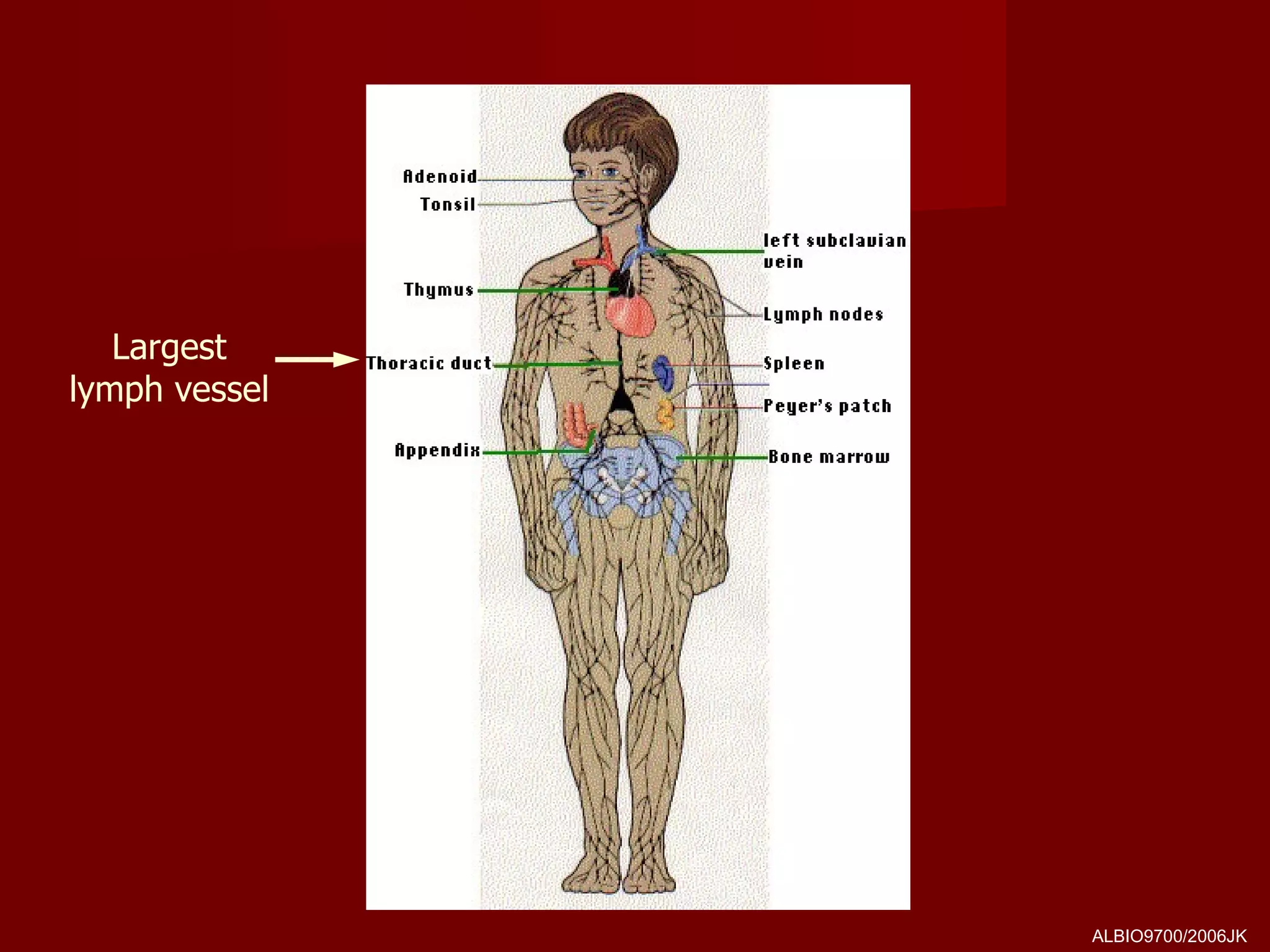
Lymph
   10% of tissue fluid are collected and returned to blood
    system through lymph vessels and lymphatics

   Lymphatics – tiny, blind-ending vessels with valves (wide
    enough to allow large protein molecules to pass
    through), found in almost all tissues

   Oedema – build up of tissue fluid due to imbalance of
    protein and rate of loss from plasma with concentration
    and rate of loss from tissue fluid

   Lymph – fluid inside lymphatics identical to tissue fluid

   Lymph nodes – intervals along lymph vessels which is
    involved in protection against disease
                                                         ALBIO9700/2006JK
Oedema


         ALBIO9700/2006JK
Lymph (cont)


               ALBIO9700/2006JK
Largest
lymph vessel


               ALBIO9700/2006JK
Red blood cells (erythrocytes)
   Red colour caused by the pigment haemoglobin
    (globular protein)

   Haemoglobin – transports oxygen from lungs to
    respiring tissues

   Formed in bone marrow (liver; humerus, femur;
    skull, ribs, pelvis, vertebrae)

   Eventually rupture within some ‘tight spot’ in the
    circulatory system, often inside the spleen
                                                 ALBIO9700/2006JK
ALBIO9700/2006JK
Red blood cells (cont)
   The structure is unusual in 3 ways:
    i) Red blood cells are very small
    (diameter=7μm) – haemoglobin/capillaries

    ii) Red blood cells are shaped like a biconcave
    disc – surface area to volume ratio

    iii) Red blood cells have no nucleus, no
    mitochondria and no endoplasmic reticulum –
    more haemoglobin
                                                 ALBIO9700/2006JK
White blood cells (leucocytes)
   Made in bone marrow


   Distinguished from red blood cells:
    – White blood cells all have nucleus
    – White blood cells are mostly larger (except
      lymphocytes)
    – White blood cells are either spherical or irregular in
      shape


                                                         ALBIO9700/2006JK
White blood cells
   Phagocytes – cells that destroy invading
    microorganisms by phagocytosis (lobed
    nuclei and granular cytoplasm)

   Lymphocytes – destroy microorganisms
    by secreting chemicals called antibodies
    which attach to and destroy the invading
    cells (smaller, large round nucleus and
    small amount of cytoplasm)

                                         ALBIO9700/2006JK
White blood cells


                    ALBIO9700/2006JK
Types of WBCs:
i) granular white blood cells include:
   – neutrophils (50 - 70% of WBCs) - phagocytosis (bacteria &
     cellular debris); very important in inflammation
   – eosinophils (1 - 4%) - help break down blood clots & kill
     parasites
   – basophils (less than 1%) - synthesize & store histamine (a
     substance released during inflammation) & heparin (an
     anticoagulant); functions(s) remain unclear

ii) agranular (or non-granular) white blood cells include:
   – lymphocytes (25 - 40%) - immune response (including
     production of antibodies)
   – monocytes (2 - 8%) - phagocytosis (typically as macrophages in
     tissues of the liver, spleen, lungs, & lymph nodes)


                                                              ALBIO9700/2006JK
ALBIO9700/2006JK
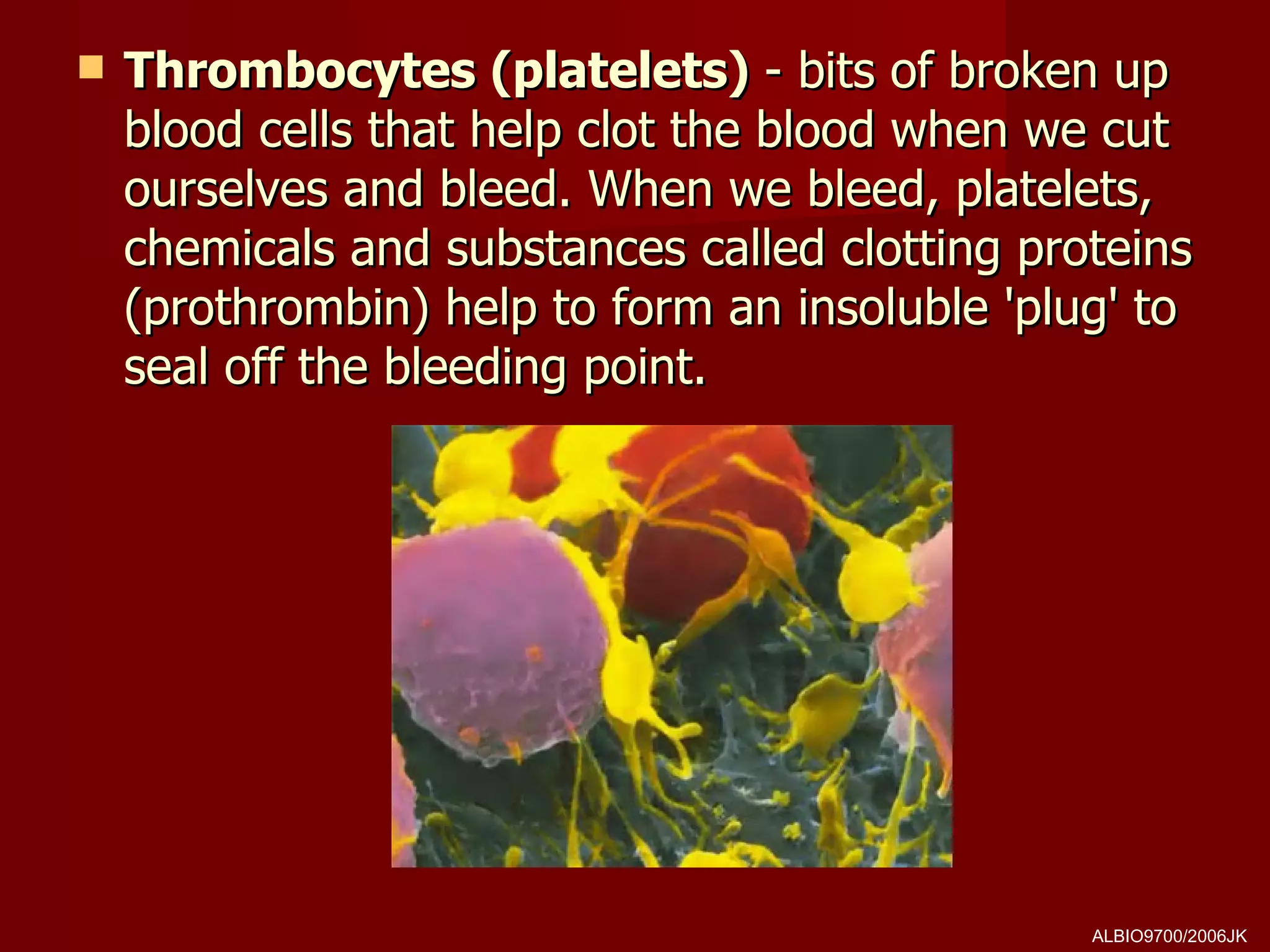
   Thrombocytes (platelets) - bits of broken up
    blood cells that help clot the blood when we cut
    ourselves and bleed. When we bleed, platelets,
    chemicals and substances called clotting proteins
    (prothrombin) help to form an insoluble 'plug' to
    seal off the bleeding point.


                                                ALBIO9700/2006JK
Some related diseases
   Anemia
   Lymphatic filariasis
   Hemophilia
   AIDS
   Leukemia
   Thalassemia


                                  ALBIO9700/2006JK
Haemoglobin
   Oxygen is transported around the body
    inside red blood cells in combination with
    the protein haemoglobin

       Hb         +   4O2        HbO8
     haemoglobin       oxygen   oxyhaemoglobin


                                                 ALBIO9700/2006JK
ALBIO9700/2006JK
 85% CO2 is transported by the blood
  through hydrogencarbonate ions, HCO3-,
  after dissociation of dissolved CO2
 5% CO2 dissolve in blood plasma without
  dissociation
 10% CO2 diffuse into red blood cells,
  combining directly with the terminal amine
  groups (-NH2) of some of the haemoglobin
  molecules (carbamino-haemoglobin)
 When blood reaches lungs, the reactions
  go into reverse
                                        ALBIO9700/2006JK
The haemoglobin dissociation curve
   Haemoglobin performs the task of picking up
    and releasing oxygen very well

   Investigate how haemoglobin behaves:
    – Samples extracted from blood and exposed to
      different concentrations (partial pressures) of
      oxygen
    – Amount of oxygen that combines with each sample of
      haemoglobin is measured
    – Maximum amount of oxygen given a value of 100%
      (saturated)
    – Amounts at lower oxygen partial pressures are
      expressed as a percentage of the maximum value
                                                   ALBIO9700/2006JK
The percentage saturation of each sample
    can be plotted against the partial pressure
         of oxygen to obtain the curve


   The shape of the haemoglobin dissociation curve can be
    explained by the behaviour of a haemoglobin molecule
    as it combines with or loses oxygen molecules
                                                     ALBIO9700/2006JK
The Bohr shift
   Amount of oxygen that haemoglobin carries is affected
    not only by the partial pressure of oxygen, but also by
    the partial pressure of carbon dioxide
                                  carbonic anhydrase
       CO2          +     H2O                         H2CO3
    carbon dioxide        water                   carbonic acid

   The carbonic acid dissociates:
       H2CO3             H+        +           HCO3-
     carbonic acid       hydrogen ion    hydrogencarbonate ion

   Haemoglobin readily combines with these hydrogen ions,
    forming haemoglobinic acid, HHb (releasing oxygen)

                                                                  ALBIO9700/2006JK
   By removing the hydrogen ions from solution,
    haemoglobin helps to maintain the pH of the
    blood close to neutral (buffer)
   Bohr effect – the presence of high partial
    pressure of carbon dioxide causes haemoglobin
    to release oxygen


                                              ALBIO9700/2006JK
Fetal haemoglobin
 The partial pressure of oxygen in the
  fetus’ blood is only a little lower than that
  in its mother’s blood
 Fetal haemoglobin combines more readily
  with oxygen than adult haemoglobin
  (higher affinity for oxygen)
 Dissociation curve lies above the curve for
  adult haemoglobin

                                           ALBIO9700/2006JK
Myoglobin
   Red pigment which combines reversibly with oxygen
   Found inside cells in some tissues of the body (muscle
    cells)
   Made up of only 1 polypeptide, 1 haem group and can
    combine with 1 oxygen molecule
   The oxymyoglobin molecule is very stable and will not
    release its oxygen unless partial pressure of oxygen
    around it is very low
   Myoglobin has a higher percentage of saturation with
    oxygen than haemoglobin
   Acts as an oxygen storage
   The oxygen held by the myoglobin is a reserve, to be
    used up only in conditions of particularly great oxygen
    demand
                                                        ALBIO9700/2006JK
ALBIO9700/2006JK
ALBIO9700/2006JK
High altitude
   At sea level:
    –   Partial pressure of O2 in atmosphere = 20kPa
    –   Partial pressure of O2 in an alveolus = 13kPa
    –   Haemoglobin almost completely saturated with
        oxygen
   At 6500m:
    –   Partial pressure of O2 in atmosphere = 10kPa
    –   Partial pressure of O2 in an alveolus = 5.3kPa
    –   Haemoglobin only about 70% saturated in lungs
   Altitude sickness:
    –   Increase in the rate and depth of breathing
    –   General feeling of dizziness and weakness (nausea)
    –   Arterioles in the brains dilate (fluids begins to leak
        into brain tissues causing disorientation and into
        lungs)
                                                          ALBIO9700/2006JK
High altitude


                ALBIO9700/2006JK
   Changes that take place as body
    acclimatises:
     – Number of red blood cells
       increases (40-50% to 50-70%)
   Adaptations to low-oxygen
    environments:
     – Broad chests (larger lung
       capacities)
     – Larger hearts (especially right
       side that pumps blood to the
       lungs)
     – More haemoglobin in blood
       (increasing efficiency of oxygen
       transport)                         ALBIO9700/2006JK
Carbon monoxide
   CO combines with the haem groups in the
    haemoglobin molecules forming
    carboxyhaemoglobin
   Haemoglobin combines with CO 250 times more
    readily than it does with O2
   Carboxyhaemoglobin is a very stable compound
   Low concentrations of CO (0.1%) in the air can
    cause death by asphyxiation
   Treatment: administration of a mixture of pure
    oxygen and carbon dioxide

                                              ALBIO9700/2006JK
ALBIO9700/2006JK

02 Blood, Tissue Fluid and Lymph

  • 1.
    Blood, Tissue Fluidand Lymph ALBIO9700/2006JK
  • 2.
    Blood plasma  Pale yellow liquid consisting of a variety of substances (10%) dissolved in water (90%) ALBIO9700/2006JK
  • 3.
    Tissue fluid  Almost identical in composition to blood plasma except fewer protein molecules, no red blood cells and some white blood cell  The amount depends on 2 opposing pressures – Blood pressure at arterial end of capillary – osmosis ALBIO9700/2006JK
  • 4.
    Tissue fluid (cont)  Importance: – Exchanges of materials between cells and the blood – Provides optimum environment in which cells can work – Homeostasis – maintenance of a constant internal environment (regulation of glucose concentration, water, pH, metabolic wastes and temperature)/takes place to maintain the composition of tissue fluid at a constant level ALBIO9700/2006JK
  • 5.
    Lymph  10% of tissue fluid are collected and returned to blood system through lymph vessels and lymphatics  Lymphatics – tiny, blind-ending vessels with valves (wide enough to allow large protein molecules to pass through), found in almost all tissues  Oedema – build up of tissue fluid due to imbalance of protein and rate of loss from plasma with concentration and rate of loss from tissue fluid  Lymph – fluid inside lymphatics identical to tissue fluid  Lymph nodes – intervals along lymph vessels which is involved in protection against disease ALBIO9700/2006JK
  • 6.
    Oedema ALBIO9700/2006JK
  • 7.
    Lymph (cont) ALBIO9700/2006JK
  • 8.
    Largest lymph vessel ALBIO9700/2006JK
  • 9.
    Red blood cells(erythrocytes)  Red colour caused by the pigment haemoglobin (globular protein)  Haemoglobin – transports oxygen from lungs to respiring tissues  Formed in bone marrow (liver; humerus, femur; skull, ribs, pelvis, vertebrae)  Eventually rupture within some ‘tight spot’ in the circulatory system, often inside the spleen ALBIO9700/2006JK
  • 10.
  • 11.
    Red blood cells(cont)  The structure is unusual in 3 ways: i) Red blood cells are very small (diameter=7μm) – haemoglobin/capillaries ii) Red blood cells are shaped like a biconcave disc – surface area to volume ratio iii) Red blood cells have no nucleus, no mitochondria and no endoplasmic reticulum – more haemoglobin ALBIO9700/2006JK
  • 12.
    White blood cells(leucocytes)  Made in bone marrow  Distinguished from red blood cells: – White blood cells all have nucleus – White blood cells are mostly larger (except lymphocytes) – White blood cells are either spherical or irregular in shape ALBIO9700/2006JK
  • 13.
    White blood cells  Phagocytes – cells that destroy invading microorganisms by phagocytosis (lobed nuclei and granular cytoplasm)  Lymphocytes – destroy microorganisms by secreting chemicals called antibodies which attach to and destroy the invading cells (smaller, large round nucleus and small amount of cytoplasm) ALBIO9700/2006JK
  • 14.
    White blood cells ALBIO9700/2006JK
  • 15.
    Types of WBCs: i)granular white blood cells include: – neutrophils (50 - 70% of WBCs) - phagocytosis (bacteria & cellular debris); very important in inflammation – eosinophils (1 - 4%) - help break down blood clots & kill parasites – basophils (less than 1%) - synthesize & store histamine (a substance released during inflammation) & heparin (an anticoagulant); functions(s) remain unclear ii) agranular (or non-granular) white blood cells include: – lymphocytes (25 - 40%) - immune response (including production of antibodies) – monocytes (2 - 8%) - phagocytosis (typically as macrophages in tissues of the liver, spleen, lungs, & lymph nodes) ALBIO9700/2006JK
  • 16.
  • 17.
    Thrombocytes (platelets) - bits of broken up blood cells that help clot the blood when we cut ourselves and bleed. When we bleed, platelets, chemicals and substances called clotting proteins (prothrombin) help to form an insoluble 'plug' to seal off the bleeding point. ALBIO9700/2006JK
  • 18.
    Some related diseases  Anemia  Lymphatic filariasis  Hemophilia  AIDS  Leukemia  Thalassemia ALBIO9700/2006JK
  • 19.
    Haemoglobin  Oxygen is transported around the body inside red blood cells in combination with the protein haemoglobin  Hb + 4O2 HbO8 haemoglobin oxygen oxyhaemoglobin ALBIO9700/2006JK
  • 20.
  • 21.
     85% CO2is transported by the blood through hydrogencarbonate ions, HCO3-, after dissociation of dissolved CO2  5% CO2 dissolve in blood plasma without dissociation  10% CO2 diffuse into red blood cells, combining directly with the terminal amine groups (-NH2) of some of the haemoglobin molecules (carbamino-haemoglobin)  When blood reaches lungs, the reactions go into reverse ALBIO9700/2006JK
  • 22.
    The haemoglobin dissociationcurve  Haemoglobin performs the task of picking up and releasing oxygen very well  Investigate how haemoglobin behaves: – Samples extracted from blood and exposed to different concentrations (partial pressures) of oxygen – Amount of oxygen that combines with each sample of haemoglobin is measured – Maximum amount of oxygen given a value of 100% (saturated) – Amounts at lower oxygen partial pressures are expressed as a percentage of the maximum value ALBIO9700/2006JK
  • 23.
    The percentage saturationof each sample can be plotted against the partial pressure of oxygen to obtain the curve  The shape of the haemoglobin dissociation curve can be explained by the behaviour of a haemoglobin molecule as it combines with or loses oxygen molecules ALBIO9700/2006JK
  • 24.
    The Bohr shift  Amount of oxygen that haemoglobin carries is affected not only by the partial pressure of oxygen, but also by the partial pressure of carbon dioxide carbonic anhydrase  CO2 + H2O H2CO3 carbon dioxide water carbonic acid  The carbonic acid dissociates: H2CO3 H+ + HCO3- carbonic acid hydrogen ion hydrogencarbonate ion  Haemoglobin readily combines with these hydrogen ions, forming haemoglobinic acid, HHb (releasing oxygen) ALBIO9700/2006JK
  • 25.
    By removing the hydrogen ions from solution, haemoglobin helps to maintain the pH of the blood close to neutral (buffer)  Bohr effect – the presence of high partial pressure of carbon dioxide causes haemoglobin to release oxygen ALBIO9700/2006JK
  • 26.
    Fetal haemoglobin  Thepartial pressure of oxygen in the fetus’ blood is only a little lower than that in its mother’s blood  Fetal haemoglobin combines more readily with oxygen than adult haemoglobin (higher affinity for oxygen)  Dissociation curve lies above the curve for adult haemoglobin ALBIO9700/2006JK
  • 27.
    Myoglobin  Red pigment which combines reversibly with oxygen  Found inside cells in some tissues of the body (muscle cells)  Made up of only 1 polypeptide, 1 haem group and can combine with 1 oxygen molecule  The oxymyoglobin molecule is very stable and will not release its oxygen unless partial pressure of oxygen around it is very low  Myoglobin has a higher percentage of saturation with oxygen than haemoglobin  Acts as an oxygen storage  The oxygen held by the myoglobin is a reserve, to be used up only in conditions of particularly great oxygen demand ALBIO9700/2006JK
  • 28.
  • 29.
  • 30.
    High altitude  At sea level: – Partial pressure of O2 in atmosphere = 20kPa – Partial pressure of O2 in an alveolus = 13kPa – Haemoglobin almost completely saturated with oxygen  At 6500m: – Partial pressure of O2 in atmosphere = 10kPa – Partial pressure of O2 in an alveolus = 5.3kPa – Haemoglobin only about 70% saturated in lungs  Altitude sickness: – Increase in the rate and depth of breathing – General feeling of dizziness and weakness (nausea) – Arterioles in the brains dilate (fluids begins to leak into brain tissues causing disorientation and into lungs) ALBIO9700/2006JK
  • 31.
    High altitude ALBIO9700/2006JK
  • 32.
    Changes that take place as body acclimatises: – Number of red blood cells increases (40-50% to 50-70%)  Adaptations to low-oxygen environments: – Broad chests (larger lung capacities) – Larger hearts (especially right side that pumps blood to the lungs) – More haemoglobin in blood (increasing efficiency of oxygen transport) ALBIO9700/2006JK
  • 33.
    Carbon monoxide  CO combines with the haem groups in the haemoglobin molecules forming carboxyhaemoglobin  Haemoglobin combines with CO 250 times more readily than it does with O2  Carboxyhaemoglobin is a very stable compound  Low concentrations of CO (0.1%) in the air can cause death by asphyxiation  Treatment: administration of a mixture of pure oxygen and carbon dioxide ALBIO9700/2006JK
  • 34.