BONE

 Dr Laxman Khanal
MS- Human Anatomy
    Batch-2011
 Date-25-04-2012
OBJECTIVES….
•   Introduction
•   Functions.
•   Embryological source of bone.
•   Parts of bones
•   Laws of ossification
•   Blood supply of bones
•   Classification of bones

25/27/2012            1212413114    2
…OBJECTIVES
• Microscopic study of bones.
Compact and cancellous bone
• Composition of bones.
• Ossification of bones.
 Intramembranous
 Endochondral
• Growth of bones
• Factors affecting the bone

25/27/2012         1212413114   3
Introduction
•   Bone is mineralized dense connective tissue
•   Made up of few cells in mineralized matrix
•   Consists of 30-40 % of our body weight.
•   Dynamic in nature


25/27/2012             1212413114                 4
Function
•   Framework of the body.
•   Attachment of muscle and tendon.
•   Permit the movements in body parts.
•   Protection of organs.
•   Haematopoiesis
•   Reservoir of minerals and fat.


25/27/2012            1212413114          5
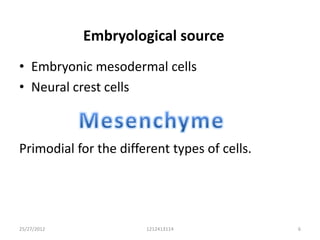
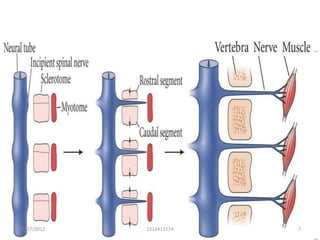
Embryological source
• Embryonic mesodermal cells
• Neural crest cells


Primodial for the different types of cells.


25/27/2012             1212413114             6
25/27/2012   1212413114   7
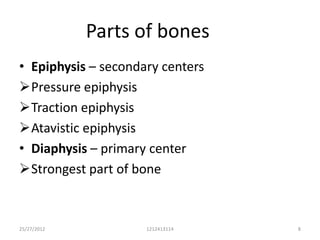
Parts of bones
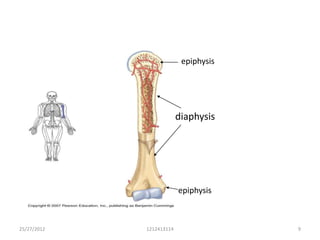
• Epiphysis – secondary centers
Pressure epiphysis
Traction epiphysis
Atavistic epiphysis
• Diaphysis – primary center
Strongest part of bone


25/27/2012           1212413114   8
epiphysis


                          diaphysis


                          epiphysis


25/27/2012   1212413114                9
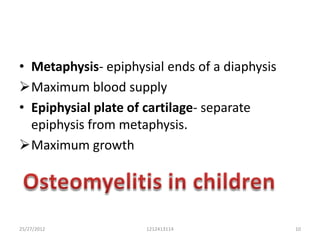
• Metaphysis- epiphysial ends of a diaphysis
Maximum blood supply
• Epiphysial plate of cartilage- separate
  epiphysis from metaphysis.
Maximum growth


25/27/2012           1212413114                10
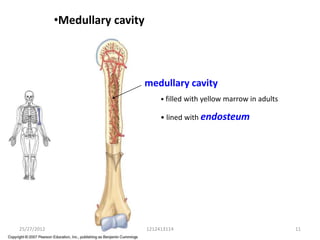
•Medullary cavity


                                 medullary cavity
                                      • filled with yellow marrow in adults

                                      • lined with endosteum


25/27/2012                       1212413114                                   11
Principles of Ossification
• Primary ossification center –before birth
• Secondary ossification center- after birth
• Ossification center which appears first is
  usually last to fuse except for Fibula.
• In long bone with single epiphysis, that
  epiphysis is at the movable end


25/27/2012              1212413114             12
Principles of ossification
• Larger the epiphysis earlier the ossification
  center appears in long bone
• If epiphysis develops from more than one
  centers the various centers coalesce before
  union occurs with the diaphysis.
• When epiphysis fuses with the diaphysis the
  growth ceases.
• This fusion occurs 1 year earlier in females
  than in males.
25/27/2012              1212413114                13
Blood supply
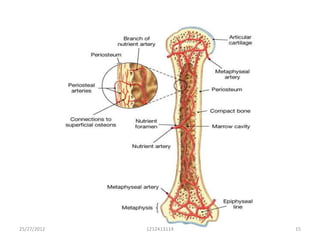
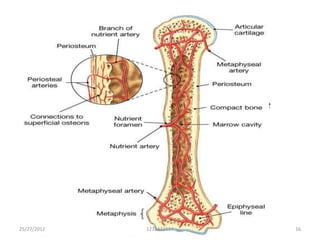
• Nutrient artery
terminates in the adult metaphysis by
  anastomosing with epiphysial, metaphysial
  and periosteal arteries.
Supplies medullary cavity , inner 2/3rd of
  cortex and metaphysis.
• Periosteal arteries
Enter the Volkmann’s canals . Supply outer
  1/3rd of cortex.
25/27/2012           1212413114               14
25/27/2012   1212413114   15
• Epiphysial arteries
Derived from periarticular vascular
  arcades(circulus vasculosus) found on the
  nonarticula bony surface.
• Metaphysial arteries
Derived from the neighbouring systemic
  vessels.


25/27/2012           1212413114               16
Classification
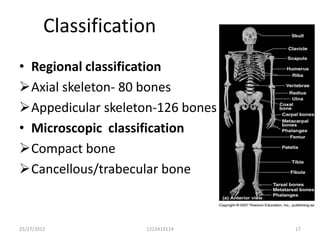
• Regional classification
Axial skeleton- 80 bones
Appedicular skeleton-126 bones
• Microscopic classification
Compact bone
Cancellous/trabecular bone


25/27/2012           1212413114   17
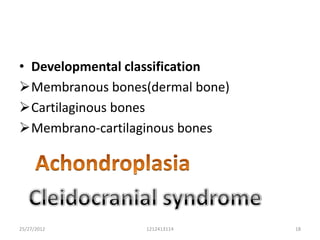
• Developmental classification
Membranous bones(dermal bone)
Cartilaginous bones
Membrano-cartilaginous bones


25/27/2012        1212413114     18
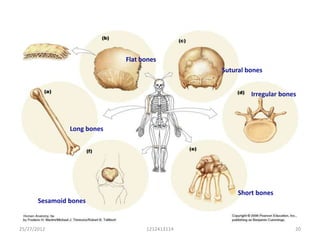
• Bone shapes
Long bones
Short bones
Flat bones
Irregular bones
Sesamoid bones
Pneumatic bones
Accessory bones
25/27/2012         1212413114   19
Flat bones
                                                Sutural bones


                                                         Irregular bones


                Long bones


                                                     Short bones
       Sesamoid bones


25/27/2012                         1212413114                          20
Microscopic study


25/27/2012         1212413114    21
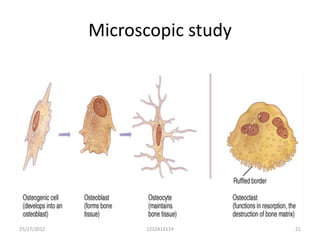
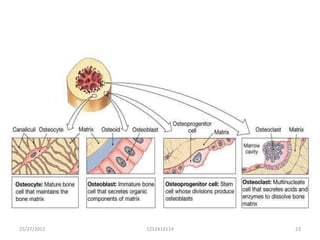
Bone Cells
• Osteocytes = mature bone cells
      In lacunae
      Connected by canaliculi
• Osteoblasts
      Osteogenesis
      Contain Alk phosphatase and pyrophosphatase
• Osteoclasts
      Osteolysis
• Osteoprogenitor cells
 differentiate into osteoblasts

25/27/2012                  1212413114               22
25/27/2012   1212413114   23
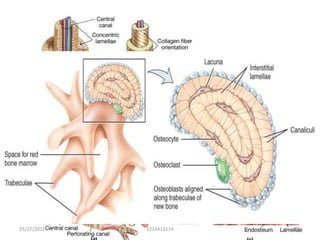
Compact and Spongy Bone


25/27/2012             1212413114      24
25/27/2012   1212413114   25
Compact and Spongy Bone
• Compact bone located where stresses are
  limited in direction.

• Spongy bone located where stresses are
  weaker or multi-directional.


25/27/2012             1212413114           26
Periosteum and endosteum
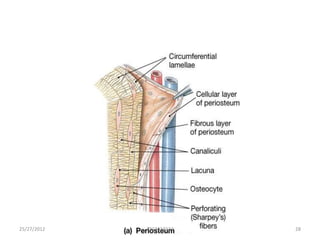
• Periosteum
Superficial surface of all bone except in joint
  cavities.
Provide route for blood and nerve supply
Participate in bone growth and repair
Outer fibrous layer and inner cellular layer
 perforating fibers called as Sharpey’s fibers

25/27/2012             1212413114                  27
25/27/2012   1212413114   28
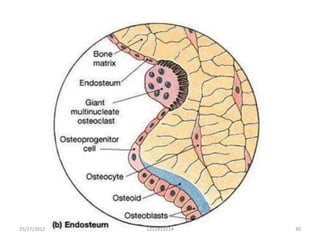
• Endosteum
Lines the marrow cavity
Incomplete cellular layer
Where layer is incomplete, Osteoblasts and
  osteoclasts can deposit or remove matrix
  components.
Shallow groove formed by osteoclasts called
  as Howship’s lacunae
25/27/2012          1212413114                 29
25/27/2012   1212413114   30
Composition of Bone
• cellular structures in ground substance
• Ground substance made up of
Inorganic minerals and organic matrix
• Organic matrix(35%)
Collagen type 1
Glycosaminoglycans
Proteoglycans, osteonectin and osteocalcin

25/27/2012          1212413114                31
• Inorganic content(65%)
 largely made up of Ca ++ , PO4--- and OH- .
• These ions arranged parallel to the direction
  of collagen fibers by forming a crystalline
  structure called as Hydroxyapatite .
           Ca10(Po4)6(OH)2
Living bone contain 20% of water


25/27/2012           1212413114               32
• Inorganic content give rigidity to the bone
• Organic content give the elasticity to the
  bone.
• Lack of inorganic content- soft bone
• Lack of organic content- brittle bone


25/27/2012            1212413114                33
Intramembranous osteogenesis
• Bone formation directly from the
  mesenchymal sheath( formed by collagen
  fibers in between the mesenchymal cells)
• Not the common process
• Also called as dermal ossification because of
  its presence in deeper layers of dermis.
• Roofing bones of skull, clavicle and mandible.


25/27/2012            1212413114                   34
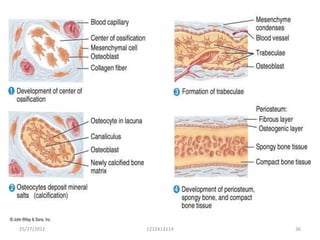
Intramembranous ossification
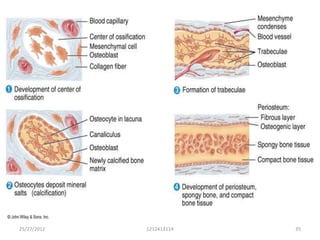
• Mesenchymal cells condensation
• Secretion of organic matrix by the
  mesenchymal cells which consists of collagen
  fibers. Thus forming the mesenchymal sheath.
• Localized differentiation of osteoblasts with in
  sheath


25/27/2012            1212413114                 35
• Bone grows outward from the ossification
  center in radiating fashion and forms
  tabeculae.
• Trapped osteoblast in between the layer of
  bone is called as osteocytes.
• Blood vessels grows and trapped in between
  trabeculae.
• Initially spongy bone is formed which later
  changed to the compact bone.
25/27/2012           1212413114                 36
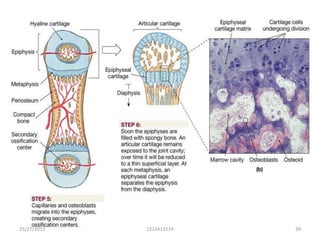
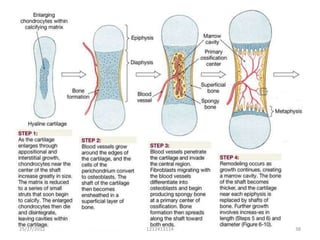
Endochondral ossification
• Most bone formed by this way
• Cartilaginous model is replaced(!!) by the
  bone.
• Chondrocyte hypertrophy
• Degeneration and calcification
• Vascular invasion
• ossificaton

25/27/2012             1212413114              37
25/27/2012   1212413114   38
25/27/2012   1212413114   39
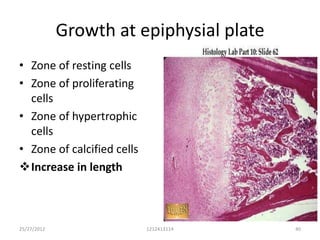
Growth at epiphysial plate
• Zone of resting cells
• Zone of proliferating
  cells
• Zone of hypertrophic
  cells
• Zone of calcified cells
Increase in length


25/27/2012                  1212413114    40
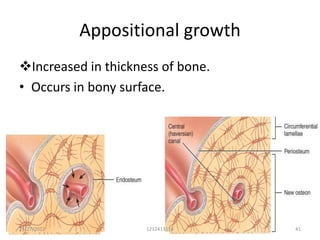
Appositional growth
Increased in thickness of bone.
• Occurs in bony surface.


25/27/2012           1212413114    41
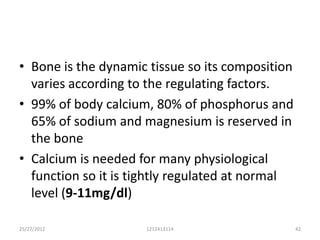
• Bone is the dynamic tissue so its composition
  varies according to the regulating factors.
• 99% of body calcium, 80% of phosphorus and
  65% of sodium and magnesium is reserved in
  the bone
• Calcium is needed for many physiological
  function so it is tightly regulated at normal
  level (9-11mg/dl)

25/27/2012           1212413114                   42
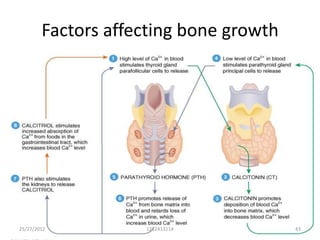
Factors affecting bone growth
•   Minerals
•   Vitamins
•   Hormones
•   Exercise


25/27/2012          1212413114          43
Clinical Aspects
• Subluxation
Incomplete or partial displacement of joint
• Dislocation / Luxation
Complete displacement of joint
• Fracture
Loss of continuity of bone due to abnormal
  forces or due to weakening of bone.

25/27/2012           1212413114                44
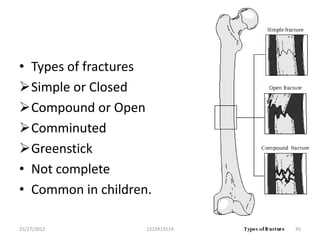
• Types of fractures
Simple or Closed
Compound or Open
Comminuted
Greenstick
• Not complete
• Common in children.

25/27/2012          1212413114   45
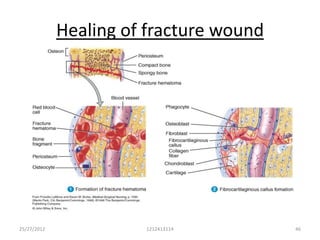
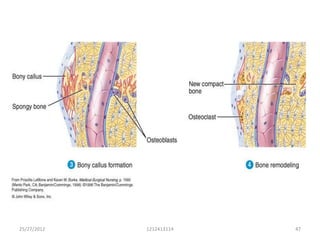
Healing of fracture wound


25/27/2012             1212413114        46
25/27/2012   1212413114   47
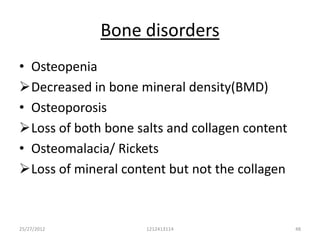
Bone disorders
• Osteopenia
Decreased in bone mineral density(BMD)
• Osteoporosis
Loss of both bone salts and collagen content
• Osteomalacia/ Rickets
Loss of mineral content but not the collagen


25/27/2012           1212413114                 48
Bone disorders
• Paget’s disease
Abnormal bone remodeling , lead to abnormal
  thickening of the bone
Consequences ???
• Osteomyelitis
Inflammation of bone marrow
Most commonly by staphylococcus aureus

25/27/2012         1212413114              49
Bone disorders
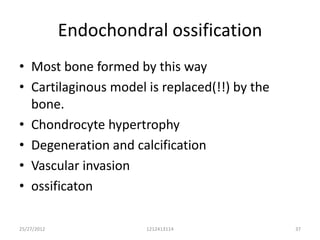
• Osteogenic sarcoma (osteosarcoma)
Bone cancer that affects osteoblast


25/27/2012          1212413114         50
THANK YOU
25/27/2012         1212413114   51
25/27/2012   1212413114   52

Bone

  • 1.
    BONE Dr LaxmanKhanal MS- Human Anatomy Batch-2011 Date-25-04-2012
  • 2.
    OBJECTIVES…. • Introduction • Functions. • Embryological source of bone. • Parts of bones • Laws of ossification • Blood supply of bones • Classification of bones 25/27/2012 1212413114 2
  • 3.
    …OBJECTIVES • Microscopic studyof bones. Compact and cancellous bone • Composition of bones. • Ossification of bones.  Intramembranous  Endochondral • Growth of bones • Factors affecting the bone 25/27/2012 1212413114 3
  • 4.
    Introduction • Bone is mineralized dense connective tissue • Made up of few cells in mineralized matrix • Consists of 30-40 % of our body weight. • Dynamic in nature 25/27/2012 1212413114 4
  • 5.
    Function • Framework of the body. • Attachment of muscle and tendon. • Permit the movements in body parts. • Protection of organs. • Haematopoiesis • Reservoir of minerals and fat. 25/27/2012 1212413114 5
  • 6.
    Embryological source • Embryonicmesodermal cells • Neural crest cells Primodial for the different types of cells. 25/27/2012 1212413114 6
  • 7.
    25/27/2012 1212413114 7
  • 8.
    Parts of bones •Epiphysis – secondary centers Pressure epiphysis Traction epiphysis Atavistic epiphysis • Diaphysis – primary center Strongest part of bone 25/27/2012 1212413114 8
  • 9.
    epiphysis diaphysis epiphysis 25/27/2012 1212413114 9
  • 10.
    • Metaphysis- epiphysialends of a diaphysis Maximum blood supply • Epiphysial plate of cartilage- separate epiphysis from metaphysis. Maximum growth 25/27/2012 1212413114 10
  • 11.
    •Medullary cavity medullary cavity • filled with yellow marrow in adults • lined with endosteum 25/27/2012 1212413114 11
  • 12.
    Principles of Ossification •Primary ossification center –before birth • Secondary ossification center- after birth • Ossification center which appears first is usually last to fuse except for Fibula. • In long bone with single epiphysis, that epiphysis is at the movable end 25/27/2012 1212413114 12
  • 13.
    Principles of ossification •Larger the epiphysis earlier the ossification center appears in long bone • If epiphysis develops from more than one centers the various centers coalesce before union occurs with the diaphysis. • When epiphysis fuses with the diaphysis the growth ceases. • This fusion occurs 1 year earlier in females than in males. 25/27/2012 1212413114 13
  • 14.
    Blood supply • Nutrientartery terminates in the adult metaphysis by anastomosing with epiphysial, metaphysial and periosteal arteries. Supplies medullary cavity , inner 2/3rd of cortex and metaphysis. • Periosteal arteries Enter the Volkmann’s canals . Supply outer 1/3rd of cortex. 25/27/2012 1212413114 14
  • 15.
    25/27/2012 1212413114 15
  • 16.
    • Epiphysial arteries Derivedfrom periarticular vascular arcades(circulus vasculosus) found on the nonarticula bony surface. • Metaphysial arteries Derived from the neighbouring systemic vessels. 25/27/2012 1212413114 16
  • 17.
    Classification • Regional classification Axialskeleton- 80 bones Appedicular skeleton-126 bones • Microscopic classification Compact bone Cancellous/trabecular bone 25/27/2012 1212413114 17
  • 18.
    • Developmental classification Membranousbones(dermal bone) Cartilaginous bones Membrano-cartilaginous bones 25/27/2012 1212413114 18
  • 19.
    • Bone shapes Longbones Short bones Flat bones Irregular bones Sesamoid bones Pneumatic bones Accessory bones 25/27/2012 1212413114 19
  • 20.
    Flat bones Sutural bones Irregular bones Long bones Short bones Sesamoid bones 25/27/2012 1212413114 20
  • 21.
  • 22.
    Bone Cells • Osteocytes= mature bone cells In lacunae Connected by canaliculi • Osteoblasts Osteogenesis Contain Alk phosphatase and pyrophosphatase • Osteoclasts Osteolysis • Osteoprogenitor cells  differentiate into osteoblasts 25/27/2012 1212413114 22
  • 23.
    25/27/2012 1212413114 23
  • 24.
    Compact and SpongyBone 25/27/2012 1212413114 24
  • 25.
    25/27/2012 1212413114 25
  • 26.
    Compact and SpongyBone • Compact bone located where stresses are limited in direction. • Spongy bone located where stresses are weaker or multi-directional. 25/27/2012 1212413114 26
  • 27.
    Periosteum and endosteum •Periosteum Superficial surface of all bone except in joint cavities. Provide route for blood and nerve supply Participate in bone growth and repair Outer fibrous layer and inner cellular layer  perforating fibers called as Sharpey’s fibers 25/27/2012 1212413114 27
  • 28.
    25/27/2012 1212413114 28
  • 29.
    • Endosteum Lines themarrow cavity Incomplete cellular layer Where layer is incomplete, Osteoblasts and osteoclasts can deposit or remove matrix components. Shallow groove formed by osteoclasts called as Howship’s lacunae 25/27/2012 1212413114 29
  • 30.
    25/27/2012 1212413114 30
  • 31.
    Composition of Bone •cellular structures in ground substance • Ground substance made up of Inorganic minerals and organic matrix • Organic matrix(35%) Collagen type 1 Glycosaminoglycans Proteoglycans, osteonectin and osteocalcin 25/27/2012 1212413114 31
  • 32.
    • Inorganic content(65%) largely made up of Ca ++ , PO4--- and OH- . • These ions arranged parallel to the direction of collagen fibers by forming a crystalline structure called as Hydroxyapatite . Ca10(Po4)6(OH)2 Living bone contain 20% of water 25/27/2012 1212413114 32
  • 33.
    • Inorganic contentgive rigidity to the bone • Organic content give the elasticity to the bone. • Lack of inorganic content- soft bone • Lack of organic content- brittle bone 25/27/2012 1212413114 33
  • 34.
    Intramembranous osteogenesis • Boneformation directly from the mesenchymal sheath( formed by collagen fibers in between the mesenchymal cells) • Not the common process • Also called as dermal ossification because of its presence in deeper layers of dermis. • Roofing bones of skull, clavicle and mandible. 25/27/2012 1212413114 34
  • 35.
    Intramembranous ossification • Mesenchymalcells condensation • Secretion of organic matrix by the mesenchymal cells which consists of collagen fibers. Thus forming the mesenchymal sheath. • Localized differentiation of osteoblasts with in sheath 25/27/2012 1212413114 35
  • 36.
    • Bone growsoutward from the ossification center in radiating fashion and forms tabeculae. • Trapped osteoblast in between the layer of bone is called as osteocytes. • Blood vessels grows and trapped in between trabeculae. • Initially spongy bone is formed which later changed to the compact bone. 25/27/2012 1212413114 36
  • 37.
    Endochondral ossification • Mostbone formed by this way • Cartilaginous model is replaced(!!) by the bone. • Chondrocyte hypertrophy • Degeneration and calcification • Vascular invasion • ossificaton 25/27/2012 1212413114 37
  • 38.
    25/27/2012 1212413114 38
  • 39.
    25/27/2012 1212413114 39
  • 40.
    Growth at epiphysialplate • Zone of resting cells • Zone of proliferating cells • Zone of hypertrophic cells • Zone of calcified cells Increase in length 25/27/2012 1212413114 40
  • 41.
    Appositional growth Increased inthickness of bone. • Occurs in bony surface. 25/27/2012 1212413114 41
  • 42.
    • Bone isthe dynamic tissue so its composition varies according to the regulating factors. • 99% of body calcium, 80% of phosphorus and 65% of sodium and magnesium is reserved in the bone • Calcium is needed for many physiological function so it is tightly regulated at normal level (9-11mg/dl) 25/27/2012 1212413114 42
  • 43.
    Factors affecting bonegrowth • Minerals • Vitamins • Hormones • Exercise 25/27/2012 1212413114 43
  • 44.
    Clinical Aspects • Subluxation Incompleteor partial displacement of joint • Dislocation / Luxation Complete displacement of joint • Fracture Loss of continuity of bone due to abnormal forces or due to weakening of bone. 25/27/2012 1212413114 44
  • 45.
    • Types offractures Simple or Closed Compound or Open Comminuted Greenstick • Not complete • Common in children. 25/27/2012 1212413114 45
  • 46.
    Healing of fracturewound 25/27/2012 1212413114 46
  • 47.
    25/27/2012 1212413114 47
  • 48.
    Bone disorders • Osteopenia Decreasedin bone mineral density(BMD) • Osteoporosis Loss of both bone salts and collagen content • Osteomalacia/ Rickets Loss of mineral content but not the collagen 25/27/2012 1212413114 48
  • 49.
    Bone disorders • Paget’sdisease Abnormal bone remodeling , lead to abnormal thickening of the bone Consequences ??? • Osteomyelitis Inflammation of bone marrow Most commonly by staphylococcus aureus 25/27/2012 1212413114 49
  • 50.
    Bone disorders • Osteogenicsarcoma (osteosarcoma) Bone cancer that affects osteoblast 25/27/2012 1212413114 50
  • 51.
    THANK YOU 25/27/2012 1212413114 51
  • 52.
    25/27/2012 1212413114 52