D. Crowley, 2007
To understand the difference between an element,

a compound and a mixture
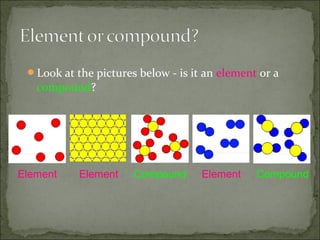
Look at the pictures below - is it an element or a

compound?

Element

Element

Compound

Element

Compound
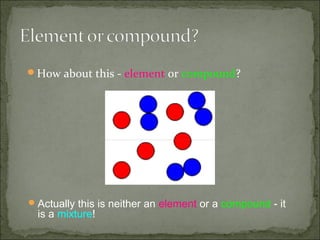
How about this - element or compound?

 Actually this is neither an element or a compound - it

is a mixture!
How can we describe a mixture?
Remember: an element is made up of just one

type of atom

A compound is two or more elements which

are chemically bound together…

A mixture is made from different substances

which are not chemically bound
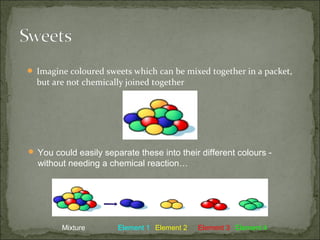
 Imagine coloured sweets which can be mixed together in a packet,

but are not chemically joined together

 You could easily separate these into their different colours -

without needing a chemical reaction…

Mixture

Element 1 Element 2

Element 3 Element 4
A mixture is made from different substances,

which are not chemically bound

E.g. air is a mixture of gases
The gases (oxygen; nitrogen; argon; and carbon

dioxide) can be easily separated

The properties of the mixture are just a mixture

of the properties of the separate parts!!!
Remember, in a compound a chemical reaction

binds the substances together.
This means the properties of the newly formed
compound are different from the original
elements
In a mixture no chemical reaction occurs
So the properties of the mixture is a mixture of all

the properties that make the mixture up!
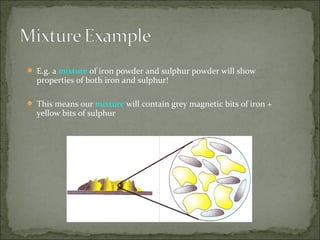
 E.g. a mixture of iron powder and sulphur powder will show

properties of both iron and sulphur!

 This means our mixture will contain grey magnetic bits of iron +

yellow bits of sulphur
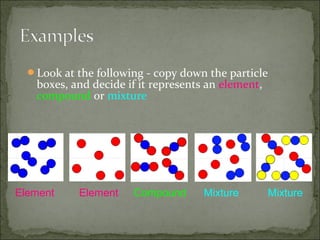
Look at the following - copy down the particle

boxes, and decide if it represents an element,
compound or mixture

Element

Element

Compound

Mixture

Mixture
 An element contains just one type of atom
 A compound contains two or more types of atoms that are

chemically bound

 A mixture contains two or more different substances, that are not

chemically bound

 The different substances in a mixture can be elements or compounds
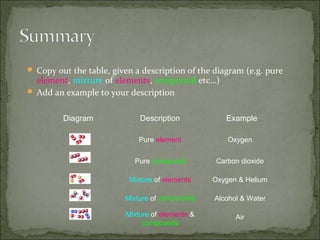
 Copy out the table, given a description of the diagram (e.g. pure

element, mixture of elements, compound etc…)
 Add an example to your description
Diagram

Description

Example

Pure element

Oxygen

Pure compound

Carbon dioxide

Mixture of elements

Oxygen & Helium

Mixture of compounds

Alcohol & Water

Mixture of elements &
compounds

Air
Try the online quiz: http://www.bbc.co.uk/schools/ks3bitesize/science/chemistry/elements_com_mix_test.shtml

Elements, compounds & mixtures

  • 1.
  • 2.
    To understand thedifference between an element, a compound and a mixture
  • 3.
    Look at thepictures below - is it an element or a compound? Element Element Compound Element Compound
  • 4.
    How about this- element or compound?  Actually this is neither an element or a compound - it is a mixture!
  • 5.
    How can wedescribe a mixture? Remember: an element is made up of just one type of atom A compound is two or more elements which are chemically bound together… A mixture is made from different substances which are not chemically bound
  • 6.
     Imagine colouredsweets which can be mixed together in a packet, but are not chemically joined together  You could easily separate these into their different colours - without needing a chemical reaction… Mixture Element 1 Element 2 Element 3 Element 4
  • 7.
    A mixture ismade from different substances, which are not chemically bound E.g. air is a mixture of gases The gases (oxygen; nitrogen; argon; and carbon dioxide) can be easily separated The properties of the mixture are just a mixture of the properties of the separate parts!!!
  • 8.
    Remember, in acompound a chemical reaction binds the substances together. This means the properties of the newly formed compound are different from the original elements In a mixture no chemical reaction occurs So the properties of the mixture is a mixture of all the properties that make the mixture up!
  • 9.
     E.g. amixture of iron powder and sulphur powder will show properties of both iron and sulphur!  This means our mixture will contain grey magnetic bits of iron + yellow bits of sulphur
  • 10.
    Look at thefollowing - copy down the particle boxes, and decide if it represents an element, compound or mixture Element Element Compound Mixture Mixture
  • 11.
     An elementcontains just one type of atom  A compound contains two or more types of atoms that are chemically bound  A mixture contains two or more different substances, that are not chemically bound  The different substances in a mixture can be elements or compounds
  • 12.
     Copy outthe table, given a description of the diagram (e.g. pure element, mixture of elements, compound etc…)  Add an example to your description Diagram Description Example Pure element Oxygen Pure compound Carbon dioxide Mixture of elements Oxygen & Helium Mixture of compounds Alcohol & Water Mixture of elements & compounds Air
  • 13.
    Try the onlinequiz: http://www.bbc.co.uk/schools/ks3bitesize/science/chemistry/elements_com_mix_test.shtml