Chapter 13


      Heart and Circulation
Copyright © The McGraw-Hill Companies, Inc. Permission required for reproduction or display.


    Functions of the Circulatory
    System
   Transportation:
       Respiratory:
             Transport 02 and C02.
       Nutritive:
             Carry absorbed digestion products to liver and
              to tissues.
       Excretory:
             Carry metabolic wastes to kidneys to be
              excreted.
Copyright © The McGraw-Hill Companies, Inc. Permission required for reproduction or display.


    Functions of the Circulatory
    System                     (continued)


   Regulation:
       Hormonal:
             Carry hormones to target tissues to produce
              their effects.
       Temperature:
             Divert blood to cool or warm the body.
       Protection:
             Blood clotting.
       Immune:
             Leukocytes, cytokines and complement act
              against pathogens.
Copyright © The McGraw-Hill Companies, Inc. Permission required for reproduction or display.


        Components of Circulatory
        System

   Cardiovascular System (CV):
       Heart:
            Pumping action creates pressure head needed to push blood
             through vessels.
       Blood vessels:
            Permits blood flow from heart to cells and back to the heart.
                Arteries, arterioles, capillaries, venules, veins.


   Lymphatic System:
       Lymphatic vessels transport interstitial fluid.
            Lymph nodes cleanse lymph prior to return in venous blood.
Copyright © The McGraw-Hill Companies, Inc. Permission required for reproduction or display.


    Composition of Blood
   Plasma:
       Straw-colored liquid.
             Consists of H20 and dissolved solutes.
                     Ions, metabolites, hormones, antibodies.
                         Na+ is the major solute of the plasma.


   Plasma proteins:
       Constitute 7-9% of plasma.
             Albumin:
                     Accounts for 60-80% of plasma proteins.
                     Provides the colloid osmotic pressure needed to
                      draw H20 from interstitial fluid to capillaries.
                         Maintains blood pressure.
Copyright © The McGraw-Hill Companies, Inc. Permission required for reproduction or display.


Composition of the Blood                                                                          (continued)


   Plasma proteins (continued):
       Globulins:
            α globulin:
                    Transport lipids and fat soluble vitamins.
            β globulin:
                    Transport lipids and fat soluble vitamins.
            γ globulin:
                    Antibodies that function in immunity.
   Fibrinogen:
       Constitutes 4% of plasma proteins.
       Important clotting factor.
            Converted into fibrin during the clotting process.
Copyright © The McGraw-Hill Companies, Inc. Permission required for reproduction or display.


Composition of the Blood                                                                          (continued)


   Serum:
       Fluid from clotted blood.
            Does not contain fibrinogen.
   Plasma volume:
       Number of regulatory mechanisms in the
        body maintain homeostasis of plasma
        volume.
            Osmoreceptors.
            ADH.
            Renin-angiotensin-aldosterone system.
Copyright © The McGraw-Hill Companies, Inc. Permission required for reproduction or display.


Erythrocytes

   Flattened biconcave discs.
   Provide increased surface area through which
    gas can diffuse.
   Lack nuclei and mitochondria.
       Half-life ~ 120 days.
   Each RBC contains 280 million hemoglobin
    with 4 heme chains (contain iron).
   Removed from circulation by phagocytic cells
    in liver, spleen, and bone marrow.
Copyright © The McGraw-Hill Companies, Inc. Permission required for reproduction or display.


     Leukocytes
   Contain nuclei and mitochondria.
   Move in amoeboid fashion.
       Can squeeze through capillary walls (diapedesis).
   Almost invisible, so named after their staining
    properties.
       Granular leukocytes:
            Help detoxify foreign substances.
                  Release heparin.
       Agranular leukocytes:
            Phagocytic.
                  Produce antibodies.
Copyright © The McGraw-Hill Companies, Inc. Permission required for reproduction or display.


    Platelets (thrombocytes)
   Smallest of formed elements.
       Are fragments of megakaryocytes.
       Lack nuclei.
   Capable of amoeboid movement.
   Important in blood clotting:
       Constitute most of the mass of the clot.
       Release serotonin to vasoconstrict and reduce
        blood flow to area.
   Secrete growth factors:
       Maintain the integrity of blood vessel wall.
   Survive 5-9 days.
Copyright © The McGraw-Hill Companies, Inc. Permission required for reproduction or display.


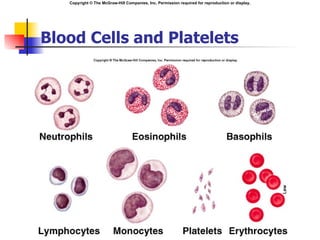
Blood Cells and Platelets
Copyright © The McGraw-Hill Companies, Inc. Permission required for reproduction or display.


Hematopoiesis
   Undifferentiated cells gradually differentiate to
    become stem cells, that form blood cells.
   Occurs in myeloid tissue (bone marrow of long
    bones) and lymphoid tissue.
   2 types of hematopoiesis:
       Erythropoiesis:
            Formation of RBCs.
       Leukopoiesis:
            Formation of WBCs.
Copyright © The McGraw-Hill Companies, Inc. Permission required for reproduction or display.


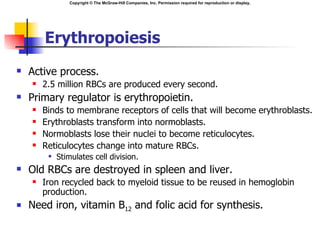
        Erythropoiesis
   Active process.
       2.5 million RBCs are produced every second.
   Primary regulator is erythropoietin.
       Binds to membrane receptors of cells that will become erythroblasts.
       Erythroblasts transform into normoblasts.
       Normoblasts lose their nuclei to become reticulocytes.
       Reticulocytes change into mature RBCs.
            Stimulates cell division.
   Old RBCs are destroyed in spleen and liver.
       Iron recycled back to myeloid tissue to be reused in hemoglobin
        production.
   Need iron, vitamin B12 and folic acid for synthesis.
Copyright © The McGraw-Hill Companies, Inc. Permission required for reproduction or display.


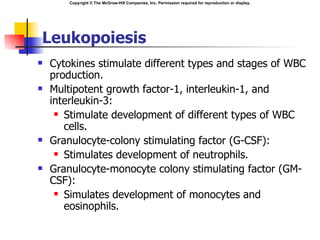
Leukopoiesis
   Cytokines stimulate different types and stages of WBC
    production.
   Multipotent growth factor-1, interleukin-1, and
    interleukin-3:
      Stimulate development of different types of WBC

       cells.
   Granulocyte-colony stimulating factor (G-CSF):
      Stimulates development of neutrophils.

   Granulocyte-monocyte colony stimulating factor (GM-
    CSF):
      Simulates development of monocytes and

       eosinophils.
Copyright © The McGraw-Hill Companies, Inc. Permission required for reproduction or display.


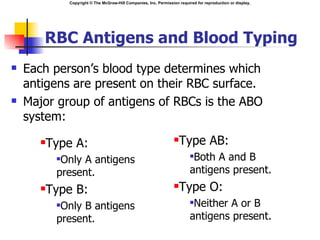
       RBC Antigens and Blood Typing
   Each person’s blood type determines which
    antigens are present on their RBC surface.
   Major group of antigens of RBCs is the ABO
    system:
          Type A:                                                      Type AB:
            Only A antigens                                                 Both A and B
            present.                                                         antigens present.
          Type B:                                                      Type O:
            Only B antigens                                                 Neither A or B
            present.                                                         antigens present.
Copyright © The McGraw-Hill Companies, Inc. Permission required for reproduction or display.


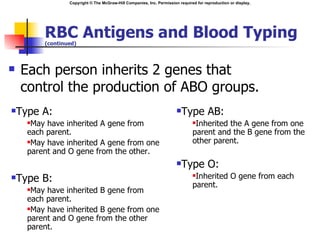
          RBC Antigens and Blood Typing
          (continued)


   Each person inherits 2 genes that
    control the production of ABO groups.
   Type A:                                                                Type AB:
      May have inherited A gene from                                           Inherited the A gene from one
      each parent.                                                              parent and the B gene from the
      May have inherited A gene from one                                       other parent.
      parent and O gene from the other.
                                                                           Type O:
   Type B:                                                                     Inherited O gene from each
                                                                                parent.
      May have inherited B gene from
      each parent.
      May have inherited B gene from one

      parent and O gene from the other
      parent.
Copyright © The McGraw-Hill Companies, Inc. Permission required for reproduction or display.


        Transfusion Reactions

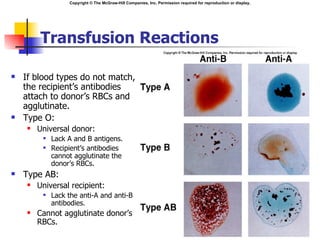
    If blood types do not match,
                                                                                 Insert fig. 13.6

                                                                           
    the recipient’s antibodies
    attach to donor’s RBCs and
    agglutinate.
   Type O:
       Universal donor:
            Lack A and B antigens.
            Recipient’s antibodies
             cannot agglutinate the
             donor’s RBCs.
   Type AB:
       Universal recipient:
            Lack the anti-A and anti-B
             antibodies.
       Cannot agglutinate donor’s
        RBCs.
Copyright © The McGraw-Hill Companies, Inc. Permission required for reproduction or display.


        Rh Factor
   Another group of antigens found on RBCs.
   Rh positive:
       Has Rho(D) antigens.
   Rh negative:
       Does not have Rho(D) antigens.
   Significant when Rh- mother gives birth to Rh+ baby.
       At birth, mother may become exposed to Rh+ blood of fetus.
            Mother at subsequent pregnancies may produce antibodies
             against the Rh factor.
   Erythroblastosis fetalis:
       Rh- mother produces antibodies, which cross placenta.
            Hemolysis of Rh+ RBCs in the fetus.
Copyright © The McGraw-Hill Companies, Inc. Permission required for reproduction or display.


Blood Clotting

   Function of platelets:
       Platelets normally repelled away from
        endothelial lining by prostacyclin
        (prostaglandin).
              Do not want to clot normal vessels.
   Damage to the endothelium wall:
       Exposes subendothelial tissue to the blood.
Copyright © The McGraw-Hill Companies, Inc. Permission required for reproduction or display.


         Blood Clotting                                           (continued)


   Platelet release reaction:
       Endothelial cells secrete von Willebrand factor to cause
        platelets to adhere to collagen.
       When platelets stick to collagen, they degranulate as
        platelet secretory granules:
            Release ADP, serotonin and thromboxane A2.
                  Serotonin and thromboxane A2 stimulate vasoconstriction.
                  ADP and thromboxane A2 make other platelets “sticky.”
                      Platelets adhere to collagen.

                      Stimulates the platelet release reaction.

            Produce platelet plug.
                  Strengthened by activation of plasma clotting factors.
Copyright © The McGraw-Hill Companies, Inc. Permission required for reproduction or display.


Blood Clotting                                         (continued)


   Platelet plug strengthened by fibrin.
   Clot reaction:
       Contraction of the platelet mass forms a more
        compact plug.
        Conversion of fibrinogen to fibrin occurs.
   Conversion of fibrinogen to fibrin:
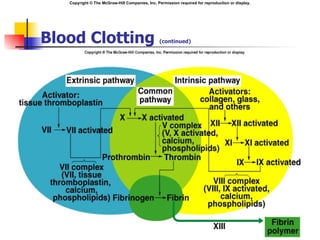
       Intrinsic Pathway:
            Initiated by exposure of blood to a negatively charged
             surface (collagen).
                    This activates factor XII (protease), which activates other
                     clotting factors.
            Ca2+ and phospholipids convert prothrombin to thrombin.
                    Thrombin converts fibrinogen to fibrin.
                        Produces meshwork of insoluble fibrin polymers.
Copyright © The McGraw-Hill Companies, Inc. Permission required for reproduction or display.


Blood Clotting                                        (continued)


   Extrinsic pathway:
       Thromboplastin is not a part of the blood,
        so called extrinsic pathway.
       Damaged tissue releases thromboplastin.
            Thromboplastin initiates a short cut to formation
             of fibrin.
Copyright © The McGraw-Hill Companies, Inc. Permission required for reproduction or display.


Blood Clotting                                  (continued)
Copyright © The McGraw-Hill Companies, Inc. Permission required for reproduction or display.


Dissolution of Clots

   Activated factor XII converts an inactive
    molecule into the active form (kallikrein).
       Kallikrein converts plasminogen to plasmin.
   Plasmin is an enzyme that digests the fibrin.
       Clot dissolution occurs.
   Anticoagulants:
       Heparin:
              Activates antithrombin III.
       Coumarin:
              Inhibits cellular activation of vitamin K.
Copyright © The McGraw-Hill Companies, Inc. Permission required for reproduction or display.


    Acid-Base Balance in the Blood


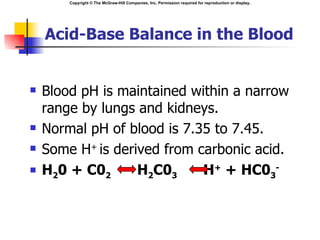
   Blood pH is maintained within a narrow
    range by lungs and kidneys.
   Normal pH of blood is 7.35 to 7.45.
   Some H+ is derived from carbonic acid.
   H20 + C02      H2C03     H+ + HC03-
Copyright © The McGraw-Hill Companies, Inc. Permission required for reproduction or display.


        Acid-Base Balance in the Blood
        (continued)


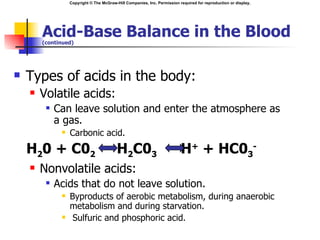
   Types of acids in the body:
       Volatile acids:
            Can leave solution and enter the atmosphere as
             a gas.
                 Carbonic acid.
    H20 + C02                             H2C03                           H+ + HC03-
       Nonvolatile acids:
            Acids that do not leave solution.
                 Byproducts of aerobic metabolism, during anaerobic
                  metabolism and during starvation.
                  Sulfuric and phosphoric acid.
Copyright © The McGraw-Hill Companies, Inc. Permission required for reproduction or display.


Buffer Systems

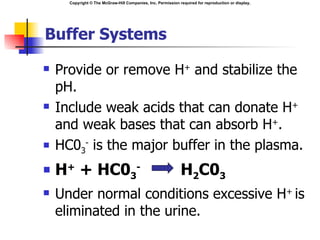
   Provide or remove H+ and stabilize the
    pH.
   Include weak acids that can donate H+
    and weak bases that can absorb H+.
   HC03- is the major buffer in the plasma.
   H+ + HC03-                                                H2C03
   Under normal conditions excessive H+ is
    eliminated in the urine.
Copyright © The McGraw-Hill Companies, Inc. Permission required for reproduction or display.


         Acid Base Disorders

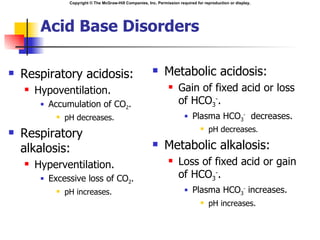
   Respiratory acidosis:                                          Metabolic acidosis:
       Hypoventilation.                                                  Gain of fixed acid or loss
            Accumulation of CO2.                                          of HCO3-.
                  pH decreases.                                                 Plasma HCO3- decreases.
                                                                                          pH decreases.
    Respiratory
                                                                                      


    alkalosis:                                                     Metabolic alkalosis:
       Hyperventilation.
                                                                          Loss of fixed acid or gain
            Excessive loss of CO2.                                        of HCO3-.
                  pH increases.                                                 Plasma HCO3- increases.
                                                                                         pH increases.
Copyright © The McGraw-Hill Companies, Inc. Permission required for reproduction or display.


pH

   Normal pH is obtained when the ratio of
    HCO3- to C02 is 20:1.
   Henderson-Hasselbalch equation:
   pH = 6.1 + log = [HCO3-]

    [0.03PC02]
Copyright © The McGraw-Hill Companies, Inc. Permission required for reproduction or display.


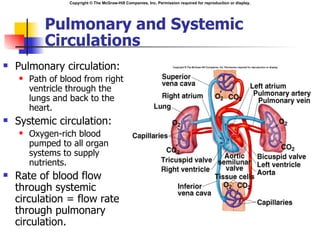
           Pulmonary and Systemic
           Circulations
   Pulmonary circulation:
       Path of blood from right
        ventricle through the
        lungs and back to the
        heart.
   Systemic circulation:
       Oxygen-rich blood
        pumped to all organ
        systems to supply
        nutrients.
   Rate of blood flow
    through systemic
    circulation = flow rate
    through pulmonary
    circulation.
Copyright © The McGraw-Hill Companies, Inc. Permission required for reproduction or display.


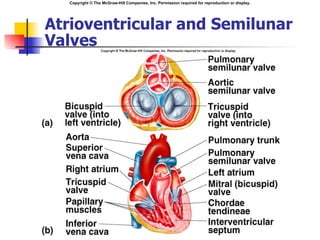
          Atrioventricular and Semilunar
          Valves
   Atria and ventricles are separated into 2 functional
    units by a sheet of connective tissue by AV
    (atrioventricular) valves.
       One way valves.
       Allow blood to flow from atria into the ventricles.
   At the origin of the pulmonary artery and aorta are
    semilunar valves.
       One way valves.
       Open during ventricular contraction.
   Opening and closing of valves occur as a result of
    pressure differences.
Copyright © The McGraw-Hill Companies, Inc. Permission required for reproduction or display.


Atrioventricular and Semilunar
Valves
Copyright © The McGraw-Hill Companies, Inc. Permission required for reproduction or display.


Cardiac Cycle
   Refers to the repeating pattern of contraction
    and relaxation of the heart.
       Systole:
          Phase of contraction.

       Diastole:
          Phase of relaxation.

       End-diastolic volume (EDV):
            Total volume of blood in the ventricles at the end of
             diastole.
       Stroke volume (SV):
            Amount of blood ejected from ventricles during systole.
       End-systolic volume (ESV):
            Amount of blood left in the ventricles at the end of
             systole.
Copyright © The McGraw-Hill Companies, Inc. Permission required for reproduction or display.


Cardiac Cycle                                       (continued)


   Step 1: Isovolumetric contraction:
       QRS just occurred.
       Contraction of the ventricle causes ventricular pressure to
        rise above atrial pressure.
             AV valves close.
       Ventricular pressure is less than aortic pressure.
             Semilunar valves are closed.
                      Volume of blood in ventricle is EDV.
   Step 2: Ejection:
       Contraction of the ventricle causes ventricular pressure to
        rise above aortic pressure.
             Semilunar valves open.
       Ventricular pressure is greater than atrial pressure.
             AV valves are closed.
                      Volume of blood ejected: SV.
Copyright © The McGraw-Hill Companies, Inc. Permission required for reproduction or display.


        Cardiac Cycle                                          (continued)


   Step 3: T wave occurs:
       Ventricular pressure drops below aortic pressure.
   Step 4: Isovolumetric relaxation:
       Back pressure causes semilunar valves to close.
            AV valves are still closed.
                   Volume of blood in the ventricle: ESV.
   Step 5: Rapid filling of ventricles:
       Ventricular pressure decreases below atrial pressure.
            AV valves open.
                   Rapid ventricular filling occurs.
Copyright © The McGraw-Hill Companies, Inc. Permission required for reproduction or display.


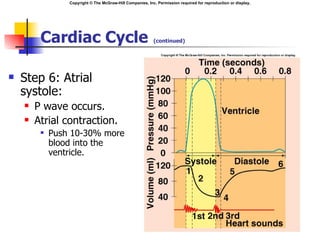
         Cardiac Cycle                                     (continued)


   Step 6: Atrial
    systole:
       P wave occurs.
       Atrial contraction.
            Push 10-30% more
             blood into the
             ventricle.
Copyright © The McGraw-Hill Companies, Inc. Permission required for reproduction or display.


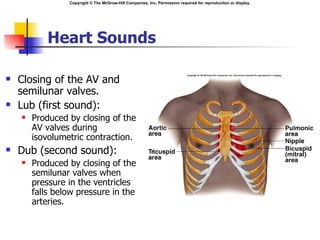
            Heart Sounds

   Closing of the AV and
    semilunar valves.
   Lub (first sound):
       Produced by closing of the
        AV valves during
        isovolumetric contraction.
   Dub (second sound):
       Produced by closing of the
        semilunar valves when
        pressure in the ventricles
        falls below pressure in the
        arteries.
Copyright © The McGraw-Hill Companies, Inc. Permission required for reproduction or display.


        Heart Murmurs
   Abnormal heart sounds produced by abnormal patterns
    of blood flow in the heart.
   Defective heart valves:
       Valves become damaged by antibodies made in response to
        an infection, or congenital defects.
   Mitral stenosis:
       Mitral valve becomes thickened and calcified.
            Impairs blood flow from left atrium to left ventricle.
            Accumulation of blood in left ventricle may cause pulmonary HTN.
   Incompetent valves:
       Damage to papillary muscles.
            Valves do not close properly.
                  Murmurs produced as blood regurgitates through valve flaps.
Copyright © The McGraw-Hill Companies, Inc. Permission required for reproduction or display.


         Heart Murmurs

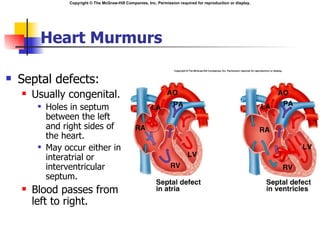
   Septal defects:
       Usually congenital.
            Holes in septum
             between the left
             and right sides of
             the heart.
            May occur either in
             interatrial or
             interventricular
             septum.
       Blood passes from
        left to right.
Copyright © The McGraw-Hill Companies, Inc. Permission required for reproduction or display.


         Electrical Activity of the Heart
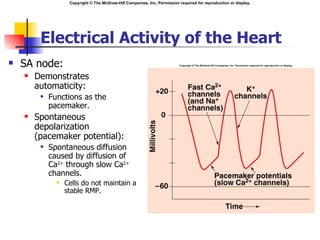
   SA node:
       Demonstrates
        automaticity:
            Functions as the
             pacemaker.
       Spontaneous
        depolarization
        (pacemaker potential):
            Spontaneous diffusion
             caused by diffusion of
             Ca2+ through slow Ca2+
             channels.
                  Cells do not maintain a
                   stable RMP.
Copyright © The McGraw-Hill Companies, Inc. Permission required for reproduction or display.


Pacemaker AP
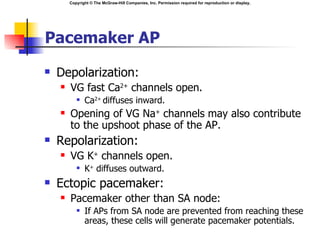
   Depolarization:
       VG fast Ca2+ channels open.
              Ca2+ diffuses inward.
       Opening of VG Na+ channels may also contribute
        to the upshoot phase of the AP.
   Repolarization:
       VG K+ channels open.
              K+ diffuses outward.
   Ectopic pacemaker:
       Pacemaker other than SA node:
              If APs from SA node are prevented from reaching these
               areas, these cells will generate pacemaker potentials.
Copyright © The McGraw-Hill Companies, Inc. Permission required for reproduction or display.


    Myocardial APs
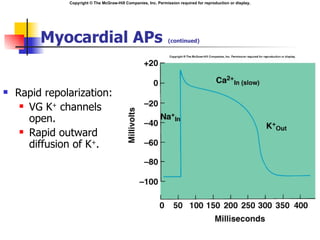
   Majority of myocardial cells have a RMP of –90
    mV.
   SA node spreads APs to myocardial cells.
       When myocardial cell reaches threshold, these cells
        depolarize.
   Rapid upshoot occurs:
       VG Na+ channels open.
            Inward diffusion of Na+.
   Plateau phase:
       Rapid reversal in membrane polarity to –15 mV.
            VG slow Ca2+ channels open.
                    Slow inward flow of Ca2+ balances outflow of K+.
Copyright © The McGraw-Hill Companies, Inc. Permission required for reproduction or display.


         Myocardial APs                                          (continued)


   Rapid repolarization:
      VG K+ channels

       open.
      Rapid outward

       diffusion of K+.
Copyright © The McGraw-Hill Companies, Inc. Permission required for reproduction or display.


         Conducting Tissues of the Heart

   APs spread through myocardial cells through gap
    junctions.
   Impulses cannot spread to ventricles directly
    because of fibrous tissue.
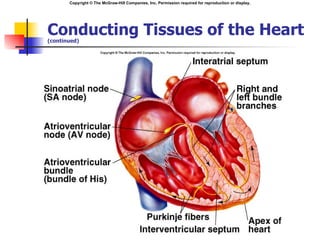
   Conduction pathway:
       SA node.
       AV node.
       Bundle of His.
       Purkinje fibers.
   Stimulation of Purkinje fibers cause both
    ventricles to contract simultaneously.
Copyright © The McGraw-Hill Companies, Inc. Permission required for reproduction or display.


Conducting Tissues of the Heart
(continued)
Copyright © The McGraw-Hill Companies, Inc. Permission required for reproduction or display.


Conduction of Impulse
   APs from SA node spread quickly at rate of
    0.8 - 1.0 m/sec.
   Time delay occurs as impulses pass through
    AV node.
       Slow conduction of 0.03 – 0.05 m/sec.
   Impulse conduction increases as spread to
    Purkinje fibers at a velocity of 5.0 m/sec.
       Ventricular contraction begins 0.1–0.2 sec. after
        contraction of the atria.
Copyright © The McGraw-Hill Companies, Inc. Permission required for reproduction or display.


           Refractory Periods
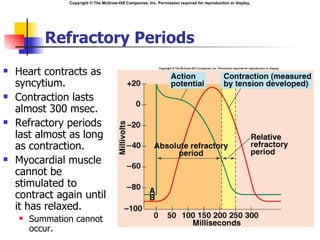
   Heart contracts as
    syncytium.
   Contraction lasts
    almost 300 msec.
   Refractory periods
    last almost as long
    as contraction.
   Myocardial muscle
    cannot be
    stimulated to
    contract again until
    it has relaxed.
       Summation cannot
        occur.
Copyright © The McGraw-Hill Companies, Inc. Permission required for reproduction or display.


Excitation-Contraction Coupling
in Heart Muscle

   Depolarization of myocardial cell stimulates
    opening of VG Ca2+ channels in sarcolema.
       Ca2+ diffuses down gradient into cell.
              Stimulates opening of Ca2+-release channels in SR.
       Ca2+ binds to troponin and stimulates contraction
        (same mechanisms as in skeletal muscle).
   During repolarization Ca2+ actively transported
    out of the cell via a Na+-Ca2+- exchanger.
Copyright © The McGraw-Hill Companies, Inc. Permission required for reproduction or display.


    Electrocardiogram (ECG/EKG)

   The body is a good conductor of electricity.
       Tissue fluids have a high [ions] that move in
        response to potential differences.
   Electrocardiogram:
       Measure of the electrical activity of the heart
        per unit time.
             Potential differences generated by heart are conducted
              to body surface where they can be recorded on
              electrodes on the skin.
   Does NOT measure the flow of blood through
    the heart.
Copyright © The McGraw-Hill Companies, Inc. Permission required for reproduction or display.


             ECG Leads
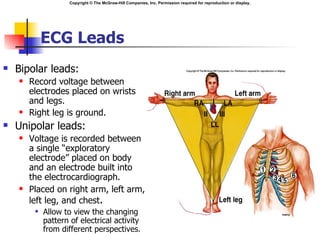
   Bipolar leads:
       Record voltage between
        electrodes placed on wrists
        and legs.
       Right leg is ground.
   Unipolar leads:
       Voltage is recorded between
        a single “exploratory
        electrode” placed on body
        and an electrode built into
        the electrocardiograph.
       Placed on right arm, left arm,
        left leg, and chest.
            Allow to view the changing
             pattern of electrical activity
             from different perspectives.
Copyright © The McGraw-Hill Companies, Inc. Permission required for reproduction or display.


          ECG
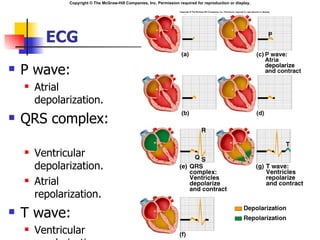
   P wave:
       Atrial
        depolarization.
   QRS complex:

       Ventricular
        depolarization.
       Atrial
        repolarization.
   T wave:
       Ventricular
Copyright © The McGraw-Hill Companies, Inc. Permission required for reproduction or display.


        Correlation of ECG with Heart
        Sounds
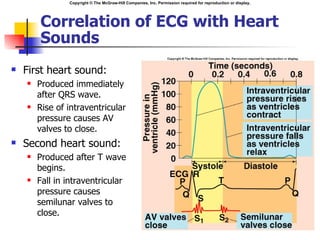
   First heart sound:
       Produced immediately
        after QRS wave.
       Rise of intraventricular
        pressure causes AV
        valves to close.
   Second heart sound:
       Produced after T wave
        begins.
       Fall in intraventricular
        pressure causes
        semilunar valves to
        close.
Copyright © The McGraw-Hill Companies, Inc. Permission required for reproduction or display.


Systemic Circulation

   Arteries.                                         Role is to direct
   Arterioles.                                        the flow of
                                                       blood from the
   Capillaries.
                                                       heart to the
   Venules.                                           capillaries, and
   Veins.                                             back to the
                                                       heart.
Copyright © The McGraw-Hill Companies, Inc. Permission required for reproduction or display.


    Blood Vessels

   Walls composed of 3 “tunics:”
       Tunica externa:
            Outer layer comprised of connective tissue.
       Tunica media:
            Middle layer composed of smooth muscle.
       Tunica interna:
            Innermost simple squamous endothelium.
            Basement membrane.
            Layer of elastin.
Copyright © The McGraw-Hill Companies, Inc. Permission required for reproduction or display.


    Blood Vessels                                      (continued)


   Elastic arteries:
        Numerous layers of elastin fibers between smooth
         muscle.
             Expand when the pressure of the blood rises.
                     Act as recoil system when ventricles relax.
   Muscular arteries:
        Are less elastic and have a thicker layer of smooth
         muscle.
        Diameter changes slightly as BP raises and falls.
   Arterioles:
        Contain highest % smooth muscle.
             Greatest pressure drop.
                     Greatest resistance to flow.
Copyright © The McGraw-Hill Companies, Inc. Permission required for reproduction or display.


     Blood Vessels                                        (continued)


   Most of the blood volume is contained in the
    venous system.
       Venules:
            Formed when capillaries unite.
                  Very porous.
       Veins:
            Contain little smooth muscle or elastin.
                  Capacitance vessels (blood reservoirs).
            Contain 1-way valves that ensure blood flow to the heart.
   Skeletal muscle pump and contraction of
    diaphragm:
       Aid in venous blood return of blood to the heart.
Copyright © The McGraw-Hill Companies, Inc. Permission required for reproduction or display.


    Types of Capillaries
   Capillaries:
        Smallest blood vessels.
             1 endothelial cell thick.
                     Provide direct access to cells.
                          Permits exchange of nutrients and wastes.
        Continuous:
             Adjacent endothelial cells tightly joined together.
                     Intercellular channels that permit passage of molecules (other than
                      proteins) between capillary blood and tissue fluid.
                          Muscle, lungs, and adipose tissue.
        Fenestrated:
             Wide intercellular pores.
                     Provides greater permeability.
                          Kidneys, endocrine glands, and intestines.
        Discontinuous (sinusoidal):
             Have large, leaky capillaries.
                     Liver, spleen, and bone marrow.
Copyright © The McGraw-Hill Companies, Inc. Permission required for reproduction or display.


     Atherosclerosis

   Most common form of arteriosclerosis
    (hardening of the arteries).
   Mechanism of plaque production:
       Begins as a result of damage to endothelial cell
        wall.
            HTN, smoking, high cholesterol, and diabetes.
       Cytokines are secreted by endothelium; platelets,
        macrophages, and lymphocytes.
            Attract more monocytes and lymphocytes.
Copyright © The McGraw-Hill Companies, Inc. Permission required for reproduction or display.


         Atherosclerosis                                           (continued)


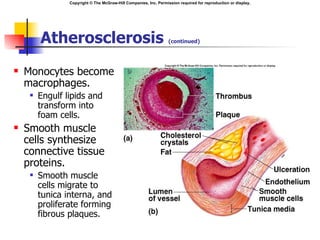
   Monocytes become
    macrophages.
        Engulf lipids and
         transform into
         foam cells.
   Smooth muscle
    cells synthesize
    connective tissue
    proteins.
        Smooth muscle
         cells migrate to
         tunica interna, and
         proliferate forming
         fibrous plaques.
Copyright © The McGraw-Hill Companies, Inc. Permission required for reproduction or display.


Cholesterol and Plasma
Lipoproteins
   High blood cholesterol associated with
    risk of atherosclerosis.
   Lipids are carried in the blood attached
    to protein carriers.
   Cholesterol is carried to the arteries by
    LDLs (low-density lipoproteins).
       LDLs are produced in the liver.
             LDLs are small protein-coated droplets of
              cholesterol, neutral fat, free fatty acids, and
              phospholipids.
Copyright © The McGraw-Hill Companies, Inc. Permission required for reproduction or display.


Cholesterol and Plasma
Lipoproteins                                    (continued)


   Cells in various organs contain receptors for
    proteins in LDL.
       LDL protein attaches to receptors.
            The cell engulfs the LDL and utilizes cholesterol for
             different purposes.
            LDL is oxidized and contributes to:
                    Endothelial cell injury.
                    Migration of monocytes and lymphocytes to tunica
                     interna.
                    Conversion of monocytes to macrophages.
       Excessive cholesterol is released from the cells.
            Travel in the blood as HDLs (high-density lipoproteins),
             and removed by the liver.
                    Artery walls do not have receptors for HDL.
Copyright © The McGraw-Hill Companies, Inc. Permission required for reproduction or display.


             Ischemic Heart Disease
   Ischemia:
       Oxygen supply to tissue
        is deficient.
            Most common cause is
             atherosclerosis of
             coronary arteries.
       Increased [lactic acid]
        produced by anaerobic
        respiration.
   Angina pectoris:
       Substernal pain.
   Myocardial infarction
    (MI):
       Changes in T segment of
        ECG.
       Increased CPK and LDH.
Copyright © The McGraw-Hill Companies, Inc. Permission required for reproduction or display.


        Arrhythmias Detected on ECG
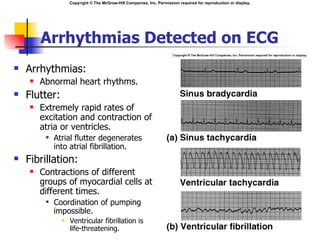
   Arrhythmias:
       Abnormal heart rhythms.
   Flutter:
       Extremely rapid rates of
        excitation and contraction of
        atria or ventricles.
            Atrial flutter degenerates
             into atrial fibrillation.
   Fibrillation:
       Contractions of different
        groups of myocardial cells at
        different times.
            Coordination of pumping
             impossible.
                  Ventricular fibrillation is
                   life-threatening.
Copyright © The McGraw-Hill Companies, Inc. Permission required for reproduction or display.


    Arrhythmias Detected on ECG
    (continued)


   Bradycardia:
        HR slower < 60 beats/min.
   Tachycardia:
        HR > 100 beats/min.
   First–degree AV nodal block:
        Rate of impulse conduction through AV node
         exceeds 0.2 sec.
             P-R interval.
   Second-degree AV nodal block:
        AV node is damaged so that only 1 out of 2-4
         atrial APs can pass to the ventricles.
             P wave without QRS.
Copyright © The McGraw-Hill Companies, Inc. Permission required for reproduction or display.


        Arrhythmias Detected on ECG
        (continued)


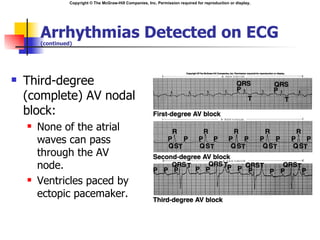
   Third-degree
    (complete) AV nodal
    block:
       None of the atrial
        waves can pass
        through the AV
        node.
       Ventricles paced by
        ectopic pacemaker.
Copyright © The McGraw-Hill Companies, Inc. Permission required for reproduction or display.


Lymphatic System

   3 basic functions:
       Transports interstitial (tissue) fluid back to
        the blood.
       Transports absorbed fat from small
        intestine to the blood.
       Helps provide immunological defenses
        against pathogens.
Copyright © The McGraw-Hill Companies, Inc. Permission required for reproduction or display.


             Lymphatic System                                                     (continued)


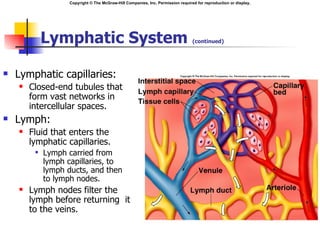
   Lymphatic capillaries:
       Closed-end tubules that
        form vast networks in
        intercellular spaces.
   Lymph:
       Fluid that enters the
        lymphatic capillaries.
            Lymph carried from
             lymph capillaries, to
             lymph ducts, and then
             to lymph nodes.
       Lymph nodes filter the
        lymph before returning it
        to the veins.

Heart circulation

  • 1.
    Chapter 13 Heart and Circulation
  • 2.
    Copyright © TheMcGraw-Hill Companies, Inc. Permission required for reproduction or display. Functions of the Circulatory System  Transportation:  Respiratory:  Transport 02 and C02.  Nutritive:  Carry absorbed digestion products to liver and to tissues.  Excretory:  Carry metabolic wastes to kidneys to be excreted.
  • 3.
    Copyright © TheMcGraw-Hill Companies, Inc. Permission required for reproduction or display. Functions of the Circulatory System (continued)  Regulation:  Hormonal:  Carry hormones to target tissues to produce their effects.  Temperature:  Divert blood to cool or warm the body.  Protection:  Blood clotting.  Immune:  Leukocytes, cytokines and complement act against pathogens.
  • 4.
    Copyright © TheMcGraw-Hill Companies, Inc. Permission required for reproduction or display. Components of Circulatory System  Cardiovascular System (CV):  Heart:  Pumping action creates pressure head needed to push blood through vessels.  Blood vessels:  Permits blood flow from heart to cells and back to the heart.  Arteries, arterioles, capillaries, venules, veins.  Lymphatic System:  Lymphatic vessels transport interstitial fluid.  Lymph nodes cleanse lymph prior to return in venous blood.
  • 5.
    Copyright © TheMcGraw-Hill Companies, Inc. Permission required for reproduction or display. Composition of Blood  Plasma:  Straw-colored liquid.  Consists of H20 and dissolved solutes.  Ions, metabolites, hormones, antibodies.  Na+ is the major solute of the plasma.  Plasma proteins:  Constitute 7-9% of plasma.  Albumin:  Accounts for 60-80% of plasma proteins.  Provides the colloid osmotic pressure needed to draw H20 from interstitial fluid to capillaries.  Maintains blood pressure.
  • 6.
    Copyright © TheMcGraw-Hill Companies, Inc. Permission required for reproduction or display. Composition of the Blood (continued)  Plasma proteins (continued):  Globulins:  α globulin:  Transport lipids and fat soluble vitamins.  β globulin:  Transport lipids and fat soluble vitamins.  γ globulin:  Antibodies that function in immunity.  Fibrinogen:  Constitutes 4% of plasma proteins.  Important clotting factor.  Converted into fibrin during the clotting process.
  • 7.
    Copyright © TheMcGraw-Hill Companies, Inc. Permission required for reproduction or display. Composition of the Blood (continued)  Serum:  Fluid from clotted blood.  Does not contain fibrinogen.  Plasma volume:  Number of regulatory mechanisms in the body maintain homeostasis of plasma volume.  Osmoreceptors.  ADH.  Renin-angiotensin-aldosterone system.
  • 8.
    Copyright © TheMcGraw-Hill Companies, Inc. Permission required for reproduction or display. Erythrocytes  Flattened biconcave discs.  Provide increased surface area through which gas can diffuse.  Lack nuclei and mitochondria.  Half-life ~ 120 days.  Each RBC contains 280 million hemoglobin with 4 heme chains (contain iron).  Removed from circulation by phagocytic cells in liver, spleen, and bone marrow.
  • 9.
    Copyright © TheMcGraw-Hill Companies, Inc. Permission required for reproduction or display. Leukocytes  Contain nuclei and mitochondria.  Move in amoeboid fashion.  Can squeeze through capillary walls (diapedesis).  Almost invisible, so named after their staining properties.  Granular leukocytes:  Help detoxify foreign substances.  Release heparin.  Agranular leukocytes:  Phagocytic.  Produce antibodies.
  • 10.
    Copyright © TheMcGraw-Hill Companies, Inc. Permission required for reproduction or display. Platelets (thrombocytes)  Smallest of formed elements.  Are fragments of megakaryocytes.  Lack nuclei.  Capable of amoeboid movement.  Important in blood clotting:  Constitute most of the mass of the clot.  Release serotonin to vasoconstrict and reduce blood flow to area.  Secrete growth factors:  Maintain the integrity of blood vessel wall.  Survive 5-9 days.
  • 11.
    Copyright © TheMcGraw-Hill Companies, Inc. Permission required for reproduction or display. Blood Cells and Platelets
  • 12.
    Copyright © TheMcGraw-Hill Companies, Inc. Permission required for reproduction or display. Hematopoiesis  Undifferentiated cells gradually differentiate to become stem cells, that form blood cells.  Occurs in myeloid tissue (bone marrow of long bones) and lymphoid tissue.  2 types of hematopoiesis:  Erythropoiesis:  Formation of RBCs.  Leukopoiesis:  Formation of WBCs.
  • 13.
    Copyright © TheMcGraw-Hill Companies, Inc. Permission required for reproduction or display. Erythropoiesis  Active process.  2.5 million RBCs are produced every second.  Primary regulator is erythropoietin.  Binds to membrane receptors of cells that will become erythroblasts.  Erythroblasts transform into normoblasts.  Normoblasts lose their nuclei to become reticulocytes.  Reticulocytes change into mature RBCs.  Stimulates cell division.  Old RBCs are destroyed in spleen and liver.  Iron recycled back to myeloid tissue to be reused in hemoglobin production.  Need iron, vitamin B12 and folic acid for synthesis.
  • 14.
    Copyright © TheMcGraw-Hill Companies, Inc. Permission required for reproduction or display. Leukopoiesis  Cytokines stimulate different types and stages of WBC production.  Multipotent growth factor-1, interleukin-1, and interleukin-3:  Stimulate development of different types of WBC cells.  Granulocyte-colony stimulating factor (G-CSF):  Stimulates development of neutrophils.  Granulocyte-monocyte colony stimulating factor (GM- CSF):  Simulates development of monocytes and eosinophils.
  • 15.
    Copyright © TheMcGraw-Hill Companies, Inc. Permission required for reproduction or display. RBC Antigens and Blood Typing  Each person’s blood type determines which antigens are present on their RBC surface.  Major group of antigens of RBCs is the ABO system:  Type A:  Type AB: Only A antigens Both A and B present. antigens present.  Type B:  Type O: Only B antigens Neither A or B present. antigens present.
  • 16.
    Copyright © TheMcGraw-Hill Companies, Inc. Permission required for reproduction or display. RBC Antigens and Blood Typing (continued)  Each person inherits 2 genes that control the production of ABO groups.  Type A:  Type AB: May have inherited A gene from Inherited the A gene from one each parent. parent and the B gene from the May have inherited A gene from one other parent. parent and O gene from the other.  Type O:  Type B: Inherited O gene from each parent. May have inherited B gene from each parent. May have inherited B gene from one parent and O gene from the other parent.
  • 17.
    Copyright © TheMcGraw-Hill Companies, Inc. Permission required for reproduction or display. Transfusion Reactions If blood types do not match, Insert fig. 13.6   the recipient’s antibodies attach to donor’s RBCs and agglutinate.  Type O:  Universal donor:  Lack A and B antigens.  Recipient’s antibodies cannot agglutinate the donor’s RBCs.  Type AB:  Universal recipient:  Lack the anti-A and anti-B antibodies.  Cannot agglutinate donor’s RBCs.
  • 18.
    Copyright © TheMcGraw-Hill Companies, Inc. Permission required for reproduction or display. Rh Factor  Another group of antigens found on RBCs.  Rh positive:  Has Rho(D) antigens.  Rh negative:  Does not have Rho(D) antigens.  Significant when Rh- mother gives birth to Rh+ baby.  At birth, mother may become exposed to Rh+ blood of fetus.  Mother at subsequent pregnancies may produce antibodies against the Rh factor.  Erythroblastosis fetalis:  Rh- mother produces antibodies, which cross placenta.  Hemolysis of Rh+ RBCs in the fetus.
  • 19.
    Copyright © TheMcGraw-Hill Companies, Inc. Permission required for reproduction or display. Blood Clotting  Function of platelets:  Platelets normally repelled away from endothelial lining by prostacyclin (prostaglandin).  Do not want to clot normal vessels.  Damage to the endothelium wall:  Exposes subendothelial tissue to the blood.
  • 20.
    Copyright © TheMcGraw-Hill Companies, Inc. Permission required for reproduction or display. Blood Clotting (continued)  Platelet release reaction:  Endothelial cells secrete von Willebrand factor to cause platelets to adhere to collagen.  When platelets stick to collagen, they degranulate as platelet secretory granules:  Release ADP, serotonin and thromboxane A2.  Serotonin and thromboxane A2 stimulate vasoconstriction.  ADP and thromboxane A2 make other platelets “sticky.”  Platelets adhere to collagen.  Stimulates the platelet release reaction.  Produce platelet plug.  Strengthened by activation of plasma clotting factors.
  • 21.
    Copyright © TheMcGraw-Hill Companies, Inc. Permission required for reproduction or display. Blood Clotting (continued)  Platelet plug strengthened by fibrin.  Clot reaction:  Contraction of the platelet mass forms a more compact plug.  Conversion of fibrinogen to fibrin occurs.  Conversion of fibrinogen to fibrin:  Intrinsic Pathway:  Initiated by exposure of blood to a negatively charged surface (collagen).  This activates factor XII (protease), which activates other clotting factors.  Ca2+ and phospholipids convert prothrombin to thrombin.  Thrombin converts fibrinogen to fibrin.  Produces meshwork of insoluble fibrin polymers.
  • 22.
    Copyright © TheMcGraw-Hill Companies, Inc. Permission required for reproduction or display. Blood Clotting (continued)  Extrinsic pathway:  Thromboplastin is not a part of the blood, so called extrinsic pathway.  Damaged tissue releases thromboplastin.  Thromboplastin initiates a short cut to formation of fibrin.
  • 23.
    Copyright © TheMcGraw-Hill Companies, Inc. Permission required for reproduction or display. Blood Clotting (continued)
  • 24.
    Copyright © TheMcGraw-Hill Companies, Inc. Permission required for reproduction or display. Dissolution of Clots  Activated factor XII converts an inactive molecule into the active form (kallikrein).  Kallikrein converts plasminogen to plasmin.  Plasmin is an enzyme that digests the fibrin.  Clot dissolution occurs.  Anticoagulants:  Heparin:  Activates antithrombin III.  Coumarin:  Inhibits cellular activation of vitamin K.
  • 25.
    Copyright © TheMcGraw-Hill Companies, Inc. Permission required for reproduction or display. Acid-Base Balance in the Blood  Blood pH is maintained within a narrow range by lungs and kidneys.  Normal pH of blood is 7.35 to 7.45.  Some H+ is derived from carbonic acid.  H20 + C02 H2C03 H+ + HC03-
  • 26.
    Copyright © TheMcGraw-Hill Companies, Inc. Permission required for reproduction or display. Acid-Base Balance in the Blood (continued)  Types of acids in the body:  Volatile acids:  Can leave solution and enter the atmosphere as a gas.  Carbonic acid. H20 + C02 H2C03 H+ + HC03-  Nonvolatile acids:  Acids that do not leave solution.  Byproducts of aerobic metabolism, during anaerobic metabolism and during starvation.  Sulfuric and phosphoric acid.
  • 27.
    Copyright © TheMcGraw-Hill Companies, Inc. Permission required for reproduction or display. Buffer Systems  Provide or remove H+ and stabilize the pH.  Include weak acids that can donate H+ and weak bases that can absorb H+.  HC03- is the major buffer in the plasma.  H+ + HC03- H2C03  Under normal conditions excessive H+ is eliminated in the urine.
  • 28.
    Copyright © TheMcGraw-Hill Companies, Inc. Permission required for reproduction or display. Acid Base Disorders  Respiratory acidosis:  Metabolic acidosis:  Hypoventilation.  Gain of fixed acid or loss  Accumulation of CO2. of HCO3-.  pH decreases.  Plasma HCO3- decreases. pH decreases. Respiratory   alkalosis:  Metabolic alkalosis:  Hyperventilation.  Loss of fixed acid or gain  Excessive loss of CO2. of HCO3-.  pH increases.  Plasma HCO3- increases.  pH increases.
  • 29.
    Copyright © TheMcGraw-Hill Companies, Inc. Permission required for reproduction or display. pH  Normal pH is obtained when the ratio of HCO3- to C02 is 20:1.  Henderson-Hasselbalch equation:  pH = 6.1 + log = [HCO3-] [0.03PC02]
  • 30.
    Copyright © TheMcGraw-Hill Companies, Inc. Permission required for reproduction or display. Pulmonary and Systemic Circulations  Pulmonary circulation:  Path of blood from right ventricle through the lungs and back to the heart.  Systemic circulation:  Oxygen-rich blood pumped to all organ systems to supply nutrients.  Rate of blood flow through systemic circulation = flow rate through pulmonary circulation.
  • 31.
    Copyright © TheMcGraw-Hill Companies, Inc. Permission required for reproduction or display. Atrioventricular and Semilunar Valves  Atria and ventricles are separated into 2 functional units by a sheet of connective tissue by AV (atrioventricular) valves.  One way valves.  Allow blood to flow from atria into the ventricles.  At the origin of the pulmonary artery and aorta are semilunar valves.  One way valves.  Open during ventricular contraction.  Opening and closing of valves occur as a result of pressure differences.
  • 32.
    Copyright © TheMcGraw-Hill Companies, Inc. Permission required for reproduction or display. Atrioventricular and Semilunar Valves
  • 33.
    Copyright © TheMcGraw-Hill Companies, Inc. Permission required for reproduction or display. Cardiac Cycle  Refers to the repeating pattern of contraction and relaxation of the heart.  Systole:  Phase of contraction.  Diastole:  Phase of relaxation.  End-diastolic volume (EDV):  Total volume of blood in the ventricles at the end of diastole.  Stroke volume (SV):  Amount of blood ejected from ventricles during systole.  End-systolic volume (ESV):  Amount of blood left in the ventricles at the end of systole.
  • 34.
    Copyright © TheMcGraw-Hill Companies, Inc. Permission required for reproduction or display. Cardiac Cycle (continued)  Step 1: Isovolumetric contraction:  QRS just occurred.  Contraction of the ventricle causes ventricular pressure to rise above atrial pressure.  AV valves close.  Ventricular pressure is less than aortic pressure.  Semilunar valves are closed.  Volume of blood in ventricle is EDV.  Step 2: Ejection:  Contraction of the ventricle causes ventricular pressure to rise above aortic pressure.  Semilunar valves open.  Ventricular pressure is greater than atrial pressure.  AV valves are closed.  Volume of blood ejected: SV.
  • 35.
    Copyright © TheMcGraw-Hill Companies, Inc. Permission required for reproduction or display. Cardiac Cycle (continued)  Step 3: T wave occurs:  Ventricular pressure drops below aortic pressure.  Step 4: Isovolumetric relaxation:  Back pressure causes semilunar valves to close.  AV valves are still closed.  Volume of blood in the ventricle: ESV.  Step 5: Rapid filling of ventricles:  Ventricular pressure decreases below atrial pressure.  AV valves open.  Rapid ventricular filling occurs.
  • 36.
    Copyright © TheMcGraw-Hill Companies, Inc. Permission required for reproduction or display. Cardiac Cycle (continued)  Step 6: Atrial systole:  P wave occurs.  Atrial contraction.  Push 10-30% more blood into the ventricle.
  • 37.
    Copyright © TheMcGraw-Hill Companies, Inc. Permission required for reproduction or display. Heart Sounds  Closing of the AV and semilunar valves.  Lub (first sound):  Produced by closing of the AV valves during isovolumetric contraction.  Dub (second sound):  Produced by closing of the semilunar valves when pressure in the ventricles falls below pressure in the arteries.
  • 38.
    Copyright © TheMcGraw-Hill Companies, Inc. Permission required for reproduction or display. Heart Murmurs  Abnormal heart sounds produced by abnormal patterns of blood flow in the heart.  Defective heart valves:  Valves become damaged by antibodies made in response to an infection, or congenital defects.  Mitral stenosis:  Mitral valve becomes thickened and calcified.  Impairs blood flow from left atrium to left ventricle.  Accumulation of blood in left ventricle may cause pulmonary HTN.  Incompetent valves:  Damage to papillary muscles.  Valves do not close properly.  Murmurs produced as blood regurgitates through valve flaps.
  • 39.
    Copyright © TheMcGraw-Hill Companies, Inc. Permission required for reproduction or display. Heart Murmurs  Septal defects:  Usually congenital.  Holes in septum between the left and right sides of the heart.  May occur either in interatrial or interventricular septum.  Blood passes from left to right.
  • 40.
    Copyright © TheMcGraw-Hill Companies, Inc. Permission required for reproduction or display. Electrical Activity of the Heart  SA node:  Demonstrates automaticity:  Functions as the pacemaker.  Spontaneous depolarization (pacemaker potential):  Spontaneous diffusion caused by diffusion of Ca2+ through slow Ca2+ channels.  Cells do not maintain a stable RMP.
  • 41.
    Copyright © TheMcGraw-Hill Companies, Inc. Permission required for reproduction or display. Pacemaker AP  Depolarization:  VG fast Ca2+ channels open.  Ca2+ diffuses inward.  Opening of VG Na+ channels may also contribute to the upshoot phase of the AP.  Repolarization:  VG K+ channels open.  K+ diffuses outward.  Ectopic pacemaker:  Pacemaker other than SA node:  If APs from SA node are prevented from reaching these areas, these cells will generate pacemaker potentials.
  • 42.
    Copyright © TheMcGraw-Hill Companies, Inc. Permission required for reproduction or display. Myocardial APs  Majority of myocardial cells have a RMP of –90 mV.  SA node spreads APs to myocardial cells.  When myocardial cell reaches threshold, these cells depolarize.  Rapid upshoot occurs:  VG Na+ channels open.  Inward diffusion of Na+.  Plateau phase:  Rapid reversal in membrane polarity to –15 mV.  VG slow Ca2+ channels open.  Slow inward flow of Ca2+ balances outflow of K+.
  • 43.
    Copyright © TheMcGraw-Hill Companies, Inc. Permission required for reproduction or display. Myocardial APs (continued)  Rapid repolarization:  VG K+ channels open.  Rapid outward diffusion of K+.
  • 44.
    Copyright © TheMcGraw-Hill Companies, Inc. Permission required for reproduction or display. Conducting Tissues of the Heart  APs spread through myocardial cells through gap junctions.  Impulses cannot spread to ventricles directly because of fibrous tissue.  Conduction pathway:  SA node.  AV node.  Bundle of His.  Purkinje fibers.  Stimulation of Purkinje fibers cause both ventricles to contract simultaneously.
  • 45.
    Copyright © TheMcGraw-Hill Companies, Inc. Permission required for reproduction or display. Conducting Tissues of the Heart (continued)
  • 46.
    Copyright © TheMcGraw-Hill Companies, Inc. Permission required for reproduction or display. Conduction of Impulse  APs from SA node spread quickly at rate of 0.8 - 1.0 m/sec.  Time delay occurs as impulses pass through AV node.  Slow conduction of 0.03 – 0.05 m/sec.  Impulse conduction increases as spread to Purkinje fibers at a velocity of 5.0 m/sec.  Ventricular contraction begins 0.1–0.2 sec. after contraction of the atria.
  • 47.
    Copyright © TheMcGraw-Hill Companies, Inc. Permission required for reproduction or display. Refractory Periods  Heart contracts as syncytium.  Contraction lasts almost 300 msec.  Refractory periods last almost as long as contraction.  Myocardial muscle cannot be stimulated to contract again until it has relaxed.  Summation cannot occur.
  • 48.
    Copyright © TheMcGraw-Hill Companies, Inc. Permission required for reproduction or display. Excitation-Contraction Coupling in Heart Muscle  Depolarization of myocardial cell stimulates opening of VG Ca2+ channels in sarcolema.  Ca2+ diffuses down gradient into cell.  Stimulates opening of Ca2+-release channels in SR.  Ca2+ binds to troponin and stimulates contraction (same mechanisms as in skeletal muscle).  During repolarization Ca2+ actively transported out of the cell via a Na+-Ca2+- exchanger.
  • 49.
    Copyright © TheMcGraw-Hill Companies, Inc. Permission required for reproduction or display. Electrocardiogram (ECG/EKG)  The body is a good conductor of electricity.  Tissue fluids have a high [ions] that move in response to potential differences.  Electrocardiogram:  Measure of the electrical activity of the heart per unit time.  Potential differences generated by heart are conducted to body surface where they can be recorded on electrodes on the skin.  Does NOT measure the flow of blood through the heart.
  • 50.
    Copyright © TheMcGraw-Hill Companies, Inc. Permission required for reproduction or display. ECG Leads  Bipolar leads:  Record voltage between electrodes placed on wrists and legs.  Right leg is ground.  Unipolar leads:  Voltage is recorded between a single “exploratory electrode” placed on body and an electrode built into the electrocardiograph.  Placed on right arm, left arm, left leg, and chest.  Allow to view the changing pattern of electrical activity from different perspectives.
  • 51.
    Copyright © TheMcGraw-Hill Companies, Inc. Permission required for reproduction or display. ECG  P wave:  Atrial depolarization.  QRS complex:  Ventricular depolarization.  Atrial repolarization.  T wave:  Ventricular
  • 52.
    Copyright © TheMcGraw-Hill Companies, Inc. Permission required for reproduction or display. Correlation of ECG with Heart Sounds  First heart sound:  Produced immediately after QRS wave.  Rise of intraventricular pressure causes AV valves to close.  Second heart sound:  Produced after T wave begins.  Fall in intraventricular pressure causes semilunar valves to close.
  • 53.
    Copyright © TheMcGraw-Hill Companies, Inc. Permission required for reproduction or display. Systemic Circulation  Arteries.  Role is to direct  Arterioles. the flow of blood from the  Capillaries. heart to the  Venules. capillaries, and  Veins. back to the heart.
  • 54.
    Copyright © TheMcGraw-Hill Companies, Inc. Permission required for reproduction or display. Blood Vessels  Walls composed of 3 “tunics:”  Tunica externa:  Outer layer comprised of connective tissue.  Tunica media:  Middle layer composed of smooth muscle.  Tunica interna:  Innermost simple squamous endothelium.  Basement membrane.  Layer of elastin.
  • 55.
    Copyright © TheMcGraw-Hill Companies, Inc. Permission required for reproduction or display. Blood Vessels (continued)  Elastic arteries:  Numerous layers of elastin fibers between smooth muscle.  Expand when the pressure of the blood rises.  Act as recoil system when ventricles relax.  Muscular arteries:  Are less elastic and have a thicker layer of smooth muscle.  Diameter changes slightly as BP raises and falls.  Arterioles:  Contain highest % smooth muscle.  Greatest pressure drop.  Greatest resistance to flow.
  • 56.
    Copyright © TheMcGraw-Hill Companies, Inc. Permission required for reproduction or display. Blood Vessels (continued)  Most of the blood volume is contained in the venous system.  Venules:  Formed when capillaries unite.  Very porous.  Veins:  Contain little smooth muscle or elastin.  Capacitance vessels (blood reservoirs).  Contain 1-way valves that ensure blood flow to the heart.  Skeletal muscle pump and contraction of diaphragm:  Aid in venous blood return of blood to the heart.
  • 57.
    Copyright © TheMcGraw-Hill Companies, Inc. Permission required for reproduction or display. Types of Capillaries  Capillaries:  Smallest blood vessels.  1 endothelial cell thick.  Provide direct access to cells.  Permits exchange of nutrients and wastes.  Continuous:  Adjacent endothelial cells tightly joined together.  Intercellular channels that permit passage of molecules (other than proteins) between capillary blood and tissue fluid.  Muscle, lungs, and adipose tissue.  Fenestrated:  Wide intercellular pores.  Provides greater permeability.  Kidneys, endocrine glands, and intestines.  Discontinuous (sinusoidal):  Have large, leaky capillaries.  Liver, spleen, and bone marrow.
  • 58.
    Copyright © TheMcGraw-Hill Companies, Inc. Permission required for reproduction or display. Atherosclerosis  Most common form of arteriosclerosis (hardening of the arteries).  Mechanism of plaque production:  Begins as a result of damage to endothelial cell wall.  HTN, smoking, high cholesterol, and diabetes.  Cytokines are secreted by endothelium; platelets, macrophages, and lymphocytes.  Attract more monocytes and lymphocytes.
  • 59.
    Copyright © TheMcGraw-Hill Companies, Inc. Permission required for reproduction or display. Atherosclerosis (continued)  Monocytes become macrophages.  Engulf lipids and transform into foam cells.  Smooth muscle cells synthesize connective tissue proteins.  Smooth muscle cells migrate to tunica interna, and proliferate forming fibrous plaques.
  • 60.
    Copyright © TheMcGraw-Hill Companies, Inc. Permission required for reproduction or display. Cholesterol and Plasma Lipoproteins  High blood cholesterol associated with risk of atherosclerosis.  Lipids are carried in the blood attached to protein carriers.  Cholesterol is carried to the arteries by LDLs (low-density lipoproteins).  LDLs are produced in the liver.  LDLs are small protein-coated droplets of cholesterol, neutral fat, free fatty acids, and phospholipids.
  • 61.
    Copyright © TheMcGraw-Hill Companies, Inc. Permission required for reproduction or display. Cholesterol and Plasma Lipoproteins (continued)  Cells in various organs contain receptors for proteins in LDL.  LDL protein attaches to receptors.  The cell engulfs the LDL and utilizes cholesterol for different purposes.  LDL is oxidized and contributes to:  Endothelial cell injury.  Migration of monocytes and lymphocytes to tunica interna.  Conversion of monocytes to macrophages.  Excessive cholesterol is released from the cells.  Travel in the blood as HDLs (high-density lipoproteins), and removed by the liver.  Artery walls do not have receptors for HDL.
  • 62.
    Copyright © TheMcGraw-Hill Companies, Inc. Permission required for reproduction or display. Ischemic Heart Disease  Ischemia:  Oxygen supply to tissue is deficient.  Most common cause is atherosclerosis of coronary arteries.  Increased [lactic acid] produced by anaerobic respiration.  Angina pectoris:  Substernal pain.  Myocardial infarction (MI):  Changes in T segment of ECG.  Increased CPK and LDH.
  • 63.
    Copyright © TheMcGraw-Hill Companies, Inc. Permission required for reproduction or display. Arrhythmias Detected on ECG  Arrhythmias:  Abnormal heart rhythms.  Flutter:  Extremely rapid rates of excitation and contraction of atria or ventricles.  Atrial flutter degenerates into atrial fibrillation.  Fibrillation:  Contractions of different groups of myocardial cells at different times.  Coordination of pumping impossible.  Ventricular fibrillation is life-threatening.
  • 64.
    Copyright © TheMcGraw-Hill Companies, Inc. Permission required for reproduction or display. Arrhythmias Detected on ECG (continued)  Bradycardia:  HR slower < 60 beats/min.  Tachycardia:  HR > 100 beats/min.  First–degree AV nodal block:  Rate of impulse conduction through AV node exceeds 0.2 sec.  P-R interval.  Second-degree AV nodal block:  AV node is damaged so that only 1 out of 2-4 atrial APs can pass to the ventricles.  P wave without QRS.
  • 65.
    Copyright © TheMcGraw-Hill Companies, Inc. Permission required for reproduction or display. Arrhythmias Detected on ECG (continued)  Third-degree (complete) AV nodal block:  None of the atrial waves can pass through the AV node.  Ventricles paced by ectopic pacemaker.
  • 66.
    Copyright © TheMcGraw-Hill Companies, Inc. Permission required for reproduction or display. Lymphatic System  3 basic functions:  Transports interstitial (tissue) fluid back to the blood.  Transports absorbed fat from small intestine to the blood.  Helps provide immunological defenses against pathogens.
  • 67.
    Copyright © TheMcGraw-Hill Companies, Inc. Permission required for reproduction or display. Lymphatic System (continued)  Lymphatic capillaries:  Closed-end tubules that form vast networks in intercellular spaces.  Lymph:  Fluid that enters the lymphatic capillaries.  Lymph carried from lymph capillaries, to lymph ducts, and then to lymph nodes.  Lymph nodes filter the lymph before returning it to the veins.