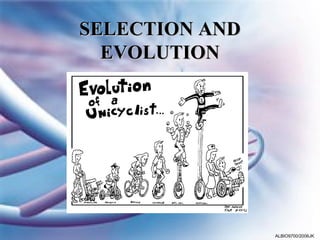
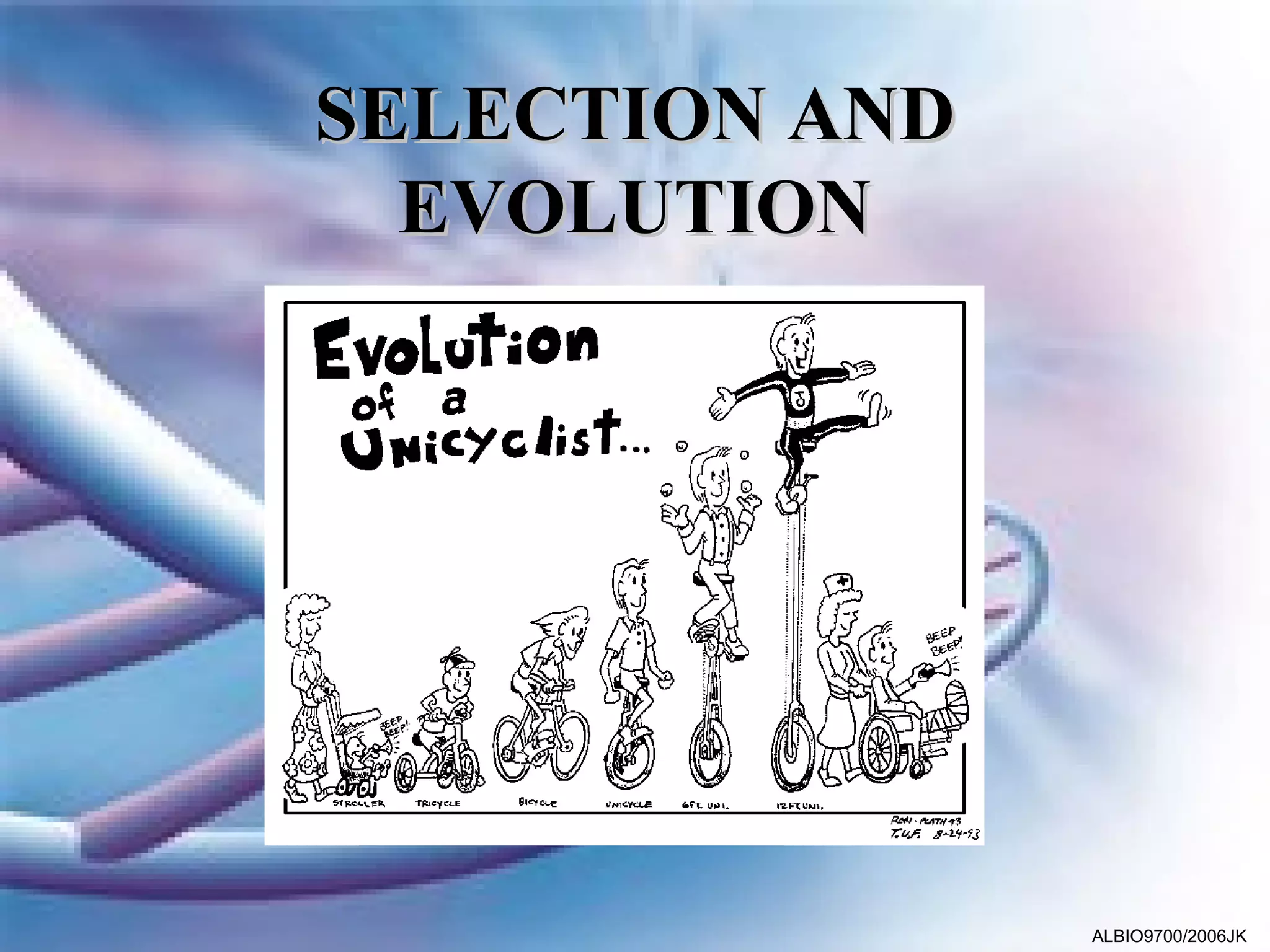
SELECTION AND
  EVOLUTION


                ALBIO9700/2006JK
Important terms
•   Natural selection
•   Evolution
•   Variation
•   Overproduce
•   Allele frequencies
•   Isolating mechanisms
•   Artificial selection

                             ALBIO9700/2006JK
ALBIO9700/2006JK
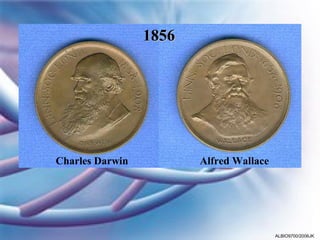
1856


Charles Darwin          Alfred Wallace


                                         ALBIO9700/2006JK
Evolution
• Changes within lines of descent over time

• Successive changes in allele frequencies in
  population as brought about by occurrences
  such as mutation, genetic drift, gene flow,
  and selection pressure


                                         ALBIO9700/2006JK
NATURAL SELECTION
• The way in which individuals with particular
  characteristics have a greater chance of
  survival than individuals without those
  characteristics, which are therefore more
  likely to breed and pass on the genes for
  these characteristics to their offspring

• The strongest survive and propagate and
  therefore increase the strength of the
  species


                                           ALBIO9700/2006JK
Observation 1


• Organisms produce more offspring
    than are needed to replace the
               parents


                              ALBIO9700/2006JK
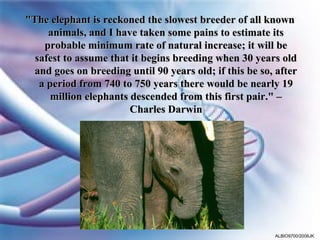
"The elephant is reckoned the slowest breeder of all known
     animals, and I have taken some pains to estimate its
    probable minimum rate of natural increase; it will be
  safest to assume that it begins breeding when 30 years old
  and goes on breeding until 90 years old; if this be so, after
   a period from 740 to 750 years there would be nearly 19
      million elephants descended from this first pair." –
                        Charles Darwin


                                                         ALBIO9700/2006JK
Observation 2


• Natural populations tend to remain
    stable in size over long periods


                                ALBIO9700/2006JK
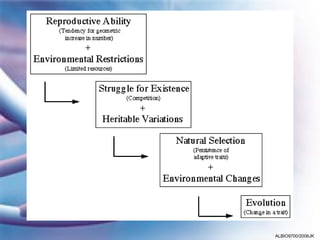
Observation 1 + Observation 2

           Deduction 1
• There is a competition for survival
     (a ‘struggle for existence’)


                                 ALBIO9700/2006JK
Observation 3

• There is variation among the
  individuals of a given species


                               ALBIO9700/2006JK
Deduction 1 + Observation 3

               Deduction 2
• The best adapted variants will be selected
  for by the natural conditions operating at
  the time.
• Natural selection occurs
• The ‘best’ variants have a selective
  advantage; ‘survival of the fittest’ occurs

                                           ALBIO9700/2006JK
ALBIO9700/2006JK
Examples of Natural Selection


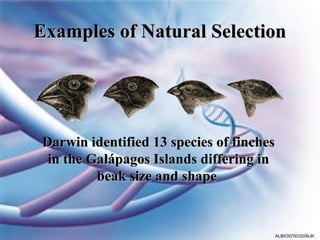
 Darwin identified 13 species of finches
  in the Galápagos Islands differing in
          beak size and shape


                                       ALBIO9700/2006JK
Examples of Natural Selection
           (cont)


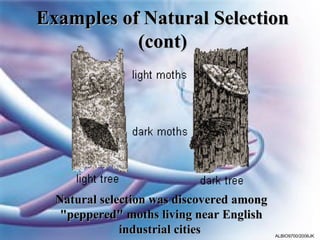
  Natural selection was discovered among
   "peppered" moths living near English
              industrial cities            ALBIO9700/2006JK
Overproduction
• If left unchecked by environmental factors ,
  numbers in a population may increase
  exponentially

• Environmental factors
  i) biotic – living organisms (predation,
  competition for food, pathogenic infection)

  ii) abiotic – non-living components (water supply,
  soil nutrient levels)


                                                ALBIO9700/2006JK
• Natural selection keeps things the way they are
  – stabilising selection

• Unless a new environmental factor or new allele
  is introduced – directional selection

• Evolution occurs because natural selection gives
  some alleles a better chance of survival than
  others. Therefore, changes in allele frequency in
  a population are the basis of evolution .


                                              ALBIO9700/2006JK
Processes that affect allele
    frequencies in populations?

• Malaria and sickle cell anaemia


• Antibiotic resistance


• Industrial melanism


                                    ALBIO9700/2006JK

01 selection and evolution

  • 1.
    SELECTION AND EVOLUTION ALBIO9700/2006JK
  • 2.
    Important terms • Natural selection • Evolution • Variation • Overproduce • Allele frequencies • Isolating mechanisms • Artificial selection ALBIO9700/2006JK
  • 3.
  • 4.
    1856 Charles Darwin Alfred Wallace ALBIO9700/2006JK
  • 5.
    Evolution • Changes withinlines of descent over time • Successive changes in allele frequencies in population as brought about by occurrences such as mutation, genetic drift, gene flow, and selection pressure ALBIO9700/2006JK
  • 6.
    NATURAL SELECTION • Theway in which individuals with particular characteristics have a greater chance of survival than individuals without those characteristics, which are therefore more likely to breed and pass on the genes for these characteristics to their offspring • The strongest survive and propagate and therefore increase the strength of the species ALBIO9700/2006JK
  • 7.
    Observation 1 • Organismsproduce more offspring than are needed to replace the parents ALBIO9700/2006JK
  • 8.
    "The elephant isreckoned the slowest breeder of all known animals, and I have taken some pains to estimate its probable minimum rate of natural increase; it will be safest to assume that it begins breeding when 30 years old and goes on breeding until 90 years old; if this be so, after a period from 740 to 750 years there would be nearly 19 million elephants descended from this first pair." – Charles Darwin ALBIO9700/2006JK
  • 9.
    Observation 2 • Naturalpopulations tend to remain stable in size over long periods ALBIO9700/2006JK
  • 10.
    Observation 1 +Observation 2 Deduction 1 • There is a competition for survival (a ‘struggle for existence’) ALBIO9700/2006JK
  • 11.
    Observation 3 • Thereis variation among the individuals of a given species ALBIO9700/2006JK
  • 12.
    Deduction 1 +Observation 3 Deduction 2 • The best adapted variants will be selected for by the natural conditions operating at the time. • Natural selection occurs • The ‘best’ variants have a selective advantage; ‘survival of the fittest’ occurs ALBIO9700/2006JK
  • 13.
  • 14.
    Examples of NaturalSelection Darwin identified 13 species of finches in the Galápagos Islands differing in beak size and shape ALBIO9700/2006JK
  • 15.
    Examples of NaturalSelection (cont) Natural selection was discovered among "peppered" moths living near English industrial cities ALBIO9700/2006JK
  • 16.
    Overproduction • If leftunchecked by environmental factors , numbers in a population may increase exponentially • Environmental factors i) biotic – living organisms (predation, competition for food, pathogenic infection) ii) abiotic – non-living components (water supply, soil nutrient levels) ALBIO9700/2006JK
  • 17.
    • Natural selectionkeeps things the way they are – stabilising selection • Unless a new environmental factor or new allele is introduced – directional selection • Evolution occurs because natural selection gives some alleles a better chance of survival than others. Therefore, changes in allele frequency in a population are the basis of evolution . ALBIO9700/2006JK
  • 18.
    Processes that affectallele frequencies in populations? • Malaria and sickle cell anaemia • Antibiotic resistance • Industrial melanism ALBIO9700/2006JK