05/19/15 Dr. M. S. Prasad 1
Vitamin-D DeficiencyVitamin-D Deficiency
Dr. M. S. PrasadDr. M. S. Prasad
Retired Consultant & Head
Department of Pediatrics
VM Medical College & Safdarjung Hospital
New Delhi
05/19/15 Dr. M. S. Prasad 2
S Balasubramanian, K Dhanalakshmi and Sumanth Amperavani:
Vitamin-D Deficiency in Childhood – A Review of Current
Guidelines on Diagnosis and Management.
Indian Pediatrics, Vol. 50 – July 15, 2013 pp 669 – 675.
Indian Pediatrics, Volume 51, April 15, 2014.
05/19/15 Dr. M. S. Prasad 3
IntroductionIntroduction
• Most common nutritional deficiency,
• One of the most common undiagnosed
medical conditions in the world.
• Vitamin-D has evolved into a hormone.
05/19/15 Dr. M. S. Prasad 4
FunctionsFunctions
• Regulates calcium and bone metabolism,
• Reduce the risk of chronic diseases:
– Auto-immune diseases,
– Malignancies,
– Cardiovascular, and
– Infectious diseases.
05/19/15 Dr. M. S. Prasad 5
Facts!!Facts!!
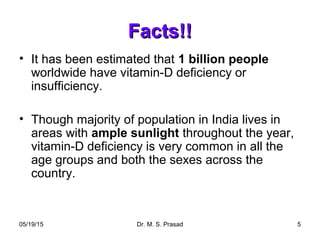
• It has been estimated that 1 billion people
worldwide have vitamin-D deficiency or
insufficiency.
• Though majority of population in India lives in
areas with ample sunlight throughout the year,
vitamin-D deficiency is very common in all the
age groups and both the sexes across the
country.
05/19/15 Dr. M. S. Prasad 6
Facts!!!Facts!!!
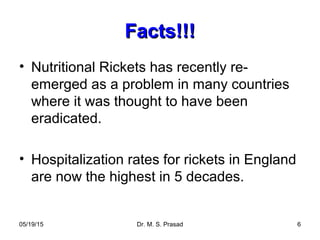
• Nutritional Rickets has recently re-
emerged as a problem in many countries
where it was thought to have been
eradicated.
• Hospitalization rates for rickets in England
are now the highest in 5 decades.
05/19/15 Dr. M. S. Prasad 7
EtiologyEtiology
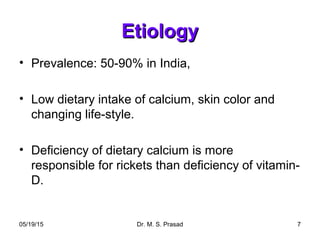
• Prevalence: 50-90% in India,
• Low dietary intake of calcium, skin color and
changing life-style.
• Deficiency of dietary calcium is more
responsible for rickets than deficiency of vitamin-
D.
05/19/15 Dr. M. S. Prasad 8
EtiologyEtiology (continued)
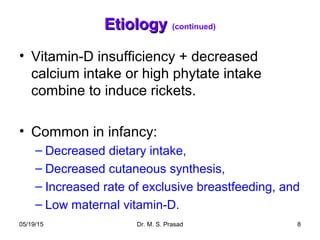
• Vitamin-D insufficiency + decreased
calcium intake or high phytate intake
combine to induce rickets.
• Common in infancy:
– Decreased dietary intake,
– Decreased cutaneous synthesis,
– Increased rate of exclusive breastfeeding, and
– Low maternal vitamin-D.
05/19/15 Dr. M. S. Prasad 9
EtiologyEtiology (continued)
• Decreased vitamin-D synthesis,
• Decreased nutritional intake of vitamin-D,
• Age & Physiology related,
• Decreased maternal vitamin-D stores,
05/19/15 Dr. M. S. Prasad 10
EtiologyEtiology (continued)
• Malabsorption,
• Decreased metabolic conversion to
active form,
• Increased degradation of 25(OH)D.
05/19/15 Dr. M. S. Prasad 11
Decreased vitamin-D synthesisDecreased vitamin-D synthesis
• Skin pigmentation,
• Physical agents blocking
UVR exposure,
• Clothing,
• Latitude,
• Season,
• Air-pollution,
• Cloud cover,
• Altitude.
05/19/15 Dr. M. S. Prasad 12
MalabsorptionMalabsorption
• Celiac disease,
• Pancreatic insufficiency (cystic fibrosis),
• Biliary obstruction (Biliary Atresia)
05/19/15 Dr. M. S. Prasad 13
Decreased metabolic conversionDecreased metabolic conversion
• Chronic Liver Disease,
• Chronic Renal Failure.
05/19/15 Dr. M. S. Prasad 14
Increased degradation of 25(OH)DIncreased degradation of 25(OH)D
• Drugs such as:
– Rifampicin,
– Isoniazid,
– Anticonvulsants,
– Glucocorticocoids.
05/19/15 Dr. M. S. Prasad 15
OthersOthers
• Decreased nutritional intake:
– Strict Vegan Diet.
• Age & Physiology related:
– Elderly,
– Obese,
– Institutionalized.
• Decreased maternal vitamin-D stores:
– Exclusive Breastfeeding.
05/19/15 Dr. M. S. Prasad 16
Definition of vitamin-D statusDefinition of vitamin-D status
• Debated by clinicians and researchers,
• Defined as serum level of 25(OH)D less
than 20 ng/dL.
• Less than 15 ng/dl: Definite Deficiency.
• Less than 5 ng/dL: Severe Deficiency.
05/19/15 Dr. M. S. Prasad 17
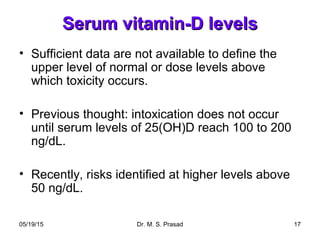
Serum vitamin-D levelsSerum vitamin-D levels
• Sufficient data are not available to define the
upper level of normal or dose levels above
which toxicity occurs.
• Previous thought: intoxication does not occur
until serum levels of 25(OH)D reach 100 to 200
ng/dL.
• Recently, risks identified at higher levels above
50 ng/dL.
05/19/15 Dr. M. S. Prasad 18
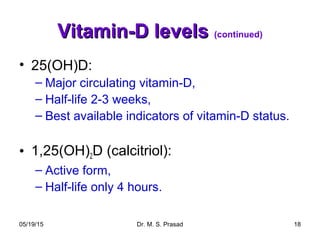
Vitamin-D levelsVitamin-D levels (continued)
• 25(OH)D:
– Major circulating vitamin-D,
– Half-life 2-3 weeks,
– Best available indicators of vitamin-D status.
• 1,25(OH)2D (calcitriol):
– Active form,
– Half-life only 4 hours.
05/19/15 Dr. M. S. Prasad 19
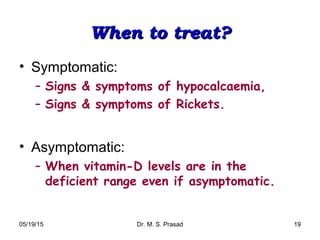
When to treat?When to treat?
• Symptomatic:
– Signs & symptoms of hypocalcaemia,
– Signs & symptoms of Rickets.
• Asymptomatic:
– When vitamin-D levels are in the
deficient range even if asymptomatic.
05/19/15 Dr. M. S. Prasad 20
Treatment RegimenTreatment Regimen
• D3: 2000 IU daily or D2: 50000 IU weekly.
• Stoss Therapy: 6 lakh units once, or
• D3: 1000 – 5000 IU/day for weeks, or
• D2: 50000 units/wk for 8 weeks.
05/19/15 Dr. M. S. Prasad 21
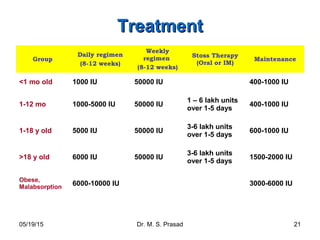
TreatmentTreatment
Group
Daily regimen
(8-12 weeks)
Weekly
regimen
(8-12 weeks)
Stoss Therapy
(Oral or IM)
Maintenance
<1 mo old 1000 IU 50000 IU 400-1000 IU
1-12 mo 1000-5000 IU 50000 IU
1 – 6 lakh units
over 1-5 days
400-1000 IU
1-18 y old 5000 IU 50000 IU
3-6 lakh units
over 1-5 days
600-1000 IU
>18 y old 6000 IU 50000 IU
3-6 lakh units
over 1-5 days
1500-2000 IU
Obese,
Malabsorption
6000-10000 IU 3000-6000 IU
05/19/15 Dr. M. S. Prasad 22
TreatmentTreatment (continued)
• A single dose of 300, 000 IU is not inferior to
double of this dose (600, 000 IU).
• The dose is effective orally.
• Intramuscular dose is painful and unnecessary.
• I. M. reserved for cases with malabsorption only.
05/19/15 Dr. M. S. Prasad 23
DiscussionDiscussion
• Lack of compliance  lack of response.
• Solution: Administer high dose of 100000 to 600000 IU
over 1-5 days (Stoss Therapy).
• Advantage of Stoss therapy: Vitamin-D is efficiently
stored in adipose tissue and muscle and is continuously
converted into active form.
• Shah and Finberg successfully administered 1 lakh IU
every 12 hours over 12 hour period.
05/19/15 Dr. M. S. Prasad 24
MaintenanceMaintenance
• After completion of treatment, continue
vitamin-D at 800-1000 IU/day till serum
alkaline phosphatase returns to normal.
• D3 is 3 times more potent than D2.
• Provide Calcium supplement throughout
treatment and maintenance.
(elemental calcium 30-75 mg/kg/day in 3 divided doses).
05/19/15 Dr. M. S. Prasad 25
Indian Pediatrics: Volume 51, April 15, 2014Indian Pediatrics: Volume 51, April 15, 2014
• Both 3 lakh and 6 lakh IU vitamin D3 as
single day doses are equally effective in
treating children between 6 months and 5
years of age with vitamin D deficiency
rickets.
• Neither dose is able to normalize the
vitamin D status of the children 3 months
after the administered dose.
05/19/15 Dr. M. S. Prasad 26
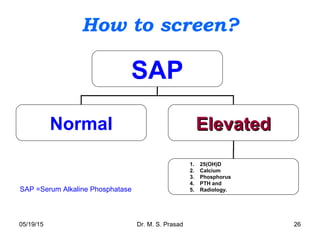
How to screen?
SAP
Normal ElevatedElevated
1. 25(OH)D
2. Calcium
3. Phosphorus
4. PTH and
5. Radiology.SAP =Serum Alkaline Phosphatase
05/19/15 Dr. M. S. Prasad 27
Whom to screen?Whom to screen?
• Dark skinned infants who live at higher
altitude and infants born to vitamin-D
deficient mothers.
• In the presence of non-specific symptoms
like poor growth, gross motor
developmental delay and unusual
irritability.
05/19/15 Dr. M. S. Prasad 28
Whom to screen?
• Children with suspected rickets, those with
osteopenia.
• Chronic Kidney Disease.
• Hepatic Failure.
• Hyperparathyroidism.
05/19/15 Dr. M. S. Prasad 29
Whom to screen?
• Malabsorption syndrome:
– Cystic Fibrosis,
– IBD (Inflammatory Bowel Disease),
– Crohn’s Disease
• Medications:
– Anticonvulsants,
– Glucocorticosteroids,
– AIDS medication,
– Antifungal (ketoconazole).
05/19/15 Dr. M. S. Prasad 30
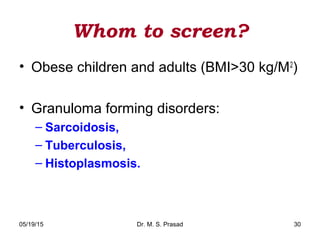
Whom to screen?
• Obese children and adults (BMI>30 kg/M2
)
• Granuloma forming disorders:
– Sarcoidosis,
– Tuberculosis,
– Histoplasmosis.
05/19/15 Dr. M. S. Prasad 31
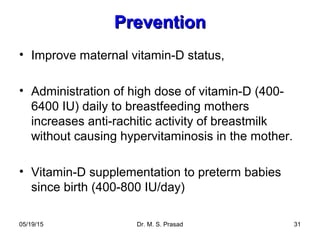
PreventionPrevention
• Improve maternal vitamin-D status,
• Administration of high dose of vitamin-D (400-
6400 IU) daily to breastfeeding mothers
increases anti-rachitic activity of breastmilk
without causing hypervitaminosis in the mother.
• Vitamin-D supplementation to preterm babies
since birth (400-800 IU/day)
05/19/15 Dr. M. S. Prasad 32
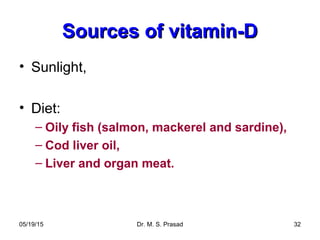
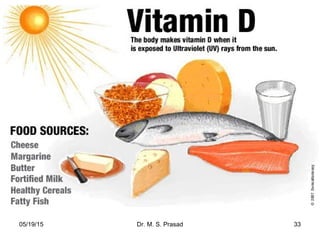
Sources of vitamin-DSources of vitamin-D
• Sunlight,
• Diet:
– Oily fish (salmon, mackerel and sardine),
– Cod liver oil,
– Liver and organ meat.
05/19/15 Dr. M. S. Prasad 33
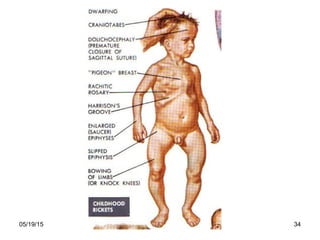
05/19/15 Dr. M. S. Prasad 34
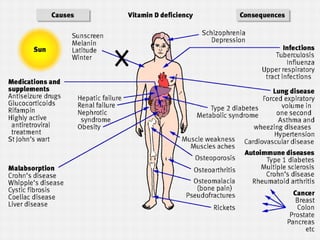
05/19/15 Dr. M. S. Prasad 35

Vitamin d deficiency

  • 1.
    05/19/15 Dr. M.S. Prasad 1 Vitamin-D DeficiencyVitamin-D Deficiency Dr. M. S. PrasadDr. M. S. Prasad Retired Consultant & Head Department of Pediatrics VM Medical College & Safdarjung Hospital New Delhi
  • 2.
    05/19/15 Dr. M.S. Prasad 2 S Balasubramanian, K Dhanalakshmi and Sumanth Amperavani: Vitamin-D Deficiency in Childhood – A Review of Current Guidelines on Diagnosis and Management. Indian Pediatrics, Vol. 50 – July 15, 2013 pp 669 – 675. Indian Pediatrics, Volume 51, April 15, 2014.
  • 3.
    05/19/15 Dr. M.S. Prasad 3 IntroductionIntroduction • Most common nutritional deficiency, • One of the most common undiagnosed medical conditions in the world. • Vitamin-D has evolved into a hormone.
  • 4.
    05/19/15 Dr. M.S. Prasad 4 FunctionsFunctions • Regulates calcium and bone metabolism, • Reduce the risk of chronic diseases: – Auto-immune diseases, – Malignancies, – Cardiovascular, and – Infectious diseases.
  • 5.
    05/19/15 Dr. M.S. Prasad 5 Facts!!Facts!! • It has been estimated that 1 billion people worldwide have vitamin-D deficiency or insufficiency. • Though majority of population in India lives in areas with ample sunlight throughout the year, vitamin-D deficiency is very common in all the age groups and both the sexes across the country.
  • 6.
    05/19/15 Dr. M.S. Prasad 6 Facts!!!Facts!!! • Nutritional Rickets has recently re- emerged as a problem in many countries where it was thought to have been eradicated. • Hospitalization rates for rickets in England are now the highest in 5 decades.
  • 7.
    05/19/15 Dr. M.S. Prasad 7 EtiologyEtiology • Prevalence: 50-90% in India, • Low dietary intake of calcium, skin color and changing life-style. • Deficiency of dietary calcium is more responsible for rickets than deficiency of vitamin- D.
  • 8.
    05/19/15 Dr. M.S. Prasad 8 EtiologyEtiology (continued) • Vitamin-D insufficiency + decreased calcium intake or high phytate intake combine to induce rickets. • Common in infancy: – Decreased dietary intake, – Decreased cutaneous synthesis, – Increased rate of exclusive breastfeeding, and – Low maternal vitamin-D.
  • 9.
    05/19/15 Dr. M.S. Prasad 9 EtiologyEtiology (continued) • Decreased vitamin-D synthesis, • Decreased nutritional intake of vitamin-D, • Age & Physiology related, • Decreased maternal vitamin-D stores,
  • 10.
    05/19/15 Dr. M.S. Prasad 10 EtiologyEtiology (continued) • Malabsorption, • Decreased metabolic conversion to active form, • Increased degradation of 25(OH)D.
  • 11.
    05/19/15 Dr. M.S. Prasad 11 Decreased vitamin-D synthesisDecreased vitamin-D synthesis • Skin pigmentation, • Physical agents blocking UVR exposure, • Clothing, • Latitude, • Season, • Air-pollution, • Cloud cover, • Altitude.
  • 12.
    05/19/15 Dr. M.S. Prasad 12 MalabsorptionMalabsorption • Celiac disease, • Pancreatic insufficiency (cystic fibrosis), • Biliary obstruction (Biliary Atresia)
  • 13.
    05/19/15 Dr. M.S. Prasad 13 Decreased metabolic conversionDecreased metabolic conversion • Chronic Liver Disease, • Chronic Renal Failure.
  • 14.
    05/19/15 Dr. M.S. Prasad 14 Increased degradation of 25(OH)DIncreased degradation of 25(OH)D • Drugs such as: – Rifampicin, – Isoniazid, – Anticonvulsants, – Glucocorticocoids.
  • 15.
    05/19/15 Dr. M.S. Prasad 15 OthersOthers • Decreased nutritional intake: – Strict Vegan Diet. • Age & Physiology related: – Elderly, – Obese, – Institutionalized. • Decreased maternal vitamin-D stores: – Exclusive Breastfeeding.
  • 16.
    05/19/15 Dr. M.S. Prasad 16 Definition of vitamin-D statusDefinition of vitamin-D status • Debated by clinicians and researchers, • Defined as serum level of 25(OH)D less than 20 ng/dL. • Less than 15 ng/dl: Definite Deficiency. • Less than 5 ng/dL: Severe Deficiency.
  • 17.
    05/19/15 Dr. M.S. Prasad 17 Serum vitamin-D levelsSerum vitamin-D levels • Sufficient data are not available to define the upper level of normal or dose levels above which toxicity occurs. • Previous thought: intoxication does not occur until serum levels of 25(OH)D reach 100 to 200 ng/dL. • Recently, risks identified at higher levels above 50 ng/dL.
  • 18.
    05/19/15 Dr. M.S. Prasad 18 Vitamin-D levelsVitamin-D levels (continued) • 25(OH)D: – Major circulating vitamin-D, – Half-life 2-3 weeks, – Best available indicators of vitamin-D status. • 1,25(OH)2D (calcitriol): – Active form, – Half-life only 4 hours.
  • 19.
    05/19/15 Dr. M.S. Prasad 19 When to treat?When to treat? • Symptomatic: – Signs & symptoms of hypocalcaemia, – Signs & symptoms of Rickets. • Asymptomatic: – When vitamin-D levels are in the deficient range even if asymptomatic.
  • 20.
    05/19/15 Dr. M.S. Prasad 20 Treatment RegimenTreatment Regimen • D3: 2000 IU daily or D2: 50000 IU weekly. • Stoss Therapy: 6 lakh units once, or • D3: 1000 – 5000 IU/day for weeks, or • D2: 50000 units/wk for 8 weeks.
  • 21.
    05/19/15 Dr. M.S. Prasad 21 TreatmentTreatment Group Daily regimen (8-12 weeks) Weekly regimen (8-12 weeks) Stoss Therapy (Oral or IM) Maintenance <1 mo old 1000 IU 50000 IU 400-1000 IU 1-12 mo 1000-5000 IU 50000 IU 1 – 6 lakh units over 1-5 days 400-1000 IU 1-18 y old 5000 IU 50000 IU 3-6 lakh units over 1-5 days 600-1000 IU >18 y old 6000 IU 50000 IU 3-6 lakh units over 1-5 days 1500-2000 IU Obese, Malabsorption 6000-10000 IU 3000-6000 IU
  • 22.
    05/19/15 Dr. M.S. Prasad 22 TreatmentTreatment (continued) • A single dose of 300, 000 IU is not inferior to double of this dose (600, 000 IU). • The dose is effective orally. • Intramuscular dose is painful and unnecessary. • I. M. reserved for cases with malabsorption only.
  • 23.
    05/19/15 Dr. M.S. Prasad 23 DiscussionDiscussion • Lack of compliance  lack of response. • Solution: Administer high dose of 100000 to 600000 IU over 1-5 days (Stoss Therapy). • Advantage of Stoss therapy: Vitamin-D is efficiently stored in adipose tissue and muscle and is continuously converted into active form. • Shah and Finberg successfully administered 1 lakh IU every 12 hours over 12 hour period.
  • 24.
    05/19/15 Dr. M.S. Prasad 24 MaintenanceMaintenance • After completion of treatment, continue vitamin-D at 800-1000 IU/day till serum alkaline phosphatase returns to normal. • D3 is 3 times more potent than D2. • Provide Calcium supplement throughout treatment and maintenance. (elemental calcium 30-75 mg/kg/day in 3 divided doses).
  • 25.
    05/19/15 Dr. M.S. Prasad 25 Indian Pediatrics: Volume 51, April 15, 2014Indian Pediatrics: Volume 51, April 15, 2014 • Both 3 lakh and 6 lakh IU vitamin D3 as single day doses are equally effective in treating children between 6 months and 5 years of age with vitamin D deficiency rickets. • Neither dose is able to normalize the vitamin D status of the children 3 months after the administered dose.
  • 26.
    05/19/15 Dr. M.S. Prasad 26 How to screen? SAP Normal ElevatedElevated 1. 25(OH)D 2. Calcium 3. Phosphorus 4. PTH and 5. Radiology.SAP =Serum Alkaline Phosphatase
  • 27.
    05/19/15 Dr. M.S. Prasad 27 Whom to screen?Whom to screen? • Dark skinned infants who live at higher altitude and infants born to vitamin-D deficient mothers. • In the presence of non-specific symptoms like poor growth, gross motor developmental delay and unusual irritability.
  • 28.
    05/19/15 Dr. M.S. Prasad 28 Whom to screen? • Children with suspected rickets, those with osteopenia. • Chronic Kidney Disease. • Hepatic Failure. • Hyperparathyroidism.
  • 29.
    05/19/15 Dr. M.S. Prasad 29 Whom to screen? • Malabsorption syndrome: – Cystic Fibrosis, – IBD (Inflammatory Bowel Disease), – Crohn’s Disease • Medications: – Anticonvulsants, – Glucocorticosteroids, – AIDS medication, – Antifungal (ketoconazole).
  • 30.
    05/19/15 Dr. M.S. Prasad 30 Whom to screen? • Obese children and adults (BMI>30 kg/M2 ) • Granuloma forming disorders: – Sarcoidosis, – Tuberculosis, – Histoplasmosis.
  • 31.
    05/19/15 Dr. M.S. Prasad 31 PreventionPrevention • Improve maternal vitamin-D status, • Administration of high dose of vitamin-D (400- 6400 IU) daily to breastfeeding mothers increases anti-rachitic activity of breastmilk without causing hypervitaminosis in the mother. • Vitamin-D supplementation to preterm babies since birth (400-800 IU/day)
  • 32.
    05/19/15 Dr. M.S. Prasad 32 Sources of vitamin-DSources of vitamin-D • Sunlight, • Diet: – Oily fish (salmon, mackerel and sardine), – Cod liver oil, – Liver and organ meat.
  • 33.
    05/19/15 Dr. M.S. Prasad 33
  • 34.
    05/19/15 Dr. M.S. Prasad 34
  • 35.
    05/19/15 Dr. M.S. Prasad 35