Structure and Composition of
Bone
Biomechanics aims to explain the
mechanics of life and living.
From molecules to organisms,
everything must obey the laws of
mechanics.
Y. C.
Fung
Learning Objectives
 Identify important structures of bone at
gross, macro and micro levels.
 Compare contributions of different
components of bone (such as cells) to
its functions
 Describe the effects of structure of
bone on its functions (Wolff’s Law)
Bone – a quick overview
 Composite of extracellular matrix proteins
◦ Mineralizes through elegant feedback and regulation
mechanisms
 Cellular components
◦ Maintain structural integrity
◦ Respond to metabolic and mechanical requirements
 Functions
◦ Protects organs
◦ Supports
◦ Allows movement through attachment for muscles
◦ Manufactures blood cells (bone marrow)
◦ Stores Ca2+ and PO4
3-
Bones can be classified on the macro
level several ways, such as by position...
 Axial skeleton – Bone forming axis of
body, e.g skull, rib, sternum and
vertebrae
 Appendicular skeleton – bones
forming appendages of body, e.g.
limbs, shoulder and hip.
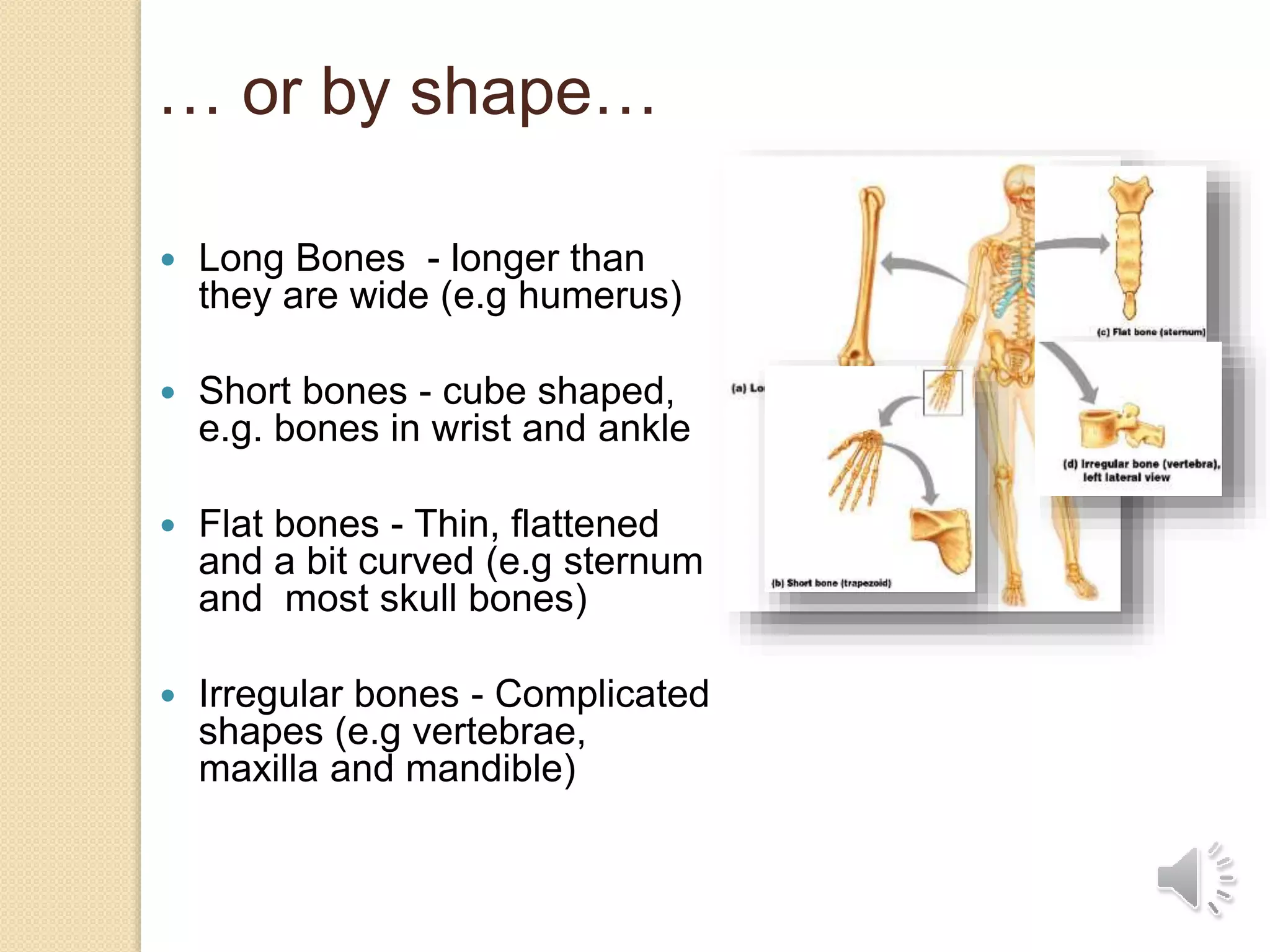
 Long Bones - longer than
they are wide (e.g humerus)
 Short bones - cube shaped,
e.g. bones in wrist and ankle
 Flat bones - Thin, flattened
and a bit curved (e.g sternum
and most skull bones)
 Irregular bones - Complicated
shapes (e.g vertebrae,
maxilla and mandible)
… or by shape…
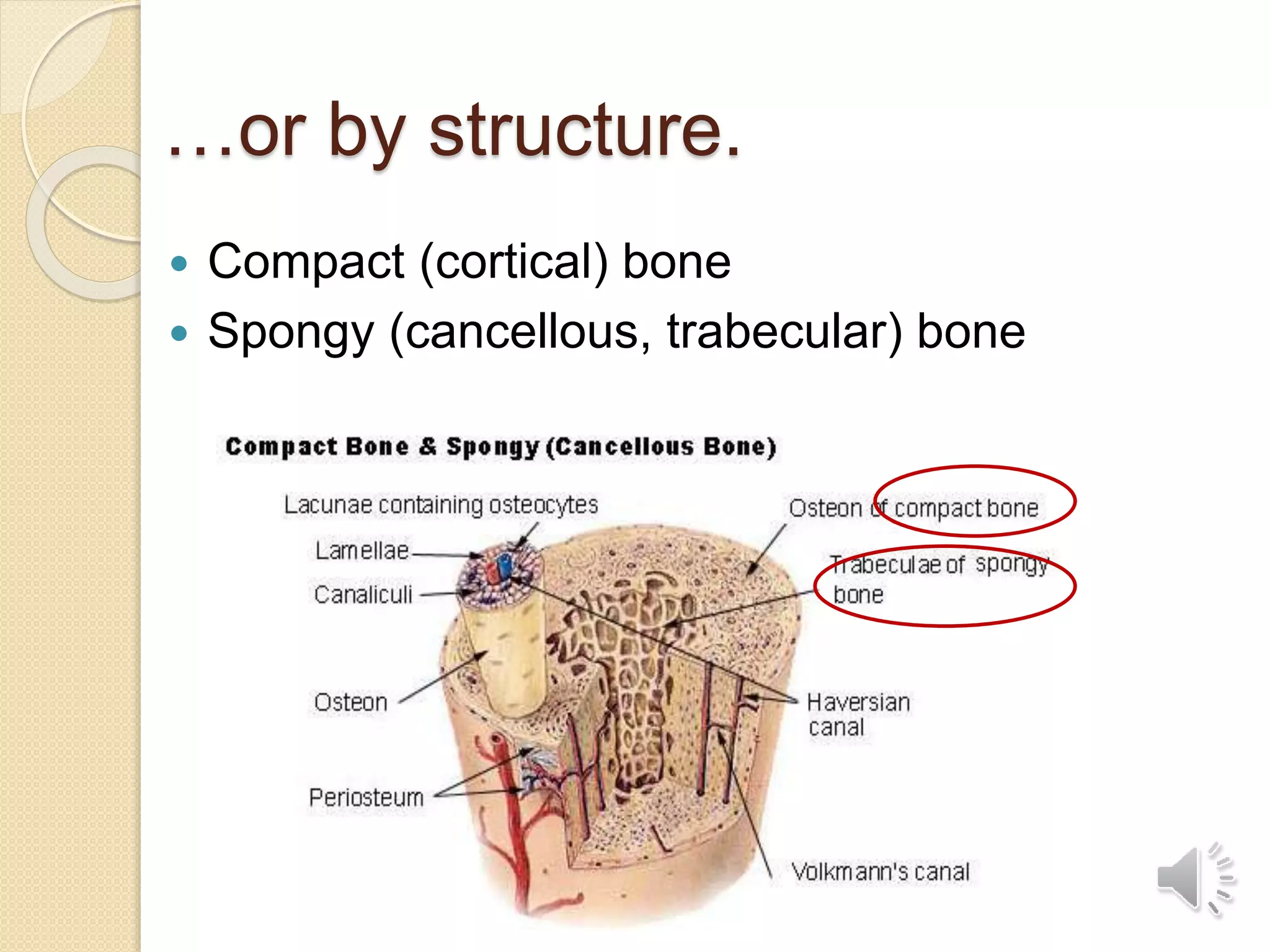
…or by structure.
 Compact (cortical) bone
 Spongy (cancellous, trabecular) bone
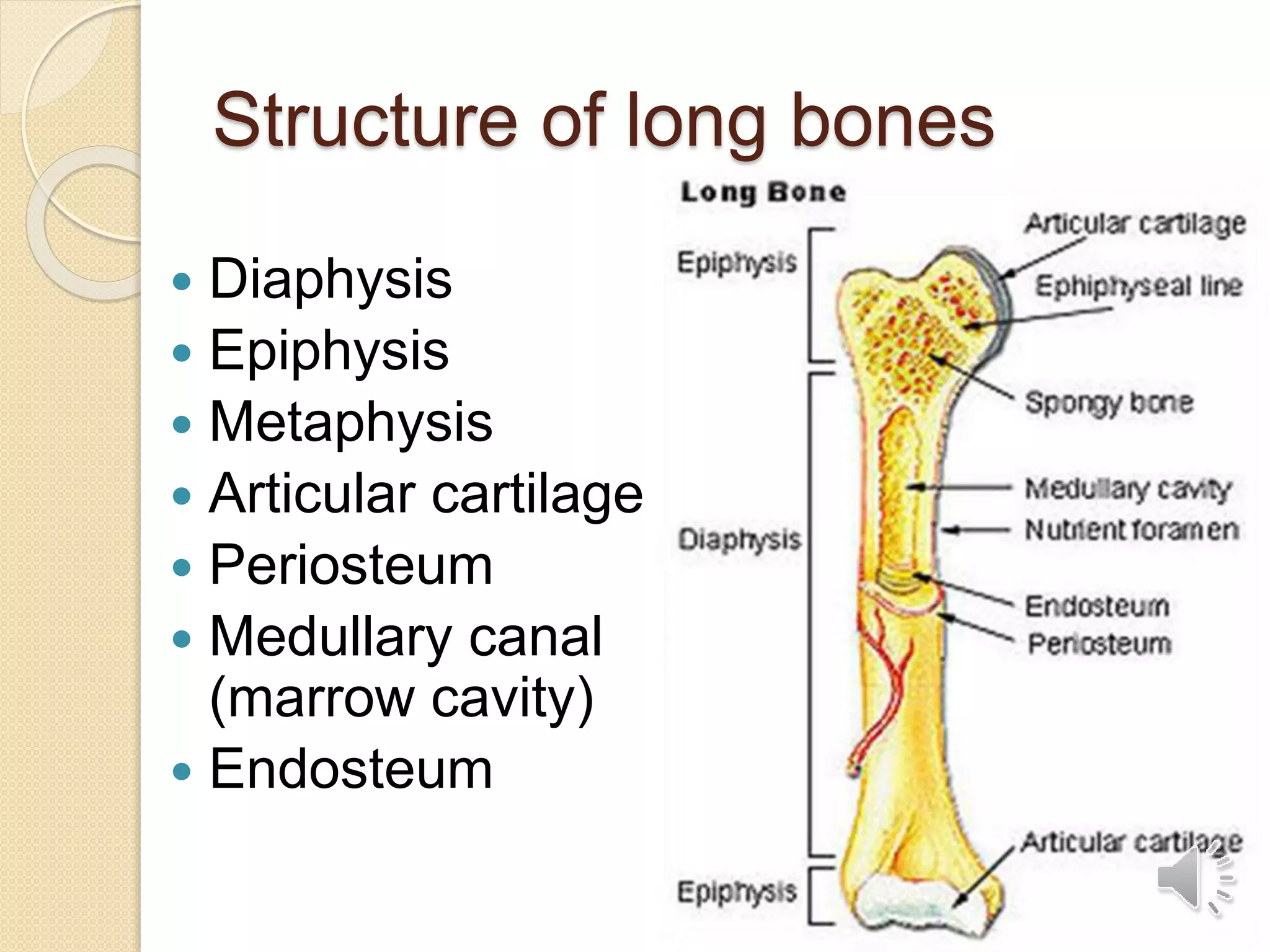
Structure of long bones
 Diaphysis
 Epiphysis
 Metaphysis
 Articular cartilage
 Periosteum
 Medullary canal
(marrow cavity)
 Endosteum
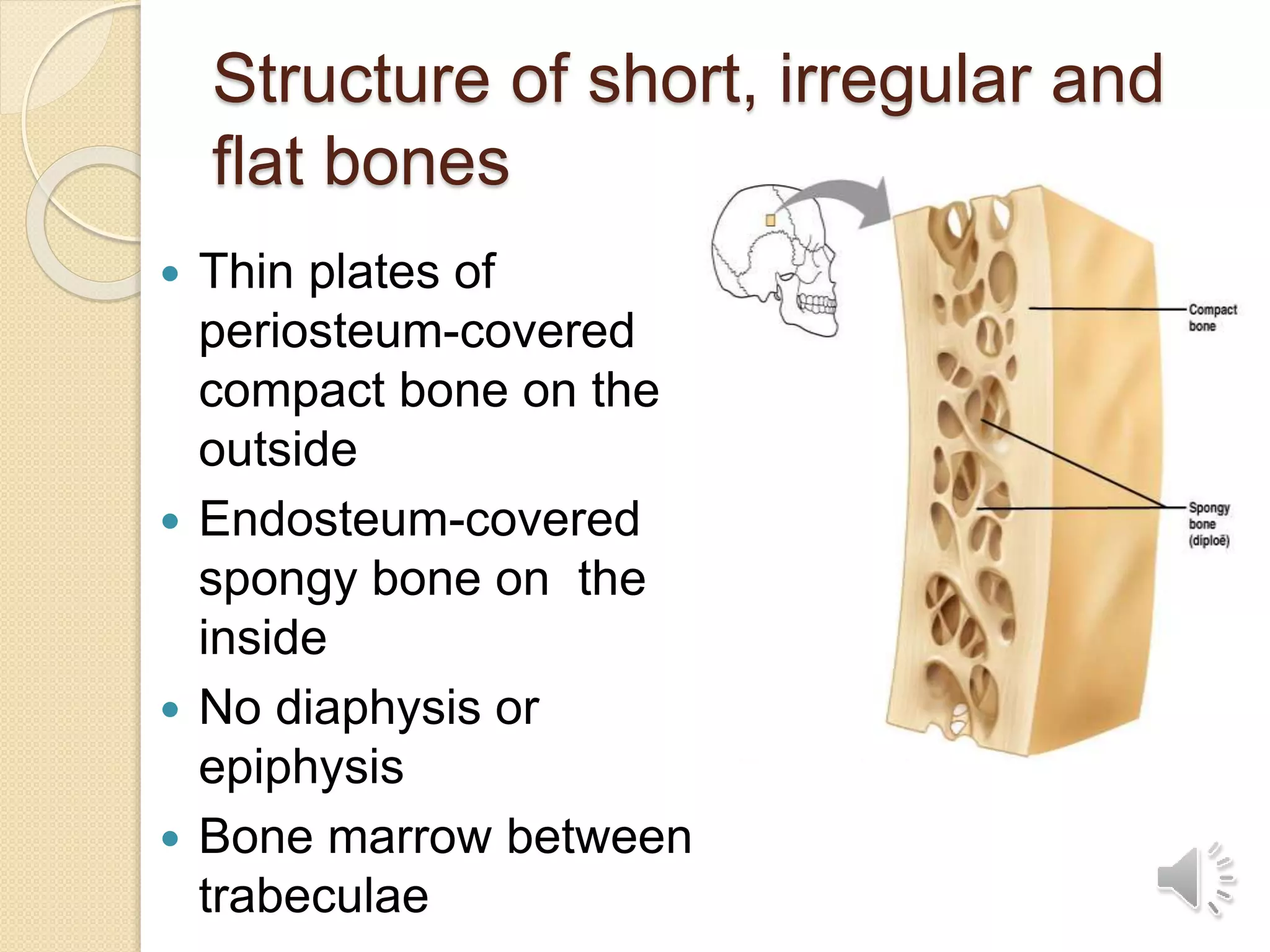
Structure of short, irregular and
flat bones
 Thin plates of
periosteum-covered
compact bone on the
outside
 Endosteum-covered
spongy bone on the
inside
 No diaphysis or
epiphysis
 Bone marrow between
trabeculae
Microstructure of adult bone:
Lamellar bone
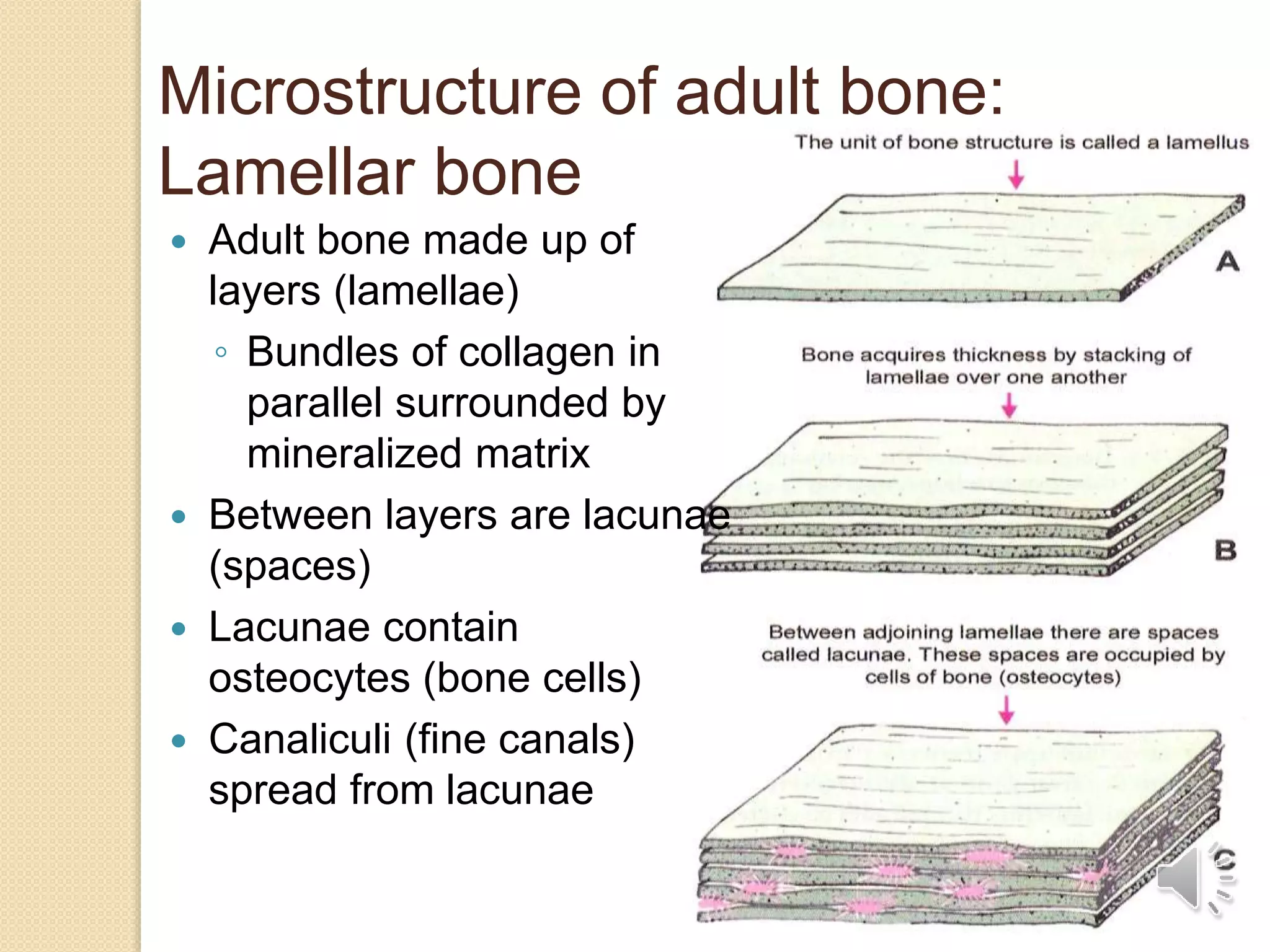
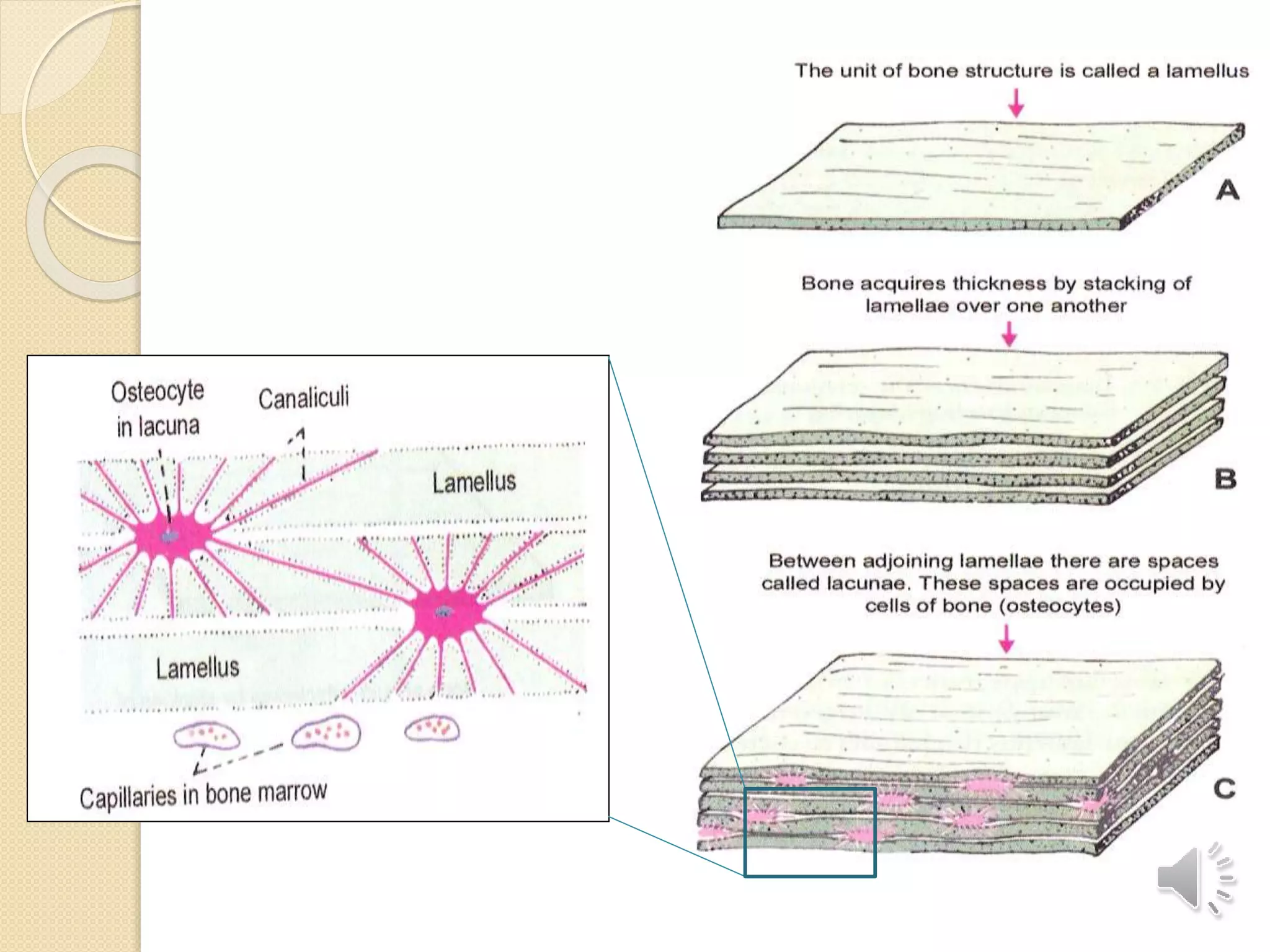
 Adult bone made up of
layers (lamellae)
◦ Bundles of collagen in
parallel surrounded by
mineralized matrix
 Between layers are lacunae
(spaces)
 Lacunae contain
osteocytes (bone cells)
 Canaliculi (fine canals)
spread from lacunae
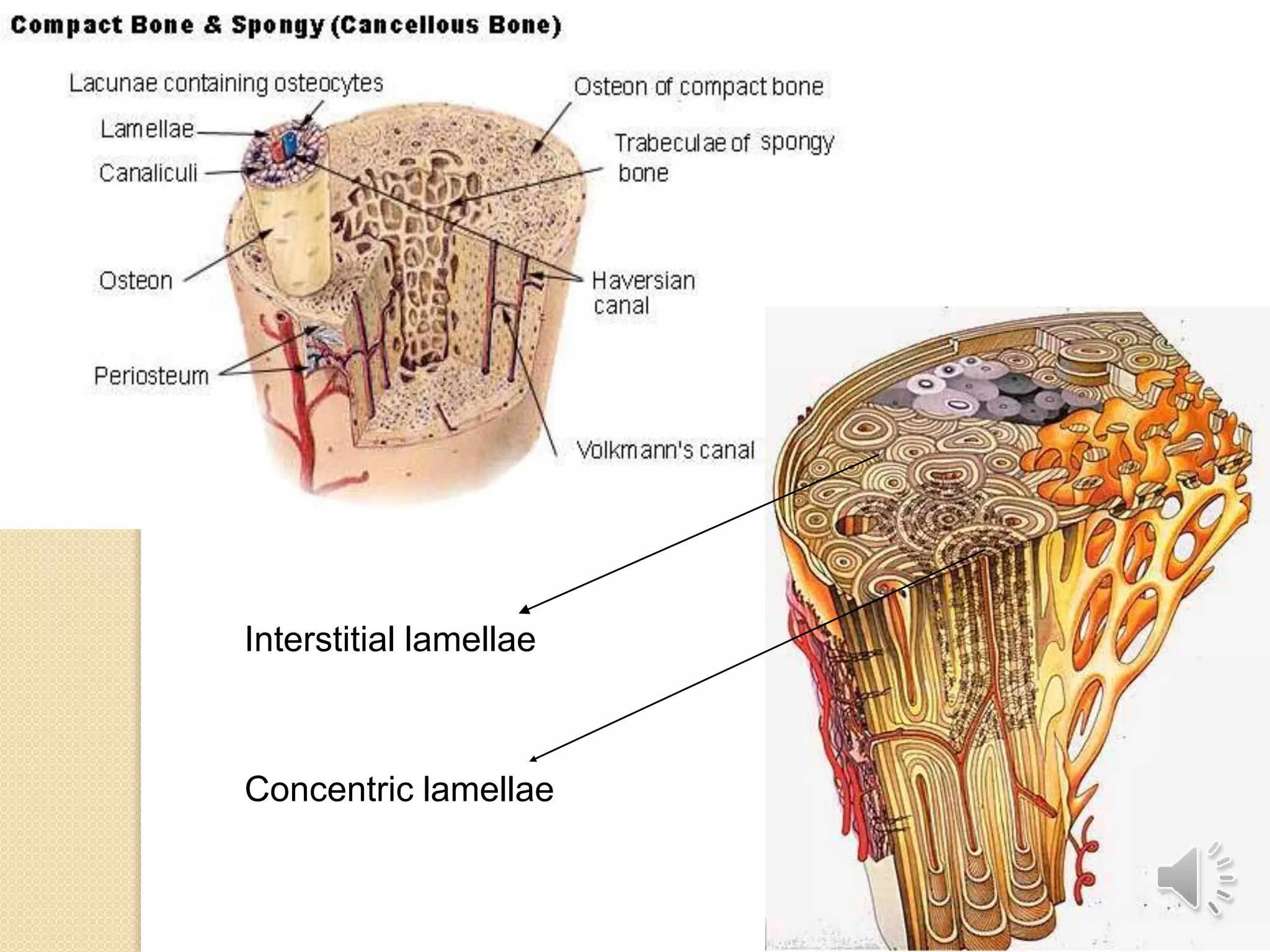
Interstitial lamellae
Concentric lamellae
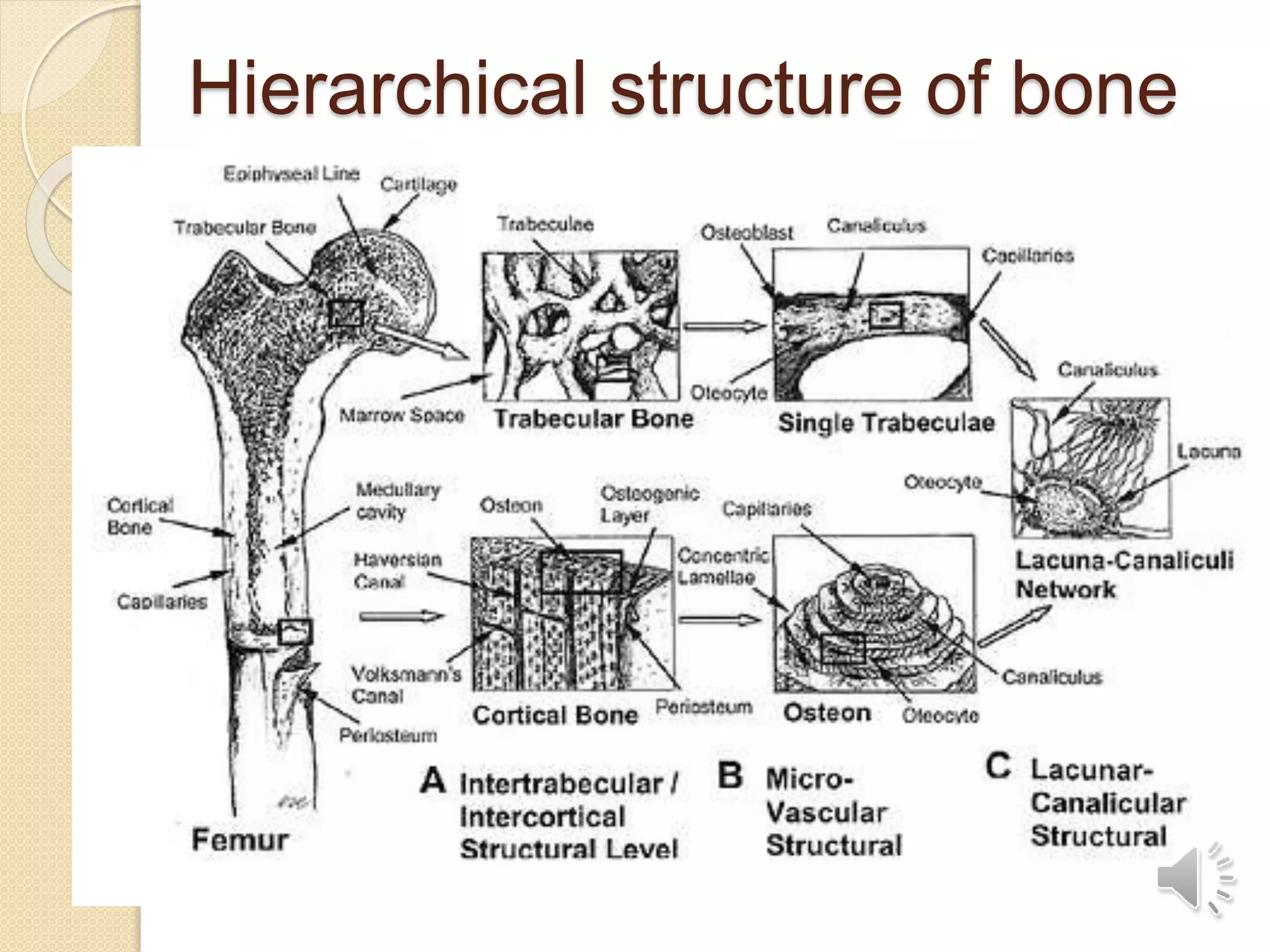
Hierarchical structure of bone
Composition of bone
 ~1/3 organic
◦ Collagen fiber matrix (~88%) organized
around lamellae
◦ Non-collagen (~12%); Glycoproteins,
proteoglycans, lipids, etc)
 ~1/3 inorganic (mineral)
◦ Mostly dense calcium phosphate in the form
of highly insoluble crystals of hydroxyapatite
 ~1/3 water
 Cells – osteoblasts, osteoclasts,
osteocytes, bone lining cells
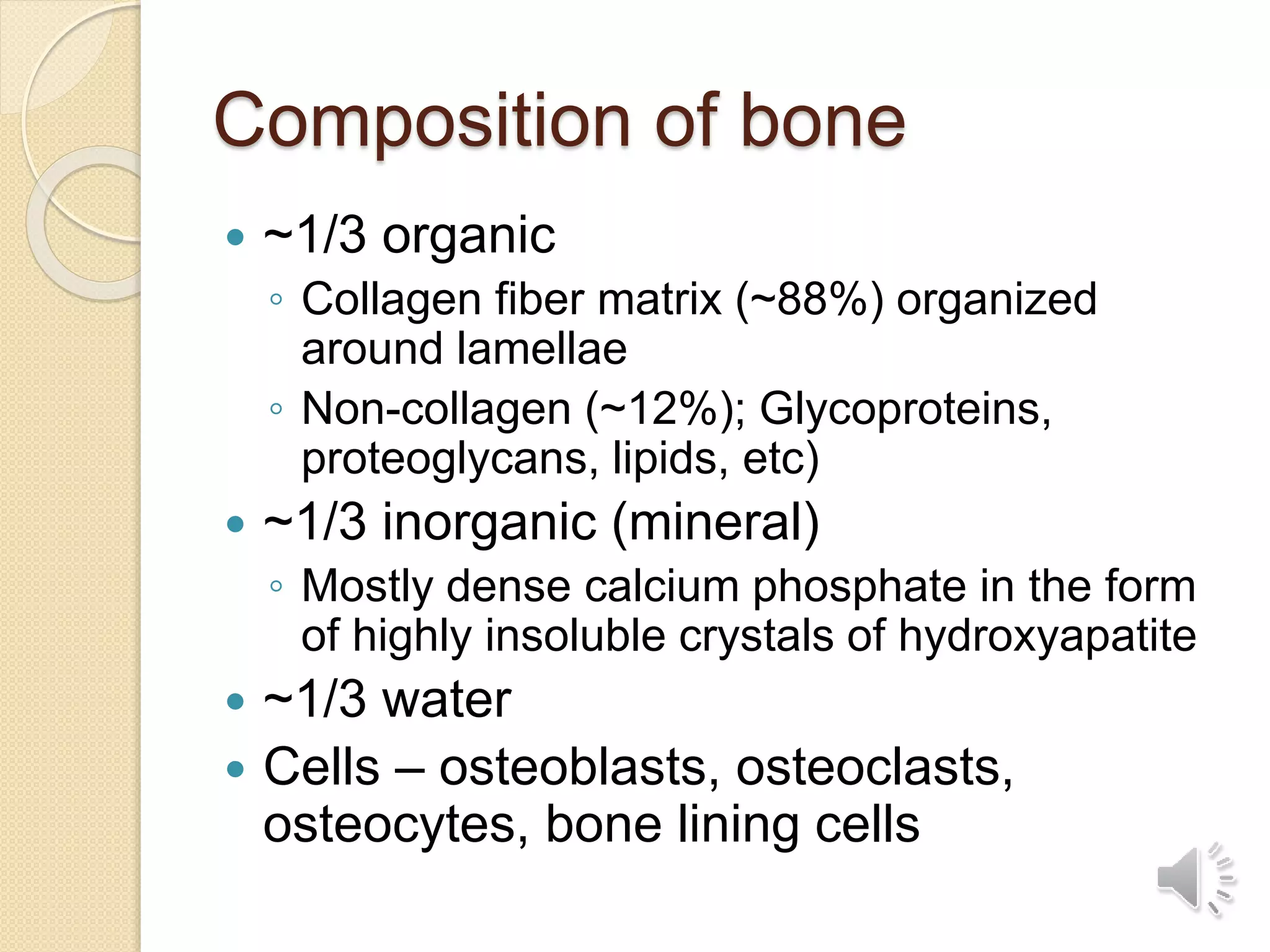
Bone cells: Osteoblasts
 Bone formers: produce organic matrix
 Found on surfaces where bone is formed
 Responsible for growth in thickness of long bones
 Can initiate bone resorption
 Synthesize osteoid, collagen
 Control mineralization
 Extend to adjacent osteoblasts through canaliculi
 Receptors – estrogen, parathyroid hormone,
Vitamin D, growth factors
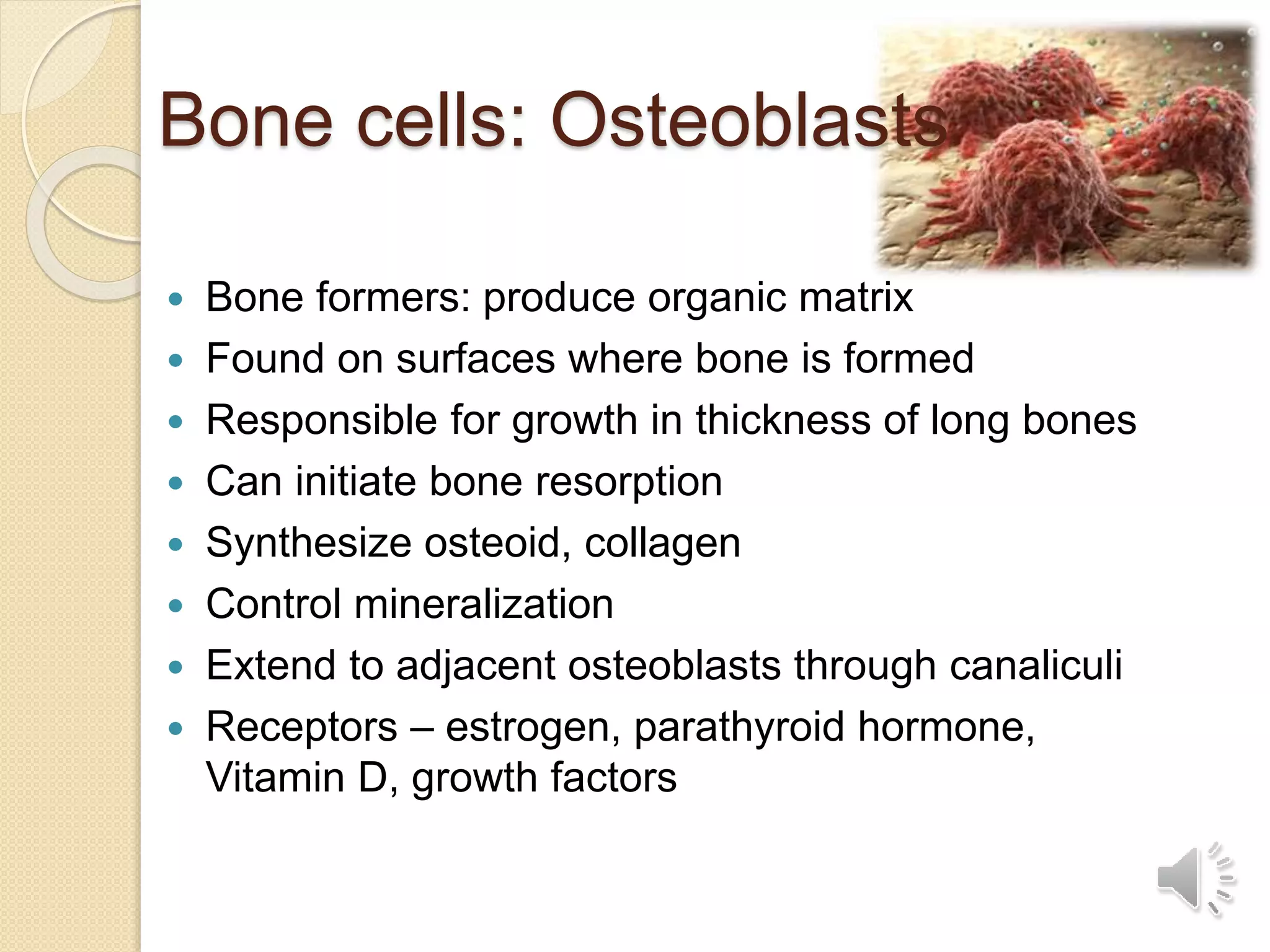
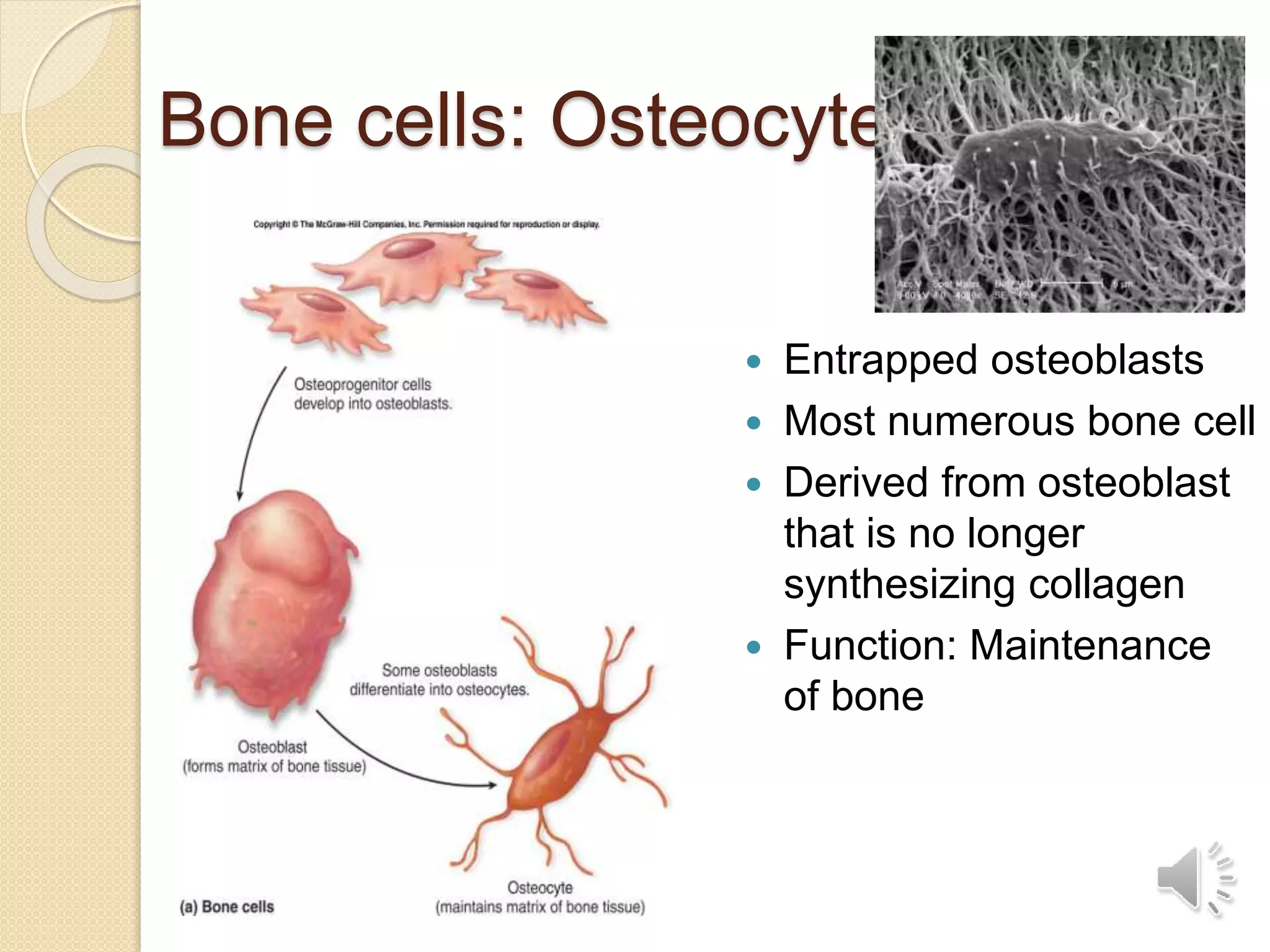
Bone cells: Osteocytes
 Entrapped osteoblasts
 Most numerous bone cell
 Derived from osteoblast
that is no longer
synthesizing collagen
 Function: Maintenance
of bone
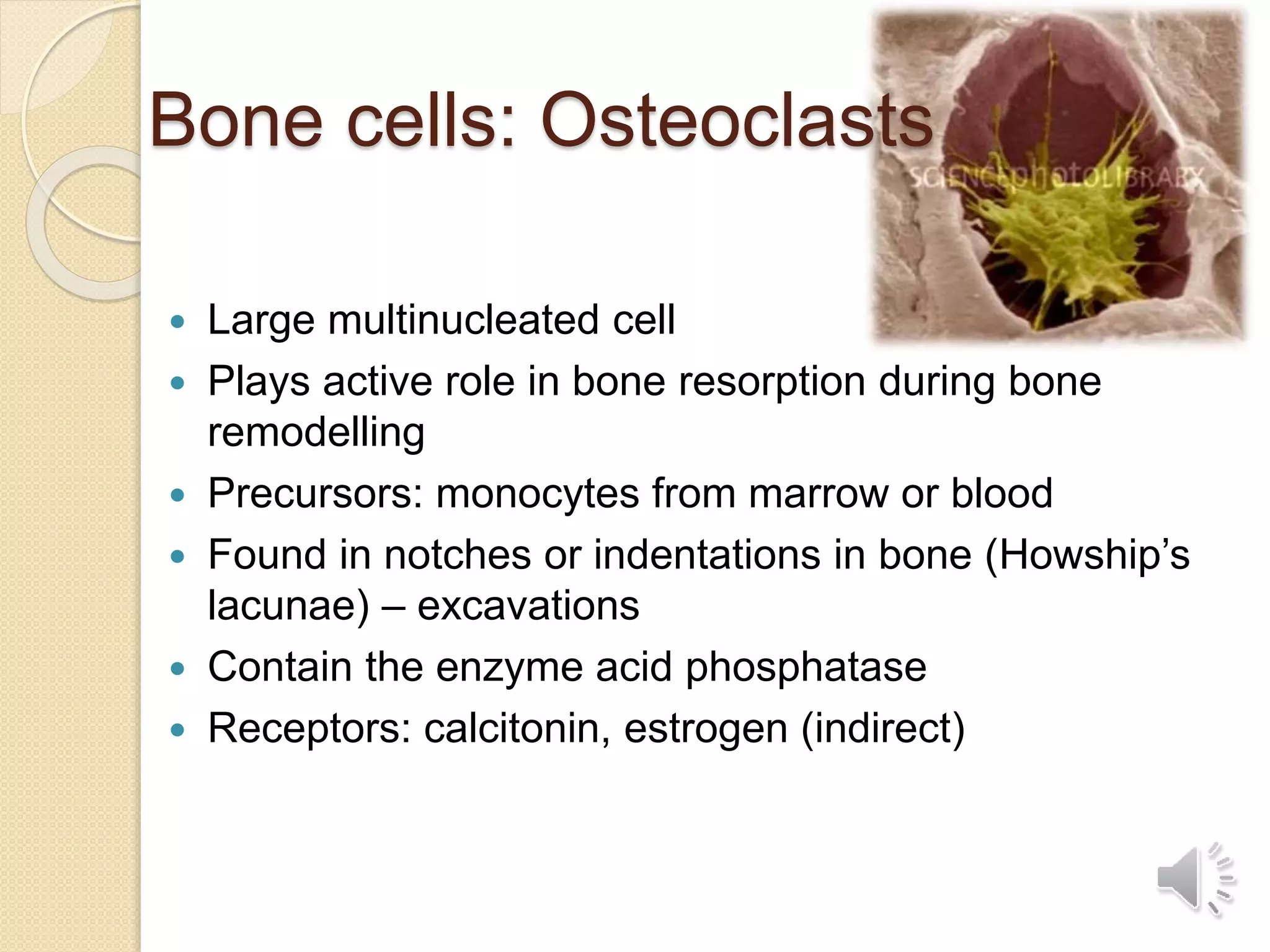
Bone cells: Osteoclasts
 Large multinucleated cell
 Plays active role in bone resorption during bone
remodelling
 Precursors: monocytes from marrow or blood
 Found in notches or indentations in bone (Howship’s
lacunae) – excavations
 Contain the enzyme acid phosphatase
 Receptors: calcitonin, estrogen (indirect)
Bone Lining Cells
 Cover inactive (nonremodeling) bone
surfaces
 Connect to other cells through
canaliculi
 May play important roles in
◦ Hematopoiesis
◦ Mechanotransduction – propagating
signals initiating bone resorption and
remodeling
◦ Maintenance of bone fluids and
movement of ions for mineral
Relationships between structure
and function
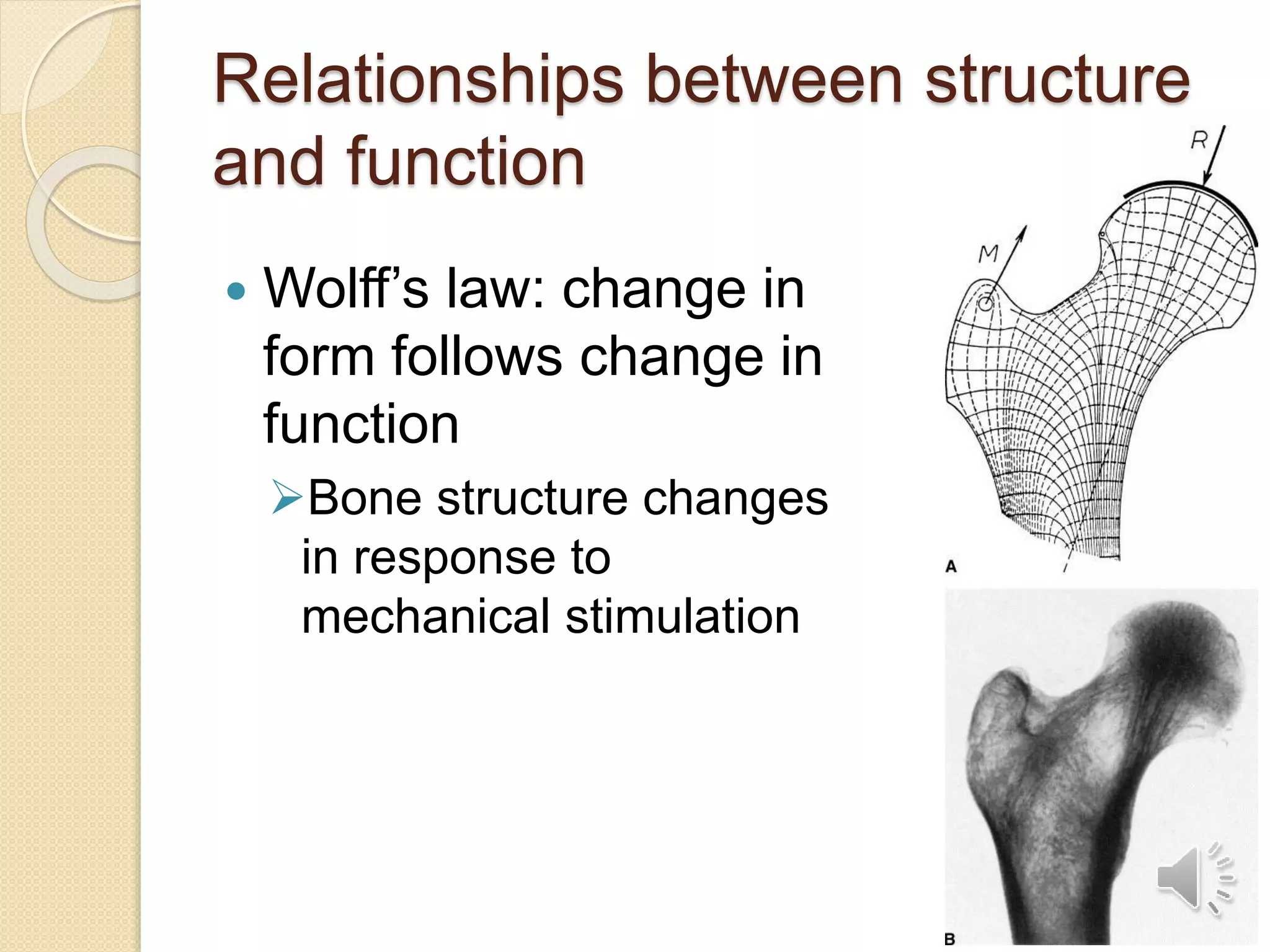
 Wolff’s law: change in
form follows change in
function
Bone structure changes
in response to
mechanical stimulation
Relationships between structure
and function
 Mechanotransduction:
◦ Mechanical signals  Biochemical
signals
◦ Response: cell activity
 Bone formation/resorption depends on
duration, magnitude and rate of
loading
 Cyclic loading induces bone formation
 Unloading induces bone resorption

1 Bone Structure and Composition

  • 1.
    Structure and Compositionof Bone Biomechanics aims to explain the mechanics of life and living. From molecules to organisms, everything must obey the laws of mechanics. Y. C. Fung
  • 2.
    Learning Objectives  Identifyimportant structures of bone at gross, macro and micro levels.  Compare contributions of different components of bone (such as cells) to its functions  Describe the effects of structure of bone on its functions (Wolff’s Law)
  • 3.
    Bone – aquick overview  Composite of extracellular matrix proteins ◦ Mineralizes through elegant feedback and regulation mechanisms  Cellular components ◦ Maintain structural integrity ◦ Respond to metabolic and mechanical requirements  Functions ◦ Protects organs ◦ Supports ◦ Allows movement through attachment for muscles ◦ Manufactures blood cells (bone marrow) ◦ Stores Ca2+ and PO4 3-
  • 4.
    Bones can beclassified on the macro level several ways, such as by position...  Axial skeleton – Bone forming axis of body, e.g skull, rib, sternum and vertebrae  Appendicular skeleton – bones forming appendages of body, e.g. limbs, shoulder and hip.
  • 5.
     Long Bones- longer than they are wide (e.g humerus)  Short bones - cube shaped, e.g. bones in wrist and ankle  Flat bones - Thin, flattened and a bit curved (e.g sternum and most skull bones)  Irregular bones - Complicated shapes (e.g vertebrae, maxilla and mandible) … or by shape…
  • 6.
    …or by structure. Compact (cortical) bone  Spongy (cancellous, trabecular) bone
  • 7.
    Structure of longbones  Diaphysis  Epiphysis  Metaphysis  Articular cartilage  Periosteum  Medullary canal (marrow cavity)  Endosteum
  • 8.
    Structure of short,irregular and flat bones  Thin plates of periosteum-covered compact bone on the outside  Endosteum-covered spongy bone on the inside  No diaphysis or epiphysis  Bone marrow between trabeculae
  • 9.
    Microstructure of adultbone: Lamellar bone  Adult bone made up of layers (lamellae) ◦ Bundles of collagen in parallel surrounded by mineralized matrix  Between layers are lacunae (spaces)  Lacunae contain osteocytes (bone cells)  Canaliculi (fine canals) spread from lacunae
  • 11.
  • 12.
  • 13.
    Composition of bone ~1/3 organic ◦ Collagen fiber matrix (~88%) organized around lamellae ◦ Non-collagen (~12%); Glycoproteins, proteoglycans, lipids, etc)  ~1/3 inorganic (mineral) ◦ Mostly dense calcium phosphate in the form of highly insoluble crystals of hydroxyapatite  ~1/3 water  Cells – osteoblasts, osteoclasts, osteocytes, bone lining cells
  • 14.
    Bone cells: Osteoblasts Bone formers: produce organic matrix  Found on surfaces where bone is formed  Responsible for growth in thickness of long bones  Can initiate bone resorption  Synthesize osteoid, collagen  Control mineralization  Extend to adjacent osteoblasts through canaliculi  Receptors – estrogen, parathyroid hormone, Vitamin D, growth factors
  • 15.
    Bone cells: Osteocytes Entrapped osteoblasts  Most numerous bone cell  Derived from osteoblast that is no longer synthesizing collagen  Function: Maintenance of bone
  • 16.
    Bone cells: Osteoclasts Large multinucleated cell  Plays active role in bone resorption during bone remodelling  Precursors: monocytes from marrow or blood  Found in notches or indentations in bone (Howship’s lacunae) – excavations  Contain the enzyme acid phosphatase  Receptors: calcitonin, estrogen (indirect)
  • 17.
    Bone Lining Cells Cover inactive (nonremodeling) bone surfaces  Connect to other cells through canaliculi  May play important roles in ◦ Hematopoiesis ◦ Mechanotransduction – propagating signals initiating bone resorption and remodeling ◦ Maintenance of bone fluids and movement of ions for mineral
  • 18.
    Relationships between structure andfunction  Wolff’s law: change in form follows change in function Bone structure changes in response to mechanical stimulation
  • 19.
    Relationships between structure andfunction  Mechanotransduction: ◦ Mechanical signals  Biochemical signals ◦ Response: cell activity  Bone formation/resorption depends on duration, magnitude and rate of loading  Cyclic loading induces bone formation  Unloading induces bone resorption

Editor's Notes

  • #6 Long bones: Long shaft with two bulky ends or extremities; Primarily compact bone but may have spongy bone at ends or extremities Short, flat and irregular bones: Mainly spongy bone covered by a thin layer of compact bone; Short bones can be those that form within tendons (e.g. patella)
  • #7 Bones can also be classified by how they develop (from the fetal stage through bone growth into adulthood), including membranous bone (ectodermal) and cartilaginous (endochondral) bone. But that is beyond the scope of this course.
  • #11 Bone cells are never more than 100 µm from a blood supply
  • #12 Compact Bone: Lamellae arranged in concentric rings around Haversian canals containing blood, lymph and nerves Perforating (Volkmann’s) canals connect blood, lymph and nerves from periosteum with medullary canal and Haversian canals Osteon (Haversian system) = one Haversian canal and lamellae around it; typically about 200 microns, so no point is more than 100 microns from the central blood supply Interstitial lamellae are like partial osteons, and are no more than 100 microns from a blood supply. Spongy Bone: No osteons Trabeculae - Lamellae arranged in latticework of thin plates of bone Spaces between trabeculae filled with red marrow which produces blood cells
  • #13 Section A: ~10 mm Section B: ~200 microns Section C: ~ 20 microns; collagen fibrils are ~200 nm
  • #16 Osteocytes synthesize collagen, control mineralization within lacunae, may be involved with resorption They maintain calcium exchange between bone and extracellular fluid