MUSADIQ KHAN
DURRANI 1
MUSADIQ KHAN Durrani
UCMD
University of Lahore
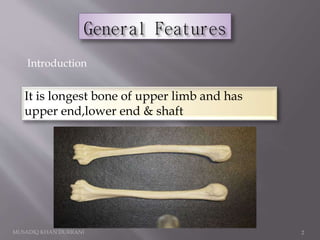
It is longest bone of upper limb and has
upper end,lower end & shaft
Introduction
MUSADIQ KHAN DURRANI 2
MUSADIQ KHAN
DURRANI 3
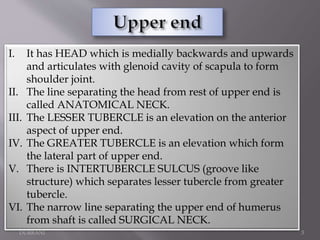
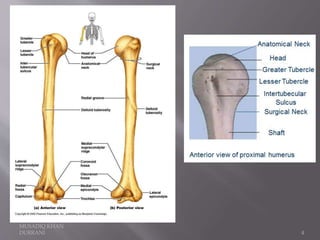
I. It has HEAD which is medially backwards and upwards
and articulates with glenoid cavity of scapula to form
shoulder joint.
II. The line separating the head from rest of upper end is
called ANATOMICAL NECK.
III. The LESSER TUBERCLE is an elevation on the anterior
aspect of upper end.
IV. The GREATER TUBERCLE is an elevation which form
the lateral part of upper end.
V. There is INTERTUBERCLE SULCUS (groove like
structure) which separates lesser tubercle from greater
tubercle.
VI. The narrow line separating the upper end of humerus
from shaft is called SURGICAL NECK.
MUSADIQ KHAN
DURRANI 4
MUSADIQ KHAN
DURRANI 5
Bony Features
Articular Part:
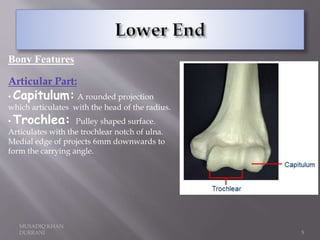
• Capitulum: A rounded projection
which articulates with the head of the radius.
• Trochlea: Pulley shaped surface.
Articulates with the trochlear notch of ulna.
Medial edge of projects 6mm downwards to
form the carrying angle.
MUSADIQ KHAN
DURRANI 6
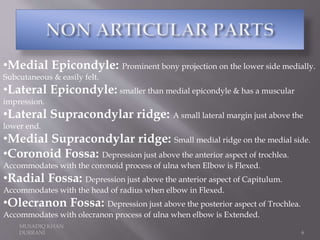
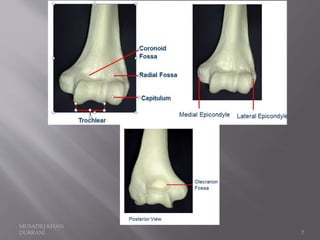
•Medial Epicondyle: Prominent bony projection on the lower side medially.
Subcutaneous & easily felt.
•Lateral Epicondyle: smaller than medial epicondyle & has a muscular
impression.
•Lateral Supracondylar ridge: A small lateral margin just above the
lower end.
•Medial Supracondylar ridge: Small medial ridge on the medial side.
•Coronoid Fossa: Depression just above the anterior aspect of trochlea.
Accommodates with the coronoid process of ulna when Elbow is Flexed.
•Radial Fossa: Depression just above the anterior aspect of Capitulum.
Accommodates with the head of radius when elbow in Flexed.
•Olecranon Fossa: Depression just above the posterior aspect of Trochlea.
Accommodates with olecranon process of ulna when elbow is Extended.
MUSADIQ KHAN
DURRANI 7
MUSADIQ KHAN
DURRANI 8
•Rounded in the upper half & triangular in
the lower half. Contains three borders &
three surfaces.
Borders:
o Anterior Border: Upper one third forms the Lateral lip of the
intertubercular sulcus. Middle part forms the anterior region of Deltoid
tuberosity. Lower half is smooth & rounded.
o Lateral Border: Prominent only in the lower region where it forms
lateral supracondylar ridge. In the middle it is interrupted by Radial groove.
o Medial Border: Forms the medial lip of the intertubercular sulcus.
Rough through its middle & continuous below with the medial
supracondylar ridge.
MUSADIQ KHAN
DURRANI 9
Surfaces:
o Anterolateral Surface(b/w anterior &
lateral borders): Upper half is covered by the
deltoid. A little above it is marked by a V shaped
deltoid tuberosity. Radial groove runs downwards &
forwards across the surface.
o Anteromedial Surface(b/w anterior &
medial border): Upper end is narrow & forms
floor of the intertubercular sulcus. Nutrient foramen is
seen near the medial border.
o Posterior Surface(b/w medial & lateral
borders): Upper part is marked by an oblique ridge
& lower end is crossed by a radial groove.
MUSADIQ KHAN
DURRANI 10
•Upper end: Rounded.
• Lower end: Expanded from side to side & flattened
from before backwards.
• Head: Directed posterior & medially upwards.
• Lesser Tubercle: Projects from the front of the
upper end & is limited laterally by the
intertubercular sulcus.
MUSADIQ KHAN
DURRANI 11
MUSADIQ KHAN
DURRANI 12
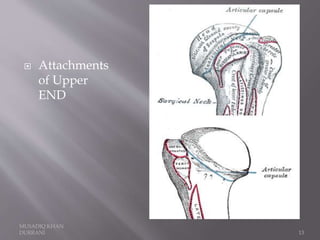
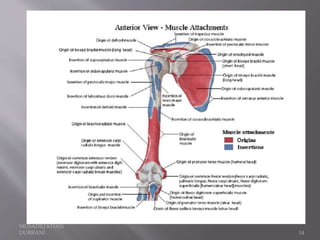
MUSCLE ATTACHMENTS
Lesser Tubercle: Insertion of The Multipennate SUBSCAPULARIS.
Greater Tubercle(uppermost impression): Insertion of the
SUPRASPINATUS.
Greater Tubercle(middle impression): Insertion of the
INFRASPINATUS.
Greater Tubercle(lower impression): Insertion of TERES MINOR.
 Intertubercular Sulcus(lateral lip): Insertion of PECTORALIS MAJOR.
 Intertubercular Sulcus(floor): Insertion of LATISSMUS DORSI.
 Intertubercular Sulcus(medial lip): Insertion of TERES MAJOR.
Deltoid Tuberosity: Insertion of DELTOID.
 Medial Border(rough area): Insertion of
CHORACOBRACHIALLIS.
 Shaft: BRACHIALIS arises from the lower halves of the anteromedial &
anterolateral surfaces of the shaft.
 Attachments
of Upper
END
MUSADIQ KHAN
DURRANI 13
MUSADIQ KHAN
DURRANI 14
MUSADIQ KHAN
DURRANI 15
MUSADIQ KHAN
DURRANI 16
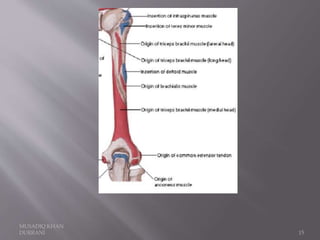
Lower end:
 Lateral Supracondylar Ridge:
BRACHIORADIALUS arises from the upper two thirds.
EXTENSOR CARPI RADIALIS LONGUS arises from the lower
one third.
 Medial Supracondylar Ridge: Humeral head of PRONATOR
TERES arises from lower one third.
 Lateral Epicondyle: ANCONEUS arises from the posterior
surface of lateral epicondyle.
 Radial Groove: Lateral head of TRICEPS BRACHII arises from
the oblique ridge on the upper part of posterior surface above the
radial groove, while its Medial head arises from the posterior
surface below radial groove.
 Medial Epicondyle(anterior aspect): Superficial FLEXOR
muscles arises from the common origin of the anterior aspect.
 Lateral Epicondyle: Superficial EXTENSOR muscles have a
common origin from the lateral epicondyle.
MUSADIQ KHAN
DURRANI 17
 CAPSULAR LIGAMENT of shoulder joint
is attached to the anatomical neck except on the medial side
where the line of attachment is down by 2cm to include a
small area of shaft. TENDON Of the LONG
HEAD OF BICEPS BRACHII leaves the joint
cavity through the aperture provided by Intertubercular
sulcus.
 CAPSULAR LIGAMENT of the Elbow
joint is attached to the lower end along the line & reaches
the upper limits of coronoid fossae & radial fossa anteriorly
& of then olecranon fossa posterioirly.
MUSADIQ KHAN
DURRANI 18
Nerves
• Three Nerves are directly related to
the Humerus.
• AXILLARY Nerve at the Surgical neck.
• RADIAL Nerve at the Radial groove.
• ULNAR Nerve behind the medial
epicondyle.
MUSADIQ KHAN
DURRANI 19
THANKS

Humerus Bone and attachments

  • 1.
    MUSADIQ KHAN DURRANI 1 MUSADIQKHAN Durrani UCMD University of Lahore
  • 2.
    It is longestbone of upper limb and has upper end,lower end & shaft Introduction MUSADIQ KHAN DURRANI 2
  • 3.
    MUSADIQ KHAN DURRANI 3 I.It has HEAD which is medially backwards and upwards and articulates with glenoid cavity of scapula to form shoulder joint. II. The line separating the head from rest of upper end is called ANATOMICAL NECK. III. The LESSER TUBERCLE is an elevation on the anterior aspect of upper end. IV. The GREATER TUBERCLE is an elevation which form the lateral part of upper end. V. There is INTERTUBERCLE SULCUS (groove like structure) which separates lesser tubercle from greater tubercle. VI. The narrow line separating the upper end of humerus from shaft is called SURGICAL NECK.
  • 4.
  • 5.
    MUSADIQ KHAN DURRANI 5 BonyFeatures Articular Part: • Capitulum: A rounded projection which articulates with the head of the radius. • Trochlea: Pulley shaped surface. Articulates with the trochlear notch of ulna. Medial edge of projects 6mm downwards to form the carrying angle.
  • 6.
    MUSADIQ KHAN DURRANI 6 •MedialEpicondyle: Prominent bony projection on the lower side medially. Subcutaneous & easily felt. •Lateral Epicondyle: smaller than medial epicondyle & has a muscular impression. •Lateral Supracondylar ridge: A small lateral margin just above the lower end. •Medial Supracondylar ridge: Small medial ridge on the medial side. •Coronoid Fossa: Depression just above the anterior aspect of trochlea. Accommodates with the coronoid process of ulna when Elbow is Flexed. •Radial Fossa: Depression just above the anterior aspect of Capitulum. Accommodates with the head of radius when elbow in Flexed. •Olecranon Fossa: Depression just above the posterior aspect of Trochlea. Accommodates with olecranon process of ulna when elbow is Extended.
  • 7.
  • 8.
    MUSADIQ KHAN DURRANI 8 •Roundedin the upper half & triangular in the lower half. Contains three borders & three surfaces. Borders: o Anterior Border: Upper one third forms the Lateral lip of the intertubercular sulcus. Middle part forms the anterior region of Deltoid tuberosity. Lower half is smooth & rounded. o Lateral Border: Prominent only in the lower region where it forms lateral supracondylar ridge. In the middle it is interrupted by Radial groove. o Medial Border: Forms the medial lip of the intertubercular sulcus. Rough through its middle & continuous below with the medial supracondylar ridge.
  • 9.
    MUSADIQ KHAN DURRANI 9 Surfaces: oAnterolateral Surface(b/w anterior & lateral borders): Upper half is covered by the deltoid. A little above it is marked by a V shaped deltoid tuberosity. Radial groove runs downwards & forwards across the surface. o Anteromedial Surface(b/w anterior & medial border): Upper end is narrow & forms floor of the intertubercular sulcus. Nutrient foramen is seen near the medial border. o Posterior Surface(b/w medial & lateral borders): Upper part is marked by an oblique ridge & lower end is crossed by a radial groove.
  • 10.
    MUSADIQ KHAN DURRANI 10 •Upperend: Rounded. • Lower end: Expanded from side to side & flattened from before backwards. • Head: Directed posterior & medially upwards. • Lesser Tubercle: Projects from the front of the upper end & is limited laterally by the intertubercular sulcus.
  • 11.
  • 12.
    MUSADIQ KHAN DURRANI 12 MUSCLEATTACHMENTS Lesser Tubercle: Insertion of The Multipennate SUBSCAPULARIS. Greater Tubercle(uppermost impression): Insertion of the SUPRASPINATUS. Greater Tubercle(middle impression): Insertion of the INFRASPINATUS. Greater Tubercle(lower impression): Insertion of TERES MINOR.  Intertubercular Sulcus(lateral lip): Insertion of PECTORALIS MAJOR.  Intertubercular Sulcus(floor): Insertion of LATISSMUS DORSI.  Intertubercular Sulcus(medial lip): Insertion of TERES MAJOR. Deltoid Tuberosity: Insertion of DELTOID.  Medial Border(rough area): Insertion of CHORACOBRACHIALLIS.  Shaft: BRACHIALIS arises from the lower halves of the anteromedial & anterolateral surfaces of the shaft.
  • 13.
  • 14.
  • 15.
  • 16.
    MUSADIQ KHAN DURRANI 16 Lowerend:  Lateral Supracondylar Ridge: BRACHIORADIALUS arises from the upper two thirds. EXTENSOR CARPI RADIALIS LONGUS arises from the lower one third.  Medial Supracondylar Ridge: Humeral head of PRONATOR TERES arises from lower one third.  Lateral Epicondyle: ANCONEUS arises from the posterior surface of lateral epicondyle.  Radial Groove: Lateral head of TRICEPS BRACHII arises from the oblique ridge on the upper part of posterior surface above the radial groove, while its Medial head arises from the posterior surface below radial groove.  Medial Epicondyle(anterior aspect): Superficial FLEXOR muscles arises from the common origin of the anterior aspect.  Lateral Epicondyle: Superficial EXTENSOR muscles have a common origin from the lateral epicondyle.
  • 17.
    MUSADIQ KHAN DURRANI 17 CAPSULAR LIGAMENT of shoulder joint is attached to the anatomical neck except on the medial side where the line of attachment is down by 2cm to include a small area of shaft. TENDON Of the LONG HEAD OF BICEPS BRACHII leaves the joint cavity through the aperture provided by Intertubercular sulcus.  CAPSULAR LIGAMENT of the Elbow joint is attached to the lower end along the line & reaches the upper limits of coronoid fossae & radial fossa anteriorly & of then olecranon fossa posterioirly.
  • 18.
    MUSADIQ KHAN DURRANI 18 Nerves •Three Nerves are directly related to the Humerus. • AXILLARY Nerve at the Surgical neck. • RADIAL Nerve at the Radial groove. • ULNAR Nerve behind the medial epicondyle.
  • 19.