EXCHANGE AND TRANSPORT
BLOOD AND TISSUE FLUID
We are learning to…
Explain how materials are exchanged between cells and the blood
You will be able to…
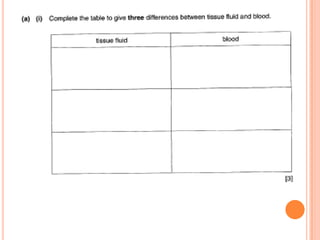
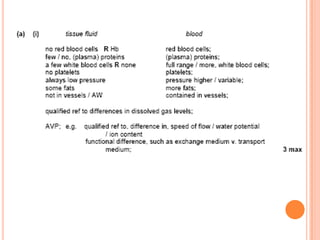
Explain the differences between blood, tissue fluid and lymph
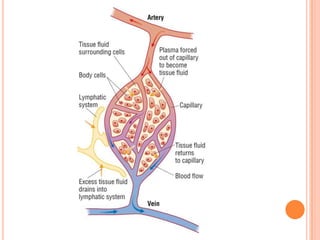
Describe how tissue fluid is formed from plasma
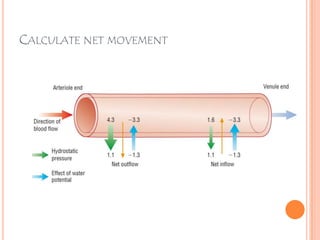
CALCULATE NET MOVEMENT
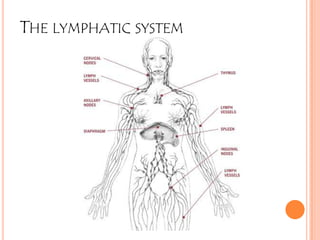
THE LYMPHATIC SYSTEM
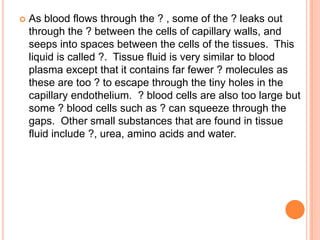
 As blood flows through the ? , some of the ? leaks out
through the ? between the cells of capillary walls, and
seeps into spaces between the cells of the tissues. This
liquid is called ?. Tissue fluid is very similar to blood
plasma except that it contains far fewer ? molecules as
these are too ? to escape through the tiny holes in the
capillary endothelium. ? blood cells are also too large but
some ? blood cells such as ? can squeeze through the
gaps. Other small substances that are found in tissue
fluid include ?, urea, amino acids and water.
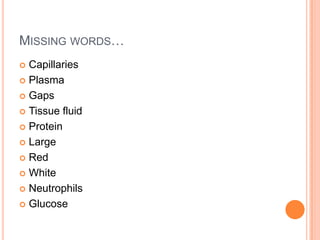
MISSING WORDS…
 Capillaries
 Plasma
 Gaps
 Tissue fluid
 Protein
 Large
 Red
 White
 Neutrophils
 Glucose
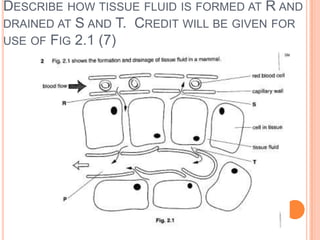
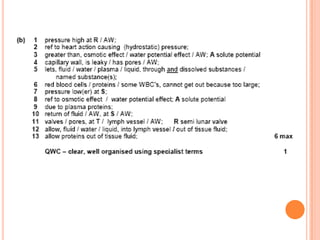
DESCRIBE HOW TISSUE FLUID IS FORMED AT R AND
DRAINED AT S AND T. CREDIT WILL BE GIVEN FOR
USE OF FIG 2.1 (7)
Formation of tissue fluid

Formation of tissue fluid

  • 1.
    EXCHANGE AND TRANSPORT BLOODAND TISSUE FLUID We are learning to… Explain how materials are exchanged between cells and the blood You will be able to… Explain the differences between blood, tissue fluid and lymph Describe how tissue fluid is formed from plasma
  • 3.
  • 4.
  • 5.
     As bloodflows through the ? , some of the ? leaks out through the ? between the cells of capillary walls, and seeps into spaces between the cells of the tissues. This liquid is called ?. Tissue fluid is very similar to blood plasma except that it contains far fewer ? molecules as these are too ? to escape through the tiny holes in the capillary endothelium. ? blood cells are also too large but some ? blood cells such as ? can squeeze through the gaps. Other small substances that are found in tissue fluid include ?, urea, amino acids and water.
  • 6.
    MISSING WORDS…  Capillaries Plasma  Gaps  Tissue fluid  Protein  Large  Red  White  Neutrophils  Glucose
  • 9.
    DESCRIBE HOW TISSUEFLUID IS FORMED AT R AND DRAINED AT S AND T. CREDIT WILL BE GIVEN FOR USE OF FIG 2.1 (7)