Unit 4: The Skeleton System
Section 3: Bone Formation & Growth
Anatomy & Physiology
Mrs. DeFord
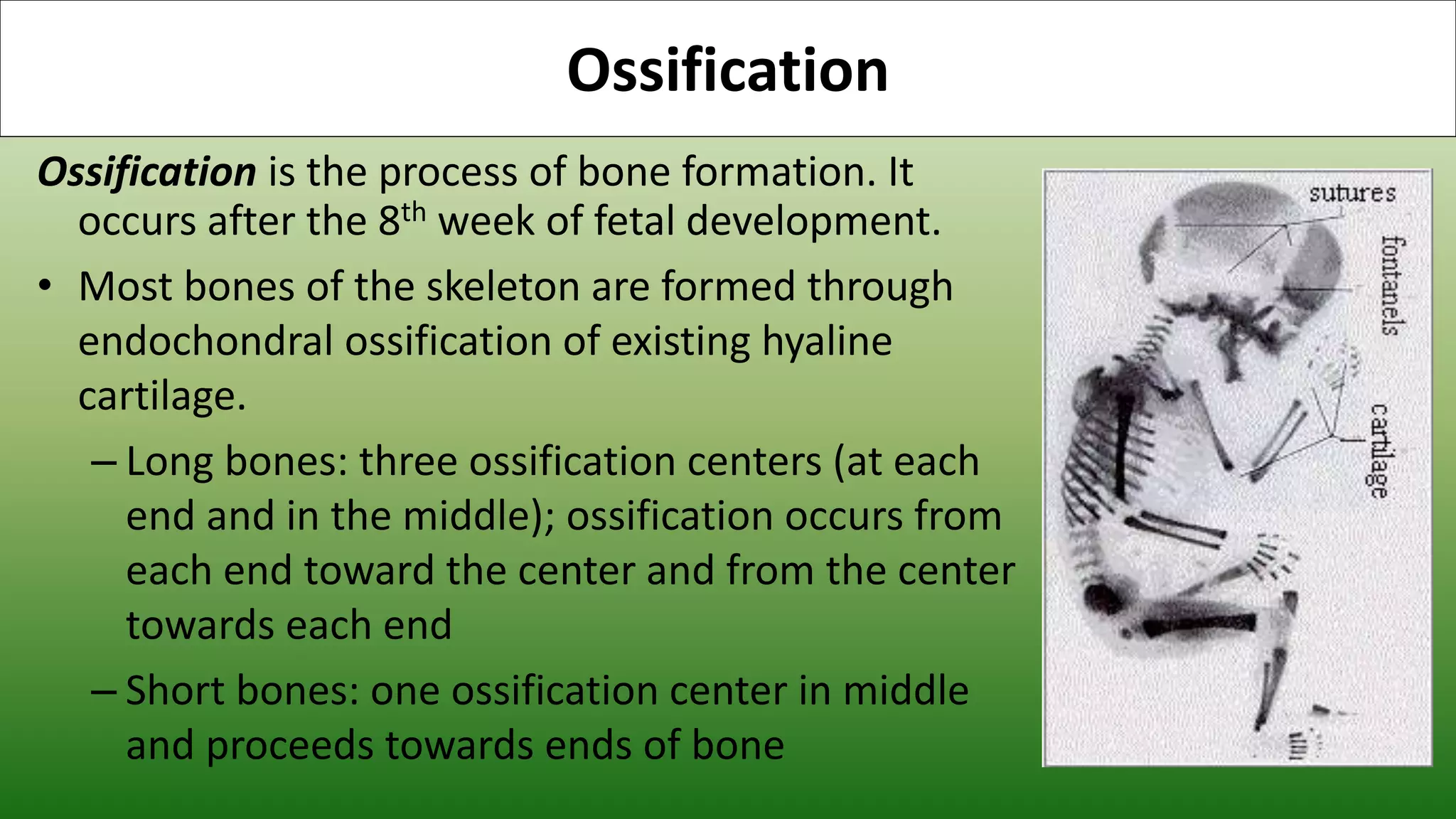
Ossification is the process of bone formation. It
occurs after the 8th week of fetal development.
• Most bones of the skeleton are formed through
endochondral ossification of existing hyaline
cartilage.
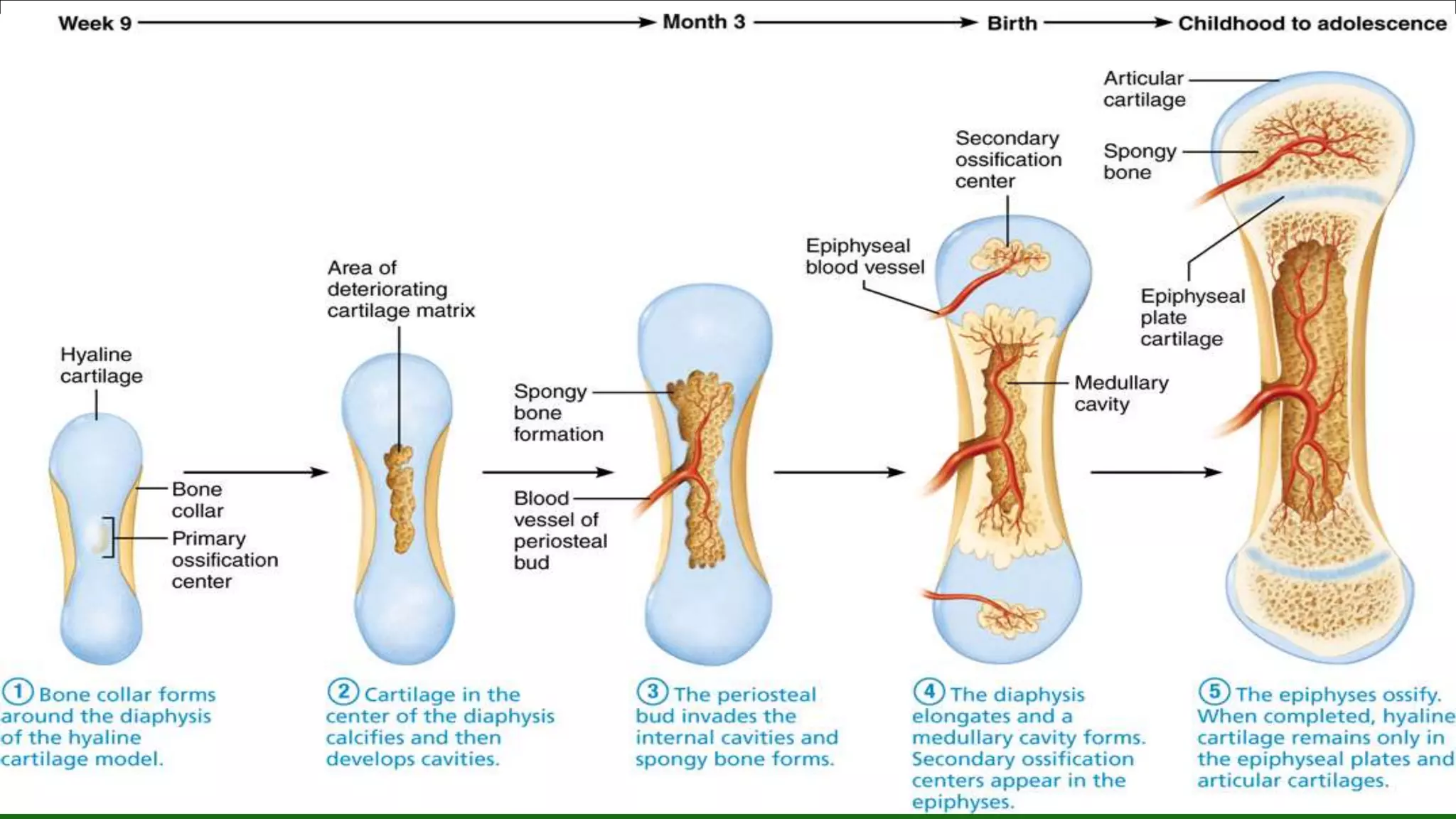
– Long bones: three ossification centers (at each
end and in the middle); ossification occurs from
each end toward the center and from the center
towards each end
– Short bones: one ossification center in middle
and proceeds towards ends of bone
Ossification
Long Bone Development
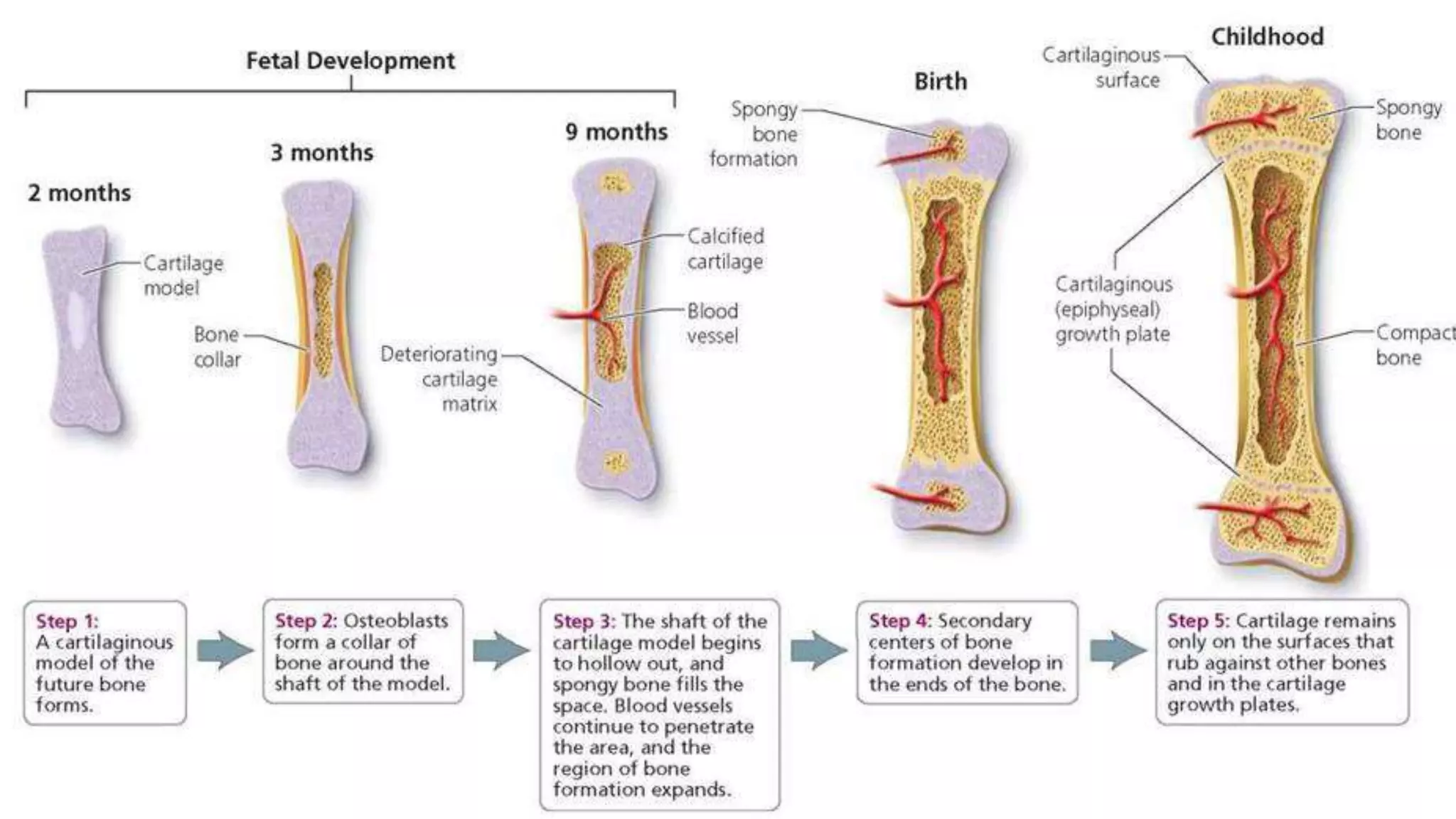
Two growth processes are responsible for long bone development.
First Process:
• OSTEOBLASTS (bone builders) – add bone to the outside surface,
enlarging and elongating the bone.
• OSTEOCLASTS (bone eaters) – tunnel out the marrow cavity and internal
spaces (these work at the same time as osteoblasts.)
Second Process (greatest growth):
• EPIPHYSEAL PLATES (growth plates) are found at either end of the bone
where the shaft (diaphysis) meets the head or base (epiphysis). These
growth plates are made of cartilage cells which multiply rapidly and the
outside cells ossify, increasing the length of the shaft.
Bone Growth of the Long Bone
Short Bone Growth
Human Body Bone Growth Pattern
• The human body changes length in the following pattern:
– Feet and hands develop first (increase in size)
– Lower legs and forearms grow rapidly
– Thighs and upper arms increase in length
– Finally, the trunk develops in length
• The width of the body develops next, as the shoulders and pelvis widen
• Minerals:
– Calcium and Phosphate (increases bone density)
• Vitamins:
– Vitamin D3 (promotes bone resorption)
– Vitamin C (required for collagen synthesis and stimulation of osteoblast
differentiation)
– Vitamin A (stimulates osteoblast activity)
• Hormones:
– Growth Hormone (stimulate bone growth)
– Sex Hormones (stimulate osteoblasts, responsible for gender differences in
skeleton)
– Thyroid Hormones (stimulates replacement of cartilage by bone)
Requirements for Normal Bone Growth
• Basic control of growth is genetic.
• Bones change in shape throughout life. This remodelling occurs in
response to:
– Hormones (mentioned previously)
– Mechanical stresses acting on the skeleton:
• Starvation and malnutrition can delay growth spurt.
• Major illness slow down growth.
• Regular exercise has many growth benefits.
• Aerobic exercise also increases the size and efficiency of the heart,
blood and lungs. However, repetitive long distance training for
marathons or triathlons may damage epiphyseal plates.
Factors Affecting Growth

APU4.3 Skeleton System (Bone Formation & Growth)

  • 1.
    Unit 4: TheSkeleton System Section 3: Bone Formation & Growth Anatomy & Physiology Mrs. DeFord
  • 2.
    Ossification is theprocess of bone formation. It occurs after the 8th week of fetal development. • Most bones of the skeleton are formed through endochondral ossification of existing hyaline cartilage. – Long bones: three ossification centers (at each end and in the middle); ossification occurs from each end toward the center and from the center towards each end – Short bones: one ossification center in middle and proceeds towards ends of bone Ossification
  • 3.
  • 4.
    Two growth processesare responsible for long bone development. First Process: • OSTEOBLASTS (bone builders) – add bone to the outside surface, enlarging and elongating the bone. • OSTEOCLASTS (bone eaters) – tunnel out the marrow cavity and internal spaces (these work at the same time as osteoblasts.) Second Process (greatest growth): • EPIPHYSEAL PLATES (growth plates) are found at either end of the bone where the shaft (diaphysis) meets the head or base (epiphysis). These growth plates are made of cartilage cells which multiply rapidly and the outside cells ossify, increasing the length of the shaft. Bone Growth of the Long Bone
  • 5.
  • 6.
    Human Body BoneGrowth Pattern • The human body changes length in the following pattern: – Feet and hands develop first (increase in size) – Lower legs and forearms grow rapidly – Thighs and upper arms increase in length – Finally, the trunk develops in length • The width of the body develops next, as the shoulders and pelvis widen
  • 7.
    • Minerals: – Calciumand Phosphate (increases bone density) • Vitamins: – Vitamin D3 (promotes bone resorption) – Vitamin C (required for collagen synthesis and stimulation of osteoblast differentiation) – Vitamin A (stimulates osteoblast activity) • Hormones: – Growth Hormone (stimulate bone growth) – Sex Hormones (stimulate osteoblasts, responsible for gender differences in skeleton) – Thyroid Hormones (stimulates replacement of cartilage by bone) Requirements for Normal Bone Growth
  • 8.
    • Basic controlof growth is genetic. • Bones change in shape throughout life. This remodelling occurs in response to: – Hormones (mentioned previously) – Mechanical stresses acting on the skeleton: • Starvation and malnutrition can delay growth spurt. • Major illness slow down growth. • Regular exercise has many growth benefits. • Aerobic exercise also increases the size and efficiency of the heart, blood and lungs. However, repetitive long distance training for marathons or triathlons may damage epiphyseal plates. Factors Affecting Growth

Editor's Notes

  • #2 The skeleton is formed from two of the strongest and most supportive tissues in the body – cartilage and bone. You'd be floppy like a beanbag. Could you stand up? Forget it. Could you walk? No way. Without bones you'd be just a puddle of skin and guts on the floor.
  • #3 At birth, most of the skeletal system is composed of cartilage, which over time is replaced by bone. By the early twenties, most bone growth is complete, although bone is remodeled throughout life. Through the process of remodeling, osteoclasts circulate throughout the bones and look for old or damaged osteocytes to break down, which are then replaced by osteoblasts which lay down new bone tissue. This breakdown and bujildup occurs throughout the bone, but is most visible at the growth plates of the bone which form at the juction of the epiphysis (bone ends), and the diaphysis (bone shaft). This junction is called the epiphyseal plate, located towards the end of the bone shaft. Finally, some growth occurs in the periosteum, which is a thin sheaf of tissue that covers the outside of the bone surface. The periosteum also serves as an intake of nutrition and gasses. Longitudinal growth continues as long as epiphyseal plates are open. These plates disappear and close by 20 years. Growth in diameter continues throughout life!
  • #5 At birth, most of the skeletal system is composed of cartilage, which over time is replaced by bone. By the early twenties, most bone growth is complete, although bone is remodeled throughout life. Through the process of remodeling, osteoclasts circulate throughout the bones and look for old or damaged osteocytes to break down, which are then replaced by osteoblasts which lay down new bone tissue. This breakdown and bujildup occurs throughout the bone, but is most visible at the growth plates of the bone which form at the juction of the epiphysis (bone ends), and the diaphysis (bone shaft). This junction is called the epiphyseal plate, located towards the end of the bone shaft. Finally, some growth occurs in the periosteum, which is a thin sheaf of tissue that covers the outside of the bone surface. The periosteum also serves as an intake of nutrition and gasses. Longitudinal growth continues as long as epiphyseal plates are open. These plates disappear and close by 20 years. Growth in diameter continues throughout life!
  • #8 Hormones Human Growth Hormone Promotes general growth of all body tissue and normal growth in children Insulin-like Growth Factor Stimulates uptake of amino acids and protein synthesis Insulin Promotes normal bone growth and maturity Thyroid Hormones Promotes normal bone growth and maturity Estrogen and Testosterone Increases ossification at puberty and is responsible for gender differences of skeletons
  • #9 Many people mistakenly think that bones are lifeless structures that never change once long-bone growth has ended. Nothing could be further from the truth: bone is a dynamic and active tissue. Bones are remodeled continually in response to changes in two factors: (1) the calcium ion level in the blood and (2) the pull of gravity and muscles on the skeleton. Bone remodeling is essential if bones are to retain normal proportions and strength during long-bone growth as the body increases in size and weight. It also accounts for the fact that bones become thicker and form large projections to increase their strength in areas where bulky muscles attach. In contrast, the bones of bedridden or physically inactive people tend to lose mass and atrophy because they are no longer subjected to stress.