GENERAL ANATOMY
HIPPOCRATES(460-377BC)
 Greek physician
 Father of Medicine
 His name is memorialized in
the Hippocratic oath
 Humoral theory :
Four body humors –
-blood
.
-phlegum
- -yellow bile
- -black
bile
 Attributed diseases to natural
causes .
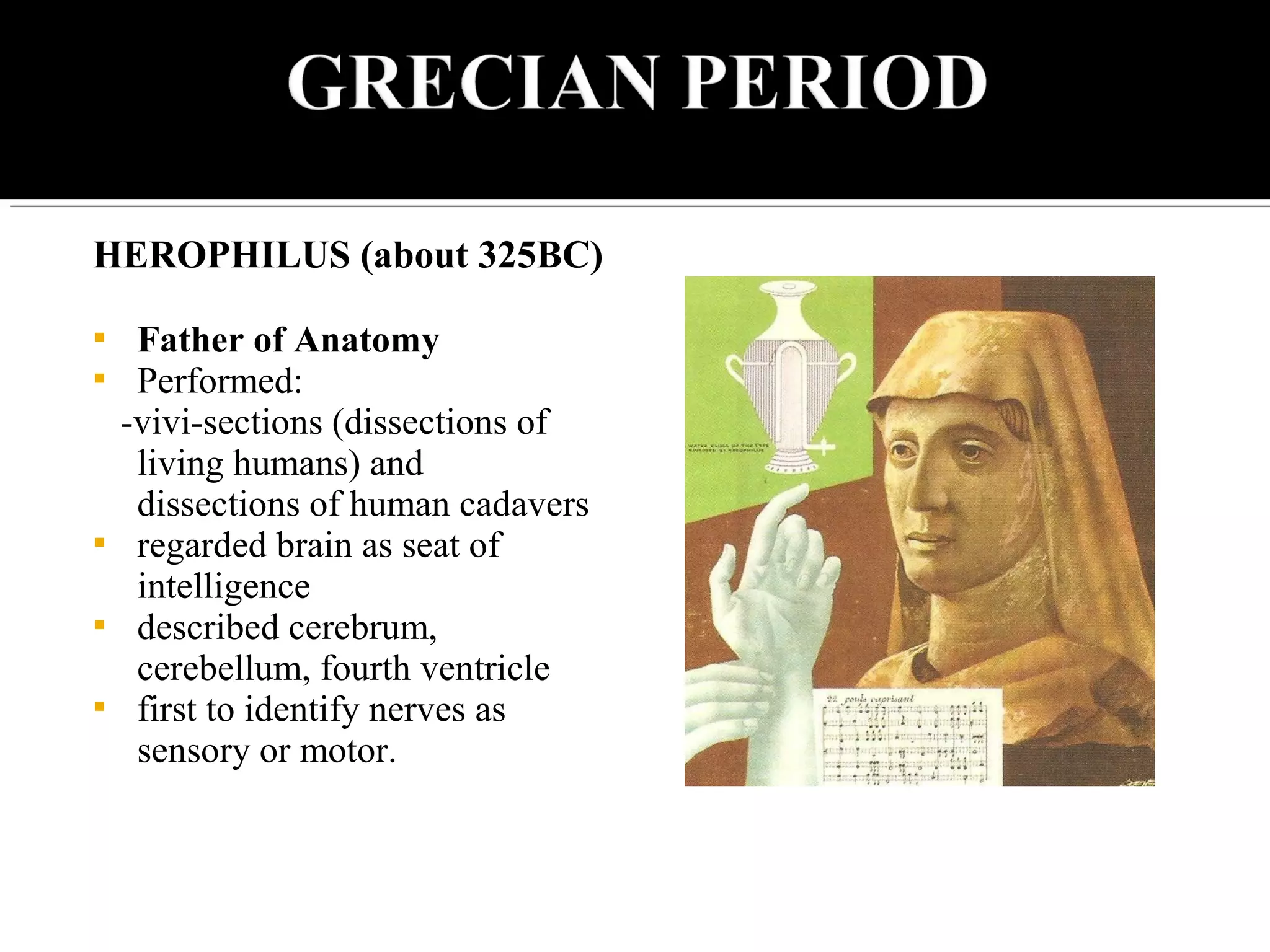
HEROPHILUS (about 325BC)
 Father of Anatomy
 Performed:
-vivi-sections (dissections of
living humans) and -
dissections of human cadavers
 regarded brain as seat of
intelligence
 described cerebrum,
cerebellum, fourth ventricle
 first to identify nerves as
sensory or motor.
VESALIUS(1514- 1654)
 His work De humani corporis
fabrica written in 7 volumes
 His work revolutionised the
teaching of anatomy and ruled
for two centuries
 Chose not to have his name
attached to the parts of body he
described unlike anatomists
Sylvius, Fallopius, Eustachius.
 Father of Modern Anatomy
 ‘Reformer of Anatomy’
GENERAL ANATOMY
Anatomy = Ana (Gr) Tome (Gr)
Apart To Cut
Dissection = Dissecare (Latin)
To cut apart
Anatomy
 Gross/ Cadaveric Anatomy
 Microscopic Anatomy (Histology)
 Developmental Anatomy (Embryology)
 Living Anatomy
 Clinical Anatomy (Applied)
 Neuroanatomy
 Surface (Topographic) Anatomy
 Radiographic Anatomy
 Comparative Anatomy
 Sectional Anatomy
 REGIONAL ANATOMY
- Head and neck
- Brain
-Thorax
- Abdomen
- Upper Limb
- Lower limb
 SYSTEMIC ANATOMY
- Integumentary system
- Skeletal system
- Muscular system
- Nervous system
- Cardiovascular system
- Lymphatic system
- Endocrine system
- Digestive system, Respiratory system, Urogenital
system
SUB – DIVISIONS OF BODY
Head and Neck
Brain
Superior Extremity
Thorax
Abdomen and Pelvis
Inferior Extremity
Anatomy
ANATOMICAL POSITION
Standing up right
Looking straight towards
horizon
Upper limbs hanging by the
side of body
Palms facing forwards
 Lower limbs are parallel
with toes pointing forwards
Anatomy
1. MID SAGITTAL
(Median Plane):
A vertical plane dividing
the body into right and
left equal halves.
2. SAGITTAL:
A vertical plane which is
parallel to the sagittal
plane.
TERMS OF PLANES
Anatomy
3. CORONAL PLANE
(Frontal Plane):
A vertical plane which is at
right angles to the median
plane dividing the body
into an anterior and a
posterior part.
4. TRANSVERSE PLANE:
A plane at right angles to
the sagittal / coronal plane
dividing the body into an
upper and lower part.
TERMS OF PLANES
Anatomy
 HORIZONTAL PLANE: A plane parrallel
to
the ground.
 OBLIQUE PLANE: Any plane other than of
aforementioned planes.
TERMS OF POSTURE
Anatomy
Supine Prone Left Lateral
Right Lateral
Lithotomy
Erect Upside Down
Anterior = Ventral
Intermediate = Middle
Posterior = Dorsal
TERMS OF POSITION
Anatomy
• Lateral
• Intermediate
• Medial
• Median
TERMS OF POSITION
Anatomy
For solid organs:
-Superficial
-Deep
For hollow organs:
-Interior
-Exterior
For indicating the side:
-Ipsilateral
-Contralateral
OTHER TERMS
Anatomy
Superior = Cephalic
Inferior = Caudal
TERMS OF POSITION
Anatomy
Proximal
Distal
Radial
Ulnar
Tibial
Fibular
Preaxial border
Postaxial border
TERMS FOR LIMBS
Anatomy
Skull - Inferior surface is called as Base
Hand - Posterior surface - Dorum of Hand
- Anterior surface - Palmar surface
TERMS OF POSITION
Anatomy
TERMS OF POSITION
Anatomy
Foot
- Superior surface -
Dorsum of Foot
- Inferior Surface -
Plantar Surface
Combination of Terms:
- Supero medial
- Infero lateral
- Postero superior
- Antero inferior
TERMS OF POSITION
Anatomy
Flexion: - Moving part is carried forwards
- Movement on the transverse
axis
Extension- Moving part is carried
backwards
- Movement on the transverse
axis.
Circumduction: Moving part forms the
base of a cone
TERMS OF MOVEMENT
Anatomy
Abduction: - Moving part is carried
away from the body/
reference line.
- Movement on antero –
posterior axis.
Adduction: - Moving part is carried
towards the body /
reference line.
-Movement on antero –
posterior axis.
TERMS OF MOVEMENT
Anatomy
Medial Rotation –
-Moving part is
rotated towards the
mid line.
- Movement on
vertical axis.
Lateral Rotation –
- Moving part is
rotated away from the
mid line.
- Movement on
vertical axis.
TERMS OF MOVEMENT
Anatomy
LEG:
Flexion – A movement on knee
joint in which leg is carried
backwards.
Extension – A movement on knee
joint in which leg is carried
forwards.
TOES:
Abduction – Toes move away from
the long axis of 2nd
toe.
Adduction – Toes move towards
long axis of the 2nd
toe.
SPECIAL TERMS OF MOVEMENT
Anatomy
NECK:
- Flexion
- Extension
ROTATION:
- Right
- Left
- LATERAL FLEXION
- Right
- Left
SPECIAL TERMS OF MOVEMENT
Anatomy
FINGERS:
ABDUCTION – Fingers
move away from the long
axis of middle finger.
ADDUCTION – Fingers
move towards the long axis of
middle finger.
SPECIAL TERMS OF MOVEMENT
Anatomy
Anatomy
SPECIAL TERMS OF MOVEMENT
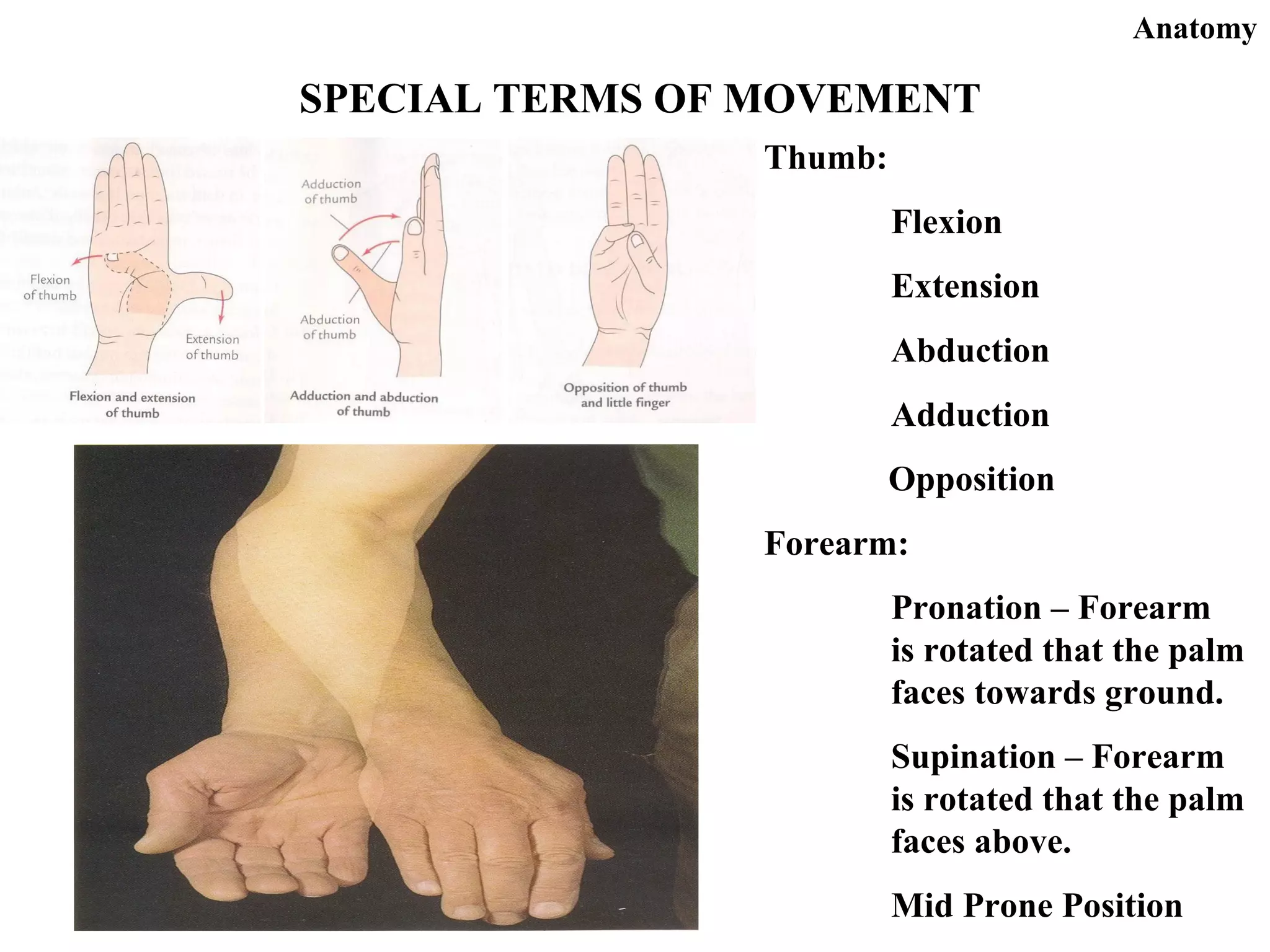
Thumb:
Flexion
Extension
Abduction
Adduction
Opposition
Forearm:
Pronation – Forearm
is rotated that the palm
faces towards ground.
Supination – Forearm
is rotated that the palm
faces above.
Mid Prone Position
Anatomy
SPECIAL TERMS OF MOVEMENT
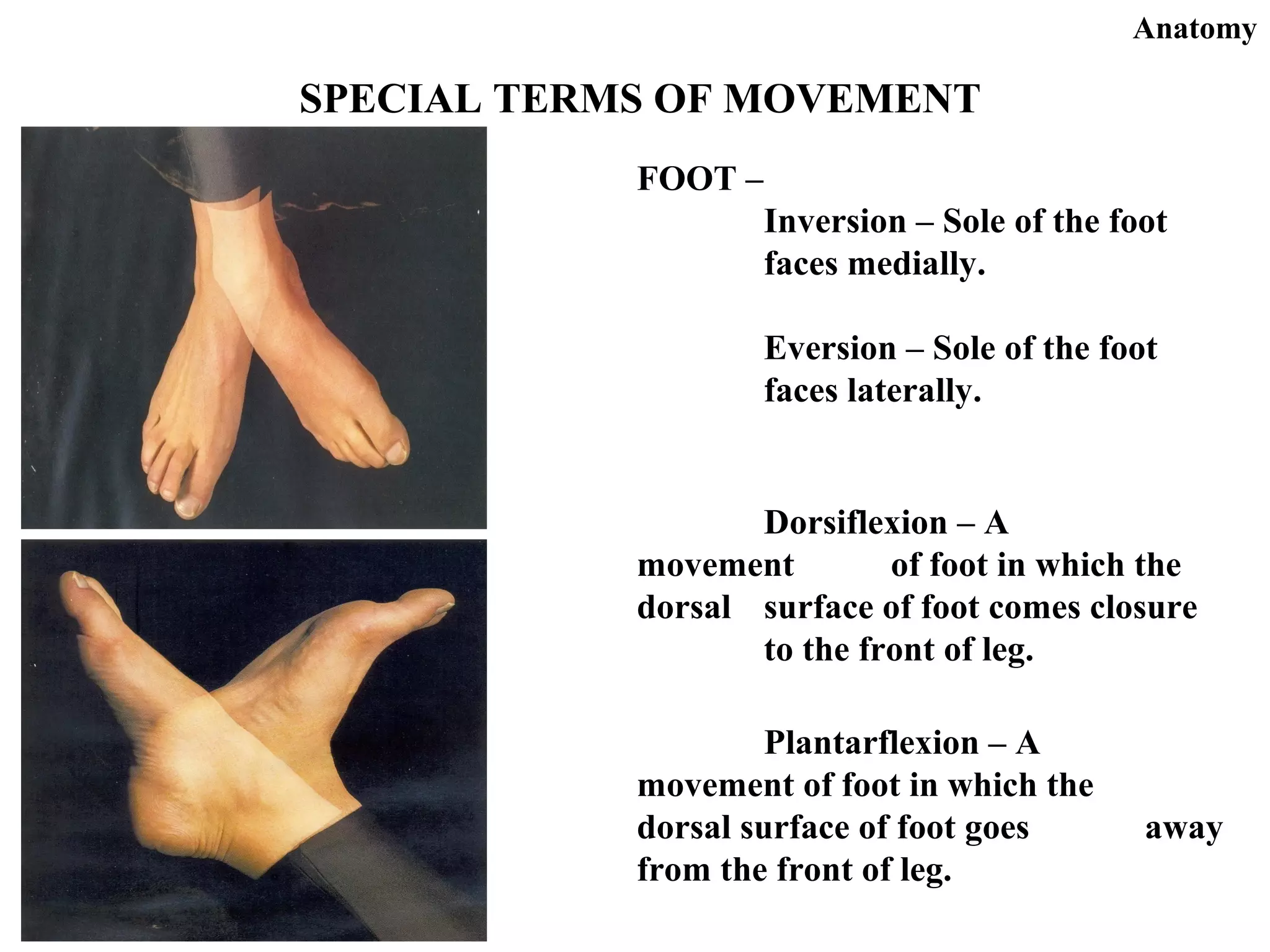
FOOT –
Inversion – Sole of the foot
faces medially.
Eversion – Sole of the foot
faces laterally.
Dorsiflexion – A
movement of foot in which the
dorsal surface of foot comes closure
to the front of leg.
Plantarflexion – A
movement of foot in which the
dorsal surface of foot goes away
from the front of leg.
Anatomy
SPECIAL TERMS OF MOVEMENT
Trunk:
Extension
Flexion
Rotation - Left
Anatomy
Rotation - Right
Lateral Flexion - Right
- Left
SPECIAL TERMS OF MOVEMENT
1. Cunningham’s Manual of Practical Anatomy, Vol.1.
2. Grant’s Method of Anatomy, 11th
Edition.
3. Vishram Singh. General Anatomy, 1st
Edition.
1. Who is the Father of Anatomy:
a) Galen
b) Herophilus
c) Vesalius
d) Hippocrates
2. The meaning of term anatomy is:
a) To analyze
b) To observe
c) To cut up
d) To make
3. The sectional plane that divides the body into
anterior and posterior portions is:
a) Transverse plane
b) Sagittal plane
c) Coronal plane
d) Oblique plane
4. Lying down position with the face directed
down is called as:
a) Supine
b) Prone
c) Anatomical
d) Lithotomy
5. During flexion of the arm, the arm moves:
a) Upwards
b) Downwards
c) Medial
d) Lateral

anatomy

  • 1.
  • 2.
    HIPPOCRATES(460-377BC)  Greek physician Father of Medicine  His name is memorialized in the Hippocratic oath  Humoral theory : Four body humors – -blood . -phlegum - -yellow bile - -black bile  Attributed diseases to natural causes .
  • 3.
    HEROPHILUS (about 325BC) Father of Anatomy  Performed: -vivi-sections (dissections of living humans) and - dissections of human cadavers  regarded brain as seat of intelligence  described cerebrum, cerebellum, fourth ventricle  first to identify nerves as sensory or motor.
  • 4.
    VESALIUS(1514- 1654)  Hiswork De humani corporis fabrica written in 7 volumes  His work revolutionised the teaching of anatomy and ruled for two centuries  Chose not to have his name attached to the parts of body he described unlike anatomists Sylvius, Fallopius, Eustachius.  Father of Modern Anatomy  ‘Reformer of Anatomy’
  • 5.
    GENERAL ANATOMY Anatomy =Ana (Gr) Tome (Gr) Apart To Cut Dissection = Dissecare (Latin) To cut apart Anatomy
  • 6.
     Gross/ CadavericAnatomy  Microscopic Anatomy (Histology)  Developmental Anatomy (Embryology)  Living Anatomy  Clinical Anatomy (Applied)  Neuroanatomy  Surface (Topographic) Anatomy  Radiographic Anatomy  Comparative Anatomy  Sectional Anatomy
  • 7.
     REGIONAL ANATOMY -Head and neck - Brain -Thorax - Abdomen - Upper Limb - Lower limb  SYSTEMIC ANATOMY - Integumentary system - Skeletal system - Muscular system - Nervous system - Cardiovascular system - Lymphatic system - Endocrine system - Digestive system, Respiratory system, Urogenital system
  • 8.
    SUB – DIVISIONSOF BODY Head and Neck Brain Superior Extremity Thorax Abdomen and Pelvis Inferior Extremity Anatomy
  • 9.
    ANATOMICAL POSITION Standing upright Looking straight towards horizon Upper limbs hanging by the side of body Palms facing forwards  Lower limbs are parallel with toes pointing forwards Anatomy
  • 10.
    1. MID SAGITTAL (MedianPlane): A vertical plane dividing the body into right and left equal halves. 2. SAGITTAL: A vertical plane which is parallel to the sagittal plane. TERMS OF PLANES Anatomy
  • 11.
    3. CORONAL PLANE (FrontalPlane): A vertical plane which is at right angles to the median plane dividing the body into an anterior and a posterior part. 4. TRANSVERSE PLANE: A plane at right angles to the sagittal / coronal plane dividing the body into an upper and lower part. TERMS OF PLANES Anatomy
  • 12.
     HORIZONTAL PLANE:A plane parrallel to the ground.  OBLIQUE PLANE: Any plane other than of aforementioned planes.
  • 13.
    TERMS OF POSTURE Anatomy SupineProne Left Lateral Right Lateral Lithotomy Erect Upside Down
  • 14.
    Anterior = Ventral Intermediate= Middle Posterior = Dorsal TERMS OF POSITION Anatomy
  • 15.
    • Lateral • Intermediate •Medial • Median TERMS OF POSITION Anatomy
  • 16.
    For solid organs: -Superficial -Deep Forhollow organs: -Interior -Exterior For indicating the side: -Ipsilateral -Contralateral OTHER TERMS Anatomy
  • 17.
    Superior = Cephalic Inferior= Caudal TERMS OF POSITION Anatomy
  • 18.
  • 19.
    Skull - Inferiorsurface is called as Base Hand - Posterior surface - Dorum of Hand - Anterior surface - Palmar surface TERMS OF POSITION Anatomy
  • 20.
    TERMS OF POSITION Anatomy Foot -Superior surface - Dorsum of Foot - Inferior Surface - Plantar Surface
  • 21.
    Combination of Terms: -Supero medial - Infero lateral - Postero superior - Antero inferior TERMS OF POSITION Anatomy
  • 22.
    Flexion: - Movingpart is carried forwards - Movement on the transverse axis Extension- Moving part is carried backwards - Movement on the transverse axis. Circumduction: Moving part forms the base of a cone TERMS OF MOVEMENT Anatomy
  • 23.
    Abduction: - Movingpart is carried away from the body/ reference line. - Movement on antero – posterior axis. Adduction: - Moving part is carried towards the body / reference line. -Movement on antero – posterior axis. TERMS OF MOVEMENT Anatomy
  • 24.
    Medial Rotation – -Movingpart is rotated towards the mid line. - Movement on vertical axis. Lateral Rotation – - Moving part is rotated away from the mid line. - Movement on vertical axis. TERMS OF MOVEMENT Anatomy
  • 25.
    LEG: Flexion – Amovement on knee joint in which leg is carried backwards. Extension – A movement on knee joint in which leg is carried forwards. TOES: Abduction – Toes move away from the long axis of 2nd toe. Adduction – Toes move towards long axis of the 2nd toe. SPECIAL TERMS OF MOVEMENT Anatomy
  • 26.
    NECK: - Flexion - Extension ROTATION: -Right - Left - LATERAL FLEXION - Right - Left SPECIAL TERMS OF MOVEMENT Anatomy
  • 27.
    FINGERS: ABDUCTION – Fingers moveaway from the long axis of middle finger. ADDUCTION – Fingers move towards the long axis of middle finger. SPECIAL TERMS OF MOVEMENT Anatomy
  • 28.
    Anatomy SPECIAL TERMS OFMOVEMENT Thumb: Flexion Extension Abduction Adduction Opposition Forearm: Pronation – Forearm is rotated that the palm faces towards ground. Supination – Forearm is rotated that the palm faces above. Mid Prone Position
  • 29.
    Anatomy SPECIAL TERMS OFMOVEMENT FOOT – Inversion – Sole of the foot faces medially. Eversion – Sole of the foot faces laterally. Dorsiflexion – A movement of foot in which the dorsal surface of foot comes closure to the front of leg. Plantarflexion – A movement of foot in which the dorsal surface of foot goes away from the front of leg.
  • 30.
    Anatomy SPECIAL TERMS OFMOVEMENT Trunk: Extension Flexion Rotation - Left
  • 31.
    Anatomy Rotation - Right LateralFlexion - Right - Left SPECIAL TERMS OF MOVEMENT
  • 32.
    1. Cunningham’s Manualof Practical Anatomy, Vol.1. 2. Grant’s Method of Anatomy, 11th Edition. 3. Vishram Singh. General Anatomy, 1st Edition.
  • 33.
    1. Who isthe Father of Anatomy: a) Galen b) Herophilus c) Vesalius d) Hippocrates
  • 34.
    2. The meaningof term anatomy is: a) To analyze b) To observe c) To cut up d) To make
  • 35.
    3. The sectionalplane that divides the body into anterior and posterior portions is: a) Transverse plane b) Sagittal plane c) Coronal plane d) Oblique plane
  • 36.
    4. Lying downposition with the face directed down is called as: a) Supine b) Prone c) Anatomical d) Lithotomy
  • 37.
    5. During flexionof the arm, the arm moves: a) Upwards b) Downwards c) Medial d) Lateral