Species and Speciation


                     ALBIO9700/2006JK
Species:
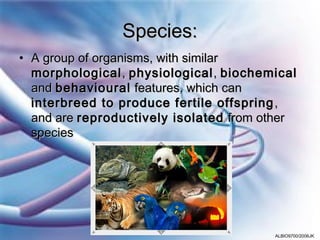
• A group of organisms, with similar
  morphological , physiological , biochemical
  and behavioural features, which can
  interbreed to produce fertile offspring ,
  and are reproductively isolated from other
  species


                                         ALBIO9700/2006JK
ALBIO9700/2006JK
Classification
• Taxonomy – the study of the classification of
  organisms

• Homologous features – shared features
  between different organisms

• Binomial – two-word Latin name for every
  species

• Phylogeny – the evolutionary history of living
  organisms

                                             ALBIO9700/2006JK
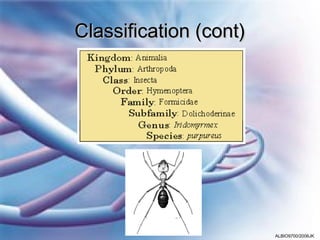
Classification (cont)


                        ALBIO9700/2006JK
New species usually develop due to:

• geographical isolation (allopatric
  speciation )

• reproductive isolation (sympatric
  speciation )


                                       ALBIO9700/2006JK
Allopatric speciation
Start with an interbreeding
population of one species.


The population becomes divided by a
physical barrier such as water,
mountains, desert, or just a large
distance. This can happen when some of
the population migrates or is dispersed,
or when the geography changes
catastrophically    (e.g.  earthquakes,
volcanoes, floods) or gradually (erosion,
continental drift).                         ALBIO9700/2006JK
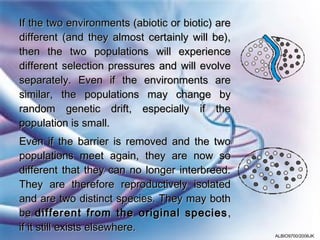
If the two environments (abiotic or biotic) are
different (and they almost certainly will be),
then the two populations will experience
different selection pressures and will evolve
separately. Even if the environments are
similar, the populations may change by
random genetic drift, especially if the
population is small.
Even if the barrier is removed and the two
populations meet again, they are now so
different that they can no longer interbreed.
They are therefore reproductively isolated
and are two distinct species. They may both
be different from the original species ,
if it still exists elsewhere.
                                                  ALBIO9700/2006JK
Sympatric speciation
• Genetic isolation

• Formation of a new species can take place in the same
  geographical area , e.g. mutations may result in
  reproductive incompatibility

• A new gene producing, say, a hormone, may lead an
  animal to be rejected from the mainstream group, but
  breeding may be possible within its own groups of
  variants

• When this mechanism results in the production of a new
  species it is known as sympatric speciation

• Polyploidy, autopolyploid, allopolyploids?        ALBIO9700/2006JK
Sympatric speciation
• Genetic isolation

• Formation of a new species can take place in the same
  geographical area , e.g. mutations may result in
  reproductive incompatibility

• A new gene producing, say, a hormone, may lead an
  animal to be rejected from the mainstream group, but
  breeding may be possible within its own groups of
  variants

• When this mechanism results in the production of a new
  species it is known as sympatric speciation

• Polyploidy, autopolyploid, allopolyploids?        ALBIO9700/2006JK

02 Species and Speciation

  • 1.
    Species and Speciation ALBIO9700/2006JK
  • 2.
    Species: • A groupof organisms, with similar morphological , physiological , biochemical and behavioural features, which can interbreed to produce fertile offspring , and are reproductively isolated from other species ALBIO9700/2006JK
  • 3.
  • 4.
    Classification • Taxonomy –the study of the classification of organisms • Homologous features – shared features between different organisms • Binomial – two-word Latin name for every species • Phylogeny – the evolutionary history of living organisms ALBIO9700/2006JK
  • 5.
    Classification (cont) ALBIO9700/2006JK
  • 6.
    New species usuallydevelop due to: • geographical isolation (allopatric speciation ) • reproductive isolation (sympatric speciation ) ALBIO9700/2006JK
  • 7.
    Allopatric speciation Start withan interbreeding population of one species.   The population becomes divided by a physical barrier such as water, mountains, desert, or just a large distance. This can happen when some of the population migrates or is dispersed, or when the geography changes catastrophically (e.g. earthquakes, volcanoes, floods) or gradually (erosion, continental drift). ALBIO9700/2006JK
  • 8.
    If the twoenvironments (abiotic or biotic) are different (and they almost certainly will be), then the two populations will experience different selection pressures and will evolve separately. Even if the environments are similar, the populations may change by random genetic drift, especially if the population is small. Even if the barrier is removed and the two populations meet again, they are now so different that they can no longer interbreed. They are therefore reproductively isolated and are two distinct species. They may both be different from the original species , if it still exists elsewhere. ALBIO9700/2006JK
  • 9.
    Sympatric speciation • Geneticisolation • Formation of a new species can take place in the same geographical area , e.g. mutations may result in reproductive incompatibility • A new gene producing, say, a hormone, may lead an animal to be rejected from the mainstream group, but breeding may be possible within its own groups of variants • When this mechanism results in the production of a new species it is known as sympatric speciation • Polyploidy, autopolyploid, allopolyploids? ALBIO9700/2006JK
  • 10.
    Sympatric speciation • Geneticisolation • Formation of a new species can take place in the same geographical area , e.g. mutations may result in reproductive incompatibility • A new gene producing, say, a hormone, may lead an animal to be rejected from the mainstream group, but breeding may be possible within its own groups of variants • When this mechanism results in the production of a new species it is known as sympatric speciation • Polyploidy, autopolyploid, allopolyploids? ALBIO9700/2006JK