General Histology
Histology definition
is the study of the tissues of the body
and how these tissues are arranged
to constitute organs. The Greek root
  histo can be translated as
either "tissue" or "web," both of
which are appropriate because
tissues are usually webs of
interwoven filaments and fibers,
both cellular and non cellular, with
membranous linings. Histology
involves all aspects of tissue biology
?Why is histology important
It is important because it is one
of the tools in the medical
toolbox for diagnosis of
diseases. A great many
diseases reveal themselves at
the cellular level: many
cancers, bone and connective
tissue diseases, vascular
diseases, liver diseases, kidney
diseases and others can be
definitively diagnosed using
. histological techniques
General information
Tissue = Cells with similar structure &.
function organized into groups or layers
:Levels of cellular organization are.
Cells>tissue>organ>system>organism
:Four major types of tissues.
Epithelial (Covers or lines surfaces,
(found in glands
Connective (Bind & support body
(parts
(Muscle (Movement
Nervous (Detect changes & transmit
I-Epithelial tissue
characteristics of epithelial tissue
(Covers all body surfaces( inside & outside
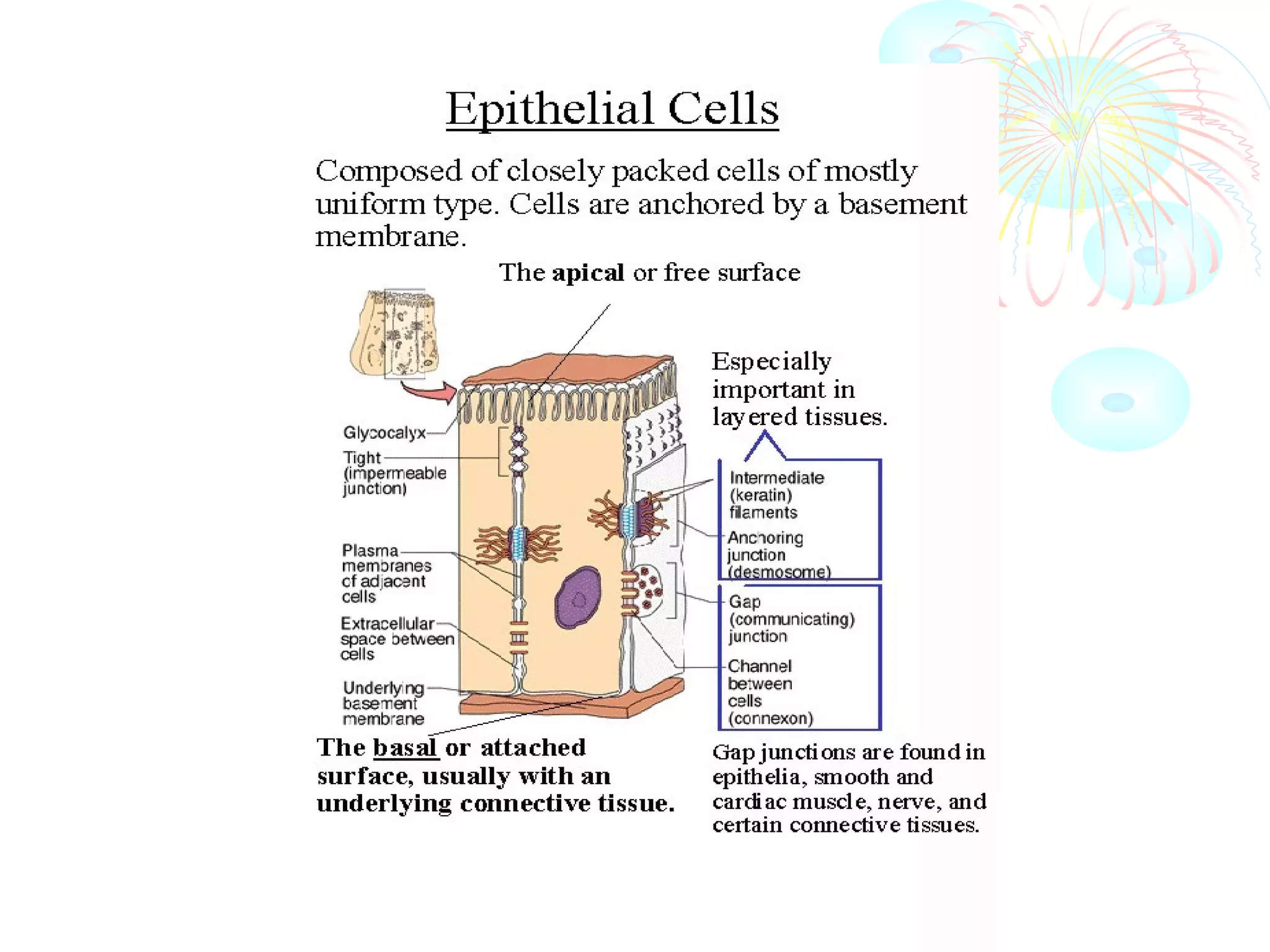
Free surface & basement membrane =basal lamina
(which is (connective tissue

•

(High rate of cell division (healing
( vascularity (rely on diffusion

Many tightly packed cells, usually arranged into layers
Epithelial tissue that occurs on the interior surfaces of the
. body is known as endothelium
small amount of intercellular substance
The basement membrane provides structural
support for the epithelium and also binds it to
. neighbouring structures
Form glands ,part of sense organs & germinal structures

:-Function
Protection – epidermis of skin
Secretion_ glands
Sensory _neuroepithelium in taste buds
Contraction _ myoepithelium
Reproduction _germinal epithelium
:_Origin
Ectodermic – skin epithelium
Endodermic_ gut epithelium
Mesodermic_ urinogenital
epithelium
Classification of epithelium according to
structure & function

I_ covering epithelium
II_ glandular epithelium
Covering epithelium
:-According to no of layers

Simple epithelium= one layer
Stratified
//
> one layer

:-According to shape of cells
Squamous… like scales ,polyhedral,oval
central nucleus
Cuboidal … like cube,spherical central
nucleus
Columnar …oval basal nucleus
Simple epithelium

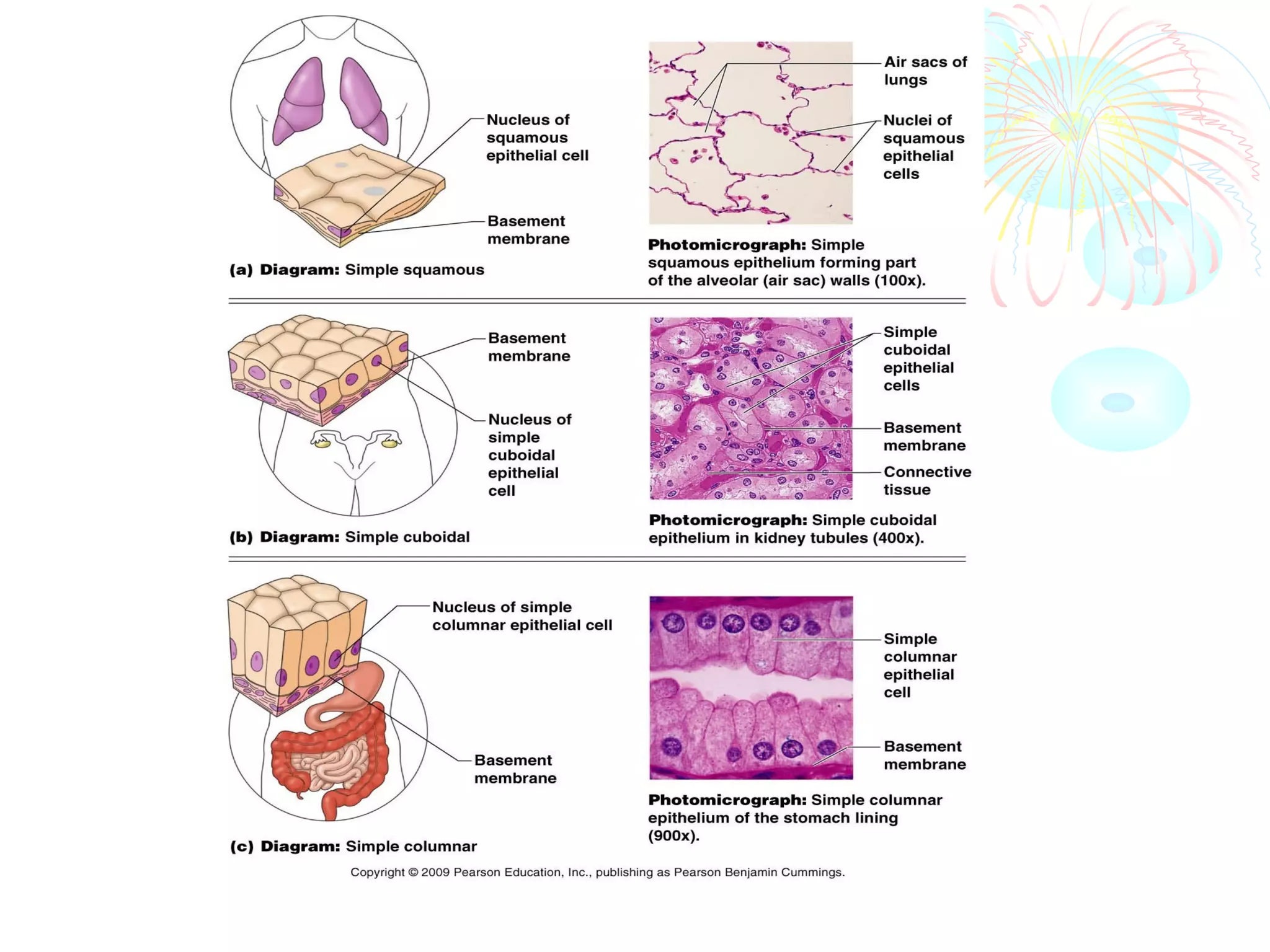
simple squamous epithelium around blood vessels,- 1
covering heart, lining body cavities
Function: diffusion
simple cubical epithelium collecting tubules of kidney-2
Function ion exchange
simple columnar epithelium intestine- 3
Function absorption
simple ciliated columnar epithelium oviduct- 4
pseudostratified columnar vasdefrense-5
pseudostratified ciliated columnar trachea-6
Stratified epithelium
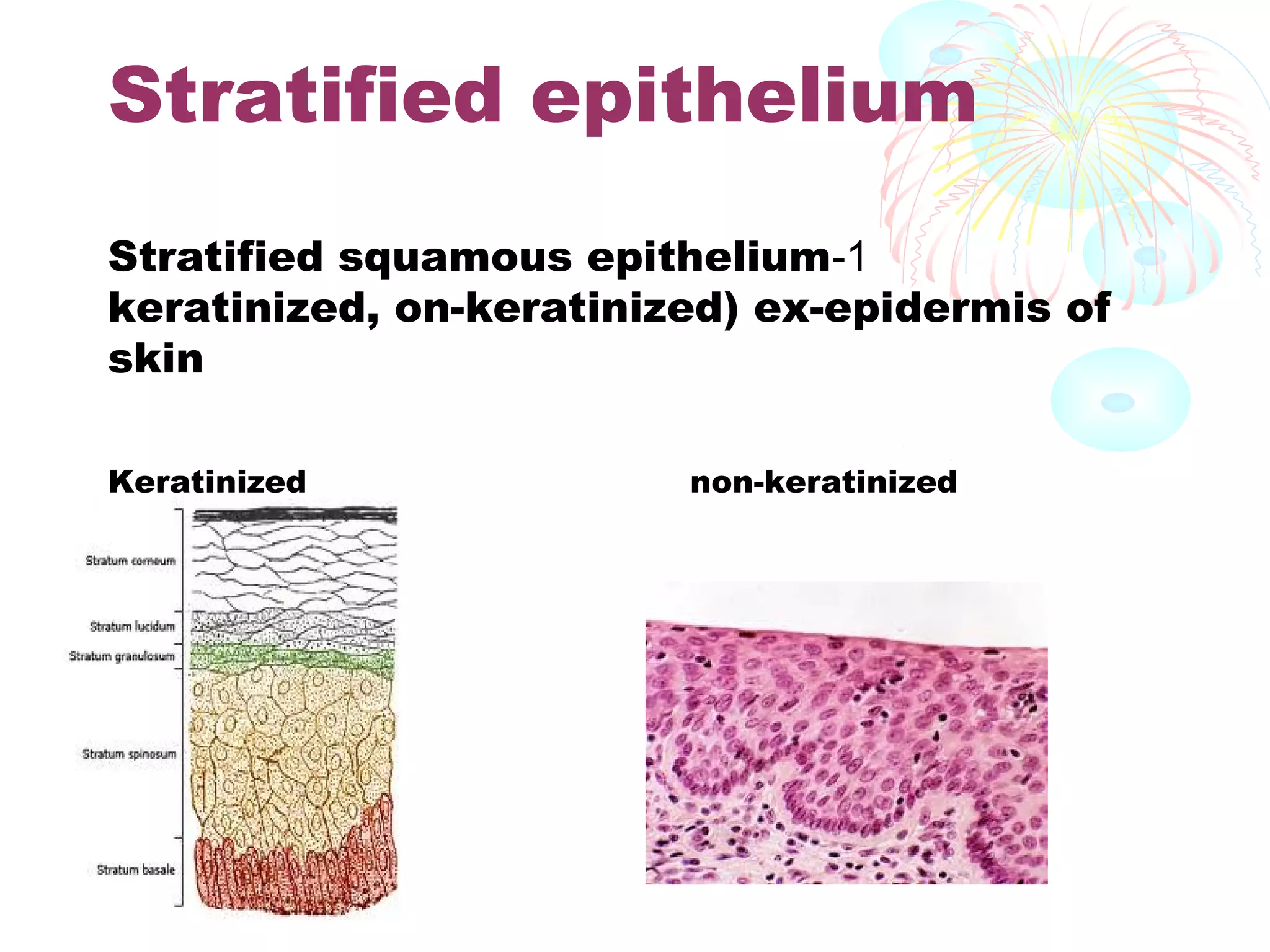
Stratified squamous epithelium-1
keratinized, on-keratinized) ex-epidermis of
skin
Keratinized

non-keratinized
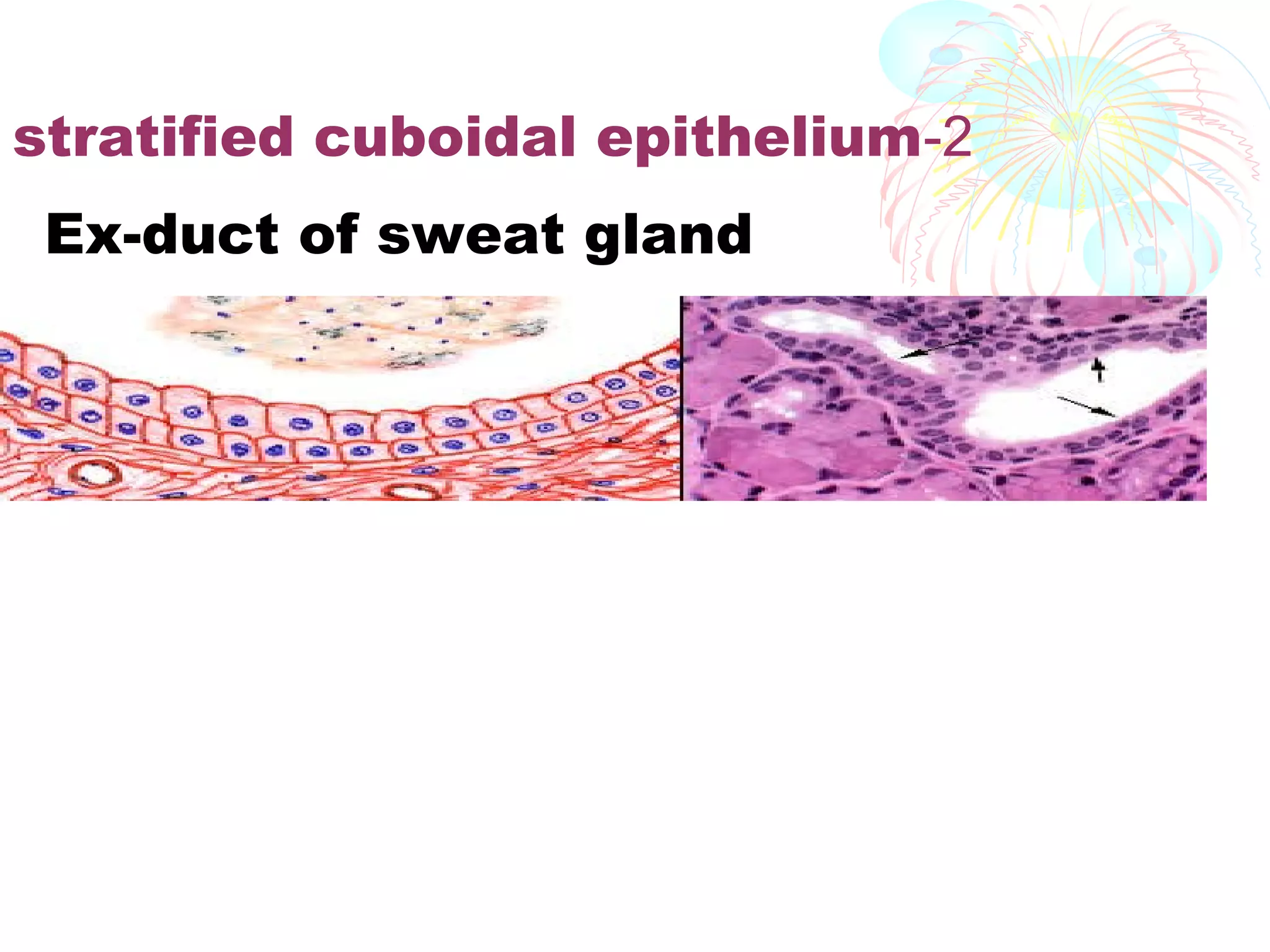
stratified cuboidal epithelium-2
Ex-duct of sweat gland
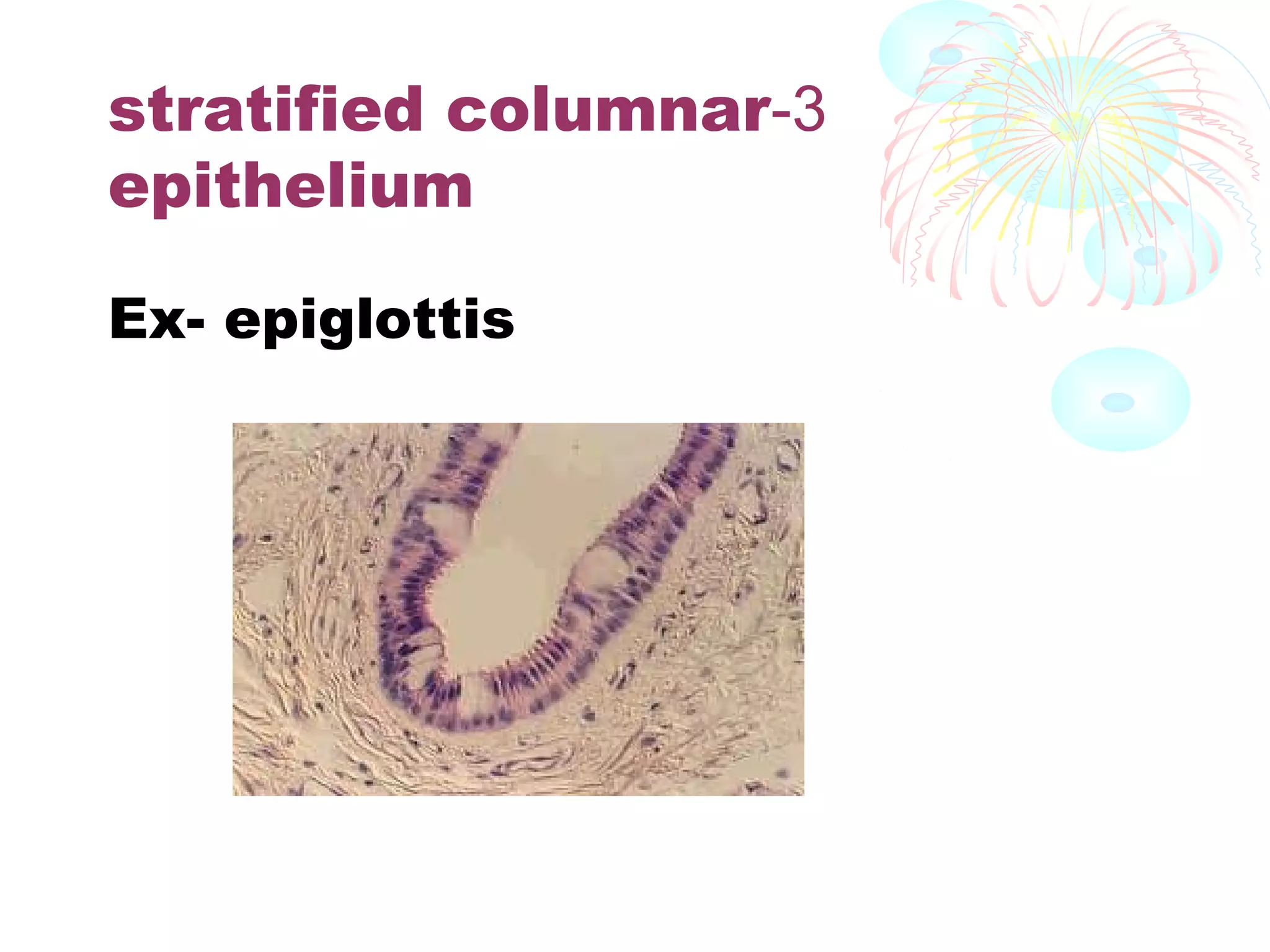
stratified columnar-3
epithelium
Ex- epiglottis
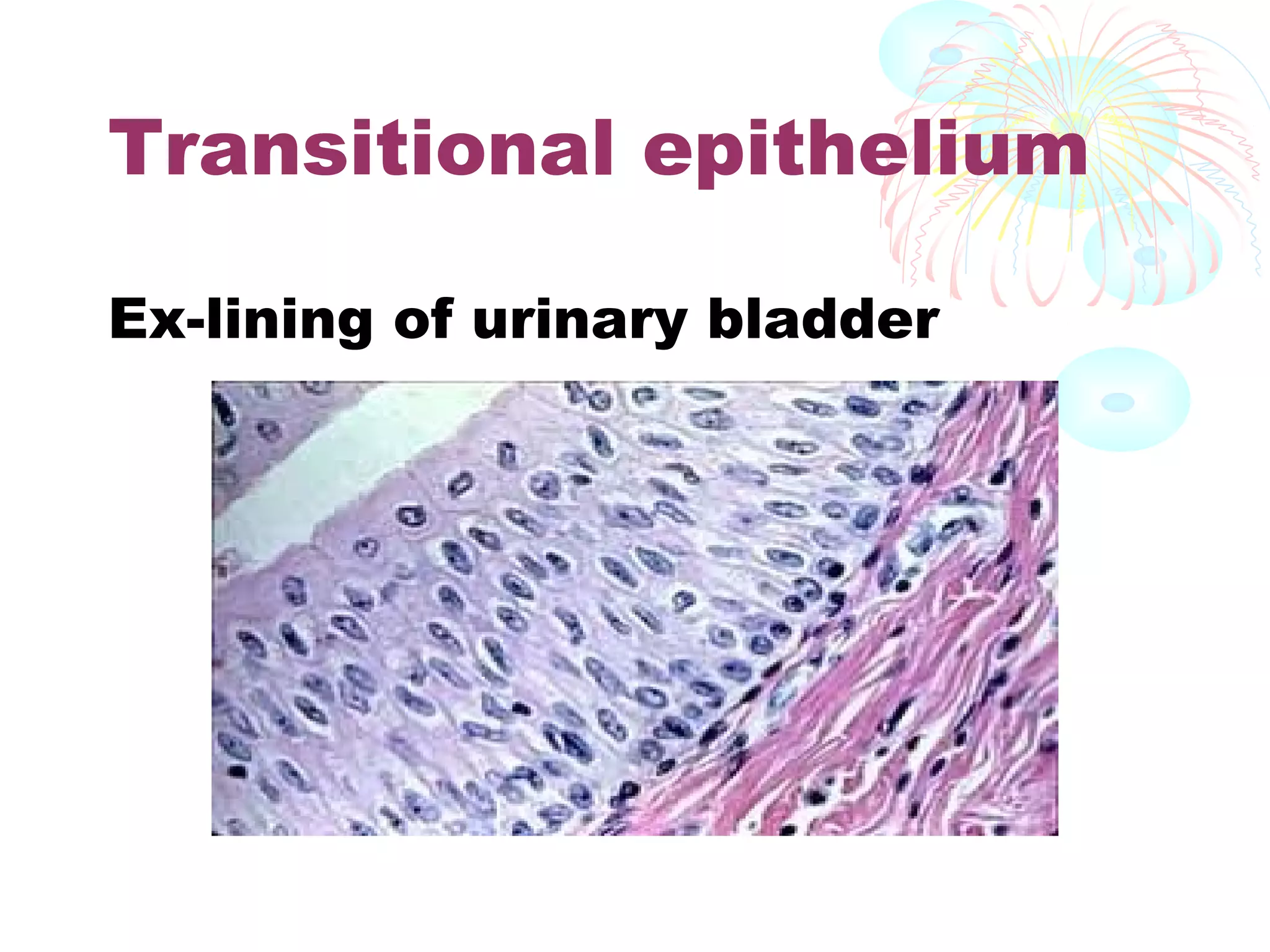
Transitional epithelium
Ex-lining of urinary bladder
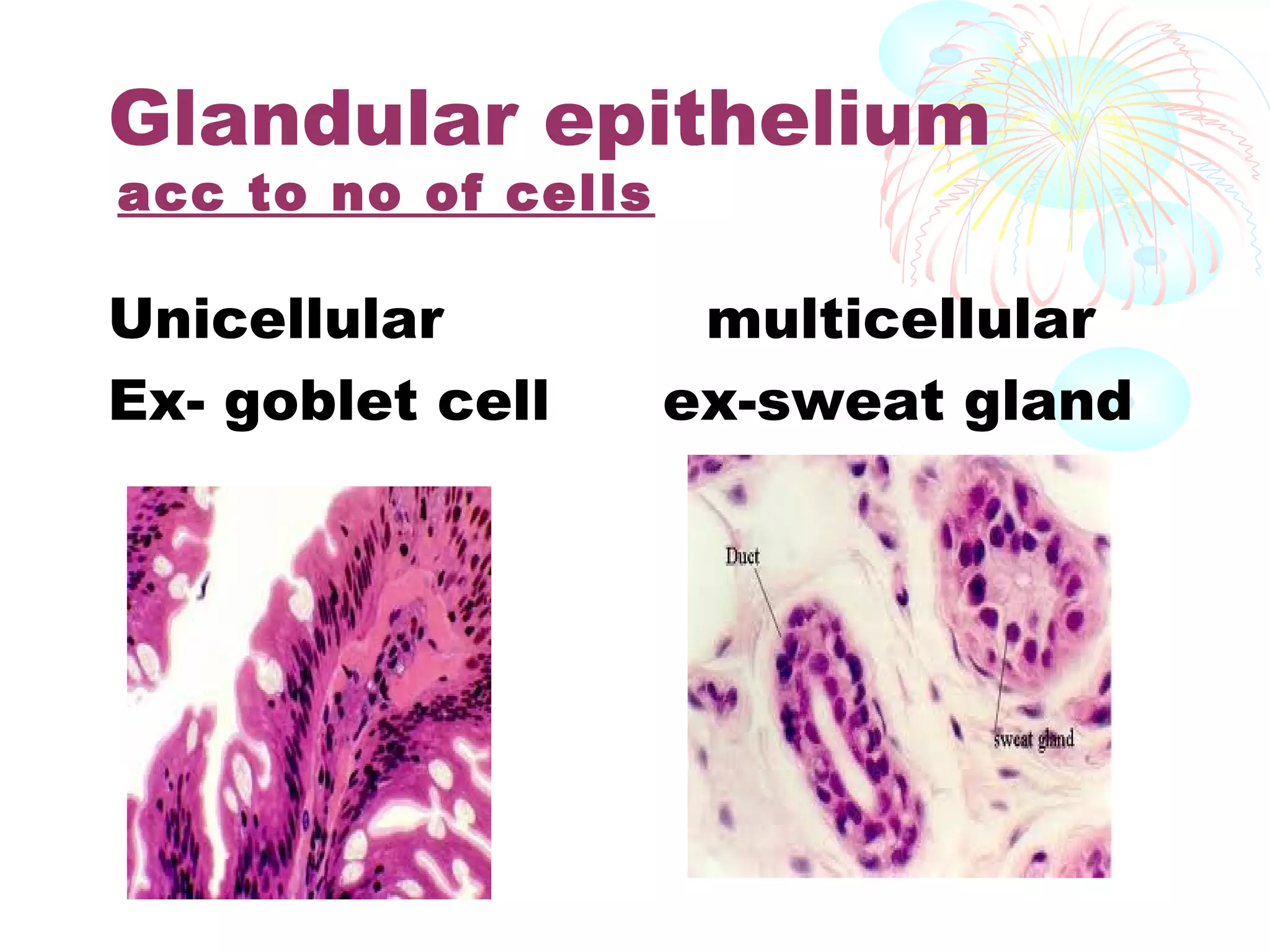
Glandular epithelium
acc to no of cells

Unicellular
Ex- goblet cell

multicellular
ex-sweat gland
Acc to presence or absence of
duct
Endocrine-thyroid gland
Exocrine- sweat gland
Mixed- pancreas
Acc to method of secretion
Merocrine -secretory cells remain
intact, discharge by exocytosis- expancrease
Apocrine-apical part of glandular cell
detaches with secretion- exmammary gland
Holocrine-glandular cell burst-exsebaceous gland
Classification of glands acc to
shape of secretory portion
(tubular (intestinal glands-1
(alveolar (poisonous gland in skin of toad-2
(Tubulo-alveolar (salivary gland & pancreas

Classification of glands Acc to duct system

A) Simple :-)
Simple tubular gland (ex) intestinal gland
Simple coiled tubular (ex) sweat gland
Simple branched tubular (ex) sebaceous gland of human skin
Simple alveolar (ex) mucous& poisonous gland in skin of toad
:_B) compound)
compound tubular (ex) kidney
Compound alveolar (ex) mammary gland
Compound Tubulo-alveolar (ex) pancreas
Special types of epithelium
neuroepithelium (ex) taste buds- 1
germinal epithelium (ex) testis& ovary-2
myoepithelium (ex) lining of glands-3

Polarity of epithelium
Cilia for movement
microvilli
Next

Connective
tissue

General histology.(introduction)

  • 1.
  • 2.
    Histology definition is thestudy of the tissues of the body and how these tissues are arranged to constitute organs. The Greek root   histo can be translated as either "tissue" or "web," both of which are appropriate because tissues are usually webs of interwoven filaments and fibers, both cellular and non cellular, with membranous linings. Histology involves all aspects of tissue biology
  • 3.
    ?Why is histologyimportant It is important because it is one of the tools in the medical toolbox for diagnosis of diseases. A great many diseases reveal themselves at the cellular level: many cancers, bone and connective tissue diseases, vascular diseases, liver diseases, kidney diseases and others can be definitively diagnosed using . histological techniques
  • 4.
    General information Tissue =Cells with similar structure &. function organized into groups or layers :Levels of cellular organization are. Cells>tissue>organ>system>organism :Four major types of tissues. Epithelial (Covers or lines surfaces, (found in glands Connective (Bind & support body (parts (Muscle (Movement Nervous (Detect changes & transmit
  • 5.
    I-Epithelial tissue characteristics ofepithelial tissue (Covers all body surfaces( inside & outside Free surface & basement membrane =basal lamina (which is (connective tissue • (High rate of cell division (healing ( vascularity (rely on diffusion Many tightly packed cells, usually arranged into layers
  • 6.
    Epithelial tissue thatoccurs on the interior surfaces of the . body is known as endothelium small amount of intercellular substance The basement membrane provides structural support for the epithelium and also binds it to . neighbouring structures Form glands ,part of sense organs & germinal structures :-Function Protection – epidermis of skin Secretion_ glands Sensory _neuroepithelium in taste buds Contraction _ myoepithelium Reproduction _germinal epithelium
  • 7.
    :_Origin Ectodermic – skinepithelium Endodermic_ gut epithelium Mesodermic_ urinogenital epithelium
  • 9.
    Classification of epitheliumaccording to structure & function I_ covering epithelium II_ glandular epithelium
  • 10.
    Covering epithelium :-According tono of layers Simple epithelium= one layer Stratified // > one layer :-According to shape of cells Squamous… like scales ,polyhedral,oval central nucleus Cuboidal … like cube,spherical central nucleus Columnar …oval basal nucleus
  • 11.
    Simple epithelium simple squamousepithelium around blood vessels,- 1 covering heart, lining body cavities Function: diffusion simple cubical epithelium collecting tubules of kidney-2 Function ion exchange simple columnar epithelium intestine- 3 Function absorption simple ciliated columnar epithelium oviduct- 4 pseudostratified columnar vasdefrense-5 pseudostratified ciliated columnar trachea-6
  • 13.
    Stratified epithelium Stratified squamousepithelium-1 keratinized, on-keratinized) ex-epidermis of skin Keratinized non-keratinized
  • 14.
  • 15.
  • 16.
  • 17.
    Glandular epithelium acc tono of cells Unicellular Ex- goblet cell multicellular ex-sweat gland
  • 18.
    Acc to presenceor absence of duct Endocrine-thyroid gland Exocrine- sweat gland Mixed- pancreas
  • 19.
    Acc to methodof secretion Merocrine -secretory cells remain intact, discharge by exocytosis- expancrease Apocrine-apical part of glandular cell detaches with secretion- exmammary gland Holocrine-glandular cell burst-exsebaceous gland
  • 20.
    Classification of glandsacc to shape of secretory portion (tubular (intestinal glands-1 (alveolar (poisonous gland in skin of toad-2 (Tubulo-alveolar (salivary gland & pancreas Classification of glands Acc to duct system A) Simple :-) Simple tubular gland (ex) intestinal gland Simple coiled tubular (ex) sweat gland Simple branched tubular (ex) sebaceous gland of human skin Simple alveolar (ex) mucous& poisonous gland in skin of toad :_B) compound) compound tubular (ex) kidney Compound alveolar (ex) mammary gland Compound Tubulo-alveolar (ex) pancreas
  • 21.
    Special types ofepithelium neuroepithelium (ex) taste buds- 1 germinal epithelium (ex) testis& ovary-2 myoepithelium (ex) lining of glands-3 Polarity of epithelium Cilia for movement microvilli
  • 22.