Yapa Wijeratne
Faculty of Medicine
University of Peradeniya
 Fascia: masses of connective tissue large
enough to be visible to the unaided eye.
 The skin is connected to the underlying bones or deep
fascia by a layer of loose areolar connective tissue.
 This layer, usually referred to as superficial fascia, is of
variable
1. Thickness
2. Fat content
3. Flat sheets of muscles- in some regions.
 The quantity and distribution of subcutaneous fat differs
o in the sexes-more in females.
o with climate (rather than race)-more in colder
geographical regions.
 Flat sheets of muscles are also present in
some regions. These include
 Skeletal muscles
 Platysma
 Palmaris brevis
 Smooth muscles
 Subareolar muscle of the nipple
 Dartos
 Corrugator cutis ani
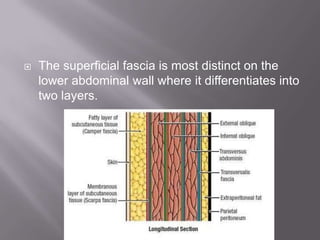
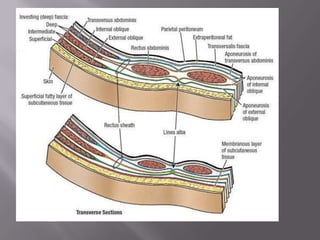
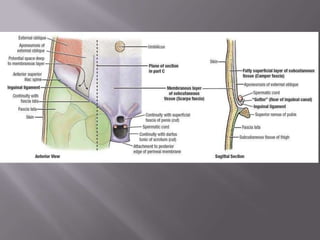
 The superficial fascia is most distinct on the
lower abdominal wall where it differentiates into
two layers.
 Well differentiated in
1. limbs
2. perineum
 Thin
1. Dorsal aspects of the hands and feet,
2. the sides of the neck and face,
3. around the anus
4. over the penis and scrotum
 Almost absent
 external ears.
 Strong connective tissue bands traverse the
superficial fascia binding the skin to the
underlying aponeurosis of the scalp, palm and
sole.
 Typical superficial fascia is lacking in the palms
and soles, where numerous strong connective
tissue collagenous bands tether the dermis of
the skin to underlying structures.
 Also atypical is the skin of the scalp, where
dense dermal connective tissue and the
epicranial aponeurosis are bound together as a
layer that ‘rides’ on loose connective tissue
overlying the periosteum of the skull.
 The limbs and body wall are wrapped in a membrane
of fibrous tissue, the deep fascia.
 It varies widely in thickness.
 Very well developed:
 iliotibial tract of the fascia lata
 So thin/Scarcely demonstrable (usually considered to
be absent):
 Over the rectus sheath
 External oblique aponeurosis of the abdominal wall
 Entirely absent:
 Face,
 Ischioanal fossa
 Where deep fascia passes directly over bone it is
always anchored firmly to the periosteum.
 In the neck, as well as the investing layer of deep
fascia, there are other deeper fascial layers enclosing
neurovascular structures, glands and muscles.
 Intermuscular septa are laminae of deep fascia which
extend between muscle groups and frequently become
continuous with the periosteum of bones.
 Transverse thickenings of deep fascia over
tendons, attached at their margins to bones, form
retinaculae at the wrists and ankles and fibrous
sheaths on the fingers and toes.
 Deep fascia is very sensitive.
 Its nerve supply, and that of subcutaneous
periosteum, is that of the overlying skin.
 The nerves to muscles supply the
intermuscular septa and deep periosteum.

Superficial & deep fascia

  • 1.
    Yapa Wijeratne Faculty ofMedicine University of Peradeniya
  • 2.
     Fascia: massesof connective tissue large enough to be visible to the unaided eye.
  • 3.
     The skinis connected to the underlying bones or deep fascia by a layer of loose areolar connective tissue.  This layer, usually referred to as superficial fascia, is of variable 1. Thickness 2. Fat content 3. Flat sheets of muscles- in some regions.  The quantity and distribution of subcutaneous fat differs o in the sexes-more in females. o with climate (rather than race)-more in colder geographical regions.
  • 4.
     Flat sheetsof muscles are also present in some regions. These include  Skeletal muscles  Platysma  Palmaris brevis  Smooth muscles  Subareolar muscle of the nipple  Dartos  Corrugator cutis ani
  • 5.
     The superficialfascia is most distinct on the lower abdominal wall where it differentiates into two layers.
  • 8.
     Well differentiatedin 1. limbs 2. perineum  Thin 1. Dorsal aspects of the hands and feet, 2. the sides of the neck and face, 3. around the anus 4. over the penis and scrotum  Almost absent  external ears.
  • 9.
     Strong connectivetissue bands traverse the superficial fascia binding the skin to the underlying aponeurosis of the scalp, palm and sole.  Typical superficial fascia is lacking in the palms and soles, where numerous strong connective tissue collagenous bands tether the dermis of the skin to underlying structures.  Also atypical is the skin of the scalp, where dense dermal connective tissue and the epicranial aponeurosis are bound together as a layer that ‘rides’ on loose connective tissue overlying the periosteum of the skull.
  • 10.
     The limbsand body wall are wrapped in a membrane of fibrous tissue, the deep fascia.  It varies widely in thickness.  Very well developed:  iliotibial tract of the fascia lata  So thin/Scarcely demonstrable (usually considered to be absent):  Over the rectus sheath  External oblique aponeurosis of the abdominal wall  Entirely absent:  Face,  Ischioanal fossa
  • 11.
     Where deepfascia passes directly over bone it is always anchored firmly to the periosteum.  In the neck, as well as the investing layer of deep fascia, there are other deeper fascial layers enclosing neurovascular structures, glands and muscles.  Intermuscular septa are laminae of deep fascia which extend between muscle groups and frequently become continuous with the periosteum of bones.  Transverse thickenings of deep fascia over tendons, attached at their margins to bones, form retinaculae at the wrists and ankles and fibrous sheaths on the fingers and toes.
  • 12.
     Deep fasciais very sensitive.  Its nerve supply, and that of subcutaneous periosteum, is that of the overlying skin.  The nerves to muscles supply the intermuscular septa and deep periosteum.