Stability of colloids
By: Maryam kazemi
Pharm.D . Ph.D student of pharmaceutics
Pharmaceutical applications of col
loids;1) Colloidal silver iodide, silver chloride & silver protein are
effective germicides & not cause irritation as ionic silver salts.
2) Colloidal copper used in cancer.
3) Colloidal gold used as diagnostic agent.
4) Colloidal mercury used in syphilis.
5) Association colloids (SAA) are used to increase solubility & sta
bility of certain compounds in aqueous & oily pharmaceutical prep
arations.
Colloidal stability
• To maintain stability through Brownian motion
we need to prevent particles sticking when they
collide.
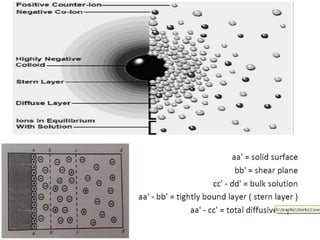
The forces between colloidal particles
1.vanderWaals forces or electromagnetic forces (attraction)
2. electrostatic forces (repulsion)
3. steric forces due to adsorbed molecules at the particle inter
face (repulsive)
4. solvation forces (repulsive)
 Criteria of stability
Salt concentration
 Counter-ion valency
ζ-potential
Particle size
Salt concentration
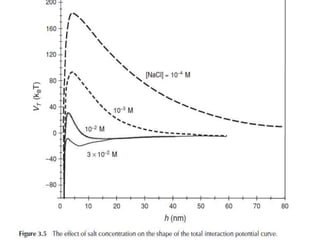
• In each case there is a steep rise to the primary maximum.
• At larger distances there is a long repulsive tail, most notable at lower
electrolyte concentrations.
• The range of the tail reduces as the electrolyte concentration increases
(in line with the decrease in the Debye length).
• The height of the maximum decreases with increasing electrolyte con
centration.
• As the primary maximum falls to below zero (above 3 × 10⁻² M NaC
l in this case), all collisions will lead to aggregation as there is no barri
er.
ζ-potential
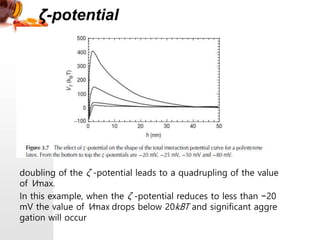
doubling of the ζ -potential leads to a quadrupling of the value
of Vmax.
In this example, when the ζ -potential reduces to less than −20
mV the value of Vmax drops below 20kBT and significant aggre
gation will occur
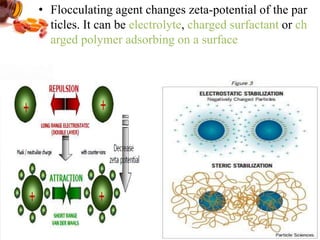
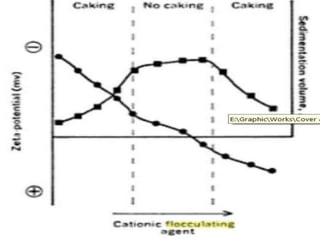
• Flocculating agent changes zeta-potential of the par
ticles. It can be electrolyte, charged surfactant or ch
arged polymer adsorbing on a surface
Flocculating Agents
Flocculating agents decreases zeta potential of the susp
ended charged particle and thus cause aggregation (fl
ock formation) of the particles.
 Examples of flocculating agents are:
 Neutral electrolytes such as KCl, NaCl.
 Surfactants
 Polymeric flocculating agents
 Sulfate, citrates, phosphates salts
 Neutral electrolytes e.g. NaCl, KCl besides acting as flo
cculating agents, also decreases interfacial tension of the
surfactant solution. If the particles are having less surfac
e charge then monovalent ions are sufficient to cause flo
cculation e.g. steroidal drugs.
 For highly charged particles e.g. insoluble polymers an
d poly-electrolytes species, di or trivalent flocculating a
gents are used.
surfactant
 Both ionic and non-ionic surfactants can be used to bring abou
t flocculation of suspended particles.
 Optimum concentration is necessary because these compou
nds also act as wetting agents to achieve dispersion.
 The particles possessing less surface free energy are attracted t
owards to each other by van der-waals forces and forms loose
agglomerates.
polymers
Polymers possess long chain in their structures.
Starch, alginates, cellulose derivatives, carbomers, tragacant
h
The part of the long chain is adsorbed on the surface of the
particles and remaining part projecting out into the dispers
ed medium.
Bridging between these later portions, also leads to the form
ation of flocs.
Particle size
• Both the attractive and repulsive contributions are propor
tional to the particle radius. At small sizes the value of V
T is directly proportional to the particle size. However, at
large sizes the value of VT has a more complicated variat
ion.
• a larger particle radius leads to a higher energy barrier; in
other words, electrostatic stability increases with increasi
ng particle radius (all other factors remaining constant).
For small particle sizes (<100 nm radius) the primary ma
ximum is directly proportional to the radius. However, th
e relationship breaks down at larger sizes and the height
of the primary maximum increases at a lower rate
• We can make a distinction here between two types of agg
regation :
• Coagulation is the rapid aggregation that happens in the a
bsence of a primary maximum and leads to a strong irrev
ersible aggregated structure.
• Flocculation is a reversible aggregation that occurs in a se
condary minimum as described. Flocculation is reversible
on the addition of energy to the system, usually the applic
ation of a shear field by shaking, stirring or other mechan
ical processes.
THANKS FOR YOUR ATTENTIO
N

Stability of colloids

  • 1.
    Stability of colloids By:Maryam kazemi Pharm.D . Ph.D student of pharmaceutics
  • 2.
    Pharmaceutical applications ofcol loids;1) Colloidal silver iodide, silver chloride & silver protein are effective germicides & not cause irritation as ionic silver salts. 2) Colloidal copper used in cancer. 3) Colloidal gold used as diagnostic agent. 4) Colloidal mercury used in syphilis. 5) Association colloids (SAA) are used to increase solubility & sta bility of certain compounds in aqueous & oily pharmaceutical prep arations.
  • 3.
    Colloidal stability • Tomaintain stability through Brownian motion we need to prevent particles sticking when they collide.
  • 4.
    The forces betweencolloidal particles 1.vanderWaals forces or electromagnetic forces (attraction) 2. electrostatic forces (repulsion) 3. steric forces due to adsorbed molecules at the particle inter face (repulsive) 4. solvation forces (repulsive)
  • 5.
     Criteria ofstability Salt concentration  Counter-ion valency ζ-potential Particle size
  • 6.
    Salt concentration • Ineach case there is a steep rise to the primary maximum. • At larger distances there is a long repulsive tail, most notable at lower electrolyte concentrations. • The range of the tail reduces as the electrolyte concentration increases (in line with the decrease in the Debye length). • The height of the maximum decreases with increasing electrolyte con centration. • As the primary maximum falls to below zero (above 3 × 10⁻² M NaC l in this case), all collisions will lead to aggregation as there is no barri er.
  • 9.
    ζ-potential doubling of theζ -potential leads to a quadrupling of the value of Vmax. In this example, when the ζ -potential reduces to less than −20 mV the value of Vmax drops below 20kBT and significant aggre gation will occur
  • 11.
    • Flocculating agentchanges zeta-potential of the par ticles. It can be electrolyte, charged surfactant or ch arged polymer adsorbing on a surface
  • 12.
    Flocculating Agents Flocculating agentsdecreases zeta potential of the susp ended charged particle and thus cause aggregation (fl ock formation) of the particles.  Examples of flocculating agents are:  Neutral electrolytes such as KCl, NaCl.  Surfactants  Polymeric flocculating agents  Sulfate, citrates, phosphates salts
  • 13.
     Neutral electrolytese.g. NaCl, KCl besides acting as flo cculating agents, also decreases interfacial tension of the surfactant solution. If the particles are having less surfac e charge then monovalent ions are sufficient to cause flo cculation e.g. steroidal drugs.  For highly charged particles e.g. insoluble polymers an d poly-electrolytes species, di or trivalent flocculating a gents are used.
  • 15.
    surfactant  Both ionicand non-ionic surfactants can be used to bring abou t flocculation of suspended particles.  Optimum concentration is necessary because these compou nds also act as wetting agents to achieve dispersion.  The particles possessing less surface free energy are attracted t owards to each other by van der-waals forces and forms loose agglomerates.
  • 16.
    polymers Polymers possess longchain in their structures. Starch, alginates, cellulose derivatives, carbomers, tragacant h The part of the long chain is adsorbed on the surface of the particles and remaining part projecting out into the dispers ed medium. Bridging between these later portions, also leads to the form ation of flocs.
  • 17.
    Particle size • Boththe attractive and repulsive contributions are propor tional to the particle radius. At small sizes the value of V T is directly proportional to the particle size. However, at large sizes the value of VT has a more complicated variat ion. • a larger particle radius leads to a higher energy barrier; in other words, electrostatic stability increases with increasi ng particle radius (all other factors remaining constant). For small particle sizes (<100 nm radius) the primary ma ximum is directly proportional to the radius. However, th e relationship breaks down at larger sizes and the height of the primary maximum increases at a lower rate
  • 18.
    • We canmake a distinction here between two types of agg regation : • Coagulation is the rapid aggregation that happens in the a bsence of a primary maximum and leads to a strong irrev ersible aggregated structure. • Flocculation is a reversible aggregation that occurs in a se condary minimum as described. Flocculation is reversible on the addition of energy to the system, usually the applic ation of a shear field by shaking, stirring or other mechan ical processes.
  • 19.
    THANKS FOR YOURATTENTIO N