1
MICELLIZATION AND FACTOR
AFFECTING MICELLE
FORMATION
Department of Pharmacy (Pharmaceutics) | Sagar savale
2
CONTENT
What is micelle?
Micelle formation
Micelle size & shape
Critical micelle concentration (CMC)
Determination of the CMC
Factors affecting CMC
3
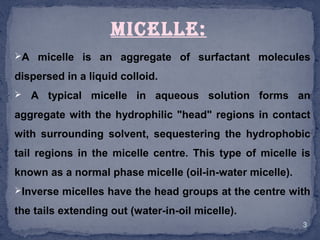
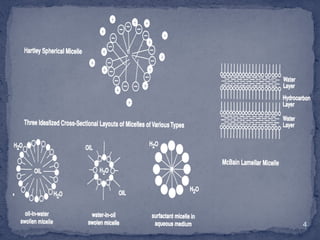
A micelle is an aggregate of surfactant molecules
dispersed in a liquid colloid.
 A typical micelle in aqueous solution forms an
aggregate with the hydrophilic "head" regions in contact
with surrounding solvent, sequestering the hydrophobic
tail regions in the micelle centre. This type of micelle is
known as a normal phase micelle (oil-in-water micelle).
Inverse micelles have the head groups at the centre with
the tails extending out (water-in-oil micelle).
MiCEllE:
4
5
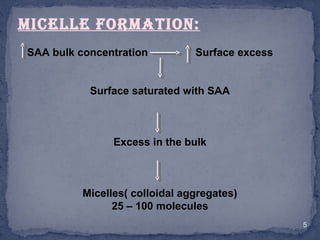
MiCEllE fOrMaTiON:
SAA bulk concentration Surface excess
Surface saturated with SAA
Excess in the bulk
Micelles( colloidal aggregates)
25 – 100 molecules
6
7
Micelle is a self-assembled structure of amphiphilic
molecules and consists of core and shell.
The process of forming micelle is known as micellization.
lyophobic core lyophilic shell
water outside shapes of micelles
8
MesoMorphous (liquid crystals) means
Meso= Between and Morph= Form.
Types of mesomorphous:
Smectic(soap like)
Nematic(thread like)
The molecule form mesomorphous are:
Organic
Elongated & rectilinear shape
Rigid
Posses strong dipoles & easily polarizable.
9
critical Micelle concentration (cMc):
The critical micelle concentration is the point at which
surfactant molecules aggregate together in the liquid to
form groups known as micelles.
The critical micelle concentration of a surfactant
indicates the point at which surface active properties
are at an optimum and performance is maximised.
10
The critical micelle concentration of a surfactant is
decreased by other components in a detergent, in
particular, electrolytes such as inorganic builders and
alkalis.
This reduction affects the adsorption, wetting and
emulsifying properties of surfactants.
Useful physical quantities for detecting the CMC are
conductivity, surface tension and fluorescence of a
chromophore added to the solution.
11
12
Determination of the CmC:
 Generally the CMC is taken at the point of
intersection of the extrapolated straight lines in either
side of the break in the curve.
 The CMC may be estimated by the addition of
traces of a third component whose absorption spectrum
depends upon the state of aggregation of the surfactant.
E.g. pinacynaol chloride.
 Iodine method is use with non-ionic compounds.
13
Because the interior of micelles in aqueous solution
is essentially hydrophobic, water-insoluble compounds
are able to dissolve in it is known as solubilization.
The solubility of the added compound increases
markedly at concentration of amphipath above the
CMC.
E.g. Digestion of fats by animals.
Solubilization
14
15
A. Molecular structure of the surface active agent:
The hydrocarbon chain:
HC length CMC
Branching of HC CMC
Unsaturation of HC CMC
The hydrophilic group
Type
- Ionic: little effect at equal valence
-Nonionic: lower CMC
Number CMC
• Position:
Middle > terminal
Factors affecting critical micelle concentrations:
16
B. Effect of additives:
1.Simple electrolytes
 Nonionic SAA: Not affected
 Ionic SAA Repulsion CMC
2. Alcohol:
CMC
 HC chain length of the alcohol
 HC chain length of the SAA
 Concentration of the alcohol
3. Hydrocarbons:
 Solubilization Repulsion CMC
C. Temperature:
 Nonionic SAA
Micellar size CMC
17
THE POLAR GROUP:
Length Of Polar Group Free Energy change CMC
HYDROGEN ION CONCENTRATION:
Free fatty acid Ph CMC
Strong acid CMC
18
E.A RAWLINS, Bentley’s text book of Pharmaceutics, Eighth
Edition, p.50-65.
H.A. LIEBERMAN, M.M. RIEGAR, G.S. BANKER,
Pharmaceutical Dosage Forms: Disperse System, Second
Edition, Vol. 2, p. 216-220.
MARTIN, J. SWARBRICK, A. CAMMARATA, Physical
Pharmacy, Third Edition, p. 70-71, 473-474.
BJELOPAVLIC Et. Al., Adsorption at then Solid liquid
interface,(1998), J. Coll. Int. Sci., 208, p. 183-190.
RefeRence:
19
ARNE THOMAS, MPI of Colloids and Interfaces, Golm,
Lecture: Colloidal Phenomena, Micelle Formation.
EMPPU SALONEN, Tfy-0.3252 Soft Matter Physics,
Lecture 4: Colloids, 2007.
M. E. CATES, S. M. FIELDING, Rheology of Giant Micelles,
Advances in Physics, 2006.
www.dur.ac.uk/.../colloids/interfacesweb2.html
P. S. GOYAL and V. K. ASWAL, Micellar structure and
inter-micelle interactions in micellar solutions: Results of
small angle neutron scattering studies, CURRENT SCIENCE,
VOL. 80, NO. 8, 25 APRIL 2001, p.972-979.
20

Micellization

  • 1.
    1 MICELLIZATION AND FACTOR AFFECTINGMICELLE FORMATION Department of Pharmacy (Pharmaceutics) | Sagar savale
  • 2.
    2 CONTENT What is micelle? Micelleformation Micelle size & shape Critical micelle concentration (CMC) Determination of the CMC Factors affecting CMC
  • 3.
    3 A micelle isan aggregate of surfactant molecules dispersed in a liquid colloid.  A typical micelle in aqueous solution forms an aggregate with the hydrophilic "head" regions in contact with surrounding solvent, sequestering the hydrophobic tail regions in the micelle centre. This type of micelle is known as a normal phase micelle (oil-in-water micelle). Inverse micelles have the head groups at the centre with the tails extending out (water-in-oil micelle). MiCEllE:
  • 4.
  • 5.
    5 MiCEllE fOrMaTiON: SAA bulkconcentration Surface excess Surface saturated with SAA Excess in the bulk Micelles( colloidal aggregates) 25 – 100 molecules
  • 6.
  • 7.
    7 Micelle is aself-assembled structure of amphiphilic molecules and consists of core and shell. The process of forming micelle is known as micellization. lyophobic core lyophilic shell water outside shapes of micelles
  • 8.
    8 MesoMorphous (liquid crystals)means Meso= Between and Morph= Form. Types of mesomorphous: Smectic(soap like) Nematic(thread like) The molecule form mesomorphous are: Organic Elongated & rectilinear shape Rigid Posses strong dipoles & easily polarizable.
  • 9.
    9 critical Micelle concentration(cMc): The critical micelle concentration is the point at which surfactant molecules aggregate together in the liquid to form groups known as micelles. The critical micelle concentration of a surfactant indicates the point at which surface active properties are at an optimum and performance is maximised.
  • 10.
    10 The critical micelleconcentration of a surfactant is decreased by other components in a detergent, in particular, electrolytes such as inorganic builders and alkalis. This reduction affects the adsorption, wetting and emulsifying properties of surfactants. Useful physical quantities for detecting the CMC are conductivity, surface tension and fluorescence of a chromophore added to the solution.
  • 11.
  • 12.
    12 Determination of theCmC:  Generally the CMC is taken at the point of intersection of the extrapolated straight lines in either side of the break in the curve.  The CMC may be estimated by the addition of traces of a third component whose absorption spectrum depends upon the state of aggregation of the surfactant. E.g. pinacynaol chloride.  Iodine method is use with non-ionic compounds.
  • 13.
    13 Because the interiorof micelles in aqueous solution is essentially hydrophobic, water-insoluble compounds are able to dissolve in it is known as solubilization. The solubility of the added compound increases markedly at concentration of amphipath above the CMC. E.g. Digestion of fats by animals. Solubilization
  • 14.
  • 15.
    15 A. Molecular structureof the surface active agent: The hydrocarbon chain: HC length CMC Branching of HC CMC Unsaturation of HC CMC The hydrophilic group Type - Ionic: little effect at equal valence -Nonionic: lower CMC Number CMC • Position: Middle > terminal Factors affecting critical micelle concentrations:
  • 16.
    16 B. Effect ofadditives: 1.Simple electrolytes  Nonionic SAA: Not affected  Ionic SAA Repulsion CMC 2. Alcohol: CMC  HC chain length of the alcohol  HC chain length of the SAA  Concentration of the alcohol 3. Hydrocarbons:  Solubilization Repulsion CMC C. Temperature:  Nonionic SAA Micellar size CMC
  • 17.
    17 THE POLAR GROUP: LengthOf Polar Group Free Energy change CMC HYDROGEN ION CONCENTRATION: Free fatty acid Ph CMC Strong acid CMC
  • 18.
    18 E.A RAWLINS, Bentley’stext book of Pharmaceutics, Eighth Edition, p.50-65. H.A. LIEBERMAN, M.M. RIEGAR, G.S. BANKER, Pharmaceutical Dosage Forms: Disperse System, Second Edition, Vol. 2, p. 216-220. MARTIN, J. SWARBRICK, A. CAMMARATA, Physical Pharmacy, Third Edition, p. 70-71, 473-474. BJELOPAVLIC Et. Al., Adsorption at then Solid liquid interface,(1998), J. Coll. Int. Sci., 208, p. 183-190. RefeRence:
  • 19.
    19 ARNE THOMAS, MPIof Colloids and Interfaces, Golm, Lecture: Colloidal Phenomena, Micelle Formation. EMPPU SALONEN, Tfy-0.3252 Soft Matter Physics, Lecture 4: Colloids, 2007. M. E. CATES, S. M. FIELDING, Rheology of Giant Micelles, Advances in Physics, 2006. www.dur.ac.uk/.../colloids/interfacesweb2.html P. S. GOYAL and V. K. ASWAL, Micellar structure and inter-micelle interactions in micellar solutions: Results of small angle neutron scattering studies, CURRENT SCIENCE, VOL. 80, NO. 8, 25 APRIL 2001, p.972-979.
  • 20.