Spreading Coefficient
When Oleic acid dropped on water, it immediately spreads on the surface of
water
Oleic Acid – Spreading Liquid (L)
Water – Sub layer Liquid (S)
Generally spreading occurs when adhesive force is more than cohesive force
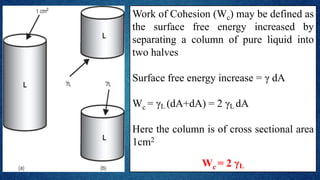
Work of Cohesion (Wc) may be defined as
the surface free energy increased by
separating a column of pure liquid into
two halves
Surface free energy increase = γ dA
Wc = γL (dA+dA) = 2 γL dA
Here the column is of cross sectional area
1cm2
Wc = 2 γL
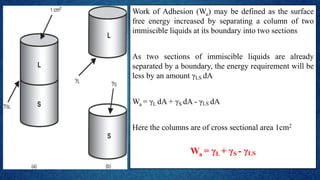
Work of Adhesion (Wa) may be defined as the surface
free energy increased by separating a column of two
immiscible liquids at its boundary into two sections
As two sections of immiscible liquids are already
separated by a boundary, the energy requirement will be
less by an amount γLS dA
Wa = γL dA + γS dA - γLS dA
Here the columns are of cross sectional area 1cm2
Wa = γL + γS - γLS
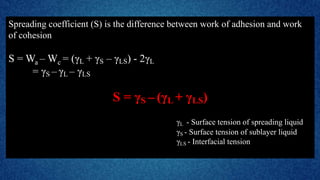
Spreading coefficient (S) is the difference between work of adhesion and work
of cohesion
S = Wa – Wc = (γL + γS – γLS) - 2γL
= γS – γL – γLS
S = γS – (γL + γLS)
γL - Surface tension of spreading liquid
γS - Surface tension of sublayer liquid
γLS - Interfacial tension
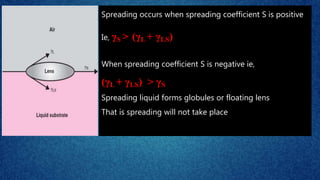
Spreading occurs when spreading coefficient S is positive
Ie, γS > (γL + γLS)
When spreading coefficient S is negative ie,
(γL + γLS) > γS
Spreading liquid forms globules or floating lens
That is spreading will not take place
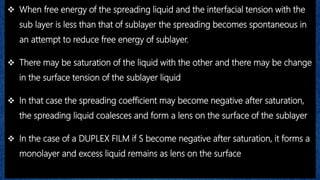
 When free energy of the spreading liquid and the interfacial tension with the
sub layer is less than that of sublayer the spreading becomes spontaneous in
an attempt to reduce free energy of sublayer.
 There may be saturation of the liquid with the other and there may be change
in the surface tension of the sublayer liquid
 In that case the spreading coefficient may become negative after saturation,
the spreading liquid coalesces and form a lens on the surface of the sublayer
 In the case of a DUPLEX FILM if S become negative after saturation, it forms a
monolayer and excess liquid remains as lens on the surface
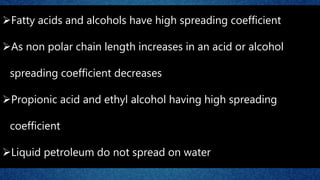
Fatty acids and alcohols have high spreading coefficient
As non polar chain length increases in an acid or alcohol
spreading coefficient decreases
Propionic acid and ethyl alcohol having high spreading
coefficient
Liquid petroleum do not spread on water
APPLICATIONS OF SPREADING COEFFICIENTS
 Absorption of medicament from creams, lotions, etc.
 Stabilization of emulsions
 Coating of tablets

Spreading coefficient

  • 1.
  • 2.
    Spreading Coefficient When Oleicacid dropped on water, it immediately spreads on the surface of water Oleic Acid – Spreading Liquid (L) Water – Sub layer Liquid (S) Generally spreading occurs when adhesive force is more than cohesive force
  • 3.
    Work of Cohesion(Wc) may be defined as the surface free energy increased by separating a column of pure liquid into two halves Surface free energy increase = γ dA Wc = γL (dA+dA) = 2 γL dA Here the column is of cross sectional area 1cm2 Wc = 2 γL
  • 4.
    Work of Adhesion(Wa) may be defined as the surface free energy increased by separating a column of two immiscible liquids at its boundary into two sections As two sections of immiscible liquids are already separated by a boundary, the energy requirement will be less by an amount γLS dA Wa = γL dA + γS dA - γLS dA Here the columns are of cross sectional area 1cm2 Wa = γL + γS - γLS
  • 5.
    Spreading coefficient (S)is the difference between work of adhesion and work of cohesion S = Wa – Wc = (γL + γS – γLS) - 2γL = γS – γL – γLS S = γS – (γL + γLS) γL - Surface tension of spreading liquid γS - Surface tension of sublayer liquid γLS - Interfacial tension
  • 6.
    Spreading occurs whenspreading coefficient S is positive Ie, γS > (γL + γLS) When spreading coefficient S is negative ie, (γL + γLS) > γS Spreading liquid forms globules or floating lens That is spreading will not take place
  • 7.
     When freeenergy of the spreading liquid and the interfacial tension with the sub layer is less than that of sublayer the spreading becomes spontaneous in an attempt to reduce free energy of sublayer.  There may be saturation of the liquid with the other and there may be change in the surface tension of the sublayer liquid  In that case the spreading coefficient may become negative after saturation, the spreading liquid coalesces and form a lens on the surface of the sublayer  In the case of a DUPLEX FILM if S become negative after saturation, it forms a monolayer and excess liquid remains as lens on the surface
  • 8.
    Fatty acids andalcohols have high spreading coefficient As non polar chain length increases in an acid or alcohol spreading coefficient decreases Propionic acid and ethyl alcohol having high spreading coefficient Liquid petroleum do not spread on water
  • 9.
    APPLICATIONS OF SPREADINGCOEFFICIENTS  Absorption of medicament from creams, lotions, etc.  Stabilization of emulsions  Coating of tablets