Solid-Crystalline,
Amorphous &
Polymorphism
PHYSICAL
PHARMACEUTICS-I
Submitted By:-
Suyash Jain
B Pharm(2nd sem)
Department of Pharmaceutical Sciences
Dr. Hari Singh Gour University Sagar(M.P.)
Solid-Crystalline, Amorphous &
Polymorphism
A Solid is one of the four fundamental states of matter characterized by particles
arranged such that their shape and volume are relatively stable.
The elements of a solid tend to be packed together, much closer than the
particles in a gas or liquid.
General Characteristic of Solids
 They have strong intermolecular forces and short inter-nuclear distance
due to close packing of constituent particles.
 Their constituent particles don’t possess translator motion but can
oscillate only around their mean position.
Due to these two basic properties, solids possess the following characteristic
properties:
 They have definite shape, mass and volume.
 They are rigid and incompressible.
 They have high density.
Habet:- Description of outer appearance of crystal with same or different
internal structure.
Habet depends on the conditions like degree of saturation, cooling rate,
agitation, type of solvent and presence of co-solvent.
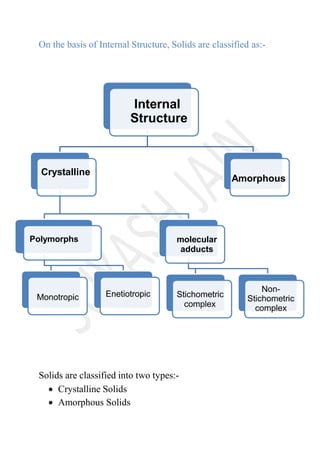
On the basis of Internal Structure, Solids are classified as:-
Solids are classified into two types:-
 Crystalline Solids
 Amorphous Solids
Internal
Structure
Crystalline
Polymorphs
Monotropic Enetiotropic
molecular
adducts
Stichometric
complex
Non-
Stichometric
complex
Amorphous
Crystalline Solids:-
The structural units crystalline solid are arranged in fixed geometric patterns or
lattice. Crystalline solids, unlike liquids and gases, have definite shapes and an
orderly arrangement of units
Eg.- ice, sodium chloride, and menthol,
Main Properties of Crystalline Solids are:-
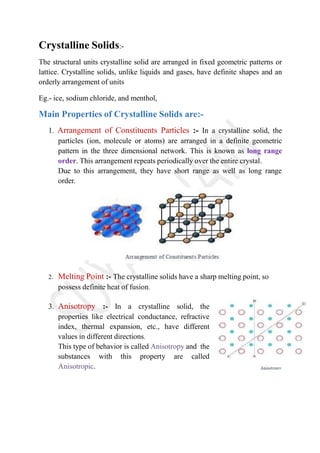
1. Arrangement of Constituents Particles :- In a crystalline solid, the
particles (ion, molecule or atoms) are arranged in a definite geometric
pattern in the three dimensional network. This is known as long range
order. This arrangement repeats periodically over the entire crystal.
Due to this arrangement, they have short range as well as long range
order.
2. Melting Point :- The crystalline solids have a sharp melting point, so
possess definite heat of fusion.
3. Anisotropy :- In a crystalline solid, the
properties like electrical conductance, refractive
index, thermal expansion, etc., have different
values in different directions.
This type of behavior is called Anisotropy and the
substances with this property are called
Anisotropic.
The various crystal forms are divided into six distinct crystal systems. They
are:-
1. Cubic (sodium chloride),
2. Tetragonal (urea),
3. Hexagonal (iodoform),
4. Rhombic (iodine),
5. Monoclinic (sucrose), and
6. Triclinic (boric acid).
The units that constitute the crystal structure can be atoms, molecules, or ions.
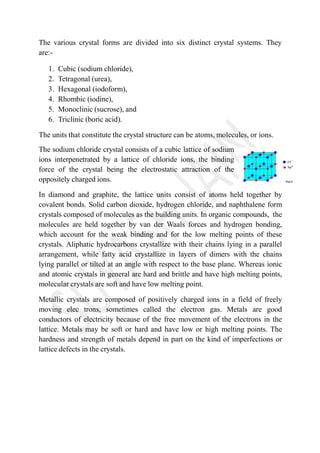
The sodium chloride crystal consists of a cubic lattice of sodium
ions interpenetrated by a lattice of chloride ions, the binding
force of the crystal being the electrostatic attraction of the
oppositely charged ions.
In diamond and graphite, the lattice units consist of atoms held together by
covalent bonds. Solid carbon dioxide, hydrogen chloride, and naphthalene form
crystals composed of molecules as the building units. In organic compounds, the
molecules are held together by van der Waals forces and hydrogen bonding,
which account for the weak binding and for the low melting points of these
crystals. Aliphatic hydrocarbons crystallize with their chains lying in a parallel
arrangement, while fatty acid crystallize in layers of dimers with the chains
lying parallel or tilted at an angle with respect to the base plane. Whereas ionic
and atomic crystals in general are hard and brittle and have high melting points,
molecular crystals are soft and have low melting point.
Metallic crystals are composed of positively charged ions in a field of freely
moving elec trons, sometimes called the electron gas. Metals are good
conductors of electricity because of the free movement of the electrons in the
lattice. Metals may be soft or hard and have low or high melting points. The
hardness and strength of metals depend in part on the kind of imperfections or
lattice defects in the crystals.
Amorphous Solids :- Amorphous solids may be considered as
supercooled liquids in which the molecules are arranged in a random manner
somewhat as in the liquid state.
Eg. glass, pitch, and many synthetic plastics, are amorphoussolids.
Main Properties of Crystalline Solids are:-
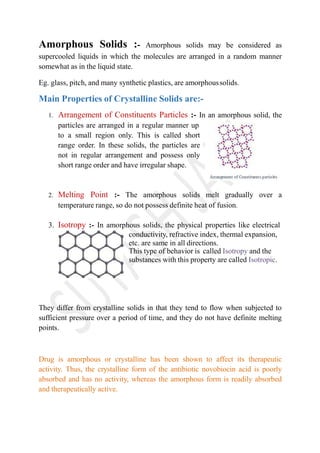
1. Arrangement of Constituents Particles :- In an amorphous solid, the
particles are arranged in a regular manner up
to a small region only. This is called short
range order. In these solids, the particles are
not in regular arrangement and possess only
short range order and have irregular shape.
2. Melting Point :- The amorphous solids melt gradually over a
temperature range, so do not possess definite heat of fusion.
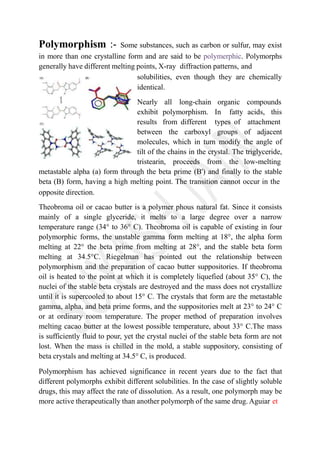
3. Isotropy :- In amorphous solids, the physical properties like electrical
conductivity, refractive index, thermal expansion,
etc. are same in all directions.
This type of behavior is called Isotropy and the
substances with this property are called Isotropic.
They differ from crystalline solids in that they tend to flow when subjected to
sufficient pressure over a period of time, and they do not have definite melting
points.
Drug is amorphous or crystalline has been shown to affect its therapeutic
activity. Thus, the crystalline form of the antibiotic novobiocin acid is poorly
absorbed and has no activity, whereas the amorphous form is readily absorbed
and therapeutically active.
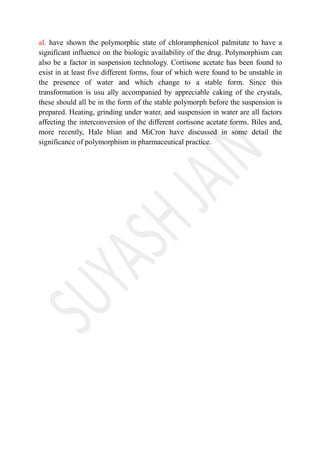
Polymorphism :- Some substances, such as carbon or sulfur, may exist
in more than one crystalline form and are said to be polymerphic. Polymorphs
generally have different melting points, X-ray diffraction patterns, and
solubilities, even though they are chemically
identical.
Nearly
exhibit
results
all long-chain
polymorphism.
from different
organic
In fatty
types of
compounds
acids, this
attachment
between the carboxyl groups of adjacent
molecules, which in turn modify the angle of
tilt of the chains in the crystal. The triglyceride,
tristearin, proceeds from the low-melting
metastable alpha (a) form through the beta prime (B') and finally to the stable
beta (B) form, having a high melting point. The transition cannot occur in the
opposite direction.
Theobroma oil or cacao butter is a polymer phous natural fat. Since it consists
mainly of a single glyceride, it melts to a large degree over a narrow
temperature range (34° to 36° C). Theobroma oil is capable of existing in four
polymorphic forms, the unstable gamma form melting at 18°, the alpha form
melting at 22° the beta prime from melting at 28°, and the stable beta form
melting at 34.5°C. Riegelman has pointed out the relationship between
polymorphism and the preparation of cacao butter suppositories. If theobroma
oil is heated to the point at which it is completely liquefied (about 35° C), the
nuclei of the stable beta crystals are destroyed and the mass does not crystallize
until it is supercooled to about 15° C. The crystals that form are the metastable
gamma, alpha, and beta prime forms, and the suppositories melt at 23° to 24° C
or at ordinary room temperature. The proper method of preparation involves
melting cacao butter at the lowest possible temperature, about 33° C.The mass
is sufficiently fluid to pour, yet the crystal nuclei of the stable beta form are not
lost. When the mass is chilled in the mold, a stable suppository, consisting of
beta crystals and melting at 34.5° C, is produced.
Polymorphism has achieved significance in recent years due to the fact that
different polymorphs exhibit different solubilities. In the case of slightly soluble
drugs, this may affect the rate of dissolution. As a result, one polymorph may be
more active therapeutically than another polymorph of the same drug. Aguiar et
al. have shown the polymorphic state of chloramphenicol palmitate to have a
significant influence on the biologic availability of the drug. Polymorphism can
also be a factor in suspension technology. Cortisone acetate has been found to
exist in at least five different forms, four of which were found to be unstable in
the presence of water and which change to a stable form. Since this
transformation is usu ally accompanied by appreciable caking of the crystals,
these should all be in the form of the stable polymorph before the suspension is
prepared. Heating, grinding under water, and suspension in water are all factors
affecting the interconversion of the different cortisone acetate forms. Biles and,
more recently, Hale blian and MiCron have discussed in some detail the
significance of polymorphism in pharmaceutical practice.
THANK
YOU

Solid-Crystalline, Amorphous & Polymorphism

  • 1.
    Solid-Crystalline, Amorphous & Polymorphism PHYSICAL PHARMACEUTICS-I Submitted By:- SuyashJain B Pharm(2nd sem) Department of Pharmaceutical Sciences Dr. Hari Singh Gour University Sagar(M.P.)
  • 2.
    Solid-Crystalline, Amorphous & Polymorphism ASolid is one of the four fundamental states of matter characterized by particles arranged such that their shape and volume are relatively stable. The elements of a solid tend to be packed together, much closer than the particles in a gas or liquid. General Characteristic of Solids  They have strong intermolecular forces and short inter-nuclear distance due to close packing of constituent particles.  Their constituent particles don’t possess translator motion but can oscillate only around their mean position. Due to these two basic properties, solids possess the following characteristic properties:  They have definite shape, mass and volume.  They are rigid and incompressible.  They have high density. Habet:- Description of outer appearance of crystal with same or different internal structure. Habet depends on the conditions like degree of saturation, cooling rate, agitation, type of solvent and presence of co-solvent.
  • 3.
    On the basisof Internal Structure, Solids are classified as:- Solids are classified into two types:-  Crystalline Solids  Amorphous Solids Internal Structure Crystalline Polymorphs Monotropic Enetiotropic molecular adducts Stichometric complex Non- Stichometric complex Amorphous
  • 4.
    Crystalline Solids:- The structuralunits crystalline solid are arranged in fixed geometric patterns or lattice. Crystalline solids, unlike liquids and gases, have definite shapes and an orderly arrangement of units Eg.- ice, sodium chloride, and menthol, Main Properties of Crystalline Solids are:- 1. Arrangement of Constituents Particles :- In a crystalline solid, the particles (ion, molecule or atoms) are arranged in a definite geometric pattern in the three dimensional network. This is known as long range order. This arrangement repeats periodically over the entire crystal. Due to this arrangement, they have short range as well as long range order. 2. Melting Point :- The crystalline solids have a sharp melting point, so possess definite heat of fusion. 3. Anisotropy :- In a crystalline solid, the properties like electrical conductance, refractive index, thermal expansion, etc., have different values in different directions. This type of behavior is called Anisotropy and the substances with this property are called Anisotropic.
  • 5.
    The various crystalforms are divided into six distinct crystal systems. They are:- 1. Cubic (sodium chloride), 2. Tetragonal (urea), 3. Hexagonal (iodoform), 4. Rhombic (iodine), 5. Monoclinic (sucrose), and 6. Triclinic (boric acid). The units that constitute the crystal structure can be atoms, molecules, or ions. The sodium chloride crystal consists of a cubic lattice of sodium ions interpenetrated by a lattice of chloride ions, the binding force of the crystal being the electrostatic attraction of the oppositely charged ions. In diamond and graphite, the lattice units consist of atoms held together by covalent bonds. Solid carbon dioxide, hydrogen chloride, and naphthalene form crystals composed of molecules as the building units. In organic compounds, the molecules are held together by van der Waals forces and hydrogen bonding, which account for the weak binding and for the low melting points of these crystals. Aliphatic hydrocarbons crystallize with their chains lying in a parallel arrangement, while fatty acid crystallize in layers of dimers with the chains lying parallel or tilted at an angle with respect to the base plane. Whereas ionic and atomic crystals in general are hard and brittle and have high melting points, molecular crystals are soft and have low melting point. Metallic crystals are composed of positively charged ions in a field of freely moving elec trons, sometimes called the electron gas. Metals are good conductors of electricity because of the free movement of the electrons in the lattice. Metals may be soft or hard and have low or high melting points. The hardness and strength of metals depend in part on the kind of imperfections or lattice defects in the crystals.
  • 6.
    Amorphous Solids :-Amorphous solids may be considered as supercooled liquids in which the molecules are arranged in a random manner somewhat as in the liquid state. Eg. glass, pitch, and many synthetic plastics, are amorphoussolids. Main Properties of Crystalline Solids are:- 1. Arrangement of Constituents Particles :- In an amorphous solid, the particles are arranged in a regular manner up to a small region only. This is called short range order. In these solids, the particles are not in regular arrangement and possess only short range order and have irregular shape. 2. Melting Point :- The amorphous solids melt gradually over a temperature range, so do not possess definite heat of fusion. 3. Isotropy :- In amorphous solids, the physical properties like electrical conductivity, refractive index, thermal expansion, etc. are same in all directions. This type of behavior is called Isotropy and the substances with this property are called Isotropic. They differ from crystalline solids in that they tend to flow when subjected to sufficient pressure over a period of time, and they do not have definite melting points. Drug is amorphous or crystalline has been shown to affect its therapeutic activity. Thus, the crystalline form of the antibiotic novobiocin acid is poorly absorbed and has no activity, whereas the amorphous form is readily absorbed and therapeutically active.
  • 7.
    Polymorphism :- Somesubstances, such as carbon or sulfur, may exist in more than one crystalline form and are said to be polymerphic. Polymorphs generally have different melting points, X-ray diffraction patterns, and solubilities, even though they are chemically identical. Nearly exhibit results all long-chain polymorphism. from different organic In fatty types of compounds acids, this attachment between the carboxyl groups of adjacent molecules, which in turn modify the angle of tilt of the chains in the crystal. The triglyceride, tristearin, proceeds from the low-melting metastable alpha (a) form through the beta prime (B') and finally to the stable beta (B) form, having a high melting point. The transition cannot occur in the opposite direction. Theobroma oil or cacao butter is a polymer phous natural fat. Since it consists mainly of a single glyceride, it melts to a large degree over a narrow temperature range (34° to 36° C). Theobroma oil is capable of existing in four polymorphic forms, the unstable gamma form melting at 18°, the alpha form melting at 22° the beta prime from melting at 28°, and the stable beta form melting at 34.5°C. Riegelman has pointed out the relationship between polymorphism and the preparation of cacao butter suppositories. If theobroma oil is heated to the point at which it is completely liquefied (about 35° C), the nuclei of the stable beta crystals are destroyed and the mass does not crystallize until it is supercooled to about 15° C. The crystals that form are the metastable gamma, alpha, and beta prime forms, and the suppositories melt at 23° to 24° C or at ordinary room temperature. The proper method of preparation involves melting cacao butter at the lowest possible temperature, about 33° C.The mass is sufficiently fluid to pour, yet the crystal nuclei of the stable beta form are not lost. When the mass is chilled in the mold, a stable suppository, consisting of beta crystals and melting at 34.5° C, is produced. Polymorphism has achieved significance in recent years due to the fact that different polymorphs exhibit different solubilities. In the case of slightly soluble drugs, this may affect the rate of dissolution. As a result, one polymorph may be more active therapeutically than another polymorph of the same drug. Aguiar et
  • 8.
    al. have shownthe polymorphic state of chloramphenicol palmitate to have a significant influence on the biologic availability of the drug. Polymorphism can also be a factor in suspension technology. Cortisone acetate has been found to exist in at least five different forms, four of which were found to be unstable in the presence of water and which change to a stable form. Since this transformation is usu ally accompanied by appreciable caking of the crystals, these should all be in the form of the stable polymorph before the suspension is prepared. Heating, grinding under water, and suspension in water are all factors affecting the interconversion of the different cortisone acetate forms. Biles and, more recently, Hale blian and MiCron have discussed in some detail the significance of polymorphism in pharmaceutical practice.
  • 9.