Critical micelle
concentration
Presented By
Guided By
MS. KRUTIKA H. PARDESHI MRS.S.B.SANDHAN
M.Pharm(Pharmaceutics) (Assistant professor)
Sem -II, Roll no. 37
NDMVP SAMAJ’S COLLEGE OF PHARMACY, NASHIK
M.Pharm Semester II -seminar
CONTENT
• Introduction
• Micelle
- Micelle formation
- Process of micellization
- Structure of micelle
- Mechanism of micelle formation
- Types of micelle
• Critical micelle concentration (CMC)
- Introduction
- Determination of CMC
- Factors affecting CMC
• Conclusion
• References
2
• INTRODUCTION
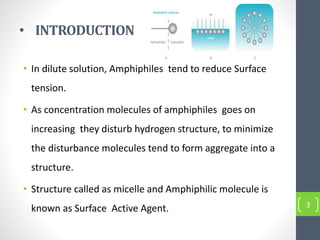
• In dilute solution, Amphiphiles tend to reduce Surface
tension.
• As concentration molecules of amphiphiles goes on
increasing they disturb hydrogen structure, to minimize
the disturbance molecules tend to form aggregate into a
structure.
• Structure called as micelle and Amphiphilic molecule is
known as Surface Active Agent. 3
4
1.Surfactants-:
Surfactants are usually organic compounds that are
amphiphilic , meaning they contain both hydrophobic
groups (their tails) and hydrophilic groups (their heads).
2.Micelle -:
A micelle is an electrically charged particle formed by an
aggregate of molecules, above a critical concentration and
occurring in certain colloidal electrolyte solutions,
especially those of soaps and detergents.
3.Critical Micelle Concentration-:
Critical Micelle Concentration is the concentration at
which the surface becomes completely loaded with
surfactant and any further additions must arrange as
micelles.
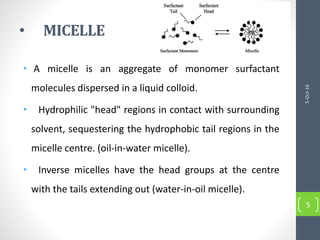
• MICELLE
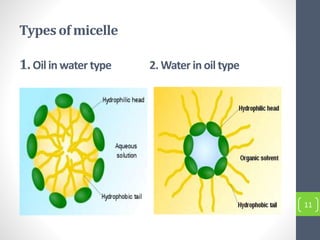
• A micelle is an aggregate of monomer surfactant
molecules dispersed in a liquid colloid.
• Hydrophilic "head" regions in contact with surrounding
solvent, sequestering the hydrophobic tail regions in the
micelle centre. (oil-in-water micelle).
• Inverse micelles have the head groups at the centre
with the tails extending out (water-in-oil micelle).
5-Oct-16
5
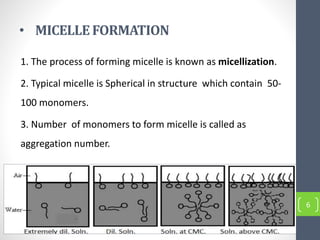
• MICELLE FORMATION
1. The process of forming micelle is known as micellization.
2. Typical micelle is Spherical in structure which contain 50-
100 monomers.
3. Number of monomers to form micelle is called as
aggregation number.
6
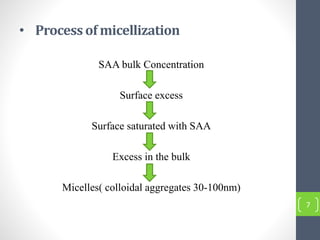
• Processof micellization
7
SAA bulk Concentration
Surface excess
Surface saturated with SAA
Excess in the bulk
Micelles( colloidal aggregates 30-100nm)
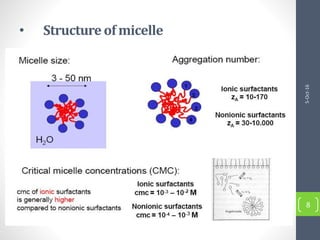
• Structureof micelle
5-Oct-16
8
• MICELLEFORMATIONMECHANISM.
9
10
Typesof micelle
1. Oil in water type 2. Water in oil type
11
• Criticalmicelle concentration(CMC)
• The lowest concentration at which micelles first appear is
called the critical concentration for micelle formation
• The critical micelle concentration is the point at which
surfactant molecules aggregate together in the liquid to form
groups known as micelles.
12
• The critical micelle concentration of a surfactant
indicates the point at which surface active properties are
at an optimum and performance is maximised.
• The CMC is the concentration above surfactant when
micelles will form spontaneously.
• Increase in concentration of surfactant beyond CMC
change number size or shape but not provide increase in
concentration of monomeric species 13
• The CMC is an important characteristic of a surfactant.
• Before reaching the CMC, the surface tension changes
strongly with the concentration of the surfactant.
• The value of the CMC for a given dispersant in a given medium
depends on temperature, pressure, and (sometimes strongly)
on the presence and concentration of other surface active
substances and electrolytes.
• Micelles only form above critical micelle temperature.
For example, the value of CMC for sodium dodecyl sulfate in
water (no other additives or salts) at 25 °C, atmospheric
pressure,
is 8x10⁻³ mol/L. 14
• Upon introduction of surfactants (or any surface active materials)
into the system, they will initially partition into the interface,
reducing the system free energy by:
1. lowering the energy of the interface (calculated as
area times surface tension), and
2. removing the hydrophobic parts of the surfactant
from contact with water.
• Subsequently, when the surface coverage by the surfactants
increases, the surface free energy (surface tension) decreases and
the surfactants start aggregating into micelles, thus again decreasing
the system's free energy by decreasing the contact area of
hydrophobic parts of the surfactant with water.
• Upon reaching CMC, any further addition of surfactants will just
increase the number of micelles (in the ideal case). 15
16
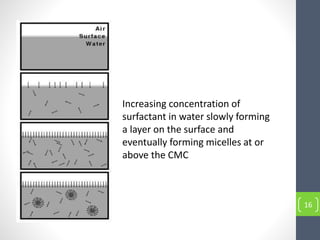
Increasing concentration of
surfactant in water slowly forming
a layer on the surface and
eventually forming micelles at or
above the CMC
• Determinationof the CMC
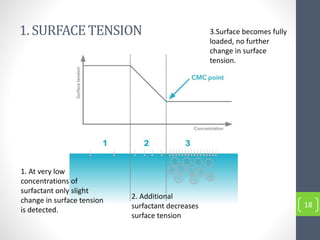
• Micelles are formed at the critical micelle concentration
(CMC), which is detected as an inflection point in physical
properties which are plotted as a function of
concentration.
• surface tension,
• Conductivity,
• Turbidity
17
1. SURFACETENSION
18
1. At very low
concentrations of
surfactant only slight
change in surface tension
is detected.
2. Additional
surfactant decreases
surface tension
3.Surface becomes fully
loaded, no further
change in surface
tension.
• CONDUCTIVITY
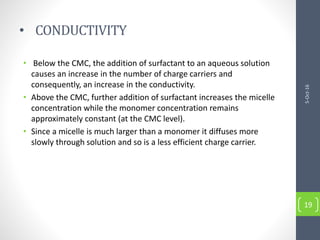
• Below the CMC, the addition of surfactant to an aqueous solution
causes an increase in the number of charge carriers and
consequently, an increase in the conductivity.
• Above the CMC, further addition of surfactant increases the micelle
concentration while the monomer concentration remains
approximately constant (at the CMC level).
• Since a micelle is much larger than a monomer it diffuses more
slowly through solution and so is a less efficient charge carrier.
5-Oct-16
19
• TURBIDITY
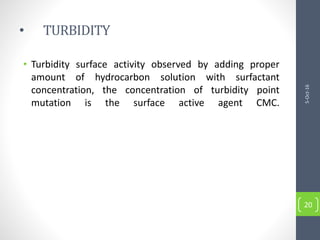
• Turbidity surface activity observed by adding proper
amount of hydrocarbon solution with surfactant
concentration, the concentration of turbidity point
mutation is the surface active agent CMC.
5-Oct-16
20
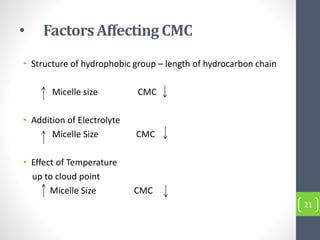
• Factors Affecting CMC
• Structure of hydrophobic group – length of hydrocarbon chain
Micelle size CMC
• Addition of Electrolyte
Micelle Size CMC
• Effect of Temperature
up to cloud point
Micelle Size CMC
21
• References
1. Ana Domínguez, Aurora Fernández, et.al., "Determination of
Critical Micelle Concentration of Some Surfactants by Three
Techniques", Journal of Chemical Education,1997,
74(10):1227-1231
2. Hakiki, F., Maharsi, et.al., “Surfactant-Polymer Coreflood
Simulation and Uncertainty Analysis Derived from
Laboratory Study” Journal of Engineering and Technological
Sciences. 2016, 47(6):706-724.
3. Mukerjee, P.; Mysels, K. J. “Critical Micelle Concentrations of
Aqueous Surfactant Systems” NIST National Institute of
Standards and Technology: Washington D.C. USA,: 36
22
4. M.E. Aulton, “Pharmaceutics science of dosage form
design”, 2nd Edition, churchill livingstone publication, page
no:88-89
5. Leon Lachman, H. A. Liberman, “The Theory and Practice of
Industrial Pharmacy”,verghese publication house, 3rd
edition, page no:106
6. Sanjay K. Jain, Vandana Soni, “Benley’s Text Book of
Pharmaceutics”, 1st edition, elesvier publication,page no:68-
74
23
24

Micelle and Critical Micelle Concentration

  • 1.
    Critical micelle concentration Presented By GuidedBy MS. KRUTIKA H. PARDESHI MRS.S.B.SANDHAN M.Pharm(Pharmaceutics) (Assistant professor) Sem -II, Roll no. 37 NDMVP SAMAJ’S COLLEGE OF PHARMACY, NASHIK M.Pharm Semester II -seminar
  • 2.
    CONTENT • Introduction • Micelle -Micelle formation - Process of micellization - Structure of micelle - Mechanism of micelle formation - Types of micelle • Critical micelle concentration (CMC) - Introduction - Determination of CMC - Factors affecting CMC • Conclusion • References 2
  • 3.
    • INTRODUCTION • Indilute solution, Amphiphiles tend to reduce Surface tension. • As concentration molecules of amphiphiles goes on increasing they disturb hydrogen structure, to minimize the disturbance molecules tend to form aggregate into a structure. • Structure called as micelle and Amphiphilic molecule is known as Surface Active Agent. 3
  • 4.
    4 1.Surfactants-: Surfactants are usuallyorganic compounds that are amphiphilic , meaning they contain both hydrophobic groups (their tails) and hydrophilic groups (their heads). 2.Micelle -: A micelle is an electrically charged particle formed by an aggregate of molecules, above a critical concentration and occurring in certain colloidal electrolyte solutions, especially those of soaps and detergents. 3.Critical Micelle Concentration-: Critical Micelle Concentration is the concentration at which the surface becomes completely loaded with surfactant and any further additions must arrange as micelles.
  • 5.
    • MICELLE • Amicelle is an aggregate of monomer surfactant molecules dispersed in a liquid colloid. • Hydrophilic "head" regions in contact with surrounding solvent, sequestering the hydrophobic tail regions in the micelle centre. (oil-in-water micelle). • Inverse micelles have the head groups at the centre with the tails extending out (water-in-oil micelle). 5-Oct-16 5
  • 6.
    • MICELLE FORMATION 1.The process of forming micelle is known as micellization. 2. Typical micelle is Spherical in structure which contain 50- 100 monomers. 3. Number of monomers to form micelle is called as aggregation number. 6
  • 7.
    • Processof micellization 7 SAAbulk Concentration Surface excess Surface saturated with SAA Excess in the bulk Micelles( colloidal aggregates 30-100nm)
  • 8.
  • 9.
  • 10.
  • 11.
    Typesof micelle 1. Oilin water type 2. Water in oil type 11
  • 12.
    • Criticalmicelle concentration(CMC) •The lowest concentration at which micelles first appear is called the critical concentration for micelle formation • The critical micelle concentration is the point at which surfactant molecules aggregate together in the liquid to form groups known as micelles. 12
  • 13.
    • The criticalmicelle concentration of a surfactant indicates the point at which surface active properties are at an optimum and performance is maximised. • The CMC is the concentration above surfactant when micelles will form spontaneously. • Increase in concentration of surfactant beyond CMC change number size or shape but not provide increase in concentration of monomeric species 13
  • 14.
    • The CMCis an important characteristic of a surfactant. • Before reaching the CMC, the surface tension changes strongly with the concentration of the surfactant. • The value of the CMC for a given dispersant in a given medium depends on temperature, pressure, and (sometimes strongly) on the presence and concentration of other surface active substances and electrolytes. • Micelles only form above critical micelle temperature. For example, the value of CMC for sodium dodecyl sulfate in water (no other additives or salts) at 25 °C, atmospheric pressure, is 8x10⁻³ mol/L. 14
  • 15.
    • Upon introductionof surfactants (or any surface active materials) into the system, they will initially partition into the interface, reducing the system free energy by: 1. lowering the energy of the interface (calculated as area times surface tension), and 2. removing the hydrophobic parts of the surfactant from contact with water. • Subsequently, when the surface coverage by the surfactants increases, the surface free energy (surface tension) decreases and the surfactants start aggregating into micelles, thus again decreasing the system's free energy by decreasing the contact area of hydrophobic parts of the surfactant with water. • Upon reaching CMC, any further addition of surfactants will just increase the number of micelles (in the ideal case). 15
  • 16.
    16 Increasing concentration of surfactantin water slowly forming a layer on the surface and eventually forming micelles at or above the CMC
  • 17.
    • Determinationof theCMC • Micelles are formed at the critical micelle concentration (CMC), which is detected as an inflection point in physical properties which are plotted as a function of concentration. • surface tension, • Conductivity, • Turbidity 17
  • 18.
    1. SURFACETENSION 18 1. Atvery low concentrations of surfactant only slight change in surface tension is detected. 2. Additional surfactant decreases surface tension 3.Surface becomes fully loaded, no further change in surface tension.
  • 19.
    • CONDUCTIVITY • Belowthe CMC, the addition of surfactant to an aqueous solution causes an increase in the number of charge carriers and consequently, an increase in the conductivity. • Above the CMC, further addition of surfactant increases the micelle concentration while the monomer concentration remains approximately constant (at the CMC level). • Since a micelle is much larger than a monomer it diffuses more slowly through solution and so is a less efficient charge carrier. 5-Oct-16 19
  • 20.
    • TURBIDITY • Turbiditysurface activity observed by adding proper amount of hydrocarbon solution with surfactant concentration, the concentration of turbidity point mutation is the surface active agent CMC. 5-Oct-16 20
  • 21.
    • Factors AffectingCMC • Structure of hydrophobic group – length of hydrocarbon chain Micelle size CMC • Addition of Electrolyte Micelle Size CMC • Effect of Temperature up to cloud point Micelle Size CMC 21
  • 22.
    • References 1. AnaDomínguez, Aurora Fernández, et.al., "Determination of Critical Micelle Concentration of Some Surfactants by Three Techniques", Journal of Chemical Education,1997, 74(10):1227-1231 2. Hakiki, F., Maharsi, et.al., “Surfactant-Polymer Coreflood Simulation and Uncertainty Analysis Derived from Laboratory Study” Journal of Engineering and Technological Sciences. 2016, 47(6):706-724. 3. Mukerjee, P.; Mysels, K. J. “Critical Micelle Concentrations of Aqueous Surfactant Systems” NIST National Institute of Standards and Technology: Washington D.C. USA,: 36 22
  • 23.
    4. M.E. Aulton,“Pharmaceutics science of dosage form design”, 2nd Edition, churchill livingstone publication, page no:88-89 5. Leon Lachman, H. A. Liberman, “The Theory and Practice of Industrial Pharmacy”,verghese publication house, 3rd edition, page no:106 6. Sanjay K. Jain, Vandana Soni, “Benley’s Text Book of Pharmaceutics”, 1st edition, elesvier publication,page no:68- 74 23
  • 24.