Coarse Dispersion
(Dr.) Mirza Salman Baig
Assistant Professor (Pharmaceutics)
AIKTC, School of Pharmacy,New Panvel
Affiliated to University of Mumbai (INDIA)
2
Ø Definition.
Ø Classification.
Ø Theoretic consideration of
suspensions
Ø Formulation of suspensions
•Sedimentation
•Brownian movement
•Electrokinetic properties
CONTENTS
33
WHY WE ARE USING SUSPENSIONS?
44
Ø The suspended particles should not settle rapidly and
sediment produced, must be easily re-suspended by the use
of moderate amount of shaking.
Ø It should be easy to pour yet not watery and no grittiness.
Ø It should have pleasing odour , colour and palatability.
Ø Good syringeability.
Ø It should be physically,chemically and microbiologically
stable.
Ø Parenteral /Ophthalmic suspension should be sterilizable.
Features Desired In Pharmaceutical
Suspensions
2018-4-14
WHAT ARE SUSPENSIONS?
6
• The term "Disperse System" refers
to a system in which one substance
(The Dispersed Phase) is
distributed, in discrete units,
throughout a second substance (the
continuous Phase ).
• Suspensions are heterogenous
system consisting of 2 phases.
6
DISPERSE SYSTEM
77
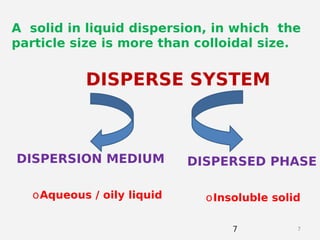
A solid in liquid dispersion, in which the
particle size is more than colloidal size.
DISPERSE SYSTEM
DISPERSION MEDIUM DISPERSED PHASE
oAqueous / oily liquid oInsoluble solid
88
Definition
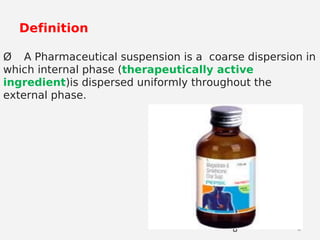
Ø A Pharmaceutical suspension is a coarse dispersion in
which internal phase (therapeutically active
ingredient)is dispersed uniformly throughout the
external phase.
9
Ø The internal phase consisting of
insoluble solid particles having a range
of size(0.5 to 5 microns) which is
maintained uniformly through out the
suspending vehicle with aid of single
or combination of suspending agent.
Ø The external phase (suspending
medium) is generally aqueous in some
instance, may be an organic or oily
liquid for non oral use.
9
10
Classification
•Based particle size of dispersed
phase
Coarse dispersion
Collidal dispersion
Molecular dispersion
• Based On Electrokinetic Nature Of
Solid Particles
Flocculated suspension
Deflocculated suspension
2018-4-14
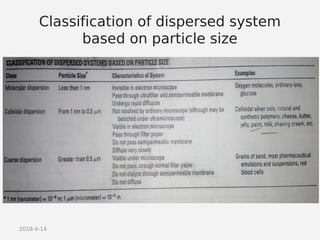
Classification of dispersed system
based on particle size
12
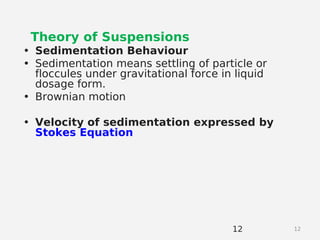
Theory of Suspensions
• Sedimentation Behaviour
• Sedimentation means settling of particle or
floccules under gravitational force in liquid
dosage form.
• Brownian motion
• Velocity of sedimentation expressed by
Stokes Equation
12
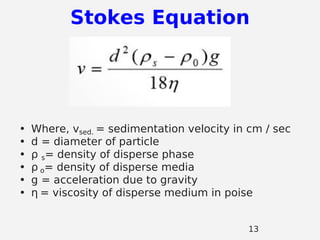
• Where, vsed. = sedimentation velocity in cm / sec
• d = diameter of particle
• ρ s= density of disperse phase
• ρ o= density of disperse media
• g = acceleration due to gravity
• η = viscosity of disperse medium in poise
Stokes Equation
13
14
Limitation of Stoke’s Equation .
Stoke's equation applies only to:
Spherical particles in a very dilute suspension
(0.5 to 2 gm per 100 ml)
Ø Particles which freely settle without collision .
Ø Particles with no physical or chemical
attraction.
1515
Sedimentation Parameters
Sedimentation volume (F) or height (H)
for flocculated suspensions:
Definition:
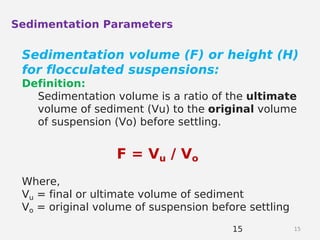
Sedimentation volume is a ratio of the ultimate
volume of sediment (Vu) to the original volume
of suspension (Vo) before settling.
F = Vu / Vo
Where,
Vu = final or ultimate volume of sediment
Vo = original volume of suspension before settling
1616
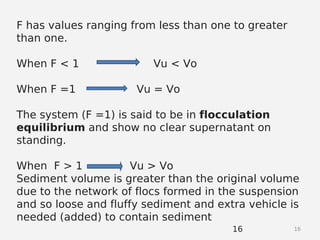
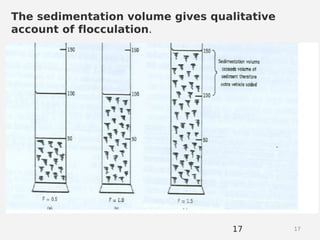
F has values ranging from less than one to greater
than one.
When F < 1 Vu < Vo
When F =1 Vu = Vo
The system (F =1) is said to be in flocculation
equilibrium and show no clear supernatant on
standing.
When F > 1 Vu > Vo
Sediment volume is greater than the original volume
due to the network of flocs formed in the suspension
and so loose and fluffy sediment and extra vehicle is
needed (added) to contain sediment
1717
The sedimentation volume gives qualitative
account of flocculation.
1818
Degree of flocculation (β)
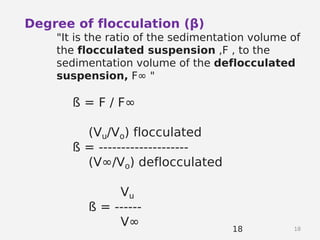
"It is the ratio of the sedimentation volume of
the flocculated suspension ,F , to the
sedimentation volume of the deflocculated
suspension, F∞ "
ß = F / F∞
(Vu/Vo) flocculated
ß = --------------------
(V∞/Vo) deflocculated
Vu
ß = ------
V∞
2018-4-14
Degree of flocculation
Note: The minimum value of ß is
1,when flocculated suspension
sedimentation volume is equal to
the sedimentation volume of
deflocculated suspension.
2020
.
Thermodynamic and kinetic stability of
dispersed systems
Brownian Movement
Brownian movement of particle prevents sedimentation
by keeping the dispersed material in random motion.
Brownian movement depends on the density of
dispersed phase and the density and viscosity of
the disperse medium.
The kinetic bombardment of the particles by the
molecules of the suspending medium will keep the
particles suspending,
Particle size is below critical radius (r) for brownian
movement.
2121
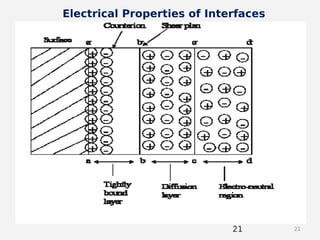
Electrical Properties of Interfaces
2018-4-14
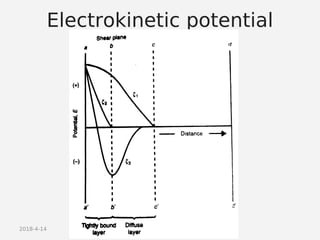
Electrical Properties of Interfaces:
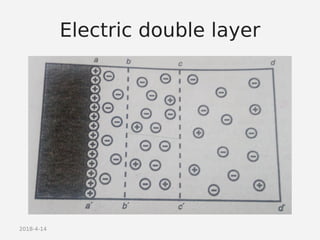
Electric double layer
• Consider solid surface in contact with solution of electrolyte
containing ions
• Some cations (+) adsorb on solid surface
• Adsorbe ions that give charge to surface aa' (in this case
cations +) known as potential determining ions.
• Anions attracted to positive charge by electrical force of
attraction known as counter ions or gegenions .
• Shear plane is bb' rather than aa' because of tightly bound
layer
• First layer is aa' to bb'
• Second layer is bb' to cc'... more negative chargr is present
in this layer in this case.
2018-4-14
Electric double layer
2018-4-14
Nerst potential
• Potential at solid surface due to aa'
due to potential determining ions is
known as nerst potential
• It is define as potential difference
between actual surface and electro
nutral region
2018-4-14
Zeta potential
Ø The zeta potential is defined as the
difference in potential between the
surface of the tightly bound layer
(shear plane) and electro-neutral
region of the solution.
Ø Zeta potential has practical
application in stability of systems
containing dispersed particles .
2626
Ø If the zeta potential is reduced below a certain
value, the attractive forces exceed the repulsive
forces, and the particles come together. This
phenomenon is known as flocculation
Ø The flocculated suspension is one in which zeta
potential of particle is -20 to +20 mV
Ø Thus the phenomenon of flocculation and
deflocculation depends on zeta potential carried
by particles.
Zeta potential
2018-4-14
Electrokinetic potential
28
28
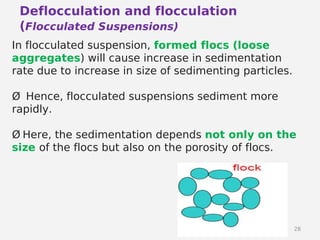
In flocculated suspension, formed flocs (loose
aggregates) will cause increase in sedimentation
rate due to increase in size of sedimenting particles.
Ø Hence, flocculated suspensions sediment more
rapidly.
Ø Here, the sedimentation depends not only on the
size of the flocs but also on the porosity of flocs.
Deflocculation and flocculation
(Flocculated Suspensions)
2929
Deflocculated suspensions
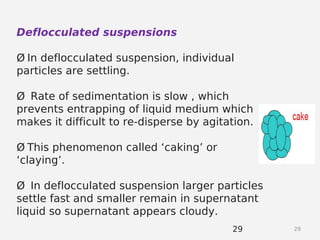
Ø In deflocculated suspension, individual
particles are settling.
Ø Rate of sedimentation is slow , which
prevents entrapping of liquid medium which
makes it difficult to re-disperse by agitation.
Ø This phenomenon called ‘caking’ or
‘claying’.
Ø In deflocculated suspension larger particles
settle fast and smaller remain in supernatant
liquid so supernatant appears cloudy.
2018-4-14
DLVO theory
• DLVO theory was developed in
the 1940s and named after the
• Russian scientists
– B. Derjaguin
– L. Landau,
• Dutch scientists
– E. Verwey
– J. Overbeek),
2018-4-14
DLVO
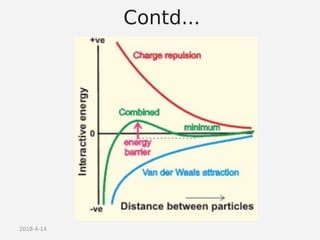
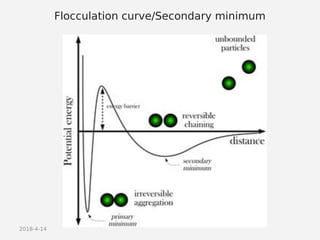
• It proposed that an energy barrier resulting from
the electrostatic repulsive force prevents two
particles approaching one another and adhering
together.
• If the particles collide with sufficient energy to
overcome the barrier, the Van der Waals attractive
force will attract them strongly and cause
them adhere together irreversibly.
• If the particles repel each other strongly, the
dispersion will resist coagulation and the
dispersed system will be stable.
• If the repulsion is not sufficient then coagulation will
take place.
2018-4-14
Contd...
2018-4-14
Flocculation curve/Secondary minimum
2018-4-14
Need of Controlled Flocculation
• Assume powder is properly wetted
and dispersed
• In order to prevent compact
sediment we need controlled
flocculation
2018-4-14
Controlled Flocculation
• Electrolytes (ionic substance) act as
flocculating agents by reducing
electrical barrier between particles...
by decresing zeta potential and
forming bridge between adjascent
particles
• Surfactant
• Polymer
2018-4-14
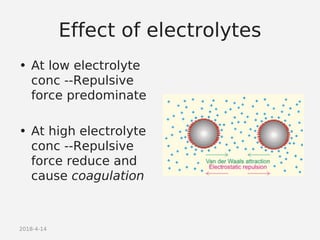
• At low electrolyte
conc --Repulsive
force predominate
• At high electrolyte
conc --Repulsive
force reduce and
cause coagulation
Effect of electrolytes
2018-4-14
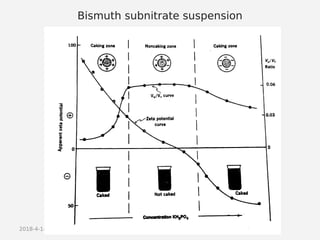
Bismuth subnitrate suspension
2018-4-14
Effect of electrolytes
• Bismuth sub nitrate particles posses
+ve charge
• If we add monobasic potassium
phosphate (KH2PO4) then positive
zeta potential decrease to zero
because of adsorption of -ve
phosphate ions then increase in
negative direction
• At certain +ve zeta potential,
maximum flocculation occur
2018-4-14
Effect of electrolytes
• Onset of flocculation coincide with
maximum sedimentation volume
• When zeta potential become
sufficiently -ve repeptization
(deflocculation) occur once again and
sedimentation volume(F) falls
2018-4-14
Effect of Surfactant
• Surfactant improve dispersion by
reducing surface tension
• Act as wetting and deflocculating
agent
• Ionic surfactant (SLS) sometime
cause flocculation
2018-4-14
Effect of Polymers
• Act as flocculating agent
• Chain of polymer adsorb on multiple
particles
• Ex. Xanthum gum
2018-4-14
Physical stability of suspensions
• Raising temperature leads to
flocculation of sterically stabilized (by
non ionic surfactant) suspension
• Repulsion force depend upon amount
of surfactant adsorbed on particles
• On heating energy of repulsion
reduces because of dehydration of
surfactant, attraction increases and
particles flocculate
2018-4-14
Physical stability of suspensions
• During freezing processes particle
overcome repulsive barrier due to ice
formation.
• Particles come close enough and
experience attractive force like in
primary minimum and form
aggregates as per DLVO theory
2018-4-14
Oswald ripening
• Fluctuation in temperature changes
particle size distribution in
suspension.
• Particle growth is common if solubility
is temperature dependant.
• When temperature is high, small
particles dissolve to form saturated
solution.
• When temperature reduces solute
deposit on large crystals hence crystal
size increases for large size crystals
2018-4-14
Oswald ripening
• Oswald ripenning can be reduced by
adding polymer or surfactant
• Polymer (PVP) segment adsorb on
drug (acetaminophen)
• Hydration sheeth present around
polymer molecule
• Polymer inhibit approach of drug
molecule from solution to crystal
surface for deposition
2018-4-14
Excipients
• Stability of suspension decrease
because of interaction with
excipients
• If low cloud point surfactant is used
then less amount of sorbitol is
needed to induce flocculation
• Amount of preservative
(Benzalkonium Cl ) can change zeta
potential

Coarse dispersion

  • 1.
    Coarse Dispersion (Dr.) MirzaSalman Baig Assistant Professor (Pharmaceutics) AIKTC, School of Pharmacy,New Panvel Affiliated to University of Mumbai (INDIA)
  • 2.
    2 Ø Definition. Ø Classification. ØTheoretic consideration of suspensions Ø Formulation of suspensions •Sedimentation •Brownian movement •Electrokinetic properties CONTENTS
  • 3.
    33 WHY WE AREUSING SUSPENSIONS?
  • 4.
    44 Ø The suspendedparticles should not settle rapidly and sediment produced, must be easily re-suspended by the use of moderate amount of shaking. Ø It should be easy to pour yet not watery and no grittiness. Ø It should have pleasing odour , colour and palatability. Ø Good syringeability. Ø It should be physically,chemically and microbiologically stable. Ø Parenteral /Ophthalmic suspension should be sterilizable. Features Desired In Pharmaceutical Suspensions
  • 5.
  • 6.
    6 • The term"Disperse System" refers to a system in which one substance (The Dispersed Phase) is distributed, in discrete units, throughout a second substance (the continuous Phase ). • Suspensions are heterogenous system consisting of 2 phases. 6 DISPERSE SYSTEM
  • 7.
    77 A solid inliquid dispersion, in which the particle size is more than colloidal size. DISPERSE SYSTEM DISPERSION MEDIUM DISPERSED PHASE oAqueous / oily liquid oInsoluble solid
  • 8.
    88 Definition Ø A Pharmaceuticalsuspension is a coarse dispersion in which internal phase (therapeutically active ingredient)is dispersed uniformly throughout the external phase.
  • 9.
    9 Ø The internalphase consisting of insoluble solid particles having a range of size(0.5 to 5 microns) which is maintained uniformly through out the suspending vehicle with aid of single or combination of suspending agent. Ø The external phase (suspending medium) is generally aqueous in some instance, may be an organic or oily liquid for non oral use. 9
  • 10.
    10 Classification •Based particle sizeof dispersed phase Coarse dispersion Collidal dispersion Molecular dispersion • Based On Electrokinetic Nature Of Solid Particles Flocculated suspension Deflocculated suspension
  • 11.
    2018-4-14 Classification of dispersedsystem based on particle size
  • 12.
    12 Theory of Suspensions •Sedimentation Behaviour • Sedimentation means settling of particle or floccules under gravitational force in liquid dosage form. • Brownian motion • Velocity of sedimentation expressed by Stokes Equation 12
  • 13.
    • Where, vsed.= sedimentation velocity in cm / sec • d = diameter of particle • ρ s= density of disperse phase • ρ o= density of disperse media • g = acceleration due to gravity • η = viscosity of disperse medium in poise Stokes Equation 13
  • 14.
    14 Limitation of Stoke’sEquation . Stoke's equation applies only to: Spherical particles in a very dilute suspension (0.5 to 2 gm per 100 ml) Ø Particles which freely settle without collision . Ø Particles with no physical or chemical attraction.
  • 15.
    1515 Sedimentation Parameters Sedimentation volume(F) or height (H) for flocculated suspensions: Definition: Sedimentation volume is a ratio of the ultimate volume of sediment (Vu) to the original volume of suspension (Vo) before settling. F = Vu / Vo Where, Vu = final or ultimate volume of sediment Vo = original volume of suspension before settling
  • 16.
    1616 F has valuesranging from less than one to greater than one. When F < 1 Vu < Vo When F =1 Vu = Vo The system (F =1) is said to be in flocculation equilibrium and show no clear supernatant on standing. When F > 1 Vu > Vo Sediment volume is greater than the original volume due to the network of flocs formed in the suspension and so loose and fluffy sediment and extra vehicle is needed (added) to contain sediment
  • 17.
    1717 The sedimentation volumegives qualitative account of flocculation.
  • 18.
    1818 Degree of flocculation(β) "It is the ratio of the sedimentation volume of the flocculated suspension ,F , to the sedimentation volume of the deflocculated suspension, F∞ " ß = F / F∞ (Vu/Vo) flocculated ß = -------------------- (V∞/Vo) deflocculated Vu ß = ------ V∞
  • 19.
    2018-4-14 Degree of flocculation Note:The minimum value of ß is 1,when flocculated suspension sedimentation volume is equal to the sedimentation volume of deflocculated suspension.
  • 20.
    2020 . Thermodynamic and kineticstability of dispersed systems Brownian Movement Brownian movement of particle prevents sedimentation by keeping the dispersed material in random motion. Brownian movement depends on the density of dispersed phase and the density and viscosity of the disperse medium. The kinetic bombardment of the particles by the molecules of the suspending medium will keep the particles suspending, Particle size is below critical radius (r) for brownian movement.
  • 21.
  • 22.
    2018-4-14 Electrical Properties ofInterfaces: Electric double layer • Consider solid surface in contact with solution of electrolyte containing ions • Some cations (+) adsorb on solid surface • Adsorbe ions that give charge to surface aa' (in this case cations +) known as potential determining ions. • Anions attracted to positive charge by electrical force of attraction known as counter ions or gegenions . • Shear plane is bb' rather than aa' because of tightly bound layer • First layer is aa' to bb' • Second layer is bb' to cc'... more negative chargr is present in this layer in this case.
  • 23.
  • 24.
    2018-4-14 Nerst potential • Potentialat solid surface due to aa' due to potential determining ions is known as nerst potential • It is define as potential difference between actual surface and electro nutral region
  • 25.
    2018-4-14 Zeta potential Ø Thezeta potential is defined as the difference in potential between the surface of the tightly bound layer (shear plane) and electro-neutral region of the solution. Ø Zeta potential has practical application in stability of systems containing dispersed particles .
  • 26.
    2626 Ø If thezeta potential is reduced below a certain value, the attractive forces exceed the repulsive forces, and the particles come together. This phenomenon is known as flocculation Ø The flocculated suspension is one in which zeta potential of particle is -20 to +20 mV Ø Thus the phenomenon of flocculation and deflocculation depends on zeta potential carried by particles. Zeta potential
  • 27.
  • 28.
    28 28 In flocculated suspension,formed flocs (loose aggregates) will cause increase in sedimentation rate due to increase in size of sedimenting particles. Ø Hence, flocculated suspensions sediment more rapidly. Ø Here, the sedimentation depends not only on the size of the flocs but also on the porosity of flocs. Deflocculation and flocculation (Flocculated Suspensions)
  • 29.
    2929 Deflocculated suspensions Ø Indeflocculated suspension, individual particles are settling. Ø Rate of sedimentation is slow , which prevents entrapping of liquid medium which makes it difficult to re-disperse by agitation. Ø This phenomenon called ‘caking’ or ‘claying’. Ø In deflocculated suspension larger particles settle fast and smaller remain in supernatant liquid so supernatant appears cloudy.
  • 30.
    2018-4-14 DLVO theory • DLVOtheory was developed in the 1940s and named after the • Russian scientists – B. Derjaguin – L. Landau, • Dutch scientists – E. Verwey – J. Overbeek),
  • 31.
    2018-4-14 DLVO • It proposedthat an energy barrier resulting from the electrostatic repulsive force prevents two particles approaching one another and adhering together. • If the particles collide with sufficient energy to overcome the barrier, the Van der Waals attractive force will attract them strongly and cause them adhere together irreversibly. • If the particles repel each other strongly, the dispersion will resist coagulation and the dispersed system will be stable. • If the repulsion is not sufficient then coagulation will take place.
  • 32.
  • 33.
  • 34.
    2018-4-14 Need of ControlledFlocculation • Assume powder is properly wetted and dispersed • In order to prevent compact sediment we need controlled flocculation
  • 35.
    2018-4-14 Controlled Flocculation • Electrolytes(ionic substance) act as flocculating agents by reducing electrical barrier between particles... by decresing zeta potential and forming bridge between adjascent particles • Surfactant • Polymer
  • 36.
    2018-4-14 • At lowelectrolyte conc --Repulsive force predominate • At high electrolyte conc --Repulsive force reduce and cause coagulation Effect of electrolytes
  • 37.
  • 38.
    2018-4-14 Effect of electrolytes •Bismuth sub nitrate particles posses +ve charge • If we add monobasic potassium phosphate (KH2PO4) then positive zeta potential decrease to zero because of adsorption of -ve phosphate ions then increase in negative direction • At certain +ve zeta potential, maximum flocculation occur
  • 39.
    2018-4-14 Effect of electrolytes •Onset of flocculation coincide with maximum sedimentation volume • When zeta potential become sufficiently -ve repeptization (deflocculation) occur once again and sedimentation volume(F) falls
  • 40.
    2018-4-14 Effect of Surfactant •Surfactant improve dispersion by reducing surface tension • Act as wetting and deflocculating agent • Ionic surfactant (SLS) sometime cause flocculation
  • 41.
    2018-4-14 Effect of Polymers •Act as flocculating agent • Chain of polymer adsorb on multiple particles • Ex. Xanthum gum
  • 42.
    2018-4-14 Physical stability ofsuspensions • Raising temperature leads to flocculation of sterically stabilized (by non ionic surfactant) suspension • Repulsion force depend upon amount of surfactant adsorbed on particles • On heating energy of repulsion reduces because of dehydration of surfactant, attraction increases and particles flocculate
  • 43.
    2018-4-14 Physical stability ofsuspensions • During freezing processes particle overcome repulsive barrier due to ice formation. • Particles come close enough and experience attractive force like in primary minimum and form aggregates as per DLVO theory
  • 44.
    2018-4-14 Oswald ripening • Fluctuationin temperature changes particle size distribution in suspension. • Particle growth is common if solubility is temperature dependant. • When temperature is high, small particles dissolve to form saturated solution. • When temperature reduces solute deposit on large crystals hence crystal size increases for large size crystals
  • 45.
    2018-4-14 Oswald ripening • Oswaldripenning can be reduced by adding polymer or surfactant • Polymer (PVP) segment adsorb on drug (acetaminophen) • Hydration sheeth present around polymer molecule • Polymer inhibit approach of drug molecule from solution to crystal surface for deposition
  • 46.
    2018-4-14 Excipients • Stability ofsuspension decrease because of interaction with excipients • If low cloud point surfactant is used then less amount of sorbitol is needed to induce flocculation • Amount of preservative (Benzalkonium Cl ) can change zeta potential