Smt. B.N.B. Swaminarayan pharmacy college 1
STABILITY OF COLLOIDS
(LYOPHOBIC):DLVO THEORY
Name : Pratik B. Gondaliya
Utkarsh B. Kikani
Sem : 6th sem
College : Smt. B.N.B Swaminarayan
pharmacy college , Salvav.
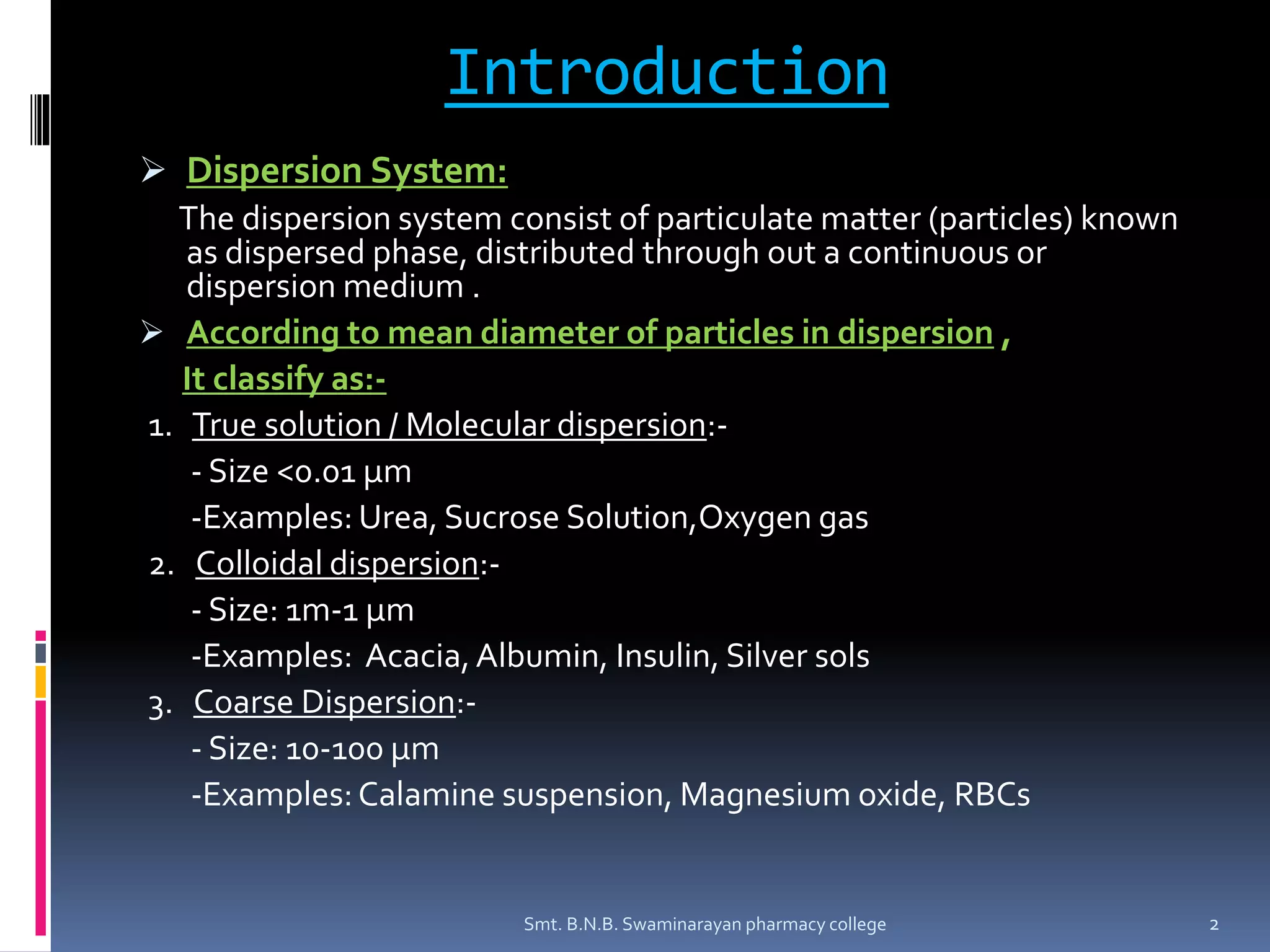
Introduction
 Dispersion System:
The dispersion system consist of particulate matter (particles) known
as dispersed phase, distributed through out a continuous or
dispersion medium .
 According to mean diameter of particles in dispersion ,
It classify as:-
1. True solution / Molecular dispersion:-
- Size <0.01 μm
-Examples: Urea, Sucrose Solution,Oxygen gas
2. Colloidal dispersion:-
- Size: 1m-1 μm
-Examples: Acacia,Albumin, Insulin, Silver sols
3. Coarse Dispersion:-
- Size: 10-100 μm
-Examples:Calamine suspension, Magnesium oxide, RBCs
Smt. B.N.B. Swaminarayan pharmacy college 2
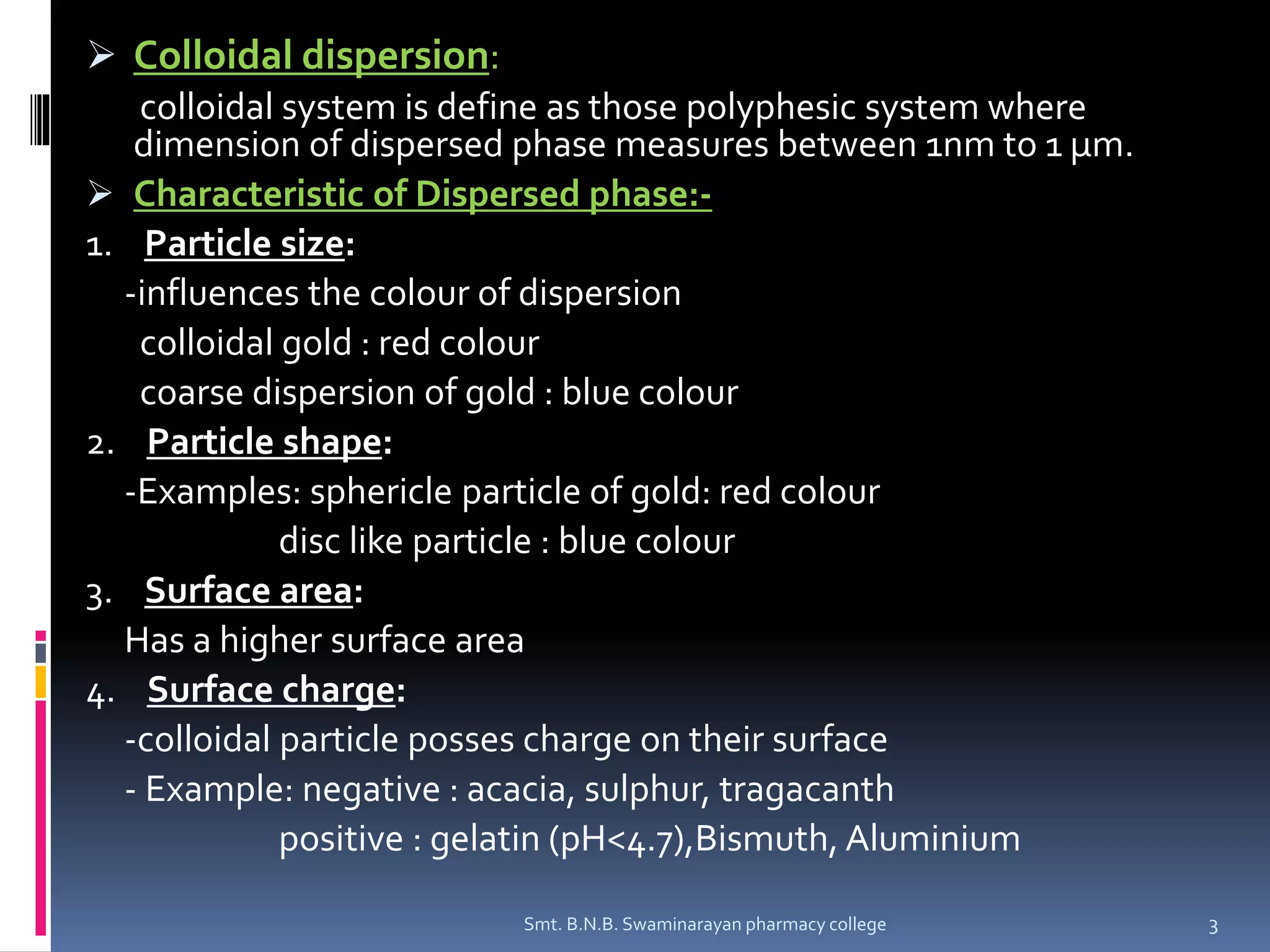
 Colloidal dispersion:
colloidal system is define as those polyphesic system where
dimension of dispersed phase measures between 1nm to 1 μm.
 Characteristic of Dispersed phase:-
1. Particle size:
-influences the colour of dispersion
colloidal gold : red colour
coarse dispersion of gold : blue colour
2. Particle shape:
-Examples: sphericle particle of gold: red colour
disc like particle : blue colour
3. Surface area:
Has a higher surface area
4. Surface charge:
-colloidal particle posses charge on their surface
- Example: negative : acacia, sulphur, tragacanth
positive : gelatin (pH<4.7),Bismuth, Aluminium
Smt. B.N.B. Swaminarayan pharmacy college 3
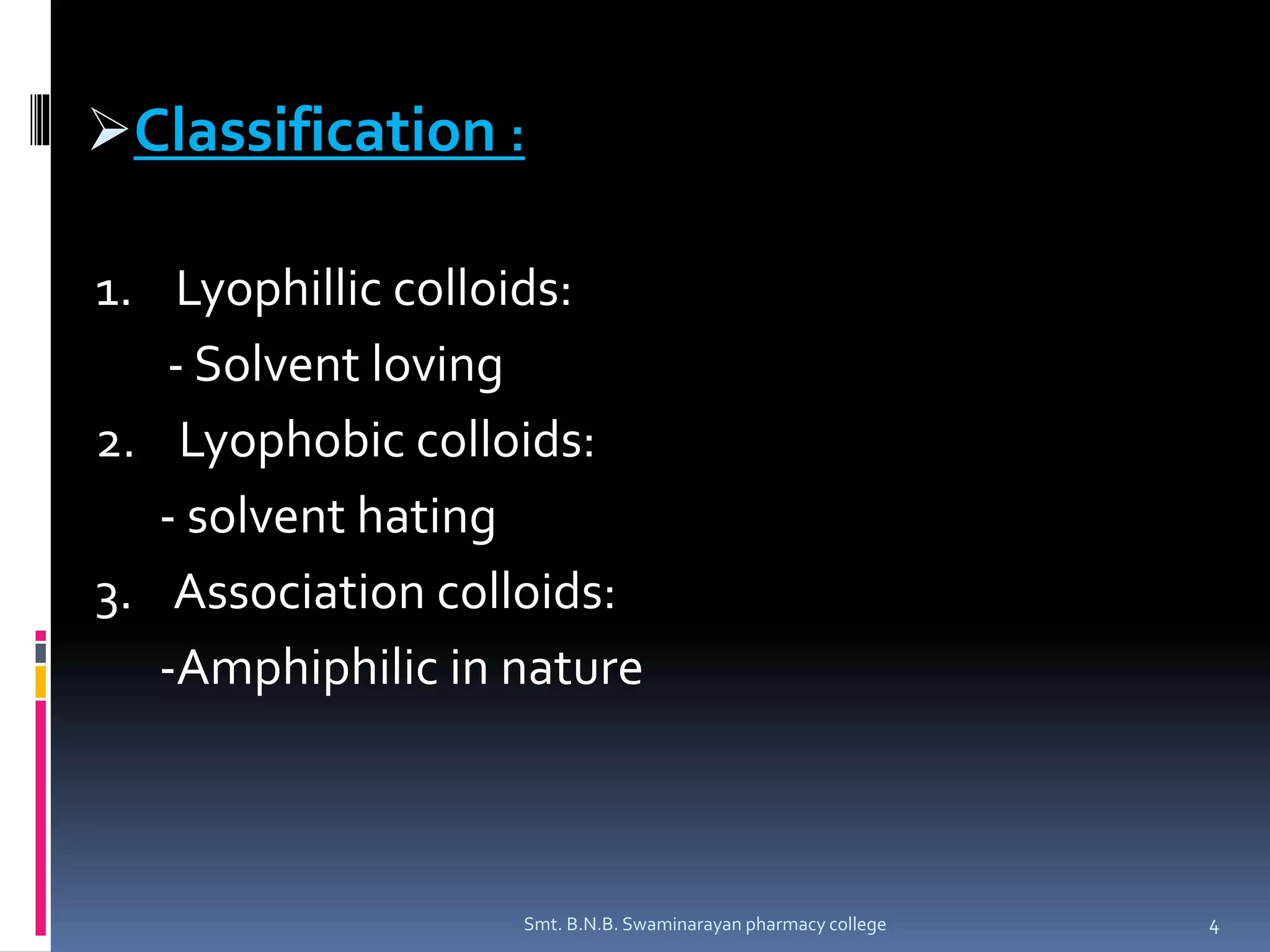
Classification :
1. Lyophillic colloids:
- Solvent loving
2. Lyophobic colloids:
- solvent hating
3. Association colloids:
-Amphiphilic in nature
Smt. B.N.B. Swaminarayan pharmacy college 4
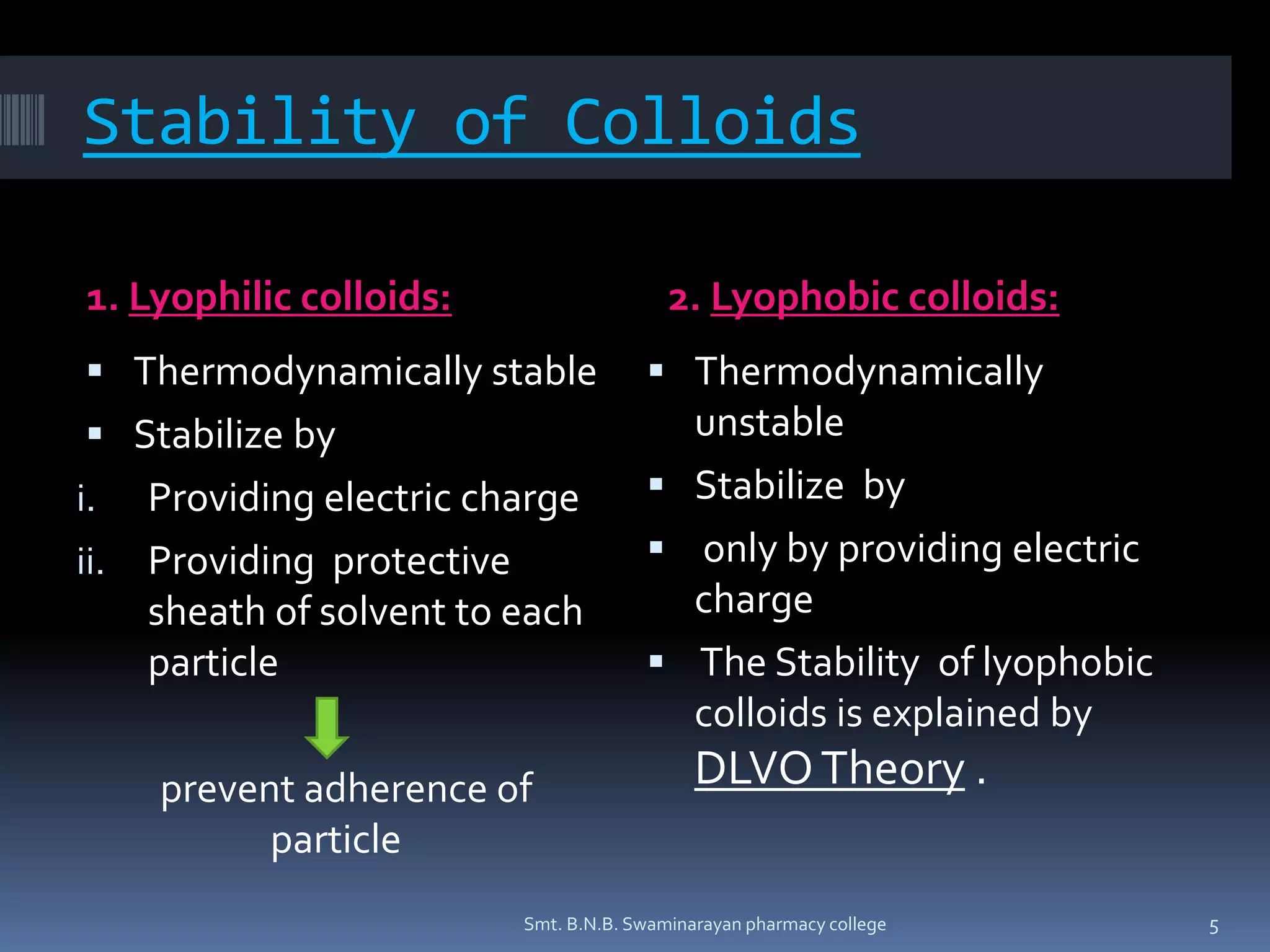
Stability of Colloids
1. Lyophilic colloids: 2. Lyophobic colloids:
 Thermodynamically stable
 Stabilize by
i. Providing electric charge
ii. Providing protective
sheath of solvent to each
particle
prevent adherence of
particle
 Thermodynamically
unstable
 Stabilize by
 only by providing electric
charge
 The Stability of lyophobic
colloids is explained by
DLVOTheory .
Smt. B.N.B. Swaminarayan pharmacy college 5
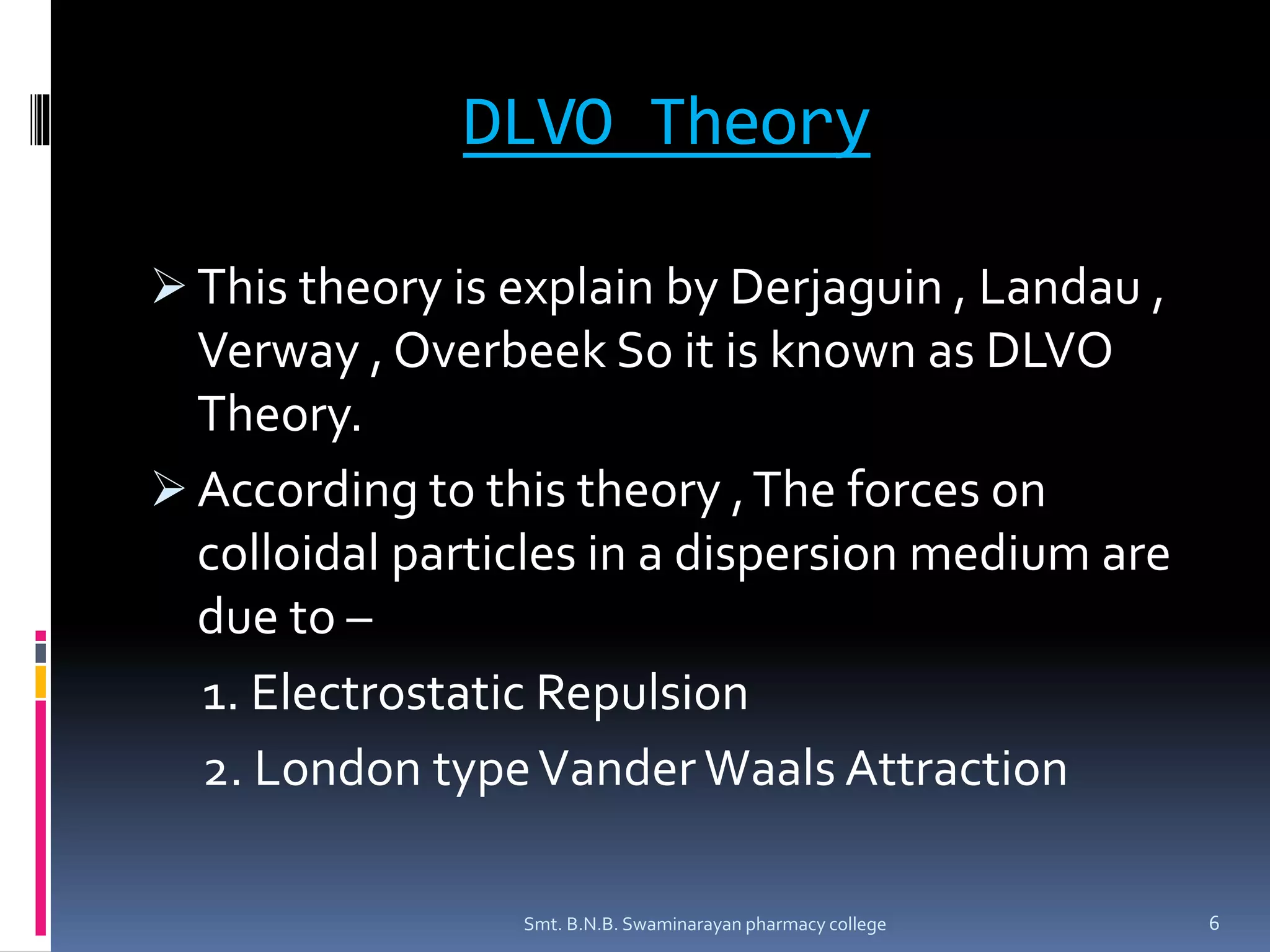
DLVO Theory
 This theory is explain by Derjaguin , Landau ,
Verway , Overbeek So it is known as DLVO
Theory.
 According to this theory ,The forces on
colloidal particles in a dispersion medium are
due to –
1. Electrostatic Repulsion
2. London typeVander Waals Attraction
Smt. B.N.B. Swaminarayan pharmacy college 6
Zeta Potential
 The potential difference across an electric
double layer usually between solid surface
and liquid.
 It should be optimum, increase or decrease in
zeta potential leads to instability in
suspension
 Range : -30 to +30 mV.
Smt. B.N.B. Swaminarayan pharmacy college 7
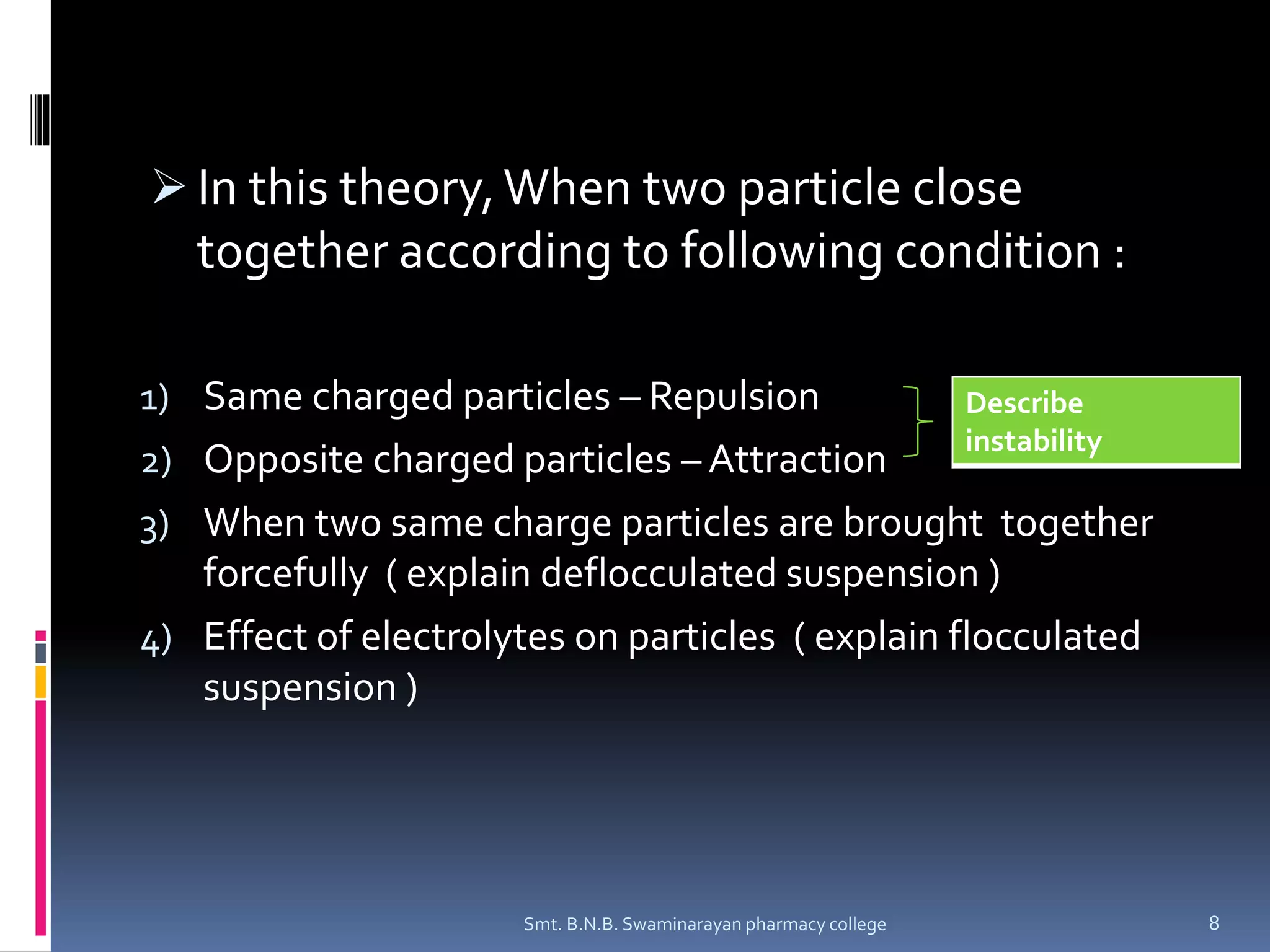
 In this theory,When two particle close
together according to following condition :
1) Same charged particles – Repulsion
2) Opposite charged particles – Attraction
3) When two same charge particles are brought together
forcefully ( explain deflocculated suspension )
4) Effect of electrolytes on particles ( explain flocculated
suspension )
Smt. B.N.B. Swaminarayan pharmacy college 8
Describe
instability
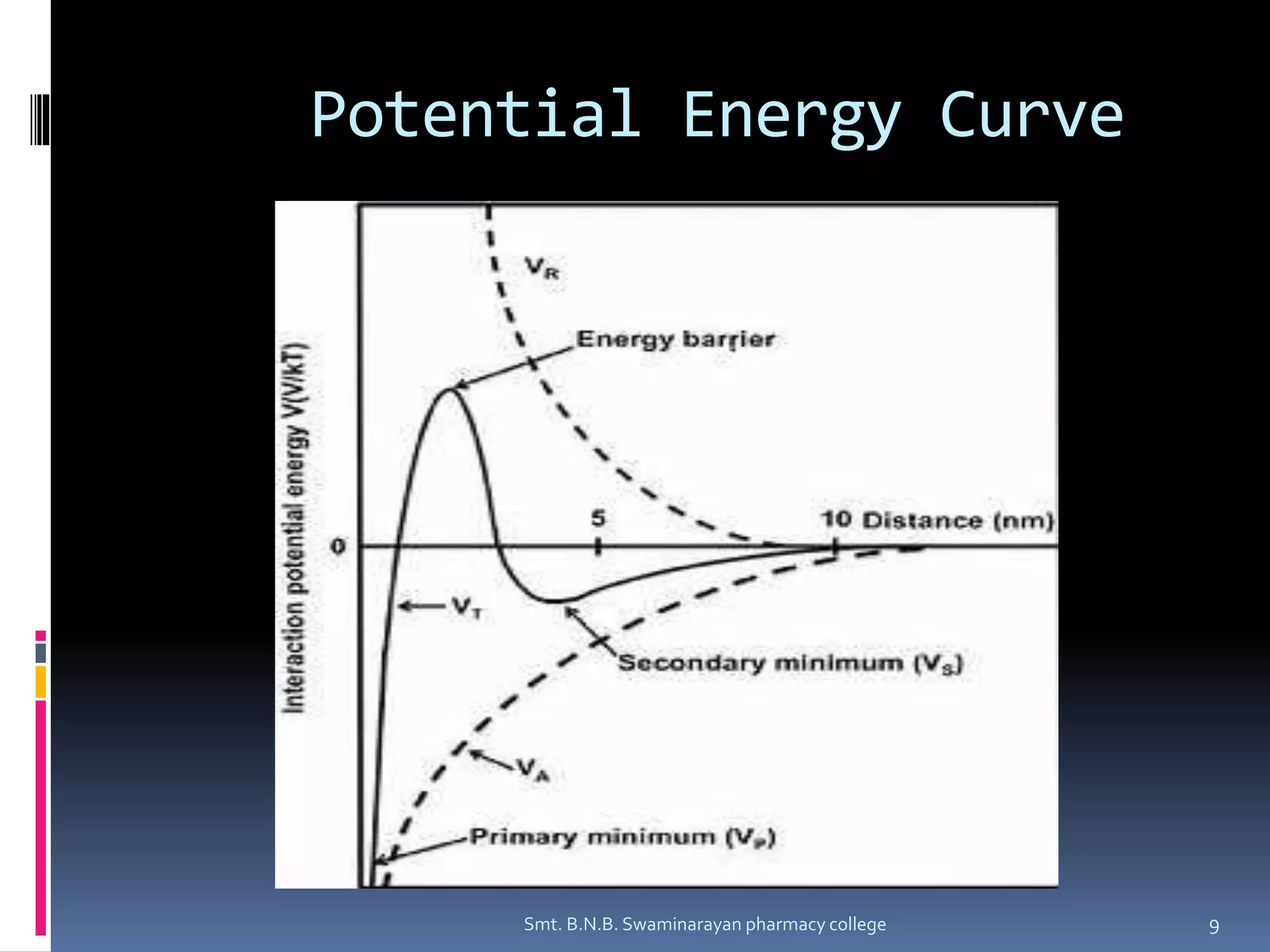
Potential Energy Curve
Smt. B.N.B. Swaminarayan pharmacy college 9
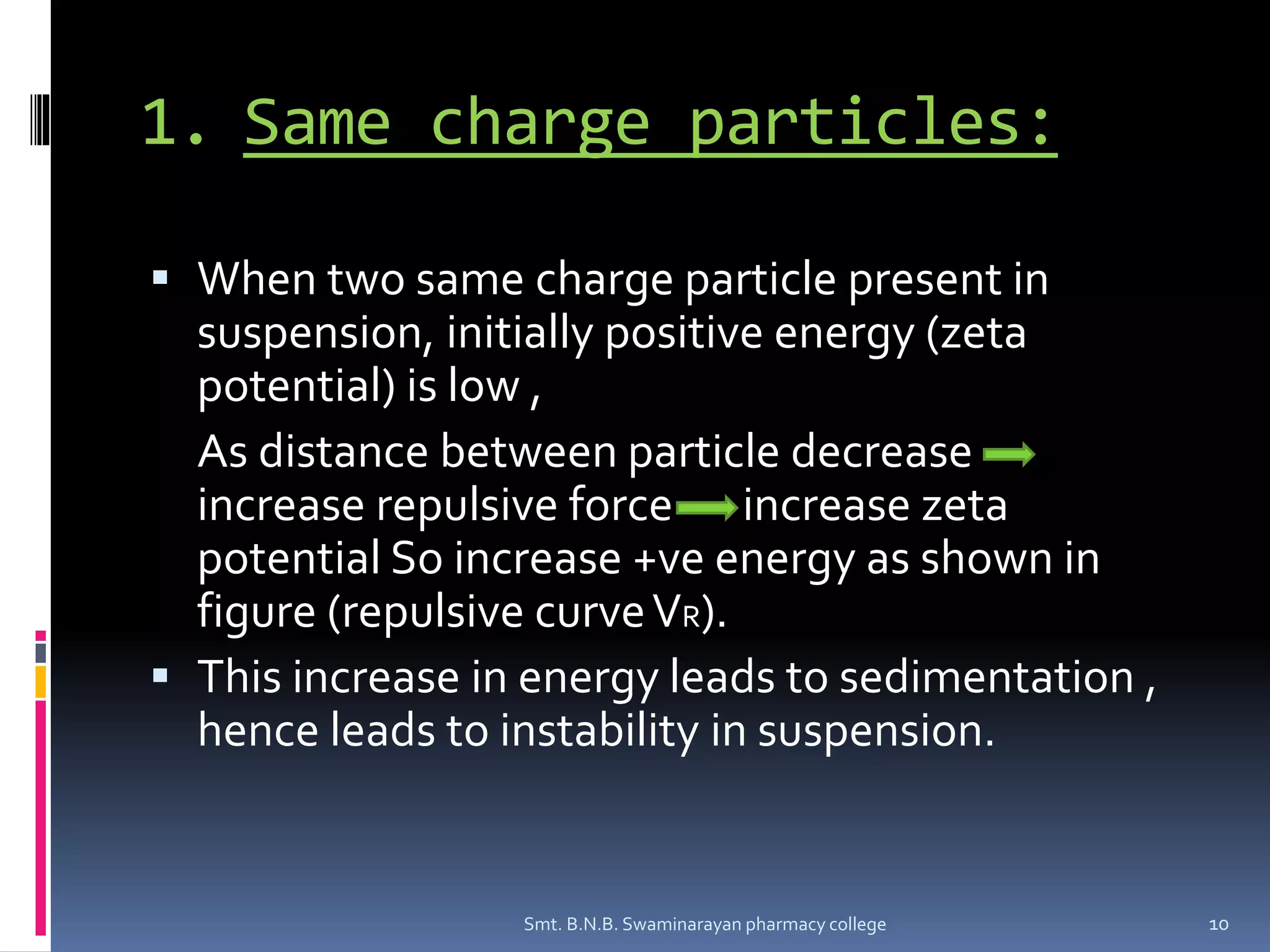
1. Same charge particles:
 When two same charge particle present in
suspension, initially positive energy (zeta
potential) is low ,
As distance between particle decrease
increase repulsive force increase zeta
potential So increase +ve energy as shown in
figure (repulsive curveVR).
 This increase in energy leads to sedimentation ,
hence leads to instability in suspension.
Smt. B.N.B. Swaminarayan pharmacy college 10
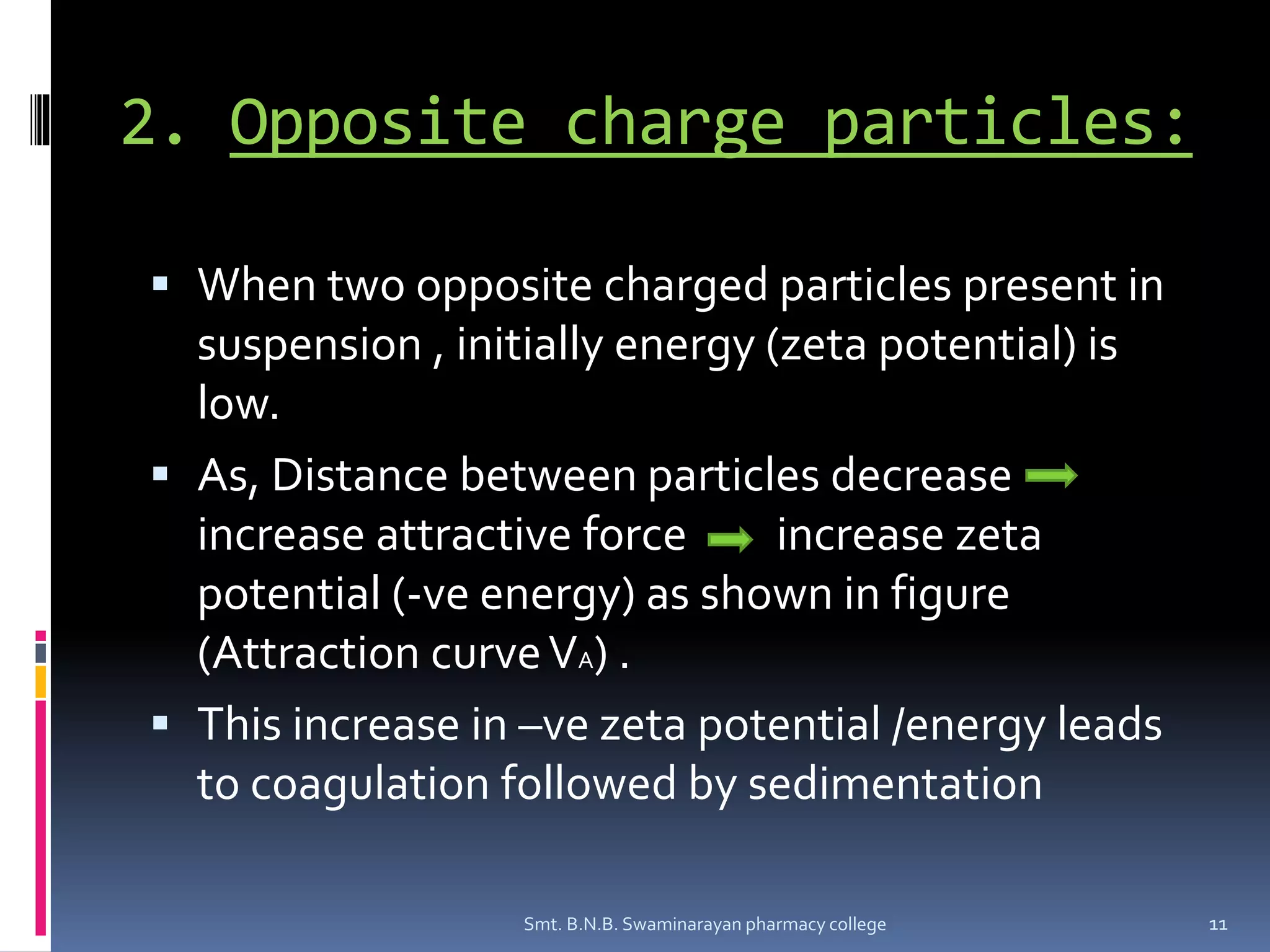
2. Opposite charge particles:
 When two opposite charged particles present in
suspension , initially energy (zeta potential) is
low.
 As, Distance between particles decrease
increase attractive force increase zeta
potential (-ve energy) as shown in figure
(Attraction curveVA) .
 This increase in –ve zeta potential /energy leads
to coagulation followed by sedimentation
Smt. B.N.B. Swaminarayan pharmacy college 11
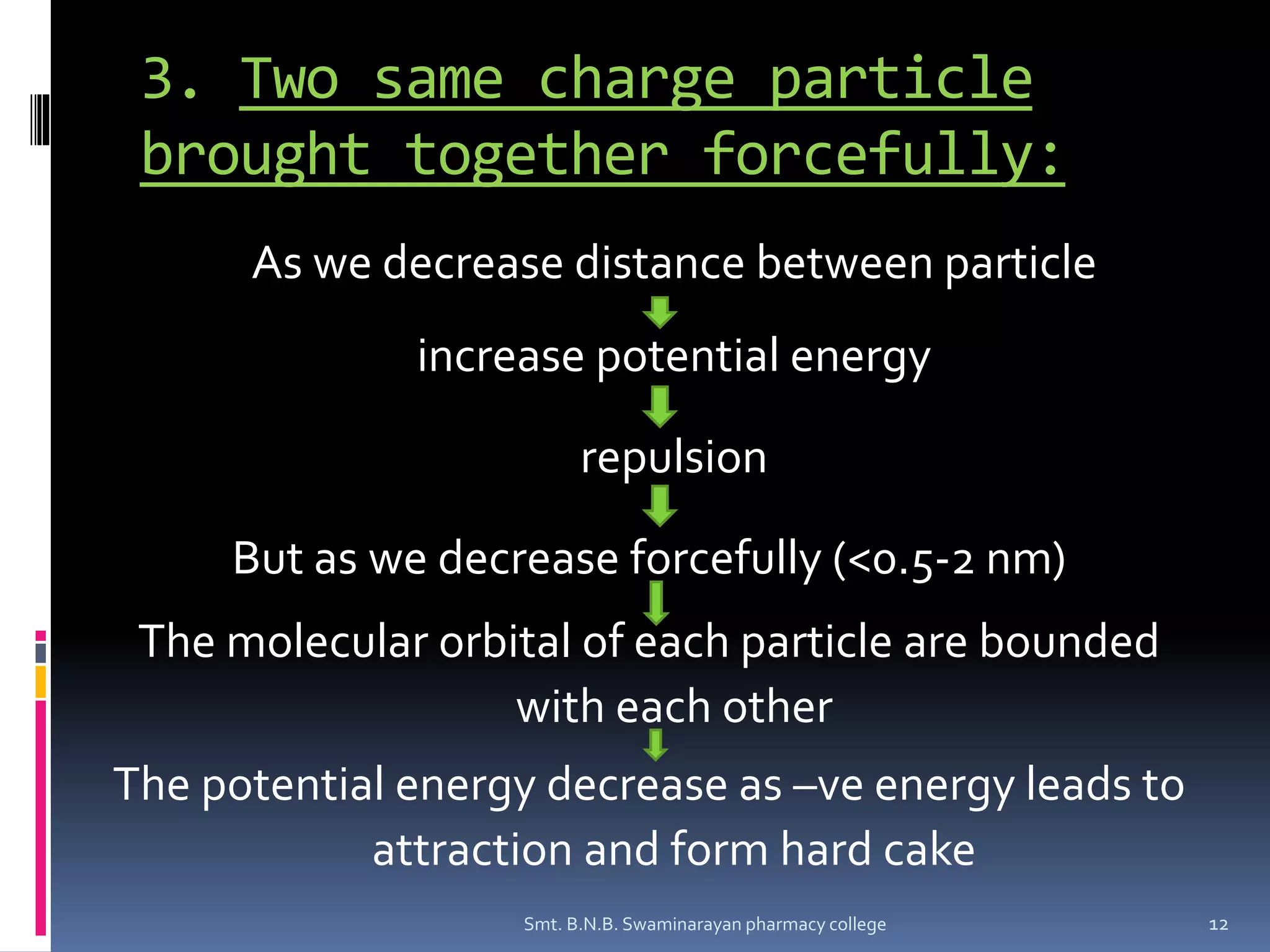
3. Two same charge particle
brought together forcefully:
As we decrease distance between particle
increase potential energy
repulsion
But as we decrease forcefully (<0.5-2 nm)
The molecular orbital of each particle are bounded
with each other
The potential energy decrease as –ve energy leads to
attraction and form hard cake
Smt. B.N.B. Swaminarayan pharmacy college 12
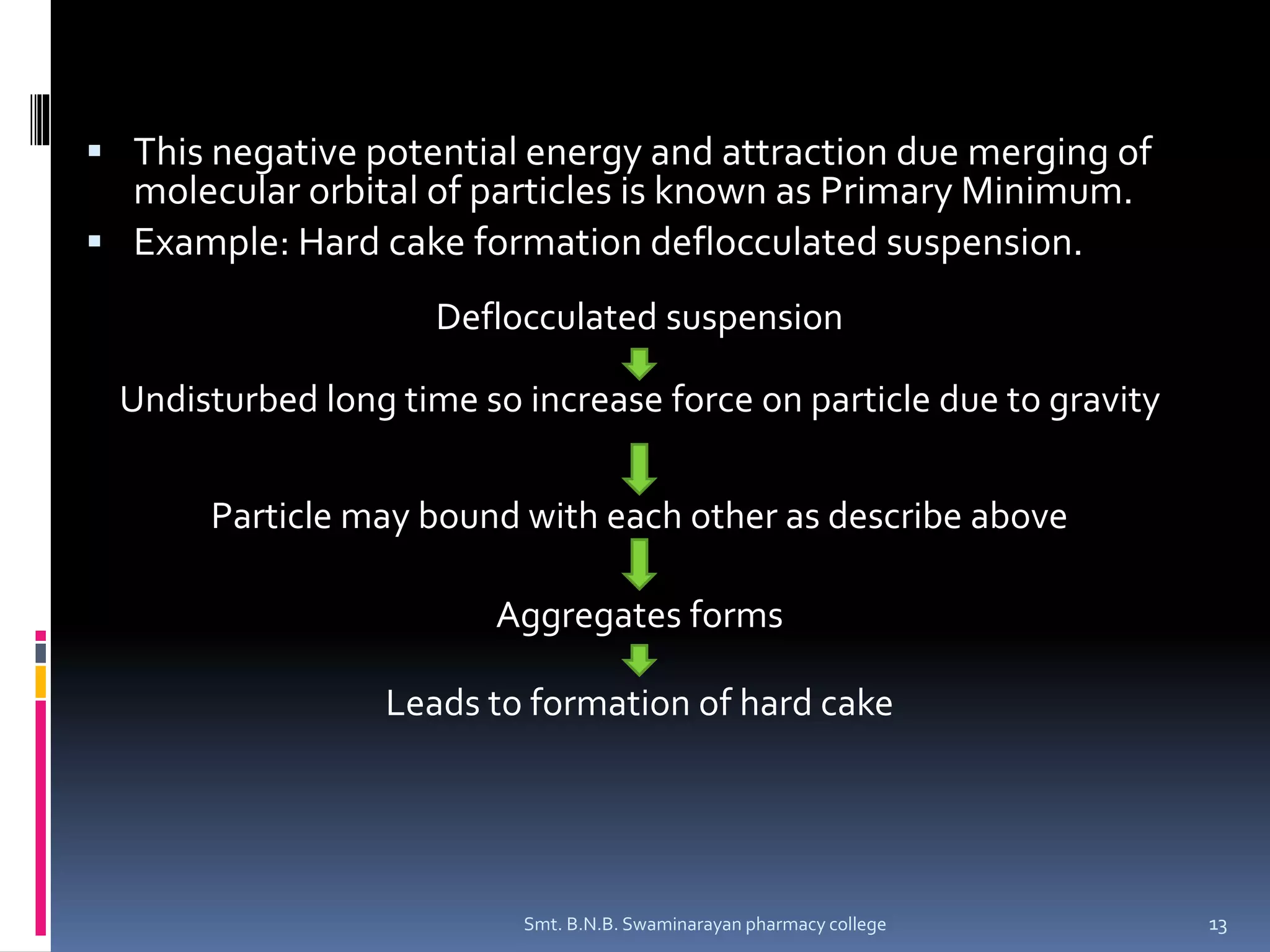
 This negative potential energy and attraction due merging of
molecular orbital of particles is known as Primary Minimum.
 Example: Hard cake formation deflocculated suspension.
Deflocculated suspension
Undisturbed long time so increase force on particle due to gravity
Particle may bound with each other as describe above
Aggregates forms
Leads to formation of hard cake
Smt. B.N.B. Swaminarayan pharmacy college 13
4. Effect of Electrolytes on
particles:
 Electrolyte like NaCl is added into suspension
 The +ve charged (Na+) absorbed on the particles.
 The –ve charged (Cl-) helps to form a weal bond between in
salt absorbed particles and form loosely arranged flocs.
 This causes slight decrease in negative potential energy , So
weak attractive force between the particles .
 So on agitation weakly bonded flocs easily break and
redispersed.
Smt. B.N.B. Swaminarayan pharmacy college 14
 This slight decrease in negative potential energy
due to flocs formation is known as Secondary
Minimum.
 Example: Flocs formation in Flocculated suspension
Application:
- since 1940s DLVO theory has been used to explain
phenomena found in colloidal science, adsorption
etc.
- nanoparticle research:
DLVO theory used to explain behaviour of both
material nanoparticle (like fullerene particle) and
micro organisms.
Smt. B.N.B. Swaminarayan pharmacy college 15
References:
1. “Physical Pharmacy - Physical Chemical
Principles InThe Pharmaceutical Science “
by Alfred Martin , James Swarbrick , Arthur
Cammarata ,3rd edition ,Varghese
Publishing House , Page no. 486
2. “Leon Lachman / Liberman’s –TheTheory
And Practice of Industrial Pharmacy “ By
Roop K Khar , S.Vyas , 4th Edition – 2013 ,
CBS Publisher And Disributors , Page no.
660
Smt. B.N.B. Swaminarayan pharmacy college 16
Smt. B.N.B. Swaminarayan pharmacy college 17

DLVO theory-Stability of colloids ( lyophobic )

  • 1.
    Smt. B.N.B. Swaminarayanpharmacy college 1 STABILITY OF COLLOIDS (LYOPHOBIC):DLVO THEORY Name : Pratik B. Gondaliya Utkarsh B. Kikani Sem : 6th sem College : Smt. B.N.B Swaminarayan pharmacy college , Salvav.
  • 2.
    Introduction  Dispersion System: Thedispersion system consist of particulate matter (particles) known as dispersed phase, distributed through out a continuous or dispersion medium .  According to mean diameter of particles in dispersion , It classify as:- 1. True solution / Molecular dispersion:- - Size <0.01 μm -Examples: Urea, Sucrose Solution,Oxygen gas 2. Colloidal dispersion:- - Size: 1m-1 μm -Examples: Acacia,Albumin, Insulin, Silver sols 3. Coarse Dispersion:- - Size: 10-100 μm -Examples:Calamine suspension, Magnesium oxide, RBCs Smt. B.N.B. Swaminarayan pharmacy college 2
  • 3.
     Colloidal dispersion: colloidalsystem is define as those polyphesic system where dimension of dispersed phase measures between 1nm to 1 μm.  Characteristic of Dispersed phase:- 1. Particle size: -influences the colour of dispersion colloidal gold : red colour coarse dispersion of gold : blue colour 2. Particle shape: -Examples: sphericle particle of gold: red colour disc like particle : blue colour 3. Surface area: Has a higher surface area 4. Surface charge: -colloidal particle posses charge on their surface - Example: negative : acacia, sulphur, tragacanth positive : gelatin (pH<4.7),Bismuth, Aluminium Smt. B.N.B. Swaminarayan pharmacy college 3
  • 4.
    Classification : 1. Lyophilliccolloids: - Solvent loving 2. Lyophobic colloids: - solvent hating 3. Association colloids: -Amphiphilic in nature Smt. B.N.B. Swaminarayan pharmacy college 4
  • 5.
    Stability of Colloids 1.Lyophilic colloids: 2. Lyophobic colloids:  Thermodynamically stable  Stabilize by i. Providing electric charge ii. Providing protective sheath of solvent to each particle prevent adherence of particle  Thermodynamically unstable  Stabilize by  only by providing electric charge  The Stability of lyophobic colloids is explained by DLVOTheory . Smt. B.N.B. Swaminarayan pharmacy college 5
  • 6.
    DLVO Theory  Thistheory is explain by Derjaguin , Landau , Verway , Overbeek So it is known as DLVO Theory.  According to this theory ,The forces on colloidal particles in a dispersion medium are due to – 1. Electrostatic Repulsion 2. London typeVander Waals Attraction Smt. B.N.B. Swaminarayan pharmacy college 6
  • 7.
    Zeta Potential  Thepotential difference across an electric double layer usually between solid surface and liquid.  It should be optimum, increase or decrease in zeta potential leads to instability in suspension  Range : -30 to +30 mV. Smt. B.N.B. Swaminarayan pharmacy college 7
  • 8.
     In thistheory,When two particle close together according to following condition : 1) Same charged particles – Repulsion 2) Opposite charged particles – Attraction 3) When two same charge particles are brought together forcefully ( explain deflocculated suspension ) 4) Effect of electrolytes on particles ( explain flocculated suspension ) Smt. B.N.B. Swaminarayan pharmacy college 8 Describe instability
  • 9.
    Potential Energy Curve Smt.B.N.B. Swaminarayan pharmacy college 9
  • 10.
    1. Same chargeparticles:  When two same charge particle present in suspension, initially positive energy (zeta potential) is low , As distance between particle decrease increase repulsive force increase zeta potential So increase +ve energy as shown in figure (repulsive curveVR).  This increase in energy leads to sedimentation , hence leads to instability in suspension. Smt. B.N.B. Swaminarayan pharmacy college 10
  • 11.
    2. Opposite chargeparticles:  When two opposite charged particles present in suspension , initially energy (zeta potential) is low.  As, Distance between particles decrease increase attractive force increase zeta potential (-ve energy) as shown in figure (Attraction curveVA) .  This increase in –ve zeta potential /energy leads to coagulation followed by sedimentation Smt. B.N.B. Swaminarayan pharmacy college 11
  • 12.
    3. Two samecharge particle brought together forcefully: As we decrease distance between particle increase potential energy repulsion But as we decrease forcefully (<0.5-2 nm) The molecular orbital of each particle are bounded with each other The potential energy decrease as –ve energy leads to attraction and form hard cake Smt. B.N.B. Swaminarayan pharmacy college 12
  • 13.
     This negativepotential energy and attraction due merging of molecular orbital of particles is known as Primary Minimum.  Example: Hard cake formation deflocculated suspension. Deflocculated suspension Undisturbed long time so increase force on particle due to gravity Particle may bound with each other as describe above Aggregates forms Leads to formation of hard cake Smt. B.N.B. Swaminarayan pharmacy college 13
  • 14.
    4. Effect ofElectrolytes on particles:  Electrolyte like NaCl is added into suspension  The +ve charged (Na+) absorbed on the particles.  The –ve charged (Cl-) helps to form a weal bond between in salt absorbed particles and form loosely arranged flocs.  This causes slight decrease in negative potential energy , So weak attractive force between the particles .  So on agitation weakly bonded flocs easily break and redispersed. Smt. B.N.B. Swaminarayan pharmacy college 14
  • 15.
     This slightdecrease in negative potential energy due to flocs formation is known as Secondary Minimum.  Example: Flocs formation in Flocculated suspension Application: - since 1940s DLVO theory has been used to explain phenomena found in colloidal science, adsorption etc. - nanoparticle research: DLVO theory used to explain behaviour of both material nanoparticle (like fullerene particle) and micro organisms. Smt. B.N.B. Swaminarayan pharmacy college 15
  • 16.
    References: 1. “Physical Pharmacy- Physical Chemical Principles InThe Pharmaceutical Science “ by Alfred Martin , James Swarbrick , Arthur Cammarata ,3rd edition ,Varghese Publishing House , Page no. 486 2. “Leon Lachman / Liberman’s –TheTheory And Practice of Industrial Pharmacy “ By Roop K Khar , S.Vyas , 4th Edition – 2013 , CBS Publisher And Disributors , Page no. 660 Smt. B.N.B. Swaminarayan pharmacy college 16
  • 17.
    Smt. B.N.B. Swaminarayanpharmacy college 17