
Colloids
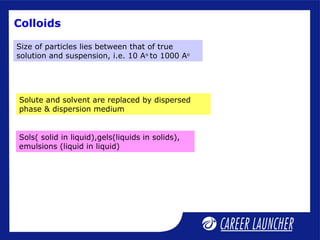
Solute and solvent are replaced by dispersed
phase & dispersion medium
Sols( solid in liquid),gels(liquids in solids),
emulsions (liquid in liquid)
Size of particles lies between that of true
solution and suspension, i.e. 10 Ao
to 1000 Ao
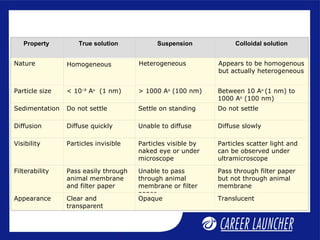
Property True solution Suspension Colloidal solution
Nature Heterogeneous Appears to be homogenous
but actually heterogeneous
Particle size < 10–9
Ao
(1 nm) > 1000 Ao
(100 nm) Between 10 Ao
(1 nm) to
1000 Ao
(100 nm)
Sedimentation Do not settle Settle on standing Do not settle
Diffusion Diffuse quickly Unable to diffuse Diffuse slowly
Visibility Particles invisible Particles visible by
naked eye or under
microscope
Particles scatter light and
can be observed under
ultramicroscope
Filterability Pass easily through
animal membrane
and filter paper
Unable to pass
through animal
membrane or filter
paper
Pass through filter paper
but not through animal
membrane
Appearance Clear and
transparent
Opaque Translucent
Homogeneous
Classification of colloids
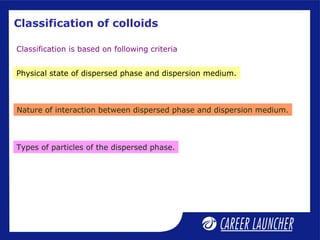
Classification is based on following criteria
Physical state of dispersed phase and dispersion medium.
Nature of interaction between dispersed phase and dispersion medium.
Types of particles of the dispersed phase.
Classification based on physical state of
dispersed phase and dispersion medium
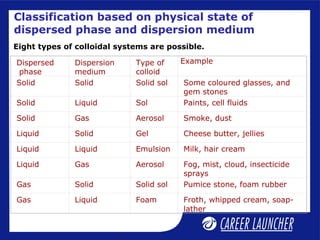
Eight types of colloidal systems are possible.
Dispersed
phase
 
Dispersion
medium
 
Type of
colloid
 
Example
Solid Solid Solid sol Some coloured glasses, and
gem stones
 Solid Liquid Sol Paints, cell fluids
 
Solid Gas Aerosol Smoke, dust
 
Liquid Solid Gel Cheese butter, jellies
 
Liquid Liquid Emulsion Milk, hair cream
 
Liquid Gas Aerosol Fog, mist, cloud, insecticide
sprays
 Gas Solid Solid sol Pumice stone, foam rubber
 
Gas Liquid Foam Froth, whipped cream, soap-
lather
 
Classification based on nature of interaction
Lyophobic colloids (solvent hating colloids )
When metals and their sulphides simply mixed with
dispersion medium, they don’t form colloids.
• need stabilizing to preserve them.
• irreversible.
• For example, colloidal solutions of gold,silver, Fe(OH)3
, As2
S3
, etc.
Lyophilic colloids ( solvent loving)
Directly formed by substances like gum, gelatine rubber etc.
on mixing with a suitable liquid(the dispersion medium).
• self-stabilizing
• reversible sols
• For example, gums, gelatin, starch, albumin in water.
Classification based on type of particles
of the dispersed phase
Multimolecular colloids : Consists of
aggregates of a large number of atoms
or smaller molecules whose diameter is
less than 1 nm
Macromolecular colloids: In these colloids,
the molecules have sizes and dimensions
comparable to colloidal particles. For example,
proteins, starch, cellulose.
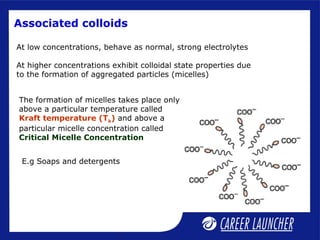
Associated colloids
At low concentrations, behave as normal, strong electrolytes
At higher concentrations exhibit colloidal state properties due
to the formation of aggregated particles (micelles)
The formation of micelles takes place only
above a particular temperature called
Kraft temperature (Tk) and above a
particular micelle concentration called
Critical Micelle Concentration
E.g Soaps and detergents
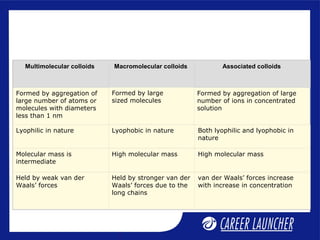
Multimolecular colloids Macromolecular colloids Associated colloids
Formed by aggregation of
large number of atoms or
molecules with diameters
less than 1 nm
Formed by aggregation of large
number of ions in concentrated
solution
Lyophilic in nature Lyophobic in nature Both lyophilic and lyophobic in
nature
Molecular mass is
intermediate
High molecular mass High molecular mass
Held by weak van der
Waals’ forces
Held by stronger van der
Waals’ forces due to the
long chains
van der Waals’ forces increase
with increase in concentration
Formed by large
sized molecules
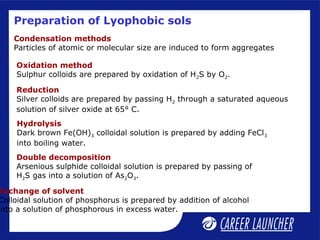
Preparation of Lyophobic sols
Condensation methods
Particles of atomic or molecular size are induced to form aggregates
Exchange of solvent
Colloidal solution of phosphorus is prepared by addition of alcohol
into a solution of phosphorous in excess water.
Oxidation method
Sulphur colloids are prepared by oxidation of H2S by O2.
Reduction
Silver colloids are prepared by passing H2 through a saturated aqueous
solution of silver oxide at 65° C.
Hydrolysis
Dark brown Fe(OH)3 colloidal solution is prepared by adding FeCl3
into boiling water.
Double decomposition
Arsenious sulphide colloidal solution is prepared by passing of
H2S gas into a solution of As2O3.
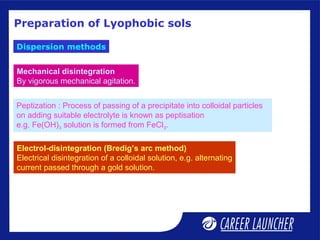
Preparation of Lyophobic sols
Dispersion methods
Mechanical disintegration
By vigorous mechanical agitation.
Peptization : Process of passing of a precipitate into colloidal particles
on adding suitable electrolyte is known as peptisation
e.g. Fe(OH)3 solution is formed from FeCl3.
Electrol-disintegration (Bredig’s arc method)
Electrical disintegration of a colloidal solution, e.g. alternating
current passed through a gold solution.
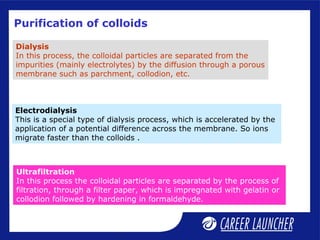
Purification of colloids
Ultrafiltration
In this process the colloidal particles are separated by the process of
filtration, through a filter paper, which is impregnated with gelatin or
collodion followed by hardening in formaldehyde.
Dialysis
In this process, the colloidal particles are separated from the
impurities (mainly electrolytes) by the diffusion through a porous
membrane such as parchment, collodion, etc.
Electrodialysis
This is a special type of dialysis process, which is accelerated by the
application of a potential difference across the membrane. So ions
migrate faster than the colloids .
Properties of colloids
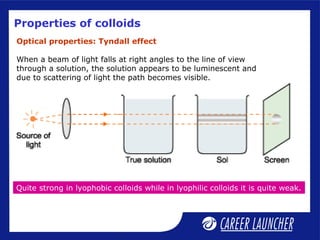
Optical properties: Tyndall effect
When a beam of light falls at right angles to the line of view
through a solution, the solution appears to be luminescent and
due to scattering of light the path becomes visible.
Quite strong in lyophobic colloids while in lyophilic colloids it is quite weak.
Properties of colloids
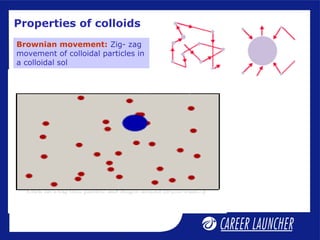
Brownian movement: Zig- zag
movement of colloidal particles in
a colloidal sol
Properties of colloids
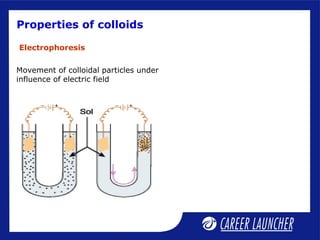
Movement of colloidal particles under
influence of electric field
Electrophoresis
Properties of colloids
Electro-osmosis: molecules of dispersion medium are allowed to move
under influence of electric field
Coagulation or flocculation:Process which involves coming
together of colloidal particles so as to change into large sized
particles which ultimately settle as a precipitate or float on
surface.It is generally brought about by addition of electrolytes.
The minimum amount of an electrolyte that must be added to one litre
of a colloidal solution so as to bring about complete coagulation or
flocculation is called coagulation or flocculation value.Smaller is the
flocculation value of an electrolyte,greater is the coagulating or
precipitating power.
Properties of colloids
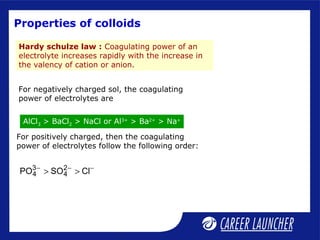
For positively charged, then the coagulating
power of electrolytes follow the following order:
3 2
4 4PO SO Cl− − −
> >
Hardy schulze law : Coagulating power of an
electrolyte increases rapidly with the increase in
the valency of cation or anion.
For negatively charged sol, the coagulating
power of electrolytes are
AlCl3 > BaCl2 > NaCl or Al3+
> Ba2+
> Na+
Gold Number
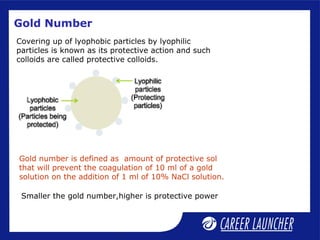
Covering up of lyophobic particles by lyophilic
particles is known as its protective action and such
colloids are called protective colloids.
Gold number is defined as amount of protective sol
that will prevent the coagulation of 10 ml of a gold
solution on the addition of 1 ml of 10% NaCl solution.
Smaller the gold number,higher is protective power
Emulsion
A colloidal dispersion of one liquid in another
immiscible liquid is known as an emulsion,
e.g. milk, Na-soaps, vanishing cream, etc.
1. Oil in water, where oil is the dispersed phase and water
is the dispersion medium, e.g. milk.
2. Water in oil where water is the dispersed phase and oil
is the dispersed medium, e.g. butter, cream.
Types of emulsions
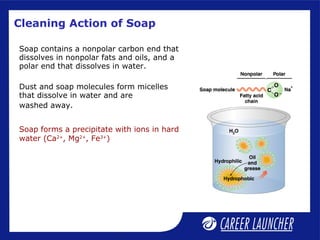
Cleaning Action of Soap
Soap contains a nonpolar carbon end that
dissolves in nonpolar fats and oils, and a
polar end that dissolves in water.
Dust and soap molecules form micelles
that dissolve in water and are
washed away.
Soap forms a precipitate with ions in hard
water (Ca2+
, Mg2+
, Fe3+
)
Applications of colloids
1. Rubber plating
2. Sewage disposal
3. Smoke screen
4. Purification of water
5. Cleaning action of soap
6. In medicine
7. Formation of delta
8. Photography
9. Artificial rain
Thank you

Colloids and surface chemistry

  • 1.
    Colloids Solute and solventare replaced by dispersed phase & dispersion medium Sols( solid in liquid),gels(liquids in solids), emulsions (liquid in liquid) Size of particles lies between that of true solution and suspension, i.e. 10 Ao to 1000 Ao
  • 2.
    Property True solutionSuspension Colloidal solution Nature Heterogeneous Appears to be homogenous but actually heterogeneous Particle size < 10–9 Ao (1 nm) > 1000 Ao (100 nm) Between 10 Ao (1 nm) to 1000 Ao (100 nm) Sedimentation Do not settle Settle on standing Do not settle Diffusion Diffuse quickly Unable to diffuse Diffuse slowly Visibility Particles invisible Particles visible by naked eye or under microscope Particles scatter light and can be observed under ultramicroscope Filterability Pass easily through animal membrane and filter paper Unable to pass through animal membrane or filter paper Pass through filter paper but not through animal membrane Appearance Clear and transparent Opaque Translucent Homogeneous
  • 3.
    Classification of colloids Classificationis based on following criteria Physical state of dispersed phase and dispersion medium. Nature of interaction between dispersed phase and dispersion medium. Types of particles of the dispersed phase.
  • 4.
    Classification based onphysical state of dispersed phase and dispersion medium Eight types of colloidal systems are possible. Dispersed phase   Dispersion medium   Type of colloid   Example Solid Solid Solid sol Some coloured glasses, and gem stones  Solid Liquid Sol Paints, cell fluids   Solid Gas Aerosol Smoke, dust   Liquid Solid Gel Cheese butter, jellies   Liquid Liquid Emulsion Milk, hair cream   Liquid Gas Aerosol Fog, mist, cloud, insecticide sprays  Gas Solid Solid sol Pumice stone, foam rubber   Gas Liquid Foam Froth, whipped cream, soap- lather  
  • 5.
    Classification based onnature of interaction Lyophobic colloids (solvent hating colloids ) When metals and their sulphides simply mixed with dispersion medium, they don’t form colloids. • need stabilizing to preserve them. • irreversible. • For example, colloidal solutions of gold,silver, Fe(OH)3 , As2 S3 , etc. Lyophilic colloids ( solvent loving) Directly formed by substances like gum, gelatine rubber etc. on mixing with a suitable liquid(the dispersion medium). • self-stabilizing • reversible sols • For example, gums, gelatin, starch, albumin in water.
  • 6.
    Classification based ontype of particles of the dispersed phase Multimolecular colloids : Consists of aggregates of a large number of atoms or smaller molecules whose diameter is less than 1 nm Macromolecular colloids: In these colloids, the molecules have sizes and dimensions comparable to colloidal particles. For example, proteins, starch, cellulose.
  • 7.
    Associated colloids At lowconcentrations, behave as normal, strong electrolytes At higher concentrations exhibit colloidal state properties due to the formation of aggregated particles (micelles) The formation of micelles takes place only above a particular temperature called Kraft temperature (Tk) and above a particular micelle concentration called Critical Micelle Concentration E.g Soaps and detergents
  • 8.
    Multimolecular colloids Macromolecularcolloids Associated colloids Formed by aggregation of large number of atoms or molecules with diameters less than 1 nm Formed by aggregation of large number of ions in concentrated solution Lyophilic in nature Lyophobic in nature Both lyophilic and lyophobic in nature Molecular mass is intermediate High molecular mass High molecular mass Held by weak van der Waals’ forces Held by stronger van der Waals’ forces due to the long chains van der Waals’ forces increase with increase in concentration Formed by large sized molecules
  • 9.
    Preparation of Lyophobicsols Condensation methods Particles of atomic or molecular size are induced to form aggregates Exchange of solvent Colloidal solution of phosphorus is prepared by addition of alcohol into a solution of phosphorous in excess water. Oxidation method Sulphur colloids are prepared by oxidation of H2S by O2. Reduction Silver colloids are prepared by passing H2 through a saturated aqueous solution of silver oxide at 65° C. Hydrolysis Dark brown Fe(OH)3 colloidal solution is prepared by adding FeCl3 into boiling water. Double decomposition Arsenious sulphide colloidal solution is prepared by passing of H2S gas into a solution of As2O3.
  • 10.
    Preparation of Lyophobicsols Dispersion methods Mechanical disintegration By vigorous mechanical agitation. Peptization : Process of passing of a precipitate into colloidal particles on adding suitable electrolyte is known as peptisation e.g. Fe(OH)3 solution is formed from FeCl3. Electrol-disintegration (Bredig’s arc method) Electrical disintegration of a colloidal solution, e.g. alternating current passed through a gold solution.
  • 11.
    Purification of colloids Ultrafiltration Inthis process the colloidal particles are separated by the process of filtration, through a filter paper, which is impregnated with gelatin or collodion followed by hardening in formaldehyde. Dialysis In this process, the colloidal particles are separated from the impurities (mainly electrolytes) by the diffusion through a porous membrane such as parchment, collodion, etc. Electrodialysis This is a special type of dialysis process, which is accelerated by the application of a potential difference across the membrane. So ions migrate faster than the colloids .
  • 12.
    Properties of colloids Opticalproperties: Tyndall effect When a beam of light falls at right angles to the line of view through a solution, the solution appears to be luminescent and due to scattering of light the path becomes visible. Quite strong in lyophobic colloids while in lyophilic colloids it is quite weak.
  • 13.
    Properties of colloids Brownianmovement: Zig- zag movement of colloidal particles in a colloidal sol
  • 14.
    Properties of colloids Movementof colloidal particles under influence of electric field Electrophoresis
  • 15.
    Properties of colloids Electro-osmosis:molecules of dispersion medium are allowed to move under influence of electric field Coagulation or flocculation:Process which involves coming together of colloidal particles so as to change into large sized particles which ultimately settle as a precipitate or float on surface.It is generally brought about by addition of electrolytes. The minimum amount of an electrolyte that must be added to one litre of a colloidal solution so as to bring about complete coagulation or flocculation is called coagulation or flocculation value.Smaller is the flocculation value of an electrolyte,greater is the coagulating or precipitating power.
  • 16.
    Properties of colloids Forpositively charged, then the coagulating power of electrolytes follow the following order: 3 2 4 4PO SO Cl− − − > > Hardy schulze law : Coagulating power of an electrolyte increases rapidly with the increase in the valency of cation or anion. For negatively charged sol, the coagulating power of electrolytes are AlCl3 > BaCl2 > NaCl or Al3+ > Ba2+ > Na+
  • 17.
    Gold Number Covering upof lyophobic particles by lyophilic particles is known as its protective action and such colloids are called protective colloids. Gold number is defined as amount of protective sol that will prevent the coagulation of 10 ml of a gold solution on the addition of 1 ml of 10% NaCl solution. Smaller the gold number,higher is protective power
  • 18.
    Emulsion A colloidal dispersionof one liquid in another immiscible liquid is known as an emulsion, e.g. milk, Na-soaps, vanishing cream, etc. 1. Oil in water, where oil is the dispersed phase and water is the dispersion medium, e.g. milk. 2. Water in oil where water is the dispersed phase and oil is the dispersed medium, e.g. butter, cream. Types of emulsions
  • 19.
    Cleaning Action ofSoap Soap contains a nonpolar carbon end that dissolves in nonpolar fats and oils, and a polar end that dissolves in water. Dust and soap molecules form micelles that dissolve in water and are washed away. Soap forms a precipitate with ions in hard water (Ca2+ , Mg2+ , Fe3+ )
  • 20.
    Applications of colloids 1.Rubber plating 2. Sewage disposal 3. Smoke screen 4. Purification of water 5. Cleaning action of soap 6. In medicine 7. Formation of delta 8. Photography 9. Artificial rain
  • 21.

Editor's Notes

  • #8 The maximum concentration above which miccells are formed is called critical micellization conc.