1
COLLOIDS
2
Introduction
 Thomas Graham (1861) studied the ability of
dissolved substances to diffuse into water across a
permeable membrane.
 He observed that crystalline substances such as sugar,
urea, and sodium chloride passed through the
membrane, while others like glue, gelatin and gum did
not.
 The former he called crystalloids
 And the latter colloids (Greek, kolla = glue ; eidos =
like).
3
Introduction
 Graham thought that the difference in the behavior of
‘crystalloids’ and ‘colloids’ was due to the particle
size.
 Later it was realized that any substance, regardless of
its nature, could be converted into a colloid by
 subdividing it into particles of colloidal size.
4
Introduction
 Dispersed system –A system in which one phase
(dispersed phase) is distributed uniformly as particles
throughout another phase (dispersion medium)
 Dispersed system can also be classified on basis of the
size of dispersed phase as
 Molecular dispersion
 Colloidal dispersion
 Coarse dispersion
5
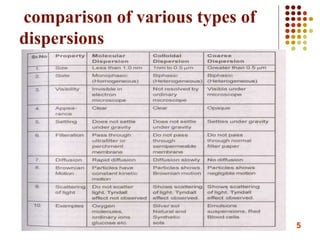
comparison of various types of
dispersions
6
Introduction
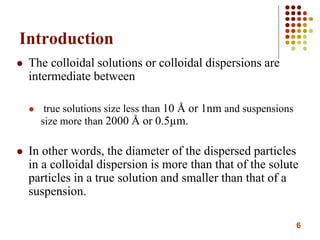
 The colloidal solutions or colloidal dispersions are
intermediate between
 true solutions size less than 10 Å or 1nm and suspensions
size more than 2000 Å or 0.5µm.
 In other words, the diameter of the dispersed particles
in a colloidal dispersion is more than that of the solute
particles in a true solution and smaller than that of a
suspension.
7
Introduction
 When the diameter of the particles of a substance
dispersed in a solvent ranges from about 10Å to
2,000Å, the system is termed a colloidal solution,
colloidal dispersion, or simply a colloid.
 The material with particle size in the colloidal range is
said to be in the colloidal state.
8
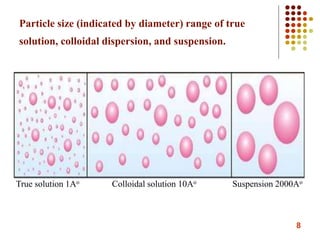
Particle size (indicated by diameter) range of true
solution, colloidal dispersion, and suspension.
True solution 1Ao Colloidal solution 10Ao Suspension 2000Ao
9
Pharmaceutical application of
colloids
 As a therapeutic agent-colloidal Cu in cancer
 Used as a diagnostic agent –colloidal gold for paresis
 As a additives- polymers used in P'ceutical preparation
 Bindings of drugs - protein
 As a plasma substitutes - dextran as plasma expander
 As a coating materials tablet & capsule coated with protect
drug
 Antibiotics –penicillin injection
 Foods
 Solubilization -surfactant
 Bioavailability –increase therapeutic activity
 Emulsion formation –emulgent colloidal in nature
 Gels
10
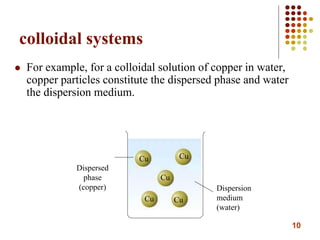
colloidal systems
 For example, for a colloidal solution of copper in water,
copper particles constitute the dispersed phase and water
the dispersion medium.
Dispersed
phase
(copper) Dispersion
medium
(water)
Cu Cu
Cu
Cu Cu
11
Types of colloidal systems
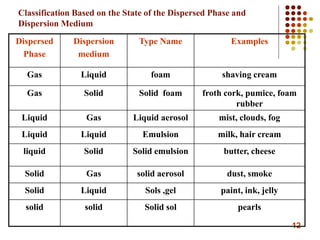
 As stated above, a colloidal system is made of a dispersed
phase and the dispersion medium.
 Because either the dispersed phase or the dispersion
medium can be a gas, liquid or solid, there are eight types
of colloidal systems possible.
 A colloidal dispersion of one gas in another is not
possible since the two gases would give a homogeneous
molecular mixture.
12
Classification Based on the State of the Dispersed Phase and
Dispersion Medium
Dispersed
Phase
Dispersion
medium
Type Name Examples
Gas Liquid foam shaving cream
Gas Solid Solid foam froth cork, pumice, foam
rubber
Liquid Gas Liquid aerosol mist, clouds, fog
Liquid Liquid Emulsion milk, hair cream
liquid Solid Solid emulsion butter, cheese
Solid Gas solid aerosol dust, smoke
Solid Liquid Sols ,gel paint, ink, jelly
solid solid Solid sol pearls
13
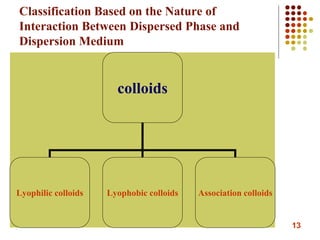
Classification Based on the Nature of
Interaction Between Dispersed Phase and
Dispersion Medium
colloids
Lyophilic colloids Lyophobic colloids Association colloids
14
Lyophilic colloids
 Its also called as homogeneous colloids or reversible
sols
 The dispersed phase of a colloidal dispersion may be
classified as Lyophilic (solvent loving)
 If the solvent is water so termed as Hydrophilic
 Strong affinity of colloidal particles for the dispersion
medium (solvent)
 Hydrated colloids swell increasing viscosity of the
system & Prepared by simply dissolving the material in
the solvent
 Examples : acacia , methylcellulose, gelatin and
albumin
15
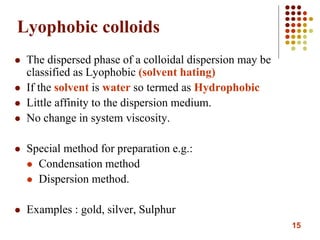
Lyophobic colloids
 The dispersed phase of a colloidal dispersion may be
classified as Lyophobic (solvent hating)
 If the solvent is water so termed as Hydrophobic
 Little affinity to the dispersion medium.
 No change in system viscosity.
 Special method for preparation e.g.:
 Condensation method
 Dispersion method.
 Examples : gold, silver, Sulphur
16
Method of preparation of Lyophobic
colloids
 Special method is required to prepare
colloids because of the weaker attraction between
particles & the medium.
1. Dispersion methods
 The general principle involves mechanical dispersion,
i.e., converting coarse particles are reduced in size
2. Condensation methods
 Materials of subcolloidal dimensions are caused to
aggregate into particles within the colloidal size range
17
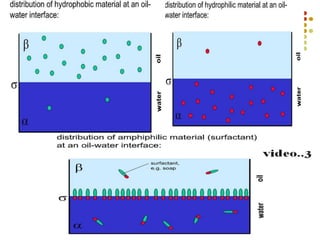
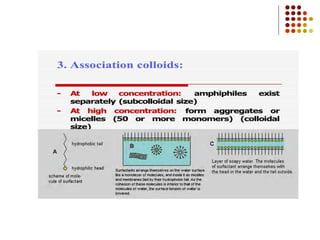
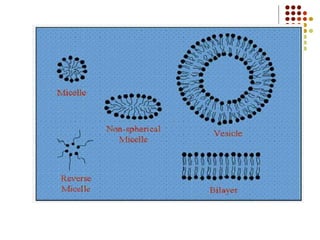
Association colloids
 Its also called as Amphiphilic colloids and micelles
 Certain molecules or ions termed as amphiphiles or
surface active agents
 These possess polar & non-polar group (water loving &
water hating (mixture of both)
18
Association colloids cont’d
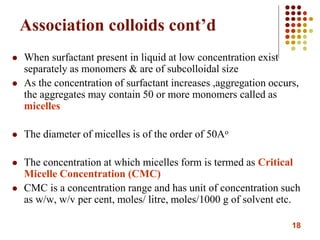
 When surfactant present in liquid at low concentration exist
separately as monomers & are of subcolloidal size
 As the concentration of surfactant increases ,aggregation occurs,
the aggregates may contain 50 or more monomers called as
micelles
 The diameter of micelles is of the order of 50Ao
 The concentration at which micelles form is termed as Critical
Micelle Concentration (CMC)
 CMC is a concentration range and has unit of concentration such
as w/w, w/v per cent, moles/ litre, moles/1000 g of solvent etc.
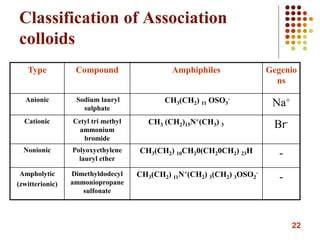
22
Classification of Association
colloids
Type Compound Amphiphiles Gegenio
ns
Anionic Sodium lauryl
sulphate
CH3(CH2) 11 OSO3
-
Na+
Cationic Cetyl tri methyl
ammonium
bromide
CH3 (CH2)15N+(CH3) 3 Br-
Nonionic Polyoxyethylene
lauryl ether
CH3(CH2) 10CH20(CH20CH2) 23H -
Ampholytic
(zwitterionic)
Dimethyldodecyl
ammoniopropane
sulfonate
CH3(CH2) 11N+(CH2) 3(CH2) 3OSO2
-
-
23
Krafft Point, Kt
 The solubility of a surface active agent
depends on the temperature of the system.
 But adequate concentration of surface
active agent is required to form micelles.
This relationship is stated by Krafft point.
 Krafft point is defined as the temperature
at which the solubility of the surfactant is
equal to the CMC
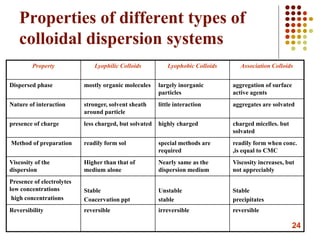
24
Properties of different types of
colloidal dispersion systems
Property Lyophilic Colloids Lyophobic Colloids Association Colloids
Dispersed phase mostly organic molecules largely inorganic
particles
aggregation of surface
active agents
Nature of interaction stronger, solvent sheath
around particle
little interaction aggregates are solvated
presence of charge less charged, but solvated highly charged charged micelles. but
solvated
Method of preparation readily form sol special methods are
required
readily form when conc.
,is equal to CMC
Viscosity of the
dispersion
Higher than that of
medium alone
Nearly same as the
dispersion medium
Viscosity increases, but
not appreciably
Presence of electrolytes
low concentrations
high concentrations
Stable
Coacervation ppt
Unstable
stable
Stable
precipitates
Reversibility reversible irreversible reversible
26
Properties of colloids
1. Optical properties of colloids
 The Faraday- Tyndall effect
 Electron microscope
 Light scattering
2. Kinetic properties of colloids
 Brownian motion
 Diffusion
 Osmotic pressure
 Sedimentation
 Viscosity
3. Electrical properties of colloids
 Electrokinetic phenomena
27
Optical Properties of colloids
The Faraday- Tyndall effect
 Beam of light directed colloidal sol some of the light may be
absorbed, some is scattered and remainder transmitted
through the sample.
 visible cone due to the light scattered by the colloidal
particles. This phenomenon is known as Faraday- Tyndall
effect
28
Optical Properties of colloids
Electron Microscope
 The use of the ultra-microscope has declined in
recent years because it frequently does not resolve
lyophilic colloids.
 The electron microscope, capable of
 Yielding pictures of the actual particles, Even those
approaching molecular dimensions
 It is now widely used to observe the size, shape, and
structure of colloidal particles.
29
Optical Properties of colloids
Electron Microscope
 The success of the electron microscope is due to its high
resolving power
 The radiation source of the electron microscope is a beam
of high-energy electrons having wavelengths in the region
of 0.01 nm (0.1 Ao).
30
Optical Properties of colloids
Light scattering
 This property depends on the Faraday-Tyndall effect
 It is a widely used for determining the molecular weight
of colloids.
 It can also be used to obtain information on the shape and
size of these particles.
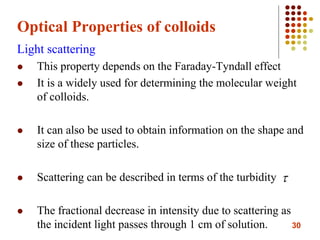
 Scattering can be described in terms of the turbidity
 The fractional decrease in intensity due to scattering as
the incident light passes through 1 cm of solution.

31
Optical Properties of colloids
Light scattering
 It can be expressed as the intensity of light scattered (Is), in
all directions, divided by the intensity of the incident
light (I)
 At a given concentration of dispersed phase, the turbidity is
proportional to the molecular weight of the lyophilic
colloid.
 Because of the low turbidity of most lyophilic colloids, it
is more convenient to measure the scattered light rather
than the transmitted light.
32
Optical Properties of colloids
Light scattering
 The turbidity can be calculated from the intensity of the
scattered light
 Its provided that the dimensions of the particle are small
compared with the wavelength of the light used.
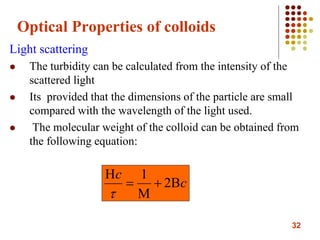
 The molecular weight of the colloid can be obtained from
the following equation:
c
c




2
1

33
Optical Properties of colloids
Light scattering
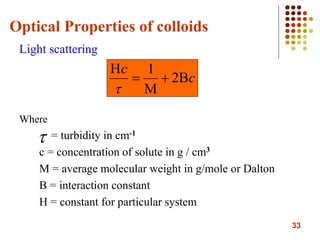
Where
= turbidity in cm-1
c = concentration of solute in g / cm3
M = average molecular weight in g/mole or Dalton
B = interaction constant
H = constant for particular system
c
c




2
1


36
Kinetic Properties of colloids
Brownian motion
 The random movement of colloidal particles in the
microscopic field
 Robert Brown (1827) studied this phenomenon.
 The erratic (unpredicted) motion, which may be observed with
particles as large as about 5µm
 The velocity of the particles increases with decreasing particle
size.
 Increasing viscosity of medium (by addition of glycerin)
,decreasing or stops the Brownian movement
37
Kinetic Properties of colloids
Diffusion
 Particles diffuse spontaneously from a higher region
concentration to one of lower concentration until the
concentration of the system is uniform throughout.
 Diffusion is a direct result of Brownian movement.
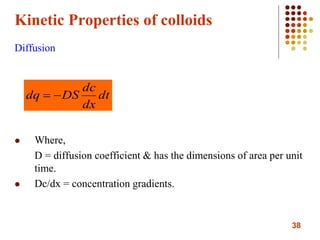
 Diffusion can be expressed by Fick's first law
 the amount dq of substance diffusing in time dt , across a
plane of area S is directly proportional to the change of
concentration, dc, with distance travelled, dx.
38
Kinetic Properties of colloids
Diffusion
 Where,
D = diffusion coefficient & has the dimensions of area per unit
time.
 Dc/dx = concentration gradients.
dt
dx
dc
DSdq 
39
Kinetic Properties of colloids
Diffusion
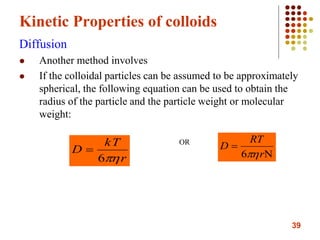
 Another method involves
 If the colloidal particles can be assumed to be approximately
spherical, the following equation can be used to obtain the
radius of the particle and the particle weight or molecular
weight:
OR
r
kT
D
6
 

r
RT
D
6
40
Kinetic Properties of colloids
3
3
4
6 

 



RT
D
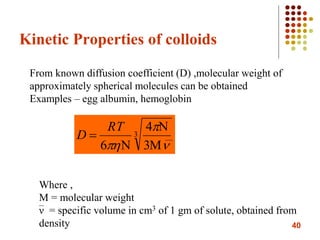
From known diffusion coefficient (D) ,molecular weight of
approximately spherical molecules can be obtained
Examples – egg albumin, hemoglobin
Where ,
M = molecular weight
ν = specific volume in cm3 of 1 gm of solute, obtained from
density
41
Kinetic Properties of colloids
Diffusion
From above equation following rules of diffusion
1. The velocity of molecules increases with decreasing particle
size
2. The velocity of molecules increases with increasing
temperature
3. The velocity of molecules decreases with increasing viscosity
of the medium
42
Kinetic Properties of colloids
Osmotic pressure
 It is mostly useful to measurement of molecular weight range
of about 104 to 106
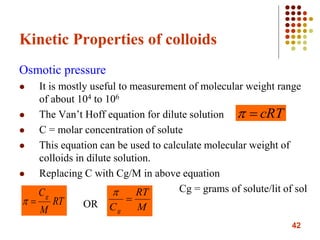
 The Van’t Hoff equation for dilute solution
 C = molar concentration of solute
 This equation can be used to calculate molecular weight of
colloids in dilute solution.
 Replacing C with Cg/M in above equation
Cg = grams of solute/lit of sol
OR
cRT
RT
M
Cg
 M
RT
Cg


43
Kinetic Properties of colloids
Osmotic pressure
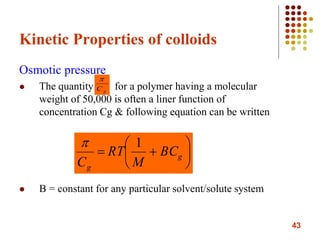
 The quantity for a polymer having a molecular
weight of 50,000 is often a liner function of
concentration Cg & following equation can be written
 B = constant for any particular solvent/solute system
gC







 g
g
BC
M
RT
C
1
44
Kinetic Properties of colloids
Sedimentation
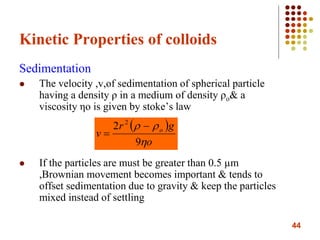
 The velocity ,v,of sedimentation of spherical particle
having a density ρ in a medium of density ρo& a
viscosity ηo is given by stoke’s law
 If the particles are must be greater than 0.5 µm
,Brownian movement becomes important & tends to
offset sedimentation due to gravity & keep the particles
mixed instead of settling
 
o
gr
v o


9
2 2


45
Kinetic Properties of colloids
Sedimentation
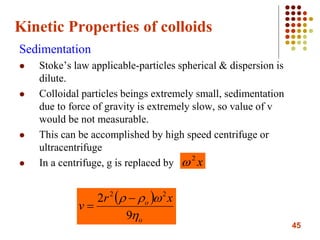
 Stoke’s law applicable-particles spherical & dispersion is
dilute.
 Colloidal particles beings extremely small, sedimentation
due to force of gravity is extremely slow, so value of v
would be not measurable.
 This can be accomplished by high speed centrifuge or
ultracentrifuge
 In a centrifuge, g is replaced by x2

 
o
o xr
v


9
2 22


46
Kinetic Properties of colloids
Sedimentation
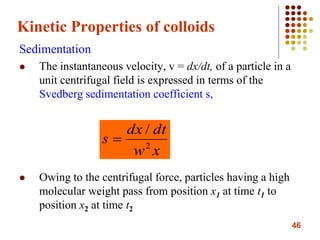
 The instantaneous velocity, v = dx/dt, of a particle in a
unit centrifugal field is expressed in terms of the
Svedberg sedimentation coefficient s,
 Owing to the centrifugal force, particles having a high
molecular weight pass from position x1 at time t1 to
position x2 at time t2
xw
dtdx
s 2
/

47
Kinetic Properties of colloids
Sedimentation
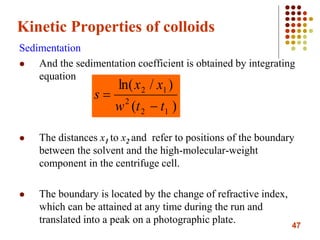
 And the sedimentation coefficient is obtained by integrating
equation
 The distances x1 to x2 and refer to positions of the boundary
between the solvent and the high-molecular-weight
component in the centrifuge cell.
 The boundary is located by the change of refractive index,
which can be attained at any time during the run and
translated into a peak on a photographic plate.
)(
)/ln(
12
2
12
ttw
xx
s


48
Kinetic Properties of colloids
Sedimentation
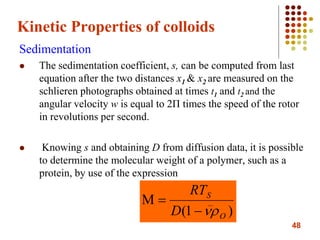
 The sedimentation coefficient, s, can be computed from last
equation after the two distances x1 & x2 are measured on the
schlieren photographs obtained at times t1 and t2 and the
angular velocity w is equal to 2Π times the speed of the rotor
in revolutions per second.
 Knowing s and obtaining D from diffusion data, it is possible
to determine the molecular weight of a polymer, such as a
protein, by use of the expression
)1( O
S
D
RT


49
Kinetic Properties of colloids
Viscosity
 The viscosity of a colloidal dispersion is affected by a variety
of factors.
 Shape of the dispersed particles : Spherical particles impart
relatively low viscosity to dispersion, while particles of linear
shape yield more viscous systems.
 Affinity of particles to the medium : If linear particles are placed
in a medium having low affinity for particles, these tend to
assume spherical shape and the viscosity falls.
50
Kinetic Properties of colloids
Viscosity
 Type of colloids : In general, lyophilic colloids have viscosities
manyfold greater than that of the dispersion medium. Lyophobic
colloids have viscosities almost equal to the dispersion medium.
 Molecular weight of the particles : Higher the molecular weight of
the material, greater will be the viscosity. Therefore, by
measuring the viscosity, molecular weight of the polymers can
be determined, examples: Dextran (plasma expanders),
gelatin etc.
51
Kinetic Properties of colloids
Viscosity
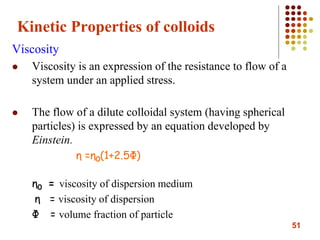
 Viscosity is an expression of the resistance to flow of a
system under an applied stress.
 The flow of a dilute colloidal system (having spherical
particles) is expressed by an equation developed by
Einstein.
η =η0(1+2.5Φ)
η0 = viscosity of dispersion medium
η = viscosity of dispersion
Φ = volume fraction of particle
52
Kinetic Properties of colloids
Viscosity
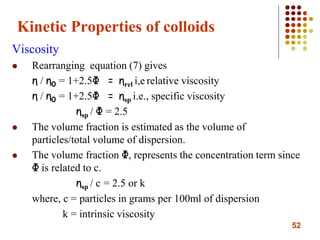
 Rearranging equation (7) gives
η / η0 = 1+2.5Φ = ηrel i,e relative viscosity
η / η0 = 1+2.5Φ = ηsp i.e., specific viscosity
ηsp / Φ = 2.5
 The volume fraction is estimated as the volume of
particles/total volume of dispersion.
 The volume fraction Φ, represents the concentration term since
Φ is related to c.
ηsp / c = 2.5 or k
where, c = particles in grams per 100ml of dispersion
k = intrinsic viscosity
53
Kinetic Properties of colloids
Viscosity
 By determining the η0 and ηrel , ηspe can be estimated.
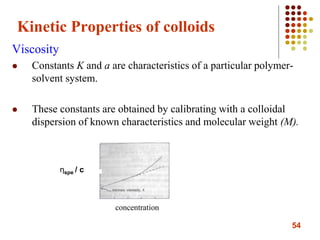
 When ηspc /c is plotted against c, a straight line may be
obtained.
 Extrapolating this line to infinite dilution (y axis) gives the
intercept, which is k value.
 This constant, k, is the intrinsic viscosity [η]
 The approximate molecular weight of the dispersed phase can
be estimated using intrinsic viscosity.
 According to Mark- Hownink equation
[η] =KMa
54
Kinetic Properties of colloids
Viscosity
 Constants K and a are characteristics of a particular polymer-
solvent system.
 These constants are obtained by calibrating with a colloidal
dispersion of known characteristics and molecular weight (M).
ηspe / c
concentration
55
Electrical Properties of colloids
Surface charge zeta potential
 In general, dispersed particles possess a charge on their
surfaces.
 The distribution of ions in the environment of a charged particle
is explained by the concept of the electrical double layer.
 When particles move, this shell of the double layer also moves
along with the particle.
 The electrical potential in the plane of shear of the charged
particle is called zeta potential.
56
Electrical Properties of colloids
Surface charge zeta potential
 Zeta potential has an application in predicting the stability of
the dispersion system.
 Zeta potential can be determined using the method of
electrophoresis.
ELECTROPHORESIS
 The principle of electrophoresis is used to determine the sign
and magnitude of zeta potential.
 It involves the movement of a charged particle through a liquid
under the influence of an applied potential difference.
57
Electrical Properties of colloids
ELECTROPHORESIS
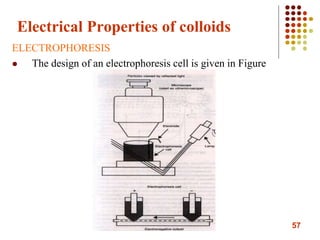
 The design of an electrophoresis cell is given in Figure
58
Electrical Properties of colloids
ELECTROPHORESIS
 An electrophoresis cell is fitted with two electrodes & the
dispersion is introduced into the cell.
 When a potential is applied across the electrodes, particles
migrate towards oppositely charged electrodes.
 If the particles move towards anode, the charge on the particle
is negative.
 If particles move towards cathode, the charge on the particles is
positive.
 Thus the sign of zeta potential can be determined.
59
Electrical Properties of colloids
ELECTROPHORESIS
 The rate of migration is a function of the charge on a particle
 The ultra microscope is used to observe the migration of
particles.
 Since shear plane of the particle is located at the periphery of
the tightly bound layer, the potential estimated represents the
zeta potential.
 Thus, sign and magnitude of the migration rate can be
determined.
60
Electrical Properties of colloids
ELECTROPHORESIS
 The apparatus is standardised by the use of particles of
known potential.
 As the potential gradient across the electrodes increases, the
velocity of migration of a particle increases.
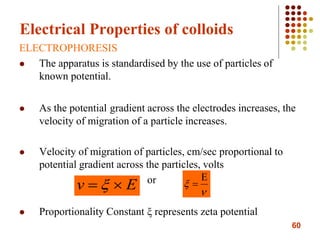
 Velocity of migration of particles, cm/sec proportional to
potential gradient across the particles, volts
or
 Proportionality Constant ξ represents zeta potential
Ev   



61
Electrical Properties of colloids
ELECTROPHORESIS
 proportionality constant ξ represents zeta potential.
 There are a number of other factors that influence the
migration.
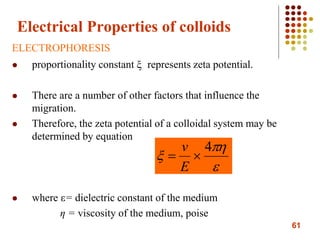
 Therefore, the zeta potential of a colloidal system may be
determined by equation
 where ε= dielectric constant of the medium
η = viscosity of the medium, poise



4

E
v
62
Electrical Properties of colloids
ELECTROPHORESIS
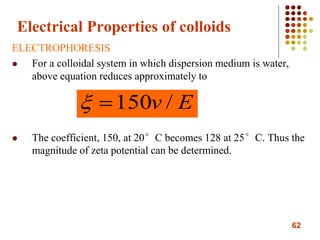
 For a colloidal system in which dispersion medium is water,
above equation reduces approximately to
 The coefficient, 150, at 20°C becomes 128 at 25°C. Thus the
magnitude of zeta potential can be determined.
Ev /150
63
STABILITY OF COLLOIDS
 Stable colloidal system is one which the particles
resist flocculation or aggregation and exhibits a long
shelf life.
 This will depend on the balance of repulsive &
attractive forces that exist between particle as they
approach one another.
 If all particles have mutual repulsion then the
dispersion will remain stable.
64
STABILITY OF COLLOIDS
Much denser form
65
STABILITY OF COLLOIDS
 In 1940's Derjaguin, Verway, Landau and Overbeek developed a
theory which dealt with colloidal stability (DLVO).
 To maintain colloidal stability, the repulsive forces between
particles must be dominant.
 Two fundamental mechanisms for repulsive forces are :
(1) STERIC REPULSION
(2) ELECTROSTATIC (CHARGE) REPULSION
66
DLVO THEORY
 According to this theory, the distance between "two dispersed
particles mainly influences particle-particle interactions.
 Using this theory, determine the amount of electrolytes of a
particular valency type required to precipitate or stabilized a
colloid
 In a colloidal dispersion, the Brownian motion results in
frequent collisions between particles.
 Such interactions are mainly responsible for the stability of
colloids. There are two types of interactions, namely attractions
and repulsions.
67
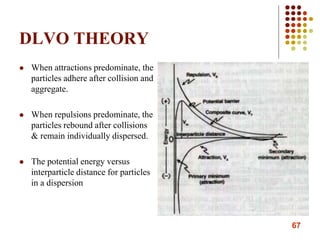
DLVO THEORY
 When attractions predominate, the
particles adhere after collision and
aggregate.
 When repulsions predominate, the
particles rebound after collisions
& remain individually dispersed.
 The potential energy versus
interparticle distance for particles
in a dispersion
68
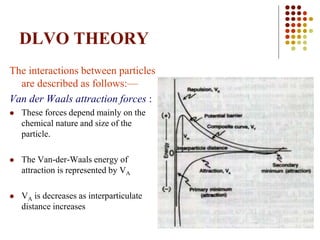
DLVO THEORY
The interactions between particles
are described as follows:—
Van der Waals attraction forces :
 These forces depend mainly on the
chemical nature and size of the
particle.
 The Van-der-Waals energy of
attraction is represented by VA
 VA is decreases as interparticulate
distance increases
69
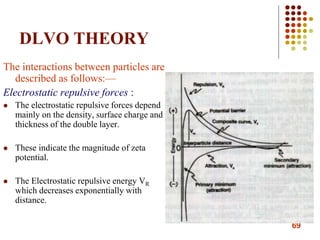
DLVO THEORY
The interactions between particles are
described as follows:—
Electrostatic repulsive forces :
 The electrostatic repulsive forces depend
mainly on the density, surface charge and
thickness of the double layer.
 These indicate the magnitude of zeta
potential.
 The Electrostatic repulsive energy VR
which decreases exponentially with
distance.
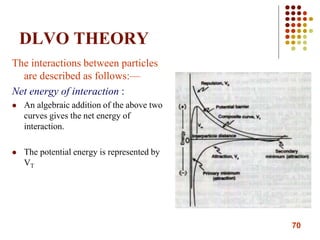
70
DLVO THEORY
The interactions between particles
are described as follows:—
Net energy of interaction :
 An algebraic addition of the above two
curves gives the net energy of
interaction.
 The potential energy is represented by
VT
71
DLVO THEORY
 At low electrolyte concentration ,the repulsive forces
predominate so that the particles experience only a repulsive
force upon approach
 The particle remain individual & system is called dispersed or
peptized
 At a higher concentration of electrolyte, the electrical double
layer forces are greatly diminished
 As result, Vander – waals forces of attraction predominate &
particles encounters net attractive forces ending in coagulation.
72
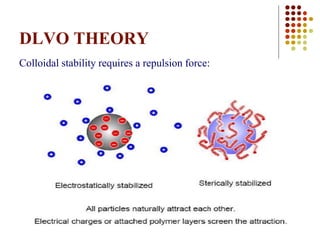
DLVO THEORY
Colloidal stability requires a repulsion force:
73
Stearic stabilization
 Its involves polymers added to the system adsorbing onto the
particles surface causing repulsion.
Electrostatic stabilization
 This is the effect on particle interaction due to the distribution
of charged species in the system.
 Stabilization or flocculation of a system may be modified
simply by altering the concentration of ions in a system. It is
reversible process and inexpensive.
 Zeta potential is a very good index of the magnitude of the
interaction between colloidal particles & measurements are
used to assess the stability of colloidal systems.
74
Zeta potential
 The Zeta potential is the over-all charge a particle acquires in a
specific medium.
 The magnitude of the Zeta potential gives an indication of the
Potential of the colloidal system
 If all the particles have a large Positive or Negative Zeta
Potential they will repel each other & there is the dispersion
stability
 If the particles have low Zeta potential then there is no force to
prevent the particles coming together and dispersion
instability.
75
Zeta potential
 A line of demarkation between stable and unstable aqueous
dispersions is generally taken at either + 30 or - 30 mV.
 Particles with Zeta potentials more positive than + 30 mV are
normally considered stable.
 Particles with Zeta potentials more negative than - 30 mV are
normally considered stable.
76
SCHULZE-HARDY RULE (Hofmeister
or lyotropic series)
 Lyophilic & association colloids are thermodynamically stable
& exist in the true solution.
 They don’t coagulate on addition of moderate amounts of
electrolytes
 But they coagulate if sufficient amount of electrolyte is added as
was evident with Lyophobic colloids, called salting out
 Hardy – Schulze rule arranges ions in the order of their capacity
to coagulate hydrophobic colloids, the Hofmeister or Lyotropic
series ranks cations & anions in order of coagulation of
hydrophilic solution
77
SCHULZE-HARDY RULE (Hofmeister
or lyotropic series)
 Anions of Hofmeister series in decreasing order of
precipitating power are
 Citrate > Tartrate > Sulphate > Acetate > Chloride
 It is depends upon the ability to dislodge solvent sheath from
the colloidal particles
 When negative & positively charged hydrophilic colloids are
mixed, the particles may separate from the dispersion to form a
layer rich in the colloidal aggregates
 The colloid rich layer is known as a coacervate & the process
is called as coacervation
 Eg gelatin & acacia
78
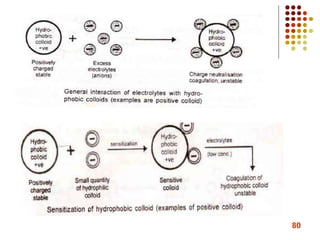
Sensitization & protective colloidal
action
 In the presence of very small amount of hydrophilic colloids or
hydrophobic colloids of opposite charge ,hydrophobic colloids
may become more susceptible to precipitation from electrolytes. It
is known as Sensitization
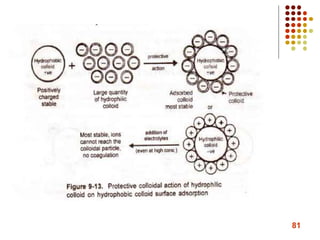
 When a large amount of hydrophilic colloid particles are added to
hydrophobic colloids, these get adsorbed on the hydrophobic
particles and form a protective layer around it. This adsorption
layer prevents the precipitating ions reaching the sol particle
 The colloid that helps to stabilize other colloids is called as a
protective colloid.
79
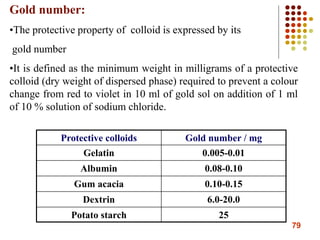
Gold number:
•The protective property of colloid is expressed by its
gold number
•It is defined as the minimum weight in milligrams of a protective
colloid (dry weight of dispersed phase) required to prevent a colour
change from red to violet in 10 ml of gold sol on addition of 1 ml
of 10 % solution of sodium chloride.
Protective colloids Gold number / mg
Gelatin 0.005-0.01
Albumin 0.08-0.10
Gum acacia 0.10-0.15
Dextrin 6.0-20.0
Potato starch 25
80
81