CONTENTS
 Dispersed system
 Classification of dispersed system
 Comparison between molecular, colloidal & coarse dispersion
 Colloids: introduction
 Characteristics of dispersed phase:
• Particle size
• Particle shape
• Surface area
• Surface charge
 Classification of colloidal dispersions
 Purification of colloidal dispersions
 Stability of colloids
Classification of colloidal dispersions
• Classification of colloids based on nature of interaction between
dispersed phase and dispersion medium:
A. Lyophilic colloids
B. Lyophobic colloids
C. Association colloids
(Lyo means solvent & philic means loving)
Lyophilic colloids
• Lyophilic means solvent-loving. The term indicates that dispersed particles have a
greater affinity to the dispersion medium.
• The dispersion medium forms a sheath around the colloidal particles and solvates.
This makes the dispersion thermodynamically stable. For this reason, preparation of
lyophilic colloids is relatively easy.
• The dispersion is reversible, i.e. colloidal particles can be reconstituted after the
purification step.
• Dispersed particles may be:
Hydrophilic (e.g. acacia, gelatin, albumin & insulin)
Lipophilic (e.g. rubber & polystyrene)
• Based on the nature of dispersed particles, dispersion media is selected for their
preparation.
• Lyophilic colloid: dispersion of rubber or polystyrene in organic solvents
such as benzene or ethylmethyl ketone.
• Hydrophilic colloid: when water is used as a dispersion medium.
Examples: acacia, gelatin and starch dispersions in water.
• It is possible to obtain lyophilic colloids with or without charge.
For example,
1. Acacia in water possess negative charge.
2. Gelatin in water has positive charge
Lyophobic Colloids
• Lyophobic means solvent- hating
• These are dispersions in which very little attraction is possible between the
dispersed particles and dispersion medium.
• These are stable because of the presence of a charge on particles.
• The like charges on particles keep them away from each other and remain
uniformly dispersed on account of repulsive forces.
• Solvent sheath surrounding the particle is absent. Therefore, these dispersions
are thermodynamically unstable.
• Method of Preparation: special methods are required to prepare lyophobic
colloids because of the weaker attraction between particles and the medium.
1. Dispersion method
2. Condensation method
Methods of Preparation
• Dispersion Method:
1. Milling and grinding
2. Peptization
3. Electric arc method
4. Ultrasonic treatment
• Condensation method:
1. Addition of nonsolvent
2. Chemical methods
Dispersion method
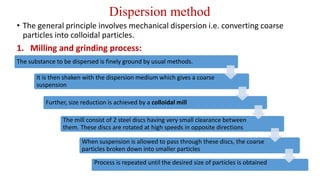
• The general principle involves mechanical dispersion i.e. converting coarse
particles into colloidal particles.
1. Milling and grinding process:
The substance to be dispersed is finely ground by usual methods.
It is then shaken with the dispersion medium which gives a coarse
suspension
Further, size reduction is achieved by a colloidal mill
The mill consist of 2 steel discs having very small clearance between
them. These discs are rotated at high speeds in opposite directions
When suspension is allowed to pass through these discs, the coarse
particles broken down into smaller particles
Process is repeated until the desired size of particles is obtained
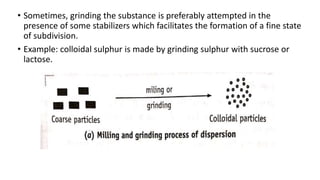
• Sometimes, grinding the substance is preferably attempted in the
presence of some stabilizers which facilitates the formation of a fine state
of subdivision.
• Example: colloidal sulphur is made by grinding sulphur with sucrose or
lactose.
2. Peptization:
• It is defined as breaking up of aggregates or secondary particles into particles of
colloidal size.
• Compounds that promote dispersibility of the solids, without entering into combination
with them, are termed as peptizing agents.
• Peptizing Agents may be liquids, electrolytes or non- electrolytes.
Example: glycerine, sugar, lactose, acids containing hydroxyl groups such as citric and
tartaric acid.
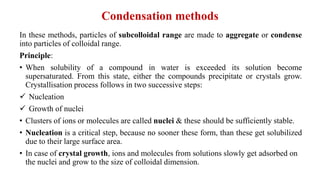
Condensation methods
In these methods, particles of subcolloidal range are made to aggregate or condense
into particles of colloidal range.
Principle:
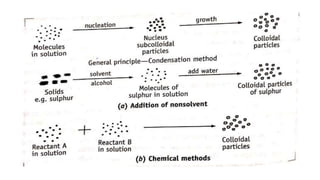
• When solubility of a compound in water is exceeded its solution become
supersaturated. From this state, either the compounds precipitate or crystals grow.
Crystallisation process follows in two successive steps:
 Nucleation
 Growth of nuclei
• Clusters of ions or molecules are called nuclei & these should be sufficiently stable.
• Nucleation is a critical step, because no sooner these form, than these get solubilized
due to their large surface area.
• In case of crystal growth, ions and molecules from solutions slowly get adsorbed on
the nuclei and grow to the size of colloidal dimension.
1. Addition of non-solvent
• Sulphur is soluble in alcohol.
• Conc. alcoholic solution of sulphur is poured into an excess amount of water.
• Sulphur which is present in a molecular state in alcohol gets precipitated out as
finely divided particles. These particles grow rapidly and form a colloidal dispersion.
2. Chemical methods
• Chemical reactions may be carried out to prepare lyophobic sols.
• These methods are largely restricted to inorganic substance.
Reaction Colloidal dispersion
Reduction Gold, silver, platinum
Oxidation Sulphur
Hydrolysis Ferric oxide
Double decomposition Arsenic oxide
Association colloids
• Surfactant
• Micelles
• CMC (Critical Micelle Concentration)
• Classification of association colloids
• Krafft point
• Applications- micellar solubilisation
• Formulation factors
1. Type of surfactant
2. Conc. of surfactant
Purification of colloidal dispersions
• Colloidal sols prepared by various methods frequently contain appreciable amounts of
electrolytes.
• These electrolytes should be removed to obtain a pure sol.
• However, from the stability point of view, an optimum concentration of electrolytes is
desirable.
• Purification of sols may be accomplished by the following methods:
a) Dialysis
b) Electrodialysis
c) Ultrafiltration
• Dialysis: In dialysis ion or molecules are removed from a colloidal dispersion by
diffusion through a semipermeable membrane.
• A semipermeable membrane of collodian has very fine pores. These pores permit the
passage of ions ( sodium and chloride), small molecules (glucose & urea), but prevent
the passage of colloidal particles owing to their bigger size.
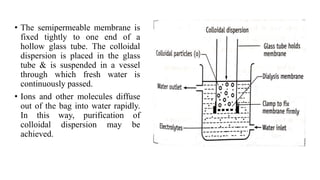
• The semipermeable membrane is
fixed tightly to one end of a
hollow glass tube. The colloidal
dispersion is placed in the glass
tube & is suspended in a vessel
through which fresh water is
continuously passed.
• Ions and other molecules diffuse
out of the bag into water rapidly.
In this way, purification of
colloidal dispersion may be
achieved.
• Dialysis method can be used to differentiate whether a dispersion is in a
colloidal state or true solution state.
• In the dialysis process, the solution that is outside the dialysis membrane is
known as diffusate and the colloidal dispersion which remains in the dialyser
is known as dialysate.
Pharmaceutical applications:
1. Drug protein binding effects can be studied employing the principles of
dialysis.
2. Used in the haemodialysis technique.
Electrodialysis
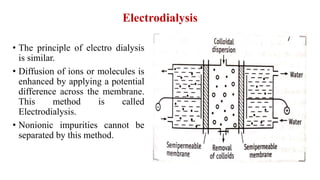
• The principle of electro dialysis
is similar.
• Diffusion of ions or molecules is
enhanced by applying a potential
difference across the membrane.
This method is called
Electrodialysis.
• Nonionic impurities cannot be
separated by this method.
Ultrafiltration
• Colloidal dispersion can pass through an
ordinary filter paper, because the pore size of
filter paper is large.
• If this filter paper is impregnated with
collodion, the pore size reduces. Such
modified filter papers are called ultrafilters.
• The colloidal dispersion is filtered through
ultrafilter to remove all electrolytes.
Colloidal particles are retained on the filter
paper as a slime. These are collected and
dispersed in a pure dispersion medium to get
a sol.
• Ultrafiltration proceeds very slowly, so
pressure or suction is aaplied to increase the
rate of filtration.

Colloids ...pptx

  • 2.
    CONTENTS  Dispersed system Classification of dispersed system  Comparison between molecular, colloidal & coarse dispersion  Colloids: introduction  Characteristics of dispersed phase: • Particle size • Particle shape • Surface area • Surface charge  Classification of colloidal dispersions  Purification of colloidal dispersions  Stability of colloids
  • 3.
    Classification of colloidaldispersions • Classification of colloids based on nature of interaction between dispersed phase and dispersion medium: A. Lyophilic colloids B. Lyophobic colloids C. Association colloids (Lyo means solvent & philic means loving)
  • 4.
    Lyophilic colloids • Lyophilicmeans solvent-loving. The term indicates that dispersed particles have a greater affinity to the dispersion medium. • The dispersion medium forms a sheath around the colloidal particles and solvates. This makes the dispersion thermodynamically stable. For this reason, preparation of lyophilic colloids is relatively easy. • The dispersion is reversible, i.e. colloidal particles can be reconstituted after the purification step. • Dispersed particles may be: Hydrophilic (e.g. acacia, gelatin, albumin & insulin) Lipophilic (e.g. rubber & polystyrene) • Based on the nature of dispersed particles, dispersion media is selected for their preparation.
  • 5.
    • Lyophilic colloid:dispersion of rubber or polystyrene in organic solvents such as benzene or ethylmethyl ketone. • Hydrophilic colloid: when water is used as a dispersion medium. Examples: acacia, gelatin and starch dispersions in water. • It is possible to obtain lyophilic colloids with or without charge. For example, 1. Acacia in water possess negative charge. 2. Gelatin in water has positive charge
  • 6.
    Lyophobic Colloids • Lyophobicmeans solvent- hating • These are dispersions in which very little attraction is possible between the dispersed particles and dispersion medium. • These are stable because of the presence of a charge on particles. • The like charges on particles keep them away from each other and remain uniformly dispersed on account of repulsive forces. • Solvent sheath surrounding the particle is absent. Therefore, these dispersions are thermodynamically unstable. • Method of Preparation: special methods are required to prepare lyophobic colloids because of the weaker attraction between particles and the medium. 1. Dispersion method 2. Condensation method
  • 7.
    Methods of Preparation •Dispersion Method: 1. Milling and grinding 2. Peptization 3. Electric arc method 4. Ultrasonic treatment • Condensation method: 1. Addition of nonsolvent 2. Chemical methods
  • 8.
    Dispersion method • Thegeneral principle involves mechanical dispersion i.e. converting coarse particles into colloidal particles. 1. Milling and grinding process: The substance to be dispersed is finely ground by usual methods. It is then shaken with the dispersion medium which gives a coarse suspension Further, size reduction is achieved by a colloidal mill The mill consist of 2 steel discs having very small clearance between them. These discs are rotated at high speeds in opposite directions When suspension is allowed to pass through these discs, the coarse particles broken down into smaller particles Process is repeated until the desired size of particles is obtained
  • 9.
    • Sometimes, grindingthe substance is preferably attempted in the presence of some stabilizers which facilitates the formation of a fine state of subdivision. • Example: colloidal sulphur is made by grinding sulphur with sucrose or lactose.
  • 10.
    2. Peptization: • Itis defined as breaking up of aggregates or secondary particles into particles of colloidal size. • Compounds that promote dispersibility of the solids, without entering into combination with them, are termed as peptizing agents. • Peptizing Agents may be liquids, electrolytes or non- electrolytes. Example: glycerine, sugar, lactose, acids containing hydroxyl groups such as citric and tartaric acid.
  • 11.
    Condensation methods In thesemethods, particles of subcolloidal range are made to aggregate or condense into particles of colloidal range. Principle: • When solubility of a compound in water is exceeded its solution become supersaturated. From this state, either the compounds precipitate or crystals grow. Crystallisation process follows in two successive steps:  Nucleation  Growth of nuclei • Clusters of ions or molecules are called nuclei & these should be sufficiently stable. • Nucleation is a critical step, because no sooner these form, than these get solubilized due to their large surface area. • In case of crystal growth, ions and molecules from solutions slowly get adsorbed on the nuclei and grow to the size of colloidal dimension.
  • 12.
    1. Addition ofnon-solvent • Sulphur is soluble in alcohol. • Conc. alcoholic solution of sulphur is poured into an excess amount of water. • Sulphur which is present in a molecular state in alcohol gets precipitated out as finely divided particles. These particles grow rapidly and form a colloidal dispersion. 2. Chemical methods • Chemical reactions may be carried out to prepare lyophobic sols. • These methods are largely restricted to inorganic substance. Reaction Colloidal dispersion Reduction Gold, silver, platinum Oxidation Sulphur Hydrolysis Ferric oxide Double decomposition Arsenic oxide
  • 14.
    Association colloids • Surfactant •Micelles • CMC (Critical Micelle Concentration) • Classification of association colloids • Krafft point • Applications- micellar solubilisation • Formulation factors 1. Type of surfactant 2. Conc. of surfactant
  • 15.
    Purification of colloidaldispersions • Colloidal sols prepared by various methods frequently contain appreciable amounts of electrolytes. • These electrolytes should be removed to obtain a pure sol. • However, from the stability point of view, an optimum concentration of electrolytes is desirable. • Purification of sols may be accomplished by the following methods: a) Dialysis b) Electrodialysis c) Ultrafiltration • Dialysis: In dialysis ion or molecules are removed from a colloidal dispersion by diffusion through a semipermeable membrane. • A semipermeable membrane of collodian has very fine pores. These pores permit the passage of ions ( sodium and chloride), small molecules (glucose & urea), but prevent the passage of colloidal particles owing to their bigger size.
  • 16.
    • The semipermeablemembrane is fixed tightly to one end of a hollow glass tube. The colloidal dispersion is placed in the glass tube & is suspended in a vessel through which fresh water is continuously passed. • Ions and other molecules diffuse out of the bag into water rapidly. In this way, purification of colloidal dispersion may be achieved.
  • 17.
    • Dialysis methodcan be used to differentiate whether a dispersion is in a colloidal state or true solution state. • In the dialysis process, the solution that is outside the dialysis membrane is known as diffusate and the colloidal dispersion which remains in the dialyser is known as dialysate. Pharmaceutical applications: 1. Drug protein binding effects can be studied employing the principles of dialysis. 2. Used in the haemodialysis technique.
  • 18.
    Electrodialysis • The principleof electro dialysis is similar. • Diffusion of ions or molecules is enhanced by applying a potential difference across the membrane. This method is called Electrodialysis. • Nonionic impurities cannot be separated by this method.
  • 19.
    Ultrafiltration • Colloidal dispersioncan pass through an ordinary filter paper, because the pore size of filter paper is large. • If this filter paper is impregnated with collodion, the pore size reduces. Such modified filter papers are called ultrafilters. • The colloidal dispersion is filtered through ultrafilter to remove all electrolytes. Colloidal particles are retained on the filter paper as a slime. These are collected and dispersed in a pure dispersion medium to get a sol. • Ultrafiltration proceeds very slowly, so pressure or suction is aaplied to increase the rate of filtration.