Rheology
Maryam kazemi
Ph.D student of pharmaceutics
Shiraz university of medical sciences
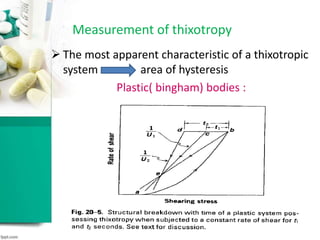
Measurement of thixotropy
 The most apparent characteristic of a thixotropic
system area of hysteresis
Plastic( bingham) bodies :
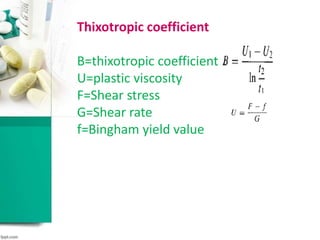
Thixotropic coefficient
B=thixotropic coefficient
U=plastic viscosity
F=Shear stress
G=Shear rate
f=Bingham yield value
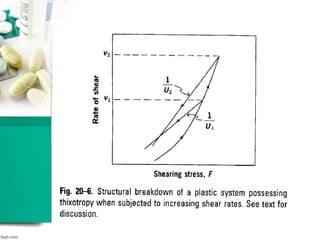
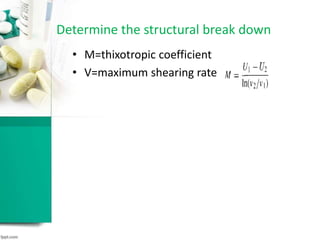
Determine the structural break down
• M=thixotropic coefficient
• V=maximum shearing rate
Bulgs & Spures
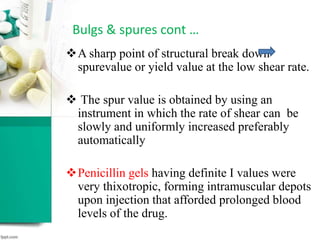
Agueous bentonit gel (10-15% by weight) hysteresis loop with
bulge in the up curve.
Procain penicillin gel IM
Bulgs & spures cont …
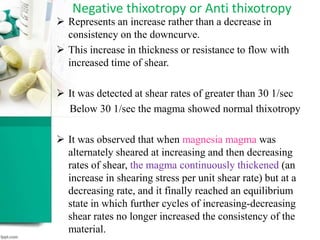
A sharp point of structural break down
spurevalue or yield value at the low shear rate.
 The spur value is obtained by using an
instrument in which the rate of shear can be
slowly and uniformly increased preferably
automatically
Penicillin gels having definite I values were
very thixotropic, forming intramuscular depots
upon injection that afforded prolonged blood
levels of the drug.
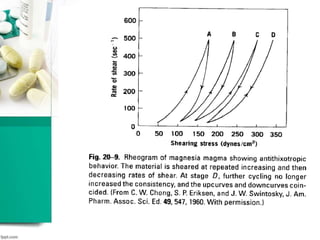
Negative thixotropy or Anti thixotropy
 Represents an increase rather than a decrease in
consistency on the downcurve.
 This increase in thickness or resistance to flow with
increased time of shear.
 It was detected at shear rates of greater than 30 1/sec
Below 30 1/sec the magma showed normal thixotropy
 It was observed that when magnesia magma was
alternately sheared at increasing and then decreasing
rates of shear, the magma continuously thickened (an
increase in shearing stress per unit shear rate) but at a
decreasing rate, and it finally reached an equilibrium
state in which further cycles of increasing-decreasing
shear rates no longer increased the consistency of the
material.
 The equilibrium system :
1) readily pourable
2)the material returned to the Sol like
properties.
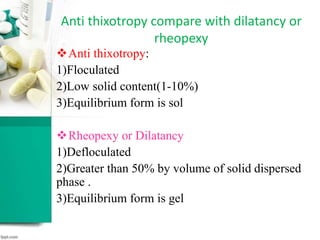
Anti thixotropy compare with dilatancy or
rheopexy
Anti thixotropy:
1)Floculated
2)Low solid content(1-10%)
3)Equilibrium form is sol
Rheopexy or Dilatancy
1)Defloculated
2)Greater than 50% by volume of solid dispersed
phase .
3)Equilibrium form is gel
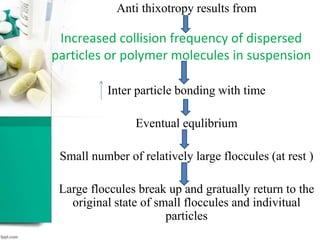
Increased collision frequency of dispersed
particles or polymer molecules in suspension
Anti thixotropy results from
Inter particle bonding with time
Eventual equlibrium
Small number of relatively large floccules (at rest )
Large floccules break up and gratually return to the
original state of small floccules and indivitual
particles
Thixotropy in Formulation
 Desirable properly in liquid pharmaceutical sys
 Ideally should have a high consistency in the
container
 Spread easily
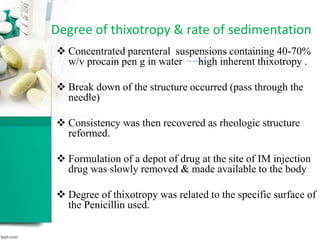
Degree of thixotropy & rate of sedimentation
 Concentrated parenteral suspensions containing 40-70%
w/v procain pen g in water high inherent thixotropy .
 Break down of the structure occurred (pass through the
needle)
 Consistency was then recovered as rheologic structure
reformed.
 Formulation of a depot of drug at the site of IM injection
drug was slowly removed & made available to the body
 Degree of thixotropy was related to the specific surface of
the Penicillin used.
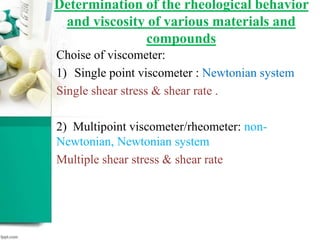
Determination of the rheological behavior
and viscosity of various materials and
compounds
Choise of viscometer:
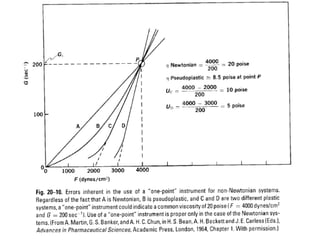
1) Single point viscometer : Newtonian system
Single shear stress & shear rate .
2) Multipoint viscometer/rheometer: non-
Newtonian, Newtonian system
Multiple shear stress & shear rate
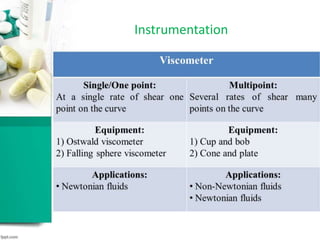
Instrumentation
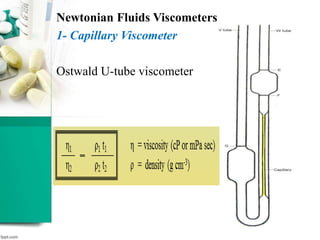
Newtonian Fluids Viscometers
1- Capillary Viscometer
Ostwald U-tube viscometer
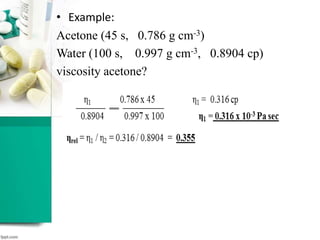
• Example:
Acetone (45 s, 0.786 g cm-3)
Water (100 s, 0.997 g cm-3, 0.8904 cp)
viscosity acetone?
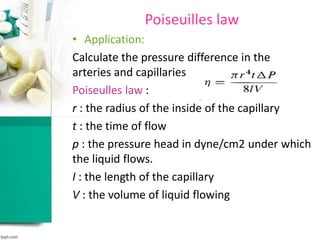
Poiseuilles law
• Application:
Calculate the pressure difference in the
arteries and capillaries.
Poiseulles law :
r : the radius of the inside of the capillary
t : the time of flow
p : the pressure head in dyne/cm2 under which
the liquid flows.
I : the length of the capillary
V : the volume of liquid flowing
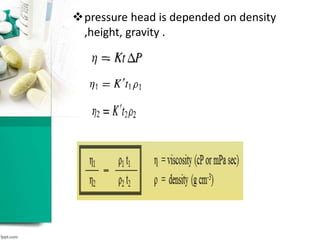
pressure head is depended on density
,height, gravity .
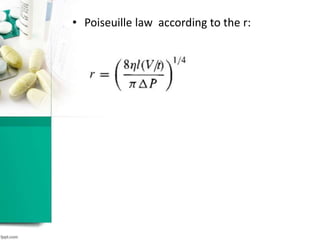
• Poiseuille law according to the r:
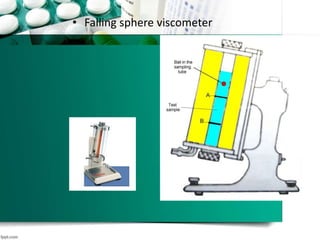
• Falling sphere viscometer
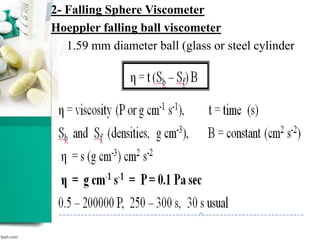
2- Falling Sphere Viscometer
Hoeppler falling ball viscometer
1.59 mm diameter ball (glass or steel cylinder
(320 mm height x 25 mm width)
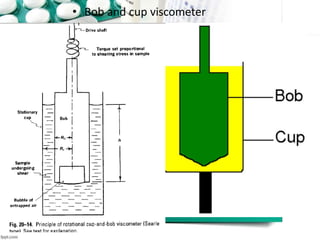
• Bob and cup viscometer
Multipoint Viscometers
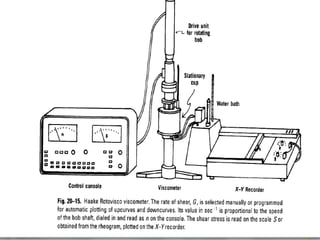
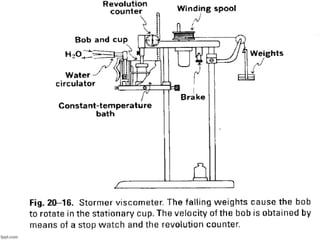
1- Bob and Cup Viscometer (concentric cylinder viscometer)
Couette (Cup rotates, and Bob stationary)
Searle (Cup stationary and Bob rotates) Rotovisco , Stormer
rotovisco:
• F = S x KF
Shear stress (dyne cm-2) = Stress reported by viscometer x
Shear stress factor (dyne cm-2)
G = KG x n
Shear rate (s-1) = Shear rate factor x Speed of rotation (rpm)
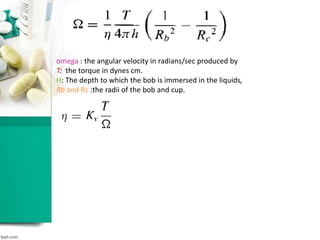
omega : the angular velocity in radians/sec produced by
T: the torque in dynes cm.
H: The depth to which the bob is immersed in the liquids,
Rb and Rc :the radii of the bob and cup.
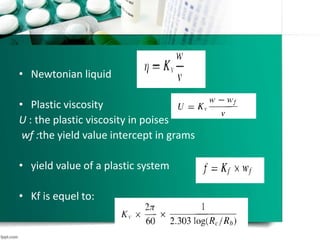
• Newtonian liquid
• Plastic viscosity
U : the plastic viscosity in poises
wf :the yield value intercept in grams
• yield value of a plastic system
• Kf is equel to:
• The Brookfield viscometer is a rotational
viscometer of the Searle type that is popular in the
quality-control laboratories of pharmaceutical
manufacturers
• Pulg flow
Flow of paste
Bob and cup

Rheology part 2

  • 1.
    Rheology Maryam kazemi Ph.D studentof pharmaceutics Shiraz university of medical sciences
  • 2.
    Measurement of thixotropy The most apparent characteristic of a thixotropic system area of hysteresis Plastic( bingham) bodies :
  • 3.
    Thixotropic coefficient B=thixotropic coefficient U=plasticviscosity F=Shear stress G=Shear rate f=Bingham yield value
  • 5.
    Determine the structuralbreak down • M=thixotropic coefficient • V=maximum shearing rate
  • 6.
    Bulgs & Spures Agueousbentonit gel (10-15% by weight) hysteresis loop with bulge in the up curve. Procain penicillin gel IM
  • 7.
    Bulgs & spurescont … A sharp point of structural break down spurevalue or yield value at the low shear rate.  The spur value is obtained by using an instrument in which the rate of shear can be slowly and uniformly increased preferably automatically Penicillin gels having definite I values were very thixotropic, forming intramuscular depots upon injection that afforded prolonged blood levels of the drug.
  • 8.
    Negative thixotropy orAnti thixotropy  Represents an increase rather than a decrease in consistency on the downcurve.  This increase in thickness or resistance to flow with increased time of shear.  It was detected at shear rates of greater than 30 1/sec Below 30 1/sec the magma showed normal thixotropy  It was observed that when magnesia magma was alternately sheared at increasing and then decreasing rates of shear, the magma continuously thickened (an increase in shearing stress per unit shear rate) but at a decreasing rate, and it finally reached an equilibrium state in which further cycles of increasing-decreasing shear rates no longer increased the consistency of the material.
  • 9.
     The equilibriumsystem : 1) readily pourable 2)the material returned to the Sol like properties.
  • 11.
    Anti thixotropy comparewith dilatancy or rheopexy Anti thixotropy: 1)Floculated 2)Low solid content(1-10%) 3)Equilibrium form is sol Rheopexy or Dilatancy 1)Defloculated 2)Greater than 50% by volume of solid dispersed phase . 3)Equilibrium form is gel
  • 12.
    Increased collision frequencyof dispersed particles or polymer molecules in suspension Anti thixotropy results from Inter particle bonding with time Eventual equlibrium Small number of relatively large floccules (at rest ) Large floccules break up and gratually return to the original state of small floccules and indivitual particles
  • 13.
    Thixotropy in Formulation Desirable properly in liquid pharmaceutical sys  Ideally should have a high consistency in the container  Spread easily
  • 14.
    Degree of thixotropy& rate of sedimentation  Concentrated parenteral suspensions containing 40-70% w/v procain pen g in water high inherent thixotropy .  Break down of the structure occurred (pass through the needle)  Consistency was then recovered as rheologic structure reformed.  Formulation of a depot of drug at the site of IM injection drug was slowly removed & made available to the body  Degree of thixotropy was related to the specific surface of the Penicillin used.
  • 15.
    Determination of therheological behavior and viscosity of various materials and compounds Choise of viscometer: 1) Single point viscometer : Newtonian system Single shear stress & shear rate . 2) Multipoint viscometer/rheometer: non- Newtonian, Newtonian system Multiple shear stress & shear rate
  • 17.
  • 18.
    Newtonian Fluids Viscometers 1-Capillary Viscometer Ostwald U-tube viscometer
  • 19.
    • Example: Acetone (45s, 0.786 g cm-3) Water (100 s, 0.997 g cm-3, 0.8904 cp) viscosity acetone?
  • 20.
    Poiseuilles law • Application: Calculatethe pressure difference in the arteries and capillaries. Poiseulles law : r : the radius of the inside of the capillary t : the time of flow p : the pressure head in dyne/cm2 under which the liquid flows. I : the length of the capillary V : the volume of liquid flowing
  • 21.
    pressure head isdepended on density ,height, gravity .
  • 22.
    • Poiseuille lawaccording to the r:
  • 23.
  • 24.
    2- Falling SphereViscometer Hoeppler falling ball viscometer 1.59 mm diameter ball (glass or steel cylinder (320 mm height x 25 mm width)
  • 25.
    • Bob andcup viscometer
  • 26.
    Multipoint Viscometers 1- Boband Cup Viscometer (concentric cylinder viscometer) Couette (Cup rotates, and Bob stationary) Searle (Cup stationary and Bob rotates) Rotovisco , Stormer rotovisco: • F = S x KF Shear stress (dyne cm-2) = Stress reported by viscometer x Shear stress factor (dyne cm-2) G = KG x n Shear rate (s-1) = Shear rate factor x Speed of rotation (rpm)
  • 29.
    omega : theangular velocity in radians/sec produced by T: the torque in dynes cm. H: The depth to which the bob is immersed in the liquids, Rb and Rc :the radii of the bob and cup.
  • 30.
    • Newtonian liquid •Plastic viscosity U : the plastic viscosity in poises wf :the yield value intercept in grams • yield value of a plastic system • Kf is equel to:
  • 31.
    • The Brookfieldviscometer is a rotational viscometer of the Searle type that is popular in the quality-control laboratories of pharmaceutical manufacturers • Pulg flow Flow of paste Bob and cup