Viscosity
  Viscosity is a property of liquids that is closely related to
  the resistance to flow.

  It is defined in terms of the force required to move one
  plane surface continuously past another under specified
  steady-state conditions when the space between is filled by
  the liquid in question.

  It is defined as the shear stress divided by the rate of shear
  strain.

  BP

  Dynamic viscosity
  Kinematic viscosity
Dynamic viscosity
The dynamic viscosity or viscosity coefficient h is the
tangential force per unit surface, known as shearing stress
t and expressed in pascals, necessary to move, parallel to
the sliding plane, a layer of liquid of 1 square metre at a
rate (v) of 1 meter per second relative to a parallel layer at
a distance (x) of 1 meter.

The ratio dv/dx is a speed gradient giving the rate of shear
D expressed in reciprocal seconds (s-1), so that h = t/D.

The unit of dynamic viscosity is the pascal second (Pa·s).
The most commonly used submultiple is the millipascal
second (mPa·s).
Kinematic viscosity

The kinematic viscosity v, expressed in square metres per
second, is obtained by dividing the dynamic viscosity h by the
density r expressed in kilograms per cubic metre, of the liquid
measured at the same temperature,

                    i.e. v = h/r.

The kinematic viscosity is usually expressed in square millimetres
per second.

USP

The basic unit is the poise (according to USP)
However, viscosities commonly encountered represent fractions of
the poise, so that the centipoise (1 poise = 100 centipoises)
proves to be the more convenient unit.
Measurement of Viscosity

The usual method for measurement of viscosity involves the
determination of the time required for a given volume of
liquid to flow through a capillary.

Many capillary-tube viscosimeters have been devised, but
Ostwald and Ubbelohde viscosimeters are among the most
frequently used.

A particularly convenient and rapid type of instrument is a
rotational viscosimeter, which utilizes a bob or spindle
immersed in the test specimen and measures the resistance
to movement of the rotating part.

Different spindles are available for given viscosity ranges,
and several rotational speeds generally are available.
• Other rotational instruments may have a stationary bob
  and a rotating cup.
• The Brookfield, Rotouisco, and Stormer viscosimeters are
  examples of rotating-bob instruments, and the
  MacMichael is an example of the rotating-cup instrument.
• Numerous other rotational instruments of advanced
  design with special devices for reading or recording, and
  with wide ranges of rotational speed, have been devised.
• Where only a particular type of instrument is suitable, the
  individual monograph so indicates.
• For measurement of viscosity or apparent viscosity, the
  temperature of the substance being measured must be
  accurately controlled, since small temperature changes
  may lead to marked changes in viscosity.
• For usual pharmaceutical purposes, the temperature
  should be held to within ±0.1 .
Common methods for determination of viscosity
Method I (U tube viscometer)
Apparatus


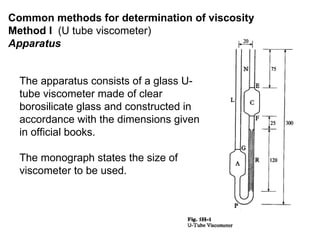
  The apparatus consists of a glass U-
  tube viscometer made of clear
  borosilicate glass and constructed in
  accordance with the dimensions given
  in official books.

  The monograph states the size of
  viscometer to be used.
Method

• Fill the viscometer with the liquid being
  examined through tube L to slightly above
  the mark G, using a long pipette to minimise
  wetting the tube above the mark.
• Place the tube vertically in a water bath and
  when it has attained the specified
  temperature, adjust the volume of the liquid
  so that the bottom of the meniscus settles at
  the mark G.
• Adjust the liquid to a point about 5 mm above
  the mark E.
• After releasing pressure or suction, measure
  the time taken for the bottom of the meniscus
  to fall from the top edge of mark E to the top
  edge of mark F.
Method II (Capillary viscometer method)

(Ph. Eur. method 2.2.9)

• The determination of viscosity using a suitable capillary
  viscometer is carried out at a temperature of 20 ± 0.1 °C,
  unless otherwise prescribed.
• The time required for the level of the liquid to drop from
  one mark to the other is measured with a stop-watch to
  the nearest one-fifth of a second.
• The result is valid only if two consecutive readings do not
  differ by more than 1 per cent.
• The average of not fewer than three readings gives the
  flow time of the liquid to be examined.
•
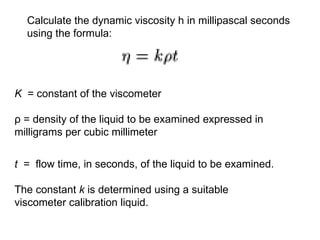
Calculate the dynamic viscosity h in millipascal seconds
  using the formula:


K = constant of the viscometer

ρ = density of the liquid to be examined expressed in
milligrams per cubic millimeter


t = flow time, in seconds, of the liquid to be examined.

The constant k is determined using a suitable
viscometer calibration liquid.
Method III (Rotating viscometer method)

(Ph. Eur. method 2.2.10)

• The principle of the method is to measure the force
  acting on a rotor (torque) when it rotates at a constant
  angular velocity (rotational speed) in a liquid.
• Rotating viscometers are used for measuring the
  viscosity of Newtonian (shear-independent viscosity) or
  non-Newtonian liquids (shear dependent viscosity or
  apparent viscosity).
• Rotating viscometers can be divided in 2 groups,
  namely absolute and relative viscometers.
• In absolute viscometers the flow in the measuring
  geometry is well defined. The measurements result in
  absolute viscosity values, which can be compared with
  any other absolute values.
In relative viscometers the flow in the measuring geometry
is not defined.
The measurements result in relative viscosity values, which
cannot be compared with absolute values or other relative
values if not determined by the same relative viscometer
method.

Different measuring systems are available for given
viscosity ranges as well as several rotational speeds.
Apparatus

The following types of instruments are
most common.

Concentric cylinder viscometers
(absolute viscometers)

In the concentric cylinder viscometer
(coaxial double cylinder viscometer or
simply coaxial cylinder viscometer), the
viscosity is determined by placing the
liquid in the gap between the inner cylinder
and the outer cylinder.
Viscosity measurement can be performed
by rotating the inner cylinder (Searle type
viscometer) or the outer cylinder (Couette
type viscometer), as shown in Figures.
Cone-plate viscometers (absolute viscometers)

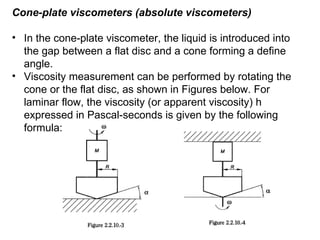
• In the cone-plate viscometer, the liquid is introduced into
  the gap between a flat disc and a cone forming a define
  angle.
• Viscosity measurement can be performed by rotating the
  cone or the flat disc, as shown in Figures below. For
  laminar flow, the viscosity (or apparent viscosity) h
  expressed in Pascal-seconds is given by the following
  formula:
Spindle viscometers (relative viscometers)

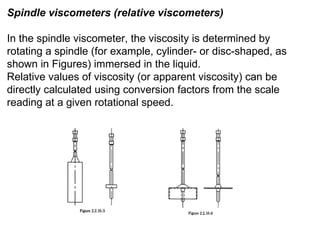
In the spindle viscometer, the viscosity is determined by
rotating a spindle (for example, cylinder- or disc-shaped, as
shown in Figures) immersed in the liquid.
Relative values of viscosity (or apparent viscosity) can be
directly calculated using conversion factors from the scale
reading at a given rotational speed.
In a general way, the constant k of the apparatus may be
determined at various speeds of rotation using a certified
viscometer calibration liquid. The viscosity ƞ then
corresponds to the formula:
Method

• Measure the viscosity (or apparent viscosity) according to
  the instructions for the operation of the rotating viscometer.
• The temperature for measuring the viscosity is indicated in
  the monograph.
• For non-Newtonian systems, the monograph indicates the
  type of viscometer to be used and if absolute viscometers
  are used the angular velocity or the shear rate at which the
  measurement is made.
• If it is impossible to obtain the indicated shear rate exactly,
  use a shear rate slightly higher and a shear rate slightly
  lower and interpolate.
• With relative viscometers the shear rate is not the same
  throughout the sample and therefore it cannot be defined.
• Under these conditions, the viscosity of non-Newtonian
  liquids determined from the previous formula has a relative
  character, which depends on the type of spindle and the
  angular velocity as well as the dimensions of the sample
  container (Ø = minimum 80 mm) and the depth of
  immersion of the spindle.
• The values obtained are comparable only if the method is
  carried out under experimental conditions that are rigorously
  the same.
Method IV (Falling ball viscometer method)

(Ph. Eur. method 2.2.49)

The determination of dynamic viscosity of Newtonian liquids
using a suitable falling ball viscometer is performed at 20 ± 0.1
°C, unless otherwise prescribed in the monograph.
The time required for a test ball to fall in the liquid to be
examined from one ring mark to the other is determined.
If no stricter limit is defined for the equipment used the result is
valid only if 2 consecutive measures do not differ by more than
1.5 per cent.
Apparatus 
• The falling ball viscometer consists of: a glass tube
  enclosed in a mantle, which allows precise control of
  temperature;
• six balls made of glass, nickel-iron or steel with different
  densities and diameters.
• The tube is fixed in such a way that the axis is inclined by
  10 ± 1° with regard to the vertical.
• The tube has 2 ring marks which define the distance the ball
  has to roll.
• Commercially available apparatus is supplied with tables
  giving the constants, the density of the balls and the
  suitability of the different balls for the expected range of
  viscosity.
•
Method
 
• Fill the clean, dry tube of the viscometer, previously
  brought to 20 ± 0.1 °C, with the liquid to be examined,
  avoiding bubbles.
• Add the ball suitable for the range of viscosity of the liquid
  so as to obtain a falling time not less than 30 s.
• Close the tube and maintain the solution at 20 ± 0.1 °C for
  at least 15 min. Let the ball run through the liquid between
  the 2 ring marks once without measurement.
• Let it run again and measure with a stop-watch, to the
  nearest one-fifth of a second, the time required for the ball
  to roll from the upper to the lower ring mark. Repeat the
  test run at least 3 times.
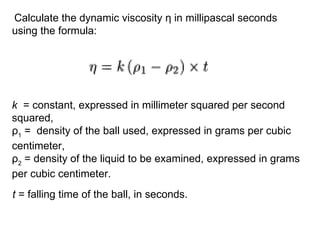
Calculate the dynamic viscosity ƞ in millipascal seconds
using the formula:


k = constant, expressed in millimeter squared per second
squared,
ρ1 = density of the ball used, expressed in grams per cubic
centimeter,
ρ2 = density of the liquid to be examined, expressed in grams
per cubic centimeter.
t = falling time of the ball, in seconds.

Viscosity and its determination

  • 1.
    Viscosity Viscosityis a property of liquids that is closely related to the resistance to flow. It is defined in terms of the force required to move one plane surface continuously past another under specified steady-state conditions when the space between is filled by the liquid in question. It is defined as the shear stress divided by the rate of shear strain. BP Dynamic viscosity Kinematic viscosity
  • 2.
    Dynamic viscosity The dynamicviscosity or viscosity coefficient h is the tangential force per unit surface, known as shearing stress t and expressed in pascals, necessary to move, parallel to the sliding plane, a layer of liquid of 1 square metre at a rate (v) of 1 meter per second relative to a parallel layer at a distance (x) of 1 meter. The ratio dv/dx is a speed gradient giving the rate of shear D expressed in reciprocal seconds (s-1), so that h = t/D. The unit of dynamic viscosity is the pascal second (Pa·s). The most commonly used submultiple is the millipascal second (mPa·s).
  • 3.
    Kinematic viscosity The kinematicviscosity v, expressed in square metres per second, is obtained by dividing the dynamic viscosity h by the density r expressed in kilograms per cubic metre, of the liquid measured at the same temperature, i.e. v = h/r. The kinematic viscosity is usually expressed in square millimetres per second. USP The basic unit is the poise (according to USP) However, viscosities commonly encountered represent fractions of the poise, so that the centipoise (1 poise = 100 centipoises) proves to be the more convenient unit.
  • 4.
    Measurement of Viscosity Theusual method for measurement of viscosity involves the determination of the time required for a given volume of liquid to flow through a capillary. Many capillary-tube viscosimeters have been devised, but Ostwald and Ubbelohde viscosimeters are among the most frequently used. A particularly convenient and rapid type of instrument is a rotational viscosimeter, which utilizes a bob or spindle immersed in the test specimen and measures the resistance to movement of the rotating part. Different spindles are available for given viscosity ranges, and several rotational speeds generally are available.
  • 5.
    • Other rotationalinstruments may have a stationary bob and a rotating cup. • The Brookfield, Rotouisco, and Stormer viscosimeters are examples of rotating-bob instruments, and the MacMichael is an example of the rotating-cup instrument. • Numerous other rotational instruments of advanced design with special devices for reading or recording, and with wide ranges of rotational speed, have been devised. • Where only a particular type of instrument is suitable, the individual monograph so indicates. • For measurement of viscosity or apparent viscosity, the temperature of the substance being measured must be accurately controlled, since small temperature changes may lead to marked changes in viscosity. • For usual pharmaceutical purposes, the temperature should be held to within ±0.1 .
  • 6.
    Common methods fordetermination of viscosity Method I (U tube viscometer) Apparatus The apparatus consists of a glass U- tube viscometer made of clear borosilicate glass and constructed in accordance with the dimensions given in official books. The monograph states the size of viscometer to be used.
  • 7.
    Method • Fill theviscometer with the liquid being examined through tube L to slightly above the mark G, using a long pipette to minimise wetting the tube above the mark. • Place the tube vertically in a water bath and when it has attained the specified temperature, adjust the volume of the liquid so that the bottom of the meniscus settles at the mark G. • Adjust the liquid to a point about 5 mm above the mark E. • After releasing pressure or suction, measure the time taken for the bottom of the meniscus to fall from the top edge of mark E to the top edge of mark F.
  • 8.
    Method II (Capillaryviscometer method) (Ph. Eur. method 2.2.9) • The determination of viscosity using a suitable capillary viscometer is carried out at a temperature of 20 ± 0.1 °C, unless otherwise prescribed. • The time required for the level of the liquid to drop from one mark to the other is measured with a stop-watch to the nearest one-fifth of a second. • The result is valid only if two consecutive readings do not differ by more than 1 per cent. • The average of not fewer than three readings gives the flow time of the liquid to be examined. •
  • 9.
    Calculate the dynamicviscosity h in millipascal seconds using the formula: K = constant of the viscometer ρ = density of the liquid to be examined expressed in milligrams per cubic millimeter t = flow time, in seconds, of the liquid to be examined. The constant k is determined using a suitable viscometer calibration liquid.
  • 10.
    Method III (Rotatingviscometer method) (Ph. Eur. method 2.2.10) • The principle of the method is to measure the force acting on a rotor (torque) when it rotates at a constant angular velocity (rotational speed) in a liquid. • Rotating viscometers are used for measuring the viscosity of Newtonian (shear-independent viscosity) or non-Newtonian liquids (shear dependent viscosity or apparent viscosity). • Rotating viscometers can be divided in 2 groups, namely absolute and relative viscometers. • In absolute viscometers the flow in the measuring geometry is well defined. The measurements result in absolute viscosity values, which can be compared with any other absolute values.
  • 11.
    In relative viscometersthe flow in the measuring geometry is not defined. The measurements result in relative viscosity values, which cannot be compared with absolute values or other relative values if not determined by the same relative viscometer method. Different measuring systems are available for given viscosity ranges as well as several rotational speeds.
  • 12.
    Apparatus The following typesof instruments are most common. Concentric cylinder viscometers (absolute viscometers) In the concentric cylinder viscometer (coaxial double cylinder viscometer or simply coaxial cylinder viscometer), the viscosity is determined by placing the liquid in the gap between the inner cylinder and the outer cylinder. Viscosity measurement can be performed by rotating the inner cylinder (Searle type viscometer) or the outer cylinder (Couette type viscometer), as shown in Figures.
  • 13.
    Cone-plate viscometers (absoluteviscometers) • In the cone-plate viscometer, the liquid is introduced into the gap between a flat disc and a cone forming a define angle. • Viscosity measurement can be performed by rotating the cone or the flat disc, as shown in Figures below. For laminar flow, the viscosity (or apparent viscosity) h expressed in Pascal-seconds is given by the following formula:
  • 14.
    Spindle viscometers (relativeviscometers) In the spindle viscometer, the viscosity is determined by rotating a spindle (for example, cylinder- or disc-shaped, as shown in Figures) immersed in the liquid. Relative values of viscosity (or apparent viscosity) can be directly calculated using conversion factors from the scale reading at a given rotational speed.
  • 15.
    In a generalway, the constant k of the apparatus may be determined at various speeds of rotation using a certified viscometer calibration liquid. The viscosity ƞ then corresponds to the formula:
  • 16.
    Method • Measure theviscosity (or apparent viscosity) according to the instructions for the operation of the rotating viscometer. • The temperature for measuring the viscosity is indicated in the monograph. • For non-Newtonian systems, the monograph indicates the type of viscometer to be used and if absolute viscometers are used the angular velocity or the shear rate at which the measurement is made. • If it is impossible to obtain the indicated shear rate exactly, use a shear rate slightly higher and a shear rate slightly lower and interpolate.
  • 17.
    • With relativeviscometers the shear rate is not the same throughout the sample and therefore it cannot be defined. • Under these conditions, the viscosity of non-Newtonian liquids determined from the previous formula has a relative character, which depends on the type of spindle and the angular velocity as well as the dimensions of the sample container (Ø = minimum 80 mm) and the depth of immersion of the spindle. • The values obtained are comparable only if the method is carried out under experimental conditions that are rigorously the same.
  • 18.
    Method IV (Fallingball viscometer method) (Ph. Eur. method 2.2.49) The determination of dynamic viscosity of Newtonian liquids using a suitable falling ball viscometer is performed at 20 ± 0.1 °C, unless otherwise prescribed in the monograph. The time required for a test ball to fall in the liquid to be examined from one ring mark to the other is determined. If no stricter limit is defined for the equipment used the result is valid only if 2 consecutive measures do not differ by more than 1.5 per cent.
  • 19.
    Apparatus  • The fallingball viscometer consists of: a glass tube enclosed in a mantle, which allows precise control of temperature; • six balls made of glass, nickel-iron or steel with different densities and diameters. • The tube is fixed in such a way that the axis is inclined by 10 ± 1° with regard to the vertical. • The tube has 2 ring marks which define the distance the ball has to roll. • Commercially available apparatus is supplied with tables giving the constants, the density of the balls and the suitability of the different balls for the expected range of viscosity. •
  • 20.
    Method   • Fill theclean, dry tube of the viscometer, previously brought to 20 ± 0.1 °C, with the liquid to be examined, avoiding bubbles. • Add the ball suitable for the range of viscosity of the liquid so as to obtain a falling time not less than 30 s. • Close the tube and maintain the solution at 20 ± 0.1 °C for at least 15 min. Let the ball run through the liquid between the 2 ring marks once without measurement. • Let it run again and measure with a stop-watch, to the nearest one-fifth of a second, the time required for the ball to roll from the upper to the lower ring mark. Repeat the test run at least 3 times.
  • 21.
    Calculate the dynamicviscosity ƞ in millipascal seconds using the formula: k = constant, expressed in millimeter squared per second squared, ρ1 = density of the ball used, expressed in grams per cubic centimeter, ρ2 = density of the liquid to be examined, expressed in grams per cubic centimeter. t = falling time of the ball, in seconds.