Basic Encryption and
Decryption
TOPIC 2
Definitions
 Encryption: process of encoding a message so
its meaning is not obvious.
 Decryption: reverse process which means try
to bring encrypted message back to normal
form.
 Cryptosystem: encryption & decryption system
 Plaintext: original form of message
 Ciphertext: encrypted form of message
Definitions
 Cryptography: hidden writing
 Cryptanalysis: breaking of secure messages
 Cryptanalyst: studies of encryption/decryption
message with the goal of finding the hidden
message (break the encrypted message).
 Cryptology: research/study of encryption &
decryption (both cryptography + cryptanalyst)
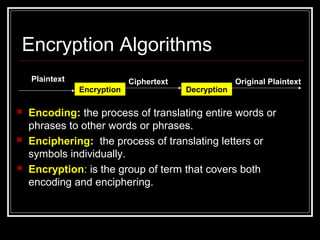
Encryption Algorithms
Plaintext
Encryption
Ciphertext
Decryption
Original Plaintext
 Encoding: the process of translating entire words or
phrases to other words or phrases.
 Enciphering: the process of translating letters or
symbols individually.
 Encryption: is the group of term that covers both
encoding and enciphering.
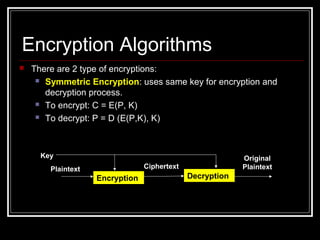
 There are 2 type of encryptions:
 Symmetric Encryption: uses same key for encryption and
decryption process.
 To encrypt: C = E(P, K)
 To decrypt: P = D (E(P,K), K)
Encryption Algorithms
Encryption Decryption
Plaintext Ciphertext
Original
Plaintext
Key
Encryption Algorithms
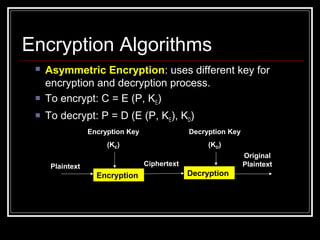
 Asymmetric Encryption: uses different key for
encryption and decryption process.
 To encrypt: C = E (P, KE)
 To decrypt: P = D (E (P, KE), KD)
Encryption Decryption
Plaintext Ciphertext
Original
Plaintext
Encryption Key
(KE)
Decryption Key
(KD)
Substitutions
 Substitution: one letter is exchanged for another.
 Can be divided into two categories:
 Monoalphabetic Substitution
 Polyalphabetic Substitution
Monoalphabetic Substitutions
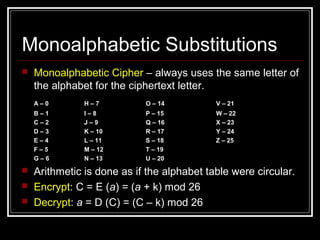
 Monoalphabetic Cipher – always uses the same letter of
the alphabet for the ciphertext letter.
A – 0 H – 7 O – 14 V – 21
B – 1 I – 8 P – 15 W – 22
C – 2 J – 9 Q – 16 X – 23
D – 3 K – 10 R – 17 Y – 24
E – 4 L – 11 S – 18 Z – 25
F – 5 M – 12 T – 19
G – 6 N – 13 U – 20
 Arithmetic is done as if the alphabet table were circular.
 Encrypt: C = E (a) = (a + k) mod 26
 Decrypt: a = D (C) = (C – k) mod 26
Monoalphabetic Substitutions
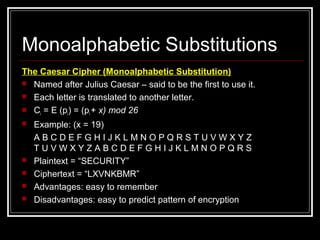
The Caesar Cipher (Monoalphabetic Substitution)
 Named after Julius Caesar – said to be the first to use it.
 Each letter is translated to another letter.
 Ci = E (pi) = (pi + x) mod 26
 Example: (x = 19)
A B C D E F G H I J K L M N O P Q R S T U V W X Y Z
T U V W X Y Z A B C D E F G H I J K L M N O P Q R S
 Plaintext = “SECURITY”
 Ciphertext = “LXVNKBMR”
 Advantages: easy to remember
 Disadvantages: easy to predict pattern of encryption
Monoalphabetic Substitutions
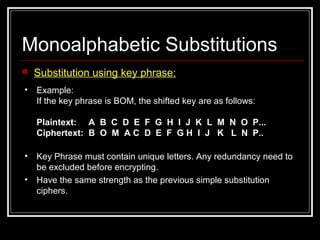
 Substitution using key phrase:
• Example:
If the key phrase is BOM, the shifted key are as follows:
Plaintext: A B C D E F G H I J K L M N O P...
Ciphertext: B O M A C D E F G H I J K L N P..
• Key Phrase must contain unique letters. Any redundancy need to
be excluded before encrypting.
• Have the same strength as the previous simple substitution
ciphers.
Monoalphabetic Substitutions
 Let’s analyze the example below:
Example:
 Key: SPECTACULAR (key must not contain redundant letters
so drop C and A), therefore key becomes SPECTAULR
 A B C D E F G H I J K L M N O P Q R S T U V W X Y Z
 S P E C T A U L R B D F G H I J K M N O Q V W X Y Z
Monoalphabetic Substitutions
 To strengthen, apply matrix such as below:
C I N A B D
E F G H J K
L M O P Q R
S T U V W X
Y Z
 Key Phrase is CINCIN
P : A B C D E F G H I J K L M N O P Q R S T U V W X Y Z
C: C E L S Y I F M T Z N G O U A H P V B J Q W D K R X
Monoalphabetic Substitutions
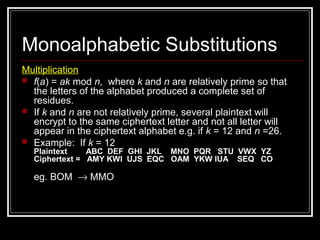
Multiplication
 f(a) = ak mod n, where k and n are relatively prime so that
the letters of the alphabet produced a complete set of
residues.
 If k and n are not relatively prime, several plaintext will
encrypt to the same ciphertext letter and not all letter will
appear in the ciphertext alphabet e.g. if k = 12 and n =26.
 Example: If k = 12
Plaintext ABC DEF GHI JKL MNO PQR STU VWX YZ
Ciphertext = AMY KWI UJS EQC OAM YKW IUA SEQ CO
eg. BOM → MMO
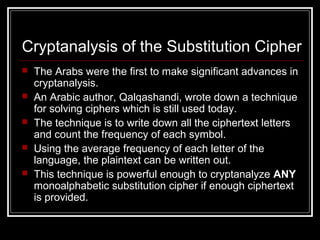
Cryptanalysis of the Substitution Cipher
 The Arabs were the first to make significant advances in
cryptanalysis.
 An Arabic author, Qalqashandi, wrote down a technique
for solving ciphers which is still used today.
 The technique is to write down all the ciphertext letters
and count the frequency of each symbol.
 Using the average frequency of each letter of the
language, the plaintext can be written out.
 This technique is powerful enough to cryptanalyze ANY
monoalphabetic substitution cipher if enough ciphertext
is provided.
Character Frequencies
 Most languages letters are not equally common
 In English e is by far the most common letter
 These are different for different languages
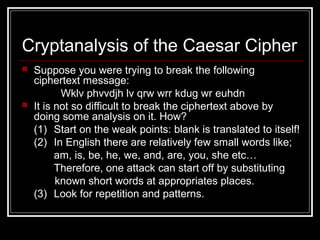
Cryptanalysis of the Caesar Cipher
 Suppose you were trying to break the following
ciphertext message:
Wklv phvvdjh lv qrw wrr kdug wr euhdn
 It is not so difficult to break the ciphertext above by
doing some analysis on it. How?
(1) Start on the weak points: blank is translated to itself!
(2) In English there are relatively few small words like;
am, is, be, he, we, and, are, you, she etc…
Therefore, one attack can start off by substituting
known short words at appropriates places.
(3) Look for repetition and patterns.
Cryptanalysis of the Caesar Cipher
Example:
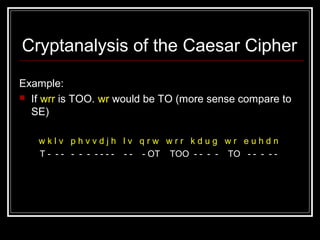
 If wrr is TOO. wr would be TO (more sense compare to
SE)
w k l v p h v v d j h l v q r w w r r k d u g w r e u h d n
T - - - - - - - - - - - - - OT TOO - - - - TO - - - - -
Polyalphabetic Substitution Ciphers
 The weakness of monoalphabetic ciphers - frequency
distribution reflects the distribution of the underlying
alphabet.
 Solution : flatten the distribution
: use polyalphabetic substitution
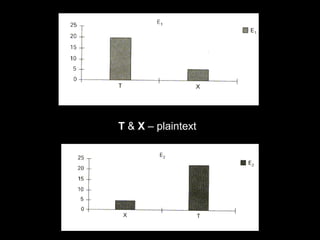
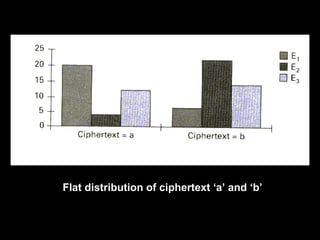
 How to flatten the distribution? – combine both high and
low distributions.
If E1 (T) = a and E2 (T) = b
E1 (X) = a and E2 (X) = b
T & X – plaintext
Flat distribution of ciphertext ‘a’ and ‘b’
Polyalphabetic Substitution Ciphers
 We can also combine two distributions by using two
separate encryption alphabets – the first for all
characters in odd positions of the plaintext message and
the second for all the characters in even positions.
Polyalphabetic Substitution Ciphers
 Consider the two encryption algorithms below:
26mod)*3()(1 λλπ = 26mod)*3()(1 λλπ =
26mod)13)*5(()(2 += λλπ
A B C D E F G H I J K L M N O P Q R S T U V W X Y Z
a d g j m p s v y b e h k n q t w z c f i l o r u x
A B C D E F G H I J K L M N O P Q R S T U V W X Y Z
n s x c h m r w b g l q v a f k p u z e j o t y d i
Table for Odd Position
Table for Even Position
Polyalphabetic Substitution Ciphers
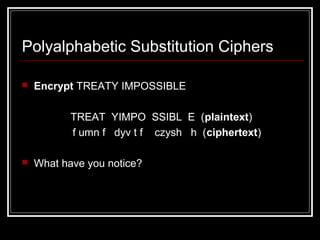
 Encrypt TREATY IMPOSSIBLE
TREAT YIMPO SSIBL E (plaintext)
f umn f dyv t f czysh h (ciphertext)
 What have you notice?
Polyalphabetic Substitution Ciphers
Vigenère Ciphers
 Proposed by Blaise de Vigenere from the court of Henry
III of France in the sixteenth century.
 Basically it’s a multiple Caesar Ciphers – each row of
the Vigenere table corresponds to a Caesar cipher. The
first row is a shift of 0, the second is a shift of 1 and the
last is a shift of 25.
 Vigenere cipher uses this table together with a keyword
to encipher a message.
Polyalphabetic Substitution Ciphers
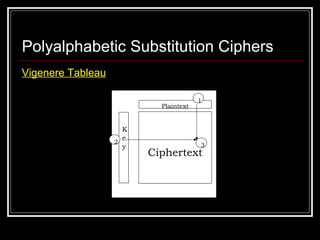
Vigenere Tableau
Plaintext
K
e
y
Ciphertext
2
1
3
Polyalphabetic Substitution Ciphers
Cryptanalysis of Polyalphabetic Substitutions
 There are two ways:
 Kasiski Method
 Index of Coincidence
Kasiski Method for repeated pattens
 Named for its developer, a Prussian military officer.
 Is a way of finding the number of alphabets that were
used for encryption.
 -th, -ion, -ed, -tion, and, to, are, appear with high
frequency (regularity of English).
Polyalphabetic Substitution Ciphers
Kasiski Method
 For Kasiski Method, the steps are:
1. Identify repeated patterns of three or more characters.
2. For each patterns write down the position at which each
instances of the pattern begins.
3. Compute the difference between the starting points of
successive instances.
4. Determine all factors of each difference.
5. If a polyalphabetic substitution cipher was used, the key
length will be one of the factors that appears often in step 4.
Polyalphabetic Substitution Ciphers
- Form set of letters according to the position of key
assumed.
- Use previous monoalphabetic cryptanalysis.
Index of Coincidence
 Index of coincidence is a measure of the variation
between frequencies in a distribution.
The “Perfect” Substitution Cipher
What makes a perfect substitution cipher?
 An ideal substitution would use many alphabets for an
unrecognizable distribution and no apparent pattern for
the choice of an alphabet at a particular point.
 Let’s look at Vernam Cipher or One-Time Pad
algorithms.
The “Perfect” Substitution Cipher
Vernam Cipher (One Time Pad)
 Introduced by Gilbert Vernam (AT&T Engineer)
in 1918.
 Immune to cryptanalytic attack because the
available ciphertext does not display the pattern
of the key.
 Involves an arbitrarily long non-repeating
sequence of numbers that are combined with
the plaintext.
The “Perfect” Substitution Cipher
Vernam Cipher (One Time Pad)
 Compared with most cryptosystems it is very simple.
 To use a one time pad, you need two copies of the
“pad” (also known as the key) which is a block of truly
random data at least as long as the message you wish
to encode.
 If the data on the pad is not truly random the security of
the pad is compromised.
The “Perfect” Substitution Cipher
Example:
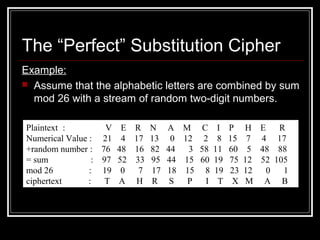
 Assume that the alphabetic letters are combined by sum
mod 26 with a stream of random two-digit numbers.
Plaintext : V E R N A M C I P H E R
Numerical Value : 21 4 17 13 0 12 2 8 15 7 4 17
+random number : 76 48 16 82 44 3 58 11 60 5 48 88
= sum : 97 52 33 95 44 15 60 19 75 12 52 105
mod 26 : 19 0 7 17 18 15 8 19 23 12 0 1
ciphertext : T A H R S P I T X M A B
The “Perfect” Substitution Cipher
 Note:
 random number 48 happen to fall at the places of repeated
letters, accounting for repeated ciphertext A but however highly
unlikely.
 repeated letter t comes from different plaintext letter
The “Perfect” Substitution Cipher
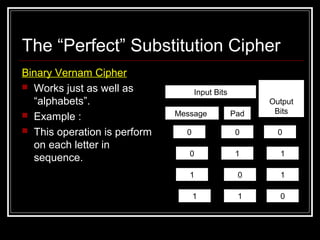
Binary Vernam Cipher
 Works just as well as
“alphabets”.
 Example :
 This operation is perform
on each letter in
sequence.
Plaintext: 1 0 1 1 0 1 1 0 0 1 0 1 0 1 1 1 0 0 1 0 1 1 0 1
Input Bits
Output
BitsMessage Pad
0
0
0 0
0
0
1 1
1 1
1 1
The “Perfect” Substitution Cipher
Vernam Cipher (One Time Pad)
 Systems using perfect random, non-repeating keys
which is endless and senseless
 Random key used once, and only once.
 It is the only unbreakable cryptography system
 Unbreakable in theory:
 the key neither repeats, nor recurs, nor makes sense,
nor erects internal frameworks
 perfect randomness nullifies any horizontal, or
lengthwise cohesion
The “Perfect” Substitution Cipher
Vernam Cipher (One Time Pad)
 Why wouldn't it be used today?
 Sender and receiver need to be perfectly synchronized
 It would not work for a T1 communication line:
 If receiver is off by a bit (bit dropped during
transmission) the plaintext will not make any sense
 If bits are altered during transmission (noise hit) those
bits will decrypt incorrectly
 It does not provides authenticity, only confidentiality
Transpositions (Permutations)
 The plaintext remains the same, but the order of characters
is shuffled around – example: shuffle secret to etcrse
 Arrangement was classically done with the aid of some
type of geometric figure, usually 2-dimensional array
(matrix).
 Transposition is not a permutation of alphabet characters
but a permutation of places:
 letters retain their identity but lose their position
 there is a permutation of the plaintext letters
Transpositions (Permutations)
Plaintext
write-in
figure
take-off
Ciphertext
Transpositions (Permutations)
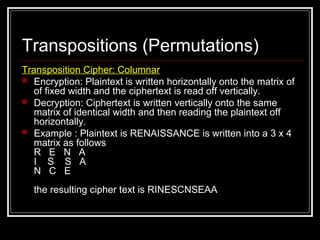
Transposition Cipher: Columnar
 Encryption: Plaintext is written horizontally onto the matrix of
of fixed width and the ciphertext is read off vertically.
 Decryption: Ciphertext is written vertically onto the same
matrix of identical width and then reading the plaintext off
horizontally.
 Example : Plaintext is RENAISSANCE is written into a 3 x 4
matrix as follows
R E N A
I S S A
N C E
the resulting cipher text is RINESCNSEAA
Transpositions (Permutations)
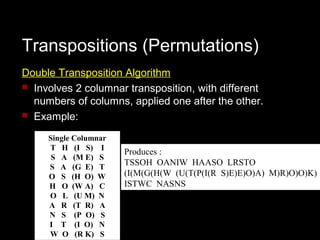
Double Transposition Algorithm
 Involves 2 columnar transposition, with different
numbers of columns, applied one after the other.
 Example:
Single Columnar
T H (I S) I
S A (M E) S
S A (G E) T
O S (H O) W
H O (W A) C
O L (U M) N
A R (T R) A
N S (P O) S
I T (I O) N
W O (R K) S
Produces :
TSSOH OANIW HAASO LRSTO
(I(M(G(H(W (U(T(P(I(R S)E)E)O)A) M)R)O)O)K)
ISTWC NASNS
Transpositions (Permutations)
 Second transposition written in an 8 by 7 matrix:
 Can you write down the result?
T S S O H O A
N I W H A A S
O L R S T O (I
(M (G (H (W (U (T (P
(I (R S) E) E) O) A)
M) R) O) O) K) I S
T W C N A S N
S X X X X X X
Transpositions (Permutations)
 Extra position must be filled with a padding character,
eg. X
 However the X’s filling the last row stands out. Better
way is to use letters that are frequently used so that it
would not be possible to identify the padding character.
Stream vsBlock Ciphers
 Stream cipher – encrypt one symbol of plaintext
immediately into a symbol of ciphertext
 Block cipher – encrypt a group of plaintext symbols as
one block.
Stream vs Block Ciphers
Advantages of stream ciphers:
 Speed of transmission – each symbol is encrypted alone, each
symbol is encrypted as soon as it is read.
 Low error propagation – an error in the encryption process affects
only that character (each symbol is separately encoded).
Disadvantages of stream ciphers:
 Low diffusion where all information of the symbol contained in one
symbol of the ciphertext – cryptanalyst consider each ciphertext as
a separate entity.
 Susceptibility to malicious insertion & modification – interceptor who
has broken the code can splice together pieces of previous
message and transmit a spurious new message that may look
authentic.
Stream vs Block Ciphers
Advantages of block ciphers:
 Diffusion – one ciphertext block may depend on several plaintext
letters.
 Immunity to insertions – because of block of symbols are
enciphered, impossible to insert a single symbol into one block.
Disadvantages of block ciphers:
 Slowness of encryption – block cipher must wait until an entire
block of plaintext symbols has been received before starting the
encryption process.
 Error propagation – an error will affect the the transformation of
all other characters in the same block.
Characteristics of “Good” Ciphers
Shannon Characteristics
 The amount of secrecy needed should determine the amount of
labor appropriate for the encryption and decryption.
 The set of keys and the enciphering algorithm should be free
from complexity.
 The implementation of the process should be as simple as
possible.
 Errors in ciphering should not propagate and cause corruption of
further information in the message.
 The size of the enciphered text should be no larger than the text
of the original message.
Characteristics of “Good” Ciphers
 Confusion – Interceptor should not be able to predict
what changing one character in the plaintext will do to
the ciphertext.
 Diffusion – Changes in the plaintext should affect many
parts of the ciphertext. Good diffusion means that the
interceptor needs access to much ciphertext to infer the
algorithm.
THE END

Basic Encryption Decryption Chapter 2

  • 1.
  • 2.
    Definitions  Encryption: processof encoding a message so its meaning is not obvious.  Decryption: reverse process which means try to bring encrypted message back to normal form.  Cryptosystem: encryption & decryption system  Plaintext: original form of message  Ciphertext: encrypted form of message
  • 3.
    Definitions  Cryptography: hiddenwriting  Cryptanalysis: breaking of secure messages  Cryptanalyst: studies of encryption/decryption message with the goal of finding the hidden message (break the encrypted message).  Cryptology: research/study of encryption & decryption (both cryptography + cryptanalyst)
  • 4.
    Encryption Algorithms Plaintext Encryption Ciphertext Decryption Original Plaintext Encoding: the process of translating entire words or phrases to other words or phrases.  Enciphering: the process of translating letters or symbols individually.  Encryption: is the group of term that covers both encoding and enciphering.
  • 5.
     There are2 type of encryptions:  Symmetric Encryption: uses same key for encryption and decryption process.  To encrypt: C = E(P, K)  To decrypt: P = D (E(P,K), K) Encryption Algorithms Encryption Decryption Plaintext Ciphertext Original Plaintext Key
  • 6.
    Encryption Algorithms  AsymmetricEncryption: uses different key for encryption and decryption process.  To encrypt: C = E (P, KE)  To decrypt: P = D (E (P, KE), KD) Encryption Decryption Plaintext Ciphertext Original Plaintext Encryption Key (KE) Decryption Key (KD)
  • 7.
    Substitutions  Substitution: oneletter is exchanged for another.  Can be divided into two categories:  Monoalphabetic Substitution  Polyalphabetic Substitution
  • 8.
    Monoalphabetic Substitutions  MonoalphabeticCipher – always uses the same letter of the alphabet for the ciphertext letter. A – 0 H – 7 O – 14 V – 21 B – 1 I – 8 P – 15 W – 22 C – 2 J – 9 Q – 16 X – 23 D – 3 K – 10 R – 17 Y – 24 E – 4 L – 11 S – 18 Z – 25 F – 5 M – 12 T – 19 G – 6 N – 13 U – 20  Arithmetic is done as if the alphabet table were circular.  Encrypt: C = E (a) = (a + k) mod 26  Decrypt: a = D (C) = (C – k) mod 26
  • 9.
    Monoalphabetic Substitutions The CaesarCipher (Monoalphabetic Substitution)  Named after Julius Caesar – said to be the first to use it.  Each letter is translated to another letter.  Ci = E (pi) = (pi + x) mod 26  Example: (x = 19) A B C D E F G H I J K L M N O P Q R S T U V W X Y Z T U V W X Y Z A B C D E F G H I J K L M N O P Q R S  Plaintext = “SECURITY”  Ciphertext = “LXVNKBMR”  Advantages: easy to remember  Disadvantages: easy to predict pattern of encryption
  • 10.
    Monoalphabetic Substitutions  Substitutionusing key phrase: • Example: If the key phrase is BOM, the shifted key are as follows: Plaintext: A B C D E F G H I J K L M N O P... Ciphertext: B O M A C D E F G H I J K L N P.. • Key Phrase must contain unique letters. Any redundancy need to be excluded before encrypting. • Have the same strength as the previous simple substitution ciphers.
  • 11.
    Monoalphabetic Substitutions  Let’sanalyze the example below: Example:  Key: SPECTACULAR (key must not contain redundant letters so drop C and A), therefore key becomes SPECTAULR  A B C D E F G H I J K L M N O P Q R S T U V W X Y Z  S P E C T A U L R B D F G H I J K M N O Q V W X Y Z
  • 12.
    Monoalphabetic Substitutions  Tostrengthen, apply matrix such as below: C I N A B D E F G H J K L M O P Q R S T U V W X Y Z  Key Phrase is CINCIN P : A B C D E F G H I J K L M N O P Q R S T U V W X Y Z C: C E L S Y I F M T Z N G O U A H P V B J Q W D K R X
  • 13.
    Monoalphabetic Substitutions Multiplication  f(a)= ak mod n, where k and n are relatively prime so that the letters of the alphabet produced a complete set of residues.  If k and n are not relatively prime, several plaintext will encrypt to the same ciphertext letter and not all letter will appear in the ciphertext alphabet e.g. if k = 12 and n =26.  Example: If k = 12 Plaintext ABC DEF GHI JKL MNO PQR STU VWX YZ Ciphertext = AMY KWI UJS EQC OAM YKW IUA SEQ CO eg. BOM → MMO
  • 14.
    Cryptanalysis of theSubstitution Cipher  The Arabs were the first to make significant advances in cryptanalysis.  An Arabic author, Qalqashandi, wrote down a technique for solving ciphers which is still used today.  The technique is to write down all the ciphertext letters and count the frequency of each symbol.  Using the average frequency of each letter of the language, the plaintext can be written out.  This technique is powerful enough to cryptanalyze ANY monoalphabetic substitution cipher if enough ciphertext is provided.
  • 15.
    Character Frequencies  Mostlanguages letters are not equally common  In English e is by far the most common letter  These are different for different languages
  • 17.
    Cryptanalysis of theCaesar Cipher  Suppose you were trying to break the following ciphertext message: Wklv phvvdjh lv qrw wrr kdug wr euhdn  It is not so difficult to break the ciphertext above by doing some analysis on it. How? (1) Start on the weak points: blank is translated to itself! (2) In English there are relatively few small words like; am, is, be, he, we, and, are, you, she etc… Therefore, one attack can start off by substituting known short words at appropriates places. (3) Look for repetition and patterns.
  • 18.
    Cryptanalysis of theCaesar Cipher Example:  If wrr is TOO. wr would be TO (more sense compare to SE) w k l v p h v v d j h l v q r w w r r k d u g w r e u h d n T - - - - - - - - - - - - - OT TOO - - - - TO - - - - -
  • 19.
    Polyalphabetic Substitution Ciphers The weakness of monoalphabetic ciphers - frequency distribution reflects the distribution of the underlying alphabet.  Solution : flatten the distribution : use polyalphabetic substitution  How to flatten the distribution? – combine both high and low distributions. If E1 (T) = a and E2 (T) = b E1 (X) = a and E2 (X) = b
  • 20.
    T & X– plaintext
  • 21.
    Flat distribution ofciphertext ‘a’ and ‘b’
  • 22.
    Polyalphabetic Substitution Ciphers We can also combine two distributions by using two separate encryption alphabets – the first for all characters in odd positions of the plaintext message and the second for all the characters in even positions.
  • 23.
    Polyalphabetic Substitution Ciphers Consider the two encryption algorithms below: 26mod)*3()(1 λλπ = 26mod)*3()(1 λλπ = 26mod)13)*5(()(2 += λλπ A B C D E F G H I J K L M N O P Q R S T U V W X Y Z a d g j m p s v y b e h k n q t w z c f i l o r u x A B C D E F G H I J K L M N O P Q R S T U V W X Y Z n s x c h m r w b g l q v a f k p u z e j o t y d i Table for Odd Position Table for Even Position
  • 24.
    Polyalphabetic Substitution Ciphers Encrypt TREATY IMPOSSIBLE TREAT YIMPO SSIBL E (plaintext) f umn f dyv t f czysh h (ciphertext)  What have you notice?
  • 25.
    Polyalphabetic Substitution Ciphers VigenèreCiphers  Proposed by Blaise de Vigenere from the court of Henry III of France in the sixteenth century.  Basically it’s a multiple Caesar Ciphers – each row of the Vigenere table corresponds to a Caesar cipher. The first row is a shift of 0, the second is a shift of 1 and the last is a shift of 25.  Vigenere cipher uses this table together with a keyword to encipher a message.
  • 26.
    Polyalphabetic Substitution Ciphers VigenereTableau Plaintext K e y Ciphertext 2 1 3
  • 27.
    Polyalphabetic Substitution Ciphers Cryptanalysisof Polyalphabetic Substitutions  There are two ways:  Kasiski Method  Index of Coincidence Kasiski Method for repeated pattens  Named for its developer, a Prussian military officer.  Is a way of finding the number of alphabets that were used for encryption.  -th, -ion, -ed, -tion, and, to, are, appear with high frequency (regularity of English).
  • 28.
    Polyalphabetic Substitution Ciphers KasiskiMethod  For Kasiski Method, the steps are: 1. Identify repeated patterns of three or more characters. 2. For each patterns write down the position at which each instances of the pattern begins. 3. Compute the difference between the starting points of successive instances. 4. Determine all factors of each difference. 5. If a polyalphabetic substitution cipher was used, the key length will be one of the factors that appears often in step 4.
  • 29.
    Polyalphabetic Substitution Ciphers -Form set of letters according to the position of key assumed. - Use previous monoalphabetic cryptanalysis. Index of Coincidence  Index of coincidence is a measure of the variation between frequencies in a distribution.
  • 30.
    The “Perfect” SubstitutionCipher What makes a perfect substitution cipher?  An ideal substitution would use many alphabets for an unrecognizable distribution and no apparent pattern for the choice of an alphabet at a particular point.  Let’s look at Vernam Cipher or One-Time Pad algorithms.
  • 31.
    The “Perfect” SubstitutionCipher Vernam Cipher (One Time Pad)  Introduced by Gilbert Vernam (AT&T Engineer) in 1918.  Immune to cryptanalytic attack because the available ciphertext does not display the pattern of the key.  Involves an arbitrarily long non-repeating sequence of numbers that are combined with the plaintext.
  • 32.
    The “Perfect” SubstitutionCipher Vernam Cipher (One Time Pad)  Compared with most cryptosystems it is very simple.  To use a one time pad, you need two copies of the “pad” (also known as the key) which is a block of truly random data at least as long as the message you wish to encode.  If the data on the pad is not truly random the security of the pad is compromised.
  • 33.
    The “Perfect” SubstitutionCipher Example:  Assume that the alphabetic letters are combined by sum mod 26 with a stream of random two-digit numbers. Plaintext : V E R N A M C I P H E R Numerical Value : 21 4 17 13 0 12 2 8 15 7 4 17 +random number : 76 48 16 82 44 3 58 11 60 5 48 88 = sum : 97 52 33 95 44 15 60 19 75 12 52 105 mod 26 : 19 0 7 17 18 15 8 19 23 12 0 1 ciphertext : T A H R S P I T X M A B
  • 34.
    The “Perfect” SubstitutionCipher  Note:  random number 48 happen to fall at the places of repeated letters, accounting for repeated ciphertext A but however highly unlikely.  repeated letter t comes from different plaintext letter
  • 35.
    The “Perfect” SubstitutionCipher Binary Vernam Cipher  Works just as well as “alphabets”.  Example :  This operation is perform on each letter in sequence. Plaintext: 1 0 1 1 0 1 1 0 0 1 0 1 0 1 1 1 0 0 1 0 1 1 0 1 Input Bits Output BitsMessage Pad 0 0 0 0 0 0 1 1 1 1 1 1
  • 36.
    The “Perfect” SubstitutionCipher Vernam Cipher (One Time Pad)  Systems using perfect random, non-repeating keys which is endless and senseless  Random key used once, and only once.  It is the only unbreakable cryptography system  Unbreakable in theory:  the key neither repeats, nor recurs, nor makes sense, nor erects internal frameworks  perfect randomness nullifies any horizontal, or lengthwise cohesion
  • 37.
    The “Perfect” SubstitutionCipher Vernam Cipher (One Time Pad)  Why wouldn't it be used today?  Sender and receiver need to be perfectly synchronized  It would not work for a T1 communication line:  If receiver is off by a bit (bit dropped during transmission) the plaintext will not make any sense  If bits are altered during transmission (noise hit) those bits will decrypt incorrectly  It does not provides authenticity, only confidentiality
  • 38.
    Transpositions (Permutations)  Theplaintext remains the same, but the order of characters is shuffled around – example: shuffle secret to etcrse  Arrangement was classically done with the aid of some type of geometric figure, usually 2-dimensional array (matrix).  Transposition is not a permutation of alphabet characters but a permutation of places:  letters retain their identity but lose their position  there is a permutation of the plaintext letters
  • 39.
  • 40.
    Transpositions (Permutations) Transposition Cipher:Columnar  Encryption: Plaintext is written horizontally onto the matrix of of fixed width and the ciphertext is read off vertically.  Decryption: Ciphertext is written vertically onto the same matrix of identical width and then reading the plaintext off horizontally.  Example : Plaintext is RENAISSANCE is written into a 3 x 4 matrix as follows R E N A I S S A N C E the resulting cipher text is RINESCNSEAA
  • 41.
    Transpositions (Permutations) Double TranspositionAlgorithm  Involves 2 columnar transposition, with different numbers of columns, applied one after the other.  Example: Single Columnar T H (I S) I S A (M E) S S A (G E) T O S (H O) W H O (W A) C O L (U M) N A R (T R) A N S (P O) S I T (I O) N W O (R K) S Produces : TSSOH OANIW HAASO LRSTO (I(M(G(H(W (U(T(P(I(R S)E)E)O)A) M)R)O)O)K) ISTWC NASNS
  • 42.
    Transpositions (Permutations)  Secondtransposition written in an 8 by 7 matrix:  Can you write down the result? T S S O H O A N I W H A A S O L R S T O (I (M (G (H (W (U (T (P (I (R S) E) E) O) A) M) R) O) O) K) I S T W C N A S N S X X X X X X
  • 43.
    Transpositions (Permutations)  Extraposition must be filled with a padding character, eg. X  However the X’s filling the last row stands out. Better way is to use letters that are frequently used so that it would not be possible to identify the padding character.
  • 44.
    Stream vsBlock Ciphers Stream cipher – encrypt one symbol of plaintext immediately into a symbol of ciphertext  Block cipher – encrypt a group of plaintext symbols as one block.
  • 45.
    Stream vs BlockCiphers Advantages of stream ciphers:  Speed of transmission – each symbol is encrypted alone, each symbol is encrypted as soon as it is read.  Low error propagation – an error in the encryption process affects only that character (each symbol is separately encoded). Disadvantages of stream ciphers:  Low diffusion where all information of the symbol contained in one symbol of the ciphertext – cryptanalyst consider each ciphertext as a separate entity.  Susceptibility to malicious insertion & modification – interceptor who has broken the code can splice together pieces of previous message and transmit a spurious new message that may look authentic.
  • 46.
    Stream vs BlockCiphers Advantages of block ciphers:  Diffusion – one ciphertext block may depend on several plaintext letters.  Immunity to insertions – because of block of symbols are enciphered, impossible to insert a single symbol into one block. Disadvantages of block ciphers:  Slowness of encryption – block cipher must wait until an entire block of plaintext symbols has been received before starting the encryption process.  Error propagation – an error will affect the the transformation of all other characters in the same block.
  • 47.
    Characteristics of “Good”Ciphers Shannon Characteristics  The amount of secrecy needed should determine the amount of labor appropriate for the encryption and decryption.  The set of keys and the enciphering algorithm should be free from complexity.  The implementation of the process should be as simple as possible.  Errors in ciphering should not propagate and cause corruption of further information in the message.  The size of the enciphered text should be no larger than the text of the original message.
  • 48.
    Characteristics of “Good”Ciphers  Confusion – Interceptor should not be able to predict what changing one character in the plaintext will do to the ciphertext.  Diffusion – Changes in the plaintext should affect many parts of the ciphertext. Good diffusion means that the interceptor needs access to much ciphertext to infer the algorithm.
  • 49.