Cryptography
Encryption and Decryption
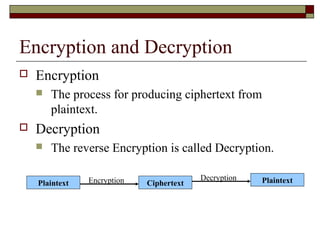
 Encryption
 The process for producing ciphertext from
plaintext.
 Decryption
 The reverse Encryption is called Decryption.
Plaintext PlaintextCiphertextEncryption Decryption
Cryptography
 Cryptography is the science of writing or reading
coded messages.
 Cryptography comes from the Greek words for
“secret writing”
 Historically, four groups of people have contributed
to the art of cryptography
 The military
 The diplomatic corps
 The diarists
 The lovers
 Of these, the military has had the most important role in this field
Common Cryptography Terms
 Plain Text
 Original message
 The message to be encrypted
 Cipher
 Secret method of writing (i.e. algorithm)
 Key
 Plain text is transformed by a function that is parameterized by a key
 Some critical information used by the cipher, known only to sender
and/or receiver
 Ciphertext
 Transformed message
 The output of the encryption process
Common Cryptography Terms
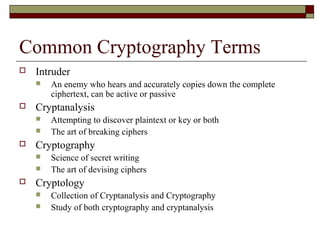
 Intruder
 An enemy who hears and accurately copies down the complete
ciphertext, can be active or passive
 Cryptanalysis
 Attempting to discover plaintext or key or both
 The art of breaking ciphers
 Cryptography
 Science of secret writing
 The art of devising ciphers
 Cryptology
 Collection of Cryptanalysis and Cryptography
 Study of both cryptography and cryptanalysis
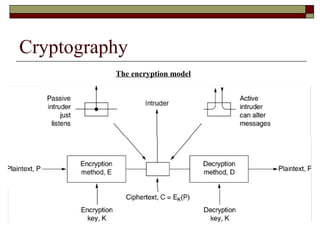
Cryptography
The encryption model
Symbolic Notations for Encryption
 C = EK(P)
 It means that the encryption of the plaintext P using key K
gives ciphertext C
 P = DK(C)
 It represents the decryption of C to get the plaintext P
again.
 It then follows that:
DK( (EK(P)) ) = P
 Note:
 E and D are just mathematical functions
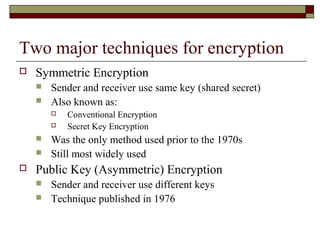
Two major techniques for encryption
 Symmetric Encryption
 Sender and receiver use same key (shared secret)
 Also known as:
 Conventional Encryption
 Secret Key Encryption
 Was the only method used prior to the 1970s
 Still most widely used
 Public Key (Asymmetric) Encryption
 Sender and receiver use different keys
 Technique published in 1976
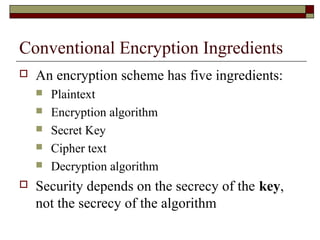
Conventional Encryption Ingredients
 An encryption scheme has five ingredients:
 Plaintext
 Encryption algorithm
 Secret Key
 Cipher text
 Decryption algorithm
 Security depends on the secrecy of the key,
not the secrecy of the algorithm
Strong Encryption
 An encryption algorithm needs to be strong
 This means that an attacker who knows:
 the algorithm
 some pieces of ciphertext
 some plaintext-ciphertext pairs (possibly)
 cannot deduce:
 the plaintext, or
 the key
Importance of Secret Key
 Every encryption and decryption process has two
aspects:
 The algorithm
 The key used for encryption and decryption
 In general, the algorithm used for encryption and
decryption processes is usually known to everybody.
However, it is the key used for encryption and
decryption that makes the process of cryptography
secure
 The greater the length of the key, the more difficult
it will be to break it using brute-force attack
Key
 A key is a digital code that can be used to encrypt,
decrypt, and sign information.
 Some keys are kept private while others are shared
and must be distributed in a secure manner.
 The area of key management has seen much progress
in the past years; this is mainly because it makes key
distribution secure and scaleable in an automated
fashion.
 Important issues with key management are creating
and distributing the keys securely.
Importance of the Key
 Usually, cryptographic mechanisms use both
an algorithm (a mathematical function) and a
secret value known as a key.
 The algorithms are widely known and
available; it is the key that is kept secret and
provides the required security.
Importance of the Key
 Analogy of Combination Lock
 The key is analogous to the combination to a lock.
Although the concept of a combination lock is well
known, you can't open a combination lock easily without
knowing the combination.
 In addition, the more numbers a given combination has,
the more work must be done to guess the combination---
the same is true for cryptographic keys.
 The more bits that are in a key, the less susceptible a key
is to being compromised by a third party.
Issue of Key Length
 The number of bits required in a key to ensure secure
encryption in a given environment can be controversial.
 The longer the key space---the range of possible values of the
key---the more difficult it is to break the key in a brute-force
attack.
 In a brute-force attack, you apply all combinations of a key
to the algorithm until you succeed in deciphering the
message.
 However, the longer the key, the more computationally
expensive the encryption and decryption process can be.
 The goal is to make breaking a key "cost" more than the
worth of the information the key is protecting.
Number of Possible Combinations
Cryptanalysis
 Cryptanalysis is the process of trying to find
the plaintext or key
 Two main approaches
 Brute Force
 try all possible keys
 Exploit weaknesses in the algorithm or key
 e.g. key generated from password entered by
user, where user can enter bad password
Cryptanalysis: Brute Force Attack
 Try all possible keys until code is broken
 On average, need to try half of all possible keys
 Infeasible if key length is sufficiently long
Three Basic Cryptographic Functions
 Cryptography is the basis for all secure
communications; it is, therefore, important that you
understand three basic cryptographic functions:
 Symmetric encryption
 Asymmetric encryption
 One-way hash functions.
 Most current authentication, integrity, and
confidentiality technologies are derived from these
three cryptographic functions.
Symmetric Key Encryption
 Symmetric encryption, often referred to as secret key
encryption, uses a common key and the same
cryptographic algorithm to scramble and unscramble
a message.
 Example: Suppose we have two users, Alice and Bob,
who want to communicate securely with each other.
 Both Alice and Bob have to agree on the same
cryptographic algorithm to use for encrypting and
decrypting data.
 They also have to agree on a common key--- the secret
key---to use with their chosen encryption/decryption
algorithm.
Symmetric Key Encryption
 A simplistic secret key algorithm is the Caesar
Cipher.
 The Caesar Cipher replaces each letter in the
original message with the letter of the alphabet n
places further down the alphabet.
 The algorithm shifts the letters to the right or left
(depending on whether you are encrypting or
decrypting).
 Figure shows two users, Alice and Bob
communicating with a Caesar Cipher where the key,
n, is three letters.
Caesar Cipher
 Alphabetic circular shift
 For each letter i of text: let pi=0 if letter is a, pi=1 if letter is
b, etc let key k be the size of the shift
 Encryption: ci = Ek(pi) = (pi + k) mod 26
 Decryption: pi = Dk(ci) = (ci – k) mod 26
 Example (setting k = 3)
attack at dawn
DWWDFN DW GDZQ
Attacking Caesar Cipher
 Brute force
 Key is just one letter (or number between 1 and
25)
 Try all 25 keys
 Easy!
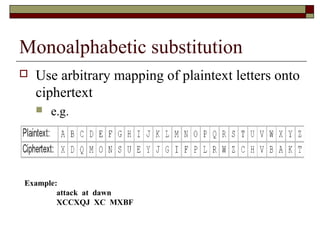
Monoalphabetic substitution
 Use arbitrary mapping of plaintext letters onto
ciphertext
 e.g.
Example:
attack at dawn
XCCXQJ XC MXBF
Attacking Monoalphabetic
 Brute force
 Very difficult; Key is 26 letters long
 No. of possible keys = 26! = 4 x 1026
 Algorithm weaknesses:
 Frequency of letters in English language is well known
 Can deduce plaintext->ciphertext mapping by analysing
frequency of occurrence
 e.g. on analysing plenty of ciphertext, most frequent letter
probably corresponds to ‘E’
 Can spot digrams and trigrams
 Digram: common 2-letter sequence; e.g. ‘th’, ‘an’, ‘ed’
 Trigram: common 3-letter sequence: e.g. ‘ing’, ‘the’, ‘est’
English Letter Frequencies
Vigenère Cipher
 In effect, 26 Caesar ciphers are used
 Example:
Vigenère Cipher
Attacking Vigenère Cipher
 Brute force
 More difficult; like password cracking
 The longer the key the harder brute force is
One-Time Pads
 One-Time Pads (OTPs) are the only theoretically
unbreakable encryption system
 An OTP is a list of numbers, in completely random
order, that is used to encode a message
 If the numbers on OTP are truly random and OTP is
only used once, then ciphertext provides no
mechanism to recover the original key (one-time pad
itself) and therefore, the message
 OTPs are used for short messages and in a very high
security environment
One-Time Pad
 Uses random key that is as long as the
message
 Can use key only once One-Time Pad
One-Time Pad Operation
One-Time Pads
 Problems with OTPs
 Generation of truly random one-time pads
 Distribution of the one-time pads between
communicating entities
 Not feasible for use in high-traffic environments

Cryptography

  • 1.
  • 2.
    Encryption and Decryption Encryption  The process for producing ciphertext from plaintext.  Decryption  The reverse Encryption is called Decryption. Plaintext PlaintextCiphertextEncryption Decryption
  • 3.
    Cryptography  Cryptography isthe science of writing or reading coded messages.  Cryptography comes from the Greek words for “secret writing”  Historically, four groups of people have contributed to the art of cryptography  The military  The diplomatic corps  The diarists  The lovers  Of these, the military has had the most important role in this field
  • 4.
    Common Cryptography Terms Plain Text  Original message  The message to be encrypted  Cipher  Secret method of writing (i.e. algorithm)  Key  Plain text is transformed by a function that is parameterized by a key  Some critical information used by the cipher, known only to sender and/or receiver  Ciphertext  Transformed message  The output of the encryption process
  • 5.
    Common Cryptography Terms Intruder  An enemy who hears and accurately copies down the complete ciphertext, can be active or passive  Cryptanalysis  Attempting to discover plaintext or key or both  The art of breaking ciphers  Cryptography  Science of secret writing  The art of devising ciphers  Cryptology  Collection of Cryptanalysis and Cryptography  Study of both cryptography and cryptanalysis
  • 6.
  • 7.
    Symbolic Notations forEncryption  C = EK(P)  It means that the encryption of the plaintext P using key K gives ciphertext C  P = DK(C)  It represents the decryption of C to get the plaintext P again.  It then follows that: DK( (EK(P)) ) = P  Note:  E and D are just mathematical functions
  • 8.
    Two major techniquesfor encryption  Symmetric Encryption  Sender and receiver use same key (shared secret)  Also known as:  Conventional Encryption  Secret Key Encryption  Was the only method used prior to the 1970s  Still most widely used  Public Key (Asymmetric) Encryption  Sender and receiver use different keys  Technique published in 1976
  • 9.
    Conventional Encryption Ingredients An encryption scheme has five ingredients:  Plaintext  Encryption algorithm  Secret Key  Cipher text  Decryption algorithm  Security depends on the secrecy of the key, not the secrecy of the algorithm
  • 10.
    Strong Encryption  Anencryption algorithm needs to be strong  This means that an attacker who knows:  the algorithm  some pieces of ciphertext  some plaintext-ciphertext pairs (possibly)  cannot deduce:  the plaintext, or  the key
  • 11.
    Importance of SecretKey  Every encryption and decryption process has two aspects:  The algorithm  The key used for encryption and decryption  In general, the algorithm used for encryption and decryption processes is usually known to everybody. However, it is the key used for encryption and decryption that makes the process of cryptography secure  The greater the length of the key, the more difficult it will be to break it using brute-force attack
  • 12.
    Key  A keyis a digital code that can be used to encrypt, decrypt, and sign information.  Some keys are kept private while others are shared and must be distributed in a secure manner.  The area of key management has seen much progress in the past years; this is mainly because it makes key distribution secure and scaleable in an automated fashion.  Important issues with key management are creating and distributing the keys securely.
  • 13.
    Importance of theKey  Usually, cryptographic mechanisms use both an algorithm (a mathematical function) and a secret value known as a key.  The algorithms are widely known and available; it is the key that is kept secret and provides the required security.
  • 14.
    Importance of theKey  Analogy of Combination Lock  The key is analogous to the combination to a lock. Although the concept of a combination lock is well known, you can't open a combination lock easily without knowing the combination.  In addition, the more numbers a given combination has, the more work must be done to guess the combination--- the same is true for cryptographic keys.  The more bits that are in a key, the less susceptible a key is to being compromised by a third party.
  • 15.
    Issue of KeyLength  The number of bits required in a key to ensure secure encryption in a given environment can be controversial.  The longer the key space---the range of possible values of the key---the more difficult it is to break the key in a brute-force attack.  In a brute-force attack, you apply all combinations of a key to the algorithm until you succeed in deciphering the message.  However, the longer the key, the more computationally expensive the encryption and decryption process can be.  The goal is to make breaking a key "cost" more than the worth of the information the key is protecting.
  • 16.
    Number of PossibleCombinations
  • 17.
    Cryptanalysis  Cryptanalysis isthe process of trying to find the plaintext or key  Two main approaches  Brute Force  try all possible keys  Exploit weaknesses in the algorithm or key  e.g. key generated from password entered by user, where user can enter bad password
  • 18.
    Cryptanalysis: Brute ForceAttack  Try all possible keys until code is broken  On average, need to try half of all possible keys  Infeasible if key length is sufficiently long
  • 19.
    Three Basic CryptographicFunctions  Cryptography is the basis for all secure communications; it is, therefore, important that you understand three basic cryptographic functions:  Symmetric encryption  Asymmetric encryption  One-way hash functions.  Most current authentication, integrity, and confidentiality technologies are derived from these three cryptographic functions.
  • 20.
    Symmetric Key Encryption Symmetric encryption, often referred to as secret key encryption, uses a common key and the same cryptographic algorithm to scramble and unscramble a message.  Example: Suppose we have two users, Alice and Bob, who want to communicate securely with each other.  Both Alice and Bob have to agree on the same cryptographic algorithm to use for encrypting and decrypting data.  They also have to agree on a common key--- the secret key---to use with their chosen encryption/decryption algorithm.
  • 21.
    Symmetric Key Encryption A simplistic secret key algorithm is the Caesar Cipher.  The Caesar Cipher replaces each letter in the original message with the letter of the alphabet n places further down the alphabet.  The algorithm shifts the letters to the right or left (depending on whether you are encrypting or decrypting).  Figure shows two users, Alice and Bob communicating with a Caesar Cipher where the key, n, is three letters.
  • 22.
    Caesar Cipher  Alphabeticcircular shift  For each letter i of text: let pi=0 if letter is a, pi=1 if letter is b, etc let key k be the size of the shift  Encryption: ci = Ek(pi) = (pi + k) mod 26  Decryption: pi = Dk(ci) = (ci – k) mod 26  Example (setting k = 3) attack at dawn DWWDFN DW GDZQ
  • 23.
    Attacking Caesar Cipher Brute force  Key is just one letter (or number between 1 and 25)  Try all 25 keys  Easy!
  • 24.
    Monoalphabetic substitution  Usearbitrary mapping of plaintext letters onto ciphertext  e.g. Example: attack at dawn XCCXQJ XC MXBF
  • 25.
    Attacking Monoalphabetic  Bruteforce  Very difficult; Key is 26 letters long  No. of possible keys = 26! = 4 x 1026  Algorithm weaknesses:  Frequency of letters in English language is well known  Can deduce plaintext->ciphertext mapping by analysing frequency of occurrence  e.g. on analysing plenty of ciphertext, most frequent letter probably corresponds to ‘E’  Can spot digrams and trigrams  Digram: common 2-letter sequence; e.g. ‘th’, ‘an’, ‘ed’  Trigram: common 3-letter sequence: e.g. ‘ing’, ‘the’, ‘est’
  • 26.
  • 27.
    Vigenère Cipher  Ineffect, 26 Caesar ciphers are used  Example:
  • 28.
  • 29.
    Attacking Vigenère Cipher Brute force  More difficult; like password cracking  The longer the key the harder brute force is
  • 30.
    One-Time Pads  One-TimePads (OTPs) are the only theoretically unbreakable encryption system  An OTP is a list of numbers, in completely random order, that is used to encode a message  If the numbers on OTP are truly random and OTP is only used once, then ciphertext provides no mechanism to recover the original key (one-time pad itself) and therefore, the message  OTPs are used for short messages and in a very high security environment
  • 31.
    One-Time Pad  Usesrandom key that is as long as the message  Can use key only once One-Time Pad
  • 32.
  • 33.
    One-Time Pads  Problemswith OTPs  Generation of truly random one-time pads  Distribution of the one-time pads between communicating entities  Not feasible for use in high-traffic environments