CS8792 – CRYPTOGRAPHY
AND NETWORK SECURITY
Classical Encryption
Techniques
~ S. Janani, AP/CSE
Kamaraj College of Engineering and Technology
Outline
2
 Introduction
 Symmetric Cipher Model
 Substitution Techniques
 Transposition Techniques
 Rotor Machines
 Steganography
Classical encryption techniques
3
 As opposed to modern cryptography
 Goals:
 to introduce basic concepts & terminology of
encryption
 to prepare us for studying modern cryptography
Basic terminology
4
 Plaintext: original message to be encrypted
 Ciphertext: the encrypted message
 Enciphering or encryption: the process of
converting plaintext into ciphertext
 Encryption algorithm: performs encryption
 Two inputs: a plaintext and a secret key
Basic terminology
5
 Deciphering or decryption: recovering plaintext
from ciphertext
 Decryption algorithm: performs decryption
 Two inputs: ciphertext and secret key
 Secret key: same key used for encryption and
decryption
 Also referred to as a symmetric key
Basic terminology
6
 Cipher or cryptographic system : a scheme for
encryption and decryption
 Cryptography: science of studying ciphers
 Cryptanalysis: science of studying attacks
against cryptographic systems
 Cryptology: cryptography + cryptanalysis
Ciphers
7
 Symmetric cipher: same key used for
encryption and decryption
 Block cipher: encrypts a block of plaintext at a
time (typically 64 or 128 bits)
 Stream cipher: encrypts data one bit or one byte
at a time
 Asymmetric cipher: different keys used for
encryption and decryption
Symmetric Cipher Model
8
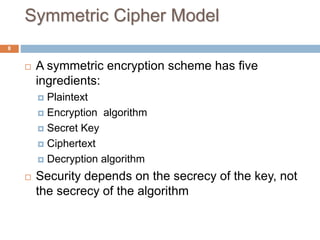
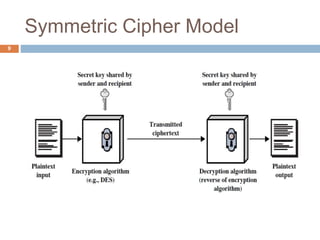
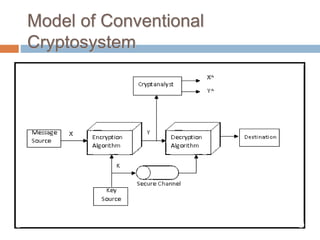
 A symmetric encryption scheme has five
ingredients:
 Plaintext
 Encryption algorithm
 Secret Key
 Ciphertext
 Decryption algorithm
 Security depends on the secrecy of the key, not
the secrecy of the algorithm
Symmetric Cipher Model
9
Symmetric Encryption
10
 or conventional / secret-key / single-key
 sender and recipient share a common key
 all classical encryption algorithms are
symmetric
 The only type of ciphers prior to the invention
of asymmetric-key ciphers in 1970’s
 by far most widely used
Symmetric Encryption
11
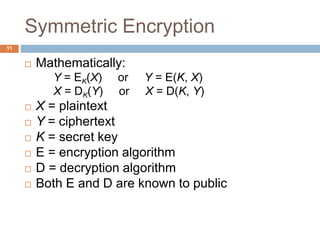
 Mathematically:
Y = EK(X) or Y = E(K, X)
X = DK(Y) or X = D(K, Y)
 X = plaintext
 Y = ciphertext
 K = secret key
 E = encryption algorithm
 D = decryption algorithm
 Both E and D are known to public
Symmetric Encryption
 two requirements for secure use of
symmetric encryption:
 a strong encryption algorithm
 a secret key known only to sender / receiver
 assume encryption algorithm is known
 implies a secure channel to distribute key
Model of Conventional
Cryptosystem
13
Cryptography
 Cryptographic systems are characterized along
three independent dimensions:
1. type of encryption operations used
 substitution
 Transposition
 product
2. number of keys used
 single-key or private
 two-key or public
Cryptography
3. way in which plaintext is processed
 block
 stream
Classical Ciphers
16
 Plaintext is viewed as a sequence of
elements (e.g., bits or characters)
 Substitution cipher: replacing each element
of the plaintext with another element.
 Transposition (or permutation) cipher:
rearranging the order of the elements of the
plaintext.
 Product cipher: using multiple stages of
substitutions and transpositions
Substitution Techniques
17
 Caeser Cipher
 Monoalphabetic Ciphers
 Playfair Cipher
 Hill Cipher
 Polyalphabetic Ciphers –Vigenere Cipher, Auto
key generation
 Vernam cipher
 One-Time Pad
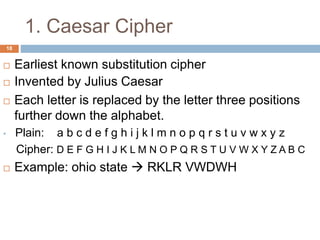
1. Caesar Cipher
18
 Earliest known substitution cipher
 Invented by Julius Caesar
 Each letter is replaced by the letter three positions
further down the alphabet.
• Plain: a b c d e f g h i j k l m n o p q r s t u v w x y z
Cipher: D E F G H I J K L M N O P Q R S T U V W X Y Z A B C
 Example: ohio state  RKLR VWDWH
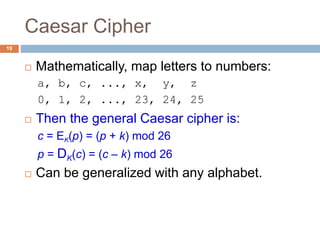
Caesar Cipher
19
 Mathematically, map letters to numbers:
a, b, c, ..., x, y, z
0, 1, 2, ..., 23, 24, 25
 Then the general Caesar cipher is:
c = EK(p) = (p + k) mod 26
p = DK(c) = (c – k) mod 26
 Can be generalized with any alphabet.
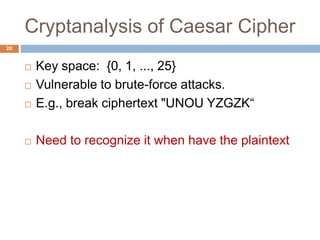
Cryptanalysis of Caesar Cipher
20
 Key space: {0, 1, ..., 25}
 Vulnerable to brute-force attacks.
 E.g., break ciphertext "UNOU YZGZK“
 Need to recognize it when have the plaintext
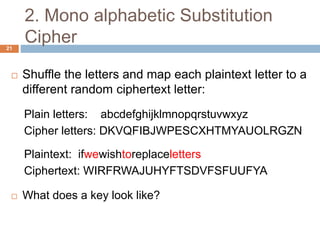
2. Mono alphabetic Substitution
Cipher21
 Shuffle the letters and map each plaintext letter to a
different random ciphertext letter:
Plain letters: abcdefghijklmnopqrstuvwxyz
Cipher letters: DKVQFIBJWPESCXHTMYAUOLRGZN
Plaintext: ifwewishtoreplaceletters
Ciphertext: WIRFRWAJUHYFTSDVFSFUUFYA
 What does a key look like?
Monoalphabetic Cipher Security
22
 Now we have a total of 26! keys.
 With so many keys, it is secure against brute-
force attacks.
 But not secure against some cryptanalytic
attacks.
 Problem is language characteristics.
Language Statistics and
Cryptanalysis23
 Human languages are not random.
 Letters are not equally frequently used.
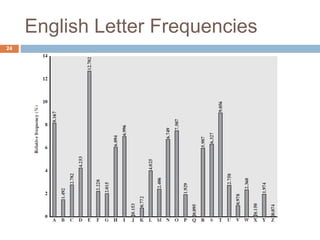
 In English, E is by far the most common letter,
followed by T, R, N, I, O, A, S.
 Other letters like Z, J, K, Q, X are fairly rare.
 There are tables of single, double & triple letter
frequencies for various languages
English Letter Frequencies
24
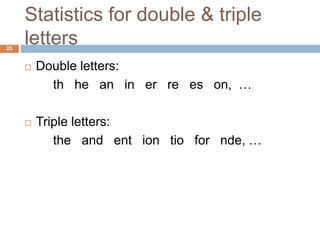
Statistics for double & triple
letters25
 Double letters:
th he an in er re es on, …
 Triple letters:
the and ent ion tio for nde, …
Use in Cryptanalysis
26
 Key concept: monoalphabetic substitution does
not change relative letter frequencies
 To attack, we
 calculate letter frequencies for ciphertext
 compare this distribution against the known one
Example Cryptanalysis
27
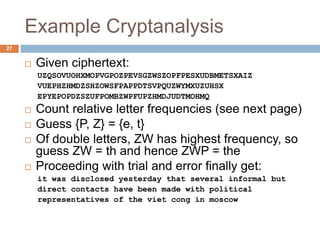
 Given ciphertext:
UZQSOVUOHXMOPVGPOZPEVSGZWSZOPFPESXUDBMETSXAIZ
VUEPHZHMDZSHZOWSFPAPPDTSVPQUZWYMXUZUHSX
EPYEPOPDZSZUFPOMBZWPFUPZHMDJUDTMOHMQ
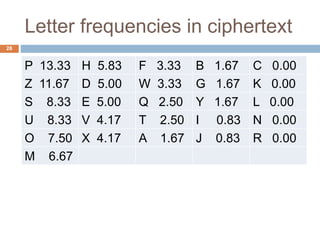
 Count relative letter frequencies (see next page)
 Guess {P, Z} = {e, t}
 Of double letters, ZW has highest frequency, so
guess ZW = th and hence ZWP = the
 Proceeding with trial and error finally get:
it was disclosed yesterday that several informal but
direct contacts have been made with political
representatives of the viet cong in moscow
Letter frequencies in ciphertext
28
P 13.33 H 5.83 F 3.33 B 1.67 C 0.00
Z 11.67 D 5.00 W 3.33 G 1.67 K 0.00
S 8.33 E 5.00 Q 2.50 Y 1.67 L 0.00
U 8.33 V 4.17 T 2.50 I 0.83 N 0.00
O 7.50 X 4.17 A 1.67 J 0.83 R 0.00
M 6.67
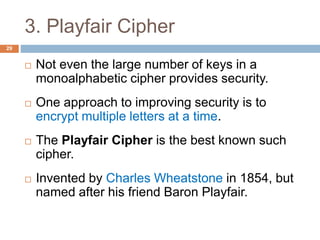
3. Playfair Cipher
29
 Not even the large number of keys in a
monoalphabetic cipher provides security.
 One approach to improving security is to
encrypt multiple letters at a time.
 The Playfair Cipher is the best known such
cipher.
 Invented by Charles Wheatstone in 1854, but
named after his friend Baron Playfair.
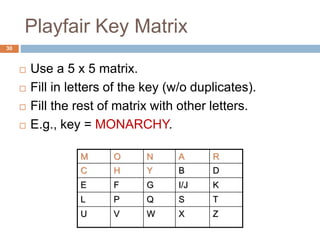
Playfair Key Matrix
30
 Use a 5 x 5 matrix.
 Fill in letters of the key (w/o duplicates).
 Fill the rest of matrix with other letters.
 E.g., key = MONARCHY.
M O N A R
C H Y B D
E F G I/J K
L P Q S T
U V W X Z
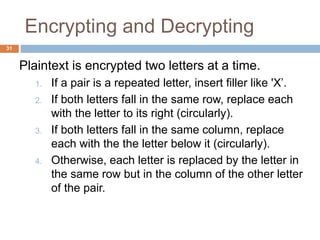
Encrypting and Decrypting
31
Plaintext is encrypted two letters at a time.
1. If a pair is a repeated letter, insert filler like 'X’.
2. If both letters fall in the same row, replace each
with the letter to its right (circularly).
3. If both letters fall in the same column, replace
each with the the letter below it (circularly).
4. Otherwise, each letter is replaced by the letter in
the same row but in the column of the other letter
of the pair.
Security of Playfair Cipher
32
 Equivalent to a monoalphabetic cipher with an
alphabet of 26 x 26 = 676 characters.
 Security is much improved over the simple
monoalphabetic cipher.
 Was widely used for many decades
 eg. by US & British military in WW1 and early WW2
 Once thought to be unbreakable.
 Actually, it can be broken, because it still leaves
some structure of plaintext intact.
4. Hill Cipher
33
Key: an invertible m x m matrix (where m is the block
length)
[defines a linear transformation]
Encryption:
-view a block of m letters as a vector, multiply by the key
Example:
key K =
What is m ?
How to encrypt blah ?
2 5
9 4
Hill Cipher
 Decrypting:
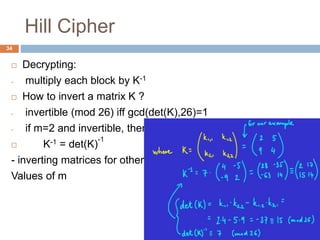
- multiply each block by K-1
 How to invert a matrix K ?
- invertible (mod 26) iff gcd(det(K),26)=1
- if m=2 and invertible, then:
 K-1 = det(K)
-1
- inverting matrices for other
Values of m
34
5. Poly alphabetic Substitution
Ciphers35
 A sequence of monoalphabetic ciphers (M1, M2,
M3, ..., Mk) is used in turn to encrypt letters.
 A key determines which sequence of ciphers to
use.
 Each plaintext letter has multiple corresponding
ciphertext letters.
 This makes cryptanalysis harder since the letter
frequency distribution will be flatter.
Vigenère Cipher
36
 Simplest polyalphabetic substitution cipher
 Consider the set of all Caesar ciphers:
{ Ca, Cb, Cc, ..., Cz }
 Key: e.g. security
 Encrypt each letter using Cs, Ce, Cc, Cu, Cr, Ci,
Ct, Cy in turn.
 Repeat from start after Cy.
 Decryption simply works in reverse.
Example of Vigenère Cipher
37
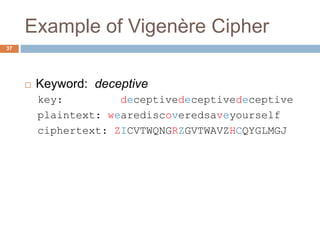
 Keyword: deceptive
key: deceptivedeceptivedeceptive
plaintext: wearediscoveredsaveyourself
ciphertext: ZICVTWQNGRZGVTWAVZHCQYGLMGJ
Security of Vigenère Ciphers
38
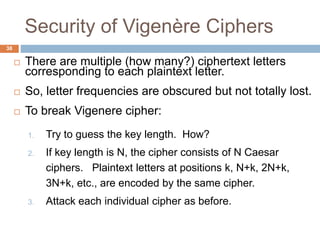
 There are multiple (how many?) ciphertext letters
corresponding to each plaintext letter.
 So, letter frequencies are obscured but not totally lost.
 To break Vigenere cipher:
1. Try to guess the key length. How?
2. If key length is N, the cipher consists of N Caesar
ciphers. Plaintext letters at positions k, N+k, 2N+k,
3N+k, etc., are encoded by the same cipher.
3. Attack each individual cipher as before.
Guessing the Key Length
39
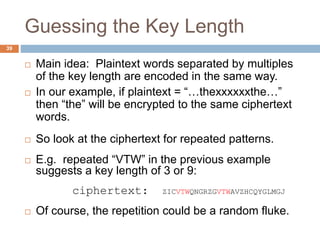
 Main idea: Plaintext words separated by multiples
of the key length are encoded in the same way.
 In our example, if plaintext = “…thexxxxxxthe…”
then “the” will be encrypted to the same ciphertext
words.
 So look at the ciphertext for repeated patterns.
 E.g. repeated “VTW” in the previous example
suggests a key length of 3 or 9:
ciphertext: ZICVTWQNGRZGVTWAVZHCQYGLMGJ
 Of course, the repetition could be a random fluke.
slide 40
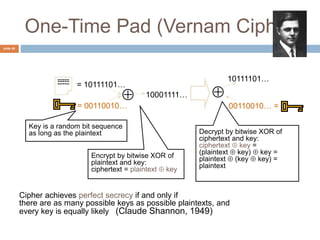
One-Time Pad (Vernam Cipher)
= 10111101…
---------------
= 00110010…
10001111…
00110010… =

10111101…
Key is a random bit sequence
as long as the plaintext
Encrypt by bitwise XOR of
plaintext and key:
ciphertext = plaintext  key
Decrypt by bitwise XOR of
ciphertext and key:
ciphertext  key =
(plaintext  key)  key =
plaintext  (key  key) =
plaintext
Cipher achieves perfect secrecy if and only if
there are as many possible keys as possible plaintexts, and
every key is equally likely (Claude Shannon, 1949)
slide 41
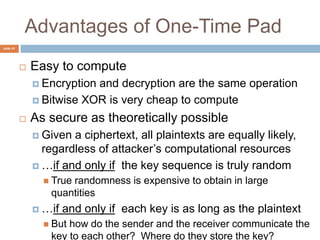
Advantages of One-Time Pad
 Easy to compute
 Encryption and decryption are the same operation
 Bitwise XOR is very cheap to compute
 As secure as theoretically possible
 Given a ciphertext, all plaintexts are equally likely,
regardless of attacker’s computational resources
 …if and only if the key sequence is truly random
 True randomness is expensive to obtain in large
quantities
 …if and only if each key is as long as the plaintext
 But how do the sender and the receiver communicate the
key to each other? Where do they store the key?
slide 42
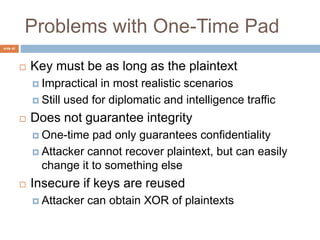
Problems with One-Time Pad
 Key must be as long as the plaintext
 Impractical in most realistic scenarios
 Still used for diplomatic and intelligence traffic
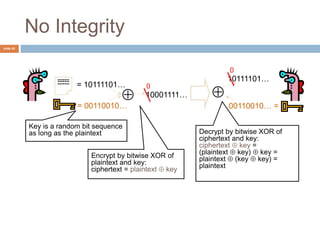
 Does not guarantee integrity
 One-time pad only guarantees confidentiality
 Attacker cannot recover plaintext, but can easily
change it to something else
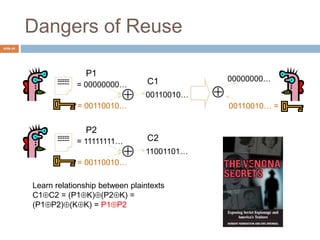
 Insecure if keys are reused
 Attacker can obtain XOR of plaintexts
slide 43
No Integrity
= 10111101…
---------------
= 00110010…
10001111…
00110010… =

10111101…
Key is a random bit sequence
as long as the plaintext
Encrypt by bitwise XOR of
plaintext and key:
ciphertext = plaintext  key
Decrypt by bitwise XOR of
ciphertext and key:
ciphertext  key =
(plaintext  key)  key =
plaintext  (key  key) =
plaintext
0
0
slide 44
Dangers of Reuse
= 00000000…
---------------
= 00110010…
00110010…
00110010… =

00000000…
P1
C1
= 11111111…
---------------
= 00110010…
11001101…
P2
C2
Learn relationship between plaintexts
C1C2 = (P1K)(P2K) =
(P1P2)(KK) = P1P2
Transposition Ciphers
45
Transposition Ciphers
46
 Also called permutation ciphers.
 Shuffle the plaintext, without altering the actual
letters used.
 Example: Railfence, Row Transposition
Ciphers
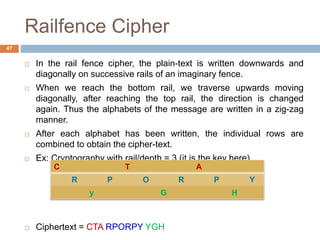
Railfence Cipher
 In the rail fence cipher, the plain-text is written downwards and
diagonally on successive rails of an imaginary fence.
 When we reach the bottom rail, we traverse upwards moving
diagonally, after reaching the top rail, the direction is changed
again. Thus the alphabets of the message are written in a zig-zag
manner.
 After each alphabet has been written, the individual rows are
combined to obtain the cipher-text.
 Ex: Cryptography with rail/depth = 3 (it is the key here)
 Ciphertext = CTA RPORPY YGH
47
C T A
R P O R P Y
y G H
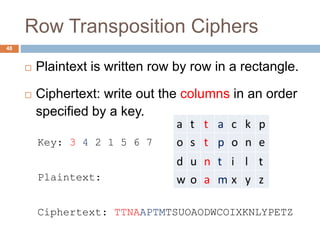
Row Transposition Ciphers
48
 Plaintext is written row by row in a rectangle.
 Ciphertext: write out the columns in an order
specified by a key.
Key: 3 4 2 1 5 6 7
Plaintext:
Ciphertext: TTNAAPTMTSUOAODWCOIXKNLYPETZ
a t t a c k p
o s t p o n e
d u n t i l t
w o a m x y z
Product Ciphers
49
 Uses a sequence of substitutions and
transpositions
 Harder to break than just substitutions or transpositions
 This is a bridge from classical to modern ciphers.
(will see later)
Rotor Machines
50
Rotor Cipher Machines
51
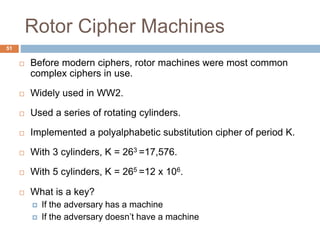
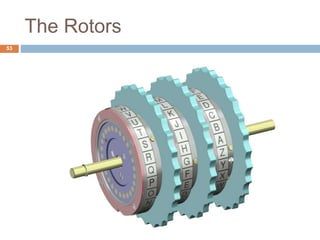
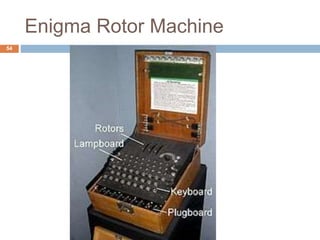
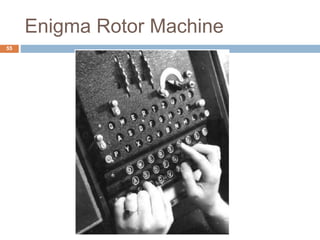
 Before modern ciphers, rotor machines were most common
complex ciphers in use.
 Widely used in WW2.
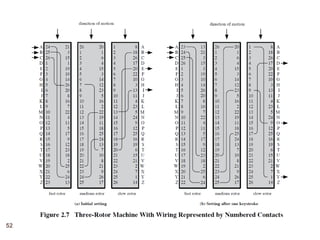
 Used a series of rotating cylinders.
 Implemented a polyalphabetic substitution cipher of period K.
 With 3 cylinders, K = 263 =17,576.
 With 5 cylinders, K = 265 =12 x 106.
 What is a key?
 If the adversary has a machine
 If the adversary doesn’t have a machine
52
The Rotors
53
Enigma Rotor Machine
54
Enigma Rotor Machine
55
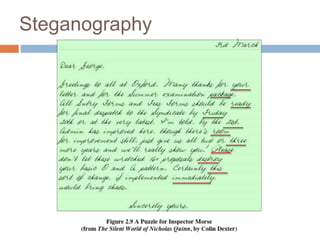
Steganography
56
 Hide a message in another message.
 E.g., hide your plaintext in a graphic image
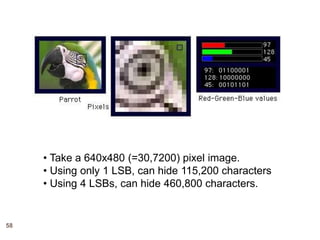
 Each pixel has 3 bytes specifying the RGB color
 The least significant bits of pixels can be changed w/o
greatly affecting the image quality
 So can hide messages in these LSBs
 Advantage: hiding existence of messages
 Drawback: high overhead
Steganography
58
• Take a 640x480 (=30,7200) pixel image.
• Using only 1 LSB, can hide 115,200 characters
• Using 4 LSBs, can hide 460,800 characters.
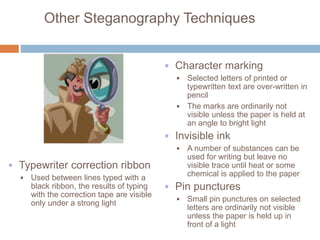
Other Steganography Techniques
• Character marking
• Selected letters of printed or
typewritten text are over-written in
pencil
• The marks are ordinarily not
visible unless the paper is held at
an angle to bright light
• Invisible ink
• A number of substances can be
used for writing but leave no
visible trace until heat or some
chemical is applied to the paper
• Pin punctures
• Small pin punctures on selected
letters are ordinarily not visible
unless the paper is held up in
front of a light
• Typewriter correction ribbon
• Used between lines typed with a
black ribbon, the results of typing
with the correction tape are visible
only under a strong light
Summary
60
 Have considered:
 classical cipher techniques and terminology
 monoalphabetic substitution ciphers
 cryptanalysis using letter frequencies
 Playfair cipher
 polyalphabetic ciphers
 transposition ciphers
 product ciphers and rotor machines
 stenography

Classical encryption techniques

  • 1.
    CS8792 – CRYPTOGRAPHY ANDNETWORK SECURITY Classical Encryption Techniques ~ S. Janani, AP/CSE Kamaraj College of Engineering and Technology
  • 2.
    Outline 2  Introduction  SymmetricCipher Model  Substitution Techniques  Transposition Techniques  Rotor Machines  Steganography
  • 3.
    Classical encryption techniques 3 As opposed to modern cryptography  Goals:  to introduce basic concepts & terminology of encryption  to prepare us for studying modern cryptography
  • 4.
    Basic terminology 4  Plaintext:original message to be encrypted  Ciphertext: the encrypted message  Enciphering or encryption: the process of converting plaintext into ciphertext  Encryption algorithm: performs encryption  Two inputs: a plaintext and a secret key
  • 5.
    Basic terminology 5  Decipheringor decryption: recovering plaintext from ciphertext  Decryption algorithm: performs decryption  Two inputs: ciphertext and secret key  Secret key: same key used for encryption and decryption  Also referred to as a symmetric key
  • 6.
    Basic terminology 6  Cipheror cryptographic system : a scheme for encryption and decryption  Cryptography: science of studying ciphers  Cryptanalysis: science of studying attacks against cryptographic systems  Cryptology: cryptography + cryptanalysis
  • 7.
    Ciphers 7  Symmetric cipher:same key used for encryption and decryption  Block cipher: encrypts a block of plaintext at a time (typically 64 or 128 bits)  Stream cipher: encrypts data one bit or one byte at a time  Asymmetric cipher: different keys used for encryption and decryption
  • 8.
    Symmetric Cipher Model 8 A symmetric encryption scheme has five ingredients:  Plaintext  Encryption algorithm  Secret Key  Ciphertext  Decryption algorithm  Security depends on the secrecy of the key, not the secrecy of the algorithm
  • 9.
  • 10.
    Symmetric Encryption 10  orconventional / secret-key / single-key  sender and recipient share a common key  all classical encryption algorithms are symmetric  The only type of ciphers prior to the invention of asymmetric-key ciphers in 1970’s  by far most widely used
  • 11.
    Symmetric Encryption 11  Mathematically: Y= EK(X) or Y = E(K, X) X = DK(Y) or X = D(K, Y)  X = plaintext  Y = ciphertext  K = secret key  E = encryption algorithm  D = decryption algorithm  Both E and D are known to public
  • 12.
    Symmetric Encryption  tworequirements for secure use of symmetric encryption:  a strong encryption algorithm  a secret key known only to sender / receiver  assume encryption algorithm is known  implies a secure channel to distribute key
  • 13.
  • 14.
    Cryptography  Cryptographic systemsare characterized along three independent dimensions: 1. type of encryption operations used  substitution  Transposition  product 2. number of keys used  single-key or private  two-key or public
  • 15.
    Cryptography 3. way inwhich plaintext is processed  block  stream
  • 16.
    Classical Ciphers 16  Plaintextis viewed as a sequence of elements (e.g., bits or characters)  Substitution cipher: replacing each element of the plaintext with another element.  Transposition (or permutation) cipher: rearranging the order of the elements of the plaintext.  Product cipher: using multiple stages of substitutions and transpositions
  • 17.
    Substitution Techniques 17  CaeserCipher  Monoalphabetic Ciphers  Playfair Cipher  Hill Cipher  Polyalphabetic Ciphers –Vigenere Cipher, Auto key generation  Vernam cipher  One-Time Pad
  • 18.
    1. Caesar Cipher 18 Earliest known substitution cipher  Invented by Julius Caesar  Each letter is replaced by the letter three positions further down the alphabet. • Plain: a b c d e f g h i j k l m n o p q r s t u v w x y z Cipher: D E F G H I J K L M N O P Q R S T U V W X Y Z A B C  Example: ohio state  RKLR VWDWH
  • 19.
    Caesar Cipher 19  Mathematically,map letters to numbers: a, b, c, ..., x, y, z 0, 1, 2, ..., 23, 24, 25  Then the general Caesar cipher is: c = EK(p) = (p + k) mod 26 p = DK(c) = (c – k) mod 26  Can be generalized with any alphabet.
  • 20.
    Cryptanalysis of CaesarCipher 20  Key space: {0, 1, ..., 25}  Vulnerable to brute-force attacks.  E.g., break ciphertext "UNOU YZGZK“  Need to recognize it when have the plaintext
  • 21.
    2. Mono alphabeticSubstitution Cipher21  Shuffle the letters and map each plaintext letter to a different random ciphertext letter: Plain letters: abcdefghijklmnopqrstuvwxyz Cipher letters: DKVQFIBJWPESCXHTMYAUOLRGZN Plaintext: ifwewishtoreplaceletters Ciphertext: WIRFRWAJUHYFTSDVFSFUUFYA  What does a key look like?
  • 22.
    Monoalphabetic Cipher Security 22 Now we have a total of 26! keys.  With so many keys, it is secure against brute- force attacks.  But not secure against some cryptanalytic attacks.  Problem is language characteristics.
  • 23.
    Language Statistics and Cryptanalysis23 Human languages are not random.  Letters are not equally frequently used.  In English, E is by far the most common letter, followed by T, R, N, I, O, A, S.  Other letters like Z, J, K, Q, X are fairly rare.  There are tables of single, double & triple letter frequencies for various languages
  • 24.
  • 25.
    Statistics for double& triple letters25  Double letters: th he an in er re es on, …  Triple letters: the and ent ion tio for nde, …
  • 26.
    Use in Cryptanalysis 26 Key concept: monoalphabetic substitution does not change relative letter frequencies  To attack, we  calculate letter frequencies for ciphertext  compare this distribution against the known one
  • 27.
    Example Cryptanalysis 27  Givenciphertext: UZQSOVUOHXMOPVGPOZPEVSGZWSZOPFPESXUDBMETSXAIZ VUEPHZHMDZSHZOWSFPAPPDTSVPQUZWYMXUZUHSX EPYEPOPDZSZUFPOMBZWPFUPZHMDJUDTMOHMQ  Count relative letter frequencies (see next page)  Guess {P, Z} = {e, t}  Of double letters, ZW has highest frequency, so guess ZW = th and hence ZWP = the  Proceeding with trial and error finally get: it was disclosed yesterday that several informal but direct contacts have been made with political representatives of the viet cong in moscow
  • 28.
    Letter frequencies inciphertext 28 P 13.33 H 5.83 F 3.33 B 1.67 C 0.00 Z 11.67 D 5.00 W 3.33 G 1.67 K 0.00 S 8.33 E 5.00 Q 2.50 Y 1.67 L 0.00 U 8.33 V 4.17 T 2.50 I 0.83 N 0.00 O 7.50 X 4.17 A 1.67 J 0.83 R 0.00 M 6.67
  • 29.
    3. Playfair Cipher 29 Not even the large number of keys in a monoalphabetic cipher provides security.  One approach to improving security is to encrypt multiple letters at a time.  The Playfair Cipher is the best known such cipher.  Invented by Charles Wheatstone in 1854, but named after his friend Baron Playfair.
  • 30.
    Playfair Key Matrix 30 Use a 5 x 5 matrix.  Fill in letters of the key (w/o duplicates).  Fill the rest of matrix with other letters.  E.g., key = MONARCHY. M O N A R C H Y B D E F G I/J K L P Q S T U V W X Z
  • 31.
    Encrypting and Decrypting 31 Plaintextis encrypted two letters at a time. 1. If a pair is a repeated letter, insert filler like 'X’. 2. If both letters fall in the same row, replace each with the letter to its right (circularly). 3. If both letters fall in the same column, replace each with the the letter below it (circularly). 4. Otherwise, each letter is replaced by the letter in the same row but in the column of the other letter of the pair.
  • 32.
    Security of PlayfairCipher 32  Equivalent to a monoalphabetic cipher with an alphabet of 26 x 26 = 676 characters.  Security is much improved over the simple monoalphabetic cipher.  Was widely used for many decades  eg. by US & British military in WW1 and early WW2  Once thought to be unbreakable.  Actually, it can be broken, because it still leaves some structure of plaintext intact.
  • 33.
    4. Hill Cipher 33 Key:an invertible m x m matrix (where m is the block length) [defines a linear transformation] Encryption: -view a block of m letters as a vector, multiply by the key Example: key K = What is m ? How to encrypt blah ? 2 5 9 4
  • 34.
    Hill Cipher  Decrypting: -multiply each block by K-1  How to invert a matrix K ? - invertible (mod 26) iff gcd(det(K),26)=1 - if m=2 and invertible, then:  K-1 = det(K) -1 - inverting matrices for other Values of m 34
  • 35.
    5. Poly alphabeticSubstitution Ciphers35  A sequence of monoalphabetic ciphers (M1, M2, M3, ..., Mk) is used in turn to encrypt letters.  A key determines which sequence of ciphers to use.  Each plaintext letter has multiple corresponding ciphertext letters.  This makes cryptanalysis harder since the letter frequency distribution will be flatter.
  • 36.
    Vigenère Cipher 36  Simplestpolyalphabetic substitution cipher  Consider the set of all Caesar ciphers: { Ca, Cb, Cc, ..., Cz }  Key: e.g. security  Encrypt each letter using Cs, Ce, Cc, Cu, Cr, Ci, Ct, Cy in turn.  Repeat from start after Cy.  Decryption simply works in reverse.
  • 37.
    Example of VigenèreCipher 37  Keyword: deceptive key: deceptivedeceptivedeceptive plaintext: wearediscoveredsaveyourself ciphertext: ZICVTWQNGRZGVTWAVZHCQYGLMGJ
  • 38.
    Security of VigenèreCiphers 38  There are multiple (how many?) ciphertext letters corresponding to each plaintext letter.  So, letter frequencies are obscured but not totally lost.  To break Vigenere cipher: 1. Try to guess the key length. How? 2. If key length is N, the cipher consists of N Caesar ciphers. Plaintext letters at positions k, N+k, 2N+k, 3N+k, etc., are encoded by the same cipher. 3. Attack each individual cipher as before.
  • 39.
    Guessing the KeyLength 39  Main idea: Plaintext words separated by multiples of the key length are encoded in the same way.  In our example, if plaintext = “…thexxxxxxthe…” then “the” will be encrypted to the same ciphertext words.  So look at the ciphertext for repeated patterns.  E.g. repeated “VTW” in the previous example suggests a key length of 3 or 9: ciphertext: ZICVTWQNGRZGVTWAVZHCQYGLMGJ  Of course, the repetition could be a random fluke.
  • 40.
    slide 40 One-Time Pad(Vernam Cipher) = 10111101… --------------- = 00110010… 10001111… 00110010… =  10111101… Key is a random bit sequence as long as the plaintext Encrypt by bitwise XOR of plaintext and key: ciphertext = plaintext  key Decrypt by bitwise XOR of ciphertext and key: ciphertext  key = (plaintext  key)  key = plaintext  (key  key) = plaintext Cipher achieves perfect secrecy if and only if there are as many possible keys as possible plaintexts, and every key is equally likely (Claude Shannon, 1949)
  • 41.
    slide 41 Advantages ofOne-Time Pad  Easy to compute  Encryption and decryption are the same operation  Bitwise XOR is very cheap to compute  As secure as theoretically possible  Given a ciphertext, all plaintexts are equally likely, regardless of attacker’s computational resources  …if and only if the key sequence is truly random  True randomness is expensive to obtain in large quantities  …if and only if each key is as long as the plaintext  But how do the sender and the receiver communicate the key to each other? Where do they store the key?
  • 42.
    slide 42 Problems withOne-Time Pad  Key must be as long as the plaintext  Impractical in most realistic scenarios  Still used for diplomatic and intelligence traffic  Does not guarantee integrity  One-time pad only guarantees confidentiality  Attacker cannot recover plaintext, but can easily change it to something else  Insecure if keys are reused  Attacker can obtain XOR of plaintexts
  • 43.
    slide 43 No Integrity =10111101… --------------- = 00110010… 10001111… 00110010… =  10111101… Key is a random bit sequence as long as the plaintext Encrypt by bitwise XOR of plaintext and key: ciphertext = plaintext  key Decrypt by bitwise XOR of ciphertext and key: ciphertext  key = (plaintext  key)  key = plaintext  (key  key) = plaintext 0 0
  • 44.
    slide 44 Dangers ofReuse = 00000000… --------------- = 00110010… 00110010… 00110010… =  00000000… P1 C1 = 11111111… --------------- = 00110010… 11001101… P2 C2 Learn relationship between plaintexts C1C2 = (P1K)(P2K) = (P1P2)(KK) = P1P2
  • 45.
  • 46.
    Transposition Ciphers 46  Alsocalled permutation ciphers.  Shuffle the plaintext, without altering the actual letters used.  Example: Railfence, Row Transposition Ciphers
  • 47.
    Railfence Cipher  Inthe rail fence cipher, the plain-text is written downwards and diagonally on successive rails of an imaginary fence.  When we reach the bottom rail, we traverse upwards moving diagonally, after reaching the top rail, the direction is changed again. Thus the alphabets of the message are written in a zig-zag manner.  After each alphabet has been written, the individual rows are combined to obtain the cipher-text.  Ex: Cryptography with rail/depth = 3 (it is the key here)  Ciphertext = CTA RPORPY YGH 47 C T A R P O R P Y y G H
  • 48.
    Row Transposition Ciphers 48 Plaintext is written row by row in a rectangle.  Ciphertext: write out the columns in an order specified by a key. Key: 3 4 2 1 5 6 7 Plaintext: Ciphertext: TTNAAPTMTSUOAODWCOIXKNLYPETZ a t t a c k p o s t p o n e d u n t i l t w o a m x y z
  • 49.
    Product Ciphers 49  Usesa sequence of substitutions and transpositions  Harder to break than just substitutions or transpositions  This is a bridge from classical to modern ciphers. (will see later)
  • 50.
  • 51.
    Rotor Cipher Machines 51 Before modern ciphers, rotor machines were most common complex ciphers in use.  Widely used in WW2.  Used a series of rotating cylinders.  Implemented a polyalphabetic substitution cipher of period K.  With 3 cylinders, K = 263 =17,576.  With 5 cylinders, K = 265 =12 x 106.  What is a key?  If the adversary has a machine  If the adversary doesn’t have a machine
  • 52.
  • 53.
  • 54.
  • 55.
  • 56.
    Steganography 56  Hide amessage in another message.  E.g., hide your plaintext in a graphic image  Each pixel has 3 bytes specifying the RGB color  The least significant bits of pixels can be changed w/o greatly affecting the image quality  So can hide messages in these LSBs  Advantage: hiding existence of messages  Drawback: high overhead
  • 57.
  • 58.
    58 • Take a640x480 (=30,7200) pixel image. • Using only 1 LSB, can hide 115,200 characters • Using 4 LSBs, can hide 460,800 characters.
  • 59.
    Other Steganography Techniques •Character marking • Selected letters of printed or typewritten text are over-written in pencil • The marks are ordinarily not visible unless the paper is held at an angle to bright light • Invisible ink • A number of substances can be used for writing but leave no visible trace until heat or some chemical is applied to the paper • Pin punctures • Small pin punctures on selected letters are ordinarily not visible unless the paper is held up in front of a light • Typewriter correction ribbon • Used between lines typed with a black ribbon, the results of typing with the correction tape are visible only under a strong light
  • 60.
    Summary 60  Have considered: classical cipher techniques and terminology  monoalphabetic substitution ciphers  cryptanalysis using letter frequencies  Playfair cipher  polyalphabetic ciphers  transposition ciphers  product ciphers and rotor machines  stenography