Digital Signature
Mohamed Talaat
1
Agenda
• What is Digital Signature?
• How DS work?
• General Framework of DS
• Key Requirements
• Private Key Protection
• Benefits of Digital Signature
• Drawbacks of Digital Signature
• Applications
2
3
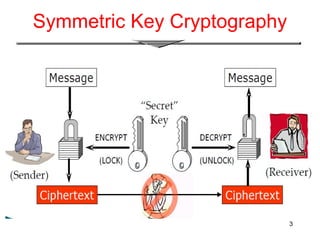
Symmetric Key Cryptography
4
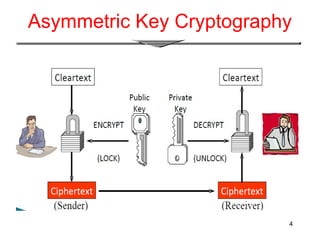
Asymmetric Key Cryptography
5
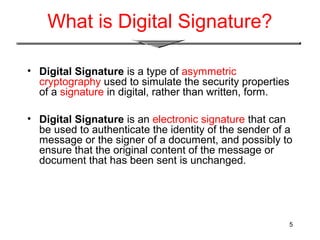
What is Digital Signature?
• Digital Signature is a type of asymmetric
cryptography used to simulate the security properties
of a signature in digital, rather than written, form.
• Digital Signature is an electronic signature that can
be used to authenticate the identity of the sender of a
message or the signer of a document, and possibly to
ensure that the original content of the message or
document that has been sent is unchanged.
How it work ?
6
7
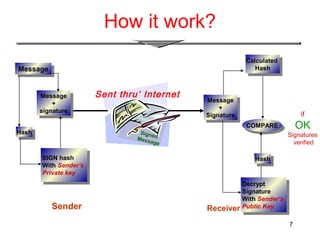
How it work?
Message
+
Signature
Message
+
Signature
HashHash
Decrypt
Signature
With Sender’s
Public Key
Decrypt
Signature
With Sender’s
Public Key
SIGN hash
With Sender’s
Private key
SIGN hash
With Sender’s
Private key
Message
+
signature
Message
+
signature
COMPARECOMPARE
Calculated
Hash
Calculated
Hash
MessageMessage
Sender Receiver
HashHash
SignedMessage
Sent thru’ Internet
if
OK
Signatures
verified
8
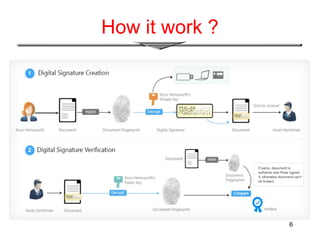
How it work ?
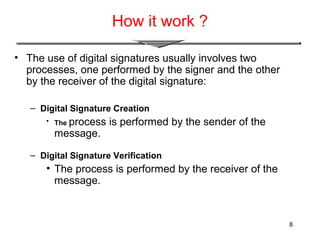
• The use of digital signatures usually involves two
processes, one performed by the signer and the other
by the receiver of the digital signature:
– Digital Signature Creation
• The process is performed by the sender of the
message.
– Digital Signature Verification
• The process is performed by the receiver of the
message.
9
How it work ?
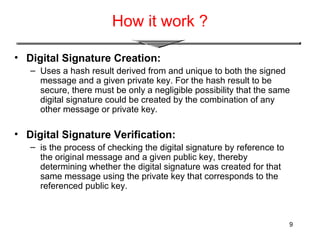
• Digital Signature Creation:
– Uses a hash result derived from and unique to both the signed
message and a given private key. For the hash result to be
secure, there must be only a negligible possibility that the same
digital signature could be created by the combination of any
other message or private key.
• Digital Signature Verification:
– is the process of checking the digital signature by reference to
the original message and a given public key, thereby
determining whether the digital signature was created for that
same message using the private key that corresponds to the
referenced public key.
10
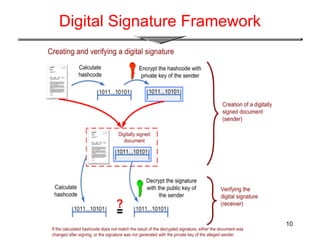
Digital Signature Framework
11
Key Requirements
• Each individual generates his own key pair, private
and public keys.
• Private key:
– Only known by the owner/sender
– Used to create the digital signature
• Public key
– It is known to everyone.
– Used to verify the digital signature.
12
Key Requirements
• Digital Certificate:
– Digital Identity that establishes your credentials when doing
business or other transactions on the Web
– Issued by a Certifying Authority (CA)
– Contains your name, serial number, expiration dates, public
key, signature of CA.
• Certificate Authority:
– Trusted Third Party.
– An organization which issues public key certificates.
– Assures the identity of the parties to whom it issues
certificates.
– Maintains online access to the public key certificates issued.
13
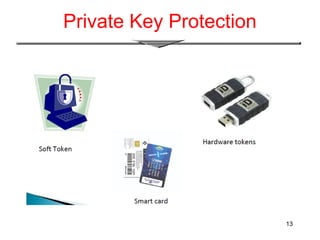
Private Key Protection
14
Benefits of Digital Signature
1. Authentication
– Digital signatures can be used to authenticate the source of
messages. When ownership of a digital signature secret key is
bound to a specific user, a valid signature shows that the message
was sent by that user.
– The importance of high confidence in sender authenticity is
especially obvious in a financial context.
15
Benefits of Digital Signature
2. Integrity:
– In many scenarios, the sender and receiver of a message may
have a need for confidence that the message has not been altered
during transmission.
– Although encryption hides the contents of a message, it may be
possible to change an encrypted message without understanding
it.
– If a message is digitally signed, any change in the message will
invalidate the signature.
– Furthermore, there is no efficient way to modify a message and its
signature to produce a new message with a valid signature,
because this is still considered to be computationally infeasible by
most cryptographic hash functions.
16
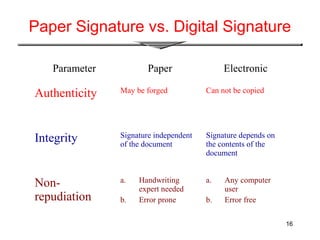
Paper Signature vs. Digital Signature
Parameter Paper Electronic
Authenticity May be forged Can not be copied
Integrity Signature independent
of the document
Signature depends on
the contents of the
document
Non-
repudiation
a. Handwriting
expert needed
b. Error prone
a. Any computer
user
b. Error free
17
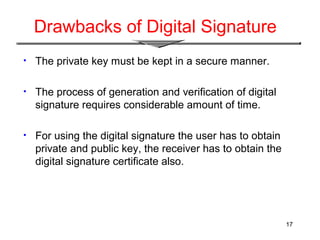
Drawbacks of Digital Signature
• The private key must be kept in a secure manner.
• The process of generation and verification of digital
signature requires considerable amount of time.
• For using the digital signature the user has to obtain
private and public key, the receiver has to obtain the
digital signature certificate also.
18
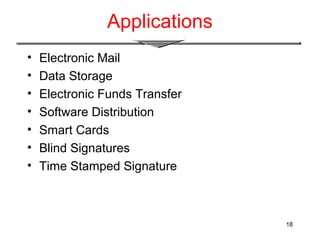
Applications
• Electronic Mail
• Data Storage
• Electronic Funds Transfer
• Software Distribution
• Smart Cards
• Blind Signatures
• Time Stamped Signature
Thanks 
19

Digital Signature

  • 1.
  • 2.
    Agenda • What isDigital Signature? • How DS work? • General Framework of DS • Key Requirements • Private Key Protection • Benefits of Digital Signature • Drawbacks of Digital Signature • Applications 2
  • 3.
  • 4.
  • 5.
    5 What is DigitalSignature? • Digital Signature is a type of asymmetric cryptography used to simulate the security properties of a signature in digital, rather than written, form. • Digital Signature is an electronic signature that can be used to authenticate the identity of the sender of a message or the signer of a document, and possibly to ensure that the original content of the message or document that has been sent is unchanged.
  • 6.
  • 7.
    7 How it work? Message + Signature Message + Signature HashHash Decrypt Signature WithSender’s Public Key Decrypt Signature With Sender’s Public Key SIGN hash With Sender’s Private key SIGN hash With Sender’s Private key Message + signature Message + signature COMPARECOMPARE Calculated Hash Calculated Hash MessageMessage Sender Receiver HashHash SignedMessage Sent thru’ Internet if OK Signatures verified
  • 8.
    8 How it work? • The use of digital signatures usually involves two processes, one performed by the signer and the other by the receiver of the digital signature: – Digital Signature Creation • The process is performed by the sender of the message. – Digital Signature Verification • The process is performed by the receiver of the message.
  • 9.
    9 How it work? • Digital Signature Creation: – Uses a hash result derived from and unique to both the signed message and a given private key. For the hash result to be secure, there must be only a negligible possibility that the same digital signature could be created by the combination of any other message or private key. • Digital Signature Verification: – is the process of checking the digital signature by reference to the original message and a given public key, thereby determining whether the digital signature was created for that same message using the private key that corresponds to the referenced public key.
  • 10.
  • 11.
    11 Key Requirements • Eachindividual generates his own key pair, private and public keys. • Private key: – Only known by the owner/sender – Used to create the digital signature • Public key – It is known to everyone. – Used to verify the digital signature.
  • 12.
    12 Key Requirements • DigitalCertificate: – Digital Identity that establishes your credentials when doing business or other transactions on the Web – Issued by a Certifying Authority (CA) – Contains your name, serial number, expiration dates, public key, signature of CA. • Certificate Authority: – Trusted Third Party. – An organization which issues public key certificates. – Assures the identity of the parties to whom it issues certificates. – Maintains online access to the public key certificates issued.
  • 13.
  • 14.
    14 Benefits of DigitalSignature 1. Authentication – Digital signatures can be used to authenticate the source of messages. When ownership of a digital signature secret key is bound to a specific user, a valid signature shows that the message was sent by that user. – The importance of high confidence in sender authenticity is especially obvious in a financial context.
  • 15.
    15 Benefits of DigitalSignature 2. Integrity: – In many scenarios, the sender and receiver of a message may have a need for confidence that the message has not been altered during transmission. – Although encryption hides the contents of a message, it may be possible to change an encrypted message without understanding it. – If a message is digitally signed, any change in the message will invalidate the signature. – Furthermore, there is no efficient way to modify a message and its signature to produce a new message with a valid signature, because this is still considered to be computationally infeasible by most cryptographic hash functions.
  • 16.
    16 Paper Signature vs.Digital Signature Parameter Paper Electronic Authenticity May be forged Can not be copied Integrity Signature independent of the document Signature depends on the contents of the document Non- repudiation a. Handwriting expert needed b. Error prone a. Any computer user b. Error free
  • 17.
    17 Drawbacks of DigitalSignature • The private key must be kept in a secure manner. • The process of generation and verification of digital signature requires considerable amount of time. • For using the digital signature the user has to obtain private and public key, the receiver has to obtain the digital signature certificate also.
  • 18.
    18 Applications • Electronic Mail •Data Storage • Electronic Funds Transfer • Software Distribution • Smart Cards • Blind Signatures • Time Stamped Signature
  • 19.