What is cryptography?
Cryptography is the practice and study of techniques
for secure communication in the presence of third parties
(called adversaries).

More generally, it is about constructing and analyzing that
overcome the influence of adversaries and which are
related to various aspects in information security such as
data confidentiality, data integrity, and authentication.
HISTORY OF CRYPTOGRAPHY
THE ORIGIN OF CRYPTOGRAPHY TOOK PLCAE AROUND
 2000 B.C. IN EGYPT.
Before the modern era, cryptography was concerned solely with
message confidentiality (i.e., Encryption)—conversion of
messages from a comprehensible form into an incomprehensible
one and back again at the other end, rendering it unreadable by
interceptors or eavesdroppers without secret knowledge.

Encryption was used to ensure secrecy in communications,
such as those of spies, military leaders, and diplomats.
CLASSIC CRYPTOGRAPHY
 The main classical cipher types are transposition
ciphers, which rearrange the order of letters in a message and
substitution ciphers, which symmetrically replace letters with
other letters.

EXAMPLE., ‘hello world’ becomes 'ehlol owrdl' in a trivially
simple rearrangement scheme.


              A cipher (or cypher) is an algorithm for performing
              encryption or decryption — a series of well-defined
              steps that can be followed as a procedure.
An early substitution cipher was the Caesar cipher, in which each letter in
the plain text was replaced by a letter some fixed number of positions further
down the alphabet.

Suetonius reports that Julius Caesar used it with a shift of three to
communicate with his generals.


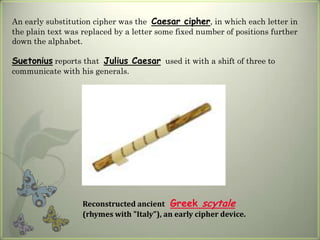
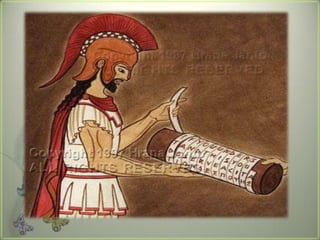
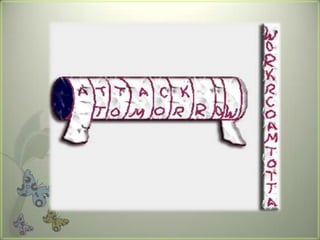
                   Reconstructed ancient Greek scytale
                   (rhymes with "Italy"), an early cipher device.
THE COMPUTER
     ERA

       OR

         MODERN
         CRYPTOGRAPHY
• The development of digital computers and electronics after WWII
  made possible much more complex ciphers. Furthermore, computers
  allowed for the encryption of any kind of data represent able in any
  binary format, unlike classical ciphers which only encrypted written
  language texts; this was new and significant.


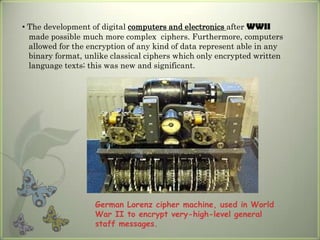
                   German Lorenz cipher machine, used in World
                   War II to encrypt very-high-level general
                   staff messages.
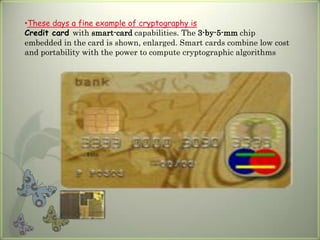
•These days a fine example of cryptography is
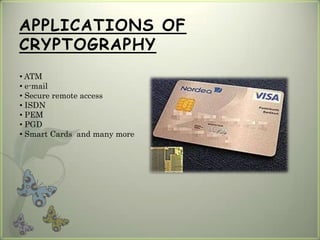
Credit card with smart-card capabilities. The 3-by-5-mm chip
embedded in the card is shown, enlarged. Smart cards combine low cost
and portability with the power to compute cryptographic algorithms
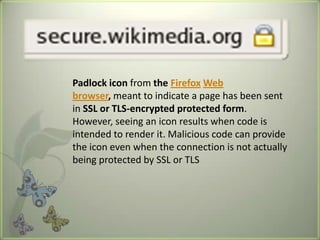
Padlock icon from the Firefox Web
browser, meant to indicate a page has been sent
in SSL or TLS-encrypted protected form.
However, seeing an icon results when code is
intended to render it. Malicious code can provide
the icon even when the connection is not actually
being protected by SSL or TLS
This is a
CRYPTOGRAPHY
PIECE
The mod e r n f ie ld o f c rypt ogra phy c a n be
d ivid e d in t o s e ve r a l a r e a s o f s t u d y :


 SYMMETRIC KEY CRYPTOGRAPHY :
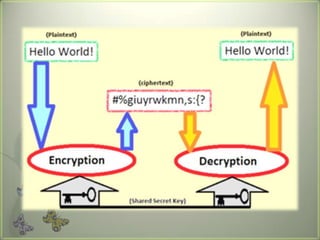
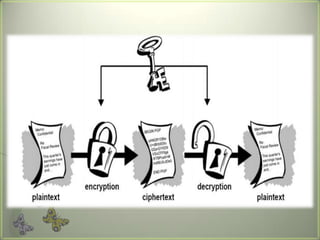
  Symmetric-key cryptography refers to encryption methods in
  which both the sender and receiver share the same key

 PUBLIC KEY CRYTOGRAPHY :
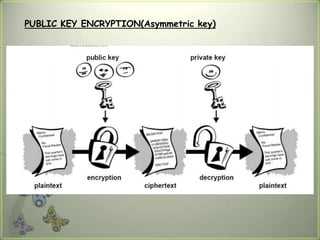
  Public key cryptography refers to encryption methods in which
  both the sender and receiver share the different keys.


              The basic elements of cryptography are:
              1. Encryption
              2. Decryption
              3. Key
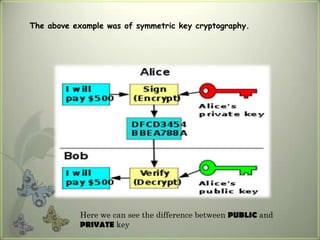
The above example was of symmetric key cryptography.


           Here we can see the difference between PUBLIC and
           PRIVATE key
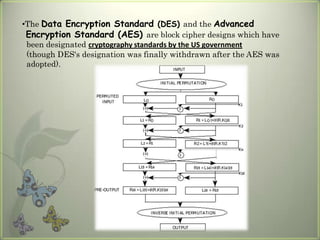
•The Data Encryption Standard (DES) and the Advanced
 Encryption Standard (AES) are block cipher designs which have
 been designated cryptography standards by the US government
 (though DES's designation was finally withdrawn after the AES was
 adopted).
PUBLIC KEY ENCRYPTION(Asymmetric key)
APPLICATIONS OF
CRYPTOGRAPHY
• ATM
• e-mail
• Secure remote access
• ISDN
• PEM
• PGD
• Smart Cards and many more
cryptography

cryptography

  • 2.
    What is cryptography? Cryptographyis the practice and study of techniques for secure communication in the presence of third parties (called adversaries). More generally, it is about constructing and analyzing that overcome the influence of adversaries and which are related to various aspects in information security such as data confidentiality, data integrity, and authentication.
  • 4.
    HISTORY OF CRYPTOGRAPHY THEORIGIN OF CRYPTOGRAPHY TOOK PLCAE AROUND 2000 B.C. IN EGYPT. Before the modern era, cryptography was concerned solely with message confidentiality (i.e., Encryption)—conversion of messages from a comprehensible form into an incomprehensible one and back again at the other end, rendering it unreadable by interceptors or eavesdroppers without secret knowledge. Encryption was used to ensure secrecy in communications, such as those of spies, military leaders, and diplomats.
  • 5.
    CLASSIC CRYPTOGRAPHY Themain classical cipher types are transposition ciphers, which rearrange the order of letters in a message and substitution ciphers, which symmetrically replace letters with other letters. EXAMPLE., ‘hello world’ becomes 'ehlol owrdl' in a trivially simple rearrangement scheme. A cipher (or cypher) is an algorithm for performing encryption or decryption — a series of well-defined steps that can be followed as a procedure.
  • 6.
    An early substitutioncipher was the Caesar cipher, in which each letter in the plain text was replaced by a letter some fixed number of positions further down the alphabet. Suetonius reports that Julius Caesar used it with a shift of three to communicate with his generals. Reconstructed ancient Greek scytale (rhymes with "Italy"), an early cipher device.
  • 9.
    THE COMPUTER ERA OR MODERN CRYPTOGRAPHY
  • 10.
    • The developmentof digital computers and electronics after WWII made possible much more complex ciphers. Furthermore, computers allowed for the encryption of any kind of data represent able in any binary format, unlike classical ciphers which only encrypted written language texts; this was new and significant. German Lorenz cipher machine, used in World War II to encrypt very-high-level general staff messages.
  • 11.
    •These days afine example of cryptography is Credit card with smart-card capabilities. The 3-by-5-mm chip embedded in the card is shown, enlarged. Smart cards combine low cost and portability with the power to compute cryptographic algorithms
  • 12.
    Padlock icon fromthe Firefox Web browser, meant to indicate a page has been sent in SSL or TLS-encrypted protected form. However, seeing an icon results when code is intended to render it. Malicious code can provide the icon even when the connection is not actually being protected by SSL or TLS
  • 13.
  • 14.
    The mod er n f ie ld o f c rypt ogra phy c a n be d ivid e d in t o s e ve r a l a r e a s o f s t u d y : SYMMETRIC KEY CRYPTOGRAPHY : Symmetric-key cryptography refers to encryption methods in which both the sender and receiver share the same key PUBLIC KEY CRYTOGRAPHY : Public key cryptography refers to encryption methods in which both the sender and receiver share the different keys. The basic elements of cryptography are: 1. Encryption 2. Decryption 3. Key
  • 16.
    The above examplewas of symmetric key cryptography. Here we can see the difference between PUBLIC and PRIVATE key
  • 17.
    •The Data EncryptionStandard (DES) and the Advanced Encryption Standard (AES) are block cipher designs which have been designated cryptography standards by the US government (though DES's designation was finally withdrawn after the AES was adopted).
  • 18.
  • 19.
    APPLICATIONS OF CRYPTOGRAPHY • ATM •e-mail • Secure remote access • ISDN • PEM • PGD • Smart Cards and many more