Data Encryption Tayyab Arif Allama Iqbal Open Unviersity Pakistan Book: Telecommunication Primer BS(cs) 7 th  Semster Mob: 00923445064252
Encryption Definition: The action of disguising information so that it can be recovered easily by the persons who have the key, but is highly resistant to recovery by persons who do not have the key. Tayyab Arif  00923445064252, Allama Iqbal Open University
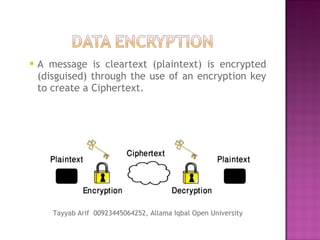
A message is cleartext (plaintext) is encrypted (disguised) through the use of an encryption key to create a Ciphertext.  Tayyab Arif  00923445064252, Allama Iqbal Open University
The encryption key may be changed from time to time to make an intruder’s task more difficult.  Restoration of a ciphertext to cleartext is achieved by the action of decryption using a decryption key. Tayyab Arif  00923445064252, Allama Iqbal Open University
In symmetric (Single key): The encryption and decryption keys are the same. In asymmetric (two keys): The encryption and decryption keys are different.  Tayyab Arif  00923445064252, Allama Iqbal Open University
Encryption Methods: Encryption is accomplished by scrambling the bits, characters, words, or phrases in the original message. Scrambling involves two activities: Transposition Substitution Tayyab Arif  00923445064252, Allama Iqbal Open University
Transposition: In which the order of the bits patterns, characters, words or phrases is rearranged. Substitution: In which new bit patterns, characters, words, or phrases are substituted for the originals without changing their order. Tayyab Arif  00923445064252, Allama Iqbal Open University
Data Encryption Standard (DES): Most widely used algorithm Pioneered by IBM It is symmetric cryptosystem Developed to protect sensitive, unclassified, US government, Computer data. Used to provide authentication of electronic funds transfer messages. Tayyab Arif  00923445064252, Allama Iqbal Open University
DES Algorithm: The algorithm accepts plaintext, P, and performs an initial permutation, IP, on P producing P 0 , The block is then broken into left and right halves, the Left (L 0 ) being the first 32 bits of P 0  and the right (R 0 ) being the last 32 bits of P 0 . With L 0  and R 0 , 16 rounds are performed until L 16  and R 16  are generated. The inverse permutation, IP -1 , is applied to L 16 R 16  to produce ciphertext C. Tayyab Arif  00923445064252, Allama Iqbal Open University
Public Key Cryptosystem It is an asymmetric cryptosystem. First announced in 1976. Offer a radically different approach to encryption. The idea depends on the use of a pair of keys that differ in a complementary way. Several algorithms are proposed RSA algorithm is considered to be highly secure. Tayyab Arif  00923445064252, Allama Iqbal Open University
Public key encryption can achieved: Privacy Authentication
Tayyab Arif Allama Iqbal Open Unviersity Pakistan Book: Telecommunication Primer BS(cs) 7 th  Semster Mob: 00923445064252 [email_address] www.youtube.com/tayyab8632

Data encryption, Description, DES

  • 1.
    Data Encryption TayyabArif Allama Iqbal Open Unviersity Pakistan Book: Telecommunication Primer BS(cs) 7 th Semster Mob: 00923445064252
  • 2.
    Encryption Definition: Theaction of disguising information so that it can be recovered easily by the persons who have the key, but is highly resistant to recovery by persons who do not have the key. Tayyab Arif 00923445064252, Allama Iqbal Open University
  • 3.
    A message iscleartext (plaintext) is encrypted (disguised) through the use of an encryption key to create a Ciphertext. Tayyab Arif 00923445064252, Allama Iqbal Open University
  • 4.
    The encryption keymay be changed from time to time to make an intruder’s task more difficult. Restoration of a ciphertext to cleartext is achieved by the action of decryption using a decryption key. Tayyab Arif 00923445064252, Allama Iqbal Open University
  • 5.
    In symmetric (Singlekey): The encryption and decryption keys are the same. In asymmetric (two keys): The encryption and decryption keys are different. Tayyab Arif 00923445064252, Allama Iqbal Open University
  • 6.
    Encryption Methods: Encryptionis accomplished by scrambling the bits, characters, words, or phrases in the original message. Scrambling involves two activities: Transposition Substitution Tayyab Arif 00923445064252, Allama Iqbal Open University
  • 7.
    Transposition: In whichthe order of the bits patterns, characters, words or phrases is rearranged. Substitution: In which new bit patterns, characters, words, or phrases are substituted for the originals without changing their order. Tayyab Arif 00923445064252, Allama Iqbal Open University
  • 8.
    Data Encryption Standard(DES): Most widely used algorithm Pioneered by IBM It is symmetric cryptosystem Developed to protect sensitive, unclassified, US government, Computer data. Used to provide authentication of electronic funds transfer messages. Tayyab Arif 00923445064252, Allama Iqbal Open University
  • 9.
    DES Algorithm: Thealgorithm accepts plaintext, P, and performs an initial permutation, IP, on P producing P 0 , The block is then broken into left and right halves, the Left (L 0 ) being the first 32 bits of P 0 and the right (R 0 ) being the last 32 bits of P 0 . With L 0 and R 0 , 16 rounds are performed until L 16 and R 16 are generated. The inverse permutation, IP -1 , is applied to L 16 R 16 to produce ciphertext C. Tayyab Arif 00923445064252, Allama Iqbal Open University
  • 10.
    Public Key CryptosystemIt is an asymmetric cryptosystem. First announced in 1976. Offer a radically different approach to encryption. The idea depends on the use of a pair of keys that differ in a complementary way. Several algorithms are proposed RSA algorithm is considered to be highly secure. Tayyab Arif 00923445064252, Allama Iqbal Open University
  • 11.
    Public key encryptioncan achieved: Privacy Authentication
  • 12.
    Tayyab Arif AllamaIqbal Open Unviersity Pakistan Book: Telecommunication Primer BS(cs) 7 th Semster Mob: 00923445064252 [email_address] www.youtube.com/tayyab8632