Chapter 11
Cash Flows and
 Other Topics
   in Capital
  Budgeting


   Copyright © 2011 Pearson Prentice Hall.
   All rights reserved.
Learning Objectives

    1. Identify guidelines by which we measure
       cash flows.
    2. Explain how a project’s benefits and costs –
       that is, its free cash flows –are calculated.
    3. Explain the importance of options or flexibility
       in capital budgeting.
    4. Explain what the appropriate measure of risk
       is for capital-budgeting purposes.
 © 2011 Pearson Prentice Hall. All rights
reserved.                                            11-2
Learning Objectives

    5. Determine the acceptability of a new project
       using the risk-adjusted discount method of
       adjusting for risk.
    6. Explain the use of simulating for imitating
       the performance of a project under
       evaluation.
    7. Explain why a multinational firm faces a
       more difficult time estimating cash flows
       along with increased risks.
 © 2011 Pearson Prentice Hall. All rights
reserved.                                            11-3
Slide Contents

     Guidelines for Capital Budgeting
     Free Cash Flow calculations
     Options in Capital Budgeting
     Risk and the Investment Decision
     Measurement of Systematic Risk
     The Multinational Firm

 © 2011 Pearson Prentice Hall. All rights
reserved.                                   11-4
1. Guidelines for
                        Capital Budgeting

     To evaluate investment proposals, we
      must first set guidelines by which we
      measure the value of each proposal.
     In effect, we are deciding what is and
      what isn’t relevant cash flow.


 © 2011 Pearson Prentice Hall. All rights
reserved.                                      11-5
Guidelines for
                        Capital Budgeting

    1. Use free cash flows, not accounting profits
    2. Think Incrementally
    3. Beware of cash flows diverted from existing
       products
    4. Look for incidental or synergistic effects
    5. Work in working-capital requirements

 © 2011 Pearson Prentice Hall. All rights
reserved.                                            11-6
Guidelines for
                        Capital Budgeting

    6. Consider incremental expenses
    7. Sunk costs are not incremental cash flows
    8. Account for opportunity costs
    9. Decide if overhead costs are truly
       incremental cash flows
    10. Ignore interest payments and financing
        flows
 © 2011 Pearson Prentice Hall. All rights
reserved.                                          11-7
Use Free Cash Flows

     Free cash flow accurately reflects the
      timing of benefits and costs—when
      money is received, when it can be
      reinvested, and when it must be paid
      out.
     Accounting profits do not reflect actual
      money in hand.
 © 2011 Pearson Prentice Hall. All rights
reserved.                                        11-8
Incremental Cash Flows

     After-tax free cash flows must be
      measured incrementally.
     Determining incremental free cash flow
      involves determining the cash flows with
      and without the project. Incremental is
      the “additional cash flows” (inflows or
      outflows) that occur due to the project.
 © 2011 Pearson Prentice Hall. All rights
reserved.                                    11-9
Beware of Diverted
                          Cash Flows

     Not all incremental free cash flow is relevant.
     Thus new product sales achieved at the cost
      of losing sales from existing product line are
      not considered a benefit.
     However, if the new product captures sales
      from competitors or prevents loss of sales to
      new competing products, it would be a
      relevant incremental free cash flows.
 © 2011 Pearson Prentice Hall. All rights             11-
reserved.                                             10
Incidental or
                        Synergistic Effects

     Although some projects may take sales
      away from a firm’s current projects, in
      other cases new products may add
      sales to the existing line. This is called
      synergistic effect and is a relevant cash
      flow.


 © 2011 Pearson Prentice Hall. All rights      11-
reserved.                                      11
Working Capital Requirement

     New projects require infusion of working
      capital (such as inventory to stock the
      shelves), which would be an outflow.
     Generally, when the project terminates,
      working capital is recovered and there
      is an inflow of working capital.


 © 2011 Pearson Prentice Hall. All rights   11-
reserved.                                   12
Sunk Costs

     Sunk costs are cash flows that have already
      occurred (such as marketing research) and
      cannot be undone. Sunk costs are considered
      irrelevant to decision making.
     Managers need to ask two basic questions:
        Will this cash flow occur if the project is accepted?
        Will this cash flow occur if the project is rejected?
     If the answer is “Yes” to #1 and “No” to #2, it
      will be an incremental cash flow.
 © 2011 Pearson Prentice Hall. All rights                    11-
reserved.                                                    13
Opportunity Costs

     Opportunity cost refers to cash flows
      that are lost because of accepting the
      current project.
     For example, using the building space
      for the project will mean loss of potential
      rental revenue.


 © 2011 Pearson Prentice Hall. All rights      11-
reserved.                                      14
Overhead Costs

     Must include incremental overhead
      costs or costs that were incurred as a
      result of the project and relevant to
      capital budgeting
     Note, not all overhead costs may be
      relevant (example, utilities bill may have
      been the same with or without the
      project)
 © 2011 Pearson Prentice Hall. All rights      11-
reserved.                                      15
Interest Payments and Financing
                          Costs

     Interest payments and other financing
      cash flows that might result from raising
      funds to finance a project are not
      relevant cash flows.
     Reason: Required rate of return
      implicitly accounts for the cost of raising
      funds to finance a new project.
 © 2011 Pearson Prentice Hall. All rights       11-
reserved.                                       16
2. Free Cash Flow Calculations

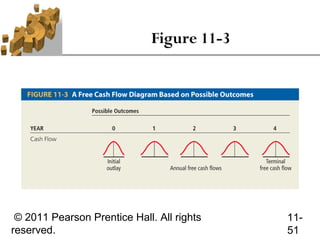
     Three components of free cash flows:
        The Initial outlay
        The differential flows over the project’s life
        The Terminal cash flow


 © 2011 Pearson Prentice Hall. All rights             11-
reserved.                                             17
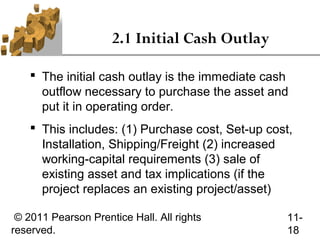
2.1 Initial Cash Outlay

     The initial cash outlay is the immediate cash
      outflow necessary to purchase the asset and
      put it in operating order.
     This includes: (1) Purchase cost, Set-up cost,
      Installation, Shipping/Freight (2) increased
      working-capital requirements (3) sale of
      existing asset and tax implications (if the
      project replaces an existing project/asset)

 © 2011 Pearson Prentice Hall. All rights          11-
reserved.                                          18
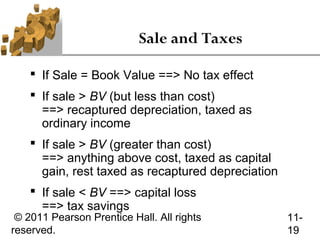
Sale and Taxes

     If Sale = Book Value ==> No tax effect
     If sale > BV (but less than cost)
      ==> recaptured depreciation, taxed as
      ordinary income
     If sale > BV (greater than cost)
      ==> anything above cost, taxed as capital
      gain, rest taxed as recaptured depreciation
     If sale < BV ==> capital loss
      ==> tax savings
 © 2011 Pearson Prentice Hall. All rights           11-
reserved.                                           19
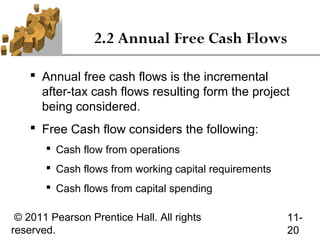
2.2 Annual Free Cash Flows

     Annual free cash flows is the incremental
      after-tax cash flows resulting form the project
      being considered.
     Free Cash flow considers the following:
        Cash flow from operations
        Cash flows from working capital requirements
        Cash flows from capital spending

 © 2011 Pearson Prentice Hall. All rights               11-
reserved.                                               20
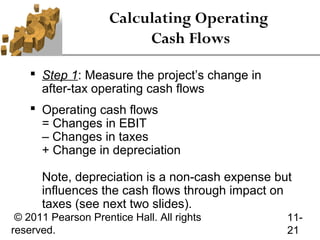
Calculating Operating
                          Cash Flows

     Step 1: Measure the project’s change in
      after-tax operating cash flows
     Operating cash flows
      = Changes in EBIT
      – Changes in taxes
      + Change in depreciation

      Note, depreciation is a non-cash expense but
      influences the cash flows through impact on
      taxes (see next two slides).
 © 2011 Pearson Prentice Hall. All rights        11-
reserved.                                        21
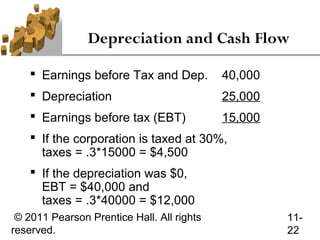
Depreciation and Cash Flow

     Earnings before Tax and Dep.          40,000
     Depreciation                          25,000
     Earnings before tax (EBT)             15,000
     If the corporation is taxed at 30%,
      taxes = .3*15000 = $4,500
     If the depreciation was $0,
      EBT = $40,000 and
      taxes = .3*40000 = $12,000
 © 2011 Pearson Prentice Hall. All rights            11-
reserved.                                            22
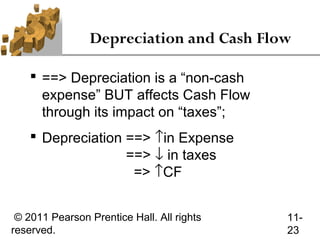
Depreciation and Cash Flow

     ==> Depreciation is a “non-cash
      expense” BUT affects Cash Flow
      through its impact on “taxes”;
     Depreciation ==> ↑in Expense
                   ==> ↓ in taxes
                    => ↑CF


 © 2011 Pearson Prentice Hall. All rights   11-
reserved.                                   23
Change in Net
                         Working Capital

     Step 2: Calculate the cash flows from
      the change in net working capital

      This refers to additional investment in
      current assets minus any additional
      short-term liabilities that were
      generated.

 © 2011 Pearson Prentice Hall. All rights       11-
reserved.                                       24
Steps in Calculating Operating
                         Cash Flows

     Step 3: Determine the cash flows from
      the change in capital spending

      This refers to any capital spending
      requirements during the life of the
      project.


 © 2011 Pearson Prentice Hall. All rights     11-
reserved.                                     25
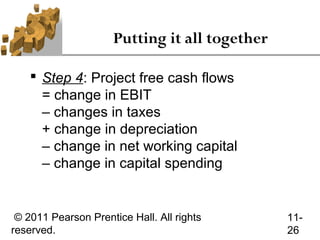
Putting it all together

     Step 4: Project free cash flows
      = change in EBIT
      – changes in taxes
      + change in depreciation
      – change in net working capital
      – change in capital spending


 © 2011 Pearson Prentice Hall. All rights       11-
reserved.                                       26
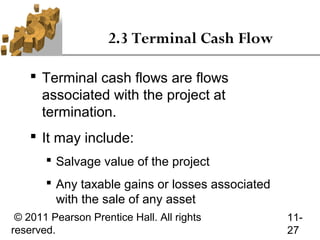
2.3 Terminal Cash Flow

     Terminal cash flows are flows
      associated with the project at
      termination.
     It may include:
        Salvage value of the project
        Any taxable gains or losses associated
         with the sale of any asset
 © 2011 Pearson Prentice Hall. All rights         11-
reserved.                                         27
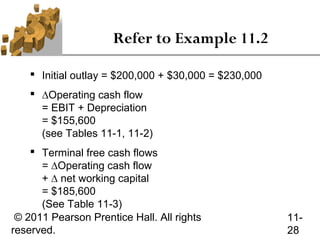
Refer to Example 11.2

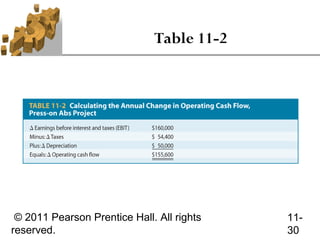
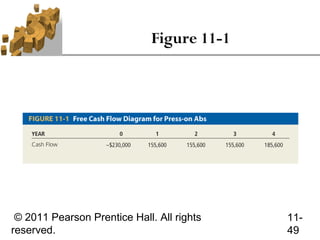
     Initial outlay = $200,000 + $30,000 = $230,000
     ∆Operating cash flow
      = EBIT + Depreciation
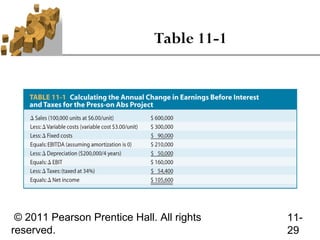
      = $155,600
      (see Tables 11-1, 11-2)
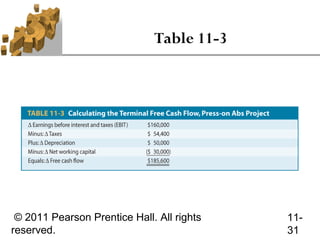
     Terminal free cash flows
      = ∆Operating cash flow
      + ∆ net working capital
      = $185,600
      (See Table 11-3)
 © 2011 Pearson Prentice Hall. All rights              11-
reserved.                                              28
Table 11-1


 © 2011 Pearson Prentice Hall. All rights   11-
reserved.                                   29
Table 11-2


 © 2011 Pearson Prentice Hall. All rights   11-
reserved.                                   30
Table 11-3


 © 2011 Pearson Prentice Hall. All rights   11-
reserved.                                   31
3. Options in
                        Capital Budgeting

     Options add value to capital budgeting
      project by being able to modify the
      project based on future developments
      (that are currently unknown). Some
      common options are:
        Option to delay a project
        Option to expand a project
        Option to abandon a project
 © 2011 Pearson Prentice Hall. All rights      11-
reserved.                                      32
Option to Delay

     Almost every project has a mutually exclusive
      alternative—waiting and pursuing at a later
      time.
     It is conceivable that a project with a negative
      NPV now may have a positive NPV if
      undertaken later on. This could be due to
      various reasons such as favorable changes in
      fashion, technology, economy, or borrowing
      costs.

 © 2011 Pearson Prentice Hall. All rights           11-
reserved.                                           33
Option to Expand

     Even if a project is currently
      unprofitable, it may be useful to
      determine whether the profitability of the
      project will change if the company is
      able to expand in the future.
     Example: Firms investing in negative
      NPV projects to gain access to new
      markets
 © 2011 Pearson Prentice Hall. All rights     11-
reserved.                                     34
Option to Abandon

     It may be necessary to abandon the project
      before its estimated life due to inaccurate
      project analysis models or cash flow forecasts
      or due to changes in market conditions.
     When comparing two projects with similar
      NPVs, project that is easier to abandon may
      be more desirable (example, temporary
      versus permanent workers, lease versus buy)

 © 2011 Pearson Prentice Hall. All rights         11-
reserved.                                         35
4. Risk and the
                      Investment Decision

    Two main issues:
       What is risk and how should it be
        measured?
       How should risk be incorporated into a
        capital budgeting analysis?


 © 2011 Pearson Prentice Hall. All rights    11-
reserved.                                    36
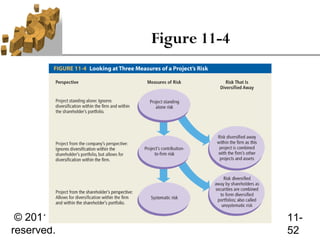
Three Perspectives on Risk

     Project standing alone risk
     Project’s contribution-to-firm risk
     Systematic risk


 © 2011 Pearson Prentice Hall. All rights     11-
reserved.                                     37
Project Standing Alone Risk

     This is a project’s risk ignoring the fact
      that much of the risk will be diversified
      away as the project is combined with
      other projects and assets.
     This is an inappropriate measure of risk
      for capital budgeting projects.


 © 2011 Pearson Prentice Hall. All rights          11-
reserved.                                          38
Contribution-to-Firm Risk

     This is the amount of risk that the project
      contributes to the firm as a whole;
     This measure considers the fact that some of
      the project’s risk will be diversified away as
      the project is combined with the firm’s other
      projects and assets but ignores the effects of
      diversification of the firm’s shareholders.


 © 2011 Pearson Prentice Hall. All rights           11-
reserved.                                           39
Systematic Risk

     Risk of the project from the viewpoint of a
      well-diversified shareholder;
     This measure takes into account that some of
      the risk will be diversified away as the project
      is combined with the firm’s other projects and
      in addition, some of the remaining risk will be
      diversified away by the shareholders as they
      combine this stock with other stocks in their
      portfolios.

 © 2011 Pearson Prentice Hall. All rights           11-
reserved.                                           40
Relevant risk

     Theoretically, the only risk of concern to
      shareholders is systematic risk.
     Since the project’s contribution-to-firm
      risk affects the probability of bankruptcy
      for the firm, it is a relevant risk measure.
     Thus we need to consider both the
      project’s contribution-to-firm risk and the
      project’s systematic risk.
 © 2011 Pearson Prentice Hall. All rights       11-
reserved.                                       41
Incorporating Risk into Capital
                       Budgeting

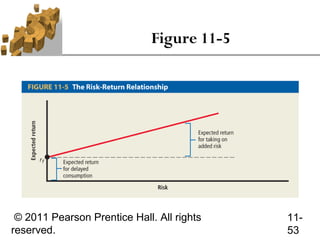
     We know that investors demand higher
      returns for more risky projects.
     As the risk of a project increases, the required
      rate of return is adjusted upward to
      compensate for the added risk.
     This risk adjusted discount rate is then
      used for discounting free cash flows (in NPV
      model) or as the benchmark required rate of
      return (in IRR model)
 © 2011 Pearson Prentice Hall. All rights            11-
reserved.                                            42
5. Measurement of Systematic
                          Risk

     Estimating risk of a project can be difficult
      Historical stock return data relates to an
      entire firm, rather than a specific project or
      division. Risk must be estimated. Options to
      estimate risk include:
        Accounting Beta
        Pure Play Method
        Simulation
        Scenario Analysis
        Sensitivity Analysis
 © 2011 Pearson Prentice Hall. All rights              11-
reserved.                                              43
Beta

    Accounting Beta Method
        Can be estimated via time-series
         regression on a division’s return on assets
         on the market index
    Pure Play Method
       Identifies publicly traded firms engaged
        solely in the same business as the project,
        using that firm’s return data to judge the
        project.
© 2011 Pearson Prentice Hall. All rights           11-
reserved.                                          44
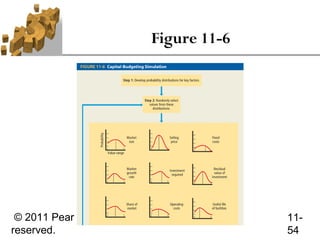
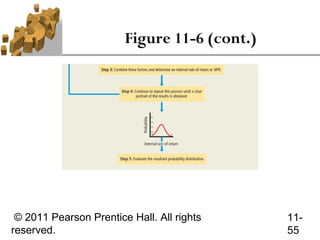
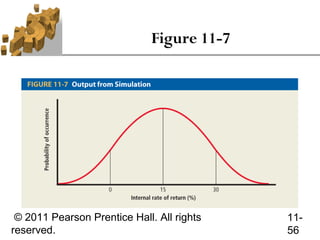
Simulation

     Involves the process of imitating the
      performance of the project under
      evaluation (See Figure 11-6)
        Done by randomly selecting observations
         from each of the distributions that affect the
         outcome of the project and continuing with
         this process until a representative record of
         the project’s probable outcome is
         assembled.
 © 2011 Pearson Prentice Hall. All rights            11-
reserved.                                            45
Scenario Analysis

     Identifies the range of possible
      outcomes under the worst, best, and
      most likely cases.


 © 2011 Pearson Prentice Hall. All rights    11-
reserved.                                    46
Sensitivity Analysis

     Determining how the distribution of
      possible net present values or internal
      rate of return for a particular project is
      affected by a change in one particular
      input variable while holding all other
      input variables constant (also known as
      what-if analysis).

 © 2011 Pearson Prentice Hall. All rights      11-
reserved.                                      47
6. The Multinational Firm

     Process of measuring the incremental
      after-tax cash flows to the company as a
      whole gets more difficult when dealing with
      competition from abroad.
        Calculating the right base case (i.e. incremental
         cash flows if project not taken) is difficult
        International opportunities come with risks such as
         currency fluctuations that can distort cash flow
         projections.
 © 2011 Pearson Prentice Hall. All rights                    11-
reserved.                                                    48
Figure 11-1


 © 2011 Pearson Prentice Hall. All rights   11-
reserved.                                   49
Figure 11-2


 © 2011 Pearson Prentice Hall. All rights   11-
reserved.                                   50
Figure 11-3


 © 2011 Pearson Prentice Hall. All rights   11-
reserved.                                   51
Figure 11-4


 © 2011 Pearson Prentice Hall. All rights   11-
reserved.                                   52
Figure 11-5


 © 2011 Pearson Prentice Hall. All rights   11-
reserved.                                   53
Figure 11-6


 © 2011 Pearson Prentice Hall. All rights   11-
reserved.                                   54
Figure 11-6 (cont.)


 © 2011 Pearson Prentice Hall. All rights     11-
reserved.                                     55
Figure 11-7


 © 2011 Pearson Prentice Hall. All rights   11-
reserved.                                   56
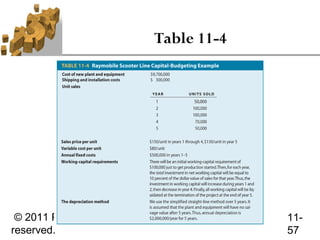
Table 11-4


 © 2011 Pearson Prentice Hall. All rights   11-
reserved.                                   57
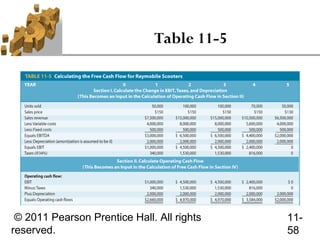
Table 11-5


 © 2011 Pearson Prentice Hall. All rights   11-
reserved.                                   58
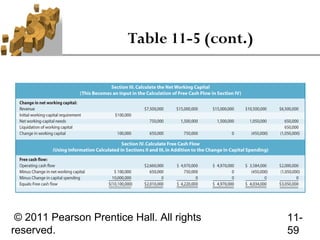
Table 11-5 (cont.)


 © 2011 Pearson Prentice Hall. All rights     11-
reserved.                                     59
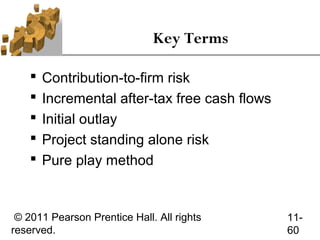
Key Terms

       Contribution-to-firm risk
       Incremental after-tax free cash flows
       Initial outlay
       Project standing alone risk
       Pure play method


 © 2011 Pearson Prentice Hall. All rights       11-
reserved.                                       60
Key Terms

       Risk-adjusted discount rate
       Scenario analysis
       Sensitivity analysis
       Simulation
       Systematic risk


 © 2011 Pearson Prentice Hall. All rights   11-
reserved.                                   61

10. cash flow in capital budgeting

  • 1.
    Chapter 11 Cash Flowsand Other Topics in Capital Budgeting Copyright © 2011 Pearson Prentice Hall. All rights reserved.
  • 2.
    Learning Objectives 1. Identify guidelines by which we measure cash flows. 2. Explain how a project’s benefits and costs – that is, its free cash flows –are calculated. 3. Explain the importance of options or flexibility in capital budgeting. 4. Explain what the appropriate measure of risk is for capital-budgeting purposes. © 2011 Pearson Prentice Hall. All rights reserved. 11-2
  • 3.
    Learning Objectives 5. Determine the acceptability of a new project using the risk-adjusted discount method of adjusting for risk. 6. Explain the use of simulating for imitating the performance of a project under evaluation. 7. Explain why a multinational firm faces a more difficult time estimating cash flows along with increased risks. © 2011 Pearson Prentice Hall. All rights reserved. 11-3
  • 4.
    Slide Contents  Guidelines for Capital Budgeting  Free Cash Flow calculations  Options in Capital Budgeting  Risk and the Investment Decision  Measurement of Systematic Risk  The Multinational Firm © 2011 Pearson Prentice Hall. All rights reserved. 11-4
  • 5.
    1. Guidelines for Capital Budgeting  To evaluate investment proposals, we must first set guidelines by which we measure the value of each proposal.  In effect, we are deciding what is and what isn’t relevant cash flow. © 2011 Pearson Prentice Hall. All rights reserved. 11-5
  • 6.
    Guidelines for Capital Budgeting 1. Use free cash flows, not accounting profits 2. Think Incrementally 3. Beware of cash flows diverted from existing products 4. Look for incidental or synergistic effects 5. Work in working-capital requirements © 2011 Pearson Prentice Hall. All rights reserved. 11-6
  • 7.
    Guidelines for Capital Budgeting 6. Consider incremental expenses 7. Sunk costs are not incremental cash flows 8. Account for opportunity costs 9. Decide if overhead costs are truly incremental cash flows 10. Ignore interest payments and financing flows © 2011 Pearson Prentice Hall. All rights reserved. 11-7
  • 8.
    Use Free CashFlows  Free cash flow accurately reflects the timing of benefits and costs—when money is received, when it can be reinvested, and when it must be paid out.  Accounting profits do not reflect actual money in hand. © 2011 Pearson Prentice Hall. All rights reserved. 11-8
  • 9.
    Incremental Cash Flows  After-tax free cash flows must be measured incrementally.  Determining incremental free cash flow involves determining the cash flows with and without the project. Incremental is the “additional cash flows” (inflows or outflows) that occur due to the project. © 2011 Pearson Prentice Hall. All rights reserved. 11-9
  • 10.
    Beware of Diverted Cash Flows  Not all incremental free cash flow is relevant.  Thus new product sales achieved at the cost of losing sales from existing product line are not considered a benefit.  However, if the new product captures sales from competitors or prevents loss of sales to new competing products, it would be a relevant incremental free cash flows. © 2011 Pearson Prentice Hall. All rights 11- reserved. 10
  • 11.
    Incidental or Synergistic Effects  Although some projects may take sales away from a firm’s current projects, in other cases new products may add sales to the existing line. This is called synergistic effect and is a relevant cash flow. © 2011 Pearson Prentice Hall. All rights 11- reserved. 11
  • 12.
    Working Capital Requirement  New projects require infusion of working capital (such as inventory to stock the shelves), which would be an outflow.  Generally, when the project terminates, working capital is recovered and there is an inflow of working capital. © 2011 Pearson Prentice Hall. All rights 11- reserved. 12
  • 13.
    Sunk Costs  Sunk costs are cash flows that have already occurred (such as marketing research) and cannot be undone. Sunk costs are considered irrelevant to decision making.  Managers need to ask two basic questions:  Will this cash flow occur if the project is accepted?  Will this cash flow occur if the project is rejected?  If the answer is “Yes” to #1 and “No” to #2, it will be an incremental cash flow. © 2011 Pearson Prentice Hall. All rights 11- reserved. 13
  • 14.
    Opportunity Costs  Opportunity cost refers to cash flows that are lost because of accepting the current project.  For example, using the building space for the project will mean loss of potential rental revenue. © 2011 Pearson Prentice Hall. All rights 11- reserved. 14
  • 15.
    Overhead Costs  Must include incremental overhead costs or costs that were incurred as a result of the project and relevant to capital budgeting  Note, not all overhead costs may be relevant (example, utilities bill may have been the same with or without the project) © 2011 Pearson Prentice Hall. All rights 11- reserved. 15
  • 16.
    Interest Payments andFinancing Costs  Interest payments and other financing cash flows that might result from raising funds to finance a project are not relevant cash flows.  Reason: Required rate of return implicitly accounts for the cost of raising funds to finance a new project. © 2011 Pearson Prentice Hall. All rights 11- reserved. 16
  • 17.
    2. Free CashFlow Calculations  Three components of free cash flows:  The Initial outlay  The differential flows over the project’s life  The Terminal cash flow © 2011 Pearson Prentice Hall. All rights 11- reserved. 17
  • 18.
    2.1 Initial CashOutlay  The initial cash outlay is the immediate cash outflow necessary to purchase the asset and put it in operating order.  This includes: (1) Purchase cost, Set-up cost, Installation, Shipping/Freight (2) increased working-capital requirements (3) sale of existing asset and tax implications (if the project replaces an existing project/asset) © 2011 Pearson Prentice Hall. All rights 11- reserved. 18
  • 19.
    Sale and Taxes  If Sale = Book Value ==> No tax effect  If sale > BV (but less than cost) ==> recaptured depreciation, taxed as ordinary income  If sale > BV (greater than cost) ==> anything above cost, taxed as capital gain, rest taxed as recaptured depreciation  If sale < BV ==> capital loss ==> tax savings © 2011 Pearson Prentice Hall. All rights 11- reserved. 19
  • 20.
    2.2 Annual FreeCash Flows  Annual free cash flows is the incremental after-tax cash flows resulting form the project being considered.  Free Cash flow considers the following:  Cash flow from operations  Cash flows from working capital requirements  Cash flows from capital spending © 2011 Pearson Prentice Hall. All rights 11- reserved. 20
  • 21.
    Calculating Operating Cash Flows  Step 1: Measure the project’s change in after-tax operating cash flows  Operating cash flows = Changes in EBIT – Changes in taxes + Change in depreciation Note, depreciation is a non-cash expense but influences the cash flows through impact on taxes (see next two slides). © 2011 Pearson Prentice Hall. All rights 11- reserved. 21
  • 22.
    Depreciation and CashFlow  Earnings before Tax and Dep. 40,000  Depreciation 25,000  Earnings before tax (EBT) 15,000  If the corporation is taxed at 30%, taxes = .3*15000 = $4,500  If the depreciation was $0, EBT = $40,000 and taxes = .3*40000 = $12,000 © 2011 Pearson Prentice Hall. All rights 11- reserved. 22
  • 23.
    Depreciation and CashFlow  ==> Depreciation is a “non-cash expense” BUT affects Cash Flow through its impact on “taxes”;  Depreciation ==> ↑in Expense ==> ↓ in taxes => ↑CF © 2011 Pearson Prentice Hall. All rights 11- reserved. 23
  • 24.
    Change in Net Working Capital  Step 2: Calculate the cash flows from the change in net working capital This refers to additional investment in current assets minus any additional short-term liabilities that were generated. © 2011 Pearson Prentice Hall. All rights 11- reserved. 24
  • 25.
    Steps in CalculatingOperating Cash Flows  Step 3: Determine the cash flows from the change in capital spending This refers to any capital spending requirements during the life of the project. © 2011 Pearson Prentice Hall. All rights 11- reserved. 25
  • 26.
    Putting it alltogether  Step 4: Project free cash flows = change in EBIT – changes in taxes + change in depreciation – change in net working capital – change in capital spending © 2011 Pearson Prentice Hall. All rights 11- reserved. 26
  • 27.
    2.3 Terminal CashFlow  Terminal cash flows are flows associated with the project at termination.  It may include:  Salvage value of the project  Any taxable gains or losses associated with the sale of any asset © 2011 Pearson Prentice Hall. All rights 11- reserved. 27
  • 28.
    Refer to Example11.2  Initial outlay = $200,000 + $30,000 = $230,000  ∆Operating cash flow = EBIT + Depreciation = $155,600 (see Tables 11-1, 11-2)  Terminal free cash flows = ∆Operating cash flow + ∆ net working capital = $185,600 (See Table 11-3) © 2011 Pearson Prentice Hall. All rights 11- reserved. 28
  • 29.
    Table 11-1 ©2011 Pearson Prentice Hall. All rights 11- reserved. 29
  • 30.
    Table 11-2 ©2011 Pearson Prentice Hall. All rights 11- reserved. 30
  • 31.
    Table 11-3 ©2011 Pearson Prentice Hall. All rights 11- reserved. 31
  • 32.
    3. Options in Capital Budgeting  Options add value to capital budgeting project by being able to modify the project based on future developments (that are currently unknown). Some common options are:  Option to delay a project  Option to expand a project  Option to abandon a project © 2011 Pearson Prentice Hall. All rights 11- reserved. 32
  • 33.
    Option to Delay  Almost every project has a mutually exclusive alternative—waiting and pursuing at a later time.  It is conceivable that a project with a negative NPV now may have a positive NPV if undertaken later on. This could be due to various reasons such as favorable changes in fashion, technology, economy, or borrowing costs. © 2011 Pearson Prentice Hall. All rights 11- reserved. 33
  • 34.
    Option to Expand  Even if a project is currently unprofitable, it may be useful to determine whether the profitability of the project will change if the company is able to expand in the future.  Example: Firms investing in negative NPV projects to gain access to new markets © 2011 Pearson Prentice Hall. All rights 11- reserved. 34
  • 35.
    Option to Abandon  It may be necessary to abandon the project before its estimated life due to inaccurate project analysis models or cash flow forecasts or due to changes in market conditions.  When comparing two projects with similar NPVs, project that is easier to abandon may be more desirable (example, temporary versus permanent workers, lease versus buy) © 2011 Pearson Prentice Hall. All rights 11- reserved. 35
  • 36.
    4. Risk andthe Investment Decision Two main issues:  What is risk and how should it be measured?  How should risk be incorporated into a capital budgeting analysis? © 2011 Pearson Prentice Hall. All rights 11- reserved. 36
  • 37.
    Three Perspectives onRisk  Project standing alone risk  Project’s contribution-to-firm risk  Systematic risk © 2011 Pearson Prentice Hall. All rights 11- reserved. 37
  • 38.
    Project Standing AloneRisk  This is a project’s risk ignoring the fact that much of the risk will be diversified away as the project is combined with other projects and assets.  This is an inappropriate measure of risk for capital budgeting projects. © 2011 Pearson Prentice Hall. All rights 11- reserved. 38
  • 39.
    Contribution-to-Firm Risk  This is the amount of risk that the project contributes to the firm as a whole;  This measure considers the fact that some of the project’s risk will be diversified away as the project is combined with the firm’s other projects and assets but ignores the effects of diversification of the firm’s shareholders. © 2011 Pearson Prentice Hall. All rights 11- reserved. 39
  • 40.
    Systematic Risk  Risk of the project from the viewpoint of a well-diversified shareholder;  This measure takes into account that some of the risk will be diversified away as the project is combined with the firm’s other projects and in addition, some of the remaining risk will be diversified away by the shareholders as they combine this stock with other stocks in their portfolios. © 2011 Pearson Prentice Hall. All rights 11- reserved. 40
  • 41.
    Relevant risk  Theoretically, the only risk of concern to shareholders is systematic risk.  Since the project’s contribution-to-firm risk affects the probability of bankruptcy for the firm, it is a relevant risk measure.  Thus we need to consider both the project’s contribution-to-firm risk and the project’s systematic risk. © 2011 Pearson Prentice Hall. All rights 11- reserved. 41
  • 42.
    Incorporating Risk intoCapital Budgeting  We know that investors demand higher returns for more risky projects.  As the risk of a project increases, the required rate of return is adjusted upward to compensate for the added risk.  This risk adjusted discount rate is then used for discounting free cash flows (in NPV model) or as the benchmark required rate of return (in IRR model) © 2011 Pearson Prentice Hall. All rights 11- reserved. 42
  • 43.
    5. Measurement ofSystematic Risk  Estimating risk of a project can be difficult Historical stock return data relates to an entire firm, rather than a specific project or division. Risk must be estimated. Options to estimate risk include:  Accounting Beta  Pure Play Method  Simulation  Scenario Analysis  Sensitivity Analysis © 2011 Pearson Prentice Hall. All rights 11- reserved. 43
  • 44.
    Beta  Accounting Beta Method  Can be estimated via time-series regression on a division’s return on assets on the market index  Pure Play Method  Identifies publicly traded firms engaged solely in the same business as the project, using that firm’s return data to judge the project. © 2011 Pearson Prentice Hall. All rights 11- reserved. 44
  • 45.
    Simulation  Involves the process of imitating the performance of the project under evaluation (See Figure 11-6)  Done by randomly selecting observations from each of the distributions that affect the outcome of the project and continuing with this process until a representative record of the project’s probable outcome is assembled. © 2011 Pearson Prentice Hall. All rights 11- reserved. 45
  • 46.
    Scenario Analysis  Identifies the range of possible outcomes under the worst, best, and most likely cases. © 2011 Pearson Prentice Hall. All rights 11- reserved. 46
  • 47.
    Sensitivity Analysis  Determining how the distribution of possible net present values or internal rate of return for a particular project is affected by a change in one particular input variable while holding all other input variables constant (also known as what-if analysis). © 2011 Pearson Prentice Hall. All rights 11- reserved. 47
  • 48.
    6. The MultinationalFirm  Process of measuring the incremental after-tax cash flows to the company as a whole gets more difficult when dealing with competition from abroad.  Calculating the right base case (i.e. incremental cash flows if project not taken) is difficult  International opportunities come with risks such as currency fluctuations that can distort cash flow projections. © 2011 Pearson Prentice Hall. All rights 11- reserved. 48
  • 49.
    Figure 11-1 ©2011 Pearson Prentice Hall. All rights 11- reserved. 49
  • 50.
    Figure 11-2 ©2011 Pearson Prentice Hall. All rights 11- reserved. 50
  • 51.
    Figure 11-3 ©2011 Pearson Prentice Hall. All rights 11- reserved. 51
  • 52.
    Figure 11-4 ©2011 Pearson Prentice Hall. All rights 11- reserved. 52
  • 53.
    Figure 11-5 ©2011 Pearson Prentice Hall. All rights 11- reserved. 53
  • 54.
    Figure 11-6 ©2011 Pearson Prentice Hall. All rights 11- reserved. 54
  • 55.
    Figure 11-6 (cont.) © 2011 Pearson Prentice Hall. All rights 11- reserved. 55
  • 56.
    Figure 11-7 ©2011 Pearson Prentice Hall. All rights 11- reserved. 56
  • 57.
    Table 11-4 ©2011 Pearson Prentice Hall. All rights 11- reserved. 57
  • 58.
    Table 11-5 ©2011 Pearson Prentice Hall. All rights 11- reserved. 58
  • 59.
    Table 11-5 (cont.) © 2011 Pearson Prentice Hall. All rights 11- reserved. 59
  • 60.
    Key Terms  Contribution-to-firm risk  Incremental after-tax free cash flows  Initial outlay  Project standing alone risk  Pure play method © 2011 Pearson Prentice Hall. All rights 11- reserved. 60
  • 61.
    Key Terms  Risk-adjusted discount rate  Scenario analysis  Sensitivity analysis  Simulation  Systematic risk © 2011 Pearson Prentice Hall. All rights 11- reserved. 61