Cryptography
Fundamental
Nguyen Ngo, Ninh Dang
Agenda
Introduction
  Background
 • What ‘s Cryptography?
 • Purpose of Cryptography
Methodology
 • Key Definition
 • Cryptography Methods
 • Symmetric Encryption
        • Stream Cipher
        • Block Cipher
        • Mod of Operator
        • Padding Scheme
        • Code Example
 • Asymmetric Encryption
 • Hashing
Practical
  Key Exchange
  Digital Signature
INTRODUCTION
Background
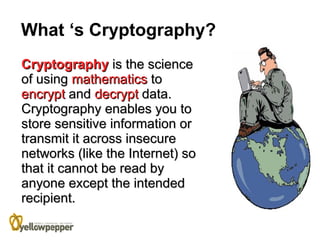
What ‘s Cryptography?
Cryptography is the science
of using mathematics to
encrypt and decrypt data.
Cryptography enables you to
store sensitive information or
transmit it across insecure
networks (like the Internet) so
that it cannot be read by
anyone except the intended
recipient.
The Purpose of Cryptography
•   Authentication: this process to prove the identity of an entity can be
    based on something you know, such as a password; something you
    have, such as an encryption key or card; something you are, such as
    biometric measurements
•    Privacy/Confidentiality: information is NOT made available or
    disclosed to unauthorized individuals, entities, or processes
•    Integrity: This property refers to data that has NOT been changed,
    destroyed, or lost in an unauthorized or accidental manner.
•    Non-repudiation: Repudiation is the denial by one of the entities
    involved in a communication of having participated in all or part of the
    communication  Non-repudiation
    Authentication    : Xác thực người dùng
    Confidentiality   : Bảo mật thông tin
    Integrity       : Toàn vẹn dữ liệu
    Non-Repudiation : Chống lại sự thoái thác trách nhiệm
Key Definition
•Plaintext.   •Encryption.   •Key.
•Ciphertext   •Decryption.   •Key space.
METHODOLOGY
Cryptography Methods
• Symmetric
   Same key for encryption and decryption
   Key distribution problem
• Asymmetric
   Mathematically related key pairs for
   encryption and decryption
  Public and private keys
 Symmetric: Mã hóa đối xứng
 Asymetric : Mã hóa bất đối xứng
Symmetric Encryption


               

                       
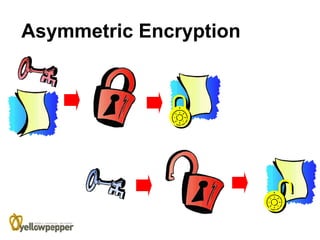
Asymmetric Encryption


             

                        
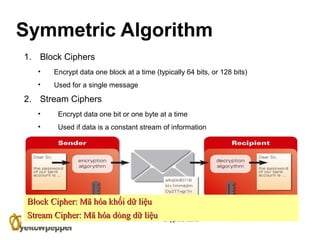
Symmetric Algorithm
1. Block Ciphers
   •   Encrypt data one block at a time (typically 64 bits, or 128 bits)
   •   Used for a single message

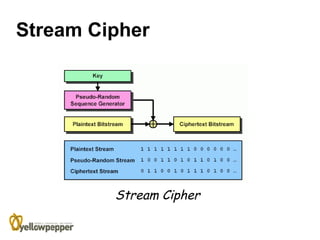
2. Stream Ciphers
   •     Encrypt data one bit or one byte at a time
   •     Used if data is a constant stream of information


 Block Cipher: Mã hóa khối dữ liệu
 Stream Cipher: Mã hóa dòng dữ liệu
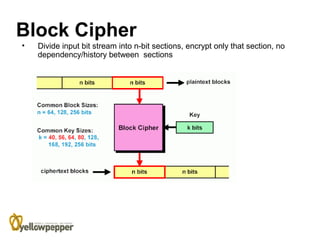
Block Cipher
•   Divide input bit stream into n-bit sections, encrypt only that section, no
    dependency/history between sections
Stream Cipher


         Stream Cipher
Mod of Operation
Modes of operation is the procedure of enabling the repeated
  and secure use of a block cipher under a single key
Mod of Operation Type:
• CBC (Cipher Block Chaining).
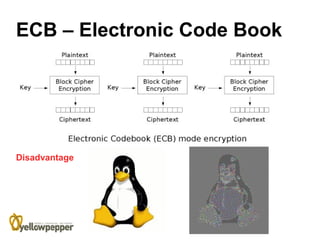
• ECB (Electronic Code Book).
• Propagating cipher-block chaining (PCBC)
• Cipher feedback (CFB)
• Output feedback (OFB)
• Counter (CTR)
ECB – Electronic Code Book


Disadvantage
CBC-Cipher Block Chaining



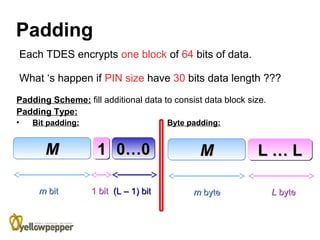
Padding
    Each TDES encrypts one block of 64 bits of data.

    What ‘s happen if PIN size have 30 bits data length ???
Padding Scheme: fill additional data to consist data block size.
Padding Type:
•     Bit padding:                       Byte padding:


         M            1 0…0                      M           L…L

        m bit        1 bit (L – 1) bit         m byte              L byte
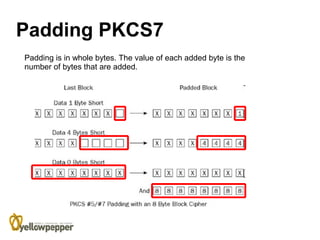
Padding PKCS7
Padding is in whole bytes. The value of each added byte is the
number of bytes that are added.
Code Example
TDES ENCRYPTION:
public string SimpleTripleDes(string Data)
{
        byte[] key = Encoding.ASCII.GetBytes("passwordDR0wSS@P6660juht");
        byte[] iv   = Encoding.ASCII.GetBytes("password");
        byte[] data = Encoding.ASCII.GetBytes(Data);
        byte[] enc = new byte[0];

        TripleDES tdes = TripleDES.Create();
        tdes.IV = iv;
        tdes.Key = key;
        tdes.Mode = CipherMode.CBC;
        tdes.Padding = PaddingMode.PKCS7;


        ICryptoTransform ict = tdes.CreateEncryptor();
        enc = ict.TransformFinalBlock(data, 0, data.Length);
        return ByteArrayToString(enc);
}
Code Example
AES ENCRYPTION:
public static string EncryptData( byte[] plainText , byte[] keyBytes )

{

     RijndaelManaged rijndaelCipher = new RijndaelManaged();

     rijndaelCipher.Mode = CipherMode.CBC;

     rijndaelCipher.Padding = PaddingMode.PKCS7;

     rijndaelCipher.KeySize = 128;

     rijndaelCipher.BlockSize = 128;

     rijndaelCipher.Key = keyBytes;

     rijndaelCipher.IV = keyBytes;

     ICryptoTransform transform = rijndaelCipher.CreateEncryptor();

     byte[] cipherBytes = transform.TransformFinalBlock(plainText, 0, plainText.Length);

     return Convert.ToBase64String(cipherBytes);

}
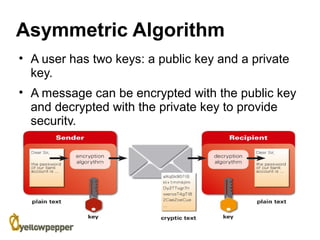
Asymmetric Algorithm
• A user has two keys: a public key and a private
  key.
• A message can be encrypted with the public key
  and decrypted with the private key to provide
  security.
RSA


  In RSA, e and n are announced to the
     public; d and Φ are kept secret.
Strengths of RSA
Example RSA


      Source Code
Hashing
• Hashing is an irreversible process with
no keys, the clear message is the only
input for the hashing process

• Its role is to
ensure the integrity
of a message
Hashing
Code Example
MD5 ENCRYPTION:
public string CalculateMD5Hash(string input) {

    // step 1, calculate MD5 hash from input
     MD5 md5 = System.Security.Cryptography.MD5.Create();
     byte[] inputBytes = System.Text.Encoding.ASCII.GetBytes(input);
     byte[] hash = md5.ComputeHash(inputBytes);

    // step 2, convert byte array to hex string
    StringBuilder sb = new StringBuilder();
    for (int i = 0; i < hash.Length; i++) {
      sb.Append(hash[i].ToString("X2"));
    }
    return sb.ToString();
}
PRACTICAL
Key Exchange
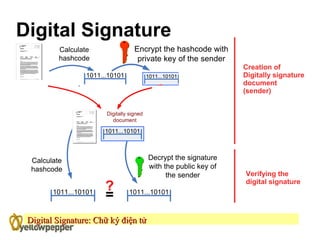
Digital Signature
                                     Creation of
                                     Digitally signature
                                     document
                                     (sender)


                                     Verifying the
                                     digital signature


 Digital Signature: Chữ ký điện tử
THANK YOU

Cryptography Fundamentals

  • 1.
  • 2.
    Agenda Introduction  Background • What ‘s Cryptography? • Purpose of Cryptography Methodology • Key Definition • Cryptography Methods • Symmetric Encryption • Stream Cipher • Block Cipher • Mod of Operator • Padding Scheme • Code Example • Asymmetric Encryption • Hashing Practical  Key Exchange  Digital Signature
  • 3.
  • 4.
  • 5.
    What ‘s Cryptography? Cryptographyis the science of using mathematics to encrypt and decrypt data. Cryptography enables you to store sensitive information or transmit it across insecure networks (like the Internet) so that it cannot be read by anyone except the intended recipient.
  • 6.
    The Purpose ofCryptography • Authentication: this process to prove the identity of an entity can be based on something you know, such as a password; something you have, such as an encryption key or card; something you are, such as biometric measurements • Privacy/Confidentiality: information is NOT made available or disclosed to unauthorized individuals, entities, or processes • Integrity: This property refers to data that has NOT been changed, destroyed, or lost in an unauthorized or accidental manner. • Non-repudiation: Repudiation is the denial by one of the entities involved in a communication of having participated in all or part of the communication  Non-repudiation Authentication : Xác thực người dùng Confidentiality : Bảo mật thông tin Integrity : Toàn vẹn dữ liệu Non-Repudiation : Chống lại sự thoái thác trách nhiệm
  • 7.
    Key Definition •Plaintext. •Encryption. •Key. •Ciphertext •Decryption. •Key space.
  • 8.
  • 9.
    Cryptography Methods • Symmetric  Same key for encryption and decryption  Key distribution problem • Asymmetric  Mathematically related key pairs for encryption and decryption Public and private keys Symmetric: Mã hóa đối xứng Asymetric : Mã hóa bất đối xứng
  • 10.
  • 11.
  • 12.
    Symmetric Algorithm 1. BlockCiphers • Encrypt data one block at a time (typically 64 bits, or 128 bits) • Used for a single message 2. Stream Ciphers • Encrypt data one bit or one byte at a time • Used if data is a constant stream of information Block Cipher: Mã hóa khối dữ liệu Stream Cipher: Mã hóa dòng dữ liệu
  • 13.
    Block Cipher • Divide input bit stream into n-bit sections, encrypt only that section, no dependency/history between sections
  • 14.
    Stream Cipher Stream Cipher
  • 15.
    Mod of Operation Modesof operation is the procedure of enabling the repeated and secure use of a block cipher under a single key Mod of Operation Type: • CBC (Cipher Block Chaining). • ECB (Electronic Code Book). • Propagating cipher-block chaining (PCBC) • Cipher feedback (CFB) • Output feedback (OFB) • Counter (CTR)
  • 16.
    ECB – ElectronicCode Book Disadvantage
  • 17.
  • 18.
    Padding Each TDES encrypts one block of 64 bits of data. What ‘s happen if PIN size have 30 bits data length ??? Padding Scheme: fill additional data to consist data block size. Padding Type: • Bit padding: Byte padding: M 1 0…0 M L…L m bit 1 bit (L – 1) bit m byte L byte
  • 19.
    Padding PKCS7 Padding isin whole bytes. The value of each added byte is the number of bytes that are added.
  • 20.
    Code Example TDES ENCRYPTION: publicstring SimpleTripleDes(string Data) {         byte[] key = Encoding.ASCII.GetBytes("passwordDR0wSS@P6660juht");         byte[] iv = Encoding.ASCII.GetBytes("password");         byte[] data = Encoding.ASCII.GetBytes(Data);         byte[] enc = new byte[0];         TripleDES tdes = TripleDES.Create();         tdes.IV = iv;         tdes.Key = key;         tdes.Mode = CipherMode.CBC;         tdes.Padding = PaddingMode.PKCS7;         ICryptoTransform ict = tdes.CreateEncryptor();         enc = ict.TransformFinalBlock(data, 0, data.Length);         return ByteArrayToString(enc); }
  • 21.
    Code Example AES ENCRYPTION: publicstatic string EncryptData( byte[] plainText , byte[] keyBytes ) { RijndaelManaged rijndaelCipher = new RijndaelManaged(); rijndaelCipher.Mode = CipherMode.CBC; rijndaelCipher.Padding = PaddingMode.PKCS7; rijndaelCipher.KeySize = 128; rijndaelCipher.BlockSize = 128; rijndaelCipher.Key = keyBytes; rijndaelCipher.IV = keyBytes; ICryptoTransform transform = rijndaelCipher.CreateEncryptor(); byte[] cipherBytes = transform.TransformFinalBlock(plainText, 0, plainText.Length); return Convert.ToBase64String(cipherBytes); }
  • 22.
    Asymmetric Algorithm • Auser has two keys: a public key and a private key. • A message can be encrypted with the public key and decrypted with the private key to provide security.
  • 23.
    RSA InRSA, e and n are announced to the public; d and Φ are kept secret.
  • 24.
  • 25.
    Example RSA Source Code
  • 26.
    Hashing • Hashing isan irreversible process with no keys, the clear message is the only input for the hashing process • Its role is to ensure the integrity of a message
  • 27.
  • 28.
    Code Example MD5 ENCRYPTION: publicstring CalculateMD5Hash(string input) { // step 1, calculate MD5 hash from input MD5 md5 = System.Security.Cryptography.MD5.Create(); byte[] inputBytes = System.Text.Encoding.ASCII.GetBytes(input); byte[] hash = md5.ComputeHash(inputBytes); // step 2, convert byte array to hex string StringBuilder sb = new StringBuilder(); for (int i = 0; i < hash.Length; i++) { sb.Append(hash[i].ToString("X2")); } return sb.ToString(); }
  • 29.
  • 30.
  • 31.
    Digital Signature Creation of Digitally signature document (sender) Verifying the digital signature Digital Signature: Chữ ký điện tử
  • 32.

Editor's Notes