Network Security and Cryptography By Adam Reagan CIS 504 – Data Communications The College of Saint Rose, Albany NY Spring 2008
A Need For Security Growing computer use implies a need for automated tools for protecting files and other information The use of networks and communications facilities for carrying data between users and computers is also growing Network security measures are needed to protect data during transmission
TCP/IP Communications Security Traffic is typically secured by using  SSL  or  VPN Secure Sockets Layer Older and more widely used protocol Communicating applications have to be written to use SSL Applications do SSL processing Flexible Virtual Private Networks Security is implemented at the IP or Data Link Layer
Aspects of Security Attack   Mechanism Service
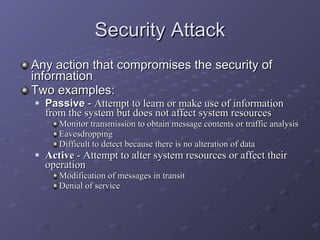
Security Attack Any action that compromises the security of information Two examples: Passive  -  Attempt to learn or make use of information from the system but does not affect system resources Monitor transmission to obtain message contents or traffic analysis Eavesdropping Difficult to detect because there is no alteration of data Active  - Attempt to alter system resources or affect their operation Modification of messages in transit Denial of service
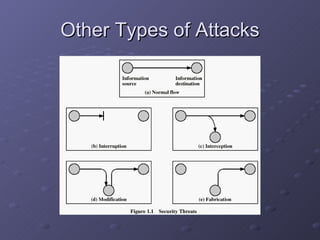
Other Types of Attacks
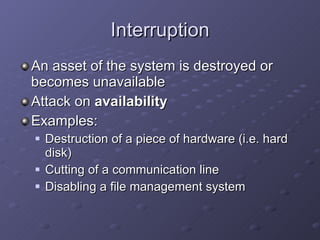
Interruption An asset of the system is destroyed or becomes unavailable Attack on  availability Examples: Destruction of a piece of hardware (i.e. hard disk) Cutting of a communication line Disabling a file management system
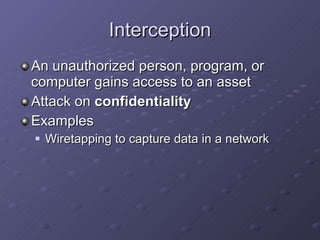
Interception An unauthorized person, program, or computer gains access to an asset Attack on  confidentiality Examples Wiretapping to capture data in a network
Modification An asset is intercepted AND tampered Attack on  integrity Examples: Changing values in a data file Altering a program to change performance Altering content of messages in transit
Fabrication An unauthorized party inserts counterfeit objects into a system Attack on  authenticity Example Addition of records to a data file
Security Mechanism Designed to detect, prevent, or recover from a security attack Most security mechanisms make use of  cryptographic techniques Encryption or encryption-like transformations of information are the most common means of providing security More to come…
Security Service Enhances the security of data processing systems and the information transfers of an organization Intended to counter security attacks Make use of one or more security mechanisms to provide the service
Examples of Services Confidentiality Information in a computer system and transmitted information are accessible only for reading by authorized parties Authentication Origin of a message or file is correctly identified, with assurance that the identity is not false Integrity Only authorized parties are able to modify computer system assets and transmitted information Availability Requires that computer system assets be available to authorized parties upon request
Conventional Encryption Encryption scheme consists of 5 main features: Plaintext  – Original message Encryption Algorithm  – Used to convert plaintext into ciphertext Key  – Information used to determine the functional output of algorithm Security depends on secrecy of the key, not secrecy of the algorithm Ciphertext  – Coded message Decryption Algorithm  – Used to recover plaintext from ciphertext
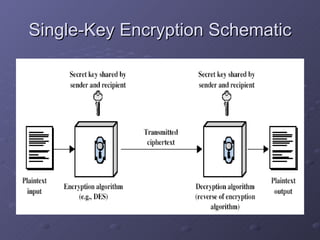
Conventional Encryption Techniques Symmetric , or  Single-Key  encryption Only one key is used to encrypt and decrypt messages Therefore, sender and receiver share the common key The key is kept private from everyone else
Single-Key Encryption Schematic
Substitution Ciphers Plaintext is replaced by different letters, numbers, or symbols If plaintext is  viewed as a sequence of bits, then substitution involves replacing plaintext bit patterns with ciphertext bit patterns
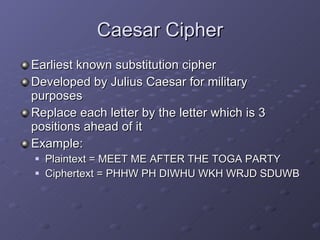
Caesar Cipher Earliest known substitution cipher Developed by Julius Caesar for military purposes Replace each letter by the letter which is 3 positions ahead of it Example: Plaintext = MEET ME AFTER THE TOGA PARTY Ciphertext = PHHW PH DIWHU WKH WRJD SDUWB
Transposition Cipher Permutation ciphers  Hide the message by rearranging the letter order WITHOUT altering the actual letters used More recognizable because frequency distribution is the same as the original text
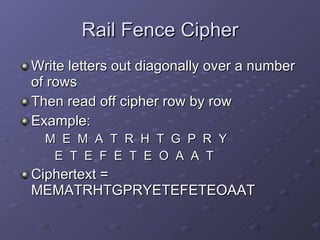
Rail Fence Cipher Write letters out diagonally over a number of rows Then read off cipher row by row Example: M  E  M  A  T  R  H  T  G  P  R  Y   E  T  E  F  E  T  E  O  A  A  T  Ciphertext = MEMATRHTGPRYETEFETEOAAT
Data Encryption Standard (DES) Selected as an official Federal Information Processing Standard (FIPS) for the U.S. in 1976 Block cipher (as opposed to a Stream cipher, where plaintext is processed on bit or byte at a time) Plaintext is processed in 64-bit blocks The algorithm used is called the Data Encryption Algorithm (DEA) Transforms 64-bit input in a series of steps into a 64-bit output The same steps are used to decrypt messages Sender and receiver share the same key (Symmetric) Now considered to be insecure Key size is 56 bits, considered to be too small
TDES and AES TDES Triple DES – Use algorithm 3 times 3 different keys (56-bits each) 168 bits total (192 if parity bits are included) Superceded by  AES AES Advanced Encryption Standard Fixed block size of 128 bits Key size can be 128, 192, or 256 bits
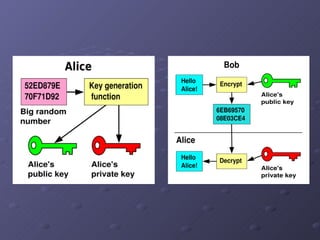
Public-Key Cryptography Asymmetric Cryptography Two keys are used for encryption and decryption of messages One is public, the other private Keys are related mathematically, but the private key cannot be practically derived from the public key A message encrypted with the public key can only be decrypted by using the private key
 
Number Theory Prime Numbers Basic building blocks of numbers An integer  p  > 1 is prime if its only divisors are  ± 1 and  ± p Occur at random intervals along the number line
Number Theory Relatively Prime Numbers Two integers are relatively prime if their only common factor is 1 If a and be are integers a and b are relatively prime if gcd(a, b) = 1 gcd = greatest common divisor Example: 8 and 15 are relatively prime because the divisors of 8 are 1, 2, 4, and 8.  The divisors of 15 are 1, 3, 5, and 15.  Therefore, 1 is the greatest common divisor
Euler Totient Function Φ (n) Returns the number of positive integers that are relatively prime to  n For a prime number  p Φ (p) = p – 1 Since all numbers less than  p  are relatively prime to  p
The RSA Algorithm Published by Ron Rivest, Adi Shamir, and Len Adleman in 1978 Best known and widely used public-key scheme Block cipher in which plaintext and ciphertext are integers between 0 and  n  – 1 for some  n
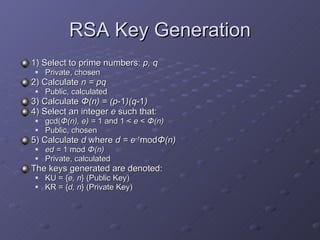
RSA Key Generation 1) Select to prime numbers:  p, q Private, chosen 2) Calculate  n = pq Public, calculated 3) Calculate  Φ (n) = (p -1 )(q -1 ) 4) Select an integer  e  such that: gcd( Φ (n), e) =  1 and 1 <  e  <  Φ (n)   Public, chosen 5) Calculate  d  where  d = e -1 mod Φ (n) ed =  1 mod  Φ (n)   Private, calculated The keys generated are denoted: KU = { e, n } (Public Key) KR = { d, n } (Private Key)
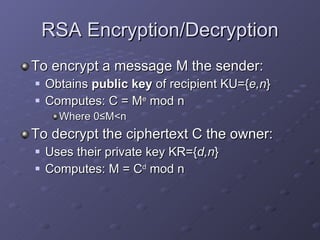
RSA Encryption/Decryption To encrypt a message M the sender: Obtains  public key  of recipient KU={ e,n }  Computes: C = M e  mod n Where 0 ≤ M < n To decrypt the ciphertext C the owner: Uses their private key KR={ d,n }  Computes: M = C d  mod n
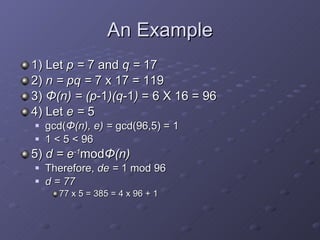
An Example 1) Let  p =  7 and  q =  17 2)  n = pq =  7 x 17 = 119 3)  Φ (n) = (p -1 )(q -1 )  = 6 X 16 = 96 4) Let  e =  5 gcd( Φ (n), e) =  gcd(96,5) =   1 1 < 5   < 96 5)  d = e -1 mod Φ (n) Therefore,  de =  1 mod 96 d = 77 77 x 5 = 385 = 4 x 96 + 1
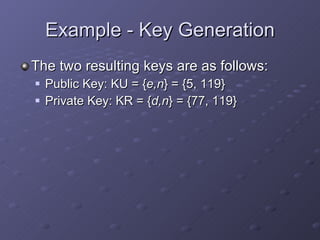
Example - Key Generation The two resulting keys are as follows: Public Key: KU = { e,n } = {5, 119} Private Key: KR = { d,n } = {77, 119}
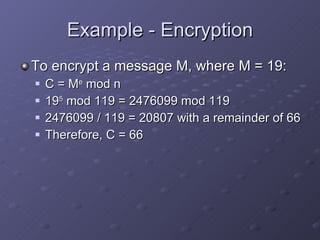
Example - Encryption To encrypt a message M, where M = 19: C = M e  mod n 19 5  mod 119 = 2476099 mod 119 2476099 / 119 = 20807 with a remainder of 66 Therefore, C = 66
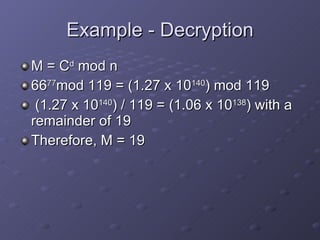
Example - Decryption M = C d  mod n 66 77 mod 119 = (1.27 x 10 140 ) mod 119 (1.27 x 10 140 ) / 119 = (1.06 x 10 138 ) with a remainder of 19 Therefore, M = 19
Summary Valuable information is constantly being exchanged between users A means to protect this information during transmission is critical Methods of security that were developed years ago are still being used (DES, RSA) The need for more complex encryption/decryption methods may be needed as advances in technology continue to flourish
Resources http://en.wikipedia.org/wiki/Data_Encryption_Standard http://en.wikipedia.org/wiki/Rsa http://www.redbooks.ibm.com/abstracts/sg246168.html Stallings, William.  Cryptography and Internet Security: Principles and Practice,  2e.  Upper Saddle River, NJ:  Prentice-Hall, 1999 Stallings, William.  Network Security Essentials: Applications and Standards, 3e.

Network Security and Cryptography

  • 1.
    Network Security andCryptography By Adam Reagan CIS 504 – Data Communications The College of Saint Rose, Albany NY Spring 2008
  • 2.
    A Need ForSecurity Growing computer use implies a need for automated tools for protecting files and other information The use of networks and communications facilities for carrying data between users and computers is also growing Network security measures are needed to protect data during transmission
  • 3.
    TCP/IP Communications SecurityTraffic is typically secured by using SSL or VPN Secure Sockets Layer Older and more widely used protocol Communicating applications have to be written to use SSL Applications do SSL processing Flexible Virtual Private Networks Security is implemented at the IP or Data Link Layer
  • 4.
    Aspects of SecurityAttack Mechanism Service
  • 5.
    Security Attack Anyaction that compromises the security of information Two examples: Passive - Attempt to learn or make use of information from the system but does not affect system resources Monitor transmission to obtain message contents or traffic analysis Eavesdropping Difficult to detect because there is no alteration of data Active - Attempt to alter system resources or affect their operation Modification of messages in transit Denial of service
  • 6.
  • 7.
    Interruption An assetof the system is destroyed or becomes unavailable Attack on availability Examples: Destruction of a piece of hardware (i.e. hard disk) Cutting of a communication line Disabling a file management system
  • 8.
    Interception An unauthorizedperson, program, or computer gains access to an asset Attack on confidentiality Examples Wiretapping to capture data in a network
  • 9.
    Modification An assetis intercepted AND tampered Attack on integrity Examples: Changing values in a data file Altering a program to change performance Altering content of messages in transit
  • 10.
    Fabrication An unauthorizedparty inserts counterfeit objects into a system Attack on authenticity Example Addition of records to a data file
  • 11.
    Security Mechanism Designedto detect, prevent, or recover from a security attack Most security mechanisms make use of cryptographic techniques Encryption or encryption-like transformations of information are the most common means of providing security More to come…
  • 12.
    Security Service Enhancesthe security of data processing systems and the information transfers of an organization Intended to counter security attacks Make use of one or more security mechanisms to provide the service
  • 13.
    Examples of ServicesConfidentiality Information in a computer system and transmitted information are accessible only for reading by authorized parties Authentication Origin of a message or file is correctly identified, with assurance that the identity is not false Integrity Only authorized parties are able to modify computer system assets and transmitted information Availability Requires that computer system assets be available to authorized parties upon request
  • 14.
    Conventional Encryption Encryptionscheme consists of 5 main features: Plaintext – Original message Encryption Algorithm – Used to convert plaintext into ciphertext Key – Information used to determine the functional output of algorithm Security depends on secrecy of the key, not secrecy of the algorithm Ciphertext – Coded message Decryption Algorithm – Used to recover plaintext from ciphertext
  • 15.
    Conventional Encryption TechniquesSymmetric , or Single-Key encryption Only one key is used to encrypt and decrypt messages Therefore, sender and receiver share the common key The key is kept private from everyone else
  • 16.
  • 17.
    Substitution Ciphers Plaintextis replaced by different letters, numbers, or symbols If plaintext is viewed as a sequence of bits, then substitution involves replacing plaintext bit patterns with ciphertext bit patterns
  • 18.
    Caesar Cipher Earliestknown substitution cipher Developed by Julius Caesar for military purposes Replace each letter by the letter which is 3 positions ahead of it Example: Plaintext = MEET ME AFTER THE TOGA PARTY Ciphertext = PHHW PH DIWHU WKH WRJD SDUWB
  • 19.
    Transposition Cipher Permutationciphers Hide the message by rearranging the letter order WITHOUT altering the actual letters used More recognizable because frequency distribution is the same as the original text
  • 20.
    Rail Fence CipherWrite letters out diagonally over a number of rows Then read off cipher row by row Example: M E M A T R H T G P R Y E T E F E T E O A A T Ciphertext = MEMATRHTGPRYETEFETEOAAT
  • 21.
    Data Encryption Standard(DES) Selected as an official Federal Information Processing Standard (FIPS) for the U.S. in 1976 Block cipher (as opposed to a Stream cipher, where plaintext is processed on bit or byte at a time) Plaintext is processed in 64-bit blocks The algorithm used is called the Data Encryption Algorithm (DEA) Transforms 64-bit input in a series of steps into a 64-bit output The same steps are used to decrypt messages Sender and receiver share the same key (Symmetric) Now considered to be insecure Key size is 56 bits, considered to be too small
  • 22.
    TDES and AESTDES Triple DES – Use algorithm 3 times 3 different keys (56-bits each) 168 bits total (192 if parity bits are included) Superceded by AES AES Advanced Encryption Standard Fixed block size of 128 bits Key size can be 128, 192, or 256 bits
  • 23.
    Public-Key Cryptography AsymmetricCryptography Two keys are used for encryption and decryption of messages One is public, the other private Keys are related mathematically, but the private key cannot be practically derived from the public key A message encrypted with the public key can only be decrypted by using the private key
  • 24.
  • 25.
    Number Theory PrimeNumbers Basic building blocks of numbers An integer p > 1 is prime if its only divisors are ± 1 and ± p Occur at random intervals along the number line
  • 26.
    Number Theory RelativelyPrime Numbers Two integers are relatively prime if their only common factor is 1 If a and be are integers a and b are relatively prime if gcd(a, b) = 1 gcd = greatest common divisor Example: 8 and 15 are relatively prime because the divisors of 8 are 1, 2, 4, and 8. The divisors of 15 are 1, 3, 5, and 15. Therefore, 1 is the greatest common divisor
  • 27.
    Euler Totient FunctionΦ (n) Returns the number of positive integers that are relatively prime to n For a prime number p Φ (p) = p – 1 Since all numbers less than p are relatively prime to p
  • 28.
    The RSA AlgorithmPublished by Ron Rivest, Adi Shamir, and Len Adleman in 1978 Best known and widely used public-key scheme Block cipher in which plaintext and ciphertext are integers between 0 and n – 1 for some n
  • 29.
    RSA Key Generation1) Select to prime numbers: p, q Private, chosen 2) Calculate n = pq Public, calculated 3) Calculate Φ (n) = (p -1 )(q -1 ) 4) Select an integer e such that: gcd( Φ (n), e) = 1 and 1 < e < Φ (n) Public, chosen 5) Calculate d where d = e -1 mod Φ (n) ed = 1 mod Φ (n) Private, calculated The keys generated are denoted: KU = { e, n } (Public Key) KR = { d, n } (Private Key)
  • 30.
    RSA Encryption/Decryption Toencrypt a message M the sender: Obtains public key of recipient KU={ e,n } Computes: C = M e mod n Where 0 ≤ M < n To decrypt the ciphertext C the owner: Uses their private key KR={ d,n } Computes: M = C d mod n
  • 31.
    An Example 1)Let p = 7 and q = 17 2) n = pq = 7 x 17 = 119 3) Φ (n) = (p -1 )(q -1 ) = 6 X 16 = 96 4) Let e = 5 gcd( Φ (n), e) = gcd(96,5) = 1 1 < 5 < 96 5) d = e -1 mod Φ (n) Therefore, de = 1 mod 96 d = 77 77 x 5 = 385 = 4 x 96 + 1
  • 32.
    Example - KeyGeneration The two resulting keys are as follows: Public Key: KU = { e,n } = {5, 119} Private Key: KR = { d,n } = {77, 119}
  • 33.
    Example - EncryptionTo encrypt a message M, where M = 19: C = M e mod n 19 5 mod 119 = 2476099 mod 119 2476099 / 119 = 20807 with a remainder of 66 Therefore, C = 66
  • 34.
    Example - DecryptionM = C d mod n 66 77 mod 119 = (1.27 x 10 140 ) mod 119 (1.27 x 10 140 ) / 119 = (1.06 x 10 138 ) with a remainder of 19 Therefore, M = 19
  • 35.
    Summary Valuable informationis constantly being exchanged between users A means to protect this information during transmission is critical Methods of security that were developed years ago are still being used (DES, RSA) The need for more complex encryption/decryption methods may be needed as advances in technology continue to flourish
  • 36.
    Resources http://en.wikipedia.org/wiki/Data_Encryption_Standard http://en.wikipedia.org/wiki/Rsahttp://www.redbooks.ibm.com/abstracts/sg246168.html Stallings, William. Cryptography and Internet Security: Principles and Practice, 2e. Upper Saddle River, NJ: Prentice-Hall, 1999 Stallings, William. Network Security Essentials: Applications and Standards, 3e.