The document provides an overview of asymmetric cryptography, detailing its importance for confidentiality, integrity, authentication, and nonrepudiation. It focuses on RSA and Diffie-Hellman key exchange methods, their key generation processes, uses, and the vulnerabilities associated with public key cryptography. Additionally, it discusses historical milestones in cryptography, notable attacks, and future events related to pentesting and capture-the-flag competitions.
Overview of asymmetric cryptography, its necessity, strengths like key distribution and security, and its computational trade-offs.
Introduction to RSA, its development, key characteristics, key generation process, and practical applications like SSL/TLS.
Presentation of Diffie-Hellman for secure key exchange, its key characteristics, process, and usage in modern communication protocols.
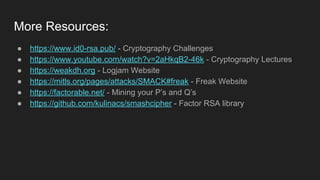
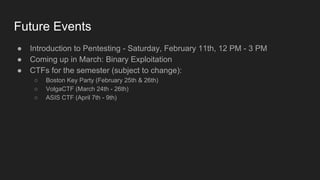
Discussion on vulnerabilities, exploits like FREAK and Logjam, factoring RSA keys, and future developments in cryptography. Additional resources for cryptography learning and upcoming events related to pentesting and capture the flag (CTF) competitions.
Why Cryptography?
● Confidentiality- only intended parties can read contents
● Integrity - message tampering can be detected
● Authentication - the author is verified
● Nonrepudiation - the author cannot deny being the author
3.
Why asymmetric cryptography?
●No need to secretly distribute key
● Difficult to brute-force
● Reuse of key does not significantly weaken security
4.
Why not asymmetriccryptography?
● More computationally-intensive than symmetric
cryptography
5.
RSA
● Developed byRivest, Shamir, and Adleman in 1977
● Based on the difficulty of factoring product of 2 large
primes, being able to compute private key from public key
● Built-in confidentiality, authentication, integrity, and
nonrepudiation from owner
● Computationally expensive
6.
RSA Keys
● Publicand private key should be prime numbers ≥ 2048
bits
● Public key should be available to everyone
○ Ex) Distribute using keyserver
● Private key should be known only to the owner of key pair
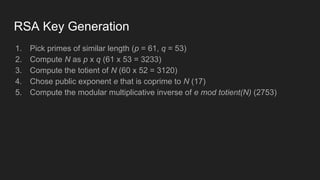
RSA Key Generation
1.Pick primes of similar length (p = 61, q = 53)
2. Compute N as p x q (61 x 53 = 3233)
3. Compute the totient of N (60 x 52 = 3120)
4. Chose public exponent e that is coprime to N (17)
5. Compute the modular multiplicative inverse of e mod totient(N) (2753)
9.
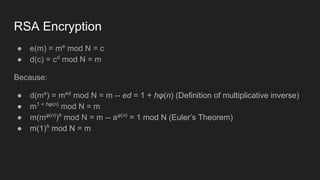
RSA Encryption
● e(m)= me
mod N = c
● d(c) = cd
mod N = m
Because:
● d(me
) = med
mod N = m -- ed = 1 + hφ(n) (Definition of multiplicative inverse)
● m1 + hφ(n)
mod N = m
● m(mφ(n)
)h
mod N = m -- aφ(n)
= 1 mod N (Euler’s Theorem)
● m(1)h
mod N = m
10.
Uses for RSA
●First connection in SSL/TLS
● Signing communication
○ More efficient to encrypt hash of message rather than
whole message
● Subscription-based services like commercial TV, radio,
etc.
11.
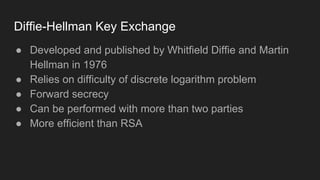
Diffie-Hellman Key Exchange
●Developed and published by Whitfield Diffie and Martin
Hellman in 1976
● Relies on difficulty of discrete logarithm problem
● Forward secrecy
● Can be performed with more than two parties
● More efficient than RSA
12.
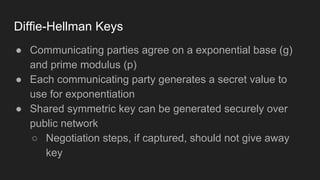
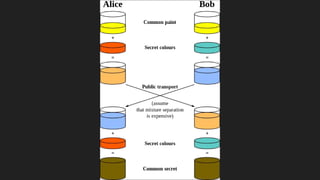
Diffie-Hellman Keys
● Communicatingparties agree on a exponential base (g)
and prime modulus (p)
● Each communicating party generates a secret value to
use for exponentiation
● Shared symmetric key can be generated securely over
public network
○ Negotiation steps, if captured, should not give away
key
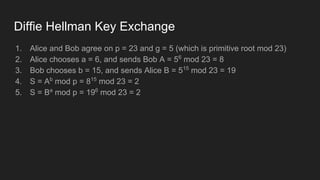
Diffie Hellman KeyExchange
1. Alice and Bob agree on p = 23 and g = 5 (which is primitive root mod 23)
2. Alice chooses a = 6, and sends Bob A = 56
mod 23 = 8
3. Bob chooses b = 15, and sends Alice B = 515
mod 23 = 19
4. S = Ab
mod p = 815
mod 23 = 2
5. S = Ba
mod p = 196
mod 23 = 2
16.
Uses for Diffie-Hellman
●Key negotiation over public or unsecured channels
(especially Ephemeral Diffie-Hellman)
○ Part of SSL/TLS
○ IPSec/VPN
○ SSH
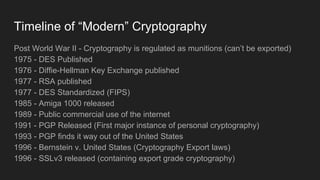
Timeline of “Modern”Cryptography
Post World War II - Cryptography is regulated as munitions (can’t be exported)
1975 - DES Published
1976 - Diffie-Hellman Key Exchange published
1977 - RSA published
1977 - DES Standardized (FIPS)
1985 - Amiga 1000 released
1989 - Public commercial use of the internet
1991 - PGP Released (First major instance of personal cryptography)
1993 - PGP finds it way out of the United States
1996 - Bernstein v. United States (Cryptography Export laws)
1996 - SSLv3 released (containing export grade cryptography)
20.
Factoring RSA ExportKeys
● FREAK
● March 3, 2015
● CVE-2015-0204
● Capitalizes on forcing the server to use RSA_EXPORT keys
● RSA_EXPORT Keys are 512 bits or less
● RSA_EXPORT keys were designed to be a backdoor, good enough for public
use, bad enough for the NSA to be able to break if needed
● 9.6% of top million domains vulnerable
21.
Factoring RSA ExportKeys
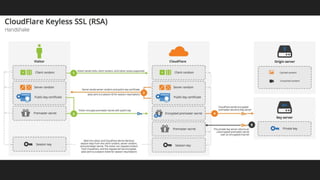
● Man in the Middle attack that requests RSA_EXPORT keys
● Most servers just go with it
● Most clients just go with it
● Generally one RSA_EXPORT key per server
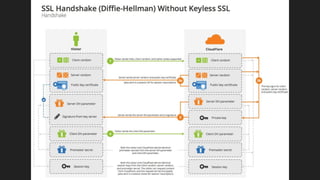
● As seen in the diagram, knowing the premaster secret breaks the session
22.
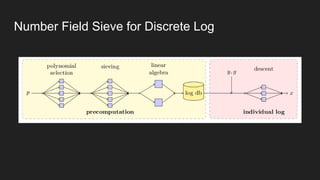
CADO-NFS
● Implementation ofNumber Field Sieve
● Current fastest way to factor large numbers
● Current fastest way to compute discrete logarithm
● Can break 512 bit RSA keys in 7 hours for ~$100 on EC2
24.
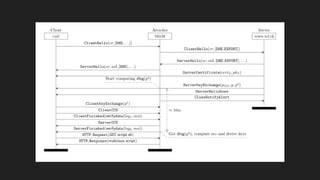
Logjam
● October 2015
●CVE-2015-4000
● Capitalizes on forcing the server to use DHE_EXPORT parameters
● Tricks the client into thinking they are standard DHE
● 8.4% of the top million domains vulnerable
“Mining your P’sand Q’s”
● Low entropy RSA keys may share a common prime
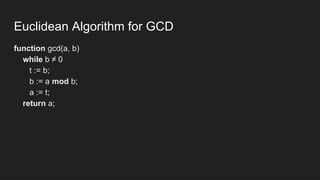
● This prime can be found trivially with Euclid’s GCD Algorithm
● Finding one prime makes the other trivial to find, making generating a private
key trivial to find
28.
Euclidean Algorithm forGCD
function gcd(a, b)
while b ≠ 0
t := b;
b := a mod b;
a := t;
return a;