1
Caesar Cipher
Caesar CipherCaesar Cipher
 In cryptography, a Caesar cipher, also known as Caesar's cipher,
the shift cipher, Caesar's code or Caesar shift, is one of the
simplest and most widely known encryption techniques.
 It is a type of substitution cipher in which each letter in the
plaintext is replaced by a letter some fixed number of positions
down the alphabet.
 For example, with a left shift of 1, A would be replaced by B, C
would become D, and so on. The method is named after Julius
Caesar, who used it in his private correspondence.
 Caesar cipher is often incorporated as part of more complex
alorithm, such as the Vigenère cipher, and still has modern
application in the ROT13 system. However it has no
communication security, and it can be easily broken even by hand.
Caesar Cipher: MathematicalCaesar Cipher: Mathematical
BaseBase
 The encryption can also be represented using modular
arithmetic by first transforming the letters into numbers,
according to the scheme, A = 0, B = 1,..., Z = 25.
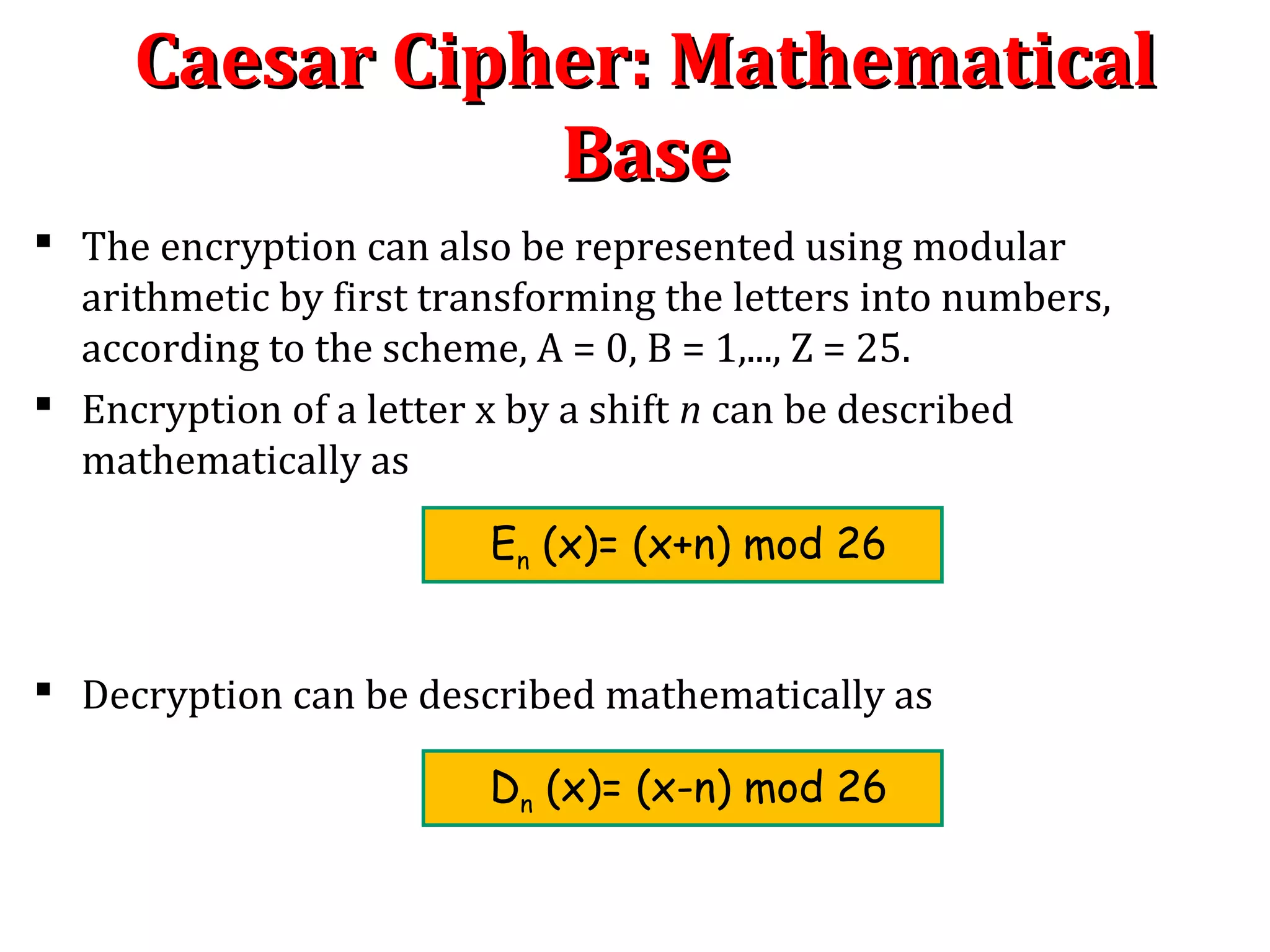
 Encryption of a letter x by a shift n can be described
mathematically as
 Decryption can be described mathematically as
En (x)= (x+n) mod 26
Dn (x)= (x-n) mod 26
Caesar Cipher: MathematicalCaesar Cipher: Mathematical
BaseBase
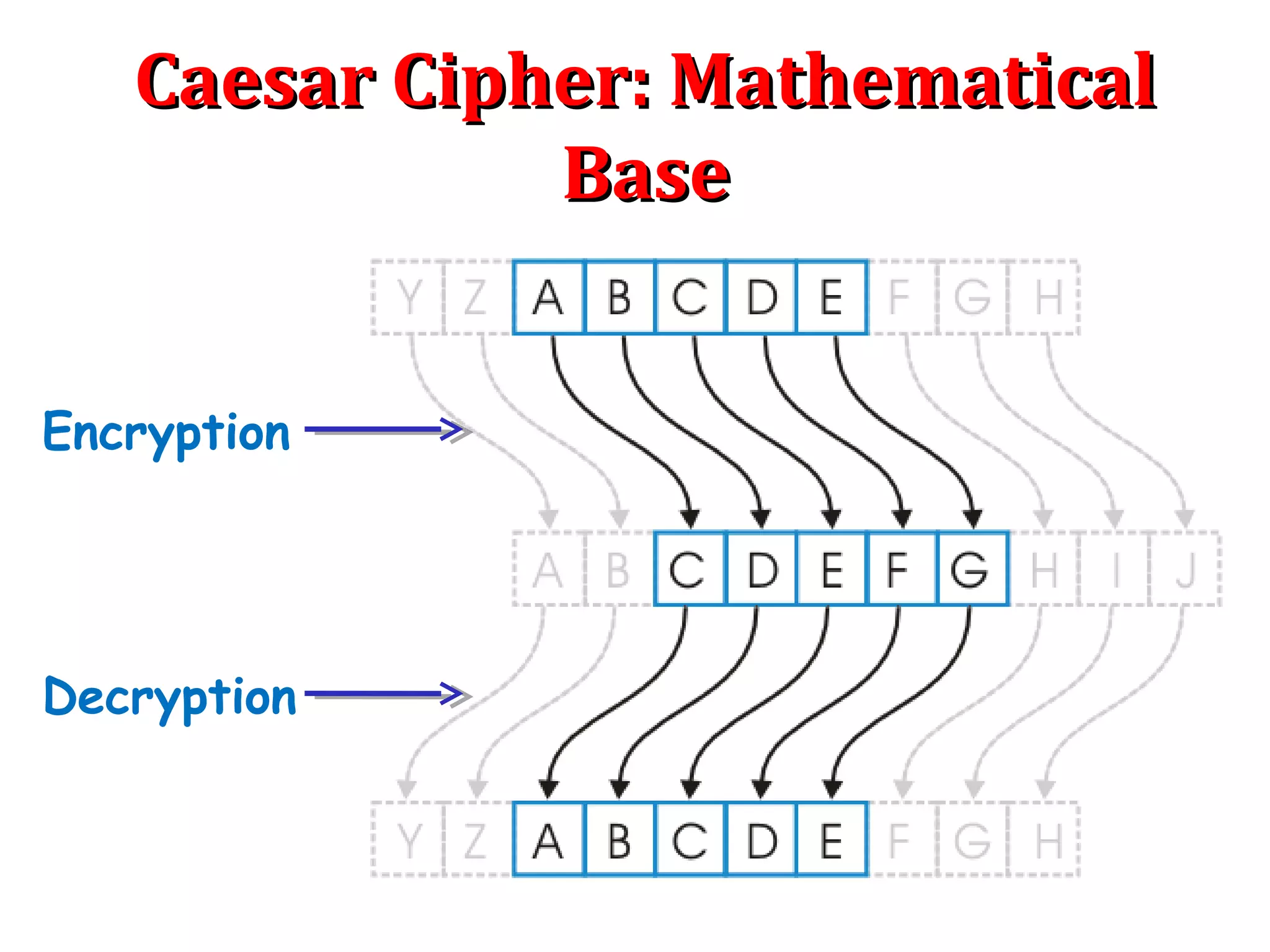
Encryption
Decryption
Caesar Cipher: ExampleCaesar Cipher: Example
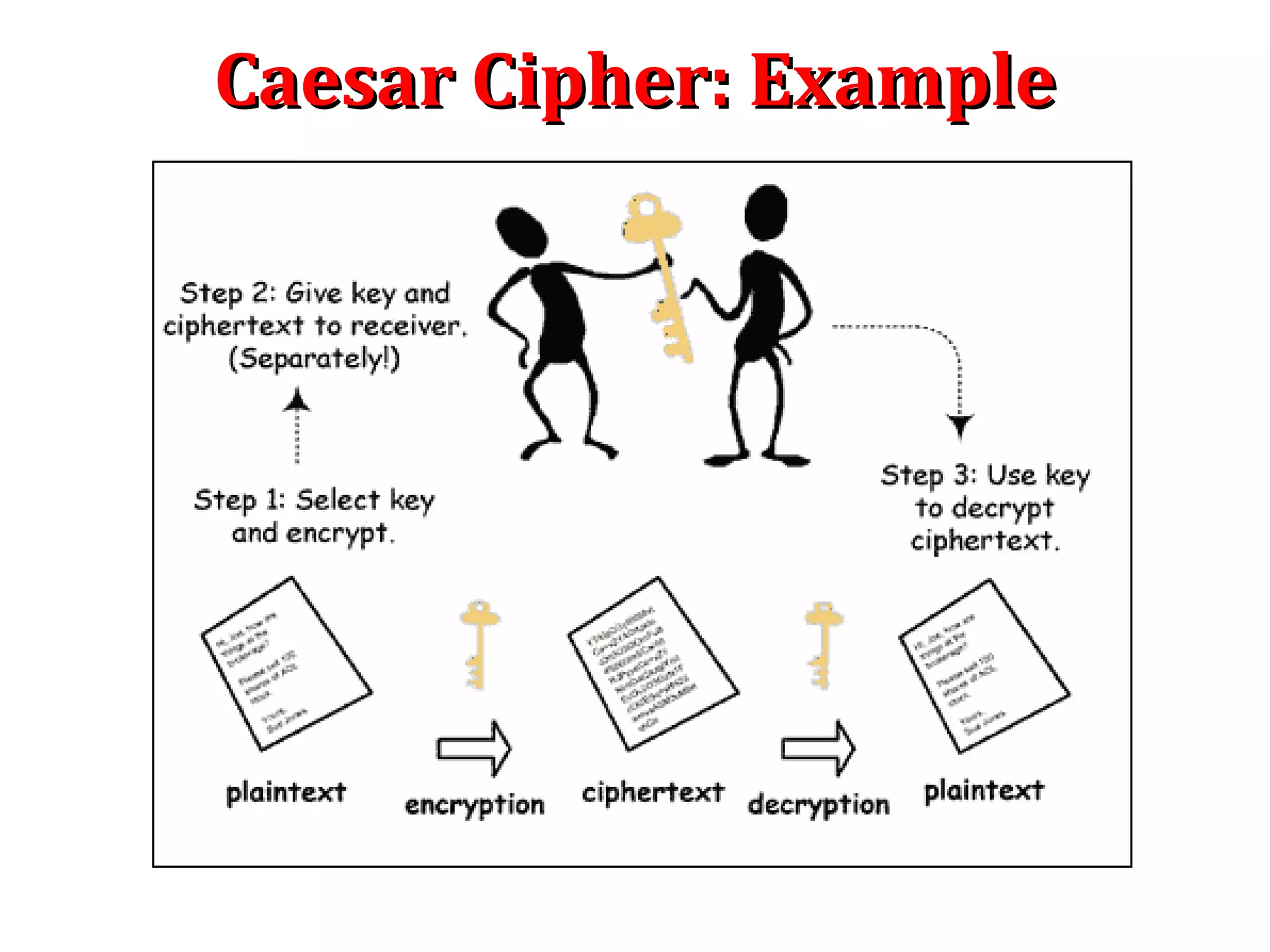
 To pass an encrypted message from sender to receiver, it is
first necessary that both parties have the 'key' for the cipher.
So that the sender may encrypt it and the receiver may
decrypt it.
 For the caesar cipher, the key is the number of characters to
shift the cipher alphabet.
 Here is a quick example of the encryption and decryption
steps involved with the caesar cipher. The text we will encrypt
is 'defend the east wall of the castle', with a shift (key) of 1.
Caesar Cipher: ExampleCaesar Cipher: Example
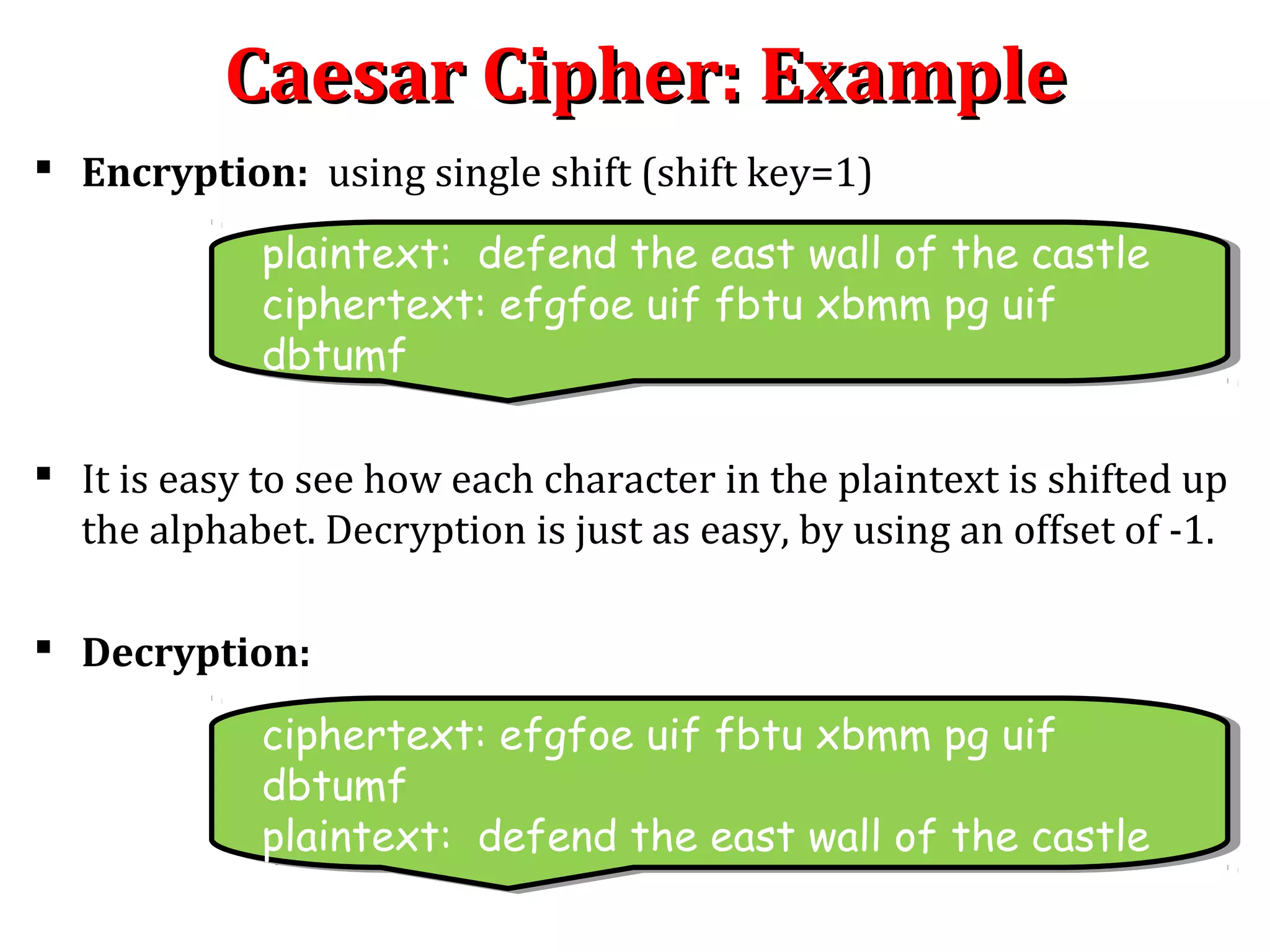
 Encryption: using single shift (shift key=1)
 It is easy to see how each character in the plaintext is shifted up
the alphabet. Decryption is just as easy, by using an offset of -1.
 Decryption:
plaintext: defend the east wall of the castle
ciphertext: efgfoe uif fbtu xbmm pg uif
dbtumf
plaintext: defend the east wall of the castle
ciphertext: efgfoe uif fbtu xbmm pg uif
dbtumf
ciphertext: efgfoe uif fbtu xbmm pg uif
dbtumf
plaintext: defend the east wall of the castle
ciphertext: efgfoe uif fbtu xbmm pg uif
dbtumf
plaintext: defend the east wall of the castle
WeaknessesWeaknesses
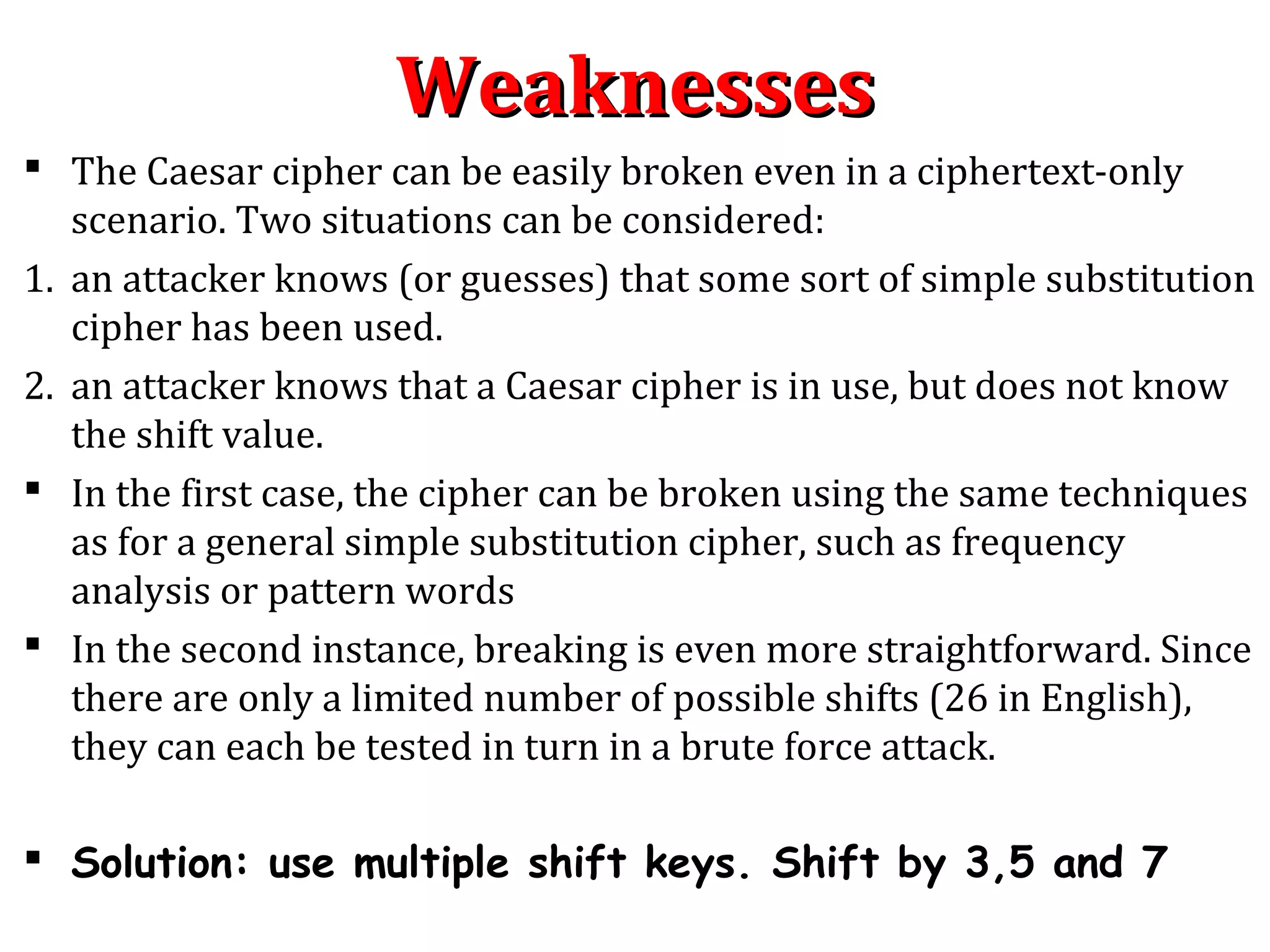
 The Caesar cipher can be easily broken even in a ciphertext-only
scenario. Two situations can be considered:
1. an attacker knows (or guesses) that some sort of simple substitution
cipher has been used.
2. an attacker knows that a Caesar cipher is in use, but does not know
the shift value.
 In the first case, the cipher can be broken using the same techniques
as for a general simple substitution cipher, such as frequency
analysis or pattern words
 In the second instance, breaking is even more straightforward. Since
there are only a limited number of possible shifts (26 in English),
they can each be tested in turn in a brute force attack.
 Solution: use multiple shift keys. Shift by 3,5 and 7
ReferencesReferences
 http://en.wikipedia.org/wiki/
 Applied Cryptography by Bruce Schneier; 10th
Anniversary
edition
10
Md. Shakhawat Hossain
Student of Department of Computer Science &
Engineering
University of Rajshahi
E-mail: mshimul86@gmail.com

Caesar cipher

  • 1.
  • 2.
    Caesar CipherCaesar Cipher In cryptography, a Caesar cipher, also known as Caesar's cipher, the shift cipher, Caesar's code or Caesar shift, is one of the simplest and most widely known encryption techniques.  It is a type of substitution cipher in which each letter in the plaintext is replaced by a letter some fixed number of positions down the alphabet.  For example, with a left shift of 1, A would be replaced by B, C would become D, and so on. The method is named after Julius Caesar, who used it in his private correspondence.  Caesar cipher is often incorporated as part of more complex alorithm, such as the Vigenère cipher, and still has modern application in the ROT13 system. However it has no communication security, and it can be easily broken even by hand.
  • 3.
    Caesar Cipher: MathematicalCaesarCipher: Mathematical BaseBase  The encryption can also be represented using modular arithmetic by first transforming the letters into numbers, according to the scheme, A = 0, B = 1,..., Z = 25.  Encryption of a letter x by a shift n can be described mathematically as  Decryption can be described mathematically as En (x)= (x+n) mod 26 Dn (x)= (x-n) mod 26
  • 4.
    Caesar Cipher: MathematicalCaesarCipher: Mathematical BaseBase Encryption Decryption
  • 5.
    Caesar Cipher: ExampleCaesarCipher: Example  To pass an encrypted message from sender to receiver, it is first necessary that both parties have the 'key' for the cipher. So that the sender may encrypt it and the receiver may decrypt it.  For the caesar cipher, the key is the number of characters to shift the cipher alphabet.  Here is a quick example of the encryption and decryption steps involved with the caesar cipher. The text we will encrypt is 'defend the east wall of the castle', with a shift (key) of 1.
  • 6.
  • 7.
    Caesar Cipher: ExampleCaesarCipher: Example  Encryption: using single shift (shift key=1)  It is easy to see how each character in the plaintext is shifted up the alphabet. Decryption is just as easy, by using an offset of -1.  Decryption: plaintext: defend the east wall of the castle ciphertext: efgfoe uif fbtu xbmm pg uif dbtumf plaintext: defend the east wall of the castle ciphertext: efgfoe uif fbtu xbmm pg uif dbtumf ciphertext: efgfoe uif fbtu xbmm pg uif dbtumf plaintext: defend the east wall of the castle ciphertext: efgfoe uif fbtu xbmm pg uif dbtumf plaintext: defend the east wall of the castle
  • 8.
    WeaknessesWeaknesses  The Caesarcipher can be easily broken even in a ciphertext-only scenario. Two situations can be considered: 1. an attacker knows (or guesses) that some sort of simple substitution cipher has been used. 2. an attacker knows that a Caesar cipher is in use, but does not know the shift value.  In the first case, the cipher can be broken using the same techniques as for a general simple substitution cipher, such as frequency analysis or pattern words  In the second instance, breaking is even more straightforward. Since there are only a limited number of possible shifts (26 in English), they can each be tested in turn in a brute force attack.  Solution: use multiple shift keys. Shift by 3,5 and 7
  • 9.
    ReferencesReferences  http://en.wikipedia.org/wiki/  AppliedCryptography by Bruce Schneier; 10th Anniversary edition
  • 10.
    10 Md. Shakhawat Hossain Studentof Department of Computer Science & Engineering University of Rajshahi E-mail: mshimul86@gmail.com